



In the third quarter, Australia’s home investment lending surpassed forecasts by 17.6%, exceeding the 4% probability.
Australia’s investment lending for homes surged by 17.6% in the third quarter, far exceeding the expected 4% increase. This strong performance highlights a significant development in the housing market, drawing the attention of financial analysts.
On a broader scale, the Reserve Bank of Australia (RBA) remains cautious. Despite this, the Australian dollar has weakened, reflecting the RBA’s careful stance and widespread economic uncertainties.
Australia Home Loans exceeded predictions by 4.7% in the third quarter, compared to expectations of 2.5%
Home loan activity in Australia increased by 4.7% in the third quarter, exceeding the expected growth of 2.5%. This surprising rise signals strong demand for housing.
At the same time, the Australian dollar is falling due to the cautious stance of the Reserve Bank of Australia. The Japanese yen is also struggling, nearing multi-month lows against the US dollar amid uncertainty around the Bank of Japan’s decisions.
USDCAD Stays Strong
In contrast, USD/CAD remains steady above 1.4000, supported by expectations of a US government reopening. West Texas Intermediate oil has gained slightly, trading above $60.50 as optimism grows about the potential end of the government shutdown. Elsewhere, the US Dollar Index has seen minor gains, holding close to 99.50, reflecting a similar vibe. Meanwhile, the People’s Bank of China set the USD/CNY reference rate at 7.0833, showing little change from before. This summary provides potential future insights, highlighting risks and uncertainties. It’s meant for informational purposes only and does not suggest any specific financial decision. Readers should conduct their own research before making any financial commitments. The unexpectedly strong Australian home loan figure of 4.7% points to a housing market that is hotter than expected. However, the falling Australian dollar suggests that investors are more concerned with the Reserve Bank of Australia’s cautious approach than the positive data. This gap between strong economic signals and a weak currency could mean that options pricing may not accurately reflect a possible sharp turnaround. We see this as an opportunity in the derivatives market, especially since Australian inflation remains stubborn. The latest core inflation data for September 2025 was at 3.8%, well above the RBA’s target. This leads us to consider buying AUD/USD call options set to expire in early 2026, betting that the RBA will need to shift from caution to a more aggressive stance.US Dollar Gains
The US dollar is strengthening as hopes rise that the government shutdown is nearing its end. This reaction is reminiscent of the market response seen after the 35-day shutdown in January 2019, when the dollar enjoyed a short-term rally before broader economic factors took hold. This historical pattern suggests the current dollar strength may not last. With the US Dollar Index around 99.50, we are close to a key resistance area that has held back rallies between 100 and 103. Therefore, selling out-of-the-money call options on a dollar index ETF could be a smart move. This strategy allows us to earn premium income by betting that the shutdown-relief rally will lose momentum before surpassing these long-standing highs. Additionally, the rise in WTI crude oil above $60.50 seems more linked to positive US political news than actual market fundamentals. This optimism faces a challenge from the latest Energy Information Administration (EIA) report, which revealed an unexpected increase in US crude inventories of 2.1 million barrels last week. Buying puts on crude oil futures could serve as a useful hedge against a “sell the news” scenario, where prices fall once the government reopening is completely factored in. The Canadian dollar is also important to watch, with USD/CAD staying above the 1.4000 level, a critical psychological mark not maintained for long since 2020. Given the strong US dollar and the fragile recovery in oil prices, this level may become a new support point. Creating a bull put spread on USD/CAD could allow us to profit if the pair stays above 1.4000 in the next few weeks. Create your live VT Markets account and start trading now.Brad Jones discusses market risk pricing challenges at the ASFA Conference in Broadbeach.
Reserve Bank of Australia Assistant Governor Brad Jones said that markets are not fully considering geopolitical risks. He also pointed out that global valuations seem overly relaxed and noted early signs of fragmentation in central bank gold reserves.
The AUD/USD rate is around 0.6530, which is a slight increase of 0.01% today. The Reserve Bank of Australia (RBA) controls monetary policy and sets interest rates to keep prices stable, targeting an inflation rate of 2-3%.
Impact of Economic Data on AUD
Higher inflation can lead to increased interest rates from central banks, drawing in investment and boosting the demand for the Australian Dollar (AUD). Economic indicators, like GDP and employment data, directly impact the AUD’s value by showing the country’s economic health. Quantitative Easing (QE) happens when the RBA buys assets to add money to the economy, which can decrease the AUD’s value. On the other hand, Quantitative Tightening (QT), which is the reduction of asset purchases, can strengthen the AUD, as it often follows economic recovery and rising inflation. It’s important to heed the Reserve Bank of Australia’s warning, as it indicates that markets may overlook significant potential shocks. Market volatility, indicated by the VIX index, has been below 14 for most of the past quarter, making protective options contracts unusually inexpensive. This situation creates a clear chance to hedge against complacency before the broader market acknowledges these risks.Geopolitical and Market Risks
The failure to price in geopolitical risks feels especially urgent given ongoing tensions in key global shipping routes and unresolved trade conflicts. We observed a similar calm in the markets in late 2021, just before inflation and central bank measures led to major market revaluations in 2022. History suggests that these quiet periods often precede significant market disruptions. Current global equity valuations add to this sense of complacency. The S&P 500 has risen over 15% in 2025, elevating its forward price-to-earnings ratio above 22. This high valuation makes markets vulnerable to a correction if geopolitical events disturb investor confidence. Consequently, buying put options on major indices could be a wise move, as their pricing currently seems to ignore this elevated risk. The mention of central banks buying gold is essential, highlighting a long-term trend toward reducing reliance on the dollar. Central banks, especially in Asia, have purchased record amounts of gold since 2022, and this trend has continued into 2024 and this year as they diversify from traditional reserve currencies. This behavior from “smart money” indicates that holding assets like gold or currencies from stable commodity-producing countries may offer a safeguard in the coming weeks. For those focused on the Australian dollar, the situation is complex. Although Australian inflation stubbornly remains above the RBA’s target, reported at 3.4% in the latest quarterly report for 2025, the AUD still reacts strongly to global market sentiment. A global shock could easily overshadow domestic factors and drive the AUD/USD lower, prompting traders to consider options strategies that could benefit from a potential spike in currency volatility. Create your live VT Markets account and start trading now.November Futures Rollover Announcement – Nov 12 ,2025
Dear Client,
New contracts will automatically be rolled over as follows:
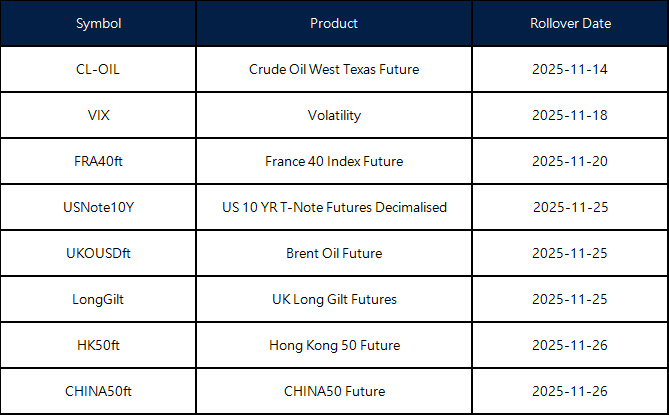
Please note:
• The rollover will be automatic, and any existing open positions will remain open.
• Positions that are open on the expiration date will be adjusted via a rollover charge or credit to reflect the price difference between the expiring and new contracts.
• To avoid CFD rollovers, clients can choose to close any open CFD positions prior to the expiration date.
• Please ensure that all take-profit and stop-loss settings are adjusted before the rollover occurs.
• All internal transfers for accounts under the same name will be prohibited during the first and last 30 minutes of the trading hours on the rollover dates.
If you’d like more information, please don’t hesitate to contact [email protected].
Traders anticipate the end of the US government shutdown, leading to a new high for the Dow Jones
The Dow Jones Industrial Average (DJI) is nearing the end of a long-term wave ((iii)), according to Elliott Wave analysis. A key price point at $45,781 acts as a support trend line that signals the conclusion of wave (iv). If this support holds, the index is likely to reach new all-time highs.
Currently, the Elliott Wave analysis shows that the DJI is in wave three of a broader five-wave trend. Wave ((iii)) started from a low on April 21, 2025, and has been rising along a strong trend line. With wave (iv) finishing at the $45,781 level on October 16, our attention turns to wave (v) of ((iii)). The ongoing rally indicates that wave iii of (v) of ((iii)) is progressing, suggesting there is potential for more gains and new highs.
Completion Of Bullish Wave
To sum up, the DJI is nearing the finish of a bullish wave ((iii)). If prices drop below $45,781, it might indicate that wave ((iii)) has peaked, possibly leading to a 5-10% decline in wave ((iv)). Based on the current Elliott Wave structure, the Dow Jones Industrial Average is in the last stages of a strong upward movement. A major factor in this rise is the expected end of the US government shutdown, which is contributing to the drive for new all-time highs. In the short term, this suggests adopting a bullish approach by utilizing short-dated call options to take advantage of the remaining upward momentum. Low market volatility supports this outlook. The VIX is currently trading near yearly lows around 13, making option premiums relatively cheap. This presents a good opportunity for traders wanting to profit from the final phase of this rally, as long as the critical support level of $45,781 remains intact. Recent economic reports show that October’s core inflation is steady at 2.1% and job growth continues, indicating that the Federal Reserve is likely to keep interest rates stable, removing a potential hurdle for stocks in the near future.Planning For Market Correction
However, it’s essential to prepare for the end of this wave, which suggests a forthcoming correction of 5-10%. This pattern is similar to market behavior in early 2018, where a sustained rally was followed by a quick 10% pullback before the broader uptrend resumed. Therefore, traders should start planning to buy put options or set up bearish spreads as the index shows signs of peaking. A decisive break below $45,781 will be the main signal to shift from a bullish to a defensive strategy. Create your live VT Markets account and start trading now.XAU/USD rises towards $4,150 due to US job loss reports and expectations of rate cuts
Gold’s price increased to about $4,140 during the early Asian session on Wednesday. This rise is due to hopes of a US Federal Reserve rate cut by the end of the year. Recent employment data from the Fed shows signs of weakness, which raises the chances of further easing, making Gold more appealing as a non-yielding asset.
There is currently a 68% chance of a 25 basis point rate cut by December and an 80% chance by January. Lower rates could boost Gold’s attractiveness by cutting the opportunity cost of holding it. Also, a resolution to the potential US government shutdown might influence Gold’s status as a safe haven.
Gold’s Historical Importance
Gold is prized for its long-standing role as a safe haven, a hedge against inflation, and a safeguard against currency decline. In 2022, central banks bought 1,136 tonnes of Gold, marking the largest annual purchase ever recorded. Emerging economies are significantly increasing their Gold reserves, which helps enhance economic stability. Gold typically moves opposite to the US Dollar and Treasuries. A weaker Dollar usually raises Gold prices. Furthermore, geopolitical unrest or market declines can increase demand for Gold. Since Gold does not yield interest, lower rates normally benefit its price, while higher rates can harm it. Gold prices are closely linked to the strength of the US Dollar. With Gold nearing $4,140, the main factor is the growing anticipation of a Federal Reserve rate cut before the year ends. This sentiment gained strength from the October 2025 Consumer Price Index report, which showed core inflation falling below 3% for the first time since 2023. Speeches from several Fed officials later today will be crucial for short-term trends.Market Reactions to Economic Indicators
The recent weak ADP report aligns with the official Non-Farm Payrolls data for October 2025, which showed only 95,000 jobs created, far below expectations. This trend of a softening labor market strengthens the case for the Fed to start easing. Derivative traders should see this as a key factor supporting higher gold prices. The options market reflects this shift, pricing in nearly a 70% likelihood of a December 2025 rate cut. This trend makes long call options on gold futures a popular strategy for gaining risk-defined upside exposure. Lower interest rates decrease the opportunity cost of holding non-yielding bullion, making it generally bullish. However, we should watch for any signs of an agreement to end the US government shutdown, as this could temporarily lessen gold’s safe-haven appeal. The recent Senate approval of a temporary funding measure has already created some short-term resistance. This mixed news suggests traders should be ready for increased volatility. Looking back, 2022 saw a record level of gold buying by central banks, a trend that continues. Data from the World Gold Council for the third quarter of 2025 reveals that emerging market central banks are still strong net buyers. This steady demand provides a solid support level for the gold price, limiting its downside potential. The US Dollar Index has dropped significantly over the past month, falling from 108 to below 104 as expectations for rate cuts have risen. Since gold is priced in dollars, this inverse relationship creates a helpful boost. We expect that any further dovish signals from the Fed will likely put pressure on the dollar and lift gold prices. Create your live VT Markets account and start trading now.Japan’s M2+CD money supply experiences steady year-on-year growth at 1.6%
Japan’s Money Supply M2+CD for October remained unchanged at 1.6% year-over-year. This stability over the past few months suggests a steady monetary environment.
Currency Dynamics
Meanwhile, the US Dollar Index climbed to around 99.50, fueled by hopes of a potential government shutdown resolution. In contrast, the Australian Dollar weakened as the US Dollar strengthened with the shutdown talks progressing. Currency traders pay close attention to key announcements from central banks, like the People’s Bank of China’s (PBOC) setting the USD/CNY reference rate at 7.0833, which helps them understand currency trends. Mixed economic indicators keep analysts alert to updates that could impact market attitudes. Both local and global markets are being monitored closely as they react to economic news and central bank messages. These factors play a big role in shaping economic predictions and financial choices around the world. Japan’s M2 money supply growth remains low at 1.6%, suggesting that the Bank of Japan will likely keep its supportive policy. This ongoing difference from other major central banks indicates continued pressure on the yen. Derivative traders might think about positioning for a weaker yen by using USD/JPY call options, especially since implied volatility seems low.Market Strategies
The US Dollar Index reaching near 99.50 due to news of a possible end to the government shutdown appears to be a short-term peak. This situation is reminiscent of a similar rally seen after budget disagreements in 2023, which led to a period of stabilization afterward. Traders might consider selling this strength by purchasing near-term puts on the dollar, as the market may soon shift its focus back to essential economic data like the recent 1.8% GDP growth in Q3. The decline in the Australian Dollar is largely due to the overall strength of the US Dollar, but there are signs that a reversal could happen soon. The People’s Bank of China’s decision to set the yuan reference rate around 7.08 indicates a desire for stability, which benefits its primary trading partners. With iron ore prices stabilizing around $115 per tonne recently, call options on the AUD/USD could present an appealing risk-reward opportunity for a rebound. Create your live VT Markets account and start trading now.GBP/USD rebound faces challenges from disappointing UK employment data and bearish momentum
GBP/USD declined on Tuesday, ending a four-day rise as the pair struggled to stay above 1.3200. UK employment data did not meet expectations, with unemployment rising more rapidly than forecasted, and more people claiming unemployment benefits than anticipated.
Wages, including bonuses, fell more than expected, highlighting difficulties in getting higher pay amid growing unemployment. Speeches from Federal Reserve policymakers are set for Wednesday, but no major changes are expected.
Looking Ahead to Key Economic Indicators
UK GDP growth figures for the third quarter are due on Thursday, with predictions suggesting they will remain steady. There are talks about a potential end to the US government shutdown, which has disrupted the flow of important data, following a Senate vote. The Pound Sterling, the UK’s official currency, is the fourth most traded currency worldwide, making up 12% of all foreign exchange transactions. The Bank of England’s monetary policy significantly impacts its value. Economic indicators such as GDP, PMIs, employment, and the Trade Balance influence the Pound’s movements. A positive Trade Balance can boost the currency due to higher demand for exports. Joshua Gibson, a seasoned trader, has joined the FXStreet team, bringing valuable experience from a career focused on technical analysis. GBP/USD is struggling to maintain its gains as it drops back from the 1.3200 level. This decline comes after disappointing UK employment data, which indicated a faster-than-expected rise in unemployment. The data reflect a weakening domestic economy, limiting the pound’s potential.Trading Strategies and Economic Expectations
This disappointing jobs report is not just a one-time issue; it fits into a larger trend we’ve noticed. Throughout 2024 and into 2025, UK unemployment has consistently increased from the post-pandemic lows, with the latest statistics showing a rise to 4.7% last quarter. This ongoing weakness in the labor market makes it hard for the Bank of England to adopt a more aggressive stance, which is negative for the Sterling. On the other side, the US government shutdown has created uncertainty by stopping the release of key data like the Consumer Price Index. Without this crucial inflation information, predicting the Federal Reserve’s next steps becomes very challenging, leading to uncertainty in the dollar’s movement. In 2018, we saw how a similar shutdown resulted in unpredictable trading conditions due to a lack of data. With UK Q3 GDP figures arriving on Thursday and expected to be flat, there’s little on the horizon to give the pound a strong boost. Given the resistance at 1.3200 and the weak economic backdrop, derivative traders might explore strategies that profit from sideways or downward movements. Selling call options with a strike price above 1.3200 could be a way to benefit from the anticipated lack of upward momentum. The overall situation indicates that the Bank of England faces challenges, as the weakening economy will pressure it to consider rate cuts next year. Markets are starting to factor in a higher chance of a policy shift in the first half of 2026, which is a sharp departure from the rate-hiking cycle that ended in 2024. This long-term expectation is likely to weigh on the pound in the weeks ahead. Create your live VT Markets account and start trading now.The Swiss Franc strengthens as USD/CHF falls for the fourth consecutive day, approaching the 0.8000 mark
The USD/CHF has dropped for the fourth straight day, landing around 0.8000 after a 0.55% decline during the North American session. This decline is due to weaker US economic data and Switzerland’s tariff cuts, which favor the Swiss Franc.
Technical indicators show that USD/CHF might test essential support levels at the 20- and 50-day SMAs, which are around 0.8002 and 0.7982. If it falls below these levels, it could drop to 0.7925, with potential for further decline to 0.7900.
Resistance Levels and Projections
If the USD/CHF rises above 0.8100, the next resistance will be at 0.8124, potentially reaching the 200-day SMA at 0.8261. This week, the Swiss Franc significantly strengthened against the Japanese Yen. Percentage changes for the Swiss Franc against major currencies include a 0.63% rise against the USD and a 0.84% rise against the JPY, while it saw a slight 0.07% adjustment against the NZD. Christian Borjon Valencia started his career in 2010, focusing on technical analysis and trading strategies. Please note that the discussions about markets and instruments are for informational purposes only. All investment responsibility lies with the investor, and FXStreet is not responsible for any errors or omissions. The USD/CHF pair continues to move toward the crucial 0.8000 level due to risk-averse sentiment and disappointing US economic data. Initial jobless claims for the week ending November 8th, 2025, were reported at 235,000, exceeding the 220,000 forecast and putting pressure on the US dollar. This continues a four-day losing streak for the pair.Market Reactions and Strategies
For derivative traders, the immediate focus is on support between 0.8002 and 0.7982. If the pair breaks below this range, it could slide toward 0.7925. In this case, considering put options with strike prices below 0.8000 might be a good strategy for the upcoming weeks. The VIX, a measure of market fear, has risen above 22, its highest since the third quarter, generally favoring strategies that benefit from declining prices or rising volatility. On the other hand, if the pair holds this support and rises above the 0.8100 resistance, it could signify a short-term bottom. Surpassing this level might encourage traders to explore call options targeting the November 5th high of 0.8124. However, a significant rebound seems unlikely without strong positive US economic news. The Swiss Franc’s strength is also backed by its own fundamentals, not just the US dollar’s weakness. The Swiss National Bank has maintained a firm stance against inflation, keeping its policy rate at 1.75% during its September 2025 meeting, contrasting with the narrative of a slowing US economy. This policy difference makes the franc an appealing safe-haven currency. This caution is evident in the markets, with gold prices nearing $4,150 per ounce following reports of US job losses. We saw a similar trend in late 2023, where concerns over global growth boosted both gold and the Swiss Franc. The current climate suggests traders should be wary of long US dollar positions against safe-haven currencies. Create your live VT Markets account and start trading now.USD/JPY remains above 154.00 as optimism grows for resolving the US government shutdown.
**The Dynamics of USD/JPY and Japanese Economic Indicators**
The Japanese Yen’s performance is influenced by several key factors. These include the Bank of Japan’s policies and the differences in bond yields between Japan and the US. The Yen is often seen as a safe-haven asset, attracting investors during turbulent market times.
Historically, the Bank of Japan has stepped into currency markets to manage the Yen’s value. Changes in interest rates between Japan and the US have also affected the USD/JPY relationship.
Overall, the Yen’s value can fluctuate widely based on major economic indicators and central bank actions. These influences determine how strong the Yen is against other currencies.
Currently, the USD/JPY pair is trading high, just above 154.00, boosted by the recent end of the US government shutdown. However, signs of a slowing US economy might limit the dollar’s future gains. The latest jobs report for October 2025 showed only a 95,000 net gain, far below expectations, and inflation has eased to 2.8%. This suggests the Federal Reserve may not need to be aggressive with monetary policy.
**Risk of Intervention from Japanese Authorities**
As the USD/JPY pair stays around 154.50, fears of intervention from Japanese officials are rising among traders. This situation recalls the Ministry of Finance’s actions in late 2022 when the dollar-yen rate exceeded 150. Any sharp increases from this point could prompt a defensive move to support the yen.
The longstanding policy differences between the US and Japan, which have led to the Yen’s weakness, are beginning to narrow. In March 2024, the Bank of Japan ended its negative interest rate policy, and recent statements suggest more tightening is on the horizon. Consequently, the yield spread between US and Japanese 10-year bonds has narrowed by 50 basis points in the last six months.
For those trading derivatives, this situation may imply that implied volatility could be undervalued, especially for bearish options. The fundamentals indicate a weaker dollar, yet the USD/JPY pair remains high, leading to a tense standoff. Therefore, buying put options to hedge against a sudden appreciation of the yen or a sharp drop in the pair could be a wise move in the coming weeks.
Create your live VT Markets account and start trading now.







