



USD/CHF pair rises to 0.8075 amid strong demand for the US Dollar
EUR/USD stays around 1.1540 as US labor market uncertainties impact the dollar
The EUR/USD pair is holding strong around 1.1540 as the US Dollar weakens due to uncertainty in the US labor market. The US Challenger report shows a big jump in layoffs, with 153,074 workers let go in October—a 183% increase from September. This trend is partly linked to the rising use of Artificial Intelligence and companies cutting costs.
Expectations for the Federal Reserve to keep interest rates steady in December are easing. The chance of rates staying between 3.50%-3.75% has dropped from 38% to 33%. In Europe, officials from the European Central Bank (ECB) say there is no need for urgent monetary policy changes. ECB Vice President Luis de Guindos has expressed satisfaction with current interest rates, feeling positive about service inflation and growth.
Global Currency Market Responses
The US Dollar Index, which measures the Dollar’s value against six currencies, is slightly up at 99.80 after support was found at 99.60. The global currency market is reacting differently to economic changes, so ongoing monitoring is needed to understand its impact on international trade. Given the renewed risks in the US labor market, we can expect continued weakness of the US Dollar against the Euro. The latest Non-Farm Payrolls report supports this trend, showing only 95,000 jobs added in October 2025, which raised the unemployment rate to 4.2%. This slowdown results from the effects of aggressive rate hikes in 2023. With core inflation now around a more manageable 2.5%, the Federal Reserve can focus on its employment goals. The market is increasingly expecting a rate cut in the December 2025 meeting, marking a significant shift in sentiment recently. This dovish outlook is a key factor putting pressure on the Dollar.Market Strategies for Traders
Meanwhile, the European Central Bank is signaling stability, with officials comfortable with current interest rates. This difference in policy—where the Fed may ease while the ECB maintains rates—should continue to support EUR/USD strength. We saw a similar situation in late 2023, which led to a steady rise in the Euro. For derivative traders, this environment points to the potential for higher volatility in the currency pair. The Cboe EuroCurrency Volatility Index (EVZ) has risen from about 5 to over 8 in the last month, a trend likely to continue. Buying straddles or strangles could be smart for trading on expected larger price movements without guessing the direction. Given the clear downward pressure on the US Dollar, purchasing call options on the EUR/USD is a defined-risk strategy to benefit from potential gains. We should focus on contracts expiring in the first quarter of 2026 to give time for this policy difference to unfold. This approach allows us to profit from a rising Euro while limiting our maximum loss to the premium paid. Create your live VT Markets account and start trading now.Seagate Technology is seen as ideal for AI because of demand from companies like OpenAI and Google.
Seagate Technology (STX) has a strong position in the data storage industry, which is vital for AI applications. Along with Western Digital, Seagate controls about 80% of the market.
The surge in demand for storage from AI companies has played a key role in Seagate’s success. Its stock has risen by 219% this year and it has seen a 39% annual return over the last five years. This positive trend matches the strong earnings outlook in the booming AI sector.
Many investors view Seagate as an attractive AI stock. It currently has a moderate buy rating and a 12-month target price of $268. However, Western Digital remains a solid competitor, offering a better price-to-earnings ratio at 22.
The AI Insights portfolio shows an impressive 5.17% gain from a $300 investment, highlighting the strength of the AI sector. In comparison, a control fund, the Vanguard Total Stock Market Index Fund, only saw a 0.56% gain.
Past picks like Micron Technology, which gained 20% in just four weeks, reinforce the strong performance of AI-related stocks lately.
We see Seagate as a “picks and shovels” play in the AI boom. Major cloud companies like Amazon and Microsoft announced more data center expansions last month, leading to increased demand for storage. This trend benefits both Seagate and Western Digital, who together dominate the market.
Historically, Seagate’s stock has risen to the $285 level by 2025, with implied volatility currently high, in the 75th percentile of its 52-week range. This creates an attractive opportunity for selling options for those who believe the stock will stay stable or increase. Selling cash-secured puts on minor dips, aimed for late December 2025 or January 2026 expiration, lets traders earn income or buy shares at a better price.
For those looking for direct bullish exposure but hesitant about the high cost of options, a bull call spread is a smart choice. We suggest buying a January 2026 $290 call while selling a $310 call to finance this strategy. Though it caps potential gains, it lowers the entry cost and limits risk if the AI momentum slows in the next few weeks.
This scenario mirrors the late 1990s when internet infrastructure suppliers saw massive growth before their valuations became too high. With Seagate’s next earnings report due in late January 2026, buying some out-of-the-money puts that expire in February could be a low-cost hedge against unexpected results. Industry reports from Q3 2025 indicated a 35% year-over-year increase in demand for high-capacity drives, but any hints of slowing growth might lead to a sharp market correction.
Silver prices rise to about $48.40 per troy ounce amid growing expectations for rate cuts
Silver prices are rising, approaching $48.50 per troy ounce. This increase comes from expectations that the Federal Reserve will cut interest rates in December. The CME FedWatch Tool shows a 67% chance for the cut, up from 62% the previous day, influenced by weak job cut data from Challenger.
In October, US companies reported over 153,000 job cuts, the highest number in over 20 years. This news adds uncertainty to the US labor market, especially as the ongoing government shutdown restricts access to key data like Nonfarm Payrolls and the Unemployment Rate.
St. Louis Fed President Alberto Musalem highlighted ongoing inflation risks, even as tariff effects lessen next year. The possibility of an interest rate cut is also influencing traders in Fed funds futures.
The US government shutdown has reached a record length, with no resolution from the Senate. This uncertainty boosts demand for safe-haven assets like Silver and other precious metals.
Several factors affect silver prices, including geopolitical issues, interest rates, and the strength of the US Dollar. Industrial demand, especially from electronics and solar energy, also plays a significant role. Silver prices often follow Gold prices because both are considered safe havens.
As of November 7, 2025, silver is pushing near $48.50. This rise is fueled by growing expectations for a Federal Reserve rate cut next month, with the probability now at 67% due to signs of a softening labor market.
The Challenger report recently indicated the highest job cuts for October in over 20 years. This supports the idea of a slowing economy, especially since official government reports like the NFP are delayed due to the shutdown. Recent data shows inflation easing to 2.8% year-over-year in October 2025, getting closer to the Fed’s target.
This economic slowdown, coupled with the lengthy government shutdown, creates considerable uncertainty. As a result, there is increasing interest in safe-haven assets like precious metals. Derivative traders should note that this political risk may boost silver prices in the short term.
In addition, we should not overlook the strong industrial demand for silver. Policies from earlier in the decade, like the 2022 Inflation Reduction Act, continue to support sectors such as solar energy and electric vehicles, which require large amounts of silver. This steady demand serves as a solid price foundation, irrespective of monetary policy shifts.
However, we must also consider the relative value of silver. With gold trading near $3,000 an ounce, the gold-to-silver ratio is around 62. This is low compared to historical ratios seen in the early 2020s, indicating silver may be overvalued compared to gold. Traders might want to use options to protect against a possible price drop or a slowdown in silver’s increase.
Dividend Adjustment Notice – Nov 07 ,2025
Dear Client,
Please note that the dividends of the following products will be adjusted accordingly. Index dividends will be executed separately through a balance statement directly to your trading account, and the comment will be in the following format “Div & Product Name & Net Volume”.
Please refer to the table below for more details:
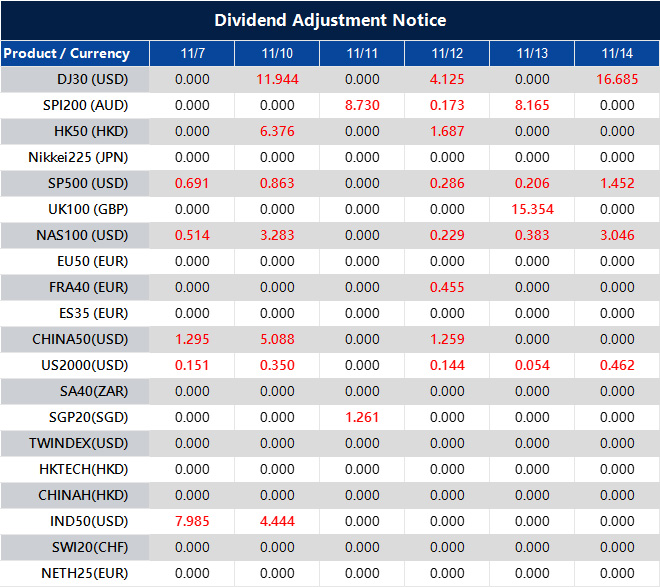
The above data is for reference only, please refer to the MT4/MT5 software for specific data.
If you’d like more information, please don’t hesitate to contact [email protected].
Gold Rebounds As Rate Cut Expectations Strengthen
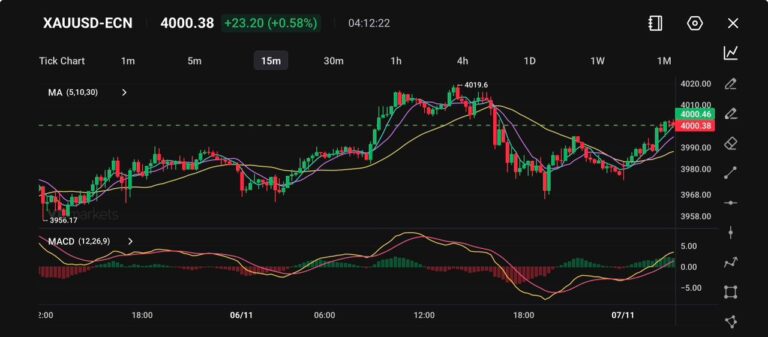
Gold strengthened on Friday, inching back towards the key $4,000 level as a softer US dollar and signs of labour market weakness revived expectations of another Federal Reserve rate cut before the end of the year.
The prolonged US government shutdown has disrupted the flow of official economic indicators, leaving traders to rely on private-sector surveys that point to a cooling jobs market.
Spot gold rose 0.5% to $3,996.72, while futures gained 0.3% to $4,004.40. Traders increased wagers on looser monetary policy, with markets now pricing in around a 69% chance of a rate cut at the Fed’s 10 December meeting.
Gold, which yields no interest, tends to perform well when borrowing costs are low. The combination of weak data and political gridlock in Washington has led investors to adopt a more defensive stance.
Labour Market Weakness Fuels Safe-Haven Demand
Recent figures indicate that the US economy lost jobs in October, particularly in the government and retail sectors, as layoffs linked to automation and cost-cutting continue to rise. Challenger data showed a sharp increase in announced job cuts, adding weight to the narrative of a slowing labour market.
The US 10-year Treasury yield, which touched a one-month high on Thursday, later declined as investors moved back into bonds and bullion. With equity markets under pressure, gold regained its shine as a hedge against both policy uncertainty and stock volatility.
Technical Analysis
Gold (XAU/USD) hovered close to $4,000, recovering from earlier dips as buying interest slowly returned. On the 15-minute chart, the metal appears to be consolidating after reaching an intraday peak near $4,019, with short-term moving averages (5, 10, 30) converging, a signal of potential stabilisation.
The MACD has crossed into positive territory, indicating that bullish momentum may be regaining strength after a brief correction.
The latest rebound underscores renewed safe-haven flows, driven by soft US employment data and dovish expectations ahead of the December Fed meeting. Markets now assign roughly a 60% probability to a rate cut, while ongoing geopolitical tensions in the Middle East continue to lend support to gold.
However, the firm dollar and resilience in US Treasury yields remain near-term headwinds, keeping gold from making a clean breakout above the $4,020–$4,030 zone.
If gold holds above $3,990, buyers could push for a retest of the recent high and potentially aim for $4,050. A failure to maintain this level, however, risks a retreat toward $3,950, where deeper profit-taking could emerge.
For now, sentiment remains cautiously bullish. Gold’s broader trend stays intact, but its next decisive move will hinge on how the Fed frames its policy stance in the coming weeks.
Outlook
If the weak jobs story continues and the Fed signals further flexibility on rates, gold could extend its rally towards the $4,050–$4,080 range. A decisive move above $4,020 would strengthen the bullish case, setting up a potential retest of $4,100.
Conversely, if policymakers strike a more guarded tone or if bond yields rebound, gold may consolidate between $3,950–$4,000 in the short term. As long as prices stay above $3,940, the broader trend remains moderately upward.
EUR/JPY drops near 176.50 as JPY strengthens against USD, despite the ECB’s cautious approach.
The EUR/JPY exchange rate fell to about 176.60 during the Asian session on Friday. This decline happened as the Japanese Yen gained strength against the US Dollar, following the Bank of Japan’s (BoJ) September policy meeting minutes and comments from Japanese officials.
BoJ Minutes and Impact on Yen
The BoJ’s minutes revealed that more policymakers are thinking about raising interest rates, with some calling for action soon. This positive outlook could boost the Yen further against the Euro. Comments from Japanese officials also supported the Yen. Finance Minister Satsuki Katayama mentioned that they are closely watching foreign exchange movements. At the same time, the European Central Bank’s (ECB) cautious approach may restrict the Euro’s decline against the Yen. ECB President Christine Lagarde stated that the bank is well-prepared and focused on maintaining its current position. ECB member Boris Vujcic expressed satisfaction with existing policies after hitting target inflation, reflecting market expectations of little interest rate reduction by 2026. The BoJ’s policies, bond yield differences, and global risk mood all affect the Japanese Yen’s value. As a safe-haven currency, it usually attracts investments during market uncertainty, which can increase its value.EUR/JPY Market Outlook
The EUR/JPY is facing challenges near 176.50 as the gap between the Bank of Japan and the European Central Bank widens. The BoJ is signaling higher rates, putting upward pressure on the Yen. In contrast, the ECB is maintaining a steady stance, believing its job on inflation is mostly finished. The BoJ’s hawkish tone is supported by solid data, with Japan’s national Core CPI for October 2025 reaching 2.9%. This marks 18 consecutive months of inflation above the central bank’s 2% goal. Consequently, the 10-year Japanese government bond yield has climbed to 1.15%, a level not seen since 2012. Increased comments from Japanese officials also contribute to the Yen’s strength. We should pay attention to these warnings, recalling that direct currency market interventions occurred in late 2022 and throughout 2024 to support the Yen. This history suggests a lower tolerance for Yen weakness and a readiness to take action. On the flip side, the ECB’s cautious stance is likely to limit any significant rises in the Euro. Recent flash PMI data from Germany indicated a slight decline in manufacturing, and with Eurozone inflation easing to 2.1%, there’s little reason for the central bank to adopt a hawkish approach. The market expects only a minimal 25 basis point cut by late 2026, confirming the view of a prolonged pause. With this outlook, traders should think about strategies that benefit from a declining or range-bound EUR/JPY in the coming weeks. Buying put options could provide a straightforward way to profit from a downward move while protecting against risk. Alternatively, establishing bear put spreads would be a lower-cost way to take advantage of a moderate decline toward the 174.00-175.00 range. Create your live VT Markets account and start trading now.Indonesia’s GDP declines to 1.43% in Q3, down from 4.04%
Indonesia’s GDP has fallen from a growth rate of 4.04% to 1.43% in the third quarter. This drop indicates that the economy is slowing down.
The changes in GDP might show how various market factors are affecting different sectors in the country. To understand this downturn better, it’s important to consider multiple aspects, including global economic trends and local policies.
Financial Market Movements
The financial markets have seen some notable changes, with currency exchanges experiencing fluctuations. The Japanese Yen and USD/INR rates were influenced by outside factors, while the NZD/USD fell due to expectations about the Reserve Bank of New Zealand’s future policies. In the commodity markets, crude oil prices remained strong as the European market opened. At the same time, gold prices stayed below $4,000, as traders await potential changes in Federal Reserve interest rates. As the market continues to evolve, many are keeping an eye on upcoming economic reports and central bank meetings. These events are likely to impact currency and commodity trends in the coming weeks.Indonesian GDP Significance
The sharp decline in Indonesian GDP to 1.43% is a clear sign of weakness. We may see further pressure on the Indonesian Rupiah, especially since Bank Indonesia is keeping rates at 6.25% to manage inflation, which is still above the target at 3.1%. This situation suggests considering short positions in the IDR through futures or non-deliverable forwards against the dollar. A general risk-off sentiment is emerging, making the US dollar the main safe-haven asset. The recent University of Michigan Consumer Sentiment index dropped to 61.2, indicating weakened consumer confidence. Additionally, the VIX volatility index rose above 20 this week. This environment supports long positions on the US Dollar Index (DXY) and buying put options on major equity indices. We’re noticing clear differences in the policies of central banks, which creates opportunities in forex pairs. The Bank of England’s cautious stance, despite UK inflation at 3.5%, continues to pressure the Pound. Meanwhile, the Kiwi has reached a six-month low near 0.5600. Selling GBP/USD futures or buying puts on NZD/USD are direct strategies to take advantage of this weakness against a strong dollar. In commodities, gold is facing challenges; its safe-haven appeal is limited by the strong dollar. A straddle options strategy could be effective to trade the volatility expected around the $4,000 mark. Additionally, WTI crude’s upward trend appears to be linked to last week’s OPEC+ announcement of further production cuts. This situation may justify call option spreads to capture potential gains while managing risk. Create your live VT Markets account and start trading now.Indonesia’s year-on-year GDP drops from 5.12% to 5.04% in the third quarter
Indonesia’s Gross Domestic Product (GDP) decreased slightly from 5.12% to 5.04% in the third quarter. This small drop indicates how the economy has performed during this time.
In other market news, the EUR/GBP made small gains near 0.8800, influenced by the Bank of England’s cautious approach. At the same time, the USD/CAD is aiming for new six-month highs around 1.4150, even though it is in the overbought zone.
WTI Crude and Pound Sterling Market Trends
WTI crude oil has seen slight gains but is still selling for less than $60.00. The Pound Sterling weakened against the US Dollar due to signs of further easing from the Bank of England. Meanwhile, the Australian Dollar is struggling as the US Dollar gains strength ahead of the Michigan consumer sentiment data. Gold prices are under pressure and remain below the $4,000 mark despite small intraday gains. Dogecoin has bounced back with potential news about the Bitwise ETF set to launch in 20 days. Looking ahead, we are monitoring various market predictions and sentiments. Brokers in 2025 are categorized by specific factors, including spreads, trading platforms, and regional presence. We also provide guidance on different types of trading accounts and platforms. The slight slowdown in Indonesia’s GDP to 5.04% suggests not a collapse but a normalization in line with global trends. This figure remains strong and matches the World Bank’s long-term forecasts for the region from 2023, indicating stability rather than panic. For traders, shorting the Indonesian Rupiah can be risky; instead, focusing on relative value trades against weaker currencies is smarter.Analyzing the Strength of the US Dollar and Market Divisions
The key issue for us is the strength of the US dollar, which is rising against many currencies. This trend is a continuation of the “higher for longer” interest rate environment in the US, a situation the markets have finally adjusted to after much speculation in 2024. We might consider using options to trade this trend, such as buying call options on the USD/CAD, which is nearing six-month highs. The Bank of England’s cautious stance is putting pressure on the Pound Sterling, creating a clear opportunity. With the latest UK inflation data dropping to 2.1%, well within the target, the central bank has the grounds to consider further easing. Selling GBP/USD futures or buying puts on the currency offers a straightforward way to take advantage of this difference in policy compared to the more aggressive stance of the US Federal Reserve. There is a notable disconnect between oil and gold prices that we can leverage. WTI crude trading under $60 a barrel suggests weakening global industrial demand or an oversupply, a scenario reinforced by non-OPEC production consistently exceeding forecasts over the past year. In contrast, gold prices near $4,000 indicate ongoing strong demand for safe-haven assets, spurred by significant central bank purchases in 2023 and 2024. This divergence hints that a pair trade could be beneficial in the upcoming weeks. We are considering strategies that involve going long on gold futures while shorting WTI crude futures. This trade aims to benefit from continuing global uncertainty and demand for safe-haven assets while hedging against a potential slowdown in manufacturing and consumer demand that could further depress oil prices. Create your live VT Markets account and start trading now.USD/CAD remains strong near six-month highs at 1.4120 despite expectations of Fed rate cuts.
**Canada’s PMI Rates Showing Expansion**
The Canadian Dollar (CAD) is affected by various factors, including Bank of Canada (BoC) interest rates, oil prices, economic health, inflation, and trade balance. Changes in oil prices directly influence the CAD since oil is Canada’s biggest export. Key economic data, like GDP and employment rates, also play a significant role in the CAD’s movement. Typically, higher interest rates strengthen the Canadian Dollar, attracting more foreign investment.
Currently, the USD/CAD pair is trading close to its six-month high of 1.4140, but support for the US dollar seems to be fading. Contributing factors include a prolonged US government shutdown and rising expectations for a Federal Reserve rate cut in December. This scenario could be a turning point for the currency pair in the upcoming weeks.
Pressure on the US dollar is increasing, especially after the latest Challenger Job Cuts report. This report revealed over 153,000 job cuts announced in October 2025, the highest for that month since the tech downturn in 2002. As a result, futures markets now show a greater than 70% chance of a 25-basis-point cut by the Federal Reserve at its next meeting.
**US Government Shutdown Impacting Data Release**
The lengthy US government shutdown is causing significant economic uncertainty and delaying the release of key data, like the Nonfarm Payrolls report. Looking back at the 35-day shutdown from 2018 to 2019, we can see the economic drag it caused. The current shutdown has already lasted longer. Without official data, traders are navigating blind, leaving the US dollar open to negative sentiment.
On the Canadian side, the situation is mixed, which may soften a drastic drop in the USD/CAD pair. The latest seasonally-adjusted PMI has fallen to 52.4. Although it still indicates expansion, this shows a loss of momentum similar to what occurred in late 2022 before a period of slower growth. Additionally, recent fluctuations in WTI crude oil prices, dropping below $80 a barrel due to global growth concerns, could challenge the Canadian dollar.
Given this context, traders should consider preparing for a potential decline in USD/CAD from its current heights. Purchasing put options on USD/CAD may be a wise move, allowing for profit from a drop while limiting potential losses if the US dollar unexpectedly rises. For those willing to take on more risk, starting short positions in USD/CAD futures with a stop-loss just above the recent 1.4140 high could be a strategic way to benefit from a market reversal.
Create your live VT Markets account and start trading now.







