



USD/CHF drops to around 0.8090 after a three-month high, as USD weakens
The USD/CHF currency pair has fallen below 0.8100 after reaching a three-month high of 0.8108. This drop comes after five days of gains, driven by the difficulties the US Dollar faces amid an ongoing government shutdown.
The US government has been at a standstill for six weeks, potentially marking the longest funding lapse in history. The USD might recover as the market takes a cautious stance on the Federal Reserve’s December policy.
The Swiss Franc strengthens as a safe haven during a global selloff of riskier assets. Increased worries about inflated AI valuations and Wall Street’s warnings have heightened risk aversion, giving support to the Swiss Franc.
Earlier this week, softer-than-expected inflation data from Switzerland raised speculation about the Swiss National Bank possibly implementing negative interest rates. The rate decisions made by the Swiss National Bank directly affect the Swiss Franc’s attractiveness; higher rates usually boost the currency, while lower rates could lead to depreciation.
Switzerland is closely tied to the Eurozone, and the Swiss Franc often reflects Euro monetary policy. Economic data from Switzerland can impact its currency’s value; it tends to strengthen when economic conditions are stable and weaken if there are concerns about growth.
Currently, the USD/CHF pair is pulling back, trading around 0.8090. This decline is directly linked to the ongoing US government shutdown. The deadlock presents a clear uncertainty that we can target in the options market.
The current political stalemate in Washington is likely temporary, and it may be wise to prepare for a resolution. Once a funding bill is approved, market attention will shift back to the Federal Reserve’s cautious policy, which suggests holding rates higher for an extended period. Buying call options on USD/CHF that expire in late December or January 2026 could be a strategy to profit from a potential rebound while limiting risk.
We’ve seen this trend before; during the 35-day shutdown from 2018-2019, the US Dollar Index dipped briefly before rising again after an agreement was reached. Recent data indicates that implied volatility for USD/CHF options has increased to over 10.5%, significantly above its six-month average of 7.2%. This suggests that the market anticipates a major move soon, making it a wise choice to buy options to capture the expected price fluctuation while managing potential losses.
On the other side of the pair, the Swiss Franc’s appeal as a safe haven could fade quickly. In October 2025, Swiss inflation was only 1.1% year-over-year, leading to speculation that the Swiss National Bank might ease its policy further. If the global selloff in AI-related tech stocks stabilizes, demand for safe havens like the Franc may diminish, creating another boost for the USD/CHF pair.
In September, Singapore’s retail sales dropped from 0.5% to -1.4%
In September, Singapore’s retail sales dropped to -1.4%, down from 0.5% the month before. This decline shows a shift from earlier growth and hints at a change in how consumers are spending.
This information is provided for your awareness and does not encourage specific financial decisions. It is wise to do your own research before investing.
Market and Economic Insights
We discuss various market elements and forecasts, including changes in forex and global economic indicators. Key topics include currency exchanges, retail price shifts, and general market trends. Traders and financial enthusiasts should pay attention to reports like the ADP Employment Report, which can indicate job growth and economic conditions. This content also highlights the current state of the US Dollar and its likely future movements influenced by geopolitical factors and Federal Reserve policies. All data shared hints at possible economic changes, but does not guarantee specific outcomes. It emphasizes the unpredictable nature of the market, highlighting the importance of personal caution when engaging in market activities.Global Currency and Market Movements
The recent drop in Singapore’s retail sales to -1.4% in September is familiar. A similar, though smaller, decline of 0.8% happened in September 2025, showing ongoing weakness in consumer demand in Asia. This trend suggests considering short positions on currencies sensitive to regional trade, like the Australian dollar. Risk-off sentiment is once again driving up the dollar, similar to past trends when fears pushed the DXY higher. With the Dollar Index staying above 107.50 after a strong jobs report for October 2025 that added 210,000 jobs, betting against the dollar seems risky. We should see any dips in the dollar as buying opportunities in the coming weeks. While EUR/USD struggled below 1.1500 previously, the situation has changed significantly. The Euro is now barely holding onto 1.0500 against the dollar, largely due to weak German factory orders. Options traders might consider strategies that profit from further declines or sideways price movements, as the pair’s difficulty in gaining strength suggests selling during recoveries. Concerns about a potential US government shutdown drove gold prices up in the past, and current geopolitical uncertainties are having a similar effect. Gold has remained well-supported around $2,150 per ounce throughout October 2025. Increased market volatility may create opportunities for call options or long futures positions using this level as a benchmark. Paying attention to US data like the ADP report is just as crucial as before, as it impacts Federal Reserve policy directly. Since recent communication from the Fed has tempered expectations for rate cuts in early 2026, we can expect high volatility around upcoming inflation and employment data. Traders should get ready for sharp market moves and consider straddles or strangles on major indexes ahead of these significant releases. Create your live VT Markets account and start trading now.US Dollar Index trades around 100.15 in Asia during ongoing US government shutdown
The US Dollar Index (DXY) fell to about 100.15 during the Asian trading session on Wednesday. This drop is happening at the same time as the US federal shutdown, which is going for 36 days, potentially the longest in history, matching the previous record from 2019.
Efforts to resolve the shutdown with temporary legislation have not succeeded so far. The Federal Reserve recently lowered its benchmark interest rate to 3.75%-4.0%, but more cuts this year aren’t guaranteed. This situation, along with some tough talk from Fed officials, has reduced the chance of a rate cut in December from 93% to 70%.
Upcoming Economic Indicators
We have some important economic reports coming up, including the US private payroll and ISM Services PMI for October. The ADP Nonfarm Employment Change is expected to show an increase of 25,000 jobs after a prior loss of 32,000. A stronger result could boost the US Dollar in the short term. The US Dollar is a major player in global currency trading, involved in 88% of all trades. It greatly influences global financial markets. The Federal Reserve’s decisions, like quantitative easing and tightening, are key to determining the Dollar’s value through interest rate changes. The US Dollar Index is heading towards the 100.00 mark, a level we haven’t seen consistently for a while, mainly due to the ongoing government shutdown. We remember the 2019 shutdown that the Congressional Budget Office estimated reduced GDP by 0.2% in the first quarter. Since this shutdown is the longest on record, traders should prepare for similar or worse economic impacts. This uncertainty between a weak economy and a cautious Federal Reserve could lead to more market volatility. Derivative traders should expect implied volatility on major USD pairs to rise in the coming weeks. Strategies that take advantage of price changes, rather than betting on a specific direction, may be useful until a resolution is reached.Positions Against The Dollar
With pressure on the dollar, pairs like EUR/USD and GBP/USD are gaining strength. Recent economic data hasn’t helped the dollar; for instance, October’s ADP private payrolls increased by only 15,000 jobs and the ISM Services PMI dropped to 50.5, just above the line between growth and contraction. These figures encourage positions that bet against the dollar’s near-term strength. In the options market, this trend points to a rising demand for puts on the DXY or related dollar-focused ETFs. Traders who currently hold long positions in the dollar should think about using these tools to hedge against further declines. We also see an increase in currency volatility indices, which suggests that the market is expecting larger price shifts soon. Now, all eyes are on how the Federal Reserve will respond to this economic strain. While officials were assertive just a month ago, the effects of the shutdown might lead them to take a more cautious stance, possibly putting a December rate cut back on the table. Any hint of a shift in the Fed’s approach could speed up the dollar’s decline. Create your live VT Markets account and start trading now.Dividend Adjustment Notice – Nov 05 ,2025
Dear Client,
Please note that the dividends of the following products will be adjusted accordingly. Index dividends will be executed separately through a balance statement directly to your trading account, and the comment will be in the following format “Div & Product Name & Net Volume”.
Please refer to the table below for more details:
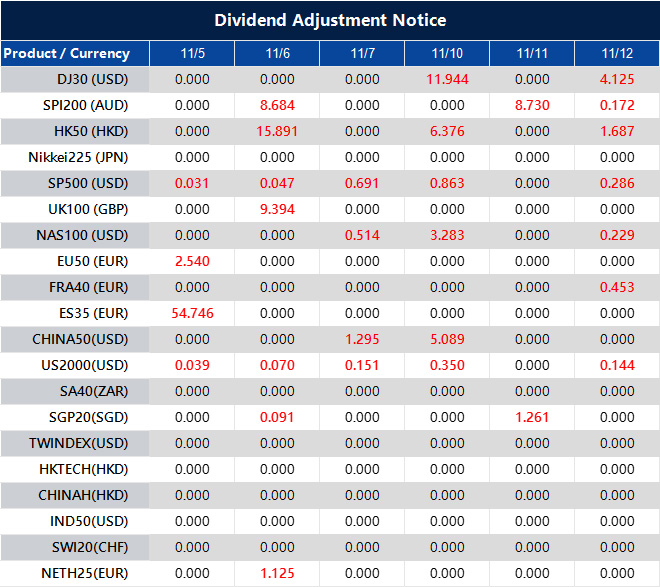
The above data is for reference only, please refer to the MT4/MT5 software for specific data.
If you’d like more information, please don’t hesitate to contact [email protected].
The Chinese Finance Ministry plans to soon reduce tariffs on American agricultural products.
The Chinese Finance Ministry has announced that starting November 10th, China will remove certain tariffs on US agricultural products. They will suspend a 24% tariff for a year, but a 10% tariff will still be in place.
The US Dollar Index is stable, hovering around 100.20. This announcement comes during ongoing trade tensions between the US and China, which have been fluctuating since 2018.
The trade war began when the US imposed tariffs on China under President Trump, leading China to retaliate with their own tariffs. The situation improved somewhat with the US-China Phase One trade deal in January 2020, which aimed to stabilize trade and the economy.
Now that Trump is returning as US President in 2025, these tensions have flared up again. He has promised to impose 60% tariffs on China, rekindling trade conflicts that disrupt global supply chains, lower investment, and increase inflation.
As of November 5th, 2025, China’s announcement serves as a small yet meaningful sign in this ongoing trade struggle. Although the initial market reaction is slight, this partial tariff relief on agricultural goods effective from November 10th presents short-term opportunities that we need to act on before considering the larger, less clear situation.
We view this as an opportunity to examine agricultural futures, especially soybeans, which have suffered since the new tariffs started in January 2025. In the first trade war, US soybean exports to China dropped by over 70% in 2018, so even a partial reopening of the market could boost prices significantly. We expect commodity trading houses to start factoring in renewed demand from China in the coming weeks.
This small move may also help ease market fears, which is why we’re considering short volatility strategies. The CBOE Volatility Index (VIX) has been above 22 since the new tariffs were introduced earlier this year, and selling out-of-the-money options could prove profitable. Any signs of further easing could bring the VIX closer to its historical average of under 20.
In the currency markets, the Australian dollar could be an interesting choice to trade alongside the easing tensions. The AUD has struggled throughout 2025, affected by the trade war and its link to China’s economic performance. A long position in AUD/USD could thrive if this tariff reduction leads to a more stable trade environment, similar to the relief rallies we saw in late 2019.
For stock traders, we are looking at call options on agricultural firms like Deere & Co. and Archer-Daniels-Midland. These stocks have lagged behind the overall market since January, and this news could act as a catalyst for improving their earnings outlook. We plan to make these short-term trades, expecting a positive response in the upcoming weeks leading into year-end.
USD/INR trading remains subdued around 88.70 due to India’s bank holidays
The USD/INR exchange rate remains above 88.50, with little movement due to an Indian bank holiday. Market activity is quiet as the US Dollar slightly declines amid ongoing concerns about the prolonged US government shutdown.
The shutdown, which is now in its sixth week, is on track to become the longest in US history because the Senate did not pass a funding bill. The USD/INR pair could strengthen if uncertainties remain regarding the US Federal Reserve’s policies. Fed Chair Jerome Powell expressed doubt about rate cuts in December, indicating a wait-and-see approach for new data.
The Indian Rupee is under pressure from foreign fund outflows, as Foreign Institutional Investors have been selling for the past four months, although the pace slowed in October. The Reserve Bank of India might step in to support the Rupee in future trading sessions.
The Rupee’s value is influenced by several factors, including crude oil prices, the strength of the US Dollar, and levels of foreign investment. The Reserve Bank of India intervenes in currency markets and adjusts interest rates to control inflation, aiming for a 4% target. Macroeconomic factors like inflation, interest rates, GDP growth, and trade balance also play a crucial role in the Rupee’s performance. Generally, higher growth and interest rates boost the Rupee, while inflation is a risk.
With the USD/INR pair staying above 88.50, the US government shutdown poses challenges for the dollar. A similar 35-day shutdown occurred in late 2018 and early 2019, during which the US Dollar Index remained stable, showing that political turmoil doesn’t always weaken the dollar. Traders should be cautious about betting against the dollar based solely on the shutdown.
The uncertainty surrounding the Federal Reserve is a more significant factor and suggests possible volatility in the upcoming weeks. Since Chair Powell hasn’t committed to a December rate cut, traders may consider strategies that benefit from price movements, like long straddles or strangles. This approach allows them to gain from a significant price change once delayed US economic data is released.
On the Rupee side, we observe continued foreign fund outflows from Indian equities, reminiscent of fall 2023 when FIIs sold over $3 billion in two months. However, the Reserve Bank of India’s substantial foreign exchange reserves, reported at over $640 billion, give it considerable power to support the Rupee. Strong intervention could quickly lower the USD/INR pair, making long positions risky.
External factors, especially crude oil prices, need careful monitoring since they directly affect India’s import costs. With Brent crude prices recently over $85 per barrel, ongoing high prices could put more pressure on the Rupee. This scenario complicates carry trades, as potential gains from India’s higher interest rates might be offset by currency depreciation.
Given these contradictory signals, traders might explore defined-risk strategies, such as spreads. A Bull Call Spread on USD/INR could be a good way to position for dollar strength if the Fed stays hawkish, while limiting potential losses if the RBI intervenes. On the other hand, a Bear Put Spread could be employed to bet on Rupee strength if a resolution for the US budget appears likely.
Canadian dollar struggles as oil prices decline; USD/CAD rises to seven-month highs near 1.4110
USD/CAD has hit a seven-month peak at 1.4119, largely due to falling crude oil prices. The Canadian Dollar weakened as oil prices dropped, prompted by a significant rise in US oil inventories.
The USD/CAD pair is on the rise, trading around 1.4110 in Asian markets, while the commodity-dependent Canadian Dollar struggles. West Texas Intermediate oil prices have fallen for a third day, sitting close to $60.00 per barrel after US inventories increased by 6.5 million barrels, much higher than the expected 2.4 million barrel drop.
US Government Shutdown Impact
The US Dollar is facing pressure from an ongoing government shutdown that has lasted six weeks. Recent attempts to pass short-term funding have failed, risking the longest shutdown in US history. The USD received some support from the cautious policy stance of the US Federal Reserve for December. Fed Chair Jerome Powell indicated uncertainty about another rate cut, suggesting a wait-and-see approach until new data comes in. The Canadian Dollar’s value is impacted by the Bank of Canada’s interest rates, oil prices, economic condition, inflation, and trade balances. Since oil is Canada’s biggest export, changes in oil prices significantly influence the CAD’s value; thus, higher oil prices are generally positive for the CAD. Currently, with USD/CAD trading around 1.3950, we notice similarities to past instances of Canadian Dollar weakness. The main factor is the low crude oil prices, with West Texas Intermediate struggling to stay above $72 per barrel. Last week’s EIA report revealed an unexpected inventory increase of 4.2 million barrels, raising concerns about a supply surplus into 2026.Market Expectations and Strategies
The loonie faces additional pressure from slowing global demand forecasts, which hit Canada hard as a major energy exporter. For traders, this highlights the fundamental weakness of the CAD compared to the US Dollar. The market is adjusting for this divergence, expecting it to persist until the year’s end. We recall a similar scenario from years ago when a spike in US inventories pushed the pair past 1.4100. That time, uncertainty in the US played a role, but weakness in oil was the main influence on the pair. History indicates that as long as crude oil remains under pressure, the USD/CAD will likely keep rising. In contrast, the US Dollar gets support from a hawkish Federal Reserve. Recent US CPI data came in slightly above expectations at 3.4%, making further rate hikes possible in early 2026. This stands in contrast to the Bank of Canada, which is expected to maintain steady rates, widening the gap in monetary policies between the two countries. Given this outlook, purchasing call options on USD/CAD appears to be a smart strategy to capture potential gains. We’re considering strikes around 1.4050 with expirations in January 2026 to allow enough time for the trend to develop, offering a low-risk opportunity to profit if the pair continues to rise. For those looking to earn premiums while maintaining a bullish-to-neutral stance, selling cash-secured puts with a strike price around 1.3700 might be appealing. This method takes advantage of time decay and volatility if the pair remains above that level. Alternatively, traders can express a direct view on oil by buying puts on WTI futures, wagering on a decline below $70. Create your live VT Markets account and start trading now.WTI crude oil falls below $60 as US inventories increase
West Texas Intermediate (WTI), the standard for US crude oil, has dipped to around $60.00 during Asian trading hours on Wednesday. This drop comes after a significant rise in US crude inventories, according to the American Petroleum Institute (API).
The API reported that US stockpiles increased by 6.5 million barrels for the week ending October 31. This is a change from a drop of 4 million barrels the previous week, leading to a total increase of 3.6 million barrels in US crude inventories for the year so far.
Geopolitical Effects on WTI Prices
Geopolitical tensions, especially in the Middle East and Black Sea, could affect WTI prices. Attacks on Russian facilities, like the refinery in Nizhny Novgorod, may push oil prices higher if conflicts escalate. WTI, characterized as light and sweet, is high-quality oil produced in the US. Prices are influenced by supply and demand, OPEC decisions, and inventory reports from both the API and EIA. OPEC plays a key role in managing oil prices through production quotas. Lower quotas tend to raise prices, while higher production can lower them. Reports from the EIA are often seen as more reliable because they come from a government source. This week, the market is facing two opposing forces. The significant increase in US crude inventories is pressing WTI down, nearing the $60 mark. However, escalating geopolitical risks in the Black Sea region are currently supporting prices.Market Volatility and OPEC+ Meeting
The API’s report of a 6.5 million barrel increase is a bearish signal, the biggest since July 2025. If today’s EIA report shows an increase of over 5 million barrels, it will be almost double the five-year average for this time of year. This could push prices down to the mid-$50s, indicating weaker US demand as winter approaches. At the same time, we can’t ignore the increased attacks on Russian refineries. Recent reports suggest that over 500,000 barrels per day of Russian processing capacity has been affected, echoing disruptions from early 2024 that caused brief price surges. A successful attack on major export terminals could rapidly reverse the current downward trend. The clash between bearish market fundamentals and bullish geopolitical risks is making prices more volatile, with the oil VIX (OVX) now above 35. This suggests traders are expecting larger-than-normal price swings in the coming weeks. For those trading derivatives, short-dated options strategies, like straddles, may be a good way to prepare for significant price movements in either direction. Looking ahead, we must keep an eye on the OPEC+ meeting scheduled for the first week of December. With prices threatening to drop below their comfort zone, they may express a willingness to increase production cuts to stabilize prices. Historically, even verbal signals from OPEC+ members have been enough to create short-term rallies in the oil market. Create your live VT Markets account and start trading now.Premier Li Qiang states that unilateral protectionist actions disrupt the global economy.
China’s Premier Li Qiang noted the negative impact that unilateral and protectionist actions have on the global economy. He stressed the need for equality, mutual benefit, and shared interests, especially as global economic growth starts to slow.
Li Qiang expressed China’s readiness to work with other countries to create an open and inclusive system. Recently, there has been a rise in trade restrictions that make business operations more difficult and hurt many countries, particularly in developing regions.
China promotes fair economic practices, urging nations to balance their own interests with global welfare. Despite facing market challenges, China is dedicated to increasing imports to show its commitment to global well-being.
China aims to change global trade rules and governance to tackle the negative effects of tariffs. There is an urgent need for better global economic governance to ensure fair and clear trade rules.
By focusing on high-quality development and exploring new growth areas in digital sectors, China is prioritizing economic growth. Experts forecast that China’s economy will surpass 170 trillion yuan within five years, driven by strong policies aimed at boosting demand and sustaining growth.
With the emphasis on fighting protectionism, we might see a temporary strengthening of the Chinese yuan. The offshore yuan (CNH) has been weak against the dollar, recently dropping to a 12-month low of 7.42 in October 2025 due to worries about global growth. Li Qiang’s statements could help stabilize the yuan, making options trading on it an appealing choice.
The commitment to increasing demand and imports signals positive news for industrial commodities. In October 2025, we noted a slight decline in China’s commodity imports, which led to a 4% drop in copper prices last month. If China follows through on its promises, it could reverse this trend and suggest that investing in copper and iron ore futures could be worthwhile.
For stock markets, the focus on growth in digital sectors is crucial. The Hang Seng Tech Index has lagged behind the overall market by almost 15% year-to-date in 2025. This targeted support could lead to a rally, making it a good moment to consider buying call spreads on ETFs that track Chinese tech firms.
Li Qiang’s criticism of tariffs and the call for trade rule reform may also help export-driven economies that trade with China, like Germany. We recall the market turbulence during the trade disputes from 2018 to 2022, which significantly impacted German industrial stocks. A softer approach from Beijing could reduce perceived risks, tightening credit default swap spreads for major European industrial companies.
The idea of “more intensive and effective micro policies” adds some uncertainty that derivative traders could exploit. After China reported a Q3 2025 GDP growth rate of 4.4%, slightly below what was expected, the market is anticipating stimulus measures. This uncertainty may lead to more volatility, so using straddles or strangles on important Chinese equity indices could be a smart move to navigate any new policy announcements.
The PBOC set the USD/CNY central rate at 7.0901, surpassing previous values.
The People’s Bank of China (PBOC) has set the USD/CNY central rate at 7.0901 for Wednesday’s trading session, up from 7.0885 the previous day. This rate is also stronger than Reuters’ estimate of 7.1336.
The PBOC focuses on keeping prices and exchange rates stable while promoting economic growth. Financial reforms, including market development, are also important goals for the bank.
The PBOC is state-owned and is influenced by the Chinese Communist Party. Mr. Pan Gongsheng currently serves as both the governor and the Secretary of the Committee.
To manage monetary policy, the PBOC uses various tools, such as the seven-day Reverse Repo Rate, Medium-term Lending Facility, foreign exchange interventions, and the Reserve Requirement Ratio. The Loan Prime Rate is the baseline interest rate, affecting loans, mortgages, and savings rates.
China has 19 private banks, making up a small part of its financial system. The top private banks, WeBank and MYbank, receive support from tech giants Tencent and Ant Group.
Recently, the PBOC allowed the yuan to weaken slightly against the dollar, setting the reference rate at 7.0901. This is much stronger than the anticipated market rate of 7.1336. This indicates that while some decline is acceptable, the authorities are working to prevent a swift drop in value.
This strategy comes during a challenging time for China’s economy, with Q3 2025 GDP growth slowing to 4.2% and exports declining. The persistent US Federal Reserve rate of 5.0% adds further pressure on the yuan, as holding dollars becomes more appealing.
The PBOC’s consistent strong fixes in 2025 suggest a desire to limit yuan weakness, keeping it around the 7.10-7.15 range for now. For traders dealing in derivatives, this environment could encourage selling out-of-the-money USD/CNY call options, given the bank’s efforts to prevent rapid increases in the rate. One-month implied volatility remains high at 5.5%, providing good premiums for those betting on stability.
This approach echoes the late 2023 strategy when the PBOC used strong fixes to stabilize the yuan amid economic challenges. This historical context shows that the PBOC has both the ability and the intent to intervene for extended periods, making a sudden policy change unlikely unless a significant economic shock occurs.







