



A bullish trend continues for AUD/JPY around 100.50, despite some selling pressure
The AUD/JPY currency pair softened to about 100.50 during early European trading on Tuesday. However, there is still a positive outlook as indicated by the bullish RSI. Immediate resistance is seen at 101.65, while a key downside target is around 100.00. The Australian Dollar is struggling against the Japanese Yen after the Reserve Bank of Australia decided to keep the Official Cash Rate steady at 3.6%. This decision came after inflation figures for the September quarter were higher than expected.
From a technical perspective, AUD/JPY is holding steady above the 100-day Exponential Moving Average on the daily chart. The 14-day Relative Strength Index reflects bullish momentum at 61.65. The first notable resistance is at 101.65; if surpassed, the pair could rise to 102.30, with the next target at 103.12. However, if the price falls below the 100.00 mark, it may retreat to 99.74 and then to 97.84.
The value of the Australian Dollar is influenced by interest rates set by the Reserve Bank of Australia, as well as factors like iron ore prices and the state of the Chinese economy. Changes in interest rates and events in China can directly affect the currency’s value. The price of iron ore and Australia’s trade balance also play significant roles in the demand for the AUD.
With the Reserve Bank keeping rates at 3.6%, the AUD/JPY remains around the 100.50 mark. The technical indicators suggest a bullish sentiment, with the price firmly above the 100-day exponential moving average. This stable foundation opens opportunities for strategies that could benefit from a gradual increase or a definitive breakout in the upcoming weeks.
Given the strong support at the 100.00 level, one strategy could be to sell cash-secured puts with a strike price just below this, possibly at 99.50. This method allows us to collect premium while maintaining a bullish structure. The Reserve Bank’s decision not to cut rates, which some anticipated earlier in 2025, adds strength to this position.
Adding to the positive outlook is the health of China, Australia’s largest trading partner. Recent data shows that China’s Caixin Manufacturing PMI came in at 50.9, exceeding market expectations and signaling slight growth in the manufacturing sector. This is a good sign for demand for Australian resources and boosts the Aussie dollar.
We are also seeing stability in key commodity prices, as iron ore futures consolidate around $120 per tonne. This is a notable recovery from the sub-$100 levels seen during a brief dip in late 2024. This price stability significantly supports Australia’s trade balance and, in turn, the AUD.
For traders looking to capitalize on a move past the immediate resistance at 101.65, buying call options presents a direct bullish strategy. A breakthrough at this level could drive the pair quickly toward the November 2024 high of 102.30. A cost-effective approach is to use a bull call spread by buying a 101.50 call and selling a 102.50 call, effectively targeting this specific move while managing risk.
US Dollar Index rises towards 100.00 during Asian trading, reflecting cautious Federal Reserve stance
The US Dollar Index (DXY) is currently around 99.90, marking its fifth day of gains. This increase is driven by a cautious perspective on the US Federal Reserve’s policy. The likelihood of a rate cut in December has dropped to 65% from 94% a week earlier. The Fed Chair emphasized uncertainty about future cuts, suggesting a wait-and-see stance until new data becomes available.
At the same time, the US Dollar is facing challenges due to a government shutdown, which continues to raise concerns about the economy. This shutdown is now in its sixth week, with federal workers still unpaid and Congress struggling to agree on a funding bill. Additionally, ISM’s Manufacturing PMI indicates a more significant contraction than expected, falling to 48.7 from 49.1 in September.
The US Dollar (USD) is the official currency of the United States and is the most traded currency globally. The Federal Reserve plays a major role in shaping the USD through its monetary policy, adjusting interest rates to manage inflation and employment. Typically, measures like quantitative easing can weaken the USD, while quantitative tightening tends to strengthen it.
Now, the US Dollar Index is approaching the important 100.00 level, fueled by a reduction in market expectations for a Federal Reserve rate cut in December. This situation creates tension for traders as the dollar’s strength contrasts with rising economic fears domestically. The main challenge is to navigate these two opposing influences in the coming weeks.
The chance of a December rate cut has decreased from over 90% to 65%, contributing to the dollar’s rally. Traders might explore strategies to capitalize on a stronger dollar, such as selling call options on Euro futures, effectively betting against a significant drop in the dollar’s value. This method can profit from ongoing dollar strength and steadiness.
However, the ongoing six-week government shutdown poses a significant risk. Looking back at the 35-day shutdown from late 2018 to early 2019, the Congressional Budget Office estimated a short-term real GDP loss of $11 billion. This highlights how quickly the current deadlock could harm the economy and undo recent dollar gains.
This political uncertainty leads to increased market volatility. With official economic data releases on hold and business confidence likely eroding—evident in the recent drop of the ISM Manufacturing PMI to 48.7—traders should expect pronounced price movements. It may be wise to consider strategies that take advantage of this volatility, like buying straddles on major currency pairs.
Given that the 100.00 mark on the DXY is a key psychological and technical level, there is potential for strategic positioning. Buying short-term, out-of-the-money put options on the US Dollar Index or similar ETFs offers a cost-effective way to protect against long-dollar exposure. This approach safeguards against a sharp downturn should news from Washington worsen.
Amazon shares rise 5% after strong earnings report and $38 billion agreement with OpenAI
Amazon’s stock rose 5% after announcing a $38 billion deal with OpenAI, following a 10% increase after strong Q3 earnings. This partnership focuses on Amazon Web Services (AWS) providing infrastructure to support OpenAI’s artificial intelligence workloads.
The agreement lasts seven years and allows OpenAI to utilize AWS’s cloud computing resources. OpenAI will depend on AWS for AI operations, including model training and running applications like ChatGPT. AWS offers a system with many Nvidia GPU chips and can grow to meet increasing computing needs.
This deal is expected to bring AWS an additional $5.5 billion in yearly revenue. With AWS’s high profit margins, around 35%, this could lead to an estimated $1.9 billion increase in annual earnings. While Microsoft was the exclusive cloud partner for OpenAI, this deal gives AWS a share of the benefits, evening the playing field.
Analysts have a positive outlook on the deal. They see it as a strong endorsement for AWS and a boost for Amazon’s role in AI. Some analysts have raised their price targets for Amazon’s stock, with Wedbush increasing it to $340 per share. Currently, Amazon’s stock is around $254, up 14% recently, with a 16% gain for the year. The median target for the stock is $290, indicating a potential 14% rise.
The recent 15% jump in Amazon’s stock has led to higher implied volatility, a level not seen since the Q2 earnings earlier this year. This rise makes buying call options more expensive, so traders might want to consider strategies that benefit from high premiums. One option could be selling cash-secured puts with strike prices below current support, perhaps around $240, to take advantage of the inflated premium while setting a clear entry point.
The OpenAI deal is a crucial win for AWS in the competitive cloud market against Microsoft and Google. As of the last quarter, AWS held a leading market share of about 31%, and this partnership reinforces its status as a major provider for demanding AI tasks. This shifts the conversation from speculative AI investments to real, long-term revenue opportunities.
The economic landscape is more favorable now compared to 2024. The latest minutes from the Federal Reserve indicate a continued pause on interest rates. Additionally, recent data shows retail sales grew 2.8% year-over-year in October, suggesting a strong outlook for Amazon’s core business as we approach the holiday season. This creates a positive environment for the stock.
Considering Wedbush’s price target of $340, bull call spreads could be an interesting strategy to manage the cost of options. For instance, purchasing a January 2026 $260 call and selling a $290 call could capture potential upside while controlling initial costs. This approach aligns with the median analyst target and benefits from steady growth instead of rapid spikes.
The intense AI rally of 2023 and 2024 saw many tech valuations disconnect from fundamentals. However, the AWS-OpenAI partnership signifies a maturing market where substantial, multi-billion dollar contracts are the main value drivers. Traders should look for similar concrete deals from other cloud providers to identify the long-term winners.
USD/CHF rises for fifth consecutive day, hitting highest level since late August as buyers step in
**USD/CHF Performance and Monetary Policy Outlook**
Fed Chair Jerome Powell’s comments against a December interest rate cut are easing concerns about the US government shutdown. Meanwhile, the Swiss Franc faces pressure, with expectations that the Swiss National Bank (SNB) might lower interest rates into negative territory.
The different monetary policies of the Fed and SNB are boosting the USD’s strength against the CHF. Softer inflation data in Switzerland raises expectations for SNB rate cuts, which affects the Franc.
This week, there is no major economic data expected from the US due to the government shutdown. However, statements from FOMC members could sway the market. Additionally, broader market sentiment may create short-term trading opportunities for USD/CHF.
**Analysis of Current Trends and Future Expectations**
Right now, there’s a clear difference between US and Swiss monetary policy supporting the USD/CHF pair’s rise. The US Federal Reserve’s strong stance against further rate cuts contrasts with expectations for the SNB to ease its policy. In the coming weeks, the path seems to trend upwards, aiming for a stable break above the 0.8100 level.
Supporting this outlook, data from late October 2025 shows the US Core CPI steady at 3.4% year-over-year, aligning with the Fed’s “higher for longer” approach. In contrast, Switzerland’s inflation rate is a low 1.2%, prompting the SNB to consider a rate cut in December. This growing gap in policies is driving the dollar’s strength against the Franc.
For traders in derivatives, buying call options on USD/CHF might be a smart move. A call option with a strike price at or slightly above 0.8100, expiring in December 2025 or January 2026, could help capitalize on continued upward movement. This strategy limits risk to the premium paid while allowing for significant gains if the trend continues.
However, we should be mindful of risks tied to the ongoing US government shutdown. Although the dollar has held strong so far, a long shutdown could eventually impact US economic activity and investor sentiment, similar to the 35-day shutdown seen in 2018-2019. Any noticeable economic damage could quickly reverse the dollar’s gains.
**Key Factors and Potential Risks**
Another factor to consider is the current risk-on sentiment in global markets, which is reducing demand for the safe-haven Swiss franc. We must keep an eye on any changes in this sentiment, as a quick shift towards risk aversion could rapidly boost the Franc and reverse this trade. Traders should monitor global equity indices and geopolitical events closely.
Create your live VT Markets account and start trading now.
Dividend Adjustment Notice – Nov 04 ,2025
Dear Client,
Please note that the dividends of the following products will be adjusted accordingly. Index dividends will be executed separately through a balance statement directly to your trading account, and the comment will be in the following format “Div & Product Name & Net Volume”.
Please refer to the table below for more details:
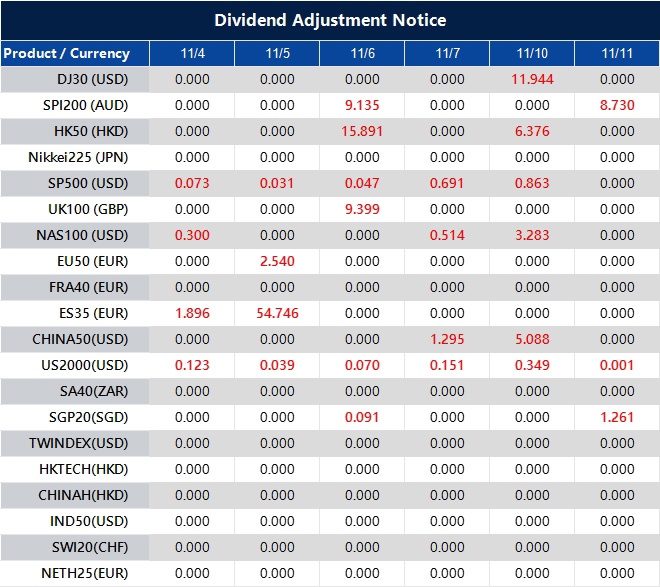
The above data is for reference only, please refer to the MT4/MT5 software for specific data.
If you’d like more information, please don’t hesitate to contact [email protected].
In October, India’s HSBC manufacturing PMI increased from 58.4 to 59.2.
India’s manufacturing sector grew in October, with the HSBC Manufacturing PMI rising from 58.4 to 59.2. This increase suggests that manufacturing activity is expanding and business conditions are improving.
In financial markets, the Japanese Yen has gained due to a global preference for safe assets. In contrast, the Australian Dollar fell amid inflation worries, resulting in a rise in the 10-year bond yield.
In the commodities market, gold prices are struggling, staying below $4,000 as traders adjust to expectations about US Federal Reserve policies. Privacy cryptocurrencies Dash and Zcash, however, increased in value despite overall market corrections.
Recently, there has been heightened scrutiny on DeFi platforms after a $120 million hack of Balancer, a well-established decentralized exchange. This incident raises concerns about security and management within the fast-evolving DeFi space.
India’s manufacturing sector is performing strongly, with a PMI of 59.2—the highest since the 2023 post-pandemic recovery. This positive data indicates ongoing economic momentum, even as other major economies slow. Consequently, purchasing call options on the Nifty 50 index could be a promising strategy for Indian equities in the near future.
Worldwide, a cautious mood prevails, but it hasn’t led to usual safe-haven buying. The US Dollar remains strong as hopes for a Federal Reserve rate cut in December have faded, bolstered by the 10-year Treasury yield staying above 4.75%. This environment could make currencies like the Australian Dollar struggle, suggesting that put options on the AUD/USD pair may be a wise choice to hedge against further declines.
The Euro is also feeling pressure, recently hitting a three-month low near 1.1500 after German industrial output unexpectedly dropped by 0.8% last month. The British Pound is weak too, as traders hold back ahead of the Bank of England’s meeting. For GBP/USD, options strategies that benefit from volatility, like a long straddle, might be suitable since the central bank’s decision could cause significant price movements.
Gold’s failure to stay above $4,000, despite market concerns, is notable. The strength of the dollar acts as a strong obstacle, similar to the trend experienced during the 2022-2023 interest rate hikes, where gold’s gains were limited. Selling out-of-the-money call options on gold futures could help generate income, as a major breakout seems unlikely in the near term.
In energy markets, there is a bearish outlook, with WTI crude oil prices decreasing. This follows a report from the Energy Information Administration (EIA) revealing an unexpected rise in US crude inventories of over 2 million barrels, indicating weaker demand. We expect this trend to continue, making long put spreads on WTI a feasible strategy for anticipating further declines in oil prices.
Sanae Takaichi says Japan hasn’t met the Bank of Japan’s price target yet
Japan’s Prime Minister, Sanae Takaichi, said that Japan has not yet reached the Bank of Japan’s (BoJ) price target. She believes the BoJ should keep working with the government to set the right monetary policy and sustainably achieve this target.
Abenomics has helped increase GDP and create jobs. The government plans to use fiscal spending wisely to boost household income and consumer confidence. Right now, the USD/JPY exchange rate is down 0.14% at 154.00.
The Japanese Yen (JPY) is one of the most traded currencies in the world, affected by Japan’s economic performance and BoJ policies. An ultra-loose monetary policy from the BoJ from 2013 to 2024 led to a weaker Yen. However, a planned policy change by the BoJ in 2024 is starting to support the Yen.
The difference in bond yields between Japan and the US also affects the Yen’s value. The BoJ’s past approaches differed from other central banks, leading to a wider yield gap and benefiting the US Dollar. Recent policy changes by the BoJ and rate cuts by other banks are helping to close this gap.
The Yen is often seen as a safe-haven currency, which tends to increase in value during market stress.
With the government indicating that Japan is only halfway to meeting its inflation target, it seems the Bank of Japan will need to keep a cautious monetary policy. This suggests that any future interest rate hikes will be gradual and clearly communicated. The main driver for a weak Yen—interest rate differences—looks set to continue.
The latest core Consumer Price Index (CPI) data from October 2025 shows a rate of 1.6%, still below the BoJ’s 2% target, reinforcing this view. The BoJ ended its negative interest rate policy in March 2024 but has only raised rates once since then, to 0.10%. This slow approach contrasts with the US Federal Reserve, which is maintaining its key interest rate between 4.00% and 4.25%, giving a significant advantage to the dollar.
For derivative traders, this situation suggests it could be beneficial to position for ongoing Yen weakness or at least a lack of Yen strength. One strategy is to sell out-of-the-money JPY call options against the dollar, allowing traders to collect premiums based on the expectation that the USD/JPY pair won’t drop significantly in the upcoming weeks.
However, we should be cautious of the risk of government intervention since the pair is trading at high levels around 154.00. In 2022 and again in 2024, Japanese authorities stepped in to support the Yen as the exchange rate approached 160. Thus, buying long-dated USD/JPY call options could be a calculated way to bet on further Yen depreciation while keeping our maximum risk defined.
The government’s focus on fiscal spending to enhance household income is a longer-term strategy that won’t impact currency markets right away. The difference in policies between a cautious Bank of Japan and a determined Federal Reserve will continue to be the central theme. This outlook strengthens the idea that carry trades, where traders borrow in Yen to invest in higher-yielding currencies, will remain popular.
EUR/JPY drops towards 177.00 as speculation about potential Bank of Japan rate hikes increases
EUR/JPY is trading at about 177.20 during Tuesday’s Asian session. The Japanese Yen is gaining strength due to recent comments from the Bank of Japan (BoJ), suggesting a possible rate hike in December or January.
There is ongoing speculation about when the next BoJ rate hike will occur. Japan’s new Prime Minister may advocate for increased fiscal spending, while the Finance Minister has recently changed her view on the Yen’s value against the dollar.
Market Reactions
The Euro could gain traction as expectations rise that the European Central Bank (ECB) will keep interest rates unchanged this year. The ECB has maintained steady rates for the third consecutive meeting, noting stable inflation and economic growth amid ongoing uncertainties. Inflation in the Eurozone has slightly eased, remaining above the ECB’s target, and third-quarter GDP growth has exceeded expectations. Business surveys in October showed improved sentiment throughout the region. Francois Villeroy de Galhau of the ECB stated that the bank is well-prepared after their October decision but highlighted the importance of being adaptable. Martins Kazaks pointed out that risks to inflation and growth are balanced, stressing the need for caution rather than reactive measures from the bank. Interest rates are set by financial institutions and influenced by central banks. Higher rates can strengthen a country’s currency and place downward pressure on gold prices, affecting global currency and commodity markets.Cross-Currency Dynamics
As EUR/JPY hovers around 177.20, the market is factoring in the BoJ’s hawkish shift from last week. The potential for a rate hike in December 2025 or January 2026 is boosting the Yen significantly. Current data shows that overnight index swaps are pricing in a 65% chance of a 10-basis-point hike by the end of January. However, this outcome is not certain, leading to uncertainty that traders must manage. Prime Minister Sanae Takaichi’s new government may favor fiscal stimulus, which could counter the BoJ’s tightening efforts. This tension between the central bank and the government introduces volatility. It’s important to recognize the significance of these potential actions by the BoJ. After ending negative interest rates in March 2024, any additional hike would mark a significant shift from years of ultra-easy monetary policy. Thus, Governor Ueda’s statements are crucial for market direction. On the other side, the Euro seems stable, possibly limiting how much EUR/JPY can drop. The ECB held rates steady last week for the third time, and new data from Eurostat shows core inflation steady at 2.1% for October. This supports the idea that the ECB is likely to adopt a wait-and-see approach for the rest of the year. This situation—a potentially aggressive BoJ vs. a neutral ECB—sets the stage for increased volatility. We anticipate that implied volatility in EUR/JPY options will rise as the market seeks clearer indications from Tokyo. The uncertainty around the timing and commitment of the BoJ will be a key factor. For derivatives traders, this climate suggests that shorting volatility could be risky. Strategies that capitalize on significant price movements, such as long straddles or strangles, may be worth considering for positioning in anticipation of a clear direction. Caution is warranted, as any delays in the BoJ’s tightening plans could lead to a sharp reversal. Create your live VT Markets account and start trading now.The AUD/NZD pair is near its highest level since September 2022, approaching 1.1500 after the RBA’s announcement.
The AUD/NZD pair is currently strong, hovering near its highest point since September 2022. This strength follows the Reserve Bank of Australia’s (RBA) decision to keep interest rates steady. The pair has risen positively for seven days straight, trading above the mid-1.1400s with a daily gain of 0.15%.
The RBA decided to maintain rates after an unexpected rise in inflation. New forecasts predict inflation will reach 3.7% by mid-next year and drop to 2.6% by the end of 2027. This outlook has reduced the likelihood of a rate cut next year, helping the Australian Dollar (AUD) strengthen against the New Zealand Dollar (NZD).
New Zealand Rate Expectations
In New Zealand, traders expect a possible rate cut at the RBNZ meeting on November 26. This expectation partly stems from US tariffs that are affecting the economy. Despite showing signs of being oversold, the AUD/NZD pair is likely to keep climbing, with any pullback seen as a chance to buy. The upcoming RBA interest rate decision will draw attention since a hawkish or dovish approach can impact the Australian Dollar. The current interest rate remains unchanged at 3.6%, meeting market expectations from prior releases. There is a noticeable divide between the Australian and New Zealand central banks, suggesting that the AUD/NZD pair will continue to gain strength. The RBA kept rates steady at 3.6% today but expressed concerns about inflation, which unexpectedly rose to 3.9% annually in the last Q3 2025 report. This divergence creates a strong case for holding long positions in the Aussie against the Kiwi in the coming weeks.Investment Strategy Considerations
In contrast, market expectations indicate a high chance of a rate cut by the RBNZ on November 26. This perspective is backed by recent data indicating minimal growth in New Zealand’s economy, with Q3 2025 GDP at just 0.1%. Such economic challenges are putting pressure on the Kiwi. For the next few weeks, buying AUD/NZD call options seems like a straightforward way to target a move towards the 1.1500 level. This strategy lets you benefit from potential gains while limiting risk to the premium paid. Choosing options that expire after the November 26 RBNZ meeting could capture possible volatility from that event. It’s important to note that the pair is technically overbought after a seven-day rise. A slight pullback towards the 1.1400 level may provide a better entry point for new long positions or for selling NZD call options against the Aussie. Taking this patient approach can help manage entry risk. Our optimistic outlook is reinforced by recent CFTC data, which shows that speculative traders are increasing their net long positions in the Australian dollar. This current divergence in policy contrasts sharply with 2022, when central banks generally raised rates simultaneously. Today’s split offers a clearer directional opportunity for the AUD/NZD pair. Create your live VT Markets account and start trading now.RBA Governor Michele Bullock explains why the interest rate remains at 3.6% during the press conference.
Michele Bullock, Governor of the Reserve Bank of Australia (RBA), announced that the key interest rate will stay at 3.6% after the November policy meeting. In her press conference, she explained that less easing might be needed than before and that cutting rates is not on the table.
The RBA’s release highlighted that annual core inflation remains above 3%, and they do not expect to cut rates further. Bullock mentioned uncertainty surrounding inflation and indicated they will closely monitor economic conditions. The RBA forecasts a steady unemployment rate and is unlikely to raise rates, noting that tight financial conditions are affecting economic growth.
The interest rate decision, made during eight scheduled meetings each year, influences the Australian Dollar (AUD). Currently, the AUD is slightly down, trading at 0.6522, which reflects some economic uncertainty. Projections suggest the trimmed mean inflation will average 3.2% until mid-2026 and likely ease by 2027.
In currency markets, the Australian Dollar is performing poorly against major currencies like the USD. Future movements of AUD/USD depend on the RBA’s forecasts; if they lower their projections, a rate cut might happen. However, if they maintain caution, the AUD could strengthen. Technical indicators suggest potential recovery if market conditions are favorable.
With the RBA keeping the cash rate at 3.6% and no clear future guidance, we expect the Australian dollar to stabilize. The Governor’s cautious message removed any strong reasons for major price changes. This implies that sharp trends are unlikely soon, and the AUD/USD will probably be influenced more by outside factors.
This neutral stance should lower implied volatility for the AUD. Recent market data shows implied volatility on one-month AUD/USD options has fallen below 8%, a significant decline from earlier in the year when rate hikes were under discussion. This trend is beneficial for option sellers who can profit from time decay, as large price fluctuations are less likely.
The interest rate difference between Australia and the United States is likely to cap the AUD/USD. The US Federal Reserve’s rate is currently at 4.5%, giving a substantial yield advantage to holding US dollars. This setup supports a strategy of selling the AUD during rallies near key resistance levels, such as the recent high around 0.6618.
Given this outlook, derivatives traders might consider range-bound strategies on the AUD/USD. For instance, they could set up an iron condor by selling call options with a strike price near 0.6650 and selling put options with a strike price close to 0.6500. This strategy works best when volatility is low, and the currency pair stays within a stable range.
Past periods of unclear policies from central banks, especially in 2023 during the global hiking pause, often saw currencies stuck in ranges for extended times. This situation can frustrate trend-followers but reward those who sell volatility. We expect a similar scenario to unfold in the weeks leading up to the holiday season.
The main risk to this outlook is unexpected economic data, which could push the RBA to take a more forceful stance. Traders should keep an eye on Australia’s upcoming monthly labor force report on November 13 and the next set of quarterly inflation data. A surprise rise in unemployment or a significant drop in inflation could prompt discussions of rate cuts and shift the AUD out of its current range.







