



Martin Kocher from the ECB indicates that their forecasts suggest long-term consistency is possible.
European Central Bank (ECB) member Martin Kocher shared that they are on track for a stable period ahead. However, he also mentioned that there is still significant uncertainty, even as recent data since September shows a small improvement.
At the time of reporting, the EUR/USD was up 0.05% at 1.1570, showing little change after Kocher’s comments. The euro was strong against major currencies, particularly the New Zealand Dollar.
The Australian dollar falls while the US dollar stabilizes amid Federal Reserve uncertainty
Australian Economic Overview
The Australian Dollar is under pressure due to mixed signals from China’s economy. In October, China’s NBS Manufacturing PMI dropped to 49.0, while the Non-Manufacturing PMI rose slightly to 50.1. This situation affects the AUD/USD exchange rate, which remains steady around 0.6550, due to Australia’s close trade relationship with China. The US Dollar is holding strong because of uncertainty around Federal Reserve policies. The US Dollar Index sits at about 99.50, as market predictions for Fed rate cuts rose to a 71% chance for December, following remarks from Federal Reserve Chair Jerome Powell. The Fed recently cut rates by 25 basis points, bringing the benchmark down to 3.75%-4.0%. Australia’s Q3 inflation data showed a 1.0% rise quarterly and a 3.0% increase yearly, which was higher than expected. This has lowered chances of immediate rate cuts by the Reserve Bank of Australia (RBA). The AUD/USD remains neutral, with support and resistance levels between 0.6450 and 0.6630. Key factors impacting the Australian Dollar include RBA interest rates, iron ore prices, and the state of the Chinese economy. Australia’s trade balance and market sentiment also matter, as favorable market conditions usually strengthen the AUD. Since China is Australia’s biggest trading partner, its economic well-being directly affects the AUD through trade. As of October 31, 2025, the Australian Dollar is stuck between opposing forces, keeping it within a narrow range. The RBA faces pressure from persistent high inflation, with the Q3 Trimmed Mean CPI reaching 3.0% annually. This makes it unlikely for the RBA to cut rates anytime soon, providing support for the currency.Market Outlook and Strategy
Despite this support, there are challenges limiting significant gains for the Australian Dollar. Recent statistics show that Australia’s unemployment rate rose to 4.2% last month, and key commodity prices, like iron ore, have dipped toward $110 per tonne. Mixed signals from China, particularly the drop in manufacturing PMI to 49.0, add to the negative sentiment surrounding its biggest trading partner. Meanwhile, the US Dollar remains strong even after the Federal Reserve’s recent rate cut. Fed Chair Powell’s cautious comments, along with a better-than-expected Non-Farm Payrolls report for September 2025—which showed an increase of 210,000 jobs—have lowered expectations for another rate cut in December. The market now sees only a 71% chance of a cut in December, down from over 90% a few weeks ago. This tug-of-war between a hawkish RBA and a stable US Dollar suggests that the AUD/USD will likely stay within its current range of roughly 0.6450 to 0.6630. We recall similar indecisive periods in 2023 when the market struggled to interpret conflicting signals from central banks. This environment may indicate that implied volatility is undervalued, presenting opportunities for traders. In the coming weeks, a good strategy would be to buy volatility through options, such as a long straddle, preparing for a breakout in either direction. The mixed fundamental factors make a sharp move likely once a trigger appears. This approach allows traders to benefit from significant price swings without predicting their direction. For traders with a clear market bias, the established range can help determine entry points. We might consider buying call options or call spreads if the price breaks above the 0.6630 resistance level. On the other hand, a sustained drop below 0.6450 would indicate a strong sign to open bearish positions using put options. Create your live VT Markets account and start trading now.The EUR/USD pair hovers around 1.1570, nearing its two-week low in Europe.
EUR/USD is trading carefully near a two-week low of 1.1570. The US Dollar is strong due to reduced expectations of further rate cuts by the Federal Reserve and improved trade relations between the US and China.
The US Dollar Index is close to a three-month high at 99.70. This week, the dollar gained the most against the British Pound, rising by 1.31%.
Fed and ECB Monetary Policies
Fed Chairman Jerome Powell mentioned that future rate cuts in December are uncertain after a recent 25-basis point reduction. Meanwhile, the European Central Bank (ECB) kept its Deposit Facility rate steady at 2%, in line with their inflation goals. This Friday, the Eurozone’s preliminary Harmonized Index of Consumer Prices will be in focus. The EUR/USD pair looks bearish, staying below the 20-day EMA at 1.1630. If the Relative Strength Index drops below 40.00, we could see more bearish movement. A drop could push the pair down to 1.1547 and 1.1528, while if it rises above 1.1728, it might reach July’s high of 1.1830. Overall, the outlook for EUR/USD is bearish. The pair is struggling near 1.1570 due to a stronger US dollar. The Federal Reserve’s hint at not cutting interest rates again in December supports the dollar’s strength, making shorting the Euro seem attractive in the short term.Recent Economic Indicators
Recently, the October non-farm payrolls report showed better-than-expected results, adding 290,000 jobs, with wage growth also rising. This strong economic data gives the Fed more reason to keep rates steady, boosting the dollar’s position and decreasing the chances of further monetary easing anticipated by traders. Given this bearish outlook, we recommend considering put options on the EUR/USD. This strategy will profit if the pair drops below key support levels like the 1.1547 low from October 30. Look for options expiring in the next few weeks to take advantage of this trend. On the Euro side, we’ll closely watch the upcoming Eurozone Harmonized Index of Consumer Prices (HICP). The consensus is for core inflation to slightly decrease to 2.5% year-over-year. A result at or below this would indicate managed price pressures. A lower inflation reading would give the ECB little reason to change its steady approach, keeping its deposit rate low at 2%. This difference between the Fed’s policies and the ECB’s inaction is likely to keep the Euro under pressure. The absence of strong signals from the ECB leaves the Euro vulnerable. This growing gap between Fed and ECB policies has been a trend throughout 2022 and 2023, historically favoring the dollar. A similar situation is developing now, as US economic strength contrasts with a more cautious view in Europe. Hence, we expect further downside movement for EUR/USD. Positioning for a decline towards August lows around 1.1528 seems wise. Options to define risk or shorting futures contracts are effective strategies for the upcoming weeks. Create your live VT Markets account and start trading now.The US Dollar Index stays stable around 99.50 amid uncertainty about Federal Reserve policy
The US Dollar Index, which measures the value of the USD against six major currencies, remains stable around 99.50. This caution comes amid uncertainty about Federal Reserve policies, even as expectations for a December rate cut have risen from 66% to 71%.
Federal Reserve Chair Jerome Powell’s recent statements have created uncertainty, lowering the previous 91% expectation for a rate cut. The Fed’s recent decision to cut the benchmark rate by 25 basis points, bringing it to a range of 3.75%-4.0%, was supported by 10 votes, though two members did not agree.
US and China Trade Negotiations
In a recent meeting, Presidents Trump and Xi reached an agreement where the US will lower tariffs on Chinese goods. In return, China has promised to make concessions on various economic issues. This development reflects ongoing trade talks that influence currency stability. As the most traded currency globally, the USD is heavily affected by the Federal Reserve’s monetary policies. Changes in interest rates or measures like quantitative easing can directly impact its value. These adjustments aim to balance inflation control with job support. Currently, the US Dollar Index is steady around 99.50, but we see this as a calm before a potential storm. The market estimates a 71% chance of a Fed rate cut in December, which conflicts with Chairman Powell’s cautious “wait-and-see” approach. This difference between market expectations and Fed guidance creates trading opportunities in the upcoming weeks. It’s important to note the division within the Federal Reserve, highlighted by the 10-2 vote on the recent rate cut. This disagreement, with one member advocating for a larger cut and another opposing a cut altogether, indicates that future policy is uncertain. The ongoing government shutdown is adding to this uncertainty, as it prevents policymakers from accessing the official data necessary for clear decision-making.Anticipating Increased Volatility
This high level of uncertainty suggests we should expect increased volatility. The MOVE index, which measures bond market volatility, recently climbed to 115, indicating growing nervousness. Looking back at the 35-day government shutdown of 2018-2019, we saw that delayed data releases led to sharp, sudden market changes once the information was finally available. Given this situation, using options strategies to prepare for significant price swings in the dollar, regardless of direction, could be wise. Although odds suggest a weaker dollar if the Fed goes ahead with the expected cut, Powell’s cautious stance poses a risk of a surprise that could strengthen the dollar. Thus, any bets against the dollar should be managed carefully, perhaps by using put spreads to limit risk. The recent trade agreement between the US and China, which includes tariff reductions, adds another dimension to our analysis. This de-escalation generally encourages a “risk-on” sentiment in global markets, which may put pressure on the USD as a safe-haven currency. This could create a consistent headwind for the dollar, potentially benefiting other currencies tied to global trade, like the Australian Dollar. Create your live VT Markets account and start trading now.Dividend Adjustment Notice – Oct 31 ,2025
Dear Client,
Please note that the dividends of the following products will be adjusted accordingly. Index dividends will be executed separately through a balance statement directly to your trading account, and the comment will be in the following format “Div & Product Name & Net Volume”.
Please refer to the table below for more details:
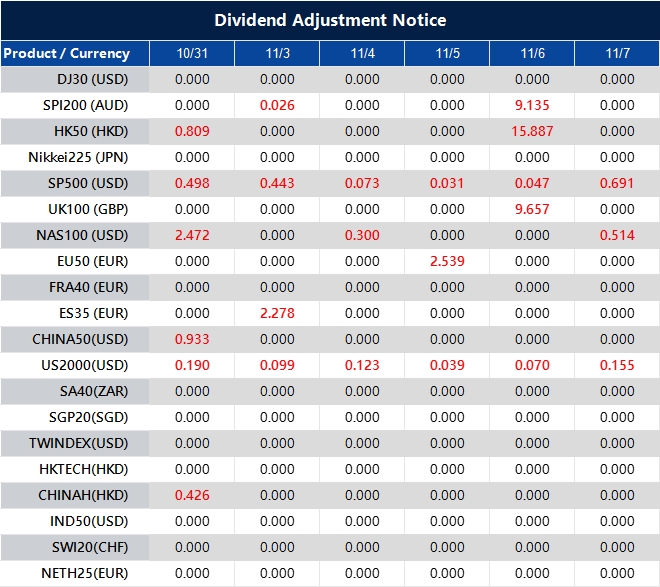
The above data is for reference only, please refer to the MT4/MT5 software for specific data.
If you’d like more information, please don’t hesitate to contact [email protected].
EUR/JPY remains stable above 178.00, with dip-buyers active around 177.85 during Asian trading
The EUR/JPY is stable above 178.00, close to its record high from Thursday. Current prices are around 178.15, showing slight stability and expectations for strong monthly gains.
The Japanese Yen got a temporary lift from stronger consumer inflation data in Tokyo. However, this boost faded quickly because of uncertainty regarding the timing of the next Bank of Japan (BoJ) rate hike and new Prime Minister Sanae Takaichi’s plans for aggressive fiscal spending. This limits how much the Yen can rise.
European Central Bank Policy
The European Central Bank (ECB) has kept interest rates steady at 2% for the third meeting in a row. The ECB believes the Eurozone economy is strong and inflation is close to the 2% goal, which supports the upward trend of EUR/JPY. The ECB oversees monetary policy in the Eurozone, striving for price stability with inflation around 2%. It uses tools like Quantitative Easing (QE) and Quantitative Tightening (QT) to affect the Euro, where QE generally weakens it and QT strengthens it. Since the EUR/JPY is near its all-time high of 178.00, it seems poised to rise further. There’s a clear difference in policies: the ECB is keeping its rate at 2%, while the BoJ is hesitant about tightening. This gap should continue to benefit the Euro against the Yen in the upcoming weeks.Japan’s Economic Challenges
Japan’s new Prime Minister and her fiscal plans create uncertainty that weighs on the Yen. Recent data reinforces this sentiment. Japan’s national CPI for October was stubborn at 2.8%, but Q3 GDP growth was only 0.1%. This leaves the BoJ with little room to raise rates aggressively. Such economic weakness suggests the BoJ will be cautious, making significant Yen strength unlikely. Conversely, the Eurozone economy shows stability, which supports the Euro. The latest Eurozone HICP inflation reading is at 2.1%, comfortably near the ECB’s target. The composite PMI stands at 50.8, indicating slight economic growth. This stable backdrop provides a solid foundation for the Euro, especially compared to a weak Yen. For derivative traders, this scenario makes buying call options on EUR/JPY an appealing strategy to capture potential gains while managing risk. The ongoing trend indicates that any pullbacks should be seen as buying opportunities. Selling out-of-the-money put options might also be a good idea to collect premium, banking on limited downside. Looking back, this situation resembles the long period of Yen weakness from 2022 to 2024 when interest rate differences pushed the currency to multi-decade lows. Traders should stay alert for any unexpected hawkish comments from the BoJ or verbal interventions from the Ministry of Finance. While currently unlikely, these events could pose risks to long EUR/JPY positions. Create your live VT Markets account and start trading now.WTI oil price stays around $60.00 for the second session due to oversupply concerns
West Texas Intermediate (WTI) Oil is currently stable at around $60.00 per barrel, with worries about oversupply ahead of the upcoming OPEC+ meeting. Reports indicate that eight OPEC+ members plan to boost production by 137,000 barrels per day in December.
In August, Saudi Arabia’s crude exports reached a six-month high at 6.41 million barrels per day, and further increases are anticipated. The Energy Information Administration noted that U.S. oil production hit a record 13.6 million barrels per day last week, adding to the oversupply concerns.
Impact Of Sanctions On Russian Oil
This situation undermines recent U.S. sanctions on Russian oil producers, as countries like India are starting to increase their purchases. The Indian Oil Corporation has secured five cargoes of Russian oil for December from non-sanctioned sources. U.S. President Donald Trump announced that China committed to importing U.S. energy, including oil and gas from Alaska, but analysts are skeptical about its potential impact on demand. Factors affecting WTI Oil prices include global demand, political instability, and decisions made by OPEC. OPEC, which consists of major oil-producing countries, significantly influences oil prices by setting production quotas. The value of the U.S. Dollar also affects oil prices since transactions are conducted in USD. Currently, West Texas Intermediate crude oil remains around $60, reflecting a market characterized by oversupply. Key contributors to this trend include OPEC+ plans to increase production, high Saudi exports, and record U.S. output. This excess supply is preventing significant price increases for the time being. The recent Energy Information Administration report shows U.S. production at a strong 13.5 million barrels per day. Additionally, there was an unexpected inventory build of 2.1 million barrels, contrary to predictions for a slight decrease. This indicates that supply is exceeding demand, reinforcing negative market sentiment. Looking ahead to the upcoming OPEC+ meeting in late November, the plans for a production increase of 137,000 barrels per day in December are already being reflected in prices. This strategy to gain market share indicates the group’s focus on volume over maintaining higher prices. Therefore, any price increases in the weeks to come might present selling opportunities.Implications For Traders
On the demand side, recent manufacturing PMI data from China and the Eurozone fell slightly short of expectations, suggesting a potential slowdown in global economic activity. This weak demand outlook does little to support oil prices amid rising supply. The anticipated U.S.-China energy deal remains doubtful and is not likely to significantly boost demand soon. U.S. sanctions on Russian producers are having a limited effect on global supply. The steady flow of Russian oil to major importers like India, through non-sanctioned channels, means that these barrels are still entering the market. This ongoing supply effectively neutralizes a possible positive influence on crude prices. For derivative traders, this environment may favor strategies that profit from stable or declining prices. Selling call spreads above previous highs, such as the $65 level, could be a strategy to take advantage of strong resistance from the oversupply. We believe that volatility may remain low, making options-selling strategies more appealing than outright bets on price recovery. This situation resembles the market environment of late 2023 when concerns about a global slowdown coincided with strong non-OPEC production growth, keeping prices in check. Unlike the supply-shock volatility seen in 2022, the current dynamic is characterized by abundant supply. Traders should be careful about expecting a lasting price rally until there is a significant change in OPEC+ policies or a notable rise in global demand indicators. Create your live VT Markets account and start trading now.XAG/USD stays steady near $49.00 despite lower expectations for Fed rate cuts
Silver prices are holding steady at around $49.00. Traders are lowering their expectations for a Federal Reserve rate cut this year. According to the CME FedWatch tool, the chance of a December rate cut has dropped from 91.1% to 72.8%. Fed Chair Jerome Powell has remarked that a December cut isn’t guaranteed, which impacts non-yielding assets like silver.
Improving US-China trade relations have decreased demand for silver as a safe-haven asset. President Donald Trump announced that China would export rare earths to the US without restrictions, cooperate on fentanyl issues, and increase agricultural trade. These developments lessen silver’s appeal as a safe investment.
Technical Analysis Of Silver
Silver is trading near $49.00 but is having trouble staying above the 20-day Exponential Moving Average of $48.55. The 14-day Relative Strength Index is below 60.00, indicating that bullish momentum is slowing down. Support is strong at the September 23 high of $44.47, while resistance stands at the all-time high of $54.50. Silver is traditionally valued for its role as a store of value, a way to diversify investment portfolios, and as a hedge against inflation. Factors driving silver prices include geopolitical tensions, interest rates, the strength of the US Dollar, investment demand, and industrial usage, especially in electronics and solar energy. Silver usually follows gold prices, and the Gold/Silver ratio helps show their relative value. The market is pulling back its expectations for a Federal Reserve rate cut in December, with chances dropping from over 90% to around 72% in just a week. This change follows Chairman Powell’s cautious remarks. Upcoming speeches from Fed officials will be important for market direction. A more hawkish stance could pressure non-yielding assets like silver.Market Strategies For Rising Volatility
With this uncertainty, implied volatility in silver options is likely to increase as the Fed speeches approach. Traders might consider strategies like long straddles or strangles to take advantage of potential price swings in either direction, without betting on a specific outcome. This method allows them to capitalize on price movements, which seem more predictable than the direction itself. From a technical perspective, silver’s price struggles to stay above the 20-day moving average, which could signal that recent bullish momentum is fading. The RSI dropping below 60 reflects this loss, suggesting a possible period of consolidation or pullback. Caution is advised for aggressive new long positions until there’s a clear upward break. It’s worth remembering that silver traded near these levels back in 2011 and experienced a sharp correction afterward. With prices close to $49.00, we’re near the historical peak of about $54.50, a level that serves as major psychological resistance. Taking some profits on existing long positions might be a wise risk management strategy. On the positive side, the long-term demand for silver in industrial uses remains strong. The solar and electric vehicle sectors are expanding in 2025, with global solar installations expected to reach record highs this year. This ongoing demand creates a solid base for silver prices, suggesting that any major dip could be seen as a buying opportunity. Additionally, it’s important to consider the gold/silver ratio, which is currently around 50. This is below the historical average of the last 20 years, indicating that silver may be overvalued compared to gold. This could lead some traders to shift from silver to gold, seeing more potential for gold. For those holding long positions, buying put options can be an effective way to protect against a downturn without selling the asset. This defines your risk if Fed officials adopt a more hawkish stance in the coming weeks, allowing you to participate in further price increases while also having a safety net for potential losses. Create your live VT Markets account and start trading now.Prasanna Gai from the RBNZ stated in Melbourne that US tariffs have a negative effect on New Zealand’s demand.
A member of the Reserve Bank of New Zealand, Prasanna Gai, said that US tariffs are causing a drop in demand for New Zealand. This situation makes it harder for growth, which is already limited.
As a result, the New Zealand Dollar fell. The NZD/USD pair decreased by 0.19%, hitting 0.5730. Compared to other major currencies, the New Zealand Dollar was weakest against the Japanese Yen, dropping 0.33%.
Currency Fluctuations
A data table showed how the New Zealand Dollar changed against major currencies today. Overall, it experienced mixed declines, falling against the USD, EUR, GBP, JPY, CAD, and AUD. Dhwani Mehta, from FXStreet in Mumbai, has over ten years of experience in analyzing global financial markets. The information in this article is for informational purposes only and is not a recommendation to buy or sell assets. The data and opinions from FXStreet do not represent the official views of the site or its advertisers. Legal notices remind readers to do thorough research before making any investment decisions. The Reserve Bank of New Zealand’s comments about US tariffs suggest a dim outlook for New Zealand’s economy. These tariffs target demand directly, complicating an already weak growth forecast. This reinforces a bearish view on the New Zealand Dollar for traders. Trade with the US is important, amounting to over NZ$20 billion in annual two-way trade as of early 2025. Recent data from Stats NZ shows that export volumes to the US fell by 4% in the third quarter of 2025, highlighting the real impact of these challenges. This trend may worsen as the tariffs affect the economy more deeply.Economic Challenges
The RBNZ is in a tricky spot, similar to the slowdown seen in late 2023. Inflation remains high at 4.5% year-over-year, far above the central bank’s target. Meanwhile, the Official Cash Rate is already restrictive at 5.50%. This stagflation makes it hard for the RBNZ to lower rates to boost growth, leaving the NZD vulnerable. Given this context, we can expect the NZD/USD pair to weaken further, currently hovering around 0.5730. There is an increase in net short positions on the Kiwi dollar, with recent CFTC data showing speculative shorts at their highest level in over a year. This suggests that the market is already preparing for a continued decline. Traders dealing in derivatives should consider strategies to profit from this expected downturn and rising uncertainty. Buying put options on the NZD/USD offers a clear bet with limited risk. Alternatively, implementing bearish put spreads could be a cost-effective way to prepare for a gradual decline toward the 0.5600 mark in the coming weeks. It’s also noteworthy that the NZD is particularly weak against the Japanese Yen, as highlighted by the currency heatmap. In times of global economic uncertainty, the JPY tends to attract safe-haven investment. Therefore, a short NZD/JPY position may present a more profitable trading opportunity than merely shorting the NZD against the US Dollar. Create your live VT Markets account and start trading now.Notification of Trading Adjustment – Oct 31 ,2025
Dear Client,
The trading hours of some MT4/MT5 products will change due to the upcoming Daylight-Saving Time change in US.
Please refer to the table below outlining the affected instruments:
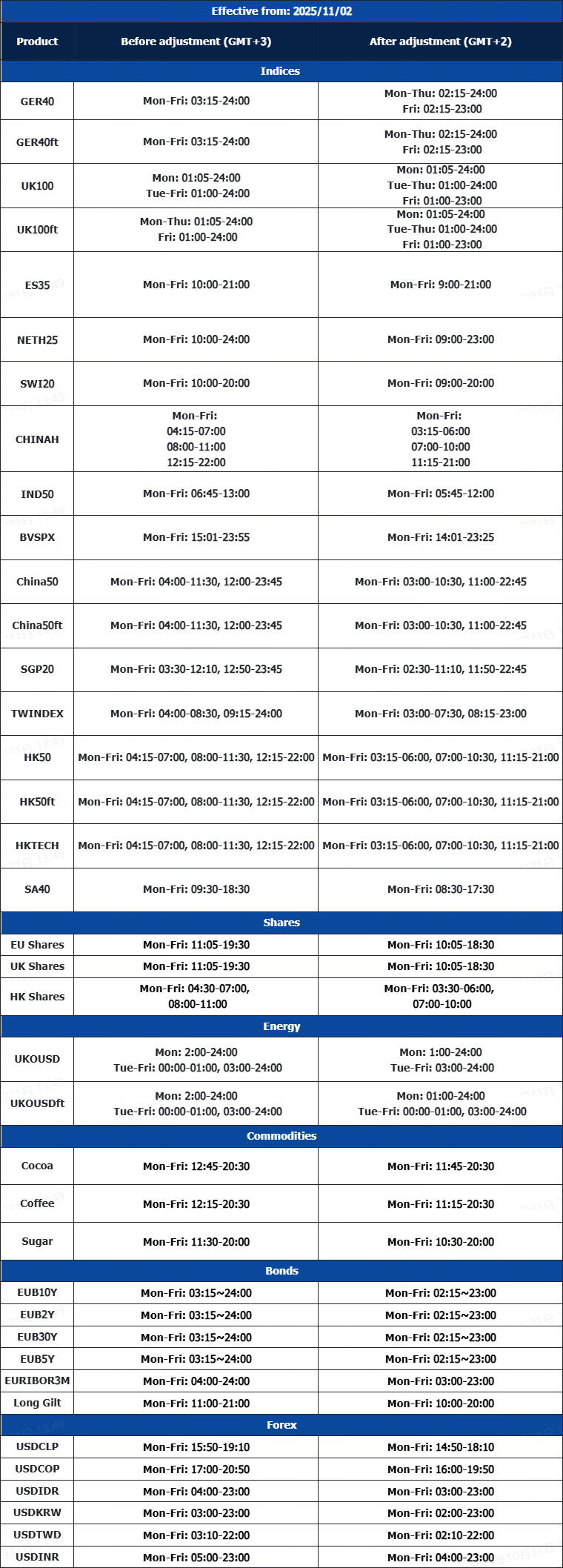
The above information is provided for reference only; please refer to the MT4/MT5 software for specific data.
If you’d like more information, please don’t hesitate to contact [email protected]







