



ANZ business confidence in New Zealand rises from 49.6 to 58.1
In October, New Zealand’s ANZ Business Confidence index increased from 49.6 to 58.1. This shows a positive trend in the business environment.
The Bank of Japan has decided to keep its interest rate at 0.5%. This decision meets market expectations and indicates stability in their approach. After the announcement, the Japanese Yen weakened slightly, and attention now turns to the upcoming press conference.
AI has become essential to the market, with Nvidia as its foundation.
Nvidia’s Role in AI and Technology
Nvidia has hit a remarkable milestone with a market valuation of $5 trillion, making it the first company to reach this level. The company’s stock has skyrocketed twelvefold since the launch of ChatGPT, significantly influencing the equity market.
Nvidia’s market capitalization now exceeds that of entire sectors in the S&P 500. It is larger than major companies like AMD, ASML, Broadcom, Intel, Micron, Qualcomm, and TSMC combined.
Jensen Huang, Nvidia’s CEO, has gained recognition for his impact on AI. He announced a $500 billion order for AI chips and plans for new supercomputers in the U.S. Nvidia’s Blackwell chips are even part of important diplomatic talks.
Nvidia is valued at thirty-three times its expected earnings, shifting Wall Street’s skepticism into optimism. This valuation is now considered reasonable, even “cheap.” The company has also committed $100 billion to help OpenAI with its data centers and is establishing partnerships across several industries.
Even with its success, there are concerns about overcapacity and comparisons to the dot-com bubble. However, Nvidia’s remarkable growth highlights a shift from traditional metrics to a narrative-driven market era, with AI at the forefront.
Market Trends and Trading Strategies
Given Nvidia’s influence, we need to adjust our trading strategies accordingly. The stock is not just a part of the Nasdaq; it is a main driver of market sentiment. Simple long calls have been successful for months, fueled by strong belief in the company’s rise to $5 trillion.
Call options are currently outpacing put options by nearly 10-to-1, a trend not seen since the peak of the meme stock hype in 2021. With implied volatility around 65%, options are costly, reflecting market expectations for significant price movements. This sentiment was heightened when Goldman Sachs raised its price target last week, suggesting Nvidia could reach a $6 trillion valuation by mid-2026.
However, this rapid growth makes hedging essential. Buying puts is an expensive form of insurance with high volatility, as their value drops quickly if the upward trend continues. Thus, we are considering bearish put spreads to limit our risk and lower the cost of protecting portfolios against sudden downturns.
We recall how Cisco was crucial to the internet in 2000, just before its valuation plummeted despite a strong business. The situation today feels similar, prompting us to bet not only on the direction of the stock but also on the size of its potential swings. The current market structure suggests that any loss of momentum could be just as sharp as the current rally.
Key events, such as comments from Jensen Huang or the upcoming Trump-Xi discussions, could trigger significant market shifts. We might use straddles or strangles approaching these events to capitalize on big moves in either direction. This strategy allows us to profit from volatility itself, rather than just the result.
The self-reinforcing nature of AI trading Nvidia stock means we must be ready for rapid momentum changes. This algorithm-driven feedback can lead to substantial gains but also makes the market vulnerable to sudden crashes if the narrative shifts. We need to keep an eye on order flows for signs of algorithmic sell-offs, as these will signal any potential changes.
Create your live VT Markets account and start trading now.
Foreign investment in Japanese stocks increased significantly from ¥752.6 billion to ¥1,344.2 billion.
Foreign investment in Japanese stocks rose from ¥752.6 billion to ¥1,344.2 billion as of October 24. This increase shows that more people are interested in Japan’s financial markets.
During the month, more capital flowed into Japan, which caught the attention of global investors. The big jump in investments indicates that Japan’s stocks are currently appealing.
Economic Activity Trends
These numbers point to a time of increased economic activity. This trend may affect both local and international markets in the coming months. We see a strong bullish signal with foreign investments in Japanese stocks nearly doubling to ¥1,344.2 billion in the report for the week of October 24. This large inflow of cash suggests that international investors find value and growth potential in the Japanese market. Such a sharp rise often signals positive price movement in the upcoming weeks. The influx of foreign money coincides with the Nikkei 225 breaking through the 42,000 resistance level, a level it has maintained for several days. The yen’s weakness, currently around 165 to the U.S. dollar, makes Japanese stocks cheaper for foreign buyers. This currency benefit gives the market strong support that we expect to last.Investment Strategies
In this scenario, traders might want to buy call options on the Nikkei 225 index or related ETFs with expirations in December 2025 and January 2026. The strong inflow provides a solid base for a continued rise, and call options can help maximize profits. We should target strike prices just above the current market price to enhance potential gains. Another option is to sell out-of-the-money put spreads on major Japanese exporters that benefit most from the weak yen. Companies in the automotive and electronics sectors have reported solid earnings, and recent data shows Japan’s exports rose 5.4% year-over-year in September. This strategy allows us to earn premium while managing our risk, as a significant downturn seems unlikely in the near future. In the past, we saw a similar wave of foreign investment in 2013, which started a multi-year bull market driven by supportive central bank policies. That time also saw the yen weaken greatly, creating a profitable landscape for equity investors. Current data suggests we might be at the beginning of a similar cycle. Create your live VT Markets account and start trading now.The Greenback’s strength from a Fed rate cut pushes GBP/USD deeper into bearish territory
**The Impact of the Fed’s Interest Rate Cut**
During U.S. trading, GBP/USD dropped below the 200-day Exponential Moving Average (EMA), signaling a bearish trend. The decline of the Pound has been worsened by a market shift towards safer assets like the Dollar, driven by risk aversion.
Federal Reserve Chair Jerome Powell’s cautious remarks suggest a “wait-and-see” approach, creating uncertainty around future rate cuts. With limited economic data and a cautious market mood, the outlook for the Pound remains bleak. In summary, the fall of GBP/USD highlights how U.S. monetary decisions and political factors affect currency values, as the Dollar strengthens amid reduced expectations for aggressive Fed actions.
Following the Federal Reserve’s latest move on October 29, 2025, it’s clear that a stronger Dollar is likely in the near future. The drop below the 200-day EMA in GBP/USD is a crucial technical signal confirming the bearish trend. Therefore, we should prepare for further weakness in the Pound against the Dollar over the coming weeks.
For those trading derivatives, buying GBP/USD put options with December or January 2026 expiries seems to be a smart strategy. This approach allows us to take advantage of potential declines while clearly defining our maximum risk to the premium paid. The market’s adjustments regarding future Fed rate cuts serve as the key driver for this trade.
**UK Domestic Data and Strategy**
This negative outlook for the Pound is supported by recent domestic data from the UK. The latest release from the Office for National Statistics revealed a sluggish GDP growth rate of just 0.1% for the third quarter, while core inflation has decreased to 2.4%. These figures give the Bank of England little reason to adopt a more aggressive stance, leaving the Pound fundamentally unsupported.
On the other hand, the Fed’s cautious approach is understandable given the resilience of the U.S. labor market. The recent Non-Farm Payrolls report, released in early October 2025, showed a healthy addition of 215,000 jobs, keeping the unemployment rate at a low 3.8%. This economic strength justifies the Fed’s hesitation to commit to further rate cuts, bolstering the Dollar’s value.
We’ve seen a similar pattern in the past, such as during the Fed’s policy shift in 2019 when an initial “hawkish cut” also led to a period of Dollar strength. In that case, markets quickly corrected their expectations for a deep easing cycle, resulting in a stronger Dollar against its peers. The current situation appears strikingly similar, suggesting that the Dollar rally may have more room to grow.
The ongoing U.S. government shutdown adds uncertainty, which could keep implied volatility high. While this increases the cost of buying options, it also creates potential for significant profits if the market moves as anticipated. Traders might also explore bear put spreads to reduce entry costs for a bearish position while targeting a specific downward range for GBP/USD.
Create your live VT Markets account and start trading now.
The Australian dollar declined as the Federal Reserve suggested that December rate cuts remain uncertain at 0.6569.
The Australian Dollar fell after the US Federal Reserve decided to cut interest rates by 25 basis points. Fed Chair Jerome Powell’s comments lowered hopes for a rate cut in December, leading to the AUD/USD trading at 0.6569, a drop of 0.25%.
In a press conference, Powell highlighted differing opinions within the Federal Open Market Committee (FOMC) about future interest rates. He indicated that the current rate may be close to neutral, consistent with the September Economic Projections.
Federal Reserve Decision
Most Fed officials agreed on the rate cut to 3.75%-4%, but two members disagreed. One wanted a larger cut, while the other preferred to keep rates unchanged. The Federal Reserve reported that economic activity is growing moderately. Unemployment remains low, even though job gains are slowing. Inflation is still somewhat high. They also announced they would stop reducing their securities holdings by December 1, as part of their policy adjustments. Australian inflation reports had initially boosted the AUD/USD, raising hopes that the Reserve Bank of Australia might hold rates steady. Still, the Fed’s firm stance limited the Australian Dollar’s rise. The Australian Dollar showed mixed performance against major currencies, performing particularly well against the British Pound. The heat map shows the percentage changes in these currencies for a clear comparison.Currency Fluctuations
A familiar trend is emerging as the US Federal Reserve takes a cautious stance for the coming months. Previous experiences of “hawkish cuts” remind us that the Fed’s guidance often has a greater impact than the rate cut itself. This situation is creating a noticeable policy gap between a strong Fed and a Reserve Bank of Australia that may need to ease. Recent US inflation data from September 2025 revealed core CPI remains stubborn at 3.5%, while jobs data added 190,000 non-farm payrolls. These stats give the Fed little reason to consider easing, thus strengthening the dollar. The market reflects this change, as the CME FedWatch Tool shows traders have cut the chance of a December 2025 rate cut to just 20%. Conversely, Australia’s latest quarterly inflation report for Q3 2025 showed a cooler-than-expected rate of 3.2%. This increases expectations that the RBA may contemplate rate cuts in early 2026. This growing gap continues to put downward pressure on the AUD/USD, which is now struggling to stay above the 0.6500 mark. For derivative traders, this situation suggests that buying put options on the AUD/USD could be a smart way to prepare for potential further weakness. Implied volatility for AUD/USD options has risen to a three-month high of 11.2%, signaling that the market anticipates bigger price changes ahead. A bear put spread may be useful to lower entry costs while still benefiting from a downward trend. This is not just about the Australian Dollar; it’s also about the strength of the US Dollar. We saw a similar situation in 2024, when a strong dollar pressured most major currencies for a long time. Therefore, traders might also explore strategies that profit from a stronger dollar against other currencies, such as selling call options on pairs like the EUR/USD. Create your live VT Markets account and start trading now.EUR/USD pair drops 0.43% after Powell’s comments on December rate cuts.
The EUR/USD dropped more than 0.40% after Federal Reserve Chair Jerome Powell indicated that a rate cut in December is unlikely. Market expectations for a December cut fell from 85% to 62%, according to LSEG data.
US Dollar Influence
Powell noted divisions within the Federal Open Market Committee and mentioned that the policy rate may be close to neutral. Following his comments, the EUR/USD fell to 1.1577, a five-day low, before slightly rising above 1.1500. The US Dollar Index rose by 0.63% to 99.28, impacting the EUR/USD exchange rate. The focus is now on the European Central Bank’s upcoming monetary policy decision, with expectations that rates will remain steady. The Federal Reserve cut rates by 25 basis points to 3.75%-4%, though not everyone agreed with the decision. Traders are also monitoring developments in the US-China trade talks. Eurozone inflation, guided by the Harmonized Index of Consumer Prices, plays a key role in shaping the ECB’s interest rate decisions. The Euro is the second most traded currency worldwide, with economic data from the Eurozone affecting its value against the US Dollar. As of October 30, 2025, the market feels reminiscent of previous situations where the Federal Reserve made a so-called “hawkish cut,” resulting in strength for the dollar. With the latest US CPI data for September 2025 at 2.8%, the market is once again speculating whether the Fed will signal a pause or a move to easier policies at the December meeting.Market Strategy and Volatility
A key takeaway from earlier periods is that the Fed’s commentary can carry more weight than its actions. In the past, a 25-basis-point cut was overshadowed by hawkish guidance, causing the EUR/USD to decline. Today, with the European Central Bank indicating it will keep rates steady despite Eurozone inflation at 3.1%, any sign of caution from the Fed could lead to a significant policy divergence and boost the dollar. For EUR/USD traders, positioning for dollar strength might be wise in the upcoming weeks. If the pair breaks below its recent support at 1.0800, it could quickly drop to August lows near 1.0650. Traders might consider buying put options on the EUR/USD to benefit from a potential decline while limiting risk. The uncertainty surrounding the Fed’s stance suggests increased volatility. In 2023, the bond market’s MOVE index surged due to policy uncertainty, and a similar situation may be developing. This makes strategies like buying option straddles on EUR/USD before the December FOMC meeting appealing, as they gain from significant price movements in either direction. Currently, derivatives markets, according to the CME FedWatch Tool, indicate about a 65% chance of a 25-basis-point cut in December, down from 80% a few weeks ago. This shift signals growing nervousness, similar to when expectations dropped from 85% to 62% right after the Fed’s announcement. Traders can use Fed Funds futures to wager directly on this outcome, suggesting the market might still be overly optimistic about a cut. Create your live VT Markets account and start trading now.Dollar Holds Firm As Powell Cools Rate-Cut Optimism
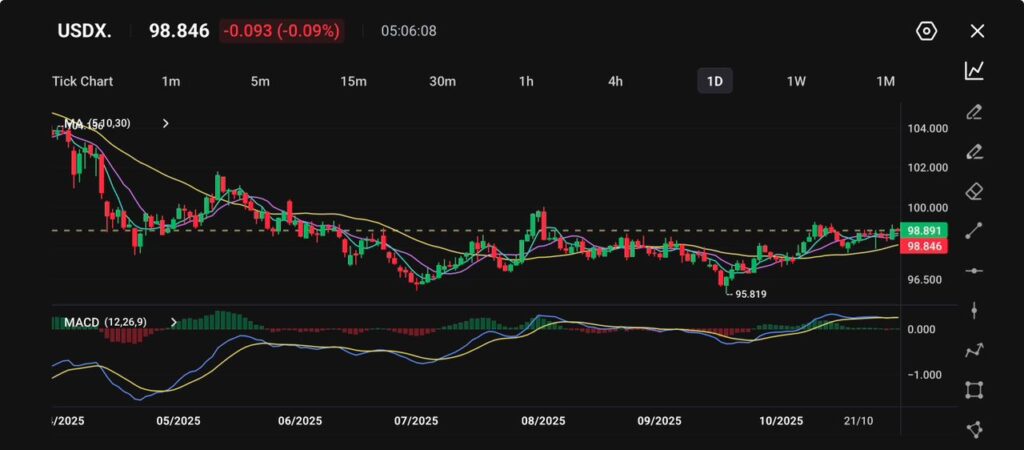
The US dollar index held steady on Thursday, trading just below the 99 mark, after the Federal Reserve’s quarter-point rate cut and Chair Jerome Powell’s cautious tone prompted markets to reassess the outlook for monetary policy.
Fed Outlook And Market Reaction
As widely expected, the Fed lowered its benchmark interest rate by 25 basis points, bringing the target range to 3.75%–4.00%, and announced plans to end its balance sheet runoff on 1 December.
However, Powell’s comments following the decision struck a more hawkish note than markets had anticipated. He emphasised the divergence of opinions among policymakers and cautioned that another rate cut later this year was far from guaranteed.
This shift in tone lifted the greenback late on Wednesday, as traders scaled back expectations for further easing. Money markets now price in less than a 70% chance of another reduction before December, signalling renewed confidence in the Fed’s cautious approach.
Trade And Global Focus
With the Fed event now behind them, traders turned their attention to the Trump–Xi meeting in South Korea, where the two leaders were expected to finalise a limited trade truce following months of tariffs and diplomatic strain.
Markets are watching closely for any mention of technology export restrictions or China’s rare earth export policies, which could have broader implications for global supply chains and commodity markets.
Technical Analysis
The US Dollar Index (USDX) slipped 0.09% to 98.85, pausing after a modest rebound earlier in the month.
The greenback remains confined to a tight trading band between 98.50 and 99.00, reflecting investor caution ahead of key US economic releases and additional commentary from Federal Reserve officials.
From a technical perspective, the dollar remains in a sideways consolidation pattern after rebounding from its October low of 95.82. The 5-, 10-, and 30-day moving averages are converging just below the 99.00 level, suggesting indecision and a lack of clear directional momentum.
A decisive breakout above 99.00 could open the way toward 100.00, while failure to hold above 98.50 may see the index retest support near 97.80.
The MACD indicator shows neutral momentum, with both the MACD and signal lines flattening around the zero axis. The histogram’s muted profile confirms that neither bulls nor bears currently hold dominance.
Fundamentally, traders remain hesitant to take large positions before upcoming US employment and inflation data, which could reshape rate-cut expectations for early 2026. Softer figures could pressure the dollar as markets price in earlier easing, while stronger readings may revive bullish momentum.
In summary, the USDX is steady but lacks conviction, consolidating below the psychological 99.00 resistance. A breakout on either side of the current range will likely define the next directional move, with market focus firmly on economic data to provide clarity.
Outlook
The dollar is expected to stay range-bound ahead of Friday’s US jobs report and the outcome of the Trump–Xi summit. While the Fed’s restrained stance continues to lend underlying support to the greenback, any signs of trade progress or softer inflation data could temper the dollar’s upward momentum in the sessions ahead.
Alphabet shares rise over 5% while Microsoft and Meta see declines after earnings reports
Meta Platforms Experiences a Stock Drop
The Federal Reserve cut interest rates by 25 basis points but remains cautious about future cuts in December. Following this announcement, yields on US treasuries with terms from 12 months to 10 years rose by over 2%. The Dow Jones and S&P 500 both fell, while the NASDAQ Composite increased by 0.55%.
The Federal Reserve’s message has created uncertainty, making a December rate cut less likely. With bond yields increasing and the VIX volatility index jumping over 15% to close at 22.5 yesterday, we can expect volatile markets in the coming weeks. This is a good time for strategies that can profit from either specific directional bets or heightened volatility.
Alphabet’s strong performance, especially its 34% growth in cloud revenue, sets it apart from competitors. Reports from Q3 2025 indicate that Google Cloud’s market share has risen to 12%, showing it is effectively gaining ground. This provides an opportunity to take bullish positions, such as buying November call options or selling put credit spreads to benefit from its upward momentum.
Strategies for Microsoft and Meta
On the other hand, the negative reactions to Microsoft and Meta present different opportunities, despite both companies’ strong revenue figures. Meta’s 7% drop likely increased option premiums, making a neutral strategy like an iron condor appealing. This approach allows us to collect premium while predicting the stock will trade within a certain range. For Microsoft, its disappointing cloud growth could make a bearish put spread effective if the stock continues to struggle.
The Fed’s cautious stance poses a challenge for the broader S&P 500. We expect the market to be very sensitive to the upcoming Personal Consumption Expenditures (PCE) inflation report for September, which the Fed closely monitors. Until that data is out, buying protective puts on an index ETF like SPY for late November could be a wise hedge against a market downturn.
The noticeable differences in performance among the “Magnificent 7” create an ideal setup for a pairs trade. We can focus on Alphabet’s strength by going long on GOOGL calls while shorting a weaker name like META with puts. We’ve seen similar patterns before, such as in late 2018, when uncertainty from the Fed led to a market downturn where individual stock fundamentals mattered most.
Create your live VT Markets account and start trading now.
Market observers anticipate stability from the BoJ and ECB as the USD recovers amid Federal Reserve speculation.
The US Dollar Index climbed to a two-week high above 99.00, boosted by rising US Treasury yields and comments from Chair Jerome Powell after a recent Federal Reserve rate cut. Fed officials Bowman and Logan are also scheduled to speak soon.
The EUR/USD pair dropped to about 1.1580 as attention shifts to the European Central Bank’s upcoming rate decision and Germany’s key economic data. Key Eurozone statistics, including Q3 GDP, Consumer Confidence, and the Unemployment Rate, are also on the horizon.
British Pound Weakness
The GBP/USD fell to multi-month lows around 1.3140 as the US Dollar strengthened and expectations for a Bank of England rate cut increased. Nationwide Housing Prices data is due on October 31. The USD/JPY rose above 153.00, continuing its upward trend. The Bank of Japan is expected to keep its policy rate unchanged, with Foreign Bond Investment data pending. The AUD/USD dropped below the 0.6600 mark as the US Dollar gained strength. Upcoming data will include Australia’s Export and Import Prices. WTI crude oil bounced back to $61.00 per barrel, influenced by trade news and a significant drop in US crude inventories. Gold fell for the fourth consecutive day due to a stronger US Dollar, while silver climbed above $48.00 per ounce.Impact of Federal Reserve Rate Cut
The recent Federal Reserve rate cut appears to be a “one and done” event for now, which is why the US Dollar is strengthening. The US Dollar Index is now above 99.00, supported by last week’s unexpected 2.5% Q3 GDP growth report, suggesting the economy doesn’t require further cuts immediately. This makes short-term bets on dollar strength appealing over the next few weeks. On the other hand, the European Central Bank is likely to adopt a more cautious stance, creating a clear policy gap with the Fed. Germany’s preliminary Q3 GDP figures show almost no growth at just 0.1%, putting pressure on the ECB to indicate potential easing. Traders might consider buying puts on the EUR/USD, aiming for a drop below the 1.1500 level. The British Pound is also facing challenges, testing lows near 1.3140, as the market anticipates a 60% chance of a Bank of England rate cut by year-end. UK inflation fell to 2.8% in September, faster than expected, giving the BoE room to act. This suggests that any short-term jumps in GBP/USD will likely be seen as selling opportunities. The Bank of Japan’s steady policy supports a strong US Dollar against the Yen, pushing USD/JPY above 153.00. This strategy worked well in 2023 and 2024, where the large interest rate gap was the main factor. As long as the BoJ remains steadfast and US yields stay high, buying dips in this pair is a solid strategy. Crude oil prices are close to $61 a barrel, bolstered by yesterday’s EIA report that showed a larger-than-expected 4.1 million barrel drop in US inventories. However, the strong dollar acts as a headwind for commodity prices, likely limiting any significant upward movement. Caution is advised for those considering large long positions until WTI can break decisively above the $65 resistance level. Gold’s decline is directly linked to rebounding US Treasury yields, with the 10-year note rising above 4.1% after the Fed meeting. This makes the non-yielding metal less appealing to investors looking for returns. Interestingly, silver rising above $48 an ounce indicates that its industrial demand is currently outpacing the trend for precious metals, a divergence worth keeping an eye on. Create your live VT Markets account and start trading now.Dow Jones falls after Powell’s cautious comments on interest rate cuts, despite reaching new highs
On Wednesday, the Dow Jones Industrial Average (DJIA) hit new highs above 48,000 during the day but fell later after Federal Reserve Chair Jerome Powell suggested that the recent interest rate cut might be the last for a while. The Fed cut interest rates by 25 basis points, as market experts expected, and also hinted at plans to reduce its Quantitative Easing balance sheet items.
Powell pointed out the difficulty in predicting economic outcomes due to the ongoing U.S. government shutdown affecting employment and labor data. He noted that inflation might rise due to tariff pressures but did not show significant concern about the job market, mentioning no signs of weakened employment.







