



USD/JPY pair at 152.27 expected to decline due to comments from Japanese officials
The USD/JPY pair is currently trading lower, influenced by comments from Japanese Ministry of Finance officials and US Treasury Secretary about keeping an eye on the yen. The exchange rate recently hit 152.27, suggesting a possible bearish trend.
While no interest rate hikes from the Bank of Japan (BoJ) are anticipated until next March, the environment is ripe for policy adjustments. A weaker USD/CNY has also impacted USD/JPY. At this time, there is no bullish momentum. The support levels are at 151.15, 150.10, and 149.20, with resistance at 153.30.
Bulls drive gold prices above $4,000 despite stronger USD ahead of Fed decision
Gold has crossed the $4,000 threshold, continuing its rise during the European session. Traders are waiting for the results of the FOMC policy meeting. Dovish expectations from the Federal Reserve are encouraging investments in gold.
The US Dollar is gaining strength ahead of the central bank’s meeting, driven by positive trade news between the US and China. This has limited gold’s price increases, even though the market expects a 25 basis point rate cut from the Fed.
Geopolitical Tensions and Gold’s Path
The ongoing government shutdown in the US and tensions with Russia have increased geopolitical risks, which could work in gold’s favor. Analysts are examining these issues to forecast gold’s potential movements, considering various retracement levels and support areas. The US Dollar has been strong against currencies like the British Pound and has shown mixed results against the Japanese Yen and the Euro. This shifting landscape is illustrated in a heat map that tracks percentage changes among different currencies. In summary, the gold market is sensitive to economic indicators and geopolitical risks. Current trends suggest that gold may continue to rise under favorable conditions, though traders remain cautious.Federal Reserve Decision and Market Implications
As the Federal Reserve’s rate decision approaches, many expect a 25-basis-point cut, which is already factored into the market. Recent data shows that the US Core CPI remains at 2.8%, while unemployment has risen to 4.2%. This gives the Fed reason to ease policy, supporting non-yielding gold. This expectation helps keep gold above the critical $4,000 mark. However, the US Dollar Index (DXY) is showing strength, currently around 106.5, which often puts pressure on gold prices. Recall that in September 2022, a DXY rise above 114 caused gold to drop below $1,650, emphasizing the risks if the Fed surprises with a hawkish stance. The tension between a dovish Fed and a strong dollar creates a complicated environment for predicting price movements. Amid this uncertainty, implied volatility in gold options has increased, with the CBOE Gold Volatility Index (GVZ) hitting 19.5 this week. This suggests that traders might look into strategies like long straddles or strangles, which benefit from significant price swings in either direction after the Fed’s announcement. Alternatively, if one suspects the event may not lead to major changes, selling volatility through iron condors could be a good strategy. From a technical perspective, we’re paying close attention to the $4,100 level, where a lot of call options open interest is sitting on the COMEX. If we break decisively above the $4,060 resistance, it could lead to a short squeeze, pushing us toward that next psychological level. Conversely, failing to maintain the $3,900 support could lead to a deeper decline toward the $3,844 support zone, a critical Fibonacci retracement level. Create your live VT Markets account and start trading now.The Bank of Canada is expected to lower rates by 25 basis points today
The Bank of Canada is expected to lower interest rates by 25 basis points today. This matches the market’s expectation, reflected in the CAD Overnight Index Swap (OIS) curve pricing at 21 basis points. The decision comes amid ongoing trade risks, heightened by recent tensions between the US and Canada, which overshadow stronger employment and inflation data from September.
Potential for More Rate Cuts
Given the worsening trade environment, further rate cuts might be needed. Currently, the market anticipates a total easing of 35 basis points by January. However, there could be calls for larger cuts if conditions worsen. Canada’s real policy rate is higher than in previous periods of similarly high unemployment at 7.1%, suggesting that more easing measures should be considered. Despite negative trade news, the Canadian dollar has remained strong because it was already undervalued compared to its short-term fair value. Now, expectations indicate USD/CAD might rise to 1.41 in the short term, although the year-end prediction stays at 1.38 if trends hold. With the Bank of Canada expected to cut rates by 25 basis points today, the market has almost fully anticipated this move. This is noteworthy given that September’s inflation unexpectedly rose to 2.3%, showing the bank’s greater concern about trade issues. The White House’s recent announcement to review tariffs on Canadian lumber and dairy underscores the rising risks. The real opportunity for traders lies in the bank’s forward guidance, likely suggesting more easing will follow. Currently, the market is only factoring in about 15 basis points of cuts over the next six months, which seems too low given the risks. With unemployment at 7.1%, historical data from 2015-2016 suggests that a more aggressive approach to easing may be necessary during times of high trade risk.Opportunities in the Options Market
This situation creates opportunities in the options market, especially buying USD/CAD calls with expirations in January 2026 to prepare for another rate cut. Implied volatility on three-month USD/CAD options has risen to 7.8% from early October lows, indicating that traders are beginning to factor in more uncertainty. A dovish surprise today could further increase volatility, making long-volatility positions appealing. While many traders are already short on the loonie, a decidedly dovish Bank of Canada could push USD/CAD higher towards the 1.41 level. This perspective is backed by the differing policies of central banks, as recent Federal Reserve minutes suggest a steady approach into early 2026. Thus, even with a year-end target of 1.38, the most likely trend in the coming weeks seems to be upward. Create your live VT Markets account and start trading now.Indian Rupee recovers despite stronger US Dollar, USD/INR declines towards 88.30
The Indian Rupee is underperforming against the US Dollar as the Dollar Index rises by 0.25% to about 99.00. The USD/INR pair is around 88.40. Updates on US monetary policy and trade tensions are affecting market sentiment.
Market analysts expect the Federal Reserve to announce a 25-basis-point interest rate cut. This would lower the Federal Funds rate to between 3.75% and 4.00%, which could influence the value of the US Dollar.
Foreign Institutional Investment Trends
Recently, Foreign Institutional Investors (FIIs) invested Rs. 10,339.80 crores in Indian equities, a stark contrast to the Rs. 1,29,870.96 crores that flowed out from July to September. Reduced trade tensions between the US and India, thanks to eased tariffs, have boosted market sentiment. Globally, the focus is shifting to US-China trade discussions, with potential tariff reductions on the horizon. The Indian Rupee has shown mixed results against major currencies, particularly gaining strength against the GBP. The USD/INR is having difficulty surpassing the 20-day EMA, currently at 88.41, while the RSI indicates some buying interest. Key support is at 87.07, and resistance is at 89.12. The Federal Reserve’s actions, such as changes to interest rates, significantly affect the US Dollar. The Fed meets eight times a year to discuss policy, with strategies like Quantitative Easing (QE) and Tightening playing crucial roles. QE tends to weaken the Dollar, while Tightening usually strengthens it.Federal Reserve’s Influence on USD
With the Federal Reserve set to announce its policy soon, the market has already factored in a 25-basis-point rate reduction. Thus, we should pay attention to the guidance for the December meeting. A hint of a pause in rate cuts could lead to a sharp rally in the US Dollar, while a dovish tone suggesting further cuts would put downward pressure on it. If the Fed indicates the need for more cuts due to a weakening labor market and the ongoing government shutdown, we might see USD/INR weaken. This situation could make buying put options or shorting futures a good strategy to target the August support level of 87.07. Conversely, if the Fed surprises with a hawkish stance, the pair might try to break its all-time high of 89.12. The upcoming meeting between Trump and Xi introduces significant uncertainty, making short-term options appealing. Buying a straddle could be a strategy to profit from potential price swings, as the outcome of these trade talks is unpredictable. This approach banks on increased volatility following the high-stakes meeting. In India, sentiment has clearly improved, demonstrated by the substantial FII inflow of over Rs. 10,000 crores. This shift from the heavy selling seen in the third quarter of 2025 shows that foreign investors are regaining confidence. This trend mirrors what occurred in early 2024 when strong capital inflows followed signs of political and economic stability. India’s strong economic fundamentals support a favorable outlook for the Rupee in the medium term. The IMF has recently projected GDP growth above 6.5%, making India one of the fastest-growing major economies. If trade tensions continue to ease, this economic divergence paints a weaker picture for the USD compared to the INR. Technically, the pair is trading in a wide range, presenting opportunities for option sellers. With key support at 87.07 and major resistance at 89.12, sellers can write out-of-the-money puts and calls. Selling puts with a strike below 87.50 or calls above 89.00 may be effective for premium collection. Create your live VT Markets account and start trading now.Traders of the Japanese Yen show indecision ahead of Fed and BoJ announcements as the European session begins
Inflation Expectations and Exchange Rate Volatility
Scott Bessent advises Japan to let the Bank of Japan (BoJ) manage its policies to keep inflation expectations steady and reduce exchange rate fluctuations. Kiuchi wants to examine how currency changes affect the economy and emphasizes the importance of avoiding sudden swings. Takaichi’s supportive approach to spending might delay the BoJ’s move to raise interest rates. Meanwhile, traders think a rate hike could happen in December or early next year, differing from the expected cautious stance of the Federal Reserve. Today, the US central bank is likely to lower borrowing costs by 25 basis points, with another cut possible in December, leading to a short-covering move in the USD/JPY pair. The USD/JPY shows a bearish double-top pattern, suggesting it may lose value. Oscillators indicate support between 151.10 and 151.00. If this support is broken, losses could extend towards 150.00, with minor support around 150.45. If the currency recovers past the recent peak of 152.20, it may run into resistance near 152.90-153.00. Breaking above 153.25-153.30 could bring back the 154.00 level and possibly push it to 154.75-154.80.Federal Reserve and Bank of Japan Updates
The Bank of Japan will announce its interest rate decision after eight important meetings this year. A positive outlook from the BoJ would boost the Yen, while a negative or rate cut would not. The next announcement is set for October 30, 2025. We are entering a crucial 24 hours. The Federal Reserve will make its decision today, October 29, followed by the Bank of Japan’s update tomorrow. The market is anticipating a cautious Fed compared to a possibly aggressive BoJ. This situation creates a significant tension between the two currencies. Traders are understandably wary of making big moves before these important events take place. Create your live VT Markets account and start trading now.Focus on Fed and BoC policy decisions amid current Forex developments
On October 29, the financial markets were stable as attention turned to the policy decisions from the Bank of Canada (BoC) and the Federal Reserve (Fed). The US Dollar steadied, performing best against the British Pound. Many expected the Fed to cut the policy rate by 25 basis points. Anticipation built around comments from Fed Chair Jerome Powell for more insights on the decision.
US President Donald Trump mentioned the possibility of a trade deal with China and a finalized agreement with South Korea. The USD/CAD fell below 1.3950, losing over 0.3%. The BoC was also expected to lower interest rates by 25 basis points to 2.25%. Meanwhile, gold prices recovered after hitting a low due to rising geopolitical tensions between Israel and Hamas.
Monetary Policy and Currency Impacts
The USD/JPY stayed above 152.00, with Japan’s Chief Cabinet Secretary expecting the BoJ to maintain its careful monetary policy. Australia’s Consumer Price Index rose 3.2% in the third quarter, surpassing the expected 3% and boosting AUD/USD to its highest in three weeks. In contrast, EUR/USD dropped below 1.1650, and GBP/USD fell to its lowest since August. The Federal Reserve mainly influences the US Dollar through interest rate changes, holding eight policy meetings each year. Quantitative Easing and Tightening have opposing effects on the value of the US Dollar. The market largely anticipates the Fed’s 25 basis point rate cut, so we are closely monitoring Chairman Powell’s remarks for real trading signals. Any indication of a pause or further cuts could cause significant movements in the US Dollar. This situation is similar to the market turmoil in early 2024 when Fed expectations shifted quickly. This presents an opportunity to use options strategies that can profit from sharp price swings, like a long straddle on currency ETFs. The CBOE Volatility Index (VIX) has been around 17, indicating that the market might be underestimating the chance of a surprise following the meeting. Therefore, purchasing volatility through options could be a smart move in the coming days.Opportunities in the Currency Markets
Australia’s unexpected 3.2% inflation figure makes AUD/USD particularly appealing for bullish strategies. We believe the Reserve Bank of Australia may need to take a more aggressive stance compared to the Fed. Buying AUD/USD call options that expire in the coming weeks could leverage this difference in monetary policy. With the Bank of Canada also expected to cut rates, the movement of USD/CAD will hinge on which central bank seems more committed to easing. Recent data shows Canadian unemployment steady at 5.7%, which may lead the BoC to indicate a “one and done” approach. This could strengthen the Canadian dollar, making put options on USD/CAD an attractive trade. Geopolitical tensions are once again providing support for gold, which is staying near the $4,000 mark. This level is vital, especially if the Fed moves to weaken the dollar. Buying call spreads on gold futures could be a cost-effective way to gain upside exposure if tensions escalate. The British Pound remains the weakest major currency against the dollar, trading at multi-month lows below 1.3250. This downtrend is likely to continue if the Fed does not deliver an overly cautious message. We can consider selling GBP/USD futures or buying put options to take advantage of this bearish trend. Create your live VT Markets account and start trading now.During the European session, WTI oil prices reached $60.21 and Brent increased to $64.01.
West Texas Intermediate (WTI) oil prices increased early Wednesday in Europe, reaching $60.21 per barrel, up from $60.03. Brent crude also rose, moving from $63.85 to $64.01. WTI is a quality oil from the US, known for its low gravity and sulfur content, and it serves as a key benchmark in the oil market.
Factors Influencing WTI Prices
WTI oil prices mainly depend on supply and demand. Global growth impacts how much oil is needed. Factors like wars and sanctions can disrupt supply. OPEC, a group of oil-producing nations, often sways oil prices through its production choices. Additionally, since oil is usually traded in US Dollars, the value of the dollar affects WTI prices. Reports from the American Petroleum Institute (API) and the Energy Information Agency (EIA) also influence WTI prices. Weekly inventory data show changes in supply and demand. For example, a drop in inventories indicates higher demand and can lead to price increases. OPEC’s production quotas, set twice a year, can either tighten or loosen supply, affecting WTI prices. OPEC+ includes extra countries like Russia, which further impacts the market. With WTI crude oil now above $60 per barrel, we’re observing some short-term positive momentum. This follows last week’s EIA report, which revealed a surprising decrease in U.S. crude inventories by 3.2 million barrels, indicating higher-than-expected demand. We need to closely monitor this week’s inventory data to see if the trend continues. However, the overall demand outlook raises concerns about any sustained price increases. Recent global growth forecasts for 2026 have seen slight downgrades due to ongoing inflation and slower industrial activity in Europe and China. This economic uncertainty could limit major price hikes above the $65-$70 range for now.OPEC+ Strategies and Market Dynamics
On the supply side, OPEC+ is maintaining strong market discipline. Saudi Arabia and Russia have extended their voluntary production cuts through the end of this year and plan to keep this tight supply strategy in place into the first quarter of 2026. This commitment is a key reason prices haven’t fallen further despite a weakening economic outlook. Given these mixed signals, the market is likely to stay within a certain range. Reflecting on the extreme price changes of 2022-2023, where prices surged above $100 and then dropped, the current situation seems more stable. In the upcoming weeks, this suggests selling call options near range highs around $65 while considering buying puts if demand worries start to push prices below critical support levels. Create your live VT Markets account and start trading now.Japan’s Consumer Confidence Index reaches 35.8, surpassing expectations of 35.6
Japan’s consumer confidence index hit 35.8 in October, just above the expected 35.6. This indicates a slight optimism among Japanese consumers regarding the economy.
In the foreign exchange markets, the Pound Sterling has fallen against the US Dollar, dipping below the 200-day EMA. On the other hand, the Australian Dollar (AUD) shows signs of a possible upward trend. The US Dollar (USD) has some upward risks, but not as much volatility as seen in September.
Gold And Commodities Outlook
In commodities, gold has climbed to $4,000 after bouncing back from a three-week low. This rise is driven by expectations that the US Federal Reserve might lower borrowing costs soon. Western Union has teamed up with Solana to introduce USDPT, responding to the growing demand for ETFs and network throughput. Solana’s status is rising, and a recent ETF saw $56 million in trades on its first day. Financial markets are now paying close attention to the Federal Reserve’s liquidity measures. Changes in repo lines and bill issuance are becoming more significant than rate decisions, according to market trends. Today, all eyes are on the Federal Reserve’s interest rate announcement. Many expect a rate cut, and we are preparing for this, along with a possible cut in December. This shift toward a more cautious monetary policy is the main focus for the coming weeks.US Dollar And Inflation Reports
The US Dollar has strengthened a bit ahead of the announcement, but this seems to be a short-term adjustment rather than a trend change. The recent September 2025 CPI report shows inflation cooling down to 2.8%, reinforcing the case for lower rates and suggesting a weaker dollar ahead. This contrasts with the high inflation rates of 2023 and 2024 that drove the Fed’s aggressive rate hikes. This situation supports a bearish outlook for the USD/JPY pair. The slightly better-than-expected Japanese consumer confidence, which stands at 35.8, provides some support for the yen. With the dollar expected to weaken due to the Fed’s actions, we believe the pair will continue its gradual decline from the highs of 2024. For derivatives traders, this might be a good time to look into options that benefit from a falling USD/JPY. Buying Japanese Yen calls or US Dollar puts could be a smart strategy to take advantage of the anticipated policy divergence. Expect elevated volatility around the Fed’s announcement, so it’s important to manage trades accordingly. This sentiment is also seen in the gold market, which has just crossed the $4,000 mark. The expectation of lower borrowing costs in the US is pushing investors towards non-yielding assets like gold. This upward momentum could continue, making gold futures call options an appealing option if the Fed confirms its dovish stance. As we transition away from policy shocks, we are entering a period of stable liquidity management. The market is concentrating on the Fed’s technical operations rather than just the overall rate. This suggests a controlled easing cycle that could support a more stable, though potentially less volatile, trend. Create your live VT Markets account and start trading now.Trump opposes Federal Reserve interest rate hikes during South Korea visit
During his visit to South Korea, US President Donald Trump said he will not let the Federal Reserve raise interest rates. He announced over $18 trillion in new investments, expecting this to reach around $21 or $22 trillion by the end of his second term.
He also predicts a 4% GDP growth in the next quarter, highlighting the revival of US factories. Semiconductor manufacturing is coming back, and there’s a plan to boost the shipbuilding industry. Trump emphasized that economic security is crucial for national security, with trade policies driving new investments. A trade deal with South Korea is expected, and talks with Chinese President Xi are on the horizon.
The Role of the Federal Reserve
The Federal Reserve (Fed) oversees US monetary policy to keep prices stable and ensure employment. It adjusts interest rates to affect the value of the US dollar. The Fed holds eight meetings each year to decide on policies. Quantitative Easing involves buying bonds to increase credit availability, which can weaken the dollar. Conversely, Quantitative Tightening stops these purchases, potentially strengthening the dollar. Lallalit Srijandorn wrote this article. After living in France since 2019, he is now based in Paris and Bangkok as a digital entrepreneur. Markets move quickly, and FXStreet offers insights through its newsletter. Looking ahead to October 29, 2025, the President’s comments shine a light on the Fed’s independence. Recent data from September shows inflation at 3.8%, still above the 2% target, giving the Fed a strong reason to consider tightening policies. As traders balance political pressure with economic indicators, we can expect increased market volatility. This uncertainty opens up opportunities in interest rate derivatives. With the current Fed funds rate between 5.00% and 5.25%, the President’s suggestion to pause rate hikes is significant. Traders might look at strategies like purchasing straddles on Treasury note futures, which allow profit from large price changes whether the Fed remains firm or yields to pressure.Impact on Equity Markets
The outlook for 4% GDP growth seems very optimistic, especially compared to the Q3 2025 estimate of just 2.1%. While lower rates usually support stock prices, this contrasting outlook calls for caution. Traders could consider using call options on the S&P 500 to gain exposure to potential gains while minimizing downside risks. The US dollar is facing two strong but opposite forces. Normally, a halt in rate hikes would weaken the dollar, but the announcement of $18 trillion in new investments creates significant demand for it. This conflicting situation suggests that trading options on the US Dollar Index (DXY) could be a smart way to navigate expected market volatility without betting on a specific trend. Certain sectors, like semiconductors and industrials, seem ready to gain from these policies. For instance, the Philadelphia Semiconductor Index (SOX) has already increased over 15% in 2025 due to reshoring news. Looking at call options on industrial ETFs could directly benefit from the “booming factories” narrative in the coming weeks. Create your live VT Markets account and start trading now.Dividend Adjustment Notice – Oct 29 ,2025
Dear Client,
Please note that the dividends of the following products will be adjusted accordingly. Index dividends will be executed separately through a balance statement directly to your trading account, and the comment will be in the following format “Div & Product Name & Net Volume”.
Please refer to the table below for more details:
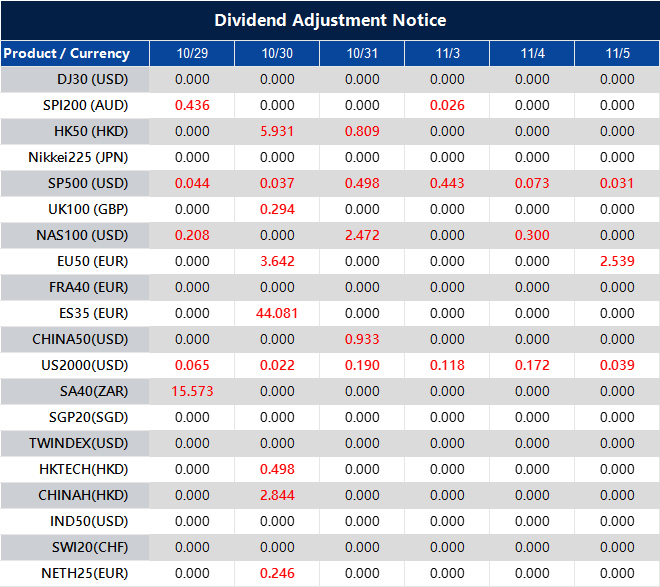
The above data is for reference only, please refer to the MT4/MT5 software for specific data.
If you’d like more information, please don’t hesitate to contact [email protected].







