Back

Sterling rebounds from lows; GBP/USD gaps lower, halts five-day rise, struggles above 1.3400, near 1.3485 peak

GBP/USD opened the week with a bearish gap, ending a five-day rise after reaching about 1.3485 last week. It rebounded from the Asian low to near 1.3400, down almost 0.45% on the day.

Market mood weakened after US-Iran talks ended without a deal, following nearly 21 hours of discussions. President Donald Trump said the US Navy would begin blockading the Strait of Hormuz, increasing Middle East tension risks and threatening a two-week ceasefire.

Risk Off Mood Lifts Dollar

The shift towards caution supported the US Dollar and pressured GBP/USD. Higher oil prices added to inflation concerns, reinforcing demand for the Dollar.

On Friday, data showed US inflation rose by the most in nearly four years in March. This reduced expectations for Federal Reserve rate cuts and increased focus on possible rate rises this year, lifting US Treasury yields.

Expectations for a more hawkish Bank of England stance helped limit sterling losses. The BoE has indicated a possible rate rise as early as April, while the UK economy remains exposed to energy price shocks linked to the Iran conflict.

Traders appeared cautious about adding bullish sterling positions without clearer follow-through. The pair’s recent rebound began from the mid-1.3100s, near the year-to-date high set on 31 March.

What Changed Since 2025

Looking back at the market situation in 2025, we saw how failed US-Iran talks and a hawkish Federal Reserve created a difficult environment for GBP/USD. Today, on April 13, 2026, the pair is trading much lower around 1.2550, but the drivers have fundamentally shifted. The key takeaway for us is how geopolitical risk consistently boosts the dollar, regardless of the source.

That recurring theme of geopolitical tension is present again, though the focus has moved from the Middle East to renewed naval disputes in the South China Sea. This has provided a floor for the US dollar, as evidenced by the VIX volatility index climbing to 19 last week from a low of 14. This safe-haven demand is capping any significant upside for the pound in the immediate term.

The most critical change for traders, however, is the divergence in central bank policy. Unlike 2025 when the Fed was looking to hike, recent US CPI data showing inflation cooling to 2.8% has markets pricing in a potential rate cut by the third quarter. In contrast, stubbornly high UK inflation, which printed at 3.5% last month, is forcing the Bank of England to maintain its restrictive stance.

This policy divergence is creating a potential long-term tailwind for the pound against the dollar. While the geopolitical situation from last year taught us that oil price shocks can complicate the BoE’s job, the current stability of WTI crude around $85 a barrel is less of an inflationary threat. It instead allows the interest rate differential between the UK and the US to become a more dominant factor for currency traders.

Given this backdrop, we should consider using options to position for potential GBP/USD upside while managing downside risk from global tensions. Buying June call options with a strike price around 1.2700 offers a defined-risk way to profit if the central bank narrative drives the pair higher. This strategy allows us to participate in a rally while limiting our potential loss to the premium paid if dollar strength unexpectedly returns.

Therefore, our focus should be on key upcoming data points that could confirm this policy split, specifically the next US PCE inflation report and the UK employment figures. Last year showed us how quickly sentiment can turn, so waiting for data to validate the interest rate differential theme is a prudent approach. Any signs of weakening US economic data will likely accelerate bets on Fed cuts and strengthen our bullish case for GBP/USD.

Create your live VT Markets account and start trading now.

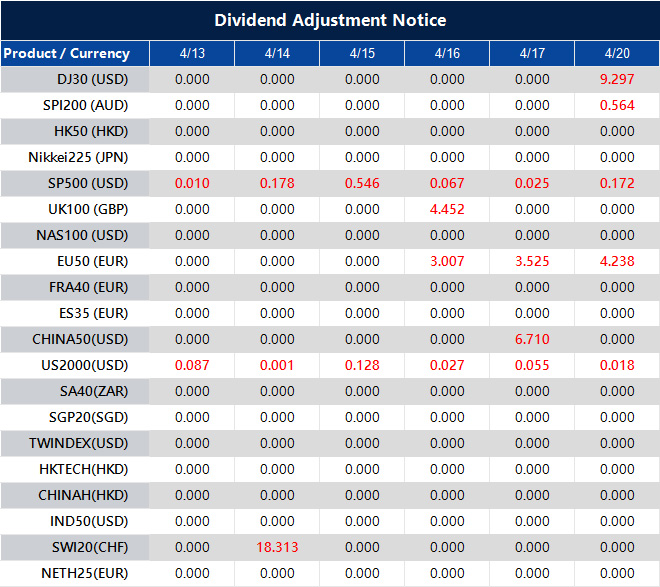
Dividend Adjustment Notice – Apr 13 ,2026

Dear Client,

Please note that the dividends of the following products will be adjusted accordingly. Index dividends will be executed separately through a balance statement directly to your trading account, and the comment will be in the following format “Div & Product Name & Net Volume”.

Please refer to the table below for more details:

Dividend Adjustment Notice

The above data is for reference only, please refer to the MT4/MT5 software for specific data.

If you’d like more information, please don’t hesitate to contact [email protected].

Trump announced on Truth Social that a blockade of ships using Iranian ports starts 10:00 AM ET

US President Donald Trump said on Truth.Social that a blockade on ships entering or leaving Iranian ports will start today, April 13, at 10:00 AM ET (14:00 GMT).

The post stated the United States would enforce the blockade from that time.

Market Response And Volatility Outlook

After the post, there was no immediate movement in the US Dollar (USD) or WTI oil prices.

The information had already been shared earlier in the day by the US Central Command (CENTCOM).

The market may seem calm now, but this is deceptive. We should anticipate a significant spike in implied volatility for oil contracts over the coming weeks as the blockade’s real-world impact begins. The Cboe Crude Oil Volatility Index (OVX), which has been trading near yearly lows, is likely to surge, making long volatility strategies attractive.

Strait Of Hormuz Risk And Pricing Impact

This blockade directly threatens the Strait of Hormuz, through which about 21 million barrels of oil, or 20% of global supply, pass daily. We are positioning for a potential price shock by buying out-of-the-money call options on Brent futures, which are more sensitive to Mideast tensions than WTI. Looking back at the market’s reaction in 2019, when attacks on Saudi facilities caused Brent to jump nearly 20% in a single day, shows how quickly the situation can escalate.

The immediate removal of Iran’s roughly 2.5 million barrels per day of exports from the market will tighten global balances considerably. We are closely watching statements from OPEC+, as their limited spare production capacity, estimated at under 4 million bpd, might not be enough to calm fears of a shortage. Any hesitation from them to increase output will add fuel to the bullish case for crude prices.

We are also looking at the Brent-WTI spread, which we expect to widen significantly as the risk is concentrated in the Eastern Hemisphere. Derivative plays on major tanker operators are now on the table, as their insurance and operational costs will soar due to the heightened risk. Similarly, call options on major defense contractors could prove profitable if the military standoff persists.

Create your live VT Markets account and start trading now.

FXStreet-compiled figures show gold prices in Saudi Arabia declined, with values falling during Monday’s session

Gold prices in Saudi Arabia fell on Monday, based on FXStreet data. Gold was priced at SAR 570.14 per gram, down from SAR 572.86 on Friday.

Gold dropped to SAR 6,650.00 per tola from SAR 6,681.67 on Friday. Other listed prices were SAR 5,701.44 for 10 grams and SAR 17,732.99 per troy ounce.

Saudi Gold Price Snapshot

FXStreet derives Saudi gold prices by converting international prices using the USD/SAR rate and local units. The figures are updated daily using market rates at the time of publication, and local prices may vary.

Central banks were reported as the largest gold holders. They added 1,136 tonnes of gold worth about $70 billion in 2022, according to the World Gold Council.

Gold is described as often moving in the opposite direction to the US Dollar and US Treasuries. It can also move against risk assets such as shares, and it may react to interest rates, recession fears, and geopolitical events.

The minor dip in gold prices to 570.14 SAR per gram reflects a momentary pause in the international markets. We see the price hovering around the $2,450 per ounce level, which presents a critical point for traders. This slight pullback could be a temporary consolidation rather than a change in trend.

Market Drivers And Outlook

As a non-yielding asset, gold’s future direction is heavily tied to interest rate expectations. With the CME FedWatch tool now showing a 65% chance of a rate cut by the end of 2026, the opportunity cost of holding gold is perceived to be decreasing. This fundamental shift is providing a strong tailwind for the metal.

We should also consider gold’s role as a safe-haven asset amid rising geopolitical tensions. Looking back at the central bank buying spree of 2025, we can see that trend has continued, with the latest World Gold Council data for Q1 2026 showing another 250 tonnes added to reserves. This consistent demand from official sources creates a solid price floor.

The inverse correlation with the US dollar remains a key factor in our analysis. The Dollar Index (DXY) has recently softened from its highs, trading around 103.5 as markets price in a more dovish Federal Reserve. A weaker dollar makes gold cheaper for foreign buyers, potentially boosting demand.

For derivative traders, the recent uptick in the CBOE Gold Volatility Index to 18 suggests now is a time to manage risk and position for potential upside. This environment could be favorable for strategies like buying call spreads to target a move towards the $2,500 level while limiting the upfront premium cost. Selling cash-secured puts below current support levels could also be a way to collect premium while expressing a bullish-to-neutral view.

Create your live VT Markets account and start trading now.

Despite trimming earlier declines, AUD/JPY stays negative, trading near 112.40–112.50 during Asian hours

AUD/JPY reduced its daily losses but stayed negative, trading near 112.40 in Asian hours on Monday. The move came as the Australian Dollar weakened amid higher risk aversion after US Vice President JD Vance said Washington and Tehran did not reach a peace agreement in Islamabad after 21 hours of talks.

US President Donald Trump said the US would begin blockading all ships entering or leaving the Strait of Hormuz. US Central Command confirmed operations targeting maritime traffic to and from Iranian ports from 10 AM ET (14:00 GMT) Monday.

Australia Inflation And Rate Outlook

Higher energy costs added to inflation concerns, with Australia’s monthly inflation gauge at a record 1.3% in March. The Reserve Bank of Australia has raised rates by 50 basis points to 4.10%, and markets expect another hike in May.

The yen faced stagflation worries as oil prices rose, while higher energy costs increased expectations of a near-term Bank of Japan rate rise. The BoJ is due to decide policy on April 28, assessing whether elevated global energy and commodity prices support tightening.

Japan’s 10-year government bond yield rose to about 2.47% on Monday as oil prices climbed after the talks broke down. The Sakura Report said members weighed inflation risks against growth risks, while all nine regions described conditions as “recovering moderately”, “picking up”, or “picking up moderately”.

Given the spike in risk aversion from the US-Iran situation, we should expect volatility to jump across asset classes. Historically, geopolitical events in the Middle East cause the VIX index to surge, as we saw in late 2023. We should therefore consider buying options that profit from large price swings, as markets are likely to remain unsettled.

Oil Supply Shock And Trade Positioning

The US blockade of the Strait of Hormuz directly threatens a significant portion of the world’s oil supply, as historically around 20% of global consumption passes through it. This makes long positions in crude oil futures or call options a direct way to trade the escalating tensions. A supply shock of this magnitude could push prices far higher than we saw during the energy crisis that began in late 2025.

For the AUD/JPY pair, conflicting pressures make a simple directional bet risky. The AUD is suffering from risk-off sentiment, but the RBA’s aggressive rate hikes offer support, while the JPY is weakened by soaring energy import costs. This suggests that the classic carry trades, like those we saw unwind during the 2008 financial crisis, are under extreme pressure from both sides.

The upcoming Bank of Japan meeting on April 28 is now a critical event. The surge in Japan’s 10-year bond yield to 2.47% signals intense market pressure on the BoJ to hike rates to combat imported inflation. We can use derivatives to position for a significant market reaction to this decision, as any policy shift will cause a major repricing in the Yen.

Create your live VT Markets account and start trading now.

FXStreet data shows Philippine gold prices declined, with the precious metal falling in value across the country

Gold prices in the Philippines fell on Monday, based on FXStreet-compiled data. Gold was priced at PHP 9,169.20 per gram, down from PHP 9,215.81 on Friday.

Gold also moved lower on a per-tola basis, easing to PHP 106,947.80 from PHP 107,491.40 on Friday. Other listed prices were PHP 91,692.88 for 10 grams and PHP 285,193.90 per troy ounce.

Philippine Gold Price Snapshot

FXStreet converts international gold prices into Philippine pesos using the USD/PHP exchange rate and local measurement units. Prices are updated daily using market rates at the time of publication, and local prices may vary slightly.

Central banks are the largest holders of gold. They added 1,136 tonnes worth around $70 billion in 2022, according to the World Gold Council, the highest annual total since records began.

Gold is described as having an inverse relationship with the US Dollar and US Treasuries, and it is also inversely linked to risk assets. Its price can be affected by geopolitical events, recession fears, interest rates, and movements in the US Dollar, because gold is priced in dollars (XAU/USD).

The recent dip in gold prices to 9,169.20 PHP per gram presents a notable data point for us. This slight pullback could be interpreted as a temporary consolidation or a potential entry point for new positions. Traders should watch if this level holds or if further weakness develops in the coming days.

Trading Considerations For Gold

The key driver against gold right now is the strong US dollar, with the Dollar Index (DXY) holding firm above 105. This strength follows recent US inflation data for March 2026 coming in slightly hotter than expected, dampening expectations for imminent rate cuts from the Federal Reserve. As a non-yielding asset, gold typically struggles when interest rates are expected to remain high.

However, we also see strong underlying support from central bank buying, a trend that continued from 2025. The World Gold Council recently reported that central banks collectively bought over 200 tonnes in the first quarter of 2026, with emerging markets leading the purchases. This consistent demand creates a solid price floor and suggests that major institutions see long-term value at these levels.

Geopolitical risk also remains a primary catalyst for gold’s safe-haven appeal. Ongoing tensions in the Middle East and Eastern Europe are keeping investors on edge. Any escalation in these conflicts would likely trigger a flight to safety, pushing gold prices higher regardless of the dollar’s performance.

We remember how gold reacted during the banking sector instability we witnessed in early 2025, surging as investors fled risk assets. That period demonstrated gold’s inverse correlation with market stability and serves as a reminder of how quickly sentiment can shift. A similar risk-off event in the stock market could easily ignite another rally.

For derivatives traders, this environment of conflicting signals suggests a period of potential volatility. Using options to construct a long straddle could be a prudent strategy, allowing one to profit from a large price swing in either direction without betting on the outcome. The current setup is a tug-of-war between a strong dollar and persistent safe-haven demand.

Those trading futures might consider the current weakness an opportunity to build a long position, but discipline is essential. Given the dollar’s strength, using tight stop-losses is crucial to manage downside risk. A decisive break below recent support levels could signal a deeper correction before the long-term bullish factors reassert themselves.

Create your live VT Markets account and start trading now.

Oil surges above $100 as Iran tensions escalate

Crude oil barrel

Key Points

  • CL-OIL is holding near the $100 level, with benchmark crude recently trading around $104, up roughly 7–8% on the day.
  • Brent has moved above $101–102, while WTI has pushed past $104, marking a sharp repricing of geopolitical risk.
  • The rally is driven by escalating tensions and a U.S. naval blockade targeting Iranian-linked shipping through the Strait of Hormuz.
  • Shipping conditions remain constrained, with tankers avoiding the region and transit volumes still below normal levels.

Oil prices jumped sharply above the $100 mark as geopolitical risks returned to the forefront, following failed U.S.-Iran talks and a planned blockade of the Strait of Hormuz.

Brent crude climbed to around $101–102, while WTI moved above $104, as markets reacted to the renewed threat of supply disruption in one of the world’s most critical energy chokepoints.

The move marks a reversal from the brief easing seen during the recent ceasefire period, reinforcing how sensitive oil remains to developments in the Middle East.

Supply Risk Back in Focus – Blockading an Already Blockaded Straight

The key driver behind the latest rally is not demand, but supply risk.

The Strait of Hormuz handles roughly 20% of global oil flows, making it one of the most strategically important routes in the energy market.

With the U.S. preparing a naval blockade targeting Iranian-linked shipping, the market is now pricing in the potential loss of up to 2 million barrels per day of supply.

Even partial disruption is enough to tighten the market quickly. Tankers have already started avoiding the region, adding to concerns around near-term availability.

Market Reaction Spreads Beyond Oil

The spike in oil is not happening in isolation.

  • Equity futures have come under pressure as higher energy costs raise concerns about inflation and growth
  • Energy-linked assets are seeing renewed interest
  • Safe-haven flows are picking up as geopolitical risk increases

At the same time, the move highlights a familiar pattern. When geopolitical shocks hit supply, oil tends to react immediately, while broader markets adjust more gradually.

Read more: Why Crude Oil Prices Swing Wildly

A Fragile Setup

Despite the sharp move, the outlook remains highly dependent on how the situation evolves.

There are two competing forces:

  • Escalation risk: Further disruption or retaliation could push prices higher, especially if shipping through Hormuz is restricted further
  • De-escalation potential: Any renewed negotiations or easing of tensions could quickly reverse part of the rally

This creates a market that is reactive rather than directional, with price swings driven more by headlines than fundamentals.

USOIL Technical Analysis

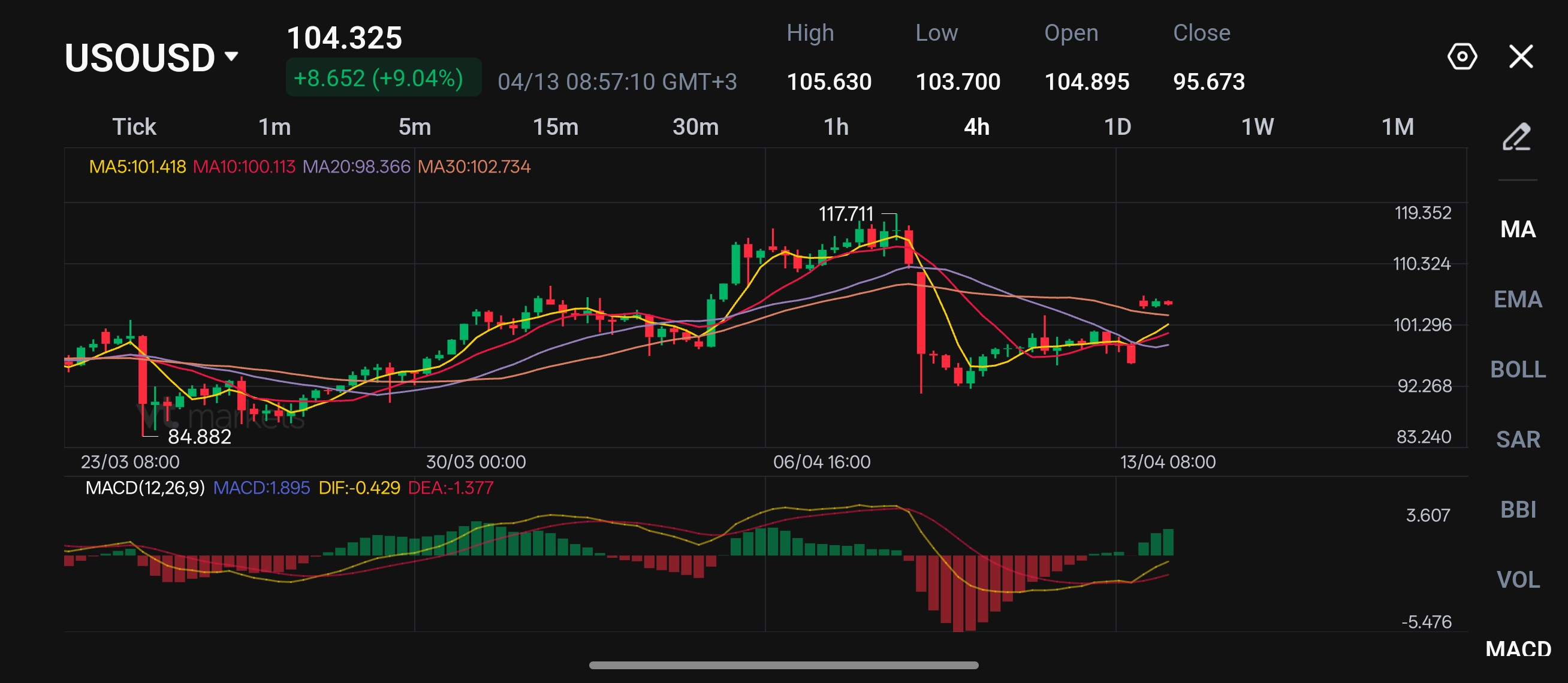
US Oil traded higher on Monday’s Asian session and currently trading above $100. Last week there was a huge bearish candlestick towards the downside and has create a huge fair value gap, it is likely that Oil will head towards previous high to fill the gap and trade above $110, provided if no successful negotiations is done.

The moving averages are slowly aligning for a bullish trend but it is not confirmed yet, we have to see 3 of the EMAs aligning towards the upside before taking any long positions.

MACD indicator is showing bullish histogram and the signal line is starting to cross into the positive region.

Key Levels To Watch:

Support: 100 -> 95.9 -> 91.2

Resistance: 105-> 109.2 -> 113.6

What to Watch

Traders should focus on three key developments:

  1. Strait of Hormuz traffic Any signs of further disruption or military escalation will directly impact supply expectations.
  2. Policy and military signals Statements from the U.S., Iran, and regional players will shape short-term sentiment.
  3. Oil price follow-through A sustained move above $100 could trigger broader positioning shifts across commodities and inflation-sensitive assets.

Market Takeaway

Oil’s move back above $100 is a reminder that geopolitics can quickly override fundamentals.

For now, the market is pricing in risk, not certainty. Whether this turns into a sustained rally or a short-term spike will depend on how the situation in the Middle East develops in the coming days.

Learn more about trading Energies on VT Markets here.

Trader Questions

What is driving oil prices above $100?
The move is being driven by supply risk, not demand. Escalating tensions and a potential blockade in the Strait of Hormuz are raising concerns about disrupted oil flows, pushing prices higher.

Why is the Strait of Hormuz so important for oil markets?
The Strait of Hormuz handles a significant share of global oil shipments. Any disruption there can quickly tighten supply, making it one of the most sensitive chokepoints for oil prices.

Is this oil rally likely to continue?
It depends on geopolitical developments. Further escalation could push prices higher, while any signs of de-escalation or resumed negotiations could reverse the move quickly.

Start trading now – Click here to create your real VT Markets account

FXStreet data shows gold prices declined in the United Arab Emirates, with values lower than previously recorded

Gold prices fell in the United Arab Emirates on Monday. Gold was priced at AED 557.44 per gram, down from AED 560.73 on Friday.

Gold fell to AED 6,501.85 per tola from AED 6,540.21 per tola. Other listed prices were AED 5,574.38 for 10 grams and AED 17,338.21 per troy ounce.

Gold Price Reference And Local Conversion

FXStreet converts international gold prices into AED using the USD/AED rate and local units. Prices are updated daily at the time of publication and are for reference, as local rates may vary.

Gold is commonly used as a store of value, a medium of exchange, and for jewellery. It is also used as a safe-haven asset and as a hedge against inflation and currency depreciation.

Central banks hold the most gold and use it to diversify reserves. They added 1,136 tonnes worth about $70 billion in 2022, the highest annual total on record.

Gold often moves inversely to the US Dollar and US Treasuries, and can also move opposite to risk assets such as stocks. Its price is influenced by geopolitics, recession fears, interest rates, and US Dollar strength.

Macro Drivers Supporting Gold

The slight dip in gold prices is likely temporary market noise given the broader economic landscape. As we see it, with recent data showing US inflation cooling to near 2.8% and growth slowing, the market is now pricing in a high probability of Federal Reserve interest rate cuts later this year. This environment is typically very supportive for gold, as it lowers the opportunity cost of holding a non-yielding asset.

This expectation for lower rates is weighing on the US Dollar, which benefits gold directly. The dollar index has struggled to stay above 102 for most of this year, a stark contrast to the strength we saw a couple of years ago. A weaker dollar makes gold cheaper for buyers using other currencies, which generally boosts demand.

We also have to consider the strong underlying support from institutional buyers. Looking back, we know that central banks continued their record-breaking purchases through 2024 and 2025, adding over 1,000 tonnes each year, according to World Gold Council data. This consistent demand, particularly from emerging market banks, creates a solid price floor and limits downside risk.

From a trading perspective, this makes selling puts or establishing bull call spreads on gold futures attractive strategies for the coming weeks. These positions would profit from either a rise in price or a period of stability, capitalizing on the strong fundamental support. Any dips caused by temporary geopolitical calm could be viewed as buying opportunities.

We should remember the price action of the last two years for context. After the major rally we saw in 2024, the market spent much of 2025 consolidating those gains and building a new base. This long period of consolidation suggests the market is preparing for its next significant move, and the current macroeconomic signals point upward.

Create your live VT Markets account and start trading now.

Oil’s rise helps the Canadian Dollar recover against the US Dollar as USD/CAD eases near 1.3860, up 0.15%

USD/CAD eased a few pips from its Asian-session peak and traded near 1.3860–1.3855, up about 0.15% on the day. It followed a modest rebound from below 1.3800 after a two-week low on Friday.

The US dollar failed to build on a weekly gap opening as reports said regional countries were trying to return the US and Iran to talks within days. Higher crude prices supported the Canadian dollar and limited gains in USD/CAD.

Oil Markets Drive Cad Support

WTI rose back to about $105 a barrel after US-Iran talks over the weekend ended without agreement. US Vice President JD Vance said a “final and best offer” was rejected, while Iranian state media cited what it called excessive demands.

US President Donald Trump said the US Navy would start blockading the Strait of Hormuz, putting a two-week ceasefire at risk. Continued Israeli strikes in Lebanon also raised fears of wider conflict and helped keep oil prices firm.

US inflation data on Friday showed the biggest monthly rise in nearly four years during March. Higher energy prices led markets to drop expectations for Fed rate cuts and shift towards possible rate rises this year, pushing up US Treasury yields.

The USD/CAD pair is holding near the 1.3850 mark, showing the strain between a strong US Dollar and high oil prices. This fundamental conflict suggests caution, as the pair could break out sharply from its recent recovery. We see this as a critical inflection point for the coming weeks.

Fed Expectations Support Usd

Crude oil prices are providing a significant tailwind for the Canadian dollar, capping the pair’s upside. West Texas Intermediate (WTI) is currently trading above $95 a barrel, its highest level in over a year, following renewed tensions in the Red Sea and OPEC+ confirming it will maintain production cuts through the second half of the year. This continued strength in energy underpins the value of the commodity-linked loonie.

On the other hand, bets on a hawkish Federal Reserve are keeping the US Dollar well-supported. Last week’s US inflation data for March 2026 showed Core CPI rising by a stubborn 0.4%, forcing markets to price out the two rate cuts previously expected for this year. This has pushed the US 10-year Treasury yield back above 4.5%, attracting capital and boosting the greenback.

We remember the sharp swings in energy prices throughout 2025, and this current environment feels similarly unstable. Given the opposing pressures on USD/CAD, traders should consider buying volatility through options strategies like straddles. This allows for profiting from a significant move in either direction, as a breakout seems more likely than a prolonged period of range-bound trading.

Create your live VT Markets account and start trading now.

FXStreet data show Pakistan’s gold prices declined, with gold falling as figures were compiled in the country

Gold prices in Pakistan fell on Monday, based on FXStreet data. Gold was priced at PKR 42,312.58 per gram, down from PKR 42,583.25 on Friday.

Gold also slipped to PKR 493,525.70 per tola from PKR 496,682.70 on Friday. Other listed prices were PKR 423,125.80 for 10 grams and PKR 1,316,054.00 per troy ounce.

Pakistan Gold Price Update

FXStreet converts international gold prices into Pakistani rupees using the USD/PKR rate and local units. The figures are updated daily at publication time and are for reference, as local rates may vary.

Central banks are the largest holders of gold. They added 1,136 tonnes worth around $70 billion in 2022, according to the World Gold Council, the highest annual total since records began.

Gold often moves opposite to the US Dollar and US Treasuries, and can also move against risk assets such as equities. Its price may also react to geopolitical events, recession fears, and changes in interest rates.

The minor drop in local gold prices reflects a temporary strengthening in the US dollar. As gold is inversely correlated with the dollar, this pullback could be a tactical entry point. We should view these daily fluctuations within the larger market context.

Key Drivers And Trade Setups

We remember that central banks significantly increased their gold reserves through 2024 and 2025, building on a trend that started back in 2022 when they bought a record 1,082 tonnes. This sustained institutional buying has created a strong underlying price floor for the metal. It shows that governments continue to hedge against currency weakness and inflation.

Looking ahead, the market is focused on upcoming inflation data from the US due next week. Current forecasts from major banks suggest a slight cooling of the Consumer Price Index to 2.9%, which could pressure the Federal Reserve to consider rate cuts later this year. As a non-yielding asset, gold tends to perform well in lower interest rate environments.

For derivatives traders, this sets up a play on volatility. With uncertainty surrounding the Fed’s next move, implied volatility in gold options has risen to a six-month high. Purchasing long straddles or strangles on gold futures would allow traders to profit from a large price move in either direction following the data release.

Alternatively, for those with a directional bias, the metal’s safe-haven status is critical amid ongoing trade negotiations between the US and China. We saw in 2019 how trade tensions quickly boosted gold by over 15% in just three months. Traders anticipating a breakdown in talks could buy out-of-the-money call options as a cheap way to gain upside exposure.

We must also monitor the US Dollar Index (DXY), which is currently testing resistance near the 105.50 level. A rejection from this level would signal dollar weakness and be a strong bullish catalyst for gold. This could be a trigger to enter long positions using June gold futures contracts for direct, leveraged exposure.

Create your live VT Markets account and start trading now.

Back To Top
server

Hello there 👋

How can I help you?

Chat with our team instantly

Live Chat

Start a live conversation through...

  • Telegram
    hold On hold
  • Coming Soon...

Hello there 👋

How can I help you?

telegram

Scan the QR code with your smartphone to start a chat with us, or click here.

Don’t have the Telegram App or Desktop installed? Use Web Telegram instead.

QR code