



Sweden’s trade balance improved from -8.9 billion to 5.4 billion in September.
In September, Sweden’s trade balance shifted dramatically, moving from an 8.9 billion SEK deficit to a 5.4 billion SEK surplus. This change indicates a positive shift in the country’s trade activities over the month.
The EUR/USD rate held steady around 1.1650, keeping previous gains, while the US Dollar weakened as the demand for safe-haven assets declined. The GBP/USD fell to about 1.3350 due to expectations of a dovish Federal Reserve.
GfK Consumer Confidence Survey in Germany records -24.1, below the expected -22
Germany’s GfK consumer confidence index for November is at -24.1, falling short of the expected -22.
Gold has dropped to its lowest point in over three weeks, falling below $3,950. This decline is linked to lower demand for safe-haven assets due to easing trade tensions between the US and China.
The USD Weakens
The US Dollar (USD) has weakened against other currencies as traders wait for updates on Federal Reserve policy. The EUR/USD is holding steady around 1.1650, maintaining its gains despite a weaker Dollar. The GBP/USD is stabilizing near 1.3350 in the European trading session. Traders are being cautious, avoiding new investments before the Fed’s policy announcements. Cardano is trading close to $0.66 as whale accumulation increases. Positive on-chain data hints at possible growth, raising interest in a potential breakout. These changes highlight worldwide market trends influenced by central bank actions and political events. The data reflects the general sentiment in financial markets as we approach key central bank decisions.German Consumer Confidence Figure
The German consumer confidence figure for November is concerning, standing at -24.1. This is worse than the expected -22 and indicates ongoing stress for consumers, a trend seen throughout 2023 and 2024. Despite the ECB’s survey showing inflation expectations dropping to 2.7%, negative sentiment from Germany, Europe’s largest economy, signals trouble ahead. With the EUR/USD near a high of 1.1650, there is a noticeable gap between the currency’s strength and the weakening economic data. This situation may present an opportunity for traders to consider bearish positions on the euro, like buying put options. Such a strategy could pay off if sentiment aligns with the currency’s price, especially before the US Federal Reserve’s policy announcement this week. The USD appears weak because many are expecting a dovish signal from the Fed, but this has already been largely factored into the market. A similar situation occurred after the aggressive rate hikes of 2022-2023 when markets quickly anticipated a shift that took time to happen. Buying straddles or strangles on major currency pairs such as the EUR/USD could be a wise move to prepare for a surprise shift and increased volatility from the Fed’s meeting. Gold’s price drop below $3,950 indicates a broader risk-on mood, but this optimism feels tenuous. With signs of economic weakness in Europe, the demand for safe havens might rise again soon. For now, selling out-of-the-money call options on gold could provide premium income while betting that its price won’t rise significantly in the short term. Overall, the market seems to be overlooking clear warning signs from Europe while focusing on a potentially dovish Fed. For instance, Germany’s economy experienced a 0.3% GDP contraction in 2023, highlighting how swiftly negative sentiment can lead to economic trouble. Given this situation, using derivatives to hedge against a downturn, like buying protective puts on European stock indices, should be a priority in the coming weeks. Create your live VT Markets account and start trading now.Speculation about intervention boosts JPY, pushing GBP/JPY below 203.00
The GBP/JPY has dropped below 203.00 as speculation about Japanese intervention has strengthened the Yen. After rising to 204.25 over three days, the exchange rate fell due to increased demand for the Yen, possibly signaling an end to its upward trend.
Japanese Economic Minister Minoru Kiuchi highlighted the need for stable currency movements that align with fundamental values. Expectations of intervention by the Japanese government led Yen bears to reduce their bets, affecting the GBP/JPY rate.
Bank of Japan Policy Expectations
The Bank of Japan (BoJ) is expected to keep its current policy during the next meeting, even as inflation pressures rise in Japan. Inflation has consistently surpassed the BoJ’s 2% target, hinting at a potential rate hike soon. This hawkish outlook from the BoJ contrasts with possible easing from the Bank of England (BoE). Concerns about the UK’s fiscal situation ahead of the Autumn budget are putting more pressure on the Pound, which may lead to GBP/JPY dropping below 202.45. The value of the Yen is closely tied to Japan’s economic performance and BoJ policies. Changes in monetary policies have narrowed yield gaps with the US, impacting the Yen, which is also seen as a safe haven during times of market stress.Traders’ Strategic Consideration
The sharp fall of GBP/JPY below 203.00 indicates strong momentum, driven by fears of Japanese intervention. These fears are valid; we recall significant yen-buying interventions in late 2022, demonstrating authorities’ willingness to act on rapid currency shifts. Current verbal warnings from government officials have created a tense atmosphere ahead of the BoJ meeting this Thursday. The upcoming BoJ decision is crucial this week. Although no immediate policy changes are expected, we should focus on ongoing inflation data. Japan’s core inflation has surpassed the BoJ’s 2% target for over three years, with the latest September figure at 2.7%, maintaining pressure for a potential rate hike soon. This situation contrasts sharply with the UK, where the BoE is dealing with a different challenge. UK inflation has significantly cooled to 2.2%, while recent quarterly GDP growth was stagnant at 0.1%. This difference in economic outlook suggests a weaker pound sterling against a possibly more hawkish Yen. For derivative traders, this environment suggests positioning for further declines in GBP/JPY. Buying put options with a strike price near 202.00 could be a direct way to benefit from a continued drop, especially with the BoJ meeting as a possible catalyst. Increased discussions of intervention have raised implied volatility, making options more expensive but reflecting the significant market risks. Given this elevated volatility, a bear put spread may be a more cost-effective strategy to express a moderately bearish outlook. This means buying a higher-strike put and selling a lower-strike put to finance the position and limit potential gains. This strategy could allow profits from a decline towards the 202.00 level while minimizing initial cash costs. Create your live VT Markets account and start trading now.GBP/USD pair rises to around 1.3365 during positive early European trading
The GBP/USD pair is on the rise, currently near 1.3365, as traders anticipate a Federal Reserve interest rate cut. The US Dollar is weakening after US CPI data came in lower than expected, suggesting that a rate cut is likely soon.
On Monday, GBP/USD bounced back from 1.3300, breaking a six-day losing streak as focus shifts to the upcoming Fed rate decision. Most expect a second rate cut, and traders are keenly watching for hints about a potential third cut in December.
Impact Of US-China Trade Talks
Right now, GBP/USD is trading at about 1.3319, up 0.07%, buoyed by hopes that the US-China trade war might ease. Additionally, falling UK inflation has led to speculation about a possible rate cut by the Bank of England in December. A meeting between US and Chinese leaders this week could also influence currency movement. All eyes are on the Federal Reserve’s decision tomorrow, where a quarter-point rate cut is mostly anticipated. This expectation is contributing to the recent weakness of the US Dollar, pushing GBP/USD closer to 1.3365. This marks a positive shift in sentiment after a six-day decline. We view this as part of the policy changes that began earlier this year after aggressive rate hikes in 2023 and 2024 aimed at controlling inflation. The latest US Consumer Price Index shows inflation at 3.0% year-over-year, down from 4.0% in late 2024, allowing the Fed to continue easing. This trend suggests that the dollar’s years-long strength is fading.Trading Strategies For Upcoming Announcements
For options traders, implied volatility on GBP/USD options is expected to rise ahead of the announcement. A key focus will be the Fed’s guidance on a possible third cut in December, which could lead to significant price movements. Strategies like long straddles may be beneficial for those looking to capitalize on market swings after the announcement, regardless of which direction the price moves. On the other hand, we’re also monitoring the Bank of England, as expectations for a December rate cut there are growing. UK inflation has dropped to 2.8% from higher levels earlier this year, but the Bank of England may proceed with caution. This policy difference will be important for the pound’s direction in the near future. Optimism about a potential US-China trade thaw, with a meeting expected this week, is supporting risk-sensitive currencies like Sterling. This positive sentiment has helped the pair recover from below 1.28, levels seen during much of 2024. Traders who are optimistic about both a dovish Fed and a good trade outcome might consider buying short-term call options on GBP/USD for potential gains. Create your live VT Markets account and start trading now.GBP/USD strengthens above 1.3350, nearing 1.3365 amid expectations of a Fed rate cut
The GBP/USD is performing well, rising to about 1.3365 during Tuesday’s European session. This increase is due to better UK Retail Sales and S&P Global PMI data, along with expectations for a Federal Reserve rate cut.
The movement of this currency pair is affected by a weakening US Dollar because of anticipated interest rate cuts by the Federal Reserve. Recent US inflation data shows that CPI is lower than expected, making a rate cut more likely, which impacts the dollar’s value.
The Federal Reserve Rate Decision
The Federal Reserve is expected to lower its key interest rate by 25 basis points at the upcoming meeting in October. Currently, traders see a 97% chance of the rate dropping to 3.75%-4.00%, which would be a second consecutive cut. Economic indicators in the UK, such as Retail Sales and PMI data, are supporting the Pound against the Dollar. The Bank of England (BoE) will announce its next interest rate decision in November, with varying opinions on whether a rate cut will happen. Economists believe the BoE may wait for the Chancellor’s Autumn Budget to evaluate its impact on inflation. The UK’s fiscal uncertainty and potential growth challenges could negatively affect the GBP.US Dollar Expectation
The US Dollar is expected to weaken ahead of the Federal Reserve’s decision tomorrow, with almost a full price in for a 25 basis point cut. The latest US CPI data for September shows inflation cooling to 3.1%, giving the Fed a solid reason for what would be its second rate reduction in a row, following the cut in September 2025. This expectation helps boost the GBP/USD pair. Meanwhile, the Sterling benefits from strong domestic data that pleasantly surprised many. Retail sales in September increased by a healthy 0.6%, and the flash Composite PMI for October rose to 51.5, indicating ongoing economic growth. This resilience makes the BoE’s interest rate decision, scheduled for next week, more complex. For derivative traders, focusing on short-term call options on GBP/USD may be a smart move to take advantage of the expected Dollar weakness after the Fed meeting. Since the rate cut is widely anticipated, the implied volatility for this week isn’t very high, making options an appealing strategy. The Fed’s guidance will be crucial; a more dovish approach could sustain the rally. Looking ahead to November, there are significant events that could limit the Pound’s gains, particularly the Bank of England meeting on November 6 and the Autumn Budget on November 26. The BoE may adopt a ‘wait-and-see’ approach before the budget, which might slow the pound’s upward momentum. Thus, selling out-of-the-money call options with late November expirations could be a smart strategy, betting that the pair won’t rise significantly. Additionally, it’s important to note that the climb toward 1.3400 is testing levels not consistently seen since the first half of 2022. While the Fed’s policy shift is currently driving this trend, any lasting strength will heavily rely on clarity regarding the UK’s fiscal and monetary policies. Any disappointing news from the UK could lead to a sharp reversal from these multi-year highs. Create your live VT Markets account and start trading now.The euro rises against the weakening US dollar ahead of the Federal Reserve’s policy announcement.
The EUR/USD has risen for five straight days, hitting a new weekly high around 1.1670 as the US Dollar weakens. Investors expect the Federal Reserve to announce an interest rate cut on Wednesday, fueled by growing optimism about trade between the US and China.
The US Dollar Index, which compares the Dollar to six major currencies, fell to a weekly low of 98.50. The Consumer Price Index for September showed a modest rise in both headline and core inflation, increasing by 0.3% and 0.2% respectively.
Trade Optimism Between US And China
There’s growing hope for a trade agreement between the US and China, which could strengthen the Dollar. President Trump has expressed confidence that a deal will come soon. Meanwhile, all eyes in Europe are on upcoming German inflation data and the Eurozone’s third-quarter GDP. These are expected to show steady economic growth. The Eurozone’s Harmonized Index of Consumer Prices (HICP) and other economic indicators are key to assessing the Euro’s value. If inflation rises above the European Central Bank’s target, it may lead to changes in interest rates, affecting how attractive the Euro is. The trade balance is also an important factor in determining the Euro’s value. The EUR/USD continues its upward trend towards 1.1670 this week, marking five consecutive days of gains. This growth is powered by a weakening US Dollar as we approach the Federal Reserve’s policy announcement tomorrow, with strong expectations for another interest rate cut. This expectation is backed by recent economic data showing the US economy is slowing down. For example, job growth has slowed compared to last year’s strong pace, and September’s CPI increase of 0.3% is not enough to stop the Fed from easing. Last year, inflation exceeded 8%, so current conditions give the central bank room to make a move.Expectations For Central Bank Decisions
With a major central bank decision just hours away, expect a significant rise in short-term volatility. Implied volatility on EUR/USD options has already increased, a pattern often seen before Fed announcements. This creates opportunities to use strategies like straddles to capitalize on the expected post-announcement price movements, regardless of direction. We also need to keep an eye on important data from Europe this Thursday, including German inflation and the Eurozone’s Q3 GDP. Analysts expect modest 0.1% growth, similar to the stagnant figures seen in parts of 2024. A surprisingly strong report from Europe could further boost the EUR/USD, especially if the Fed communicates a dovish outlook. Additionally, improving risk sentiment driven by optimism about a US-China trade deal is putting pressure on the safe-haven Dollar. The S&P 500 has risen nearly 1.5% this week, indicating a strong appetite for risk among investors. If this trend continues, it will likely add even more upward pressure on the Euro. Create your live VT Markets account and start trading now.Dividend Adjustment Notice – Oct 28 ,2025
Dear Client,
Please note that the dividends of the following products will be adjusted accordingly. Index dividends will be executed separately through a balance statement directly to your trading account, and the comment will be in the following format “Div & Product Name & Net Volume”.
Please refer to the table below for more details:
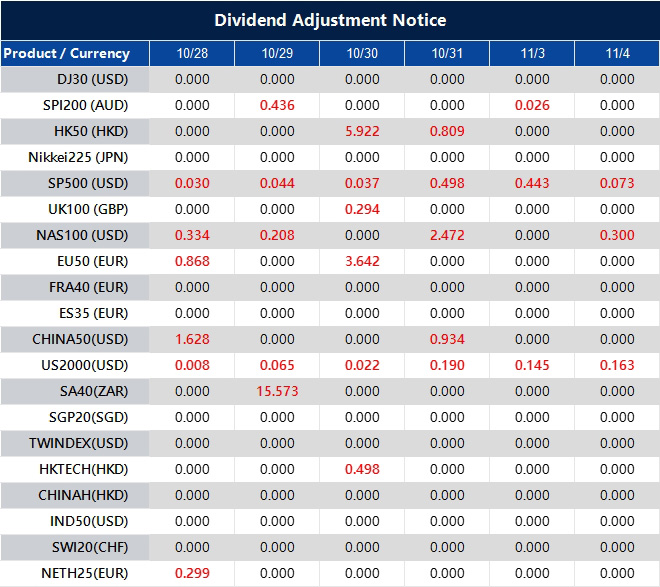
The above data is for reference only, please refer to the MT4/MT5 software for specific data.
If you’d like more information, please don’t hesitate to contact [email protected].
Recent market data shows that gold prices have decreased in Saudi Arabia.
Gold prices in Saudi Arabia fell on Tuesday. The price per gram is now 479.33 Saudi Riyals, down from 479.94 SAR the day before. The price per tola also dropped to SAR 5,591.11 from SAR 5,597.88.
FXStreet calculates gold prices in Saudi Arabia by adjusting international rates to local currency and measurement units. These rates are updated daily and might vary slightly from local prices.
Gold As A Safe Haven
Gold is widely used as a store of value and a medium for transactions. It is viewed as a safe haven during unstable times and helps protect against inflation and currency loss. Central banks often buy gold to boost their economies and currencies, making them the largest gold holders. In 2022, they added 1,136 tonnes to their reserves, worth about $70 billion. Gold prices usually increase when the US Dollar loses value or when conservative markets are doing well. On the other hand, a strong Dollar or a rise in risky assets can cause gold prices to drop. Geopolitical issues and changes in interest rates also impact gold, which often rises when interest rates are low. Today, we are seeing a little drop in gold prices, but what’s more important is the overall financial situation. Gold typically moves in the opposite direction of the US Dollar and interest rates, so we should pay attention to what the Federal Reserve does next. These elements will influence gold prices more than just daily trading changes.Central Bank Demand
Recent statements from the Federal Reserve indicate a willingness to pause rate hikes as the economy slows. US 10-year Treasury yields have responded, dipping below 4.0% for the first time in several months. This makes holding gold, which doesn’t yield interest, more appealing. For traders, this shift suggests that long positions in gold futures or buying call options could be profitable. The US Dollar Index (DXY) has weakened, recently dropping below 103. Since gold is priced in dollars, a weaker dollar benefits gold, making it cheaper for foreign buyers and pushing up its price. This indicates that buying on any price dip could be a good strategy in the coming weeks. We also need to consider the consistent demand from central banks, which helps support prices. They added a record 1,136 tonnes in 2022, and the latest data from the World Gold Council for Q3 2025 shows that this trend of buying is continuing, with another 250 tonnes purchased. This ongoing institutional buying is likely to limit the downside risk for short-term bearish bets. Even though US inflation has decreased from its highs, the latest September 2025 reading of 3.1% shows it remains above the Fed’s target. This keeps gold attractive as a hedge against inflation, especially with some volatility returning to equity markets. Traders should consider using options to protect against sudden geopolitical tensions or economic shocks that might drive investors to seek safe-haven assets. Create your live VT Markets account and start trading now.Gold prices in the Philippines have generally remained steady, according to recent data collections.
Gold prices in the Philippines remained stable on Tuesday. The price per gram was 7,554.83 Philippine Pesos, a slight decrease from 7,561.08 PHP the day before.
The price for a tola was 88,122.50 PHP, down just a bit from 88,190.95 PHP. Additionally, 10 grams were priced at 75,552.10 PHP, and a troy ounce was available for 234,987.00 PHP.







