



UK’s PPI core output increased to 3.6% year-on-year, up from 1.5%
WTI oil price rises to $58.23 and Brent climbs to $62.08 during the European opening
WTI oil prices went up on Wednesday during the early European session, trading at $58.23 per barrel, rising from $57.56 on Tuesday. Brent crude prices also increased, climbing from $61.39 to $62.08.
WTI, or West Texas Intermediate, is a high-quality type of crude oil because of its low gravity and low sulfur content. It comes from the United States and is often used as a standard for oil prices globally.
Factors That Affect WTI Oil Prices
WTI oil prices change based on supply and demand, global growth, political events, and the strength of the US Dollar. Actions from OPEC, a group of major oil-producing countries, also play a major role, along with other economic indicators. Weekly inventory reports from the American Petroleum Institute and the Energy Information Administration can affect WTI prices by providing insights into supply and demand. If inventories drop, it may indicate rising demand and push prices up. Conversely, higher inventories suggest greater supply, which could keep prices down. OPEC’s decisions on how much oil to produce are crucial in setting WTI prices. Their actions impact supply, which in turn affects global oil prices. Both OPEC and OPEC+ influence these dynamics. With WTI oil now at $58.23 per barrel, this indicates growing demand in the market. The latest report from the Energy Information Administration (EIA) shows a surprising decrease in crude inventories of 2.1 million barrels last week, contrary to expectations of an increase. This suggests that consumption is outpacing supply, helping to stabilize prices.Market Outlook and Strategy
Looking ahead, global growth forecasts for late 2025 remain slow but are not pointing to a deep recession, which should keep demand steady. We’ve noticed that the US Dollar has weakened slightly to 104.5 on the DXY index recently. A lower dollar makes oil cheaper for buyers using other currencies, adding to positive market pressure. The OPEC+ meeting scheduled for late November is a key event to watch. Prices are still below the $80-90 range seen throughout much of 2023 and 2024, so we expect the group may continue or even deepen their production cuts. Any comments from important members in the coming weeks are likely to cause market fluctuations and should be watched closely. For derivative traders, this market condition suggests buying call options could be a smart move to take advantage of possible price increases. We see good potential in near-term contracts, especially December-expiry calls with strike prices around $60 and $65. This strategy could yield profits from possible price increases during the holiday season and after the OPEC+ meeting. Create your live VT Markets account and start trading now.In September, the UK’s core PPI output stayed at 0%, down from 0.3%
The UK’s Producer Price Index (PPI) Core Output stayed the same at 0% in September, down from 0.3% the month before. This indicates that inflation pressures in the UK production sector are leveling off. The PPI tracks the average change in the prices domestic producers receive for their products over time.
Following the release of UK inflation data, the British Pound has decreased, trading below 1.3350 against the US Dollar. The UK’s annual Consumer Price Index rose by 3.8% in September, which is lower than the expected 4% increase. This unexpected dip in inflation raises the chances of a Bank of England rate cut, putting more strain on the Pound.
Gold and Cryptocurrency Market Dynamics
Gold prices have bounced back, nearing $4,150. This rise comes as concerns grow over the US government’s financial situation and expected rate cuts by the Federal Reserve. Bitcoin’s price remains unstable, drawing parallels to the past Soybean crash. Meanwhile, meme coins like Dogecoin and Shiba Inu are struggling in the broader cryptocurrency market. This instability reflects ongoing shifts in financial markets. Recent UK inflation data shows that prices are stabilizing faster than expected. The PPI’s 0% change in September confirms the consumer price index miss, creating pressure on the Bank of England to consider cutting interest rates soon. This trend explains the Pound’s recent weakness. After fighting to reduce inflation from its 2023 highs, the Bank has kept its main rate at 4.5% for the last six months. Now, derivative markets indicate there’s over a 70% chance of a rate cut in early 2026. In the upcoming weeks, it might be wise to buy put options on GBP/USD to protect against or benefit from further declines in the Pound’s value.Impact of Economic Indicators
At the same time, the US Dollar is also weakening, as more people expect the Federal Reserve to lower rates. This expectation grew after the recent Non-Farm Payrolls report, which showed only 150,000 new jobs created—marking the second consecutive month of missing forecasts. This weakness in the dollar is a major reason behind gold’s strong performance this year. This situation is very favorable for precious metals. Gold is trading close to $4,150 an ounce, boosted by significant central bank gold purchases tracked throughout 2024. Traders might consider using call options on gold futures or gold mining ETFs to benefit from potential increases while limiting their risk. In contrast, there is a noticeable decline in speculation around major cryptocurrencies. Bitcoin, which usually rises in October, has not delivered its typical “Uptober” rally, suggesting that capital is shifting towards traditional safe havens. This trend indicates a risk-off approach, where traders prefer tangible assets during times of economic uncertainty. Create your live VT Markets account and start trading now.UK Producer Price Index shows 0% output change, falling short of 0.2% forecast
The United Kingdom’s Producer Price Index (PPI) for September stayed flat at 0%. This result was lower than the expected 0.2% increase. It shows that producer prices are stable, even though a small rise was anticipated.
In the currency market, the GBP/USD pair fell below 1.3350 after the UK’s Consumer Price Index data was released. The inflation rate rose to 3.8% in September, which was below the expected 4%. This has led to discussions about a possible cut in interest rates by the Bank of England.
Gold Prices Rise
In commodities, Gold prices climbed close to $4,150. This increase is due to worries about a potential US government shutdown and ongoing global economic issues. Analysts believe the Federal Reserve may cut rates by another quarter-point in October, which could further affect Gold prices. Bitcoin has dropped 5% this month, straying from its usual rise this time of year, often called “Uptober.” There are concerns about a repeat of past commodity crashes based on current trends. The information above contains forward-looking statements and should be taken as general information, not financial advice. Anyone considering financial decisions should conduct thorough research and assess potential risks. UK producer prices are flat, and consumer inflation came in lower than expected at 3.8% for September. This reinforces the view that the Bank of England is more likely to cut rates rather than raise them. Thus, shorting the Pound Sterling through futures or buying GBP/USD put options seems like a smart move for the upcoming weeks.Market Strategies
Looking back, there has been a significant cooling in prices since the post-pandemic highs. The latest data from the Office for National Statistics supports this trend of disinflation. The market is already responding, with overnight index swaps indicating a strong chance of a rate cut before the end of the first quarter of 2026. Selling the Sterling against currencies with a more hawkish central bank perspective might present good opportunities. Gold’s movement toward $4,150 reflects global anxiety and a weakening US Dollar. With US national debt surpassing $34 trillion and discussions of another potential government shutdown, traders are seeking safe havens. We recommend buying call options on Gold futures or gold ETFs to gain exposure while limiting potential losses. This combination of cautious central banks and fiscal concerns is likely to create higher market volatility in the upcoming weeks. Although the CBOE Volatility Index (VIX) is not at the crisis levels seen in early 2020, it has been rising from the lows of 2024. Buying VIX call spreads could be a cost-effective way to protect portfolios from sudden spikes in market volatility. Unlike the clear signals from Sterling, the EUR/USD pair remains stuck, trading around 1.1600. This indicates market indecision as it weighs the dovish stance of the Fed against ongoing economic challenges in the Eurozone. For traders, this could be an opportunity to profit by selling volatility through strategies like an iron condor, betting the pair stays within a tight range for now. Create your live VT Markets account and start trading now.Silver’s value rises close to $49.00 after a recent dip to $47.53 amidst trade concerns
Silver prices (XAG/USD) bounced back to around $49.00 during the late Asian session after dipping to a two-week low at $47.53. Since Friday, the price of silver has fallen almost 12% due to optimism about a US-China trade deal. Although President Trump has expressed confidence in reaching an agreement, uncertainty remains as he suggested that a meeting with Xi might not happen.
The outlook for silver looks promising as the Federal Reserve is likely to cut interest rates soon, which benefits non-yielding assets like silver. Attention will shift to the delayed US Consumer Price Index data set to be released on Friday. Silver’s recent pullback from its peak of $54.50 has created an unclear near-term trend as it struggles to exceed the 20-day Exponential Moving Average, currently around $49.04.
Technical Indicators
The 14-day Relative Strength Index indicates decreasing bullish momentum for silver prices. If prices drop below the recent low of $47.53, they might fall to $45.90 or even $43.78. However, if prices break above the $52.71 high, they could rebound to $54.50. Although silver is less popular than gold, it is still valued for its potential as a hedge and its intrinsic worth. Silver prices are influenced by factors like geopolitical tensions and inflation, typically rising when interest rates decline and the US Dollar weakens. Industrial demand, especially from the electronics and solar industries, also plays a significant role. The economies of the US, China, and India drive silver demand, primarily through industrial uses and jewelry consumption. Silver usually mirrors gold’s movements owing to their shared safe-haven status. The Gold/Silver ratio provides insight into their relative worth, with a high ratio indicating that silver might be undervalued, while a low ratio suggests otherwise. Silver is traded worldwide in various forms and is crucial for diversifying investment portfolios. As of October 22, 2025, silver prices are finding some support around $38.50, creating a complicated scenario for derivative traders. Current conditions show slowing industrial demand alongside a cautious Federal Reserve, adding uncertainty for the metal’s next big move. This environment makes option strategies particularly useful for managing risk.Current Economic Context
The Federal Reserve’s latest update on October 18, 2025, confirmed that interest rates will remain unchanged, which is a neutral to slightly positive sign for silver. The recent US Consumer Price Index (CPI) reports core inflation stable at a manageable 2.8% year-over-year, eliminating pressure for rate hikes. This suggests that a significant price drop due to monetary policy is unlikely in the near future. Looking back at the US-China trade war volatility from the late 2010s reminds us how geopolitical tensions can cause sharp fluctuations in silver prices. Ongoing trade talks between the United States and a South American trade bloc are generating a similar, though less intense, level of headline risk. Traders should be ready for sudden price changes based not just on economic reports but also on political news. On the demand side, silver’s industrial applications lend strong long-term support for prices, despite recent slowdowns. The Silver Institute’s Q3 2025 report noted that demand from the solar panel and electric vehicle sectors rose 12% year-over-year, a trend we expect to persist. This provides a solid foundation for prices, indicating that significant declines may present buying opportunities. We are closely monitoring the Gold/Silver ratio, which is currently at a historically high 88:1. This ratio was similarly elevated in early 2023, just before silver began to outperform gold for several months. For traders with a long-term perspective, this high ratio may signal that silver is undervalued relative to gold. Given this context, derivative traders might consider strategies benefiting from a steady market or gradual rising prices. Selling cash-secured puts below current support levels near $37.00 could be a way to earn premiums while waiting for a better entry point. Alternatively, buying call option spreads may provide a cost-effective approach to positioning for a potential rally toward the $42 resistance level before the year ends. Create your live VT Markets account and start trading now.Gold prices in Saudi Arabia have stabilized with minimal variation, according to industry data.
Gold prices in Saudi Arabia remained stable on Wednesday. The price per gram was 497.36 Saudi Riyals (SAR), a slight increase from 497.31 SAR the day before. The cost for Gold per tola was stable at SAR 5,801.16, compared to 5,800.55 SAR the previous day.
FXStreet calculates Gold prices in Saudi Arabia by converting global prices into local currency. These prices are updated daily and may differ from actual local rates. Gold is considered a traditional safe investment and exchange medium, often viewed as a safe-haven asset and a protection against inflation, not tied to any government.
Central Bank Gold Reserves
Central banks hold the most Gold reserves to enhance economic confidence and diversify their portfolios. In 2022, they purchased 1,136 tonnes of gold valued at around $70 billion. Countries like China, India, and Turkey have been rapidly increasing their gold holdings. Various factors, including geopolitical tensions, recession fears, and interest rate changes, influence Gold prices. Typically, Gold prices rise when interest rates are low and are influenced by the strength of the US Dollar. When the Dollar weakens, Gold prices often increase. As of October 22, 2025, Gold prices are stable around SAR 497. This period of low volatility indicates a potential buildup before a significant price movement. This is especially relevant as global inflation numbers for September 2025 remain high, increasing gold’s appeal as a hedge against inflation. We think the US Federal Reserve is nearing the end of its rate hikes, with many anticipating a pause in the first quarter of 2026. The situation in late 2023 showed that a weaker US Dollar led to a rise in Gold prices. This trend makes long-dated call options an appealing choice for traders expecting price increases in the coming months.Geopolitical Tensions and Market Strategies
Ongoing geopolitical tensions and mild recession fears heading into 2026 continue to support Gold’s role as a safe-haven investment. Gold-backed ETFs have seen steady inflows, totaling over $3 billion globally in the past month. Traders should take this strong demand into account when planning their strategies, as it provides a solid price support. Central bank demand is a significant, non-speculative force. New data from the World Gold Council reveals that banks, especially in Asia, purchased an additional 310 tonnes of Gold in the third quarter of 2025. This sustained buying trend follows aggressive purchases from 2022 to 2024. Such consistent demand makes selling cash-secured puts on gold futures a smart strategy to collect premiums while defining a good entry point. Implied volatility in gold options has been rising, with the GVZ index climbing nearly 15% in the last four weeks. This suggests the market expects larger price swings before the year ends. For traders unsure of the price direction but anticipating a breakout, employing straddles or strangles could be an effective way to capitalize on increased volatility. Create your live VT Markets account and start trading now.Gold prices in the Philippines remain stable despite market fluctuations.
Gold prices from FXStreet are set by adjusting global rates to local units and the PHP exchange rate. These prices are updated daily, but local rates can change slightly depending on publication timing and market shifts.
Uses of Gold and Central Bank Holdings
Gold is valued for its functions as a store of value, medium of exchange, inflation hedge, and safe-haven asset. Central banks, especially in emerging markets, hold the most gold, adding 1,136 tonnes to their reserves in 2022. Gold often moves opposite the US Dollar and risk assets; it tends to rise during market uncertainty or when currencies depreciate. Prices are affected by geopolitical events, interest rates, and the strength of the US Dollar. As of October 22, 2025, gold prices are stable, seen as a consolidation before potential changes. The market is processing mixed signals from slowing global growth and ongoing inflation. Traders should keep an eye on central bank announcements for any shifts in interest rate policies. Recent US inflation data from September 2025 was slightly higher than expected, enhancing gold’s appeal as a safeguard against inflation. This challenges the Federal Reserve’s narrative and creates uncertainty about interest rates in 2026, which generally favors gold. The metal thrives when monetary policy is unpredictable.Central Bank Demand and Market Forecast
There is strong ongoing demand from central banks, a trend that picked up in 2022 and continues. Data from the World Gold Council’s third quarter of 2025 shows that central banks in emerging markets are still boosting their reserves. This steady buying creates a solid price floor, which limits potential losses for traders. The US Dollar Index has recently weakened, pulling back from earlier highs. A weaker dollar boosts gold prices, making it cheaper for buyers using other currencies. This relationship is important for our short-term outlook. With this environment, we see the current price stability as a chance to prepare for future volatility. Implied volatility for gold options is relatively low. This suggests that buying long-term call options or setting up call spreads could be a smart, cost-effective strategy. It allows participation in potential price increases while controlling maximum risk. Create your live VT Markets account and start trading now.Gold prices in the United Arab Emirates have risen, according to recent market data.
Gold prices in the United Arab Emirates went up on Wednesday, according to FXStreet data. The price reached 487.86 AED per gram, a small increase from Tuesday’s 487.00 AED. The price for a tola rose from 5,680.23 AED to 5,690.33 AED.
Current gold prices in AED are:
– 1 gram: 487.86
– 10 grams: 4,878.63
– 1 tola: 5,690.33
– 1 troy ounce: 15,174.38
Market updates indicate that the US government shutdown continues and US-China trade relations are changing, with discussions on new tariffs and negotiations.
Gold Pricing and Market Trends
FXStreet updates international gold prices to fit UAE currency and units on a daily basis. These prices are for reference only and may vary locally. Gold is seen as a reliable investment, especially during economic uncertainty. It acts as protection against inflation and currency devaluation. In 2022, central banks bought 1,136 tonnes of gold, totaling about $70 billion, marking the highest record ever. Gold’s price generally rises when the US Dollar weakens. Changes in its value are affected by global events and interest rate shifts, as gold’s value is tied closely to the Dollar. Currently, tensions are high, with stalled discussions with Russia and new tariff threats toward China. Such uncertainties often drive investors towards safe-haven assets like gold, helping it gain stability against these risks.Investment Strategies for Rising Gold Prices
The market is expecting the Federal Reserve to cut interest rates next week, with another cut likely before the year ends. When interest rates drop, gold becomes more appealing because the cost of holding it decreases. A similar situation happened in 2019 when a shift in Fed policy led to a major rally in precious metals. The dovish stance of the Federal Reserve is impacting the US Dollar, which has already dropped by 2.5% this quarter against other major currencies. A weaker Dollar supports higher gold prices since gold is priced in dollars. It’s wise to consider strategies that take advantage of this relationship in the coming weeks. We shouldn’t ignore the steady demand from central banks. After record purchases in 2022, these institutions have continued buying into 2025. Recent reports from the World Gold Council show an addition of 220 tonnes in the third quarter. This strong institutional demand underpins prices. With lower expected interest rates and increased geopolitical risks, traders should consider positioning themselves for gold to rise. Buying call options or creating bull call spreads could effectively capitalize on this anticipated upward movement. These strategies provide limited risk while allowing for potential price gains through December. Create your live VT Markets account and start trading now.Dividend Adjustment Notice – Oct 22 ,2025
Dear Client,
Please note that the dividends of the following products will be adjusted accordingly. Index dividends will be executed separately through a balance statement directly to your trading account, and the comment will be in the following format “Div & Product Name & Net Volume”.
Please refer to the table below for more details:
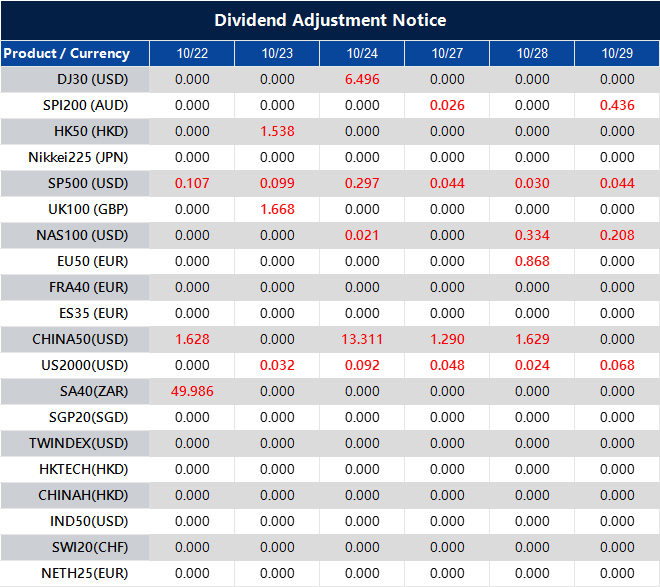
The above data is for reference only, please refer to the MT4/MT5 software for specific data.
If you’d like more information, please don’t hesitate to contact [email protected].







