



Gold prices have risen in Malaysia according to the latest available data.
Gold prices in Malaysia have increased, as reported by FXStreet. The cost for one gram rose to 576.03 Malaysian Ringgits (MYR) from 571.94 MYR, while the price for one tola went up to 6,718.69 MYR from 6,671.03 MYR.
FXStreet adjusts international gold prices to fit Malaysia’s local currency and measurements. These prices are updated daily and may vary slightly from actual local rates.
NZD/USD recovers slightly to near 0.5750 amid fears of a prolonged US government shutdown
NZD/USD rises to nearly 0.5750, fueled by concerns about a long-lasting US government shutdown. This pair has bounced back from around 0.5740, ending a seven-day decline during Thursday’s Asian session.
The US government has been in shutdown for three weeks due to the Senate’s failure to approve funding. A Treasury official mentioned that the shutdown might cost the US economy $15 billion each week, which could weaken the US dollar and help NZD/USD.
Chance Of Fed Rate Cuts
Traders see a 98% chance of a 25 basis point interest rate cut by the Fed in October and another by December, according to Reuters. Ongoing trade tensions between the US and China are adding to market worries, as President Trump pointed out rising tensions, even with a possible pause on tariffs suggested by Treasury Secretary Scott Bessent. Any rise in US-China tensions could impact the Kiwi since China is New Zealand’s largest trading partner. Factors affecting the NZD include the state of New Zealand’s economy, central bank policies, and China’s economic health. The Reserve Bank of New Zealand’s inflation targets play a role in interest rates, affecting the NZD’s appeal. Economic data and overall market sentiment are crucial as well. Strong data and positive growth boost the NZD, while uncertainty tends to favor safer assets.Trading Strategies Amid Volatility
Currently, NZD/USD is testing the 0.5750 mark as the US government shutdown continues. This extended closure is weakening the US dollar, giving the Kiwi a chance to rise. Still, ongoing trade tensions between the US and China limit the Kiwi’s potential growth. A shutdown of this length affects US economic output, as seen in past situations. The Congressional Budget Office estimated that the 35-day shutdown in late 2018 and early 2019 cost the US economy about $3 billion permanently. This history suggests why the dollar is under pressure now and reflects market anxiety. The market almost fully expects the Federal Reserve to take action, with traders pricing in a 98% likelihood of a rate cut this month. This expectation for softer monetary policy poses a challenge for the US dollar. A further rate cut is expected in December, indicating ongoing dollar weakness. Given the risk of sudden new tariffs on China, maintaining a simple long NZD/USD position may be risky. It may be wise to consider options to navigate this uncertainty. For example, buying call options on the NZD/USD can allow for profits from further gains while limiting potential losses if trade developments turn negative. Traders expecting a significant move but unsure of the direction might explore volatility strategies. A long straddle, which involves buying both a call and a put option at the same strike price, could benefit from a major movement in NZD/USD. This shift could occur either with the shutdown’s conclusion or through an escalation in trade conflicts. Create your live VT Markets account and start trading now.Christopher Kent discusses the RBA’s uncertain cash rate range at the CFA Society Australia Investment Conference
Christopher Kent, Assistant Governor of the Reserve Bank of Australia (RBA), spoke at the CFA Society Australia Investment Conference 2025. He mentioned that recent interest rate cuts have made financial conditions less strict, placing the cash rate in a broad and uncertain neutral range.
The neutral rate is not reliable for guiding short-term policy, as economic forecasts give mixed signals. The RBA will reevaluate the economic outlook based on new data and potential risks. At the same time, the Australian Dollar fell 0.17% against the USD, impacted by weak employment data from September.
Monetary Policy Decisions
The RBA sets Australia’s interest rates, influencing the AUD through regular and emergency monetary policy meetings. Their main goals include: – Maintaining price stability – Achieving full employment – Promoting economic wellbeing These goals are primarily met through interest rate changes that affect currency strength. Inflation data can influence currency value, leading central banks to change interest rates. Higher rates often attract foreign investment, increasing demand for the local currency. Economic data, such as GDP and employment statistics, also shape perceptions of the AUD. Quantitative Easing (QE) is when the RBA increases money flow by buying assets, which tends to weaken the AUD. Conversely, Quantitative Tightening (QT) stops asset purchases during economic recovery, strengthening the AUD. Recent comments indicate that the RBA is holding steady after earlier rate cuts in 2025. With the cash rate in a neutral position, the central bank is taking a cautious approach. Thus, we shouldn’t expect any policy changes unless significant surprises arise in economic data.Current Economic Data
This neutral stance is backed by conflicting economic data. The weak September employment report showed unemployment rising to 4.2%, justifying a pause. However, the latest quarterly inflation figures indicated a sticky CPI at 3.1%. This leaves the RBA in a wait-and-see mode, making future actions highly reliant on the next data release. For derivative traders, this outlook may lead to lower implied volatility for the Australian dollar. With the RBA on the sidelines, the dramatic swings caused by monetary policy surprises from 2023 and 2024 are less likely. Selling short-dated options volatility could be a good strategy, but traders should be ready for sudden, short-term spikes around key data releases like the upcoming inflation or employment reports. Given the RBA’s neutral position, the AUD/USD, currently weak at around 0.6495, will probably be more affected by external events in the upcoming weeks. The direction of US interest rates and the prices of key commodities, like iron ore, will likely be the main factors. Iron ore, for example, has struggled to stay above $105 per tonne, providing little support for the Aussie dollar at this time. Create your live VT Markets account and start trading now.Naoki Tamura suggests that the Bank of Japan raise interest rates to a neutral level.
Naoki Tamura, a member of the Bank of Japan (BoJ), has proposed that the central bank should set interest rates to neutral levels. Japan’s economy is expected to grow, supported by a moderate increase in global economic activity.
There is no need for a drastic rate hike or stricter monetary policy since there are both risks of inflation rising and falling. If inflation exceeds expectations, the BoJ may need to adjust rates to avoid drastic increases in the future.
Rising Inflation Risks
Inflation risks are increasing in Japan, with many companies sticking to their investment plans. It’s important to keep a close eye on rising food prices. Currently, Japan’s real interest rate is negative, with domestic price trends possibly rising by July 2025. The Japanese Yen (JPY) is affected by several factors, including BoJ policies, the difference in bond yields between Japan and the US, and overall market risk sentiment. The Yen typically strengthens as a safe-haven asset during uncertain times. Recent adjustments in the BoJ’s ultra-loose policy have bolstered the Yen, partly due to interest rate cuts from other major central banks. These remarks from a BoJ board member indicate a clear trend towards higher interest rates, reinforcing the hawkish attitude we’ve seen this year. The recent drop in USD/JPY to 150.60 shows the market is responding seriously. For derivative traders, this suggests that the time of a consistently weak yen may be coming to an end, prompting a need for strategic changes. The supporting data backs up this view, making the case for future rate hikes more credible. The nationwide Core CPI for September 2025 was reported at 2.3%, remaining above the BoJ’s 2% target for the eighteenth consecutive month. This ongoing inflation supports hawkish members like Tamura in advocating for further policy normalization.Wage Growth and Interest Rates
Additionally, this inflation is being fueled by strong wage growth, which the BoJ has been anticipating. The spring 2025 “shunto” wage negotiations resulted in an average pay increase of 4.5%, the highest in over thirty years. This significant shift means we should now anticipate a greater likelihood of rate hikes at upcoming BoJ meetings. For our strategies, we should prepare for greater volatility in yen-related pairs. The one-month implied volatility on USD/JPY options, which has been around 8%, is likely to rise as the market braces for the BoJ’s next move. We should think about buying options to position for larger price moves, rather than just selling them for premiums. The interest rate gap that has contributed to the yen’s weakness is clearly narrowing. The US 10-year Treasury yield has fallen to 3.8% as the Federal Reserve changes its course, while the yield on the 10-year Japanese Government Bond has risen to 0.95% due to hopes of policy normalization. This shrinking gap will keep putting downward pressure on the USD/JPY pair. Given this outlook, we should prepare for further yen strength in the upcoming weeks. Strategies like buying JPY call options or USD/JPY put options provide a way to profit from a potential move towards 148 or lower with defined risk. Timing these entries around key data releases and before the next BoJ policy meeting will be crucial. Create your live VT Markets account and start trading now.Dow futures anticipate an upward move in the fifth wave, rising from the April 2025 low.
Dow Futures short-term Elliott Wave analysis indicates that we may soon complete a cycle. Wave (5) must go beyond the 47,323 level to confirm this, which could open up promising opportunities for traders.
Gold Remains A Stable Asset
Gold continues to be a reliable asset amid economic challenges, ensuring it retains its value. Meanwhile, Dogecoin is stable at around $0.19, with large holders purchasing more. If weekly support holds, it could recover to $0.23. Traders should be mindful of risks and conduct thorough research before investing. FXStreet does not offer personalized investment advice. Currently, Dow Futures (YM) appear ready for one last upward push to complete a cycle that started in April 2025. Recent CPI data from September 2025 shows inflation cooling to 2.8%, suggesting the Federal Reserve might keep interest rates steady. The key now is for the index to break its previous high of 47,323 to confirm this final move. For traders, a short-term pullback offers a chance to buy into bullish positions, such as call options or long futures contracts. As long as the index stays above the important level of 45,391, any dips should be seen as buying opportunities. With the VIX, the market’s fear gauge, at a calm 16, there are no signs of panic that could disrupt this upward trend.US Dollar Weakness Aids Asset Strength
In addition to equities, gold’s lasting appeal is crucial as a hedge. With the US national debt surpassing $37 trillion, concerns about long-term fiscal stability are growing. Data from the third quarter of 2025 shows that central banks are still strong net buyers of gold, a trend that started during the high inflation period in 2022. The weakening US Dollar benefits both stocks and commodities. The Dollar Index (DXY) has dropped to around 103 from its high of 107 earlier this year, making dollar-denominated assets more appealing. This trend suggests continued strength in currency pairs like EUR/USD and supports the rally in equities and gold. For those willing to take on more risk, we see positive signs in speculative assets like Dogecoin. Recent data shows that wallets holding more than 10 million DOGE have increased their balances by over 5% in the past month. This accumulation by large investors could help push the price toward the $0.23 resistance level if market sentiment remains optimistic. Create your live VT Markets account and start trading now.Yen Strengthens Amid Japan’s Political Uncertainty
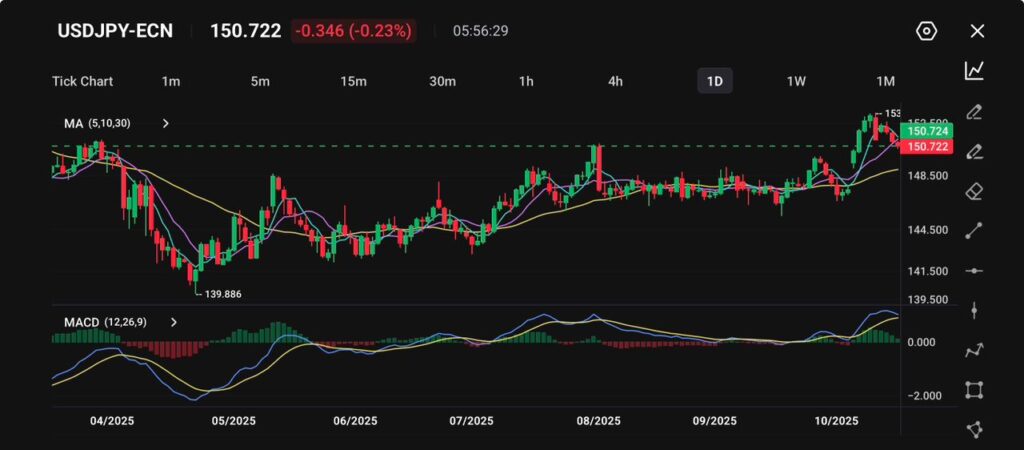
The Japanese yen extended its rally for a third straight session on Thursday, with the USD/JPY pair easing to 150.72 as traders unwound bearish bets amid growing uncertainty surrounding Japan’s political landscape.
The Liberal Democratic Party’s (LDP) recent split with coalition partner Komeito has unsettled expectations for a smooth transition of leadership to Sanae Takaichi as Japan’s next prime minister.
Although the LDP has scheduled a leadership vote for 21 October, opposition parties have yet to confirm their participation, leaving the succession process in doubt and adding to the overall political unease.
Investors who had positioned for a weaker yen under Takaichi’s anticipated pro-spending agenda are now reversing those trades, with some shifting back towards safe-haven assets amid rising political risk.
BoJ Remains Dovish, But Risk Aversion Lends Yen Support
Bank of Japan (BoJ) board member Naoki Tamura reaffirmed the central bank’s cautious stance, warning against tightening monetary policy too early. He emphasised the need to avoid a relapse into deflation and sluggish wage growth, a clear signal that Japan’s ultra-loose monetary framework is likely to stay in place for some time.
Meanwhile, the yen has also drawn strength from safe-haven inflows, supported by a weaker US dollar, escalating US-China trade tensions, and the prolonged US government shutdown, all of which have intensified global risk aversion.
Technical Analysis
The USD/JPY pair is trading around 150.72, down 0.23%, as investors take profits following the pair’s recent climb to the 152.00 region, its highest level since July.
The retracement comes amid renewed speculation that Japanese authorities may intervene to curb excessive yen weakness, while the US dollar cools off on softer Treasury yields and mixed macroeconomic data.
From a technical perspective, USD/JPY remains in a strong uptrend but is showing short-term exhaustion. After the rally from the 147.00 base, price action has begun to consolidate just below key resistance at 152.00.
The 5-day moving average has started to flatten, signalling slowing bullish momentum, while the 10-day MA is catching up as potential dynamic support. The next key support sits near 149.50, followed by 148.30, where previous consolidation occurred.
The MACD indicator also suggests early signs of weakening momentum with the histogram beginning to contract while the MACD line is curling toward the signal line, hinting at a possible short-term pullback.
However, the broader trend remains bullish as long as the pair stays above the 148.00–148.50 region.
Fundamentally, yen traders remain highly sensitive to any verbal intervention from the Bank of Japan (BoJ) or the Ministry of Finance.
With US yields still relatively elevated and the BoJ maintaining ultra-loose policy, interest rate differentials continue to support the dollar. Yet, heightened volatility around the 152.00 mark means traders are cautious about adding new longs.
Outlook
In the near term, the USD/JPY bias appears tilted to the downside as political instability and renewed safe-haven demand strengthen the yen. However, the broader trajectory will hinge on upcoming signals from the Bank of Japan and the Federal Reserve.
Markets will be watching closely to see whether this yen rebound evolves into a sustained recovery or merely a short-term corrective phase.
Australian dollar weakens against the yen, dropping to near 97.70 amid rising unemployment rates
AUD/JPY dropped to about 97.70 during Thursday’s early Asian session, marking a daily decline of 0.43%. This decrease came after Australia’s Unemployment Rate surged to 4.5% in September, the highest in four years.
The Australian Bureau of Statistics noted that the unemployment rate rose from 4.3% in August, surpassing expectations. Additionally, Australia’s Employment Change came in at 14.9K for September, which was lower than the predicted 17K.
Impact of Employment Data on the Aussie
The weak employment data affected the Australian Dollar, indicating a softer labor market. This raised conversations about potential interest rate cuts by the Reserve Bank of Australia (RBA), considering the trends in consumer spending and inflation. In Japan, political uncertainty might delay any potential rate hikes from the Bank of Japan (BoJ). This situation could influence the Japanese Yen, possibly minimizing further declines for the AUD/JPY pair, as a new leader seeks support after a coalition’s breakup. The Reserve Bank of Australia influences the value of the Australian Dollar by setting interest rates. Additionally, the health of the Chinese economy, its Trade Balance, and Iron Ore prices are significant factors. Together, these elements determine the demand and strength of the AUD in the global market.AUD/JPY Market Outlook
The AUD/JPY is facing pressure after Australia reported an unemployment rate of 4.5%, a level not seen since late 2021. This sharp rise strengthens the argument for the Reserve Bank of Australia to lower interest rates next month. In fact, overnight index swaps now reflect over a 70% chance of a 25-basis-point cut at the RBA’s November meeting. We view this as a chance to position for further AUD weakness against the Yen in the coming weeks. Derivative traders might consider buying AUD/JPY put options to benefit from a potential slide towards the psychological level of 96.00. The recent rise in one-month implied volatility to over 12% indicates that the market is preparing for larger price fluctuations, making options strategies particularly relevant. However, we need to pay attention to the situation in Japan, where political instability could slow the Bank of Japan’s plans for policy normalization. The BoJ has been very cautious since ending negative interest rates in 2024, and this uncertainty could make another rate hike before year-end less likely. Such potential JPY weakness could provide some support for the currency pair, preventing a full collapse. The overall outlook for the Aussie Dollar is also influenced by its major trading partners and commodity prices. Currently, iron ore prices are around $115 per tonne, down from their highs, raising concerns about China’s economic growth. Next week, all eyes will be on China’s Q3 GDP data; a weak report could increase pressure on the AUD. Given these mixed influences, the likely direction for the AUD/JPY appears to be lower in the short term. The recent labor market data is a clear indicator affecting RBA expectations, while the political situation in Japan is still unfolding. We believe selling out-of-the-money AUD/JPY call options could be a smart way to collect premiums while maintaining a cautious bearish outlook. Create your live VT Markets account and start trading now.In the next trading session, the central rate for USD/CNY is 7.0968 compared to 7.1021.
The People’s Bank of China (PBOC) has set the USD/CNY reference rate at 7.0968 for the next trading session. This is lower than the previous rate of 7.0995 and also below the Reuters estimate of 7.1186.
The PBOC’s main tasks include maintaining price stability and a stable exchange rate while fostering economic growth. It operates under the authority of the People’s Republic of China (PRC) and is influenced significantly by the Chinese Communist Party.
Monetary Tools Used by the PBOC
The PBOC uses several monetary tools, including the Reverse Repo Rate, Medium-term Lending Facility, Reserve Requirement Ratio, and Loan Prime Rate. The Loan Prime Rate is particularly important as it impacts borrowing costs and savings rates, which in turn affects the exchange rate of the Chinese Renminbi. China has 19 private banks, including well-known digital lenders like WeBank and MYbank. These banks began operating in a state-controlled financial sector after reforms in 2014 allowed private domestic banks to enter the market. The PBOC has indicated its intention to support the yuan by setting today’s reference rate stronger than market predictions. This action counters the negative sentiment that has developed over recent months. Traders should interpret this as a clear policy signal that the authorities are not comfortable with how quickly the yuan has been losing value.Chinese Economic Policy Insights
We’ve seen this approach before, especially amid the economic challenges of 2023, when strong reference rates were used to discourage heavy betting against the currency. With China’s GDP growth for the third quarter recently reported at a steady 4.8% year-over-year, policymakers likely believe they can maintain currency stability. This warning suggests that aggressively shorting the yuan in spot or futures markets could be risky. The ongoing difference with the US Federal Reserve’s ‘higher for longer’ interest rate policy can lead to increased market volatility. Traders using derivatives should prepare for a period of erratic trading rather than a clear trend. Implied volatility for USD/CNY options is expected to rise, making strategies that benefit from this, like straddles, more attractive. In the upcoming weeks, buying call options on the USD/CNY pair could be riskier now that the PBOC has shown its strategy. Traders with long positions might want to look into purchasing downside protection, like puts, to protect against a possible policy-driven drop toward the 7.05 level. Though the costs of these options have likely risen, they provide a way to manage risks in an unpredictable market. Create your live VT Markets account and start trading now.Australian Bureau of Statistics reports unemployment rise to 4.5%, surpassing expectations
Australia’s unemployment rate rose to 4.5% in September, up from 4.3% in August, according to the Australian Bureau of Statistics. This increase was above the expected 4.3%.
In September, employment changed by an increase of 14.9K, a recovery from the previous loss of 11.8K in August, while forecasts had anticipated a growth of 17K. The participation rate also climbed to 67%, up from 66.9%.
Employment Changes
Full-time employment increased by 8.7K, bouncing back from a previous decline of 48.6K. Part-time employment grew by 6.3K, compared to a prior increase of 36.7K. The employment-to-population ratio remained at 64.0%. The rise in unemployment partly stemmed from more people, both men and women, looking for work. The number of unemployed men rose by 24,000 to 370,000, while the number of unemployed women increased by 10,000 to 314,000. Following this news, the Australian Dollar (AUD) decreased in value, trading 0.45% lower against the USD on the same day. The AUD notably weakened most against the Swiss Franc during the week. The Reserve Bank of Australia has kept the Official Cash Rate steady at 3.6%, showing signs of recovering demand. Labor market data remains crucial for monetary policy, shaped by the current employment trends.Market Impact
The unexpected rise in unemployment to 4.5%, the highest level since late 2021, indicates a weakening Australian labor market. This surprise significantly reduces the chances of the Reserve Bank of Australia (RBA) raising rates further. For traders, it strengthens a bearish outlook on the Australian dollar, with increased odds of a future interest rate cut. We have noticed the unemployment rate steadily climbing from below 4% in 2023 and 2024. The RBA’s aggressive rate increases during that time, which drove the cash rate to a peak of 4.35%, aimed to cool the economy. Today’s data suggests that this cooling is accelerating. The current cash rate of 3.6% aligns with an easing cycle, which this report may extend. In the upcoming weeks, we should consider buying put options on the AUD/USD, aiming for a drop below the 0.6400 support level. This strategy allows us to profit from a falling Australian dollar while limiting potential losses to the premium paid. The market reacted sharply, pushing the AUD/USD down nearly half a percent, indicating quickly building bearish sentiment. The data also shows the Aussie dollar’s general weakness, especially against safe-haven currencies like the Swiss Franc. Therefore, shorting the AUD/CHF cross could be a smart move, particularly given ongoing global uncertainties such as the U.S. government shutdown. This approach targets the specific weakness in the Australian economy versus a more stable currency. With speculation that the US Federal Reserve might also cut rates, betting directly on Australian monetary policy is another strong strategy. We could explore interest rate futures to position ourselves for the RBA responding to this weaker employment data. This strategy zeroes in on the domestic situation, minimizing distractions from changing US policies. Create your live VT Markets account and start trading now.Part-time employment in Australia dropped sharply from 35.5K to 6.3K in September.
Australia’s part-time jobs dropped significantly from 35.5K to just 6.3K in September. This decline is putting pressure on the Australian Dollar, increasing the likelihood that the Reserve Bank of Australia may cut interest rates.
Gold is on the rise, now close to $4,250. This increase is driven by demand for safe assets and a weaker US Dollar. Current readings show that gold might be overbought, indicating strong interest in the metal as a secure investment during uncertain economic times.







