
Back

Danske Research says Middle East tensions and Iranian attacks on UAE energy sites keep Brent above $100

Conflict in the Middle East has escalated, with Iran attacking oil and gas sites in the UAE and other areas. Brent crude is trading at about USD 103 per barrel after a brief dip, and it has remained above USD 100/bbl so far this week. Iran struck the Shah gas field in the UAE using a drone, and a fire was reported in the Fujairah Oil Industry Zone. A tanker near the port of Fujairah was also reported to have been hit while at anchor.

Energy Infrastructure Under Attack

Israel said on Monday that it has detailed plans for at least three more weeks of war. It has continued strikes on sites across Iran and Lebanon. Oil prices fell during the previous session but rose overnight as attacks on energy infrastructure increased. The focus on energy assets raises the risk that oil prices move higher and stay elevated, even if traffic through the Strait of Hormuz returns to normal. The article was produced using an artificial intelligence tool and checked by an editor. With Iran now directly targeting energy facilities in the UAE, we see a significant geopolitical risk premium being priced into crude. The attacks on the Shah gas field and Fujairah’s oil zone suggest a deliberate strategy to disrupt supply. This points towards sustained price pressure and volatility in the coming weeks.

Market Volatility And Trading Implications

Implied volatility on crude options has surged, with key volatility indexes now trading above 50, a level we haven’t seen since the market turmoil of early 2025. This makes buying simple call options expensive, so traders should consider using bull call spreads to lower the cost of positioning for higher prices. This heightened volatility reflects the market’s deep uncertainty about potential further supply disruptions. We should remember the market’s reaction to the 2019 attacks on Saudi facilities, which caused an immediate 19% spike in Brent prices within a single day. The current situation feels more like the prolonged price elevation we experienced throughout 2022. This history suggests any headline suggesting de-escalation could be temporary, making outright short positions extremely risky. We are watching the Brent-WTI spread closely, as it has already widened to over $6 due to Brent’s greater exposure to Middle Eastern supply threats. Traders should also consider the impact on sectors sensitive to fuel costs. Hedging strategies could involve buying put options on airline and shipping equities, which face severe margin pressure from oil above $100 per barrel. Given Israel’s stated timeline for at least three more weeks of military operations, we believe the risk will remain elevated into April. Positioning through short-dated derivatives, such as April and May 2026 call options on Brent, is the most direct way to trade this expected turbulence. The risk of sudden, sharp price movements means holding positions requires diligent risk management. Create your live VT Markets account and start trading now.

Start trading now – Click here to create your real VT Markets account
EUR/GBP remains above 0.8600 near 0.8635 as traders await ECB, BoE decisions and UK jobs data

EUR/GBP traded near 0.8635 in early European dealings on Tuesday. Market participants were cautious ahead of the ECB and BoE rate decisions due on Thursday, as well as the UK employment report. The ECB is expected to keep its deposit rate at 2.0% at its March meeting on Thursday. Interest rate futures fully price one rate rise by the end of July and put the chance of a second by the end of December at about 55%, while a Reuters poll on 9–13 March pointed to steady rates.

Key Central Bank Expectations

ECB Governing Council member Peter Kazimir referred to the Iran war and its effect on inflation risk as a factor that could bring forward rate rises. The BoE is also expected to leave its rate unchanged at 3.75% on Thursday. Oxford Economics set out a scenario in which oil at $140 a barrel would raise inflation and could lead to a mild UK recession. For UK jobs data on Thursday, the ILO unemployment rate is forecast to hold at 5.2% in January. With the EUR/GBP pair holding steady near 0.8635, the market is clearly waiting for a catalyst before making its next move. This pause ahead of both the European Central Bank (ECB) and Bank of England (BoE) interest rate decisions this Thursday creates an ideal environment for volatility-based strategies. The release of the UK employment report on the same day only adds to the potential for a significant price swing. The Bank of England is facing a difficult trade-off, as we remember their struggle with persistent inflation throughout 2025. With the latest UK Consumer Price Index (CPI) reading for February coming in at a stubborn 3.1% and Brent crude oil now trading around $95 a barrel, the pressure to act is immense. A surprise rate hike is a distinct possibility, but so is a dovish pause if recession fears dominate, creating a wide range of potential outcomes for the Pound.

Trading Approaches Ahead Of Thursdays Risk Events

Across the channel, the ECB is also in a bind, with Eurozone inflation at 2.7% and geopolitical tensions from the Iran war fueling hawkish sentiment. While interest rate futures are pricing in a 55% chance of two rate hikes by the end of this year, the official line remains patient. This divergence between market pricing and central bank communication presents a clear opportunity for traders if the ECB signals a shift sooner than expected. Given this uncertainty, buying short-dated options straddles on EUR/GBP makes sense for the coming weeks. This strategy allows us to profit from a large move in either direction without having to guess the outcome of the central bank meetings. Implied volatility for one-week options has already climbed to 8.5%, reflecting the market’s anticipation of a breakout from the current range. For those with a directional view, the UK jobs data is a key pivot point. If we believe the labour market will show unexpected strength and beat the 5.2% unemployment forecast, buying GBP call options against the EUR is a measured approach. This provides upside exposure to a stronger pound while defining our maximum risk if the data disappoints or the BoE remains cautious. Create your live VT Markets account and start trading now.

Start trading now – Click here to create your real VT Markets account

After RBA decisions, AUD/USD recovered most earlier losses, rising towards 0.7085 following Governor Bullock’s briefing

AUD/USD recovered most early losses after the RBA decision and rose to about 0.7085 following Governor Michele Bullock’s press conference. The RBA raised the Official Cash Rate by 25 basis points to 4.1%, with five of nine committee members supporting the move. The RBA said the Middle East conflict had pushed fuel prices higher and that sustained rises could add to inflation. Bullock said inflation was already high because demand was exceeding supply, and that the cash rate was not high enough to return inflation to target.

Technical Picture After The RBA

The US Dollar stayed firm after a corrective move ahead of the Federal Reserve’s policy decision due on Wednesday. AUD/USD held above the rising 20-day EMA near 0.7060, supporting a mild bullish bias. The 14-day RSI moved into the 40.00–60.00 band after dropping from 60.00–80.00, pointing to steadier momentum. Resistance sits near 0.7100 and the 0.7120–0.7150 area, with further levels at the mid-0.72s and 0.7300. Support levels include 0.6944 and about 0.6900. A break below 0.6900 could open a move towards 0.6770–0.6800. We remember that period in 2025 when the RBA hiked rates to 4.1%, and Governor Bullock’s comments made it clear that domestic inflation was the real worry, even more than global oil prices. That hawkish pivot, clarifying that demand was outstripping supply, set a tone for policy that still echoes today. It showed us the central bank was willing to look through global noise to focus on homegrown price pressures.

Strategy Ideas For The Next RBA Cycle

Fast forward to today, March 2026, and the situation is getting complicated again. After falling for most of last year, the latest quarterly CPI data surprised to the upside, ticking back up to 3.4% and putting the RBA in a difficult position. With the unemployment rate also drifting higher to 4.2% from its historic lows, the bank is now torn between fighting sticky inflation and supporting a cooling labor market. This uncertainty suggests that volatility in the AUD/USD could be undervalued heading into the next RBA meetings. Traders should consider buying options straddles to profit from a significant price swing, regardless of the direction. Such a strategy would capitalize on the market’s reaction if the RBA either surprises with another hike or signals a definitive dovish pivot due to employment worries. Based on the RBA’s hawkish stance from 2025, a directional bet favouring a stronger Aussie dollar is also plausible if you believe they will prioritize inflation again. Using futures contracts to go long AUD/USD on a break above the recent 0.6750 resistance level could be a viable strategy. We can look to the old resistance levels from 2025, like 0.7100, as long-term historical targets if a new uptrend develops. The outlook for the US dollar adds another layer to this trade. While our inflation is proving sticky, the latest US CPI print came in at a more subdued 2.8%, prompting Federal Reserve officials to talk more openly about a pause. This growing policy divergence between a potentially still-hawkish RBA and a neutral-to-dovish Fed strengthens the case for a higher AUD/USD in the coming weeks. To manage risk on a bullish Aussie view, traders could use call options instead of outright futures. Buying AUD/USD call spreads allows for a defined-risk position that profits from a rise in the currency pair. This would limit potential losses if the RBA places more weight on the rising unemployment figures and issues a surprisingly cautious statement. Create your live VT Markets account and start trading now.

Start trading now – Click here to create your real VT Markets account

After lifting rates 25 bps to 4.10%, Governor Bullock outlines RBA policy outlook at press conference

The Reserve Bank of Australia raised the Official Cash Rate by 25 basis points to 4.10% from 3.85% after its March meeting. The decision was by majority, with five members voting for the rise and four voting to keep the rate at 3.85%. Governor Michele Bullock said higher petrol prices were not the reason for the increase and that the cash rate was not high enough to return inflation to target. She said the board debated timing, not the direction of policy, and some members preferred waiting until May.

Rba Signals Rates Still Not Restrictive Enough

The RBA said inflation has fallen from its 2022 peak but picked up in the second half of 2025, with capacity pressures contributing. It said short-term inflation expectations have risen and warned inflation may stay above target for longer than previously expected. The board discussed uncertainty from the Middle East, noting sharply higher fuel prices could add to inflation if sustained. It said the conflict poses risks in both directions and that how restrictive policy is remains uncertain. After the decision, AUD/USD fell to test 0.7050 and was down 0.17% on the day. Recent data cited included GDP growth of 0.8% in Q4 2025 and 2.6% year-on-year, plus CPI of 0.4% in January and 3.8% year-on-year. The Reserve Bank of Australia’s decision to raise the cash rate to 4.10% confirms a strong commitment to fighting inflation. The board’s discussion was not about whether to hike, but when, signaling that the path of least resistance is for higher rates. Derivative traders should interpret this as a hawkish stance, with the bank clearly prioritizing inflation over potential downside risks to employment.

Market Focus Turns To May Meeting

This move comes as we have seen inflation pick up materially since the second half of 2025, with the monthly CPI holding firm at 3.8% in January. Data from the Australian Bureau of Statistics confirms the Wage Price Index is running at a 4.2% annual pace, a level that will keep the central bank concerned about persistent domestic price pressures. This strong underlying data supports the RBA’s view that more work may be needed to bring demand down. Traders in interest rate markets should be focused on the May RBA meeting, which the board explicitly considered for this hike. The split vote indicates an active debate, but the overall message is that even the dissenters felt a rate rise would be needed eventually. This should lead the market to price in a higher probability of another 25 basis point hike in the next few months. For those trading the Australian dollar, the initial drop reflects that this hike was largely expected. The real takeaway is the “uncertain” forward path, which should increase implied volatility in AUD/USD options. This environment could favour strategies that profit from large price swings, as geopolitical events or a surprise inflation print could cause sharp moves. We need to remain alert to the conflict in the Middle East, which the RBA mentioned as a significant factor in its discussions. We remember from past energy shocks, such as the one in 2022 following the conflict in Ukraine, how quickly rising oil prices can feed into broader inflation. The RBA is clearly worried about this risk, and any escalation could trigger a more aggressive policy response. Create your live VT Markets account and start trading now.

Start trading now – Click here to create your real VT Markets account

Ahead of Fed and ECB rate decisions, the euro-dollar pair slips below 1.1500, trading near 1.1490 early

EUR/USD traded lower near 1.1490 in early European dealing on Tuesday, slipping below 1.1500. The US Dollar rose as higher oil prices linked to the US and Israel’s war with Iran raised inflation concerns and shifted expectations for US interest rates. The Federal Reserve is expected to leave its benchmark rate unchanged at 3.50% to 3.75% after its meeting ends on Wednesday. Goldman Sachs economists moved their forecast rate cuts to September and December, from June and September, due to a higher inflation path.

Central Bank Outlook

The European Central Bank is expected to keep its deposit rate at 2.0% at its March meeting on Thursday. ECB Governing Council member Peter Kazimir said a rate rise could come sooner than expected. Interest rate futures fully price in a rate rise by the end of July and put the chance of a second rise by the end of December at about 55%. A Reuters poll conducted March 9–13 found economists still expected steady rates. Looking back to this time in 2025, we recall the market’s anxiety as the EUR/USD fell below 1.1500. The conflict premium in oil prices was forcing a major rethink of the Federal Reserve’s path, pushing expected rate cuts deep into the year. That period of uncertainty set the stage for much of the dollar strength we experienced throughout the rest of 2025. The environment today is a direct result of those events, with the pair now trading much lower around the 1.0780 level. The interest rate differential that widened last year remains the dominant factor, as stubborn inflation has kept the Fed from cutting rates as aggressively as once hoped. We’ve seen US CPI data hover around 3.2% year-over-year for the last two reports, reinforcing the dollar’s yield advantage over the euro.

Trading Strategy Ideas

For the coming weeks, we see opportunity in selling volatility, which has subsided since the geopolitical flare-up last year. One-month implied volatility on EUR/USD options is now hovering around 6.5%, down significantly from the double-digit peaks seen in early 2025. Traders could consider selling out-of-the-money strangles, collecting premium by betting the pair remains within a defined range as central banks signal a steady policy path. Attention should now turn to upcoming inflation figures and employment data on both sides of the Atlantic. With WTI crude oil prices having stabilized near $82 per barrel, the energy-driven inflation shock from 2025 has mostly passed through the system. This suggests that any surprise weakness in US labor market data could cause a sharp repricing, making long-dated call options on EUR/USD an interesting, albeit contrarian, hedge against a sudden shift in Fed sentiment. Create your live VT Markets account and start trading now.

Start trading now – Click here to create your real VT Markets account

In Asia, USD/JPY holds above 159.00 as buyers await Fed and BoJ policy updates

USD/JPY saw dip-buying in Asia on Tuesday, which halted a modest pullback from 159.75, the highest level since July 2024, retested on Monday. The pair traded around 159.20–159.25, with buying interest tempered by intervention fears and upcoming central bank decisions. The Federal Reserve announces its decision on Wednesday after a two-day meeting, followed by the Bank of Japan policy update on Thursday. Markets are watching for clues on rate paths as inflation concerns persist amid further escalation of conflicts in the Middle East.

Near Term Technical Picture

Technically, the near-term tone is mildly bullish as price remains above the rising 200-period Simple Moving Average on the 4-hour chart. The MACD has turned slightly positive after recovering from negative territory. The RSI is near 49, close to neutral, suggesting limited momentum. Resistance is near 159.60, then 159.75 and 160.00, while support sits at 159.00, the 200-period SMA around 158.40, and then 158.00. The technical section was produced with help from an AI tool. The story was corrected on March 17 at 07:30 GMT to note 160.00 as the next resistance. The current market feels very similar to the cautious tone we saw back in 2025, with the USD/JPY pair now trading even higher, around 161.50. This places us firmly in territory where intervention from Japanese authorities is not just a risk, but an expectation. The primary challenge is balancing the strong underlying upward trend with the imminent threat of a sudden, sharp reversal.

Risk Management With Options

This upward pressure is fueled by clear economic data showing a divergence between the US and Japan. The latest US Non-Farm Payrolls report for February 2026 showed a robust 250,000 jobs added, reinforcing the Federal Reserve’s case for maintaining higher interest rates. In contrast, Japan’s most recent Tokyo Core CPI is stalled at 1.8%, giving the Bank of Japan little reason to tighten its policy aggressively. We must remember the sharp sell-offs that occurred when these levels were tested in the past, particularly the major interventions of 2022 and 2024. Looking back at the April 2024 event, the Ministry of Finance was suspected of spending over ¥9 trillion to defend the yen after it crossed the 160 mark. History shows that official action is swift and designed to have the maximum impact on market sentiment. Given this binary risk of either a breakout or a reversal, we should use options to manage our positions in the coming weeks. Buying JPY call/USD put options provides a crucial hedge against a sudden drop, protecting long spot positions from intervention-driven losses. This strategy allows us to maintain our core bullish view while defining our maximum potential loss. For traders who are less certain of the direction but expect a significant move, a long straddle strategy is appropriate. By purchasing both a call and a put option, we can profit from a large price swing in either direction, whether it’s a surge past 162.00 or a plunge back towards 158.00. The key is that implied volatility, currently around 12% for one-month options, reflects this heightened market tension. The key levels to watch are 162.00 as a psychological resistance and 160.50 as initial support. A decisive break above 162.00 could signal that the market is willing to challenge authorities, while a drop below 160.50 would be the first sign that bullish momentum is cracking. We must be prepared for increased volatility around the central bank meetings scheduled for later this month. Create your live VT Markets account and start trading now.

Start trading now – Click here to create your real VT Markets account

EUR/JPY stays above 183.00, rising near 183.10 as BoJ likely keeps rates unchanged, weakening Yen

EUR/JPY rose for a second session and traded near 183.10 in Asian hours on Tuesday, holding above 183.00. The move came as the yen softened ahead of a Bank of Japan decision that is expected to keep rates unchanged at 0.75% on Thursday. Japan’s Finance Minister Satsuki Katayama said markets are seeing higher volatility and that authorities are ready to act if needed, including in foreign exchange. That stance may limit further yen falls.

Bank Of Japan Decision In Focus

BoJ Governor Kazuo Ueda said underlying inflation is moving towards the 2% target, and policy will be set to deliver stable and sustainable inflation. Attention remains on Thursday’s BoJ decision. The euro found support as oil prices eased after several tankers passed safely through the Strait of Hormuz. Markets also expect major economies to release petroleum reserves to offset possible supply disruption. Focus also turns to the European Central Bank on Thursday, where the Main Refinancing Rate is expected to stay at 2.15%. Money markets fully price in a rate rise by July. In 2022, the euro accounted for 31% of global FX transactions, with average daily turnover above $2.2 trillion. EUR/USD makes up about 30% of all trades, followed by EUR/JPY at 4%, EUR/GBP at 3%, and EUR/AUD at 2%.

Strategy Considerations For The Weeks Ahead

The EUR/JPY cross is trading around 185.50, a very different environment from what we saw in 2025. Last year, the Bank of Japan was holding steady while the European Central Bank was still considering hikes. Now, the dynamic is shifting, and we must adapt our positions for the coming weeks. The Bank of Japan finally ended its negative interest rate policy last week, moving its key rate to 0.10% for the first time since 2007. This historic shift comes as Japan’s core inflation has stayed above the 2% target for nearly two years, hitting 2.8% in the latest reading for February. Despite this hike, the Yen remains weak, so we must still watch for verbal and physical intervention from Japanese authorities. On the other side, the European Central Bank is holding its main rate at 4.0%, but the conversation has turned to rate cuts. With the latest Eurozone inflation data showing a decline to 2.6%, money markets are pricing in a 75% chance of a first rate cut by June. This contrasts sharply with the mood in 2025 when the market was still anticipating further tightening from the ECB. We should also remember that the tailwind from falling oil prices that supported the Euro last year has reversed. Crude oil is now hovering around $85 a barrel due to persistent supply concerns, which pressures the energy-importing Eurozone economy. This higher cost of energy could limit the Euro’s upside potential against the Yen. For derivative traders, this fundamental shift suggests the long EUR/JPY trend is losing momentum. The once-widening interest rate gap is now set to narrow, making long positions less attractive. We should consider buying put options or establishing bear put spreads to protect against a potential downturn in the pair over the next month. Create your live VT Markets account and start trading now.

Start trading now – Click here to create your real VT Markets account

The GDX Gold Miners ETF shows a zigzag Elliott Wave correction, with waves A and B completed

GDX is in a short-term correction that follows a zigzag Elliott Wave pattern. From the all-time high on 2 March, wave ((A)) ended at $95.96, then wave ((B)) rose to $105.74. Price then fell below the end of wave ((A)), which marks the start of wave ((C)). Fibonacci projections place the downside area between $71.6 and $84.6, based on the 100%–161.8% extension of wave ((A)).

Wave Structure And Key Levels

Wave ((C)) is forming a five-wave impulse. From the wave ((B)) peak, wave (1) dropped to $91.13, and wave (2) is now rising. Wave (2) is correcting the move from the 10 March 2026 high and may unfold in three or seven swings. The near-term pivot is $105.74; while this level holds, rallies are treated as corrective and may fail after three or seven swings, allowing the decline to continue. Given the analysis that GDX is in a corrective downtrend, we should consider bearish derivative strategies in the coming weeks. Purchasing put options is a straightforward way to position for a decline towards the target zone of $71.60 to $84.60. Selling out-of-the-money call spreads above the key $105.74 resistance level is another viable strategy to profit if the price moves sideways or down. This technical view aligns with recent fundamental pressures on the mining sector. The latest February 2026 inflation data showed a stubborn Consumer Price Index at 3.3%, which has pushed back market expectations for imminent rate cuts. This backdrop, combined with WTI crude oil prices firming up around $82 a barrel, suggests continued margin pressure for miners. We saw a comparable dynamic in mid-2025, after gold prices stalled following a strong first quarter. During that period, GDX underperformed physical gold as uncertainty about central bank policy weighed on the broader equity markets. That historical context suggests we should remain cautious on rallies in the mining sector until there is more economic clarity.

Tactical Trade Setup

The current small rally, which began after the March 10 low, presents a tactical opportunity to initiate bearish positions at more favorable levels. We should look for this upward move to stall before it reaches the $105.74 high. This bounce allows for better entry points for puts or short positions, with a clearly defined risk level. To capitalize on the expected move lower, we are looking at put options with expiry dates in May or June 2026. This timeframe should be sufficient for the next leg down, wave (3) of ((C)), to materialize. Strike prices between $90 and $80 would offer a good balance of risk and potential reward as the ETF moves towards its Fibonacci projection targets. Create your live VT Markets account and start trading now.

Start trading now – Click here to create your real VT Markets account

Following the RBA’s 25-basis-point hike to 4.10%, the Australian Dollar weakens, pushing AUD/USD towards 0.7060

AUD/USD fell towards 0.7060 in Asian trading on Tuesday, with the Australian dollar easing against the US dollar after the Reserve Bank of Australia (RBA) rate decision. Markets are watching the RBA press conference at 4:30 GMT for further guidance on the rate outlook. The RBA raised the Official Cash Rate by 25 basis points to 4.10% from 3.85% after its meeting. RBA Governor Michele Bullock is due to explain the decision later on Tuesday.

Rba Decision And Market Focus

Attention then turns to the US Federal Reserve decision on Wednesday. The Fed is expected to keep its benchmark rate unchanged within the 3.50% to 3.75% range at the end of its two-day meeting. Higher energy prices since the start of the Iran war have led analysts to delay expected rate cuts. Goldman Sachs economists dropped their June cut forecast and now expect cuts in September and December, compared with June and September previously, citing a higher inflation path. We recall that back in March 2025, the Reserve Bank of Australia raised its key rate to 4.10% while the US Federal Reserve was holding steady at a lower 3.75%. The geopolitical tensions in Iran at the time were pushing up energy prices, complicating the outlook for inflation. This environment set the stage for a divergence in central bank policy that has since played out. Over the past year, the Fed was forced to become more aggressive than anticipated, pushing its benchmark rate up to the current 5.50% to combat persistent inflation. The RBA also tightened, but more slowly, with its cash rate now at 4.35%. This widening interest rate differential in favor of the US Dollar is a primary reason the AUD/USD pair has fallen from over 0.7000 in early 2025 to around the 0.6550 level today.

Inflation And Rate Path Uncertainty

Currently, US inflation remains sticky, with the latest Consumer Price Index (CPI) data showing a 3.2% annual increase, still well above the Fed’s 2% target. This stubbornness means that while the market anticipates rate cuts later this year, the timing is highly uncertain. The CME FedWatch Tool indicates traders are pricing in a roughly 60% chance of the first rate cut by June, but this can change quickly with new data. Australia is facing a similar challenge, with its own CPI hovering at 3.4%, giving the RBA little room to consider easing its policy. However, the market perceives the Fed as having more resolve to keep rates higher for longer, which continues to support the US Dollar. Key commodity prices, like iron ore, which is crucial for the Aussie dollar, have also softened recently, trading below $100 a tonne after a slump in demand. Given this backdrop of high but slowly moderating inflation in both countries, volatility in the AUD/USD is likely to remain elevated. Traders could consider strategies that profit from this, such as purchasing straddles or strangles around key economic data releases like the upcoming US PCE inflation report. These options strategies can benefit from a large price move in either direction without needing to predict the specific outcome. For those anticipating the pair will remain caught between a hawkish Fed and a stubborn RBA, selling options may be a viable strategy. An iron condor, which involves selling both a call spread and a put spread, could be used to define a range, for instance between 0.6400 and 0.6700, and profit from the pair’s price staying within those bounds over the next few weeks. This approach benefits from time decay as long as the currency pair does not make a significant breakout. Create your live VT Markets account and start trading now.

Start trading now – Click here to create your real VT Markets account

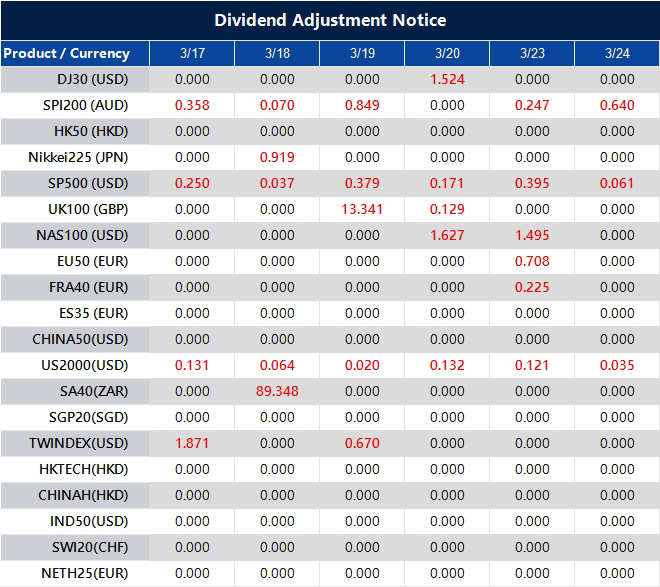
Dividend Adjustment Notice – Mar 17 ,2026

Dear Client,

Please note that the dividends of the following products will be adjusted accordingly. Index dividends will be executed separately through a balance statement directly to your trading account, and the comment will be in the following format “Div & Product Name & Net Volume”.

Please refer to the table below for more details:

Dividend Adjustment Notice

The above data is for reference only, please refer to the MT4/MT5 software for specific data.

If you’d like more information, please don’t hesitate to contact [email protected].

Back To Top
server

Hello there 👋

How can I help you?

Chat with our team instantly

Live Chat

Start a live conversation through...

  • Telegram
    hold On hold
  • Coming Soon...

Hello there 👋

How can I help you?

telegram

Scan the QR code with your smartphone to start a chat with us, or click here.

Don’t have the Telegram App or Desktop installed? Use Web Telegram instead.

QR code

