
Back

Trump urged allies to assist the US in Strait of Hormuz talks, noting Iran’s limited options remaining

US President Donald Trump said he is encouraging other countries to help the US after talks on the Strait of Hormuz. He said many countries told him they are on their way, and that some are enthusiastic while others are not. He said the US has destroyed 30 mine-laying ships and is not sure whether any mines have been dropped. He said he expects very few shots to be fired and that Iran has very few shots left.

International Support Unclear

He also said countries should be helping the US. He added that he is not sure other countries want him to say whether they are helping. With the US taking a hard line on Iran’s activities in the Strait of Hormuz, we should anticipate heightened volatility in energy markets. These comments follow last month’s incident where a tanker was briefly detained, which sent May delivery Brent crude futures above $98 a barrel for the first time in over a year. As of this week, maritime insurance premiums for vessels passing through the strait have already risen by 15%, reflecting the growing tension. The stated belief that Iran has “very few shots left” creates an environment ripe for options trading. We should consider buying volatility, as implied volatility on crude options is already climbing, with the OVX now trending towards 45. This is a level we haven’t seen since the supply chain disruptions back in late 2025, suggesting the market is pricing in a significant event. We can look back to the market’s reaction following the attacks on Saudi oil facilities in 2019 for a historical parallel. Brent prices surged almost 20% in a single session, showing how quickly geopolitical events in this region can be priced in. A similar, sharp spike is a distinct possibility if any direct confrontation occurs, even if it proves to be short-lived.

Positioning For Volatility

The commentary on international support being on the way, but unconfirmed, presents a binary risk. If a strong coalition is formally announced, it could calm markets and push oil prices down as the risk of a unilateral conflict fades. However, if no allies are named in the coming weeks, the market will likely view this as bluster, adding to the risk premium. Given this uncertainty, we should consider strategies that profit from a large move in either direction, such as a long straddle on major oil ETFs. This approach allows us to capitalize on the rising volatility without betting on a specific outcome of either escalation or a sudden diplomatic resolution. The current market setup indicates that a period of range-bound trading is the least likely outcome. Create your live VT Markets account and start trading now.

Start trading now – Click here to create your real VT Markets account
GBP/USD trades around 1.3310, erasing Friday losses as investors absorb US–Israel conflict escalation with Iran

GBP/USD rebounded to about 1.3310, ending a four-day losing run and recovering most of Friday’s losses as markets processed the latest US–Iran war news. The pair was near 1.3316 in the 4-hour view. Tensions increased after the US struck Iran’s Kharg Island on Saturday. President Donald Trump called for an international effort to protect and reopen the Strait of Hormuz, while most countries declined to send ships and instead backed diplomatic routes.

Central Bank Focus This Week

Attention now turns to central bank decisions this week. The Bank of England is expected to keep rates unchanged on Thursday, after the Federal Reserve decision on Wednesday, with markets pricing the Fed to hold at 3.50%–3.75%, alongside a new Summary of Economic Projections. Technically, the near-term tone stays bearish, with price below the 20-period SMA near 1.3325 and the 100-period SMA near 1.3411. RSI has recovered towards 48, moving away from oversold levels. Resistance is seen at 1.3317, with a break pointing to 1.3410–1.3420. Support sits at 1.3284, then 1.3230 if 1.3284 fails. Looking back at the events of 2025, we can see the rebound in GBP/USD to 1.3310 was a temporary relief rally following the US-Iran conflict. That period of tension around the Strait of Hormuz was a critical turning point for energy markets. The initial digestion of the news proved to be overly optimistic, as the situation had longer-term consequences.

Lessons For Volatility Positioning

The US strike on Kharg Island last year ultimately triggered a sustained spike in oil prices. Brent crude, which was trading around $85 a barrel before the incident, surged past $115 by the end of that quarter, causing a significant inflation shock globally. Data from the Office for National Statistics later showed UK CPI, heavily influenced by energy costs, climbed over two percentage points faster than in the US during the second half of 2025. This divergence in inflation forced the Bank of England into a more aggressive hiking cycle than the Federal Reserve, which was dealing with a less severe energy shock. While both central banks held rates in the immediate aftermath as the article noted, the BoE was later forced to raise rates by an additional 75 basis points by year-end 2025 to combat Sterling’s weakness and imported inflation. This policy divergence ultimately weighed on the UK’s growth outlook more than the US’s. Today, with GBP/USD trading closer to the 1.2550 level, we can see the long-term fallout from last year’s geopolitical flare-up. The key lesson for us as derivative traders is how quickly implied volatility can re-price. In the weeks following the 2025 strike, one-month implied volatility on GBP/USD options jumped from around 7% to over 12%, rewarding traders who were long volatility. Therefore, going forward, our focus should be on positioning for similar asymmetric risks. Even with current stability, geopolitical flashpoints in energy-producing regions remain a primary threat. We should consider buying cheap, out-of-the-money options on currency pairs sensitive to oil prices, like USD/CAD or USD/NOK, to prepare for another unexpected supply shock. Using strategies like long straddles in GBP/USD can be an effective way to position for a breakout in volatility without betting on a specific direction. The 2025 Kharg Island event demonstrated that the market’s initial reaction is often not the final one. These events introduce sustained periods of uncertainty that are best traded through options rather than spot positions. Create your live VT Markets account and start trading now.

Start trading now – Click here to create your real VT Markets account

Update: Notice on the Phased Implementation of Dynamic Leverage – Mar 17 ,2026

Dear Client,

To ensure fair trading conditions and manage market volatility during major economic announcements, VT Markets will apply temporary leverage adjustments on certain trading products during specific news periods and market opening/closing.

This mechanism will be introduced in phases starting from 19 March 2026, with full implementation across all servers and clients by 20 March 2026.

These adjustments are designed to protect clients from abnormal market fluctuations, sudden liquidity changes, and extreme price movements that may occur during high-impact news releases.

1. Products Affected

The temporary leverage adjustment may apply to the following products:
• Forex
• Gold
• Silver
• Oil
• Indices
• Commodities (including XPT and XPD)

2. Adjusted Leverage During News Releases and Market Opening/Closing

During the specified news period, maximum leverage will be adjusted as follows:
Forex: 200
Gold: 200
Silver: 50
Oil: 20
Indices: 50
Commodities: 5

Please note that each product with leverage already below the above will not be affected.

3. News Events That Can Trigger the Adjustment

Leverage adjustments may be applied during major economic announcements including:
• FOMC Interest Rate Decisions
• CPI (Consumer Price Index)
• GDP
• PMI / NMI
• PPI
• Retail Sales
• Non-Farm Payroll (NFP)
• ADP Employment Data
• Crude Oil Inventories

The above data is for reference only. Other significant macroeconomic releases from major economies may also be included.

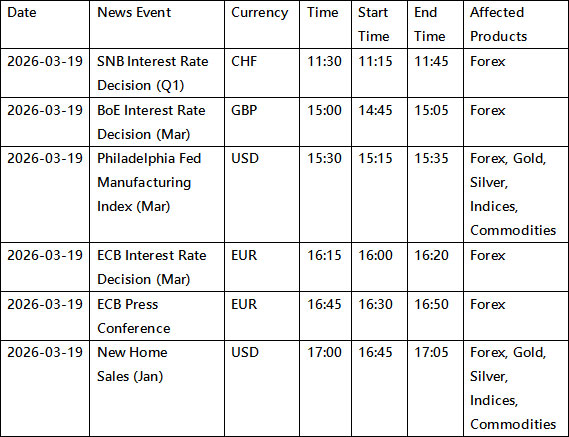
Please refer to the table below for details of the upcoming events and affected instruments:

Notice on the Phased Implementation of Dynamic Leverage

All dates and times are stated in GMT+3 (MT4/MT5 server time).

4. Affected Period of News Releases and Market Opening/Closing

Temporary leverage adjustments apply during the following periods:
Economic News Period
15 minutes before the announcement
5 minutes after the announcement
Market Opening / Closing Period
3 hours before the weekly market closing (Friday)
30 minutes after market reopening (Monday)
30 minutes before daily market closing (Monday – Thursday)

After the above period ends, leverage will automatically return to the original leverage.

5. Important Rules

• The adjustment only affects new positions open during the adjustment period.
Positions opened before the adjustment period will not be affected.
• Once the adjustment period ends, original leverage will resume automatically.

6. Example Scenarios

Example 1 – Position Opened Before the Adjustment Period
A client opens a Gold position at $3,000 before the news period.
Account leverage: 1:500
Margin required:
3000 × 100 ÷ 500 = $600
Since the position was opened before the news period, the leverage remains unchanged.

Example 2 – Position Opened During the News Period
A client opens a Gold position during the news period.
Leverage is temporarily reduced from 1:500 to 1:200
Margin required:
3000 × 100 ÷ 200 = $1500
Once the news period ends, the leverage setting will revert to the original level.

Example 3 – Product With Lower Default Leverage
A client trades an index product with leverage 1:20.
Since the leverage is already below 1:50, the news-period adjustment does not apply, and margin requirements remain unchanged.

We strongly encourage clients to take these temporary leverage adjustments into account when planning trading strategies during high-impact economic events.

If you have any questions, please contact our support team: [email protected]

Gold remains near $5,000 as US dollar and yields soften ahead of looming Fed decisions and central banks

Gold traded flat on Monday as the US Dollar and Treasury yields eased after a recent rally. XAU/USD was around $4,990, after an intraday high of $5,038. The US-Iran war entered its third week, with concerns over shipping through the Strait of Hormuz. Since the US-Israel strikes on Iran, Brent crude rose about 33% and WTI about 37% from pre-conflict levels.

Geopolitics And Oil Shock

The US carried out airstrikes on Iran’s Kharg Island, targeting military sites. President Donald Trump said the US could strike Iran’s oil infrastructure if ships are hindered, and asked China, the United Kingdom, France, Japan and South Korea to send warships. Iran’s Foreign Minister Abbas Araghchi said the strait would be closed only to “enemies and those supporting their aggression”, according to SNN. Energy costs raised inflation concerns and reduced expectations for Fed cuts. CME FedWatch showed the odds of a 25-bps June cut fell to 23.6% from 51.2% a month ago. Markets priced in one cut by year-end instead of two, ahead of a Fed decision expected to hold rates at 3.50%–3.75%. Policy decisions are also due from the BoE, ECB, BoJ, BoC and RBA. The BoE, ECB, BoJ and BoC were expected to hold, while the RBA was seen raising again.

Markets And Trading Positioning

Technically, gold tested $5,000, with the 50-day SMA near $4,955 and the 100-day SMA around $4,573. RSI was near 47, with MACD below the signal line, and resistance near $5,200. With the market’s “fear gauge,” the VIX, jumping to 28.5 this week, a level we haven’t seen since the regional banking stress in 2025, options have become expensive. We should therefore focus on strategies like credit spreads on major indices to collect this high premium, betting that markets will remain in a range ahead of Wednesday’s Fed decision. This approach allows us to profit from elevated volatility without needing to predict the market’s exact direction. The 37% spike in WTI crude is the main driver of uncertainty, and we must prepare for it to worsen. Historically, during the 1990 Gulf War, oil prices more than doubled in just a few months, showing how quickly supply disruptions can escalate. We can use long call option spreads on oil ETFs to position for further upside while defining our maximum risk if the conflict de-escalates unexpectedly. The market has aggressively priced out Fed rate cuts, with SOFR futures now implying a year-end rate near 4.0%, a sharp reversal from just last month. A direct trade for this week’s meeting is to anticipate a hawkish tone from Fed Chair Powell, given the inflation risk from energy prices. We can express this view by using derivatives to bet against Treasury bonds, such as buying puts on the TLT ETF. Gold is caught between geopolitical safe-haven demand and the pressure from higher rate expectations, pinning it near the $5,000 level. Gold’s own volatility index is up 40% in three weeks, so we can sell out-of-the-money puts below the key technical support level of $4,955. This strategy allows us to collect rich premiums while setting a price at which we would be comfortable owning gold if it drops. We should also look at the clear policy divergence between central banks this week. The Reserve Bank of Australia is expected to hike rates again, while the Bank of Japan is set to hold its policy steady. This creates a compelling opportunity to go long on the Australian dollar against the Japanese yen using currency futures or options. Create your live VT Markets account and start trading now.

Start trading now – Click here to create your real VT Markets account

US shares rise as oil prices fall; DJIA surpasses 47,000, with S&P 500 and Nasdaq advancing too

US shares rose on Monday as oil prices fell, which eased inflation fears and improved risk appetite. The Dow Jones Industrial Average gained about 1.2% to move back above 47,000 after ending Friday near 46,500. The S&P 500 rose over 1% towards 6,700 and the Nasdaq Composite climbed more than 1.2% towards 22,400. The move ended a three-week losing run for the main US indices.

Oil Pullback Lifts Risk Appetite

Crude dropped after reports said some tankers carrying liquefied petroleum gas were allowed through the Strait of Hormuz. West Texas Intermediate fell nearly 4% to around $95 a barrel, and Brent slipped after closing above $100 on Friday for the first time since August 2022. Lower oil helped consumer-linked sectors and supported bonds, with the 10-year Treasury yield easing to around 4.22%. The CBOE Volatility Index fell more than 7% to about 25. Tech and chip stocks led as Nvidia’s GTC AI event began in San Jose. Nvidia rose around 2.4%, Micron gained more than 5%, Intel surged around 6%, and Seagate added nearly 6%. Meta rose close to 3% after a report said it may cut about 20% of its global workforce. Attention now turns to the Fed decision due Wednesday, with markets expecting a 3.50%–3.75% hold and Chair Powell speaking at 19:30 GMT on Wednesday, March 18.

Options Positioning Ahead Of The Fed

With the VIX dropping but still elevated near 25, we see an opportunity in the options market. This level is significantly higher than the historical average of around 19, suggesting volatility premiums are rich. We should consider selling out-of-the-money put and call spreads on indices like the S&P 500, collecting that premium while defining our risk ahead of Wednesday’s Fed meeting. The sharp drop in WTI crude to $95 a barrel offers a tactical play, though we remain cautious given the situation in the Strait of Hormuz. We saw how quickly prices spiked above $120 back in 2022, and any renewed tension could easily reverse this week’s decline. Buying long-dated call options on energy ETFs like XLE provides upside exposure while limiting our downside risk if prices continue to ease. We are watching the semiconductor space closely as Nvidia’s conference unfolds, with implied volatility running high on names like NVDA and MU. Past GTC events have often been “sell the news” catalysts, creating a potential entry point for bearish positions after the initial excitement. We can position for this by buying put spreads on the SMH semiconductor ETF, targeting expirations in the coming weeks. All eyes are now on the Federal Reserve decision this Wednesday, which is the most significant event risk on the calendar. Given that rate cut expectations have already shifted from June to December, any hawkish surprise in the dot plot could trigger a significant market move. We can prepare for this by purchasing straddles on the SPY, a strategy that will profit from a large price swing in either direction post-announcement. After snapping a three-week losing streak, the market’s footing seems better but is not yet solid. The rebound in cyclical names like Caterpillar, aided by lower yields, suggests broadening strength. We can express a cautiously bullish view by selling cash-secured puts on these types of high-quality industrial or financial stocks that have shown relative strength. Create your live VT Markets account and start trading now.

Start trading now – Click here to create your real VT Markets account

EUR/GBP holds firm; caution prevails as markets await ECB and BoE rate decisions amid inflation worries

The Euro slipped against the Pound on Monday, with EUR/GBP giving up earlier gains as traders avoided large positions before the European Central Bank (ECB) and Bank of England (BoE) rate decisions later this week. The pair traded near 0.8636 after failing to hold above 0.8650. The policy meetings on Thursday come while the US-Iran war continues to unsettle energy markets and lift Oil prices. Higher energy costs may raise inflation pressure in the Eurozone and the UK, affecting the rate outlook for both central banks.

Central Bank Decisions In Focus

The ECB is expected to keep rates unchanged, with the Deposit Facility Rate at 2.00%, the Main Refinancing Operations Rate at 2.15%, and the Marginal Lending Facility at 2.40%. Attention is expected to move to Christine Lagarde’s guidance, with markets pricing in a rate rise by July. High Oil prices may also weigh on Eurozone growth because the region relies on imported energy. Lagarde said the ECB will act to prevent the conflict from causing an inflation shock like the one after Russia’s invasion of Ukraine. In the UK, markets now expect the BoE to hold the Bank Rate at 3.75%, after earlier pricing nearly an 80% chance of a cut. Markets are also pricing the chance of a rate rise by year-end, alongside weak growth and ongoing inflation risks. Eurozone inflation data is due on Wednesday, and the UK labour market report is scheduled for Thursday.

Looking Back At 2025

We are currently seeing the EUR/GBP pair trade around 0.8550, which is a noticeable shift from the levels around 0.8636 we saw at this time last year. Looking back to March 2025, we remember the market’s hesitation ahead of key central bank meetings. That period taught us how quickly geopolitical events, like the US-Iran conflict at the time, can change interest rate expectations. The inflation shock from rising energy prices in 2025 was real, pushing Eurozone HICP inflation to a peak of 3.4% in the third quarter before it began to recede. We saw the ECB follow through on market expectations, delivering a 25 basis point hike in July 2025. This move, however, was tempered by concerns over slowing industrial production in Germany, which limited further hawkishness. In the UK, the Bank of England surprised us by holding rates steady throughout 2025, despite the inflation pressure. The feared rate hike never materialized as Q4 2025 GDP growth came in at a dismal 0.1%, confirming that the weak economy couldn’t handle higher borrowing costs. This divergence in policy, with the ECB hiking and the BoE staying put, contributed to the pound’s relative strength over the past year. Given this history, we should consider buying volatility in the coming weeks using options straddles on EUR/GBP. Current implied volatility is relatively low at 6.2%, but with both central banks now signaling a pivot towards easing in mid-2026, any disagreement on the timing could cause a sharp move. The market is pricing a 65% chance of an ECB cut by June, but only a 40% chance for the BoE, creating a clear point of potential divergence. This means we should also look at forward rate agreements to position for the BoE remaining more hawkish, or less dovish, than the ECB. The lesson from 2025 is that weak UK growth can stay the BoE’s hand, so these positions must be hedged. We can use short-dated put options on the EUR/GBP to protect against any sudden sterling weakness if UK labor or inflation data comes in unexpectedly poor. Create your live VT Markets account and start trading now.

Start trading now – Click here to create your real VT Markets account

AUD/USD trades near 0.7060, rebounding 1.16% as Australia tightening hopes and strong China data lift AUD

AUD/USD traded near 0.7060 on Monday, up 1.16% on the day. The pair recovered after two days of declines, helped by expectations of tighter policy in Australia. Markets are positioning ahead of the Reserve Bank of Australia decision on Tuesday. A 25-basis-point rise is widely expected, taking the official rate to 4.10%.

Rba Policy Expectations

At its February meeting, the RBA lifted the rate to 3.85% and left scope for further rises to ease inflation pressure. Australian inflation is described at around 3.8% year on year. The global backdrop includes risk aversion linked to tensions in the Middle East. Markets have largely priced in another RBA rise, with attention on whether US policy becomes more restrictive. The US Dollar eased ahead of the Federal Reserve decision on Wednesday. Rates are expected to be held in the 3.50%–3.75% range. The Australian Dollar also found support from Chinese data. China’s Retail Sales rose 2.8% year on year in January–February, while Industrial Production increased 6.3% over the same period.

Market Situation In 2026

We remember the optimism surrounding the Australian dollar in early 2025, when the market was confident the currency would push higher on aggressive rate hikes. Back then, AUD/USD was trading strongly above 0.7000 as the Reserve Bank of Australia prepared to lift its cash rate. The situation today on March 16, 2026, is starkly different, with the pair struggling around 0.6550 as the RBA’s tightening cycle has clearly ended. At that time, the RBA’s move to 4.10% was seen as outpacing a Federal Reserve holding rates below 3.75%. The dynamic has since inverted, as the Fed Funds Rate is now in a 4.75%-5.00% range while the RBA has held its cash rate at 4.35% for the last four months. This negative interest rate differential against the Aussie encourages traders to favor the US dollar. The primary driver for the RBA’s hikes last year was an elevated inflation rate of around 3.8%. Recent quarterly data confirmed that inflation has cooled to 3.1% year-over-year, which is much closer to the RBA’s target band. This gives the central bank little reason to consider further rate hikes, removing the key support that lifted the currency last year. We also recall how strong Chinese economic data provided a significant tailwind for the Aussie in early 2025. Today, that support is less reliable, as the latest data for February 2026 showed a concerning slowdown in Chinese consumer spending, with retail sales rising just 1.9%. This weakness tempers expectations for Australian commodity exports. Given this new environment, the old strategy of buying AUD/USD call options on dips is no longer viable. Traders should now consider strategies that protect against further downside, such as buying put options with strike prices around 0.6450. Selling call spreads above the 0.6650 level could also be an effective way to generate income while betting that the currency’s upside remains capped. Create your live VT Markets account and start trading now.

Start trading now – Click here to create your real VT Markets account

LyondellBasell shares rebounded strongly from multi-year lows; investors now monitor a key technical level closely

LyondellBasell Industries (NYSE: LYB) fell from 2024 highs near $105 and trended lower for about 18 months. It bottomed earlier this year in the low $40s, around $42–$44. Shares then rose to just above the $71.85–$72.30 area in a matter of weeks. This is a gain of more than 60% from the low. The $71.85–$72.30 zone is described as a prior consolidation area on the weekly chart. The stock is trading just above it on a weekly closing basis, but there has not been a confirmed weekly close above $72.30. A confirmed weekly close above $72.30 would set up $84.38 as the next resistance level. That implies a move of roughly 17% from current levels. If the price fails to hold above $72.30, the $57–$60 range is noted as a support area. The multi-year lows in the low $40s are described as the next downside reference. The article also cites multiple analyst upgrades, tightening global polyethylene supply, and raised 2026 guidance after cost cuts. It states that the next weekly close may help decide whether the move continues or reverses. Looking back to late 2025, we were watching LyondellBasell stall at a critical wall around $72. The big question then was whether the 60% run-up from the lows was a genuine reversal or just a bounce. That question has now been answered, as the stock successfully confirmed a weekly close above that zone in January 2026 and has not looked back. The technical breakout was supported by improving market conditions. We’ve seen North American polyethylene contract prices increase by over 4% since the year began, driven by strong export demand and some competitor production issues. This aligns with recent government data showing the Industrial Production Index for chemical manufacturing rose 0.5% in February 2026, its second consecutive monthly gain. With the stock now pushing toward the mid-$80s, traders should view that old $72.30 level as the new floor. Selling out-of-the-money put spreads with strike prices below $75 for April and May expiration could be a way to collect premium, betting that former resistance will hold as strong support. This strategy takes advantage of the clear shift in the stock’s technical posture. However, we must respect that the next major resistance at $84.38 represents the long-term support level that failed back in 2024. For those anticipating a pause here, buying debit put spreads could offer a defined-risk way to play a potential rejection from this significant overhead supply zone. The key is that the primary trend has shifted, and dips are now opportunities rather than signs of collapse.

Start trading now – Click here to create your real VT Markets account

MUFG says rising energy costs fuel UK inflation fears, prompting BoE hike bets and boosting Sterling versus Europe

UK interest rate expectations have shifted from cuts to a possible rise, as higher energy prices raise inflation risks. This has supported recent Pound Sterling strength against other European currencies. Markets have reduced expectations for Bank of England rate cuts and now price the next move as a rise. Around 13bps of tightening is priced in by year end, compared with two full rate cuts priced before the Middle East conflict.

Market Repricing And Inflation Risks

The Bank of England is expected to keep rates unchanged while signalling concern about persistent inflation pressures linked to the energy shock. Uncertainty over the inflation outlook may lead more policymakers to vote for holding rates until there is clearer data. BoE communication may leave scope for tighter policy if needed to limit further inflation risks. The policy outlook is expected to remain dependent on how long energy prices stay elevated. In foreign exchange, the repricing of UK rates has coincided with GBP gains against European peers. EUR/GBP has moved back towards about 0.8600, near the lows seen since mid-last year. The article notes it used an AI tool and was reviewed by an editor. It also describes the FXStreet Insights Team’s role in selecting market observations and adding analysis.

Trading Implications For Sterling

We are now seeing the consequences of the sharp shift in UK rate expectations that occurred back in 2025. The energy shock from the Middle East conflict forced markets to abandon bets on rate cuts and price in tightening, a sentiment that has largely persisted into this year. With UK inflation for February 2026 coming in at a sticky 3.1%, well above the Bank of England’s target, the hawkish stance remains justified. This environment continues to support Sterling, especially against the Euro, where rate-cut expectations are more pronounced. The EUR/GBP cross has indeed broken below the 0.8600 level we saw it testing last year and is now hovering around 0.8520. For the coming weeks, traders should consider positioning for further downside through put options on EUR/GBP, using key technical levels as strike prices. The Bank of England’s decision to hike the Bank Rate to 5.50% in January 2026 cemented this hawkish policy, and derivatives pricing now reflects a “higher for longer” scenario. Trading SONIA futures can provide a direct play on this, as the market is not pricing in any cuts until late 2026 at the earliest. Any data suggesting persistent wage growth, which is still running hot at 5.2%, will likely push those expectations even further out. Volatility remains a key factor, particularly around upcoming Bank of England meetings and inflation data releases. Options strategies like straddles on GBP/USD could be effective for capitalizing on the price swings that follow these events without betting on a specific direction. The defined-risk nature of these positions is advantageous given the lingering uncertainty from last year’s energy price movements. Create your live VT Markets account and start trading now.

Start trading now – Click here to create your real VT Markets account

Nordea economists expect Riksbank to keep rates at 1.75% into 2026 amid war and energy uncertainty

Nordea economists expect Sweden’s Riksbank to keep the policy rate unchanged at 1.75% at its 19 March meeting. They also expect the rate path from the December report to remain, implying a steady policy rate through most of 2026. Inflation forecasts are described as only modestly revised, while uncertainty around energy prices remains high. The war in the Middle East is cited as a factor increasing uncertainty and encouraging a wait-and-see approach.

Inflation Forecasts Shift Higher

In response to the conflict, Nordea has raised its forecast for CPIF inflation by around 0.5 percentage points. This adjustment is said to bring its CPIF path into line with the Riksbank’s December assessment. The balance of risks for the policy rate is described as moving from a clear likelihood of a rate cut to a more neutral profile. A longer-lasting conflict is linked to a higher probability of a rate hike. A year ago, we saw the Riksbank adopting a wait-and-see approach, expecting the policy rate to hold at 1.75% through 2026. The uncertainty from the conflict in the Middle East had shifted the balance away from rate cuts. That cautious stance now appears to have been an underestimation of inflationary pressures. With the latest CPIF inflation data for February 2026 coming in at 2.4%, we are now seeing inflation remain stubbornly above the 2% target. This persistent pressure is why the Riksbank already moved its policy rate to 2.00% late last year, defying earlier expectations of a prolonged hold. The market is now pricing in the possibility of another hike to cool demand.

Market Strategy And Krona Impact

Traders in interest rate swaps should be positioning for a ‘higher-for-longer’ scenario, as the forward curve reflects a hawkish Riksbank. The view from early 2025 that rates would stay flat is no longer valid. Paying fixed on short-term swaps could be a viable strategy to speculate on further rate increases. This has directly impacted the krona, which has strengthened against the euro, with the EUR/SEK pair falling from over 11.50 to near 11.20 in recent months. Options traders should look at elevated implied volatility around upcoming central bank meetings. Buying SEK calls could be a way to position for a continued hawkish stance. However, the situation is complicated by recent signs of economic slowing, with GDP contracting by 0.1% in the final quarter of 2025. This puts the Riksbank in a difficult position of having to fight inflation while trying to avoid a deep recession. This conflict will likely increase volatility in both rates and the krona in the coming weeks. Create your live VT Markets account and start trading now.

Start trading now – Click here to create your real VT Markets account

Back To Top
server

Hello there 👋

How can I help you?

Chat with our team instantly

Live Chat

Start a live conversation through...

  • Telegram
    hold On hold
  • Coming Soon...

Hello there 👋

How can I help you?

telegram

Scan the QR code with your smartphone to start a chat with us, or click here.

Don’t have the Telegram App or Desktop installed? Use Web Telegram instead.

QR code

