Gold (XAU/USD) fell to about $5,065 in early Asian trade on Monday, after nearing $5,050. The drop came as the US Dollar strengthened and inflation risks increased.
Traders are watching developments linked to US-Iran tensions and wider Middle East risks. The US Consumer Price Index (CPI) report is due on Wednesday.
Inflation Risks And Fed Expectations
Gold came under pressure as rising crude oil prices raised inflation concerns in the US. This increased expectations that the Federal Reserve may keep interest rates higher for longer, which tends to weigh on non-yielding assets like gold.
The Federal Reserve is expected to keep rates unchanged at its March 17-18 meeting. Many economists expect the next rate cut to be delayed until June or July 2026.
Fed Governor Christopher Waller said the rise in oil prices looked like “more like a one-off event” and may not need a policy response. He also noted uncertainty if the conflict continues and oil prices keep rising.
Weaker US jobs data may limit further US Dollar gains. February Nonfarm Payrolls showed a decline of 92,000, while the Unemployment Rate rose to 4.4% from 4.3% in January.
Option Strategies Into CPI And Fed Week
With gold pulling back to the $5,050 level, we are facing a market with conflicting signals ahead of this week’s key events. The immediate focus for us is the CPI inflation report on Wednesday, which will heavily influence the Federal Reserve’s tone at their meeting next week. This setup suggests that volatility is the main opportunity right now.
Given the uncertainty, we see value in strategies that profit from a large price swing, regardless of the direction. The recent spike in WTI crude oil to over $110 a barrel has pushed implied volatility on gold options to a six-month high, making strategies like buying straddles on the GLD ETF attractive. This allows us to capitalize on a sharp move after the inflation data is released without having to guess the outcome.
If we believe the Fed will remain focused on inflation, then the weaker-than-expected jobs report will be dismissed as a one-off event. Looking back, we saw the Fed stay aggressive in 2023 even as parts of the economy cooled, a pattern they may repeat now. In this scenario, buying put options or establishing bear put spreads on gold futures (GC) would be the logical way to position for a further slide.
Conversely, the reported loss of 92,000 jobs in February is a significant crack in the labor market narrative. If this is the start of a trend, the Fed may be forced to pivot towards rate cuts sooner than the market’s June or July expectation. For us, this makes purchasing out-of-the-money call options a relatively low-cost way to bet on a sharp rebound in gold prices.
For traders with existing long gold positions, buying protective puts ahead of the Fed meeting is a prudent hedge against further downside. We are also watching the US Dollar Index, which recently climbed above the 107 level, acting as a major headwind for gold. Any sign of the dollar weakening would be a strong signal for us to increase our bullish exposure.
Create your live VT Markets account and start trading now.
Start trading now – Click here to create your real VT Markets account
Japan’s year-on-year labour cash earnings rose to 3% in January. This was up from 2.4% in the previous period.
The data shows a faster pace of earnings growth at the start of the year. No further breakdown was provided in the update.
Wage Growth Signals Policy Shift
We see that the January wage growth number, hitting 3%, is a significant acceleration and a key piece of data for the Bank of Japan. This sustained wage pressure is what officials have been waiting for to justify a move away from negative interest rates. All eyes should now be on the upcoming policy meeting on March 18-19 for a potential landmark shift.
This policy normalization will likely lead to a much stronger yen, and we should position for this accordingly. With the latest core inflation data still holding above the 2% target, the case for a rate hike is building, which could push the USD/JPY pair from its current level near 145 down towards 140. We believe purchasing puts on the USD/JPY or calls on the yen itself are viable strategies in the coming weeks.
A strengthening yen has historically been a headwind for Japanese stocks, as it reduces the value of overseas earnings for major exporters. Looking back at 2025, we saw the Nikkei 225 index pull back sharply during periods of rapid yen appreciation. Therefore, buying put options on the Nikkei 225 could serve as an effective hedge or a directional bet on a market correction.
Positioning For Rising Volatility
The prospect of Japan ending its long-standing ultra-easy monetary policy is creating significant market uncertainty. This is causing implied volatility on both yen currency pairs and the Nikkei index to rise from the multi-year lows seen last year. Traders can capitalize on this by using options strategies like long straddles, which profit from a large price move in either direction.
Create your live VT Markets account and start trading now.
Start trading now – Click here to create your real VT Markets account
China’s National Bureau of Statistics will release February CPI and PPI data at 01.30 GMT. CPI is forecast at 0.8% year-on-year, up from 0.2% in January, while PPI is forecast to fall 1.1% year-on-year after a 1.4% fall.
CPI tracks changes in prices paid by consumers and is used as a measure of inflation and spending patterns. PPI measures price changes faced by producers.
Audusd Set Up Ahead Of China Inflation
AUD/USD is lower ahead of the release, as Middle East tensions support a risk-off mood and lift the US Dollar. If the figures are stronger than forecast, AUD/USD could test 0.7055, then 0.7089 and 0.7147.
On the downside, support levels include 0.6906, then the 100-day EMA at 0.6810, followed by 0.6741. China’s CPI is released monthly, and higher CPI readings are typically associated with a firmer Renminbi, while lower readings are linked with a weaker one.
We are watching for China’s February inflation data, which is set to be released tomorrow, March 10th. The figures for the Consumer Price Index (CPI) and Producer Price Index (PPI) are critical gauges of China’s economic recovery. This data has historically been a significant catalyst for the Australian dollar.
Looking back to early 2025, we recall how similar data releases moved an AUD/USD that was trading comfortably above the 0.7000 level. At that time, a CPI reading of 0.8% was considered a positive signal for the currency. The situation is markedly different now, with the pair currently hovering around 0.6550.
Current market consensus anticipates February’s CPI to be a muted 0.5% year-over-year, with the PPI continuing its deflationary trend at -2.1%. If the numbers come in even weaker, this would reinforce concerns about slowing Chinese demand and put further downward pressure on the AUD. This outlook makes bearish strategies, such as buying AUD/USD put options with strikes below 0.6500, a consideration.
Options Positioning And Key Crosscurrents
Conversely, any upside surprise in the data would suggest China’s economy is more resilient than thought, likely sparking a sharp relief rally in the AUD. To position for this lower probability event, traders could use short-dated call options to gain upside exposure while strictly limiting risk. A move back towards the 0.6600 handle would be the initial target in such a scenario.
Implied volatility for one-week AUD/USD options has climbed to 9.5%, indicating the market is bracing for a move. For those anticipating a significant price swing but uncertain of the direction, a long straddle strategy could be appropriate. This involves buying both a call and a put option, profiting if the currency pair moves sharply either up or down.
We must also weigh this data against other factors, such as the recent slide in iron ore prices to around $115 per tonne and the cautious stance of the Reserve Bank of Australia. Any positions taken around this data release should be viewed within this broader context. A weak Chinese inflation print combined with falling commodity prices creates a particularly challenging environment for the Aussie dollar.
Create your live VT Markets account and start trading now.
Start trading now – Click here to create your real VT Markets account
Iran has named Mojtaba Khamenei as the country’s new supreme leader, CNBC reported on Sunday. He was appointed just over a week after his father, Ayatollah Ali Khamenei, was killed in US-Israeli strikes.
Mojtaba Khamenei is 56 and becomes the third leader of the Islamic Republic. His appointment is the first hereditary succession since the Pahlavi monarchy was overthrown in the 1979 revolution.
Market Reaction And Political Fallout
Last week, US President Donald Trump said such a choice would be “unacceptable”. He also suggested he wanted to handpick a new supreme leader, although Iran’s clerics usually oversee the process.
In markets, West Texas Intermediate (WTI) was up 16.77% on the day at $103.97 at the time of writing.
When we look back at the events of last year, the immediate 16% jump in WTI crude to over $100 a barrel was a clear reaction to the supreme leader’s death. While prices have since stabilized from those highs, the elevation of his son and continued US opposition mean a significant geopolitical risk premium is now embedded in the market. The coming weeks will likely see this tension manifest as sharp, unpredictable price movements.
Given the uncertainty, traders should consider using options to define their risk while capturing potential upside from any escalation. Long call spreads on WTI or Brent crude for the coming months offer a cost-effective way to bet on another price spike if rhetoric between nations worsens. Historically, similar Mideast tensions, such as the 1990 invasion of Kuwait, led to oil prices more than doubling in a short period.
Volatility itself remains a key trade, as the CBOE Crude Oil Volatility Index (OVX) is still elevated compared to levels before the 2025 strikes. We saw the OVX spike over 50% in the weeks following the Russian invasion of Ukraine in 2022, and the current situation is arguably more volatile. Buying calls on volatility indexes could serve as a direct hedge against a sudden market shock from news out of the region.
Broader Hedges And Key Watchpoints
This tension directly impacts sectors beyond energy, particularly defense. Options on aerospace and defense ETFs, like the iShares U.S. Aerospace & Defense ETF (ITA), should be considered as a proxy for rising conflict risk. After the 2022 invasion of Ukraine, that ETF rallied over 10% in less than two weeks, showing how quickly capital flows into the sector during crises.
As a hedge against widespread instability, call options on gold remain a prudent defensive position. Gold futures rallied nearly 7% in the month following the initial 2025 attack, acting as a classic safe haven. Monitoring its price action against oil can provide a good gauge of whether the market is reacting with fear or simply pricing in supply disruptions.
The primary focus for the next few weeks should be on any naval movements near the Strait of Hormuz, through which about 20% of global petroleum liquids pass. Any disruption there would be a major catalyst for the positions we’ve outlined. Pay close attention to shipping insurance rates, as a spike in those costs often precedes a major event in the Gulf.
Create your live VT Markets account and start trading now.
Start trading now – Click here to create your real VT Markets account
West Texas Intermediate (WTI), the US crude oil benchmark, traded near $103.85 in early Asian trading on Monday. The price reached its highest level since July 2022.
The move followed rising tensions in the Middle East, which have disrupted global fuel supplies. On Friday, US President Donald Trump demanded unconditional surrender from Iran, increasing concerns about a longer conflict that could affect global oil and gas markets.
Oil Volatility Strategy
With West Texas Intermediate breaking the $100 barrier, we are entering a period of extreme volatility. The immediate strategy should focus on the upside, with April and May call options at the $110 and $115 strike prices looking attractive for capturing further gains. The escalating conflict suggests this is not a short-term spike but the beginning of a significant upward trend.
This situation is critical as nearly 20% of global petroleum liquids consumption flows through the Strait of Hormuz, which is directly threatened by Iranian military action. Data from the U.S. Energy Information Administration (EIA) has consistently shown how vulnerable this chokepoint is to regional instability. We must assume that any disruption here will remove millions of barrels from the market almost overnight, making long positions highly compelling.
We are looking at a pattern reminiscent of past geopolitical shocks, such as the initial market reaction to the invasion of Ukraine back in 2022 when prices briefly surged toward $130 per barrel. Last year’s relative stability in 2025 seems a distant memory now, as this conflict has a more direct impact on major production and shipping infrastructure. The historical precedent from the 1970s oil crisis also suggests that prices could climb much higher if the conflict expands.
However, the risk of a sudden de-escalation cannot be ignored, which would cause prices to collapse sharply. To manage this risk, we believe it is wise to hedge long futures contracts by purchasing out-of-the-money put options, providing a floor for any profitable positions. The CBOE Crude Oil Volatility Index (OVX) is likely pushing past the highs we saw in late 2025, making options expensive but necessary for capital protection.
We also have to consider the macroeconomic fallout, as oil at these levels will fuel inflation and may alter central bank policy. The Federal Reserve’s anticipated rate cuts for the second half of this year could be delayed if energy prices remain this high, strengthening the US dollar. A stronger dollar typically puts downward pressure on crude, creating a complex dynamic that could cap the rally later in the year.
China’s foreign exchange reserves rose month on month in February to $3.428 trillion. The previous level was $3.428 trillion.
The data shows a month-on-month increase in headline reserves. The report does not provide extra detail on drivers in this update.
Implications For Yuan Stability
The February data showing China’s foreign exchange reserves holding steady at $3.428 trillion signals stability from the People’s Bank of China. This suggests they are not aggressively selling dollars to defend the yuan, which was a major concern during parts of 2025. For us, this implies a period of managed currency movement and lower expected volatility.
Given this stability, we should consider strategies that profit from low volatility in the USD/CNH pair. Selling options like strangles or straddles could be advantageous, as they collect premium based on the expectation that the currency will remain within a specific range. Implied volatility for yuan options has already compressed to a six-month low of 4.2%, supporting this view.
This monetary stability aligns with recent economic data, which showed China’s exports grew 7.1% year-over-year in the January-February period, beating expectations. Looking back at the uncertainty throughout 2025, this combination of reserve stability and positive trade data suggests a reduced need for heavy-handed intervention. We can therefore anticipate a calmer environment for assets linked to Chinese economic health.
Commodity And Gold Market Considerations
This steadiness also impacts commodities, as a stable yuan supports consistent purchasing power for raw materials like iron ore and copper. We should be wary of taking large directional bets and instead focus on range-bound strategies for these markets in the near term. This contrasts sharply with the dramatic price swings we traded on last year when currency fluctuations were a primary market driver.
The PBoC also continued its diversification strategy, adding to its gold holdings for the 17th consecutive month, bringing total reserves to over 2,450 tonnes. This consistent buying provides a floor for gold prices but also reinforces the central bank’s goal of long-term stability over short-term currency battles. Therefore, our derivative plays should be calibrated for a market where central bank policy is predictable, not reactive.
Create your live VT Markets account and start trading now.
Start trading now – Click here to create your real VT Markets account
US shares failed to hold Thursday’s late rebound and then fell ahead of the non-farm payrolls (NFP) release. The NFP, along with the unemployment rate and participation rate, came in weaker, with a nursing strike also affecting the data.
Rate cut expectations then helped shares recover, including financial stocks. Selling pressure in semiconductors eased, which helped the Nasdaq return to its pre-NFP level.
Market Breadth And Late Day Selling
The tech-to-S&P 500 ratio suggested a short-term counter-trend rise, but the last two hours brought steady selling as market breadth weakened. The US dollar did not need to rise for this move to occur.
Markets have largely priced Iran’s tensions as contained and short-lived. This is reflected in oil futures backwardation, with late summer contracts priced mildly while only front-month contracts rose.
Gold did not surge, even as rate cut expectations increased. The view in markets remains that the conflict will end soon, despite limited evidence, with attention also turning to midterms and upcoming inflation after earlier falls in oil and petrol prices.
Given the market’s failure to hold its rebound after the disappointing jobs report, volatility is the main takeaway. We see Friday’s report of only 95,000 jobs added as a clear sign of economic slowing, even if it fuels bets on rate cuts. This uncertainty suggests buying protective puts on the SPY for the coming weeks, as the late-day sell-off showed conviction is weak.
The split between tech and the broader market is a key area to trade. The Nasdaq 100 has outperformed the S&P 500 by over 3% since the start of March 2026, driven entirely by hopes for lower rates. This divergence allows for strategies like buying call options on the QQQ while hedging with puts on more economically sensitive sectors like financials (XLF).
Iran Risk And Oil Market Hedging
We believe the market is dangerously complacent about the conflict in Iran, treating it as a short-term issue. The deep backwardation in oil futures, with Brent’s front-month contract above $95 while December contracts lag near $82, shows this mispricing of risk. This makes long-dated call options on oil ETFs like USO a compelling hedge against a prolonged conflict.
Rising energy prices will directly challenge the very rate cuts the market is now banking on, creating a difficult environment for the Fed. We saw a similar situation in 2022, when persistent inflation forced policymakers to become more aggressive than initially expected. Puts on Treasury bond ETFs such as TLT could perform well if upcoming inflation data surprises to the upside.
The market appears to be waiting for a clear de-escalation signal, much like the 90-day tariff pause we experienced in late 2025. The CBOE Volatility Index (VIX) remains elevated above 20, showing that traders are still pricing in the potential for a sharp move. Until that catalyst arrives, using straddles on major indices could be an effective way to trade the building tension.
Create your live VT Markets account and start trading now.
Start trading now – Click here to create your real VT Markets account
Okta just delivered a Q4 earnings beat that has traders paying close attention.
With revenue surpassing analyst forecasts, a bold push into AI agent security, and a $1 billion share repurchase programme in motion, the identity management giant is sending a clear message: it isn’t slowing down.
Across the board, Okta’s fiscal fourth-quarter results came ahead of expectations with an average of 18% growth YOY, reflecting strong operational performance and better-than-expected results.
Much of that momentum is being driven by a growing portfolio of newer products that are resonating with enterprise customers, as Okta’s bold push into AI agent security.
Key Financial Highlights
Short-Term Focus (Q4 FY2026)
Revenue Growth: $761 million in Q4 revenue, up 11% YoY, driven by strong subscription performance.
Profitability:
GAAP Net Income: $63 million ($0.36 per share), up from $23 million in Q4 FY2025.
Non-GAAP EPS: $0.90, beating analyst consensus.
Cash Flow: Free Cash Flow at $252 million (33% of revenue), showing strong cash generation despite a slight decrease from the previous year.
Current RPO: $2.513 billion (+12% YoY), signalling ongoing demand for subscription services.
A standout feature of this year’s results is the significant improvement in profitability. GAAP net income surged to $235 million ($1.33 per share), a major jump from the previous year, indicating that the company is growing in terms of top-line revenue and becoming more efficient in converting that growth into actual profits.
Similarly, non-GAAP EPS climbed to $3.50, further demonstrating the company’s strong operational execution and healthy margins. The consistent growth in the backlog signals that the company is well-positioned to capitalise on long-term trends in its industry, particularly as demand for subscription-based services continues to rise.
Business Highlights
According to highlights from Okta’s Q4 earnings call, Okta released new capabilities focused on securing AI agents and other non-human identities. A group of newer products, including Okta Identity Governance, Okta Privileged Access, Identity Security Posture Management, Identity Threat Protection, Okta Device Access, Fine Grained Authorisation, and newly added AI-focused products Auth0 for AI Agents and Okta for AI Agents.
This is a meaningful product differentiation designed to give AI systems secure identities and authentication controls so they can interact safely with enterprise applications and data. As enterprise AI adoption accelerates, organisations are deploying autonomous agents that need secure, governed access to sensitive systems. Okta’s offerings are not just adopting AI, unlike Shopify, but function crucially in the sphere of security and privacy as an identity platform targeting AI agents.
Okta CEO Todd McKinnon cited the company’s internal “AI at Work” report, which found that 91% of the surveyed organisations are already using AI agents; however, only 10% have a governance strategy in place. That gap is Okta’s opportunity to build for tomorrow.
OKTA’s Opportunity in the AI Realm
The capability to ensure accessibility meets security when utilising AI agents for tools, workflows, and users’ data is a largely new frontier in the development of AI innovations.
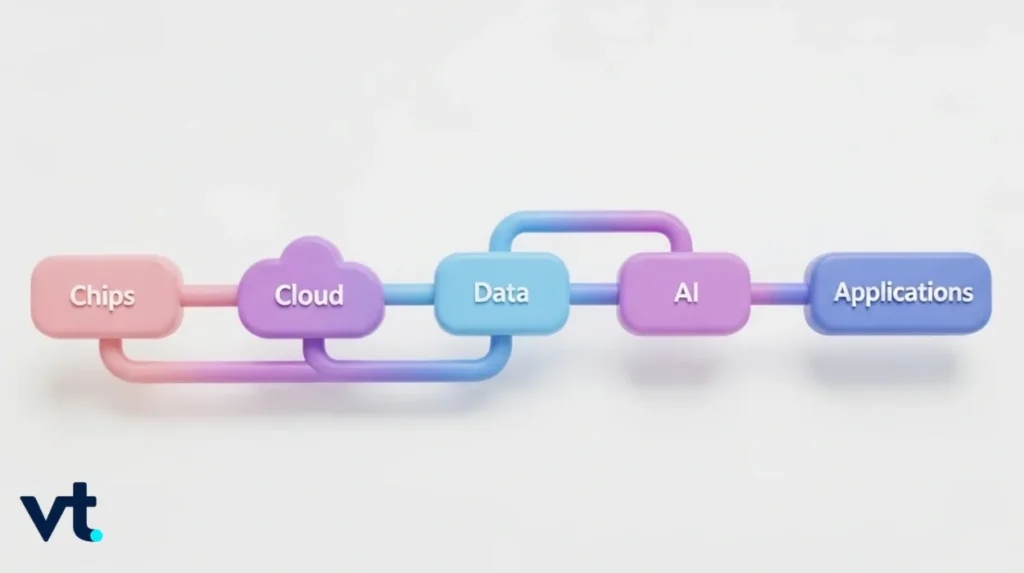
In the interconnected system of components that contribute to the development, deployment, and scaling of AI technology, OKTA’s definitive product may be able to transition AI seamlessly into the application layer.
OKTA is advancing towards the final mile in the AI chain of developments. Their new products account for roughly 30% of Q4 bookings and drove an estimated 40% average contract uplift in partnership deals.
OKTA’s Products and Core Purpose
Okta is positioning itself as a core identity security fabric for the AI era, where AI agents and non‑human identities must be governed, authenticated, and monitored just like human users.
Product
What It Does
AI Relevance
Okta Identity Governance
The centralised management of access entitlements and permissions extends to AI agents in the early access stage. It ensures compliance and minimises access risks.
Governs AI agent access alongside human users, providing visibility and control.
Okta for AI Agents
Manages the full lifecycle of AI agent identities, from provisioning to auditing. The full release is scheduled for 2027. Currently in early access.
Treats AI agents as first-class identities with lifecycle management and auditability.
Okta Identity Security Posture Management (ISPM)
Continuously assesses and improves the organisation’s identity security posture.
Detects risky configurations related to AI agents and non-human identities.
Identity Threat Protection
Uses AI and machine learning to detect and respond to identity threats in real time as part of Okta’s broader identity security capabilities.
Protects critical accounts and elevated privileges, including those tied to AI workflows. AI-enhanced features were added post-Axiom Security acquisition.
Secures AI-driven workflows and automated access to sensitive systems.
Fine-Grained Authorization
Provides detailed access control policies for both human and AI agents.
Controls AI agents’ access to sensitive data and actions within the system.
Okta Device Access
Conditional access based on device health and compliance.
Ensures secure device access for AI workflows and agents in Zero Trust environments.
Auth0 for AI Agents
Identity management and secure access for AI agents and autonomous systems available to trial for developers.
Secures login, tokens, and permissions for AI agents in enterprise systems.
With a strategy that spans:
Discovery & governance (Identity Governance, Okta for AI Agents).
Privileged control and Zero Trust enforcement (Okta Privileged Access, Fine‑Grained Authorization).
Secure AI agent workflows (Auth0 for AI Agents).
Okta’s focus on security and compliance is resonating strongly across industries, with government and regulated industries being some of the fastest-growing verticals. By offering a platform that holds “a single source of truth” for identity management, Okta’s solutions provide structural advantages across industries like financial services, cybersecurity, and government procurement — sectors where security, compliance, and governance are paramount.
While government procurement tends to move slowly, Okta’s proven scalability and security infrastructure allow it to capitalise when large-scale adoption occurs, making it a reliable partner for both government entities and large regulated enterprises.
Headwinds to Watch
No bull case is complete without accounting for the risks. OKTA stock trades at a premium, and the identity security market is drawing more players.
Microsoft — via Microsoft Entra ID (formerly Azure Active Directory) — holds the largest overall IAM installed base globally and applies bundle pricing pressure that compresses margins for standalone vendors like Okta, making it a persistent competitive threat for enterprise accounts
CrowdStrike, Ping Identity, and newer entrants are all competing in adjacent identity and access segments. Okta’s ability to establish Auth0 for AI Agents as an enterprise standard before rivals respond will be critical.
Anthropic, the AI safety company, launched Claude Code Security in February 2026 — a tool that scans codebases for vulnerabilities and suggests targeted patches, reasoning through code the way a human security researcher would. It has already identified over 500 high-severity vulnerabilities in open-source projects. The move signals that AI labs are building security tooling of their own, potentially encroaching on territory Okta wants to own
The shift of professional services revenue to partners, while strategically sound, will create near-term revenue headwinds through FY2027. With AI-agent pricing models still being refined, near-term revenue contribution from these products remains modest.
How Traders Might Approach OKTA Stock
Okta is a stock that straddles two narratives: a maturing enterprise software company generating real cash flow, and a potential AI security infrastructure play with a long runway if its agent identity products gain traction.
In the long term, two key indicators will need to be monitored: whether AI-agent product revenue begins to appear meaningfully in the current RPO by mid-FY2027, and whether Okta successfully wins federal vertical contracts at scale. If both materialise, the current valuation may look conservative in retrospect.
For those watching the chart, the $2.5 billion cash position and $1 billion buyback programme provide meaningful downside support. Okta repurchased and retired over 875,000 shares in January alone for a total outlay of $79 million, demonstrating conviction from management about the stock’s relative value.
Okta isn’t a company chasing the AI hype cycle; it’s a company building the security rails that the AI economy will run on. Trade happens when the thesis gets priced in.
Trade OKTA Stock with VT Markets
At VT Markets, we provide a regulated and reliable trading platform that puts opportunities like OKTA within reach.
With access to industry-leading platforms like MetaTrader 4 and MetaTrader 5, you can execute your trades with precision and confidence. Plus, with our demo account, you can explore your strategy in a risk-free environment before committing real capital.
Start trading OKTA and hundreds of other instruments with VT Markets today. Open your account and take your position in the stocks shaping the AI era!
Start trading now – Click here to create your real VT Markets account
China’s foreign exchange reserves rose to $3.428 trillion in January, up from $3.358 trillion.
That is an increase of $70 billion month on month.
Implications For Yuan Stability
The stronger-than-expected rise in China’s reserves for January gives us confidence in the yuan’s stability. It suggests the People’s Bank of China has ample resources to manage the currency, reducing the chance of sharp moves. This makes strategies like selling options on the USD/CNY pair, which profit from low volatility, look more attractive in the coming weeks.
This underlying economic strength points to solid demand for industrial commodities. We’ve already seen copper prices climb over 8% since the start of this year, hitting levels not seen since late 2024. Derivative traders should look at buying call options on base metals or oil to capitalize on this expected demand.
This stability is a welcome change from the capital outflow concerns we navigated throughout much of 2025. A steady currency reduces risk for foreign investors, and we are seeing renewed interest in Chinese equities, with the Hang Seng Index up 4% in February. We see this as a signal to consider long positions through call options on China-focused ETFs.
Implications For Rates Volatility
A robust Chinese economy also means they will likely continue to hold and potentially buy U.S. Treasury bonds, which helps keep a lid on yields. This contrasts with worries last year in 2025 that China might sell its holdings, which would have pushed U.S. borrowing costs higher. This environment suggests less volatility in the U.S. rates market, favoring strategies that bet on a stable range for Treasury futures.
Create your live VT Markets account and start trading now.
Start trading now – Click here to create your real VT Markets account
Colombia’s consumer price index (CPI) rose 5.29% year on year in February.
The result was below the forecast of 5.49%.
With February’s inflation coming in below expectations at 5.29%, the door is now wide open for the Banco de la República to accelerate its interest rate cuts. We are now pricing in a higher probability of a 50-basis-point cut at the next meeting, instead of the previously anticipated 25 points. This shift in monetary policy expectations is the primary driver for our strategy in the coming weeks.
This outlook will likely put significant pressure on the Colombian Peso. Consequently, we should consider establishing positions that benefit from a weakening currency, such as buying call options on the USD/COP pair. Looking back at the easing cycle that began in late 2024, we saw the peso depreciate by over 7% in the following quarter, a pattern that could repeat.
For interest rate derivatives, the path is now clearer for lower rates ahead. We see an opportunity in receiving fixed rates on short-term interest rate swaps, betting that the central bank will follow through on this disinflationary signal. This is a direct play on the market repricing a more aggressive easing cycle from the central bank.
On the equity side, a faster pace of rate cuts should provide a tailwind for the local stock market. We believe bullish positions on the COLCAP index, potentially through call options on Colombian ETFs, are warranted. This view is bolstered by the weak 0.8% GDP growth figure we saw in the final quarter of 2025, which shows the economy needs stimulus.
Start trading now – Click here to create your real VT Markets account