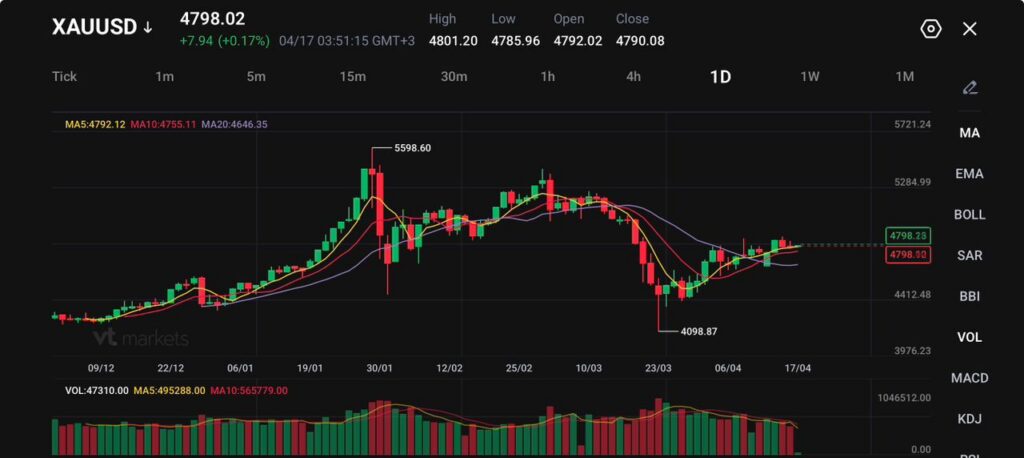
Gold edged down in the US session as Middle East tensions eased amid moves to restart US-Iran talks and a proposed Israel-Lebanon ceasefire. XAU/USD traded at $4,784, down 0.13%.
The US Dollar strengthened, with the US Dollar Index up 0.21% at 98.25, adding pressure to bullion. US equities rose as markets assessed the outlook for a Washington-Tehran deal.
Us Iran Talks Narrow Differences
Reports said the US and Iran are narrowing gaps, including on the Strait of Hormuz. Iran is seeking the release of frozen funds in exchange for allowing ships to transit via Omani waters, while the nuclear issue remains unresolved.
Donald Trump said Israel and Lebanon would begin a 10-day ceasefire at 5:00 PM EST (21:00 GMT). The pause aims to halt fighting between Israel and Hezbollah during the Iran conflict.
US Initial Jobless Claims fell to 207K for the week ending April 11, versus 215K expected and 218K prior. US Industrial Production slipped from 0.7% to -0.5% month-on-month in March, led by motor vehicles, parts, and utilities.
New York Fed President John Williams said the Iran conflict is pushing prices up and expects higher headline inflation. Governor Stephen Miran said he expects three rather than four rate cuts due to “less favorable” inflation.
April 2026 Gold Market Shift
We are looking at a much different picture now in April 2026 than we saw back in 2025 when Mideast de-escalation hopes briefly pushed gold down to the $4,780s. While those geopolitical tensions continue to simmer, providing a floor for prices, the primary driver has shifted. Gold is currently trading around $5,150, showing that underlying demand has overpowered the temporary risk-off sentiment we saw last year.
The Federal Reserve’s outlook, which hinted at three or four rate cuts in 2025, has since become more complex due to persistent inflation. Recent data for March 2026 showed the Consumer Price Index (CPI) remains elevated at 3.4% year-over-year, which is complicating the Fed’s path forward. This sticky inflation keeps gold attractive as a hedge, even if it means interest rates stay higher for longer.
A critical factor supporting this rally has been the relentless buying from central banks, a trend that accelerated significantly after 2022. According to the latest World Gold Council data, central banks collectively added over 1,037 tonnes in 2023, and reports indicate this aggressive purchasing continued through 2025 and into this year. This activity creates a strong institutional bid in the market, suggesting any significant price dips will likely be met with buying.
Despite gold’s strength, traders must watch the resilient US Dollar, which currently sits near 105 on the DXY. A strong dollar typically acts as a headwind for bullion, and the healthy US labor market, with initial jobless claims at a low 212,000 for the week ending April 11, 2026, supports the greenback. This creates a tense standoff between a strong dollar and powerful fundamental demand for gold.
For the coming weeks, this suggests a strategy of buying on weakness may be prudent, as the long-term bullish case from inflation and central bank demand remains intact. Traders could consider using options to define risk, such as buying call spreads to target a move toward the $5,250 resistance level while capping upfront costs. The $5,050 level now appears to be a key area of support to watch for entry points.