NZD/USD fell over 0.7% on Thursday, ending near 0.5900 and hitting its lowest level since late January. It has retraced most February gains after topping near 0.6090 in early February and breaking support around 0.5920.
The RBNZ kept the Official Cash Rate at 2.25% in February. It signalled no hike until late 2026, with overnight index swaps down about eight basis points and September hike odds falling to about 40% from 68%.
Monetary Policy Divergence
The policy gap with Australia widened after the RBA lifted rates to 3.85% in February and is weighing another move for May. This has added pressure on the New Zealand Dollar.
Safe-haven demand supported the US Dollar as the Strait of Hormuz was described as effectively closed. US crude oil rose above $80 per barrel for the first time since mid-2024, raising New Zealand’s oil import costs.
The Federal Reserve held rates at 3.50% to 3.75% in January, with minutes showing a hawkish tilt. US Non-Farm Payrolls are forecast at around 60K for February, down from 130K in January.
NZD/USD traded at 0.5898, with support near 0.5890–0.5900, then 0.5850 and 0.5800. Resistance sits at 0.5950, then 0.6000 and 0.6050.
Trade Bias And Key Risks
The current market environment strongly favors short positions on the NZD/USD pair. Geopolitical tension from the Strait of Hormuz crisis is driving a classic flight to safety, strengthening the US Dollar and punishing risk-sensitive currencies like the Kiwi. We see this trend continuing as long as global risk aversion is the dominant theme.
The monetary policy divergence between the central banks provides a powerful fundamental reason for this bearish view. The RBNZ’s dovish stance, keeping rates at 2.25%, contrasts sharply with the Federal Reserve’s hawkish tilt and rates above 3.50%. This interest rate differential, which is the widest we have seen since late 2024, makes holding US Dollars more profitable than holding New Zealand Dollars.
New Zealand’s specific economic vulnerabilities are also coming into focus. With US Crude Oil prices holding above $80 a barrel, the country’s status as a net energy importer becomes a significant drag on its economy. Furthermore, we saw prices in this week’s Global Dairy Trade auction slip another 1.4%, signaling weakness in New Zealand’s most important export sector.
Given the strong downward momentum, we should consider buying NZD/USD put options with a strike price at or below 0.5850. Using options allows us to define our maximum risk, which is prudent ahead of today’s highly anticipated US Non-Farm Payrolls report. A confirmed daily close below the 0.5900 support level would be the signal to initiate or add to these positions.
The NFP release is the main event risk, with a weak forecast of 60K that could cause a temporary spike. However, we recall periods in 2025 when the market looked past soft labor data because the broader inflation narrative was more compelling. A surprisingly strong NFP number would likely accelerate the sell-off, while a miss might only provide a better level to establish new shorts once the dust settles.
Create your live VT Markets account and start trading now.
Start trading now – Click here to create your real VT Markets account
The Australian Dollar fell as risk-off flows linked to the Middle East supported the US Dollar. AUD/USD dropped about 1% on Thursday to near 0.7010 after dipping below 0.7000, and it remains in a roughly 150-pip range between 0.7000 and about 0.7150.
Australia’s Q4 GDP rose 0.8% quarter-on-quarter, with annual growth at 2.6%, the fastest pace since early 2023. The RBA lifted rates to 3.85% in February, and markets price around a 30% chance of a March hike, while a move to 4.10% in May is fully priced.
Inflation And Energy Shock
Rising crude oil prices, linked to an effective Strait of Hormuz shutdown and the Iran conflict entering its sixth day, are affecting inflation expectations. The RBA’s inflation target is 2–3%.
US February nonfarm payrolls are forecast near 60K versus 130K in January, with unemployment seen at 4.3%. Fed officials continue to debate rates while still indicating cuts remain on track this year.
Technically, AUD/USD traded at 0.7009, with support at 0.6960, 0.6920, and 0.6890, and resistance at 0.7045, 0.7085, and 0.7120. Iron ore is Australia’s largest export, worth $118 billion a year (2021 data), and China is the main destination.
The Australian Dollar is currently caught between conflicting forces, with risk-off sentiment from the Middle East pushing it down while a strong domestic economy suggests it should be higher. Surging crude oil prices, with Brent crude futures now holding above $115 per barrel, are fueling global inflation fears and supporting the safe-haven US Dollar. This complicated picture makes directional bets on the Aussie risky in the immediate term.
RBA Meeting Risk
We are now looking toward the Reserve Bank of Australia’s meeting on March 16-17 with uncertainty. While the strong Q4 2025 GDP figures and the RBA’s hawkish talk suggest a rate hike is possible, market pricing and this week’s surprise 0.2% contraction in January retail sales show the economy may be cooling. This divergence between hawkish central bank commentary and weakening consumer data creates a difficult trading environment.
All eyes are now on the US Nonfarm Payrolls report due later today, which is expected to show a significant slowdown in job creation. A weaker-than-expected number could dampen the US Dollar’s recent strength, but the ongoing conflict in Iran continues to provide a strong underlying bid for the currency as a safe haven. We see this as a pivotal event that could either break the AUD/USD below key support or provide a much-needed bounce.
Adding to the pressure on the Aussie, recent data from China showed its Caixin Manufacturing PMI dipped to 49.8, indicating a slight contraction in the manufacturing sector of Australia’s largest trading partner. Consequently, we’ve seen iron ore futures pull back below $120 per tonne, weakening a key pillar of support for the currency. This raises concerns about the sustainability of Australia’s export growth in the first quarter of 2026.
Given the AUD/USD is trapped in a range and facing major event risk, derivative traders should consider strategies that profit from a spike in volatility. Implied volatility on one-month options has already climbed above 12%, and purchasing a strangle using out-of-the-money puts and calls could position for a breakout without needing to predict the direction. This allows us to capitalize on a decisive move out of the 0.7000 to 0.7150 consolidation band.
For those with a bearish bias, buying short-dated put options with a strike price just below the psychological 0.7000 level offers a low-cost way to position for a breakdown. If today’s US jobs data comes in strong or geopolitical tensions escalate further, the pair could quickly break its recent support. This strategy provides defined risk ahead of the volatile RBA meeting in just over a week’s time.
Create your live VT Markets account and start trading now.
Start trading now – Click here to create your real VT Markets account
EUR/USD fell 0.21% on Thursday, moving towards 1.1600 as risk-averse trading continued amid the conflict in the Middle East. US equity markets ended the session lower, and firm US economic data supported the US Dollar.
Initial Jobless Claims for the week ending 28 February came in at 213K versus 215K expected. Challenger, Gray & Christmas reported announced layoffs of 48,300 in February, down 55% from 108,435 in January.
Dollar Strength And Risk Aversion
Richmond Fed President Thomas Barkin referred to sticky inflation and said recent jobs figures show a solid labour market. He also said the balance of risks could change as inflation remains a concern.
European Central Bank accounts showed policymakers kept interest rates unchanged and discussed inflation possibly moving further below the 2% target. The meeting occurred before tensions between the United States and Iran escalated, which has affected the outlook for energy-importing Europe.
Friday’s Eurozone calendar includes employment data and GDP for the last quarter of 2025, alongside comments from ECB President Christine Lagarde. In the US, January retail sales and February Nonfarm Payrolls are due, with payrolls expected at 59K and unemployment seen at 4.3%.
EUR/USD traded at 1.1609, with RSI at 33 and resistance at 1.1700/1.1720 then 1.1820. Support levels are 1.1615 and 1.1570/1.1550.
The immediate outlook for EUR/USD is bearish, with the pair pressing towards the 1.1600 level as solid US economic data and global risk aversion strengthen the dollar. This environment suggests that we should consider strategies that benefit from a falling euro. We believe this downward pressure will continue in the coming weeks.
Strategy And Event Risks
The recent strength in the US labor market, reminiscent of the surprisingly resilient job reports we saw throughout 2025, gives the Federal Reserve little reason to soften its stance. With the latest Consumer Price Index data showing core inflation stubbornly holding above 3%, policymakers will likely remain concerned about sticky prices. This policy divergence strongly favors the dollar over the euro for the foreseeable future.
On the other side, the European Central Bank has signaled concerns that inflation could fall below its target, a stark contrast to the Fed’s position. This policy difference is reflected in the US-German 2-year yield spread, which has widened to over 180 basis points, making the dollar more attractive to hold. The region’s dependence on energy imports also makes it more vulnerable to the escalating US-Iran conflict, weighing heavily on the euro.
Given this outlook, we believe buying EUR/USD put options is a prudent strategy to position for further downside, targeting a move toward the 1.1550 support band. For those with a more neutral-to-bearish view, selling call spreads with a ceiling around the formidable 1.1700 resistance could be an effective way to collect premium while defining risk. These positions allow for profit from either a continued slide or sideways consolidation.
The upcoming US Nonfarm Payrolls report is the key event risk we are watching this week. While the consensus is a weak 59,000, any number significantly above 150,000 would likely validate the Fed’s cautious stance and could accelerate the EUR/USD decline. We should therefore be prepared for heightened volatility around the release and manage positions accordingly.
Create your live VT Markets account and start trading now.
Start trading now – Click here to create your real VT Markets account
USD/JPY rose during Thursday’s North American session by nearly 0.30% and traded at 157.50. It held above 157.00 as the US Dollar gained support from weaker risk appetite, strong US jobs data, and hawkish remarks from Richmond Fed President Thomas Barkin.
On the daily chart, a bullish engulfing pattern suggests buyers are in control near current levels. The move may be limited near 158.00 due to the risk of action by Japanese authorities.
Momentum And Key Technical Levels
Momentum remains positive, with the Relative Strength Index above its neutral line and still below overbought territory. Further upside would require a break above the March 3 high at 157.97.
If 157.97 is cleared, the next levels are 158.50 and 159.00. Above that, targets include the January 23 high at 159.22 and then 160.00.
The Yen is influenced by Japan’s economic performance, Bank of Japan policy, US–Japan bond yield differences, and market risk sentiment. The BoJ ran ultra-loose policy from 2013 to 2024, weakening the Yen, and began unwinding it in 2024, which has narrowed the 10-year US–Japan yield gap.
Looking back at analysis from last year, we can see the strong bullish momentum that pushed USD/JPY toward 157.50. At the time, solid US jobs data and a hawkish Fed were the primary drivers for dollar strength. Now, in March 2026, the situation has evolved, and the pair trades closer to 150.50 as different factors take priority.
Rates Policy Divergence And Intervention Risk
The interest rate differential between US and Japanese bonds, a key factor mentioned in 2025, continues to steer the currency pair. Currently, the US 10-year Treasury yield sits at around 4.1%, while the 10-year Japanese Government Bond yield has risen to 0.75%, slightly narrowing the gap that previously favored the dollar so heavily. This narrowing trend is what we are focused on for the coming weeks.
We have seen the Bank of Japan follow through on its policy shift, having exited negative interest rates late last year and signaling a potential for another small hike. This is happening just as the Federal Reserve is now projecting rate cuts for later in 2026, with recent US core PCE inflation data easing to 2.8%. The divergence in central bank policy that drove the dollar up is now beginning to reverse course.
The threat of intervention by Japanese authorities, which was a concern near 158.00 in 2025, remains a critical ceiling for the market. We only have to remember the direct interventions seen in late 2022 when the pair pushed past 151.00, a level that is once again psychologically important. Any sudden spike in USD/JPY will likely be met with aggressive verbal warnings from Tokyo, capping upside.
Given this backdrop, buying long-dated call options on USD/JPY appears to be a high-risk strategy. We believe traders should consider selling call spreads or outright selling out-of-the-money calls with strike prices above 152.50 to take advantage of the strong resistance and collect premium. This strategy positions for a range-bound or slightly lower movement in the pair over the next few weeks.
Create your live VT Markets account and start trading now.
Start trading now – Click here to create your real VT Markets account
US shares fell further on Thursday as oil rose by as much as 9% amid the war with Iran. WTI hit $81.64, its highest since summer 2024, and Brent reached $85.85.
The Dow Jones Industrial Average fell 2.25%, while the S&P 500 and Nasdaq each dropped by more than 1%. Higher oil prices can raise costs for US consumers.
Oil Supply Shock Intensifies
An Iranian missile hit an oil tanker in the Strait of Hormuz, causing a fire and forcing the crew to abandon the US-flagged ship. President Donald Trump offered insurance on Wednesday after ships lost cover following the Israel and US bombing campaign that began on Saturday.
On the sixth day of the war, Qatar shut its LNG terminals and about 150 tankers were reported stuck in the Persian Gulf. The Strait of Hormuz carries 20% of global oil supply, and Iran said ships would not be allowed to exit while the war continues.
Exxon Mobil shipped its first gasoline cargo to Australia on Thursday, while China banned petroleum exports and told Sinopec and PetroChina to halt gasoline and diesel exports. OPEC plans to raise output by over 200,000 barrels a day in April, after increasing by more than 400,000 barrels a day this month.
WTI is up about 20% since the war began on 28 February. The US is considering requiring export licences for all AI-related products from Nvidia and AMD, and South Korea’s stock market is down 20% this week.
The market’s initial drop is just the first reaction to a conflict that may last months, not weeks. With the Pentagon now planning for a war lasting until September, we must prepare for sustained uncertainty and price swings. We should be purchasing derivatives that profit from this volatility, such as options on the VIX, which has likely jumped from the mid-teens to near 30 in just the past week.
Positioning For Prolonged Volatility
With the Strait of Hormuz closed to tanker traffic, oil prices will almost certainly continue to rise toward the $100 per barrel mark, a level that has historically signaled a coming recession. Looking back at the first Gulf War in 1990, we saw crude oil prices double in just a few months, tipping the S&P 500 into a 20% decline. The clearest trade is to be long oil through call options on WTI futures or energy ETFs.
This sustained oil shock acts as a direct tax on consumers and corporations, making a broader stock market decline highly probable. We should be buying put options on the S&P 500 and Nasdaq indices to protect against this. Sectors that are highly sensitive to energy costs and consumer spending, like airlines and retail, are the most vulnerable and present clear shorting opportunities.
The specific threat of export licenses for AI chips makes semiconductor stocks like Nvidia and AMD exceptionally weak. At the same time, we must recognize that energy producers are the clear winners in this environment. This sets up a classic pairs trade: buying call options on the energy sector ETF (XLE) while simultaneously buying puts on the semiconductor ETF (SMH).
The 20% plunge in South Korea’s market this week should be seen as a leading indicator of how severe an energy crisis can be for industrial economies. The global nature of this supply shock means the contagion will likely spread. We must remain positioned for further downside and heightened volatility across all asset classes in the weeks ahead.
Create your live VT Markets account and start trading now.
Start trading now – Click here to create your real VT Markets account
USD/MXN rose to 17.72, up more than 0.95%, as the Mexican Peso weakened on Thursday. Fighting in the Middle East led to risk-off trading that supported the US Dollar.
The US–Iran conflict entered its sixth day, with Tehran forces attacking two vessels on Thursday. Reports also said US President Donald Trump rejected the son of the Ayatollah to lead Iran, and Axios said Trump would be involved in deciding Iran’s new leadership, while sirens were heard in multiple Gulf nations.
Us Data And Fed Expectations
US Initial Jobless Claims were 213K for the week ending February 28, below the 215K forecast. Challenger, Gray & Christmas said announced layoffs fell to 48,300 in February, down 55% from January’s 108,435, while hiring plans rose 140% from January but were down 63% year-on-year.
Money-market pricing moved from 40 basis points of rate cuts by year-end to 35 bps. The Fed Beige Book said expectations were “optimistic”, with “moderate growth”, and labour conditions “generally stable”.
Mexico’s Gross Fixed Investment was flat in December after -6.5% in November, versus a -2.8% forecast, and was 0.5%. Key levels cited were 17.90, 18.00, 18.30, 17.49, 17.26, and 17.00, with RSI peak at 64.88 and April 2025 highs near 21.07.
A year ago, we saw the USD/MXN spike above 17.70 due to intense conflict in the Middle East and strong US jobs data. Those events in early 2025 pushed traders into the safety of the US Dollar and dialed back expectations for Federal Reserve rate cuts. The situation today presents a different set of challenges and opportunities.
The acute geopolitical fears from 2025 have since calmed, reducing the intense flight-to-safety bids that propped up the dollar. While global risks remain, the specific US-Iran flare-up that drove markets last year has de-escalated. This has allowed the pair’s direction to be more influenced by interest rate differentials rather than sudden geopolitical shocks.
Us Mexico Rates And Trade Positioning
The US labor market continues to show resilience, much like it did throughout 2025. Today’s Nonfarm Payrolls report for February 2026 showed a gain of 275,000 jobs, beating expectations and keeping the unemployment rate low at 3.9%. This persistent strength makes the Federal Reserve cautious about cutting interest rates too quickly, providing a fundamental floor of support for the dollar.
On the Mexican side, the carry trade remains a dominant theme. With Banxico’s overnight rate holding firm at 11.00% to combat its own inflation, the yield advantage over the US Fed Funds rate of 5.25% is substantial. This wide differential has attracted significant capital inflows into the Peso over the past year, pushing the USD/MXN exchange rate down toward the 17.00 level.
Given these opposing forces, selling volatility in the coming weeks appears to be a prudent strategy. The strong US economy prevents a sharp dollar collapse, while Mexico’s high interest rates prevent a major peso sell-off. Establishing an iron condor with strikes around 16.80 and 17.50 could capitalize on this expected range-bound price action.
For those anticipating a break, buying long-dated, out-of-the-money options offers a defined-risk approach. A trader who believes persistent US strength will eventually overwhelm the carry trade could purchase call options with a strike price near the 17.90 level, which acted as key resistance in 2025. This allows for participation in a significant upward move while limiting downside to the premium paid.
Create your live VT Markets account and start trading now.
Start trading now – Click here to create your real VT Markets account
The yen trades around 157.5 per dollar on Friday, set for a third consecutive weekly decline as the dollar stays firm.
The US-Israeli offensive against Iran has entered its seventh day, lifting energy anxiety and adding pressure on Japan as an energy importer.
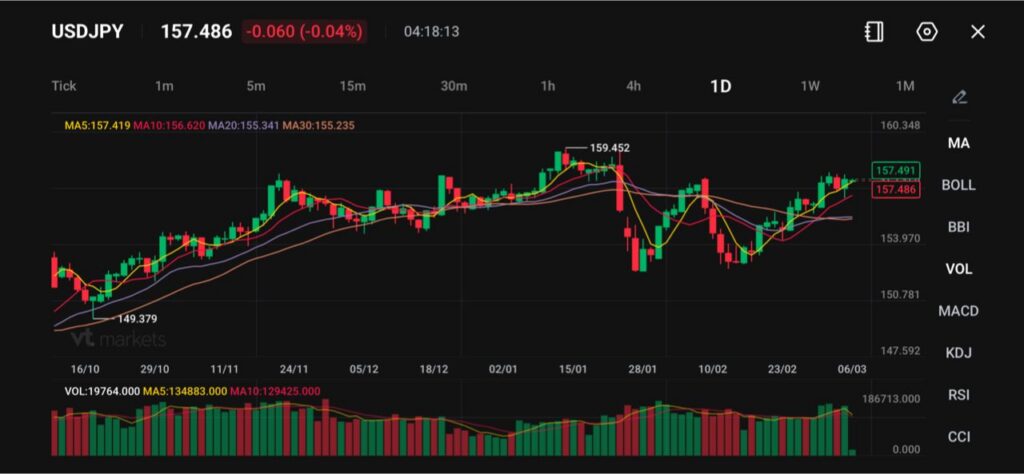
USDJPY sits near 157.486 (-0.060, -0.04%), with price above key averages: MA5 157.419, MA10 156.620, MA20 155.341, MA30 155.235.
The yen trades around 157.5 per dollar on Friday and remains on track for its third consecutive weekly decline. The driver is simple: traders keep reaching for the reserve currency as the Middle East conflict escalates, and that flow supports the dollar against most majors.
When fear rises, traders often cut exposure to carry trades and rotate into USD cash and short-dated USD assets. That can keep USDJPY elevated even if the pair looks stretched, because safety flows can overpower short-term valuation concerns.
If the conflict headlines keep landing and risk appetite stays shaky, USDJPY can hold near the high-150s and probe higher on spikes in dollar demand. If headlines cool and markets regain confidence, USDJPY may slip back toward recent support zones, but it will likely do so in choppy steps.
Oil Prices Add a Second Headwind for the Yen
The conflict has entered its seventh day, and Tehran has launched a fresh wave of missile and drone strikes across the Gulf. That keeps energy markets nervous and helps hold oil risk premiums in place.
Eyewitness video released on March 5 showed a thick cloud of dark smoke rising, following an airstrike in Iran's capital city Tehran that destroyed the Azadi Stadium, according to state agencies IRIB and WANA. pic.twitter.com/IRZ1EDFWe0
That matters for the yen because Japan relies heavily on energy imports. Higher oil prices can worsen Japan’s trade balance and lift imported inflation. This mix can weaken the yen even when global markets also call it a safe haven, because the import bill becomes a direct drag.
If oil stays bid and shipping risk remains high, the yen can stay under pressure, and USDJPY can remain supported. If oil eases and the energy premium fades, the yen can steady, but the market will still weigh the policy gap between the Fed and the BoJ.
BoJ Signals Patience as War Risks Cloud the Outlook
Bank of Japan Governor Kazuo Ueda warned the conflict could affect Japan’s economy, which strengthens the case for patience on rates. When policymakers face external shocks tied to energy costs and global growth, they often avoid sudden tightening that could hit domestic demand.
Bank of Japan officials are still on track to raise interest rates, with the possibility of April not ruled out, according to people familiar with the matter https://t.co/2JkrjhR1FZ
This matters for USDJPY because traders price the rate gap. If the Fed stays restrictive while the BoJ stays cautious, the gap can keep supporting USDJPY on dips.
If energy-driven uncertainty persists, the BoJ can lean towards a longer hold, which can leave the yen sensitive to any fresh leg higher in US yields. If inflation in Japan proves sticky and growth holds up, the BoJ may sound firmer later, but traders will likely wait for clearer action before they price a stronger yen trend.
Japan Keeps Intervention on the Table
Japan’s Finance Minister Satsuki Katayama said this week that currency market intervention remains an option, adding that authorities are monitoring the decline “with a strong sense of urgency” and coordinating closely with the US.
Japan is monitoring financial markets with vigilance and will take any necessary action in response to sharp movements, Finance Minister Satsuki Katayama said, as volatility intensifies following the US and Israeli attack on Iran https://t.co/6Jbpyf6B4e
That language tends to change trader behaviour. It can reduce appetite for one-way momentum trades because the market knows officials can act if moves become disorderly. It does not force USDJPY down on its own, but it can cap upside follow-through during thin liquidity.
If USDJPY jumps quickly through fresh highs, intervention risk rises, and volatility can increase. If the pair grinds higher more slowly, officials may rely on warnings first, which can still cause sharp pullbacks when positioning gets crowded.
Technical Analysis
The USDJPY pair is trading near 157.49, holding close to the upper range of its recent recovery as the dollar maintains moderate strength against the yen. The pair has rebounded steadily from the late-January lows near 152, gradually rebuilding bullish momentum after the sharp correction from the 159.45 peak earlier this year.
From a technical perspective, price is currently trading above the key short-term moving averages, with the 5-day moving average at 157.42 and the 10-day at 156.62, both trending upward.
The 20-day (155.34) and 30-day (155.24) averages remain below the current price level, suggesting that the broader bullish structure is intact as the pair continues to form higher lows.
Immediate resistance is located around 158.50–159.45, where the previous rally topped out. A sustained move above this region could open the path toward the 160.00 psychological level.
On the downside, initial support is seen around 156.50–157.00, followed by stronger structural support near 155.00, which aligns closely with the 20-day and 30-day moving averages.
Overall, the technical outlook remains moderately bullish while USDJPY holds above the 155–156 support zone, though price may experience short-term consolidation as it approaches the upper boundary of its recent trading range.
What Traders Should Watch Next
Whether the conflict remains in escalation mode after day seven, because that drives both the dollar’s haven bid and oil risk.
Any shift in BoJ tone from Ueda as markets digest the economic hit from higher energy costs.
Intervention rhetoric from Katayama, especially if USDJPY accelerates rather than trends.
Price behaviour around 159.452 on the topside, and the moving-average zone around 156.620 to 155.341 on the downside.
Why is USDJPY Weakening the Yen Despite Global Risk? In many crises, the yen strengthens as a safe-haven currency, but this time the dollar is attracting the bulk of defensive flows. Investors often move into the US Treasury markets and dollar liquidity during geopolitical stress. That dynamic keeps USDJPY near 157.5 per dollar even though global risk sentiment is fragile.
How Do Rising Oil Prices Affect the Japanese Yen? Japan imports most of its energy. When oil prices rise sharply, the country spends more on imports, which can widen the trade deficit. A larger import bill tends to weaken the yen because more yen must be exchanged for foreign currency to pay for energy shipments.
Why Does Monetary Policy Matter So Much for USDJPY? Currency markets often follow interest rate differentials. If US rates remain higher while the Bank of Japan keeps borrowing costs low, capital tends to move toward dollar assets. That gap can keep USDJPY elevated even if economic conditions in Japan remain stable.
What does a “third consecutive weekly decline” for the Yen indicate? Three straight weeks of losses often signal sustained pressure rather than a single reaction to headlines. It suggests traders continue to favour the dollar and have not yet found a reason to rebuild large yen positions.
Why Are Japanese Officials Talking About Currency Intervention? Authorities sometimes step in when exchange rate moves become rapid or disorderly. Finance Minister Satsuki Katayama said intervention remains an option and that officials are watching markets “with a strong sense of urgency”. Statements like this aim to slow speculation and remind traders that the government can act if volatility increases.
Start trading now – Click here to create your real VT Markets account
The US Dollar firmed as crude oil rose to its highest level since July 2024, amid reports of possible disruption in the Strait of Hormuz and attacks on vessels. The US Dollar Index moved up to around 99.20 ahead of the US Nonfarm Payrolls release.
US employment data showed 48.307K job cuts in February, down 55% from 108.435K in January, while initial jobless claims were 213K for the week ending 28 February, below the 215K estimate. EUR/USD traded near 1.1580 after ECB meeting accounts noted confidence on inflation but ongoing uncertainty, while markets priced a 75% chance of an ECB rate rise this year.
Market Snapshot
GBP/USD traded near 1.3330 and resumed a decline after a brief pause. AUD/USD fell to around 0.6990 as demand rose for perceived safe-haven assets.
Gold traded at $5,066 and gave back earlier gains as the Dollar strengthened. The calendar included Germany factory orders, Eurozone employment change and GDP (Q4), US earnings, participation rate, Nonfarm Payrolls, retail sales, U6 rate and unemployment rate, plus Canada’s Ivey PMIs.
Gold is commonly used as a store of value, a hedge against inflation, and protection against currency weakness. Central banks added 1,136 tonnes of gold worth about $70 billion in 2022, the largest annual purchase on record.
A year ago, we saw a market dominated by a strong US Dollar, driven by geopolitical fears in the Middle East and a resilient American labor market. Oil prices were surging on fears of supply disruptions, pushing investors into the Greenback as the primary safe haven. This environment rewarded long-dollar positions and punished riskier currencies like the Australian Dollar.
The narrative has shifted considerably over the last twelve months, as the US labor market is now showing signs of cooling. With the latest Nonfarm Payrolls report for February 2026 coming in at a modest 175,000 and the unemployment rate ticking up to 4.0%, the Federal Reserve has signaled a pivot towards potential rate cuts later this year. For derivative traders, this means the conviction behind long US Dollar call options has faded, and strategies like buying DXY puts could be used to position for further softening.
Trading Implications
The intense geopolitical risk premium in oil has also subsided since early 2025, with tensions in the Strait of Hormuz having de-escalated. Crude oil is now trading closer to $82 a barrel, driven more by OPEC+ supply management than by conflict, a significant change from the highs seen after July 2024. This suggests reduced volatility, making strategies like selling covered calls on oil futures attractive to generate income in what is now a more range-bound market.
As the US Dollar has lost some of its appeal and with interest rate cuts on the horizon, Gold has reasserted its traditional safe-haven role. A year ago, we saw it struggle against the dollar even at $5,066; today it is finding support around $5,250 as it benefits from the lower-rate outlook. This environment makes buying Gold call options or futures contracts a compelling trade, especially as central banks globally continued to add to their reserves through the end of 2025, creating a steady source of demand.
Looking at currency pairs, the dynamic for the Euro has changed from bets on ECB rate hikes to a focus on relative economic performance against the US. The AUD/USD, which fell sharply to 0.6990 amid the risk-off sentiment last year, has since recovered as fears receded and is now more sensitive to Chinese economic data. This suggests that the outright bearish positions of early 2025 are no longer viable, and traders may consider options strategies that profit from range-bound movements in EUR/USD or position for modest upside in the Aussie.
Create your live VT Markets account and start trading now.
Start trading now – Click here to create your real VT Markets account
WTI crude rose over 6% on Thursday and moved above $80 a barrel for the first time since June 2024. It is up about 19% since strikes in Iran began on Saturday, climbing from about $67 to just over $80.
The surge followed reports that the Strait of Hormuz was closed after a joint US-Israeli operation. Iran’s IRGC said on Monday it would target vessels attempting to pass through, and tanker traffic fell to near zero.
Market Disruption And Supply Shock
At least five vessels were damaged and more than 150 ships were stranded outside the waterway. Maersk and Hapag-Lloyd halted transits, while drone strikes on QatarEnergy’s Ras Laffan and Mesaieed sites removed about one-fifth of global LNG export capacity.
Iraq began shutting production as exports through the strait became constrained. OPEC+ agreed on Sunday to add 206,000 barrels per day in April, compared with a pre-crisis expectation of 137,000.
Goldman Sachs said a temporary move to $100 per barrel could cut global growth by 0.4 percentage points. The US Nonfarm Payrolls report is due Friday, with a forecast near 60K.
WTI traded at $79.78, above the rising 50-day and 200-day EMAs, with Stochastic overbought. Support sits near $74.50–$75.00, then $70.00–$71.00 and $67.00–$68.00; resistance is in the low-$80s, then the mid-$80s.
We remember last year’s crisis, when the closure of the Strait of Hormuz sent WTI crude prices soaring 19% in just a few days. That event in 2025 showed how quickly geopolitical shocks can override fundamental supply and demand analysis. Traders should therefore remain highly sensitive to any new military posturing or diplomatic tensions in the Middle East.
Risk Management And Market Positioning
The extreme price volatility we saw in 2025, where the oil volatility index (OVX) likely spiked above 60, underscores the risk of holding unhedged futures positions. In the coming weeks, using options to define risk could be a prudent strategy, allowing for participation in upside moves while capping potential losses if a sudden reversal occurs. Buying calls or call spreads can offer exposure to another potential supply shock.
The Strait of Hormuz remains a critical chokepoint, with roughly 21 million barrels of oil passing through it daily, representing over 20% of global petroleum liquids consumption. We should be monitoring tanker tracking data and naval reports from the region for any sign of disruption, as last year’s events proved this is the single largest catalyst for a sudden price spike. Any slowdown in traffic could immediately send prices higher, regardless of other market factors.
Beyond immediate shocks, we must balance supply data with demand forecasts. OPEC+ has maintained its production discipline through early 2026, but the latest IMF World Economic Outlook projects global growth at a modest 2.9%, potentially capping long-term demand. Traders should weigh the cartel’s ability to constrain supply against the risk of a global economic slowdown.
Looking at the charts, the price levels from the 2025 rally are now key psychological markers. The mid-$70s, which acted as a breakout point last year, have become a significant long-term support zone for the current uptrend. With WTI currently trading above both its 50-day and 200-day moving averages, the technical picture remains constructive for now.
Finally, we must consider how energy prices influence wider economic policy, a lesson reinforced by last year’s inflation scare. With recent US Consumer Price Index data showing inflation still hovering around 3.1%, any new surge in oil prices could force central banks to delay expected rate cuts. This makes upcoming jobs and inflation reports critical, as they will shape the demand outlook for the rest of the year.
Create your live VT Markets account and start trading now.
Start trading now – Click here to create your real VT Markets account
China has set a 2026 GDP growth target of 4.5–5.0%, down from “around 5%” used for the past three years. The earlier wording was widely seen as implying 0.2–0.3 percentage points of flexibility around 5%.
Fiscal and employment goals were kept broadly steady, alongside stable fiscal deficit and bond issuance targets. ING forecasts GDP growth of 4.6% year-on-year, which sits within the new official range.
National Target Reset
The government work report kept the aim of doubling per capita GDP by 2035 compared with 2020. Several provinces had already lowered their growth targets, which aligned with the national adjustment.
Policy direction is expected to continue emphasising moving up the supply chain and improving technology self-reliance. A key uncertainty is whether domestic demand can be strengthened while confidence remains weak.
The article states it was produced using an Artificial Intelligence tool and reviewed by an editor.
China’s new GDP growth target of 4.5% to 5.0% signals a shift away from the more aggressive stimulus measures some traders were hoping for. This realistic target, coming after we saw official growth hit 5.2% in 2025, suggests upside for Chinese equity indices like the CSI 300 will be capped. Strategies that bet on a strong, stimulus-fueled rally should be reconsidered in favor of more cautious approaches.
Market Strategy Implications
The decision to avoid a major fiscal push means demand for industrial commodities will likely remain subdued. This is bearish for assets like iron ore and copper futures, which rely on large-scale infrastructure and property development. Given the ongoing weakness in China’s property sector, we believe selling call options on any commodity price rallies could be a prudent strategy.
The biggest uncertainty remains domestic demand, as consumer confidence continues to be a drag on the economy. Recent data from the National Bureau of Statistics showed the consumer confidence index struggled to stay above the neutral 100-point mark through February. This tepid sentiment makes it difficult to expect a consumption-led recovery, which will weigh on consumer-facing stocks.
For currency traders, this softer growth outlook could put gentle downward pressure on the Yuan. However, the People’s Bank of China will likely manage any depreciation carefully, as we observed throughout 2025, to avoid capital flight. This suggests a slow grind higher for USD/CNH, making it a market for patient traders rather than those seeking high volatility.
The clearer but lower growth target may actually reduce overall market volatility by managing expectations. This environment favors strategies that profit from range-bound price action, such as selling strangles or straddles on equity index options. Big directional bets appear less favorable until we see a meaningful improvement in domestic confidence.
Create your live VT Markets account and start trading now.
Start trading now – Click here to create your real VT Markets account