
Back

Commerzbank’s Lay and Lim report Brent nearing $80 as Hormuz disruption stalls oil and LNG shipping flows

Brent crude rose towards USD79–80 per barrel after shipping through the Strait of Hormuz was effectively halted, disrupting oil flows. The oil price also increased by more than USD5 per barrel in a day, reaching just under USD80. The disruption also affected liquefied natural gas shipments, with exports temporarily halted. This added to energy price rises.

Middle East Conflict Inflation Impact

If the Middle East war were to continue for several months, eurozone inflation could increase by at least 1 percentage point. Eurozone economic growth could be a few tenths of a percentage point lower. Futures markets indicate the oil price is likely to fall again in the summer. The article was produced using an AI tool and reviewed by an editor. We are seeing Brent crude surge towards $80 a barrel this first week of March 2026. This is a direct result of shipping being effectively halted in the Strait of Hormuz, a critical chokepoint for global energy. This disruption is squeezing both oil and LNG flows, creating immediate upward pressure on prices and presenting a clear, conflict-driven trading environment. This uncertainty has sent oil market volatility soaring, with the CBOE Crude Oil Volatility Index (OVX) jumping over 35% in the last two weeks alone. For traders, this suggests options strategies that profit from large price swings could be effective in the very near term. The elevated implied volatility means that buying calls to capture further upside or puts to protect against a sudden resolution could be considered.

Backwardation And Summer Price Expectations

However, the futures market is telling a different story, predicting a significant price drop by the summer. The current market structure, known as backwardation, shows the August 2026 contract trading at a near $6 discount to the current spot price, suggesting this spike is viewed as temporary. This presents an opportunity for calendar spread trades, which could profit as the near-term premium collapses faster than in later months. We should remember a similar, though less severe, spike we saw back in the spring of 2024 during a flare-up of regional tensions. Back then, the price increase lasted only a few weeks before supply routes adapted and the geopolitical risk premium faded. This past event supports the view that the current high prices may not be sustainable if the conflict is resolved or contained within the next month or two. We must also watch the ripple effects in the Eurozone, where a prolonged conflict could add at least one percentage point to inflation. With Eurostat’s latest flash estimate for February 2026 inflation already at 2.6%, this would push it far above the central bank’s target and could delay expected interest rate cuts. This creates potential trades on derivatives tied to European stock indices or the euro, which would likely weaken under such a stagflationary shock. Create your live VT Markets account and start trading now.

Start trading now – Click here to create your real VT Markets account
WTI futures climb 2.3% to nearly $73 after Strait of Hormuz closure sparks supply disruption concerns

WTI futures on NYMEX rose 2.3% to near $73.00 in early European trading on Tuesday. The move followed reports that the Strait of Hormuz was closed, a route used for 20% of global crude oil shipments. Reuters reported that, late Monday, an Iranian Revolutionary Guard statement said ships attempting to pass would be fired upon. Iran has increased military activity near the strait amid conflict involving the US and Israel.

Geopolitical Risk Premium Impact

US forces said they destroyed command posts of Iran’s Revolutionary Guards, plus Iranian air defence and missile launch sites. The reports said this reduced Tehran’s ability to carry out attacks. US interest-rate expectations also shifted after data on factory-level inflation. The CME FedWatch tool put the probability of rates being held steady in June at 53.5%, up from 42.7% on Friday. The ISM Manufacturing PMI report showed the Prices Paid sub-index rose to 70.5. This compared with estimates of 59.5 and a previous reading of 59.0. WTI is a US-sourced crude benchmark distributed via the Cushing hub. Its price is driven by supply and demand, global growth, political events, OPEC decisions, the US Dollar, and weekly inventory data from the API and EIA, which are usually within 1% of each other 75% of the time.

Market Positioning And Inventory Risk

When we look back at the 2025 crisis, the surge in WTI to near $73 following the Strait of Hormuz closure established a new psychological floor for the market. That event introduced a significant geopolitical risk premium that we see has persisted into today’s trading. The memory of that supply shock means that traders are now quicker to react to any tensions in the Middle East. Even with the strait long reopened, volatility remains elevated, which is a direct consequence of the 2025 incident. The CBOE Crude Oil Volatility Index (OVX) is currently trading around 38, which is noticeably higher than the averages we saw prior to the 2025 conflict. This suggests that the options market is still pricing in a high probability of sudden price swings. In response to last year’s price instability, we have seen a significant ramp-up in non-OPEC production, particularly from the United States. The most recent Energy Information Administration (EIA) data shows U.S. crude output has now climbed to a record 13.5 million barrels per day. This increased supply provides a crucial buffer that helps to cap the upside potential of oil prices during minor disruptions. Simultaneously, the demand side of the equation remains constrained by the monetary policy decisions made in the wake of the 2025 inflation spike. The Federal Reserve, having been forced to hold rates higher for longer throughout last year, is keeping global economic growth in check. We see this reflected in recent global manufacturing PMI figures, which have been hovering just above the 50-point mark, indicating only modest expansion. For derivative traders, this environment points towards strategies that benefit from a range-bound, yet volatile, market. Selling out-of-the-money call spreads with strike prices above $85 per barrel could be a prudent approach to capitalize on the production cap. This allows traders to collect premium while betting that strong U.S. supply and cautious Fed policy will prevent a runaway price scenario like the one we briefly saw in 2025. Given the market’s heightened sensitivity, we must place an even greater emphasis on weekly EIA inventory reports. An unexpected large draw in inventories could easily trigger a sharp rally, testing the upper limits of the current range. Therefore, holding positions through these Wednesday reports carries significantly more risk than it did before the 2025 disruption. Create your live VT Markets account and start trading now.

Start trading now – Click here to create your real VT Markets account

Philip Lane warns extended conflict may sharply raise eurozone inflation while simultaneously causing a steep output decline

Philip Lane said a prolonged conflict could cause a substantial rise in inflation and a sharp fall in euro area output. He said higher energy prices would push inflation up, especially in the near term. He said the size of the shock would depend on how wide the conflict is and how long it lasts. He added that, without major shocks, the euro area economy is growing near its potential.

Prolonged Conflict Risks For Inflation And Growth

Lane said inflation remains above the 2% medium-term target even after removing energy price volatility. He said he does not support taking on extra inflation risk in the current setting. At the time of writing, EUR/USD was 0.16% lower on the day at 1.1670. Given the escalating tensions around key global shipping lanes, we see how a prolonged conflict could lead to a substantial spike in inflation. Brent crude futures have already jumped 15% in the last month to over $95 a barrel, putting direct upward pressure on near-term inflation forecasts. This reminds us of the initial energy price shock we witnessed back in late 2022. At the same time, this energy shock could also cause a sharp drop in output in the euro area, creating a stagflationary environment. We remember from the 2023-2024 period how persistently high energy costs eroded consumer purchasing power and corporate margins, slowing economic growth significantly. This makes buying downside protection on major European indices like the EURO STOXX 50 a prudent consideration.

Implications For Strategy And Hedging

This is all happening while core inflation is already running above the 2% medium-term target, even when you strip out energy volatility. The most recent Eurostat data for February 2026 showed core inflation holding stubbornly at 2.8%, which limits the European Central Bank’s ability to support the economy. This is not an environment where we should be taking risks on inflation falling on its own. The magnitude of the economic shock heavily depends on the duration of the current tensions, creating significant uncertainty. This uncertainty itself is a tradable event, suggesting that owning volatility through instruments like VSTOXX futures or options is a logical strategy for the weeks ahead. It provides a hedge whether the market moves sharply up or down based on news flow. For the EUR/USD, the path is unclear as a hawkish ECB response to inflation would fight against a growth slowdown that would weaken the currency. This environment is less suited for simple directional trades and more for options strategies that can profit from a large move in either direction. Straddles or strangles could perform well if the currency breaks out of its recent tight range. Create your live VT Markets account and start trading now.

Start trading now – Click here to create your real VT Markets account

Data shows gold prices in India increased, with FXStreet figures indicating a rise during Tuesday’s trading session

Gold prices rose in India on Tuesday, based on FXStreet-compiled data. Gold was priced at INR 15,891.23 per gram, up from INR 15,775.35 on Monday. The price per tola increased to INR 185,352.20 from INR 184,000.60 a day earlier. Other listed prices were INR 158,912.30 for 10 grams and INR 494,273.30 per troy ounce.

India Gold Price Conversion Method

FXStreet derives India gold prices by converting international prices using the USD/INR rate and local units. Prices are updated daily using market rates at the time of publication and are for reference, as local rates may vary. Central banks are the largest holders of gold and added 1,136 tonnes worth about $70 billion to reserves in 2022, according to the World Gold Council. This was the highest annual purchase since records began, with emerging economies such as China, India and Turkey increasing reserves. Gold often moves inversely to the US Dollar and US Treasuries, and can also move opposite to risk assets such as equities. Its price can be influenced by geopolitical risks, recession concerns, interest rates, and changes in the US Dollar, since gold is priced in dollars (XAU/USD). The recent uptick in gold prices to over 15,800 INR per gram is getting our attention, especially with its inverse relationship to the US dollar. This move comes as the US dollar index has slipped below 102.0 in late February 2026, a significant drop from its highs in late 2025. Central bank demand also remains a strong floor under the market, with World Gold Council data for the fourth quarter of 2025 showing net purchases remained robust at over 250 tonnes.

Positioning With Options And Futures

Given this bullish momentum, we are looking at buying call options to gain upside exposure while limiting risk. Implied volatility in gold options has been creeping up, with the CBOE Gold Volatility Index (GVZ) rising 5% over the last month, suggesting the market is pricing in larger price swings ahead. This makes entry timing critical, as option premiums are becoming more expensive. For those with higher conviction, long positions in gold futures could provide more direct, leveraged exposure to any price increases. We also see this as a key moment to use gold derivatives as a portfolio hedge. With recent Q4 2025 GDP figures from the Eurozone coming in weaker than expected, adding gold exposure can help offset potential downturns in global equity markets. However, we must remain cautious about any surprisingly strong US economic data, such as an upcoming non-farm payrolls report beating expectations. Such an event could quickly reverse the dollar’s weakness and put immediate pressure on gold prices. Therefore, holding some out-of-the-money put options could serve as a cheap insurance policy against a sudden bearish reversal. Looking back, we remember how gold consolidated and faced headwinds during the aggressive interest rate hikes of 2024. That period showed us just how sensitive the metal is to hawkish central bank policy. The market’s current expectation of a more dovish Federal Reserve in 2026 is a primary driver, so we must watch their communications very closely. Create your live VT Markets account and start trading now.

Start trading now – Click here to create your real VT Markets account

AUD/USD rises near 0.7110, aiming above 0.7150, as the Aussie gains on hawkish RBA signals

AUD/USD rose 0.2% to about 0.7110 in Asian trade on Tuesday, as the Australian Dollar outperformed after comments from RBA Governor Michele Bullock. She said the board is uncertain whether financial conditions are restrictive enough to return inflation to the midpoint of the target within a reasonable timeframe. Bullock also referred to rising inflation pressures linked to the war in the Middle East, and said the central bank is positioned to respond. In February, the RBA lifted its Official Cash Rate by 25 basis points to 3.85% and left scope for further tightening.

Dollar Supported By Safe Haven Demand

The US Dollar stayed broadly firm on safe-haven demand amid the war involving the United States, Israel, and Iran. Factory-gate inflation data also supported expectations that the Federal Reserve will keep rates steady in the near term. The ISM Manufacturing PMI showed the Prices Paid sub-index jumped to 70.5, versus 59.5 expected and 59.0 previously. Technically, AUD/USD is holding above the rising 20-day EMA, while the 14-day RSI remains above 60.00. Support is seen at 0.7050, then 0.7000 and the February 6 low near 0.6900. Resistance is around the three-year high at 0.7150, with 0.7200 above that. Looking back to early 2025, we were positioned for a fresh upside move in AUD/USD above 0.7150, driven by a hawkish Reserve Bank of Australia. That bullish momentum we saw ultimately stalled, as the global economic picture shifted throughout the year. The pair failed to hold those highs and has since established a much lower trading range.

Rate Differentials And China Risks

The RBA did follow through on its hawkish stance, eventually lifting its Official Cash Rate to 4.35%, where it remains today. However, with the latest quarterly inflation figures now moderating to 3.4%, the urgency for further hikes has disappeared. The central bank is now in a clear holding pattern, removing a key pillar of support for the Aussie dollar. Meanwhile, the US Federal Reserve has also held its policy rate firm in the 5.25-5.50% range, creating a significant interest rate advantage for the US dollar. This rate differential, which heavily influences currency flows, continues to pressure the AUD/USD pair, which is currently struggling around the 0.6600 level. The safe-haven demand for the dollar also remains a background theme, given ongoing global tensions. Adding to the headwinds for the Australian dollar are persistent concerns about the economic health of its largest trading partner, China. Recent data, like the Caixin Manufacturing PMI coming in just under the expansionary 50 mark at 49.5, reinforces a cautious outlook on demand for Australian commodities. This acts as a cap on any potential rallies for the Aussie. Given this environment, we believe the upside for AUD/USD is limited in the coming weeks. Traders should consider selling out-of-the-money call options to collect premium, targeting strikes around the 0.6750 level. This strategy benefits from range-bound price action or a slow grind lower. The main risk to this view would be a surprisingly strong Australian inflation report or a sudden dovish pivot from the US Fed, which could cause a sharp spike in the pair. Therefore, managing position size is critical, and traders could use a portion of the premium collected from selling calls to purchase cheaper, further out-of-the-money puts as a hedge against an unexpected downturn. Create your live VT Markets account and start trading now.

Start trading now – Click here to create your real VT Markets account

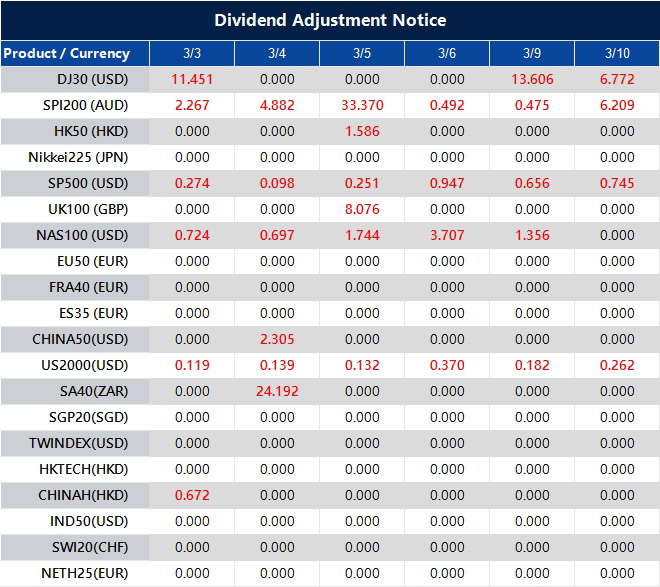
Dividend Adjustment Notice – Mar 03 ,2026

Dear Client,

Please note that the dividends of the following products will be adjusted accordingly. Index dividends will be executed separately through a balance statement directly to your trading account, and the comment will be in the following format “Div & Product Name & Net Volume”.

Please refer to the table below for more details:

Dividend Adjustment Notice

The above data is for reference only, please refer to the MT4/MT5 software for specific data.

If you’d like more information, please don’t hesitate to contact [email protected].

Data show gold prices in Malaysia increased today, with FXStreet’s compiled figures indicating a rise overall

Gold prices rose in Malaysia on Tuesday, based on FXStreet data. Gold was priced at MYR 678.06 per gram, up from MYR 673.00 on Monday. Gold increased to MYR 7,909.00 per tola from MYR 7,849.75 a day earlier. FXStreet listed unit prices as MYR 6,780.76 for 10 grams and MYR 21,089.92 per troy ounce.

Malaysia Gold Price Methodology

FXStreet estimates Malaysia’s gold prices by converting international rates using USD/MYR and local measures. The figures are updated daily at the publication time and are for reference, as local prices may vary slightly. Central banks are the largest holders of gold. World Gold Council data shows central banks added 1,136 tonnes of gold worth about $70 billion in 2022, the highest annual total since records began. Gold prices can move with shifts in the US Dollar and US Treasuries, and they often move in the opposite direction. Prices may also change with interest rates, stock market moves, geopolitical events, and recession fears. The recent strength in gold, with prices rising again today, suggests a positive outlook for the coming weeks. We see this as a continuation of the trend from late 2025, fueled by expectations of shifting monetary policy. Derivative traders should consider positioning for further upside, as gold’s safe-haven appeal is being reinforced.

Central Bank Demand And Market Outlook

Central bank buying continues to provide a strong floor for prices, removing significant supply from the market. Looking back, we saw them add over 1,037 tonnes to their reserves in 2025, nearly matching the record pace of the prior two years. This persistent demand signals a long-term strategic interest in the metal as a reserve asset. Gold is a yield-less asset, and its prospects look brighter as interest rates are expected to fall. After a long period of high rates, markets are now pricing in a greater than 70% probability of a Federal Reserve rate cut by mid-year, which would weaken the dollar. A softer dollar makes gold cheaper for foreign buyers, which should further boost demand. Lingering geopolitical tensions also support the case for holding gold as a hedge against uncertainty. Furthermore, while inflation has cooled from the highs we saw in 2024, it remains sticky and above the 2% target in most Western economies. This environment makes gold an attractive store of value for those looking to protect their purchasing power. For traders using options, buying call spreads could be an effective strategy to gain bullish exposure with a defined risk. This allows participation in potential upward moves while limiting the cost of entry in a market that has already seen a significant run-up. Volatility is expected to pick up around central bank meetings, making defined-risk strategies particularly prudent. Create your live VT Markets account and start trading now.

Start trading now – Click here to create your real VT Markets account

EUR/JPY dips near 183.90 as yen gains on Middle East tensions, yet trend stays above EMA

EUR/JPY trades slightly lower near 183.90 in early European trading on Tuesday, after moving below 184.00. The broader uptrend is still in place while price stays above the 100-day EMA at about 181.20. The Yen gains as demand for safer assets rises amid Middle East tensions. Support also comes from hawkish comments by Bank of Japan policymakers.

Eurozone Inflation In Focus

Markets are waiting for the Eurozone’s preliminary HICP inflation data due later on Tuesday. A higher reading could support the Euro against the Yen. On the daily chart, price has slipped back towards 183.25–183.50 after failing to hold above recent highs near 186.00. The Bollinger midline is near 183.40, and RSI is in the low-50s after easing from stronger levels. First support is at 183.40, then 182.50, and then the 100-day EMA near 181.20. Resistance is at 185.00, followed by 186.00 and the upper Bollinger Band near 186.25. If the pair stays below 185.00, it may consolidate or drift towards 182.50. A daily close above 186.00 would point back to the wider uptrend.

Short Term Strategy Considerations

Given the current price action around 183.90, we see a short-term consolidation phase for EUR/JPY. While the broader uptrend from the past couple of years remains, the failure to push past 186.00 suggests buying momentum is fading. For the next week or two, range-bound strategies seem most appropriate. The yen is getting a boost from more than just geopolitical jitters. We’ve just seen the minutes from the Bank of Japan’s January 2026 meeting, which showed a more serious debate about ending their ultra-loose policy than previously expected. With core inflation in Tokyo staying above 2% for over 20 consecutive months, the market is pricing in a higher chance of a policy shift this year, supporting the JPY. On the other side, the Eurozone’s preliminary inflation numbers for February 2026 just came in at 2.1%, slightly hotter than the 1.9% forecast. After the European Central Bank paused its hiking cycle in late 2025, this persistent inflation makes them less likely to talk about rate cuts soon. This dynamic is likely what is keeping the pair from falling more sharply. Considering this tug-of-war, selling out-of-the-money call options with a strike price at or above the 185.00 resistance level could be a viable strategy. This allows traders to collect premium, capitalizing on the view that the cross will struggle to break new highs in the immediate future. The primary risk is a sudden surge in Eurozone inflation data that pushes the pair through that resistance. For those holding long-term bullish positions, the current dip is a cause for caution but not panic. Buying protective put options with a strike near 182.00 could serve as a cheap form of insurance. This would shield profits from a potential deeper correction toward the critical 100-day moving average support level around 181.20. We must remember the significant run-up we witnessed through 2024 and 2025, so this period of sideways movement is not unexpected. The key level to watch remains that 100-day average near 181.20. A firm break below that would signal a more significant shift in the trend we’ve been riding. Create your live VT Markets account and start trading now.

Start trading now – Click here to create your real VT Markets account

Driven by safe-haven demand, the US Dollar Index holds near 98.50 after previous session’s 1% rise

The US Dollar Index (DXY), which tracks the US Dollar against six major currencies, steadied around 98.50 in Asian trading on Tuesday. It followed nearly 1% gains in the prior session, with demand rising amid the Middle East war. US President Donald Trump said a “big wave” of strikes against Iran is still to come. Marco Rubio said the United States is preparing for a “major uptick” in attacks in Iran over the next 24 hours.

Escalation In The Middle East

The United States and Israel hit thousands of targets inside Iran during a joint campaign. The report said this followed the killing of Iran’s supreme leader, Ayatollah Ali Khamenei. Reuters cited Ebrahim Jabari, an adviser to the Islamic Revolutionary Guard Corps commander-in-chief, saying: “The Strait of Hormuz is closed.” He added that any ships attempting passage would be set ablaze by Revolutionary Guards and the regular navy. In US data, the ISM Manufacturing PMI eased to 52.4 in February from 52.6 in January, above the 51.8 forecast. The Manufacturing Employment Index rose to 48.8 from 48.1, remaining below 50. The dollar also drew support from expectations that higher energy prices could raise inflation and reduce the likelihood of near-term Federal Reserve rate cuts. Higher energy costs also weighed on currencies in major energy-importing economies, including Europe and Japan.

Market Implications And Positioning

Looking back to early 2025, we saw the US Dollar Index surge as the conflict with Iran escalated and key shipping lanes were threatened. The flight to safety was immediate, driving the dollar higher as concerns over a wider war grew. This initial move was a clear signal of the market’s response to geopolitical instability in the Middle East. The closure of the Strait of Hormuz caused a massive energy price shock that rippled through the global economy for the rest of that year. Brent crude oil prices spiked to over $150 per barrel by June 2025, pushing US headline CPI inflation up to a painful 5.8% by the fourth quarter. This forced the Federal Reserve not only to scrap any plans for rate cuts but to implement two more hikes, bringing the Fed funds rate to its current 6.0% level. Today, the dollar’s dominance continues, with the DXY now firmly entrenched above the 105 level as high interest rates and safe-haven demand provide dual support. Currencies of major energy importers have suffered immensely, with the Japanese Yen weakening past 160 to the dollar. In Europe, persistently high energy costs have kept the Euro below parity with the USD for several months. Given this sustained trend, we should consider using call options on the UUP exchange-traded fund to maintain long exposure to the dollar while defining our risk. Continuing to buy puts on the Euro and Yen also makes sense, as their economies show little sign of overcoming the energy cost burden. These positions capitalize on the clear divergence in central bank policy and economic outlook. Volatility in the energy sector will remain extremely high, making it a difficult market for directional bets. A better approach is to trade the volatility itself by using long straddles or strangles on WTI crude oil futures. This strategy will profit from the large price swings that are likely to continue as long as tensions in the Middle East remain unresolved. The sustained high-rate environment has also put significant pressure on the stock market, with the S&P 500 having entered a bear market in late 2025. We should expect this pressure to persist as borrowing costs weigh on corporate earnings. Purchasing VIX call options or puts on major equity indices like the SPY remains a prudent hedge against further market declines in the coming weeks. Create your live VT Markets account and start trading now.

Start trading now – Click here to create your real VT Markets account

Geopolitical tensions and central-bank divergence push GBP/JPY below 211.00, capping recovery near 211.35

GBP/JPY met selling near 211.35 in Asian trading on Tuesday, after rebounding from 209.00, a four-day low. It then slipped back under 211.00, with limited follow-through. Sterling weakened amid UK political uncertainty following the Green Party’s victory in the Gorton and Denton by-election. The result raised questions over Prime Minister Keir Starmer’s leadership, while expectations for Bank of England easing also weighed on the pound.

Policy Divergence In Focus

BoE Governor Andrew Bailey told Parliament’s Treasury Committee last week there is scope for rate cuts, with inflation expected to return to the 2% target. Bank of Japan Governor Kazuo Ueda said last Thursday the bank’s stance is to keep raising rates if its economic and price forecasts are met. Geopolitical tensions supported demand for the Japanese yen as a safe-haven currency, adding pressure to GBP/JPY. However, Tokyo core consumer inflation fell below the BoJ’s 2% target for the first time since 2024, according to data released last Friday. Reports also said Japan’s Prime Minister Sanae Takaichi voiced reservations about further tightening in a meeting with the BoJ governor. This reduced expectations for an immediate rate rise and limited yen strength. We remember the monetary policy divergence between the Bank of England and Bank of Japan that was becoming clear in 2025. This gap has since widened, with the Bank of England having delivered two rate cuts late last year while the Bank of Japan officially ended its negative interest rate policy in October 2025. Consequently, the GBP/JPY cross has trended lower and is now trading with less conviction around the 205.50 level.

Trading Strategies And Risk Management

The political instability that we saw weaken the Pound last year has persisted, creating a difficult environment for the currency. With the latest data showing UK GDP contracted by 0.1% in the final quarter of 2025, markets are now pricing in a 60% chance of another Bank of England rate cut by June. This underlying weakness suggests traders should consider buying put options to protect against a further slide below the key 205.00 level. On the other side of the trade, the Japanese Yen continues to draw strength from both geopolitical tensions and a hawkish central bank. Tokyo’s core inflation for February 2026 unexpectedly rose to 2.1%, putting pressure on the Bank of Japan to signal another rate hike in the second quarter. This ongoing policy differential makes shorting GBP/JPY futures a compelling strategy over the next several weeks. Implied volatility in the currency pair has increased from around 9% in mid-2025 to over 11% today, reflecting the growing certainty of this policy divergence. Given this environment, a bear put spread could be an effective strategy to position for downside while managing the higher cost of options. This allows for a targeted bet on further GBP/JPY weakness without being fully exposed to sharp, unexpected reversals. Create your live VT Markets account and start trading now.

Start trading now – Click here to create your real VT Markets account

Back To Top
server

Hello there 👋

How can I help you?

Chat with our team instantly

Live Chat

Start a live conversation through...

  • Telegram
    hold On hold
  • Coming Soon...

Hello there 👋

How can I help you?

telegram

Scan the QR code with your smartphone to start a chat with us, or click here.

Don’t have the Telegram App or Desktop installed? Use Web Telegram instead.

QR code

