
Back

Societe Generale analysts say China can manage U.S.–Iran oil tensions, despite Iran supplying most imports

Following the US attack on Iran in June 2025, Iran’s average shipments to China accounted for 94% of Iran’s total oil exports. The UAE and Iraq made up the remaining exports. Iran ships almost all its oil to China, which prefers to avoid long disruptions. China’s energy security approach includes supply diversification, stockpiling, and demand substitution through electrification.

China Energy Security After June 2025

The Strait of Hormuz supplies around 50% of China’s total oil imports. China has built roughly 1.5 billion barrels of strategic petroleum reserves, enough to cover around 200 days of oil imports. China can manage disruptions by drawing down reserves and using Russian supply. It is expected to criticise US militarisation in the Middle East, while not intervening directly in the near term. Following the US-Iran tensions in June 2025, the market has now had time to assess China’s energy security, which appears more robust than initially feared. China’s strategic petroleum reserves, which we still estimate at over 1.2 billion barrels, have created a significant buffer against price shocks. This large cushion has consistently tempered upside volatility in crude oil over the last several months. The flow of Russian oil to China, a trend that accelerated after the events of last year, has proven to be a key stabilizing factor. Recent shipping data confirms that Russia remains China’s top supplier, with seaborne exports holding strong at nearly 2 million barrels per day through January and February of this year. This steady, diversified supply chain away from the Strait of Hormuz means traders should be wary of overreacting to minor regional headlines.

Implications For Oil Volatility And Positioning

In the coming weeks, this underlying stability suggests that implied volatility on crude options may be inflated during any periods of tension. History shows that after the initial shock of an event, such as the one in early 2022, volatility tends to decline as the market adapts to the new reality. Therefore, derivative strategies that benefit from range-bound price action or falling volatility, like selling covered calls on existing long positions, could be prudent. Our immediate focus must be the planned meeting between Presidents Trump and Xi in April, which is a major potential catalyst. Any unexpected announcements on energy policy or sanctions could swiftly disrupt the current market calm. Traders should consider using low-cost options to hedge against a surprise outcome from that summit, as it represents the most significant known event risk on the horizon. Create your live VT Markets account and start trading now.

Start trading now – Click here to create your real VT Markets account

USDX Holds Gains as Middle East Tensions Lift Safe-Haven Demand

Key Takeaways

  • The US dollar index (USDX) stabilised near 98.5 after rising nearly 1% in the previous session.
  • Escalating US-Israel military activity against Iran boosted safe-haven demand.
  • Rising energy prices are reinforcing inflation concerns and pushing back Fed rate-cut expectations.
  • Markets now expect the next Fed cut in September rather than July.

Dollar Supported by Global Risk Premium

The US dollar index hovered around 98.5 after surging nearly 1% in the prior session, as investors sought safety amid intensifying Middle East tensions.

Reports that Washington may significantly ramp up military action against Iran by targeting missile production, drone programmes and naval assets have reinforced risk aversion across markets.

In periods of geopolitical stress, the dollar typically benefits from its reserve currency status and the depth of US Treasury markets. That dynamic was evident as capital rotated defensively.

Energy Shock Complicates Rate-Cut Outlook

The dollar’s strength is not solely a safe-haven reaction.

Rising oil prices, driven by escalating conflict, have renewed inflation concerns. Higher energy costs feed into transportation, manufacturing and consumer pricing channels, potentially slowing progress toward the Federal Reserve’s inflation target.

Markets have consequently pushed back expectations for the next Fed rate cut to September, from earlier projections of July. However, approximately two 25-basis-point cuts remain priced in for the year.

The repricing reflects growing uncertainty around how persistent energy-driven inflation could influence policy timing.

Pressure on Energy-Importing Economies

Elevated oil prices are weighing more heavily on major energy-importing economies, particularly in Europe and Japan.

Higher energy costs can widen trade deficits, pressure corporate margins and dampen growth expectations. This dynamic has contributed to relative weakness in the euro and yen compared with the US dollar.

The divergence highlights how commodity shocks can alter currency performance through both inflation and trade channels.

Technical Outlook for USDX

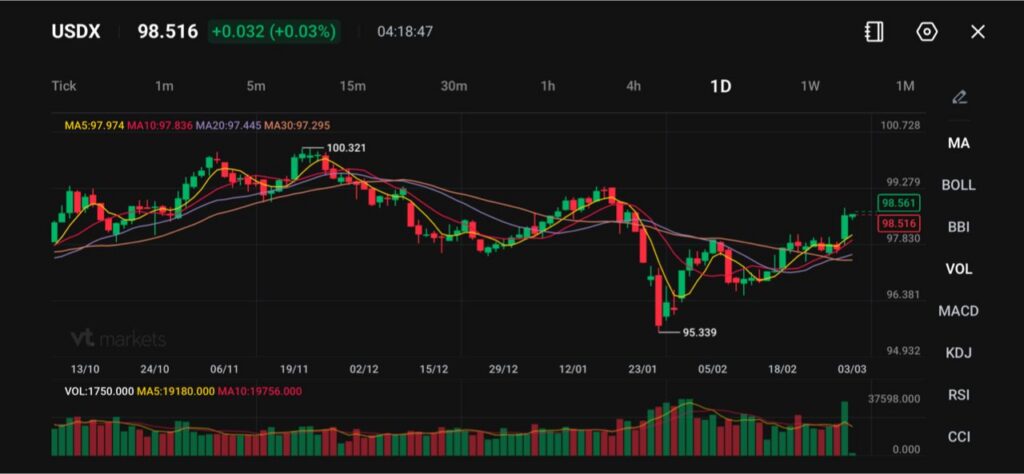
The US Dollar Index (USDX) is trading near 98.52, marginally higher on the session, as the dollar continues to stabilise following its rebound from the 95.34 January low. The broader structure shows a recovery phase underway after the sharp mid-winter decline.

On the daily chart, price is now holding above the short-term moving averages. The 5-day (97.97) and 10-day (97.84) are turning higher, while the 20-day (97.45) and 30-day (97.30) sit just below current price and are beginning to flatten.

This alignment suggests improving short-term momentum, with the dollar attempting to build a higher base.

Immediate resistance lies near 98.80–99.30, where previous consolidation and rejection occurred. A sustained break above 99.30 would strengthen the recovery narrative and open the path toward the psychological 100.00–100.30 region.

On the downside, initial support is seen around 97.80, followed by stronger support near 97.30–97.50. A move back below 97.30 would weaken the rebound structure and could shift momentum back to the downside.

Learn more about trading Indices on VT Markets today.

Frequently Asked Questions

  1. Why is the US dollar rising?
    The dollar is strengthening due to safe-haven demand amid escalating Middle East tensions and expectations that higher energy prices could delay Federal Reserve rate cuts.
  2. How do rising oil prices support the dollar?
    Higher oil prices can reinforce inflation pressures in the US, potentially reducing the urgency for the Fed to cut interest rates. Fewer expected rate cuts generally support the dollar through yield differentials.
  3. Why are the euro and yen under pressure?
    Europe and Japan are major energy importers. Rising oil prices increase their import costs and can weaken growth prospects, placing downward pressure on their currencies relative to the dollar.
  4. Have Fed rate-cut expectations changed?
    Yes. Markets have shifted expectations for the next Fed rate cut to September from July, although two rate reductions are still broadly priced in for the year.
  5. What would weaken the dollar from here?
    A rapid de-escalation in geopolitical tensions, a decline in energy prices or significantly weaker US economic data could reduce safe-haven flows and revive earlier rate-cut expectations.

Start trading now – Click here to create your real VT Markets account

Governor Bullock said February’s rate rise was justified by data, while Middle East tensions increase uncertainty

RBA Governor Michelle Bullock said recent data supported the Reserve Bank of Australia’s February rate rise. She said the Board is unsure whether financial conditions are restrictive enough to return inflation to the midpoint of the target within a reasonable timeframe. Bullock said indicators show labour market conditions are tight. She said underlying demand is further from the economy’s supply potential than previously assessed.

Inflation Drivers And Expectations

She said a large part of the unexpected rise in inflation came from sector-specific factors that are likely to ease. She said inflation is still elevated and inflation expectations need close monitoring. Bullock said events in the Middle East are a reminder of geopolitical uncertainty. She said a prolonged shock could weigh on global economic activity and a supply shock could add to inflation pressures. She said the RBA is well placed to respond with policy if needed. She said every Board meeting is live. We remember the hawkish signals from this time in 2025, which correctly warned that policy was not yet restrictive enough to tame inflation. The Reserve Bank of Australia did follow through on that warning, hiking the cash rate again to its current level of 4.85% by August of last year. This move was justified as inflation, while lower, still printed a stubborn 4.5% in the last quarter of 2025.

Market Implications For Rates And Fx

The geopolitical uncertainty highlighted a year ago remains a key factor, creating volatility in energy prices and the Australian dollar. With every RBA meeting still considered “live,” traders should look at buying options on interest rate futures to hedge against a surprise policy move. Implied volatility on the AUD could be underpriced if the market is too complacent about the RBA holding steady through mid-year. A year ago, the tight labor market was a primary reason for the RBA’s hawkish stance. Now, with the unemployment rate having drifted up from below 4% to a recent reading of 4.3%, we are seeing clear signs that the past rate hikes are beginning to bite. This suggests that derivative positions anticipating an eventual easing, such as receiving fixed on interest rate swaps for late 2026, are becoming more attractive. The assessment in early 2025 that underlying demand was outpacing the economy’s potential has been directly challenged by the subsequent hikes. We now see that retail sales figures have been flat for two consecutive quarters, indicating that restrictive financial conditions are finally working as intended. This supports a view that the yield curve may be too steep, as the market could be underestimating how quickly demand-side inflation will fade. Create your live VT Markets account and start trading now.

Start trading now – Click here to create your real VT Markets account
Argentina’s monthly tax revenue fell to 16231.8B in February, down from 18337.6B previously

Argentina’s tax revenue totalled 16,231.8 billion in February, down from 18,337.6 billion in the previous month. That is a month-on-month fall of 2,105.8 billion. This equals an 11.5% decrease compared with the prior month. We are seeing a significant month-over-month drop in tax collection, which signals a deepening economic contraction. This nearly 12% nominal decrease is concerning because it challenges the narrative of a sustainable fiscal adjustment. The data suggests that economic activity is slowing faster than the government may have anticipated. When we factor in recent inflation data, the picture gets worse. With monthly inflation still high, running at a reported 8.5% for February 2026, the drop in real, inflation-adjusted tax revenue is much steeper, pointing towards a severe recessionary environment. This trend aligns with recent industrial production figures, which showed a year-over-year decline of 10.2%, confirming the broad-based weakness in the economy. For derivative traders, this puts downward pressure on the Argentine peso (ARS). We should anticipate the central bank will be forced to maintain tight monetary policy, potentially even holding off on expected rate cuts to defend the currency. This environment warrants considering strategies that profit from peso weakness, such as buying USD/ARS non-deliverable forwards (NDFs). Looking back from our perspective in 2025, we recall the initial market rally following the austerity measures introduced in late 2023. This current data point suggests the low-hanging fruit of fiscal consolidation has been picked, and the government now faces the political challenge of maintaining austerity during a painful recession. The sustainability of the fiscal surplus is now in question. Therefore, volatility is likely to increase in the coming weeks. We can expect Argentina’s sovereign credit default swaps (CDS), currently trading around 1,450 basis points, to face upward pressure as default risk is repriced. Traders might look at buying puts on Argentine equity ETFs or employing straddles to trade the expected increase in price swings around the next major data releases.

Start trading now – Click here to create your real VT Markets account

GBP/JPY rebounds from 209.10 amid Middle East tensions, rising 0.24% and nearing resistance around 211.00

GBP/JPY rose 0.24% in the North American session on Monday. It recovered from a daily low of 209.10 linked to risk aversion tied to tensions between the US and Iran, and traded at 210.98 near 211.00. The pair started the week lower and formed a bullish engulfing candlestick pattern. If confirmed, it suggests scope for further gains.

Renewed Upward Momentum

The Relative Strength Index (RSI) rebounded after bottoming near the 50 line. This points to renewed upward momentum. A move above 211.00 would open the way to 212.12, the February 25 swing high. If price breaks above that level, the next target is 213.82, the February 10 high, with 214.00 beyond. If the pair falls below 210.00, 209.35 comes into view. Further downside could test 209.00 and then the 100-day Simple Moving Average at 207.91. Looking back to early 2025, we saw a bullish engulfing pattern that suggested a move toward 211.00 was likely. That technical signal proved to be a strong indicator, as the pair broke through the initial targets of 212.12 and 213.82 in the months that followed. Now, with the pair trading around 217.50, the underlying drivers for pound strength have only intensified.

Divergent Central Bank Policies

The fundamental picture today is defined by divergent central bank policies, a theme that has rewarded long positions for over a year. Recent data from late February shows UK inflation remains persistent at 3.1%, keeping the Bank of England under pressure to maintain higher rates. In contrast, the Bank of Japan has only made minor adjustments to its policy, keeping the interest rate differential between the two nations historically wide. For those looking to position for further upside, buying call options with strike prices at 219.00 and 220.00 expiring in late April offers a defined-risk way to capture the next leg up. With yen volatility currently moderate, as measured by the JYVIX index at 9.5, option premiums are not excessively expensive. This strategy allows us to capitalize on the bullish momentum while capping our potential loss to the premium paid. Traders already holding long positions should consider protecting gains against any sudden reversals spurred by geopolitical shifts. Purchasing put options with a strike price near the 215.50 level could serve as an effective hedge. A bull call spread is another viable strategy, which involves selling a higher-strike call to finance the purchase of a lower-strike one, reducing the overall cost basis. We remember that last year, the 100-day simple moving average provided a key support level around 207.91. Today, that same moving average has risen significantly and now sits near 214.80, which we view as the new critical floor for the current trend. A decisive break below this level would indicate a serious loss of momentum and would force us to reassess the immediate bullish outlook. Create your live VT Markets account and start trading now.

Start trading now – Click here to create your real VT Markets account

Following US-Israeli strikes on Iran, the Swiss franc rose versus the euro, then stabilised after SNB warnings

The Swiss Franc rose in early Monday trading as US-Israeli strikes on Iran drove demand for safer assets. EUR/CHF fell to about 0.9030, the lowest since 2015, then rebounded to near 0.9110 after the Swiss National Bank said it was “increasingly prepared” to intervene. The Franc weakened against the US Dollar, with USD/CHF up 1.25% to about 0.7780, and it later lost ground against other major currencies by the end of the US session. The SNB policy rate is 0%, inflation is near zero, and the bank forecasts 0.3% average inflation for 2026. Swiss data were weaker, with January real retail sales down 1.1% year-on-year versus 2.7% expected, after 2.8% in December. February SVME PMI was 47.4 versus 50 forecast, down from 48.8. Markets expect Wednesday’s February CPI at 0.4% month-on-month and -0.1% year-on-year. USD/CHF was at 0.7789, with resistance near 0.7830 and 0.7900, and support around 0.7730 and 0.7625. The Franc is among the top ten traded currencies and was pegged to the Euro from 2011 to 2015; removal of the peg led to a rise of more than 20%. Some models put EUR-CHF correlation at more than 90%, and the SNB meets four times a year with an inflation aim below 2%. As we see it today on March 3rd, 2026, the Swiss Franc is caught between a geopolitical safe-haven bid and a central bank determined to weaken it. The US dollar is winning the safe-haven battle, primarily due to its significant yield advantage with a Federal Funds Rate near 3% compared to the Swiss National Bank’s (SNB) 0% rate. This interest rate difference is a powerful force that should continue to support USD/CHF. The SNB’s strong warning about being “increasingly prepared” to intervene is the most important factor right now. The combination of falling retail sales, a contracting manufacturing sector, and the risk of deflation from this week’s CPI data puts immense pressure on the central bank to act. We have seen this playbook before, as the SNB has a long history of massive currency interventions to prevent the franc from getting too strong. For derivatives traders, this suggests the 0.9000-0.9100 range in EUR/CHF is a line in the sand that the central bank will likely defend vigorously. This could make selling out-of-the-money puts on EUR/CHF an attractive strategy for collecting premium, betting that SNB action will limit further downside. The recent sharp plunge and quick recovery show the market is already pricing in this intervention risk. Looking at USD/CHF, the fundamental picture now clashes with the recent bearish technical trend. Given the SNB’s dovish stance and the attractive US yields, buying call options on USD/CHF could be a good way to position for a potential breakout above the 0.7830 and 0.7900 resistance levels. A deflationary CPI print this Wednesday would be the catalyst needed to fuel such a move higher. The weak economic data from Switzerland cannot be ignored and supports the case for a weaker franc. The PMI reading of 47.4 signals a deeper manufacturing contraction than we saw for much of the 2023 slowdown, reinforcing the SNB’s need to avoid a strong currency harming exports further. This weak domestic backdrop makes it very difficult for the franc to sustain strength on its own merits.

Start trading now – Click here to create your real VT Markets account

Following US-Israeli attacks killing Iran’s Supreme Leader, the US dollar climbed above 98.50 amid heightened tensions

The United States, allied with Israel, struck Iran over the weekend and killed Iran’s Supreme Leader, Ayatollah Ali Khamenei. Iran responded with missile and drone attacks on US military bases across several nations, and fighting continued. The US Dollar Index (DXY) traded near 98.50 and rose to a five-week high. US manufacturing expanded in February, with the ISM Manufacturing PMI at 52.4 versus 52.6 in January, the Employment Index at 48.8 versus 48.1, and the New Orders Index at 55.8 versus 57.1.

Central Banks Signal Policy Flexibility

EUR/USD traded near 1.1700 after a risk-off start to the week. ECB member Martin Kocher said the ECB should be ready to move interest rates “in either direction” if uncertainty grows. GBP/USD traded near 1.3420 after earlier falling to 1.3314, its lowest since 17 December. Local elections in northern England weakened Prime Minister Keir Starmer’s position within the Labour Party. USD/JPY traded near 157.30. AUD/USD traded near 0.7100 after opening with a gap and then trimming losses as commodity prices rose. Gold traded at $5,330 and gave back about half of its intraday gains. Central banks added 1,136 tonnes of gold worth around $70 billion in 2022, the highest yearly purchase on record.

Key Data Releases To Watch

Data due include Australia building permits and industry and PMI releases, Eurozone HICP and Italian CPI, then GDP, PMIs, CPI, US ADP and ISM services data, jobless claims, and US nonfarm payrolls. The escalating conflict between the United States and Iran has injected massive uncertainty into the market, which is a clear signal to buy volatility. We are looking at options strategies like straddles or strangles on major indices and currency pairs, as implied volatility is surging in a way we haven’t seen since the geopolitical shocks of 2022. Hedging any existing equity exposure with put options is now a critical defensive maneuver. With the US Dollar Index (DXY) hitting a five-week high, the dollar has clearly become the primary safe-haven asset, drawing capital away from other havens. This trend is likely to continue as long as the conflict is active, similar to how the DXY rallied for months after the outbreak of the war in Ukraine in February 2022. We should consider maintaining long positions on the dollar through futures contracts or by buying call options. The direct conflict in the Middle East puts global energy supplies at immediate risk, especially with Iran’s proximity to the Strait of Hormuz, through which about 21% of global petroleum liquids consumption passes. We believe oil prices are poised to climb significantly higher from here, making long positions in WTI and Brent crude futures the most direct way to trade the crisis. Buying call options on major energy stocks and ETFs is another viable strategy. Gold’s price action shows it is struggling against the sheer strength of the US dollar, despite the classic risk-off environment. While the price has soared to over $5,300, its inability to hold its highest gains shows the dollar is currently winning the safe-haven battle. We see this as a temporary headwind, and any sign of de-escalation or a pause in the dollar’s rally could trigger another sharp move up in gold, so we are watching it closely. For currency pairs, we anticipate continued weakness in risk-sensitive currencies like the Australian Dollar and pro-cyclical currencies like the Euro. The political uncertainty in the UK makes the pound particularly vulnerable, so we view shorting GBP/USD and EUR/USD as favorable positions. Even the Japanese Yen is failing to act as a safe haven, meaning selling USD/JPY is not the trade it once was during times of crisis. This week is packed with economic data, culminating in the US Nonfarm Payrolls report on Friday. While geopolitics is firmly in the driver’s seat, a surprisingly weak jobs number could momentarily complicate the dollar’s rally and inject further volatility. We must be prepared for economic fundamentals to either clash with or amplify the geopolitical narrative, creating sharp, unpredictable swings. Create your live VT Markets account and start trading now.

Start trading now – Click here to create your real VT Markets account

Amid Iran tensions and robust US data, the Australian dollar weakens, pushing AUD/USD down to 0.7083

AUD/USD fell after weekend events in the Middle East. It traded at 0.7083, down 0.37% at the time of writing. US President Donald Trump said attacks on Iran would continue for four or five weeks. He also said the “big wave” in the war with Iran is yet to come.

Middle East Escalation Drives Risk Off

A US and Israeli attack killed Iran’s Ayatollah Ali Khamenei on Saturday. Iran then hit US bases in Gulf state countries and fired a missile at a UK airbase in Cyprus. US data showed manufacturing held up. The ISM Manufacturing PMI for February was 52.4, down from 52.6, staying in expansion for a second month. The ISM Prices Paid index rose from 59 in January to 70.5. This was the highest level since October 2022, a three-and-a-half-year high. Markets shifted expected US rate cuts from 60 basis points to 48 basis points. The US Dollar Index rose 0.83% to 98.45.

Key Central Bank Speakers Ahead

RBA Governor Michele Bullock is due to speak on Tuesday. Fed officials John Williams and Jeffrey Schmid are also due to speak. AUD/USD support is near 0.7090, then 0.7050 and 0.7000, with resistance near 0.7125 and 0.7170. A close above 0.7170 targets 0.7250. Looking back at the events of 2025, we saw the AUD/USD pair drop to around 0.7083 following the escalation of conflict in the Middle East. Today, on March 3rd, 2026, the situation has evolved, with the pair trading significantly lower near 0.6550. The intense flight-to-safety from last year has subsided, but the market dynamics have fundamentally shifted since then. A year ago, markets were pricing in nearly 50 basis points of Federal Reserve rate cuts, but persistent inflation kept the Fed on hold for much longer than anticipated. The US Dollar Index (DXY) reflects this reality, holding strong around 104.5, a considerable difference from the 98.45 level seen during the 2025 turmoil. This sustained dollar strength remains the primary headwind for the AUD/USD. The spike in oil prices during the 2025 conflict has moderated, with WTI crude now trading near $82 per barrel, down from the peaks but still at a level that adds to global inflationary pressures. While the direct military threat has de-escalated, we see that underlying tensions continue to simmer, representing a background risk. This keeps a floor under haven currencies like the US dollar. Australia’s key export, iron ore, has also softened, with prices now hovering around $110 per tonne amid ongoing concerns about China’s property sector and overall industrial demand. This is a change from the more robust commodity environment that supported the Aussie dollar in the past. We must factor this commodity weakness into our outlook. Given this backdrop, we should consider buying put options on the AUD/USD to protect against further downside. A put option with a strike price around 0.6400 could offer a cost-effective hedge if US economic data continues to outperform or if risk aversion returns. This strategy allows for participation in a further decline while capping the initial risk. Implied volatility in AUD/USD has decreased since the highs of the 2025 conflict, and we believe it may be underpricing the risk of renewed market stress. Therefore, establishing long volatility positions, like a long strangle, could be advantageous. This would profit from a significant move in either direction, which is plausible given the uncertain outlook for both global growth and central bank policy in the coming weeks. Create your live VT Markets account and start trading now.

Start trading now – Click here to create your real VT Markets account

Markets wobble as US-Iran tensions rise; Dow slips 0.2%, S&P flat, Nasdaq edges higher

US shares fell at the open then rebounded from lows after US and Israeli strikes on Iran over the weekend. The Dow Jones Industrial Average was down about one-fifth of one percent, the S&P 500 was nearly flat, and the Nasdaq Composite turned positive after earlier drops of 1.2% for the Dow and S&P 500 and 1.6% for the Nasdaq. West Texas Intermediate crude traded near $72 a barrel, up about 8% from roughly $67, and Brent rose above $78 to a new 52-week high. Gold climbed over 2% to about $5,400 an ounce, while the VIX rose about 19% to around 23.6, above its long-run average near 20 and its highest level of 2026.

Market Reaction And Geopolitical Shock

The operation, named “Epic Fury”, was reported to have killed Ayatollah Ali Khamenei, followed by Iranian strikes that killed three US service members. Shipping firms suspended routes through the Strait of Hormuz and rerouted around Africa. Defence stocks rose, with Lockheed Martin up over 3%, Northrop Grumman about 4%, RTX about 4%, and AeroVironment over 10%. Airlines fell, including United down over 5%, with American and Delta also down about 5%. Energy shares gained, led by Exxon up about 4%, Chevron about 3%, and ConocoPhillips over 5%. Tanker stocks rose: Frontline over 5%, DHT Holdings 7%, and International Seaways 6%. Markets priced a roughly 96% chance the Fed holds rates at 3.50–3.75% in March. Nvidia said it will invest $2 billion each in Lumentum and Coherent; both rose over 7% premarket.

Key Risks And Trading Implications

ISM Manufacturing PMI was 52.4 in February versus 52.6 in January, the second month of expansion and only the third time in 40 months. New Orders were 55.8, down from 57.1. With the VIX spiking nearly 20% to 23.6, we see a clear opportunity to buy protection and bet on continued uncertainty. Historically, geopolitical shocks like this cause sustained volatility; for instance, after the initial conflict escalation in early 2022, the VIX remained above 20 for several months. We believe buying out-of-the-money VIX calls or establishing call spreads for April and May expirations is a prudent move. The surge in WTI crude to $72 a barrel is the market’s most immediate concern, directly threatening the inflation outlook. We should look at buying call options on oil futures and energy stocks like Exxon Mobil, which has already gained 4%. Looking back at similar supply shock events, such as the 10% jump in oil prices during a single week in March of 2022, the follow-through for energy equities lasted for several weeks. This creates a classic pair trade opportunity between soaring defense stocks and plummeting travel names. We can go long calls on RTX and Lockheed Martin while simultaneously buying puts on United Airlines and booking platforms like Expedia. The performance gap is already stark, with the Dow Jones U.S. Aerospace & Defense Index outperforming the Dow Jones Travel & Tourism Index by over 8% in a single session, a divergence we expect to widen. The oil shock complicates the Federal Reserve’s path, making rate cuts in the near future highly unlikely. After we saw core inflation finally dip below 3% in late 2025, a sustained energy price increase could easily reverse that progress and force policymakers to hold rates steady. This suggests we should consider trades that bet against a dovish turn, such as buying puts on Treasury bond ETFs. While the broader market recovered from its lows, we should use any strength to hedge long-term portfolios. The announced Nvidia investment is a positive fundamental story, but it is being completely overshadowed by the macro risk. Buying puts on the Nasdaq 100 ETF (QQQ) can protect against further downside if the conflict escalates and oil prices continue to climb toward $80 per barrel. Create your live VT Markets account and start trading now.

Start trading now – Click here to create your real VT Markets account

MUFG’s Michael Wan warns Iran-driven oil spikes could weaken Asian currencies, especially KRW, INR, PHP

MUFG said sustained oil price spikes linked to the Iran conflict could weaken most Asian currencies because many countries in the region are net oil importers. It said KRW, INR and, to a lesser extent, PHP may be more exposed, while CNH and MYR may be more resilient. MUFG estimated CPI inflation across Asia could rise by about 0.1–0.9 percentage points if higher oil prices persist. It said Thailand, Vietnam, the Philippines and South Korea are the most sensitive to oil price increases.

Asian Central Banks And Policy Timing

MUFG said central banks in Asia may not raise rates solely because of this risk, but lower oil-related inflation and uncertainty could affect policy timing. It said rate cuts could be delayed in the Philippines and Indonesia, and the likelihood of cuts could fall in India and South Korea. MUFG said FX forward curves may steepen in some Asian markets due to higher risk premia. It added that JPY may outperform in the near term, while AUD may underperform. With Brent crude futures now pushing past $95 a barrel on renewed geopolitical risk, a sustained price spike will pressure Asian currencies. The region is dominated by net oil importers, creating a direct negative impact on their trade balances. We have seen this dynamic before, but the current market fragility makes the situation more acute. We believe traders should anticipate weakness in the South Korean Won, Indian Rupee, and Philippine Peso. South Korea’s February inflation just came in hot at 3.2%, and India is still battling inflation above 5%, making their economies highly sensitive to higher energy costs. These currencies are the most vulnerable given their high dependence on oil imports and, in the Won’s case, its high-beta nature.

Relative Resilience In CNH And MYR

Conversely, the Chinese Yuan and Malaysian Ringgit should show relative resilience in the region. Malaysia is a net energy exporter and directly benefits from higher crude prices, as reflected in Petronas’s strong earnings reports from last year. China’s continued access to discounted Russian oil provides a significant buffer that insulates its economy from the full force of global price shocks. This oil shock is unlikely to cause central banks to hike rates, but it will certainly delay anticipated rate cuts. We are now pricing out cuts for the Philippines and Indonesia for the foreseeable future, and the probability of cuts in India and South Korea has diminished significantly. The Bank of Korea’s minutes from last week already showed a more cautious tone even before this latest oil surge. For derivatives, we expect a steepening in FX forward curves, particularly for the INR and KRW. This reflects the rising cost of hedging and an increase in risk premia being priced into the market. Traders should be prepared for higher volatility and wider bid-ask spreads in these currency pairs. From a global perspective, this environment favors traditional havens like the Japanese Yen over high-beta currencies like the Australian Dollar. This risk-off positioning is consistent with patterns we observed during the market volatility spikes in late 2025. We would look to express these views through selling AUD/JPY as a proxy for broader risk aversion. Create your live VT Markets account and start trading now.

Start trading now – Click here to create your real VT Markets account

Back To Top
server

Hello there 👋

How can I help you?

Chat with our team instantly

Live Chat

Start a live conversation through...

  • Telegram
    hold On hold
  • Coming Soon...

Hello there 👋

How can I help you?

telegram

Scan the QR code with your smartphone to start a chat with us, or click here.

Don’t have the Telegram App or Desktop installed? Use Web Telegram instead.

QR code

