Back

S&P 500 Futures Stabilise Ahead of Upcoming Earnings Reports

Key Takeaways

  • The index rose 1.02% on Monday, recovering losses linked to the Middle East conflict and returning to levels seen before the war-related sell-off.
  • Oil prices remained volatile, with Brent crude at $97.90 and WTI at $96.75, as the market reacted to tensions around the Strait of Hormuz.
  • While energy stocks benefited from higher oil prices earlier, tech stocks have recently taken the lead as market momentum shifted back toward growth sectors.
  • Earnings season is now a key focus, with major banks such as JPMorgan Chase, Wells Fargo, and Citigroup set to report.

The S&P 500 has shown notable resilience in recent sessions, with futures holding steady even amid ongoing geopolitical tensions and the breakdown of peace talks between the US and Iran.

On Monday, the index climbed 1.02%, reversing losses tied to the rising Middle East conflict and wiping out declines seen since the war began.

Even though peace talks between the US and Iran collapsed over the weekend, the index regained its ground, showing that investors still have confidence in the market.

President Trump’s remarks that Iran may be open to more talks helped calm some investor fears.

Despite the ongoing conflict, investors are confident in the long-term economic outlook, focusing on factors like company profits and growth rather than short-term political issues. This recovery highlights the market’s ability to adapt and stay focused on what drives economic strength.

Oil Prices Rise Amid Middle East Tensions

While the S&P 500 has remained steady, the oil market has been much more volatile. Brent crude futures fell 1.47% to $97.90 per barrel, while U.S. West Texas Intermediate (WTI) declined 2.35% to $96.75.

These price decreases are driven by rising tensions in the Middle East, especially in the Strait of Hormuz, where the US has started a blockade, tightening oil supply and pushing prices lower.

As tensions in the Middle East continue to affect the oil market, experts are weighing in on the situation. Rusty Hutson Jr., founder of Diversified Energy, provides his insight into the current dynamics driving oil prices that are not fully reflected in the market, suggesting that prices should be trading above $100 per barrel.

Although higher oil prices present challenges for energy consumers, they have boosted energy stocks, which are seeing gains. Despite these fluctuations, the broader market remains focused on economic recovery, maintaining its emphasis on stability and progress.

Tech Outperforms as Energy Stalls

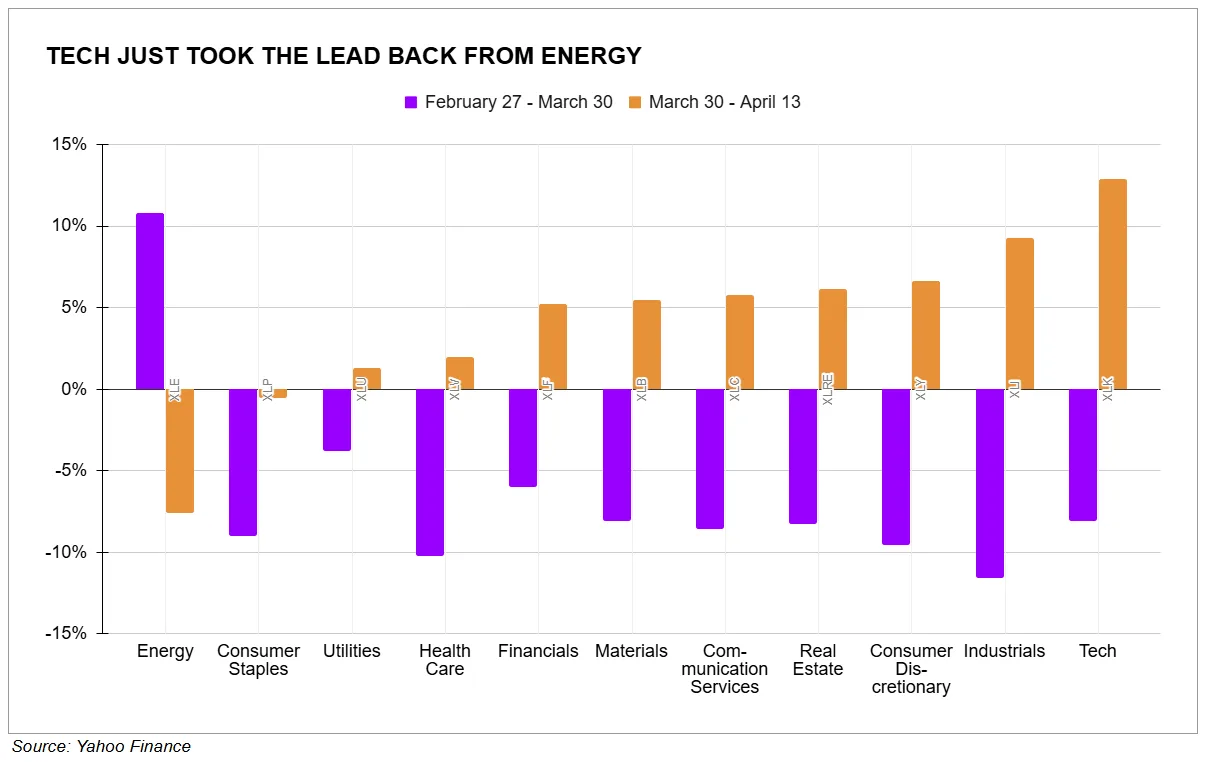
Energy stocks have been strong performers, driven by rising oil prices that boosted expectations for higher profits in energy companies. However, as oil prices stabilise, the tech sector has regained momentum and is now outperforming energy stocks.

The graph below clearly shows the shift in sector performance, with tech stocks surging since March 30, while energy stocks have started to decline. This reversal highlights how tech, which had lagged behind, is now leading the market.
Source: Yahoo Finance

The recent rally in the Nasdaq Composite reflects this shift, with tech making strong gains as investors move back into growth stocks.

Although energy continues to benefit from rising commodity prices, it’s clear that the tech sector has reclaimed the lead, showing a strong recovery despite earlier concerns. This change suggests a return to a more traditional market dynamic, where tech sectors tend to lead during periods of economic recovery.

Earnings Season to Offer New Insights

As earnings season unfolds, the market will carefully scrutinise the results from key financial institutions.

Banks such as JPMorgan Chase, Wells Fargo, and Citigroup are set to report their quarterly earnings this week, offering critical insights into the financial health of the economy and how well the corporate sector is navigating rising geopolitical risks.

The performance of the banking sector is particularly significant this quarter, as investors will be seeking indicators of stability amid global uncertainties.

Goldman Sachs recently reported impressive earnings, with $17.55 per share and $17.23 billion in revenues, surpassing expectations despite challenges.

However, the results were somewhat mixed, as a notable decline in fixed-income trading revenue was counterbalanced by strong gains in investment banking.

With this backdrop, attention now shifts to how other major banks will fare. Solid earnings from these institutions could reinforce the belief that the economy is effectively managing geopolitical challenges, further bolstering the positive sentiment propelling the S&P 500.

Technical Analysis

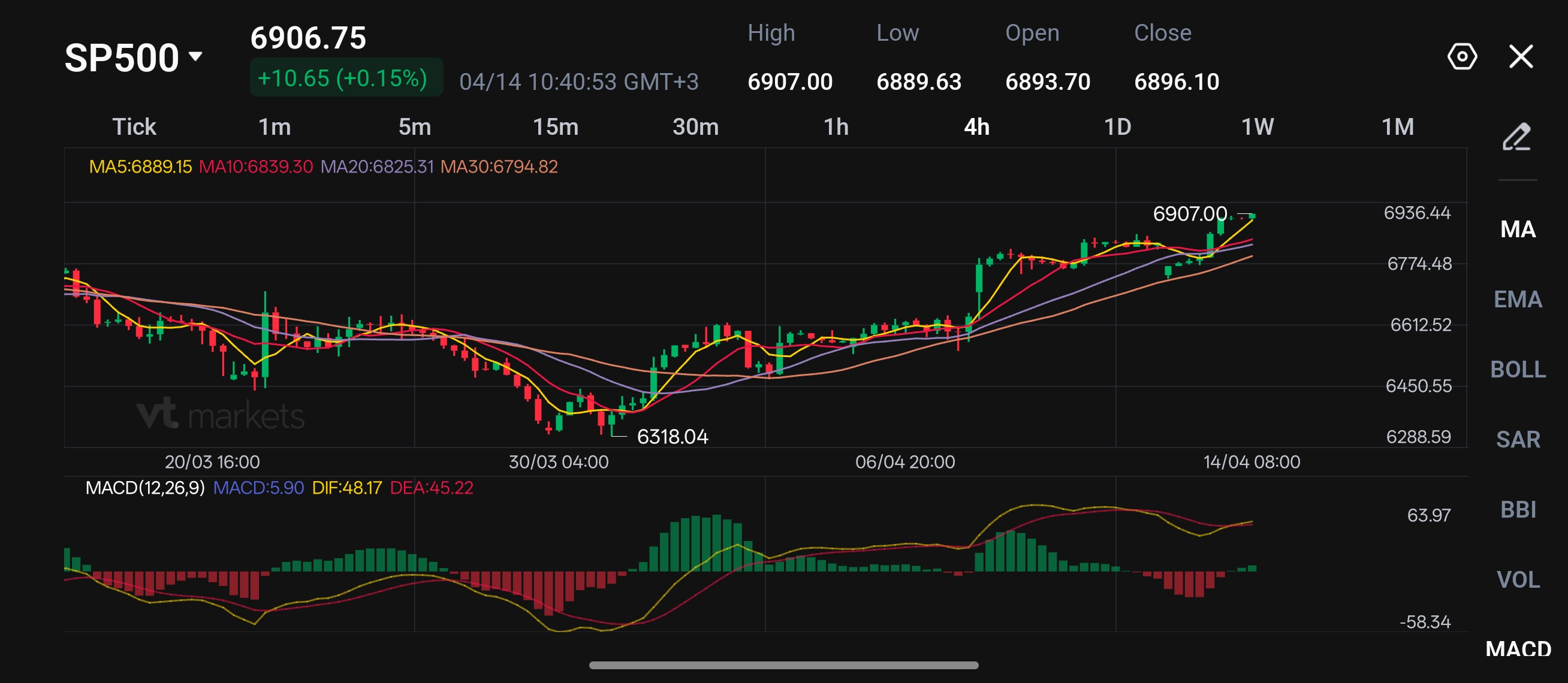
The index established a local bottom near 6318.04 on March 30. Since then, it has maintained a consistent upward trajectory, characterised by higher highs and higher lows. The current price of 6906.75 is hovering just below the recent peak of 6907.00, suggesting the market is testing immediate resistance.

The MACD indicator shows a bullish crossover that occurred around April 6. While the MACD histogram is currently positive (green bars), the momentum appears to be flattening slightly as the bars get smaller. A tightening of these lines could signal a brief consolidation or a minor pullback before the next leg up.
Key Levels To Watch:

  • Support: 6889
  • Resistance: 7000

What Traders Should Watch Next

The next move for the S&P 500 depends on how the market reacts to the upcoming earnings reports from major banks and whether geopolitical tensions, particularly in the US-Iran conflict, escalate or stabilise.

Traders will also be keeping an eye on oil prices, as any significant changes could influence both energy stocks and broader market sentiment. If tech continues its upward momentum and energy stocks stabilise, the S&P 500 may maintain its gains.

However, if energy prices spike again or geopolitical risks heighten, the index could face challenges holding its current levels.

Learn more about trading Indices on VT Markets today.

Trader Questions

1. Why did the S&P 500 recover even after US-Iran peace talks collapsed?
The S&P 500 recovered because the market believed the conflict might not escalate further. Hopes for renewed US-Iran talks helped reduce panic, while traders shifted their focus back to company earnings, economic strength, and the broader market outlook.

2. How are Middle East tensions affecting the S&P 500?
Middle East tensions are affecting the S&P 500 mainly through oil prices and market sentiment. Rising conflict risk has made the oil market more volatile, but the index has remained relatively steady as traders continue to focus on earnings season and economic resilience.

3. Why are oil prices important for the stock market right now?
Oil prices matter because they influence inflation, energy company earnings, and overall market confidence. When crude prices rise sharply, they can support energy stocks but also raise concerns about higher costs across the economy, which can affect the broader stock market.

4. Why is tech outperforming energy now?
Tech is outperforming energy because market momentum has shifted back toward growth stocks. Energy stocks benefited earlier from rising oil prices, but as that move cooled, traders returned to technology shares, helping the Nasdaq and other growth sectors lead the latest rally.

5. What should traders watch during earnings season?
During earnings season, traders should watch results from major banks and large US companies. These reports can show how strong business activity remains, how companies are handling uncertainty, and whether the current S&P 500 rally has enough support to continue

Start trading now – Click here to create your real VT Markets account

FXStreet data shows gold prices in the Philippines increased, with values rising according to compiled figures today

Gold prices in the Philippines rose on Tuesday, based on data compiled by FXStreet. Gold was priced at PHP 9,178.61 per gram, up from PHP 9,119.29 on Monday.

Gold increased to PHP 107,057.70 per tola from PHP 106,365.60 a day earlier. Other listed prices were PHP 91,786.59 for 10 grams and PHP 285,486.90 per troy ounce.

How FXStreet Calculates Philippine Gold Prices

FXStreet derives Philippine gold prices by converting international rates using the USD/PHP exchange rate and local measurement units. The figures are updated daily using market rates at the time of publication, and are provided as reference as local prices may vary.

Central banks are the largest holders of gold. They added 1,136 tonnes worth about $70 billion to reserves in 2022, according to the World Gold Council, the highest annual purchase on record.

Gold prices can move with geopolitical risks, recession fears, interest rates, and changes in the US Dollar, as gold is priced in dollars (XAU/USD). Gold also tends to move inversely to the US Dollar, US Treasuries, and risk assets such as equities.

The slight rise in local gold prices reflects a much larger global story for the weeks ahead. We see the US Dollar Index has softened by nearly 3% in the first quarter of 2026, which typically provides a tailwind for gold. This inverse correlation is a fundamental principle traders should be watching.

Implications For Traders

With the Federal Reserve signaling a potential pause on rate hikes, the opportunity cost of holding a non-yielding asset like gold is decreasing. Last month’s CPI data showed inflation remains persistent at over 3%, reinforcing gold’s appeal as a hedge against eroding purchasing power. We saw how gold performed well during the similar inflationary pressures experienced back in 2024.

Geopolitical tensions are also providing a floor for prices, increasing its status as a safe-haven asset during turbulent times. The World Gold Council’s data confirmed that central banks continued their aggressive buying through the end of 2025, adding over 800 tonnes to global reserves. This shows strong underlying demand from the biggest players in the market.

For derivative traders, this environment suggests that buying call options or call spreads could be a strategy to capitalize on potential upside. The Cboe Gold ETF Volatility Index (GVZ) is up 15% since January, indicating that options are pricing in larger price swings in the weeks ahead. This makes strategies that profit from volatility worth considering if a major price move is expected.

Create your live VT Markets account and start trading now.

Asian stocks rose as US leaders suggested Iran talks may continue, led by Japan’s Nikkei 225

Asian stock markets rose on Tuesday after remarks from US President Donald Trump and Vice President JD Vance suggested talks with Iran were not a complete failure, lifting demand for risk-sensitive assets.

Nikkei 225 was up over 2.5% to near 58,000, Shanghai rose 0.55% to slightly above 4,000, and Hang Seng gained 0.5% to near 25,785. Indian stock markets were closed due to Dr. Baba Saheb Ambedkar Jayanti.

Iran Talks And Market Reaction

On Monday, Trump said Iran wants a deal “very badly” and said the US Navy has blockaded Iranian ports. Vance said his team gained “valuable insight into Iran’s negotiating approach” during a first round of talks in Pakistan over the weekend.

Vance said Iran ending its nuclear ambitions and the reopening of the Strait of Hormuz are not negotiable terms. CNN reported that Washington officials are discussing a possible second in-person meeting with Iranian officials before the two-week ceasefire ends on April 21, but said it is unclear if it will happen.

Attention is also on a meeting in Washington, DC between Lebanese Ambassador Nada Hamadeh and Israeli Ambassador Yechiel Leiter at 15:00 GMT.

Looking back to this time last year, we saw a significant risk-on rally when it seemed a US-Iran deal was possible. That optimism proved short-lived, as the ceasefire expired and talks ultimately stalled by mid-2025. Today, with renewed naval exercises in the Gulf, the market is pricing in a higher probability of conflict than it did during that brief hopeful period.

Trading And Hedging Considerations

The blockade of Iranian ports in April 2025 caused Brent crude to spike over $110 a barrel, creating huge profits on long call options. We are seeing a similar setup now, as current reports from early April 2026 show Iranian-backed disruptions in the Red Sea have already pushed the CBOE Crude Oil Volatility Index (OVX) up 15% in two weeks. Traders should consider buying out-of-the-money calls on crude futures, as any escalation could cause a repeat of last year’s sharp price increase.

We recall the Nikkei 225 jumping 2.5% on the 2025 negotiation news, but those gains were erased within a month as tensions returned. This pattern suggests that traders should view any positive geopolitical headlines with skepticism and consider buying protection. For instance, VIX futures for the coming months are still relatively cheap, trading below 18, which is low considering the historical volatility during the 2019 Strait of Hormuz incidents.

The US dollar typically strengthens during Middle East crises, a trend we saw in the second quarter of 2025. As tensions simmer again, going long the dollar against riskier currencies or commodity-linked currencies is a prudent strategy. Options on currency ETFs like UUP can provide leveraged exposure to a strengthening dollar as a safe-haven asset.

While the major focus is on Iran, we must also watch for flare-ups in related conflicts, such as the Israel-Lebanon dynamic mentioned last year. These secondary events can trigger sudden, localized volatility spikes that are perfect for trading short-dated, weekly options. These situations often provide clear entry and exit points for nimble traders before the broader market fully reacts.

Create your live VT Markets account and start trading now.

FXStreet data shows gold prices in Malaysia increased, with the precious metal rising during Tuesday trading

Gold prices rose in Malaysia on Tuesday, based on FXStreet data. Gold was priced at MYR 607.46 per gram, up from MYR 603.22 on Monday.

Gold increased to MYR 7,085.28 per tola from MYR 7,035.79 a day earlier. Other listed prices were MYR 6,074.59 for 10 grams and MYR 18,894.09 per troy ounce.

Malaysia Gold Pricing Method

FXStreet calculates Malaysia’s gold prices by converting international prices using the USD/MYR rate and local units. The figures are updated daily at the time of publication and are for reference, with local rates able to differ slightly.

Central banks are the largest holders of gold and use it as part of their reserves. World Gold Council data says central banks added 1,136 tonnes of gold worth around $70 billion in 2022, the highest annual purchase since records began.

Gold is described as inversely correlated with the US Dollar and US Treasuries, and also inversely correlated with risk assets. Gold prices can also be affected by geopolitical events, recession fears, interest rates, and the strength of the US Dollar, as gold is priced in dollars (XAU/USD).

The recent rise in gold prices, reflected in currencies like the Malaysian Ringgit, points to a broader bullish trend we are seeing globally. This momentum is supported by gold futures climbing over 8% in the first quarter of 2026, breaking past key psychological resistance levels. We believe derivative traders should view any small dips as potential buying opportunities in the near term.

Market Drivers And Trading Outlook

A key factor is the shifting stance of the US Federal Reserve. After holding interest rates at 3.5% through late 2025, recent cooling in US inflation data to 2.7% has the market anticipating at least one rate cut by the third quarter. Historically, the prospect of lower rates weakens the US dollar, which has an inverse correlation with gold.

We are also seeing continued, aggressive purchasing from central banks, a trend that has solidified since it accelerated back in 2022. The People’s Bank of China has reportedly added another 40 tonnes to its reserves in the first quarter of 2026 alone, providing a strong floor for the market. This consistent institutional demand limits the potential downside for traders holding long positions.

Looking back at the sharp volatility we experienced during 2024, it is clear that geopolitical flare-ups can cause rapid price spikes. Current tensions in the South China Sea are creating a similar environment, driving safe-haven demand that supports bullish derivative plays. We see traders increasingly using options to capitalize on this expected volatility.

Given this backdrop, strategies like buying call options or bull call spreads could be effective to capture further upside while defining risk. The implied volatility in gold options has been rising, suggesting the market anticipates significant price moves in the coming weeks. Traders should monitor the dollar index closely, as a break below its current support level could trigger the next leg up for gold.

Create your live VT Markets account and start trading now.

In Asian trading, Sterling keeps rising to about 1.3515 versus the Dollar, lifted by risk appetite

Sterling extended gains to about 1.3515 against the US Dollar in Asian trading on Tuesday, with market mood favouring riskier assets. S&P 500 futures were flat after rising over 1% on Monday, while the US Dollar Index hit a six-week low near 98.30.

GBP/USD dipped to around 1.3380 early Monday, then recovered to close near 1.3510, up 0.35% on the day. It traded above 1.3500 for the first time since the sell-off after the Iran conflict began and reached its highest level since late February.

Risk Appetite And Dollar Softness

The pair has risen by over 350 pips from an early April low near 1.3160, reversing about half of the drop from the year-to-date high near 1.3870. Moves followed changes in risk appetite and a broad softening in the US Dollar.

A US announcement on a blockade of the Strait of Hormuz after weekend talks in Pakistan failed weighed on Sterling early in the week. The blockade began at 10:00 AM EDT on Monday and aimed to stop Iranian-flagged vessels and other ships leaving Iranian ports.

Reports also said Iran may be considering abandoning uranium enrichment and halting its nuclear programme. On Monday, GBP/USD was quoted at 1.3457.

We can see how a risk-on mood, driven by hopes of a US-Iran ceasefire, boosted the Pound to over 1.3500 around this time in 2025. This shows how quickly sentiment can shift and weaken the US Dollar, a pattern traders should watch for. That volatility based on geopolitical headlines is a key lesson from last year’s market.

Policy Divergence And Trading Implications

However, the landscape today on April 14, 2026, is shaped more by economic policy than by the specific geopolitical events of last year. Persistent US inflation, which has hovered stubbornly above 3%, is forcing the Federal Reserve to signal fewer interest rate cuts than previously expected. This contrasts with the Bank of England, which is now anticipated to cut rates sooner to stimulate a sluggish UK economy, creating a headwind for the Pound.

This policy divergence suggests derivative traders might consider strategies that hedge against further Pound weakness relative to the Dollar. Buying GBP/USD put options could be a straightforward way to position for a stronger Dollar if the Fed remains hawkish. Current one-month implied volatility is hovering around 6.8%, which is not at extreme levels and makes purchasing options a relatively affordable form of protection against a downturn.

Recalling how quickly the market shifted on headlines in 2025, positioning for a surprise is also a valid approach. A long straddle, which involves buying both a call and a put option, would profit from a significant price move in either direction. Such a strategy could pay off if upcoming inflation data or central bank statements from either the US or UK deviate sharply from current expectations.

Create your live VT Markets account and start trading now.

During Asian trading, USD/CHF drifted near 0.7830, extending a seven-day slide amid US-Iran talks impacting dollar

USD/CHF fell for a seventh day and traded near 0.7830 in Asian hours on Tuesday. The move followed reports that the US and Iran may hold further talks before a two-week truce ends.

Donald Trump said Iran had made contact and wanted to resume negotiations. JD Vance referred to ongoing diplomatic efforts and said weekend talks were constructive for understanding Iran’s stance.

Swiss Franc Support And SNB Watch

The Swiss franc found support as oil prices eased, which raised attention on possible Swiss National Bank policy adjustments. Switzerland’s annual consumer inflation rose to 0.3% in March from 0.1% in February, the highest in a year, while the SNB repeated it could intervene to limit excessive CHF strength.

The US dollar also faced pressure as the drop in oil prices reduced hawkish pricing around the Federal Reserve outlook. Fed Governor Stephen Miran said the energy shock linked to Iran had not altered long-term inflation expectations and that inflation could return to target within a year.

US Treasury Secretary Scott Bessent told Semafor the US should “wait and see” before cutting rates. He said he expects recent price rises will not become embedded in inflation expectations.

Given the continued slide in USD/CHF, we should consider strategies that benefit from further Swiss Franc strength in the near term. Buying put options on the USD/CHF pair offers a way to profit from this downward momentum while limiting potential losses to the premium paid. This is particularly relevant as the market is pricing in a higher probability of a US-Iran deal, which reduces demand for the safe-haven US Dollar.

Risk Management And Cross Market Positioning

However, we must be cautious of the Swiss National Bank, as the pair approaches levels that have historically triggered intervention. We saw the SNB aggressively defend the Franc back in the 2015-2022 period, and their recent statements confirm they are ready to act again. A long volatility strategy, such as a straddle, could be prudent to capture a sharp move in either direction should the SNB surprise the market or the Iran talks suddenly collapse.

On the US side, the market seems to be ignoring underlying inflation risks. We remember that US Core CPI remained stubbornly above 3.5% for much of 2025, so the current relief from falling oil prices might be temporary. If upcoming US economic data shows persistent price pressures, the Federal Reserve could quickly turn hawkish again, causing a sharp reversal in the Dollar’s fortunes.

This situation is deeply connected to the energy markets, where easing tensions are pushing crude oil prices down. The prospect of a deal reduces the risk premium associated with potential supply disruptions in the Strait of Hormuz, where nearly 20% of the world’s oil transits daily. Consequently, bearish positions on crude oil futures could serve as a complementary trade to a short USD/CHF stance.

Create your live VT Markets account and start trading now.

Yen Gains, Conviction Weak on Hormuz Risks

Key Points

  • USD/JPY drops toward 159.00 as easing tensions over Iran and a dovish Fed outlook reduce USD’s safe-haven appeal.
  • Rising energy risks from the Strait of Hormuz limit JPY’s potential upside despite USD softness.
  • Mixed fundamentals keep USD/JPY range-bound, with geopolitical and inflation data influencing future price movement.

USD/JPY extends Monday’s pullback from the 159.85 area, drifting lower in Tuesday’s Asian session and slipping toward the 159.00 mark. However, losses appear contained amid mixed fundamentals.

Despite stalled US-Iran talks over the weekend, markets remain hopeful that diplomacy is still on the table. US Vice President JD Vance noted that meaningful progress has been made, even without a breakthrough. This optimism weighs on the US Dollar’s safe-haven appeal, adding pressure to USD/JPY.

USD pressured as Fed outlook stays mixed

Adding to this, uncertainty surrounding US inflation trends and the Federal Reserve’s policy path has weighed on the US Dollar, pushing it to its weakest level since early March.

Friday’s data showed inflation accelerating at its fastest pace in nearly four years, reinforcing concerns that price pressures remain sticky and may force the Fed to maintain a restrictive stance for longer than previously expected.

This has led markets to reassess the likelihood of additional rate hikes later this year. However, sentiment remains divided, as some traders continue to price in potential rate cuts, supported by signs of easing geopolitical tensions that could reduce inflationary risks over time.

JPY capped by energy risks, intervention fears

The Japanese Yen may find it difficult to attract sustained buying interest amid rising energy-related economic concerns linked to escalating instability in the Strait of Hormuz.

US President Donald Trump confirmed that a naval blockade of the strategic waterway is underway, escalating geopolitical tensions and warning of potential action against Iranian vessels operating in the region.

In response, Iran issued broad threats targeting shipping routes and ports across the Persian Gulf and the Gulf of Oman, further heightening fears of disruptions to global energy flows.

Given Japan’s heavy reliance on crude oil imports from the Middle East, any prolonged disruption or spike in energy prices could significantly strain the country’s trade balance and economic outlook. This reduces appetite for aggressive bullish positioning on the JPY, as higher import costs and growth concerns tend to undermine currency strength.

As a result, this dynamic may help cushion downside pressure in USD/JPY despite broader dollar softness. That said, growing speculation that Japanese authorities could step in to curb excessive Yen weakness may act as a limiting factor on any sustained upside in the pair, keeping overall price action relatively range-bound.

USDJPY Technical Analysis

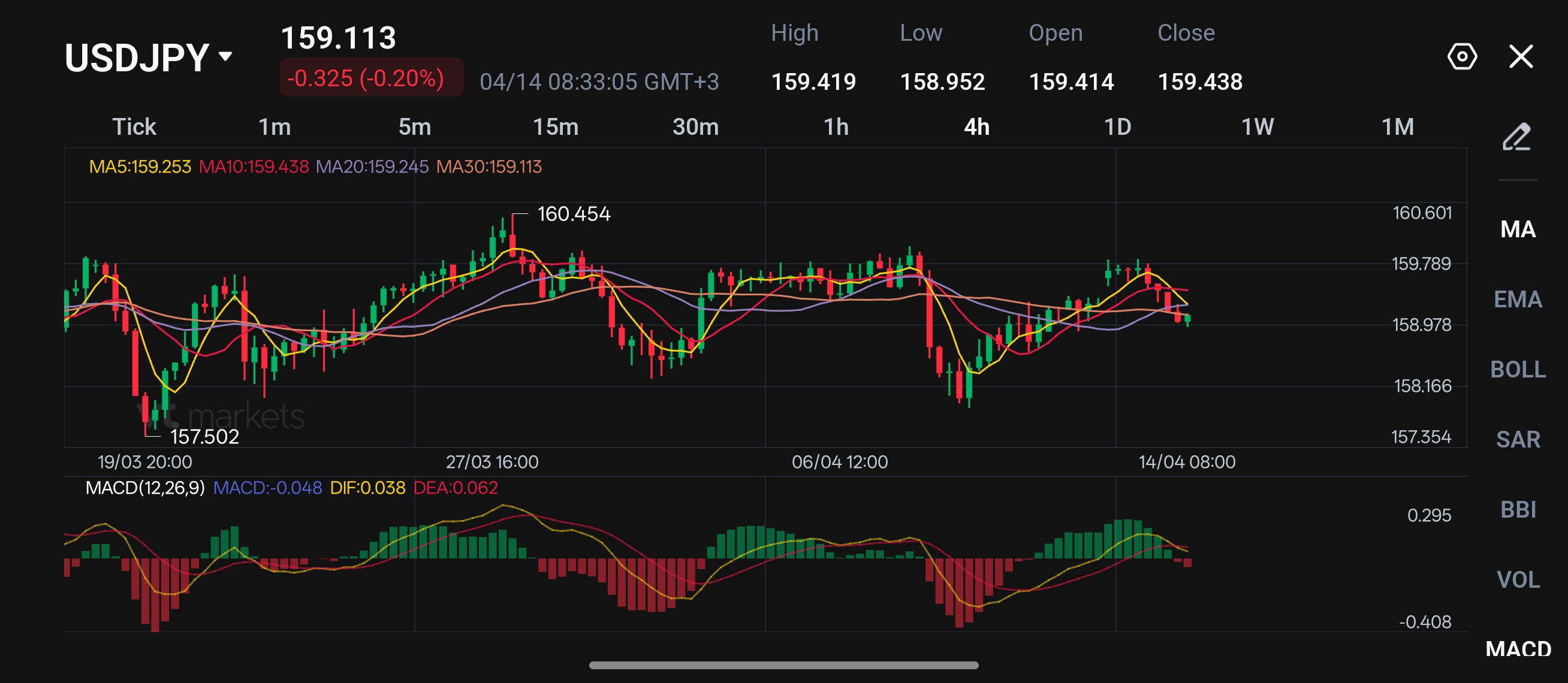
USDJPY currently trades near 160.000 key resistance levels and as seen in the chart below, USDJPY ranges between 157.000 to 160.000. It is still unclear currently to decide if USDJPY is going to create a leg up or a huge retracement coming with Japanese government intervention.

The moving averages currently are quite flat, showing neither bullish or bearish momentum is strong at the moment. To see a clear trend, we want to see the moving averages aligned with obvious gap in between to be confident that price will move towards that direction.

MACD’s histogram is starting to turn bearish and the signal line is very close to crossing into the negative region indicating sellers are starting to step into the market and want to push prices lower. However, in the lower region, there is still quite an amount of strong support levels.

Key Levels To Watch:

  • Support: 158.336
  • Resistance: 159.805

What to Watch

Going forward, USD/JPY is likely to remain sensitive to incoming US data and shifts in geopolitical headlines. Traders should closely monitor upcoming inflation releases and any signals from the Federal Reserve, as a clearer policy direction could drive the next leg for the US Dollar.

At the same time, developments surrounding the Strait of Hormuz and energy prices will be key for Yen sentiment, particularly given Japan’s import dependency. Any signs of escalation could limit JPY strength, while easing tensions may allow the currency to recover.

In parallel, market participants will stay alert to potential intervention signals from Japanese authorities, especially if USD/JPY approaches recent highs again.

Market Takeaway

USD/JPY remains trapped in a tug-of-war between softening US Dollar sentiment and underlying weakness in the Japanese Yen. While fading safe-haven demand and a mixed Fed outlook are pressuring the pair lower, energy risks and Japan’s import exposure continue to limit JPY strength.

For now, this keeps price action broadly range-bound, with neither side holding a clear directional edge until a stronger macro catalyst emerges.

Learn more about trading Forex Pairs on VT Markets here.

Trader Questions

1) Why is USD/JPY falling today?

The USD/JPY pair is extending its pullback toward the 159.00 level due to a combination of cooling safe-haven demand for the US Dollar and mixed signals regarding Federal Reserve policy. While US-Iran diplomatic talks haven’t reached a breakthrough, recent optimistic comments from US Vice President JD Vance have eased immediate geopolitical fears, reducing the “safety bid” that previously propped up the Greenback.

2) How is US inflation impacting the US Dollar (USD)?

The US Dollar has hit its weakest level since early March. Recent data shows inflation accelerating at its fastest pace in nearly four years. This has created a mixed outlook:

  • The Hawkish View: Sticky inflation may force the Fed to keep interest rates higher for longer.
  • The Dovish View: Easing geopolitical tensions could eventually lower energy-driven inflation, leading some traders to still bet on potential rate cuts later this year.

3) What is the Strait of Hormuz factor for the Japanese Yen?

The Japanese Yen (JPY) is currently struggling due to Japan’s heavy reliance on Middle Eastern crude oil. With reports of a naval blockade in the Strait of Hormuz and threats from Iran against shipping routes, energy supply risks are surging. High energy prices typically hurt the Yen because they worsen Japan’s trade balance, making the currency less attractive to buyers despite the USD’s weakness.

4) Will the Bank of Japan (BoJ) or Japanese authorities intervene?

Speculation is mounting that Japanese authorities may step in to support the Yen if it weakens too aggressively. Fear of direct intervention (where the government buys JPY to move the market) is currently acting as a ceiling for USD/JPY, preventing the pair from rallying too far past the 159.85 resistance zone.

5) What are the key technical levels to watch for USD/JPY?

Resistance: The recent high near 159.85 remains the primary hurdle for bulls.

Support: Traders are closely watching the 159.00 psychological mark. A sustained break below this level could open the door for a deeper correction toward March lows.

6) How does the Trump administration’s stance affect the pair?

President Trump’s confirmation of naval activity in the Persian Gulf has escalated geopolitical tensions. While this usually strengthens the USD as a safe haven, the simultaneous diplomacy narrative from the administration is creating a tug-of-war in market sentiment, keeping the pair in a volatile, range-bound pattern.

7) Is USD/JPY a “Buy” or a “Sell” right now?

The market is currently characterized by mixed fundamentals. The pair is caught between a softening US Dollar and a Yen that is burdened by energy security risks. Most analysts view the current price action as range-bound, suggesting that traders are waiting for clearer signals from either the Federal Reserve or a resolution to the tensions in the Middle East.

Start trading now – Click here to create your real VT Markets account

China’s March year-on-year imports rose 27.8%, far outpacing forecasts of 11.1%

China’s year-on-year imports rose by 27.8% in March. The increase was above expectations of 11.1%.

The data measures how imports changed compared with the same month a year earlier. No other figures were provided in the release.

Imports Surge Signals Risk On

The massive beat on China’s year-over-year import data is a clear risk-on signal for the coming weeks. A figure of 27.8% indicates that domestic demand is running significantly hotter than anyone anticipated. This suggests the economic recovery has much stronger momentum than models predicted, requiring an immediate reassessment of global growth-sensitive assets.

We should anticipate a sustained rally in industrial commodities. With iron ore imports reportedly hitting a new monthly record and copper inventories in Shanghai falling 8% last week, the physical demand is undeniable. Long call options on copper futures and major oil contracts like Brent are attractive ways to position for this surging demand from the world’s largest consumer.

This data is extremely bullish for commodity-linked currencies, especially the Australian Dollar. The AUD/USD pair has already broken above 0.7150, but we see it heading towards the 0.7400 level we last saw before the global manufacturing slowdown in 2025. Traders should consider buying AUD/USD call options or selling out-of-the-money puts to finance those positions.

Global mining and resource equities are a direct beneficiary of this trend. Stocks like BHP and Rio Tinto are already up over 5% this week, and we expect their earnings estimates to be revised sharply higher. Bull call spreads on the MSCI World Metals and Mining Index offer a broader way to capture this upside, which should outperform general indices.

Volatility is likely to compress further as strong growth data eases recessionary fears. The VIX has already dropped below 14, a low not seen since the third quarter of 2025, suggesting a return of market complacency. Selling VIX call spreads or even cautiously buying VIX puts could be a profitable strategy as this positive sentiment solidifies.

Yuan Outlook Strengthens

The strength in the Chinese economy should also support its currency, reversing the weakening trend we observed for much of 2025. The People’s Bank of China will have less incentive to devalue, and the USD/CNH pair could break below the key 6.80 support level in the coming weeks. We are looking at put options on the USD/CNH as a direct play on renewed Yuan strength.

Create your live VT Markets account and start trading now.

China’s year-on-year exports rose 7.1% in March, underperforming forecasts that anticipated 8.3%

China’s exports grew 7.1% year on year in March. This was below the expected 8.3%.

The data shows export growth slowed compared with forecasts. The release compares March exports with the same month last year.

Implications For Currencies

The miss in China’s March export growth signals a cooling in global demand for manufactured goods. We see this as a reason to anticipate weakness in currencies closely tied to China’s economic health, such as the Australian dollar. The AUD/USD has already slipped to a three-month low around 0.6550, and we could use options to position for a further decline towards the 0.64 mark in the weeks ahead.

This data directly impacts industrial commodities, as China is the world’s largest consumer. We are therefore considering bearish derivative strategies on copper, which has now dipped below $8,400 per tonne on the LME. Shorting copper futures or buying put options on major mining companies that rely on Chinese demand are potential plays.

Global equity indices with high exposure to China, particularly Germany’s DAX, are now vulnerable. We saw a similar reaction when disappointing Chinese data was released back in the third quarter of 2025, leading to a sharp drop in European automaker and luxury goods stocks. Buying put options on the DAX index provides broad exposure to this expected downturn.

Uncertainty stemming from this data miss is likely to increase market volatility. This makes buying call options on a volatility index like the VIX a prudent hedge against broader market turbulence. A flight to safety could also boost government bonds, suggesting long positions in bond futures may become profitable.

Policy Response And Risk Management

The weak export figure puts pressure on the People’s Bank of China to introduce economic stimulus. We will be watching for any announcements regarding liquidity injections or cuts to bank reserve requirements. Such a move could cause a sharp, temporary reversal, making it essential to use stop-losses on any bearish positions we establish.

Create your live VT Markets account and start trading now.

China’s March trade balance in dollars was $51.13B, missing expectations of $112B by $60.87B

China’s trade balance in March was $51.13bn in surplus. This was below the forecast of $112bn.

The result was $60.87bn under the forecast. The data are reported in US dollars.

Global Demand Weakens

This massive miss suggests global demand for Chinese goods is faltering much more than anticipated. Data just released shows exports fell 7.5% year-over-year, which is the core reason for the weak number. This is a clear signal of a slowdown that we must act on.

We see this as a direct negative for currencies tied to Chinese growth, particularly the Australian dollar. The AUD has already dropped to a six-month low of 0.6450 against the US dollar on this news. We should consider buying put options on the AUD/USD pair or shorting it outright, expecting further weakness in the coming weeks.

This report is also a strong bearish signal for industrial commodities. We should look to increase bets against base metals, as China is the world’s largest consumer. For instance, copper futures have already fallen 2.5% to $8,300 a tonne, and we expect this downward pressure to persist.

In equity markets, this data increases the risk of a correction in China-linked indices like the Hang Seng. The CBOE Hang Seng Volatility Index (VHSI) has jumped 15% today, showing that fear is rising. We should use options to position for more downside, as buying puts is now a prudent strategy to hedge portfolios.

This setup is very similar to what we observed during the growth scare in mid-2025. Back then, a similar slump in export data preceded a 12% drop in the Hang Seng over the following two months. We believe history could be a guide for what to expect through May and June of this year.

Historical Playbook

Create your live VT Markets account and start trading now.

Back To Top
server

Hello there 👋

How can I help you?

Chat with our team instantly

Live Chat

Start a live conversation through...

  • Telegram
    hold On hold
  • Coming Soon...

Hello there 👋

How can I help you?

telegram

Scan the QR code with your smartphone to start a chat with us, or click here.

Don’t have the Telegram App or Desktop installed? Use Web Telegram instead.

QR code