



HSBC analyzes currency pairs by examining macro factors, market trends, and trader sentiment.
Last Friday, the euro gained strength against the U.S. dollar. This was due to a weakening dollar, steady forecasts from the European Central Bank (ECB), and different attitudes towards tariff risks. The British pound also rose against the dollar, boosted by positive retail sales data from the UK, which reflected the overall weakness of the dollar.
The Australian dollar improved against the U.S. dollar due to strong employment data and expectations of an interest rate hike from the Reserve Bank of Australia (RBA). Similarly, both the Swiss franc and the Canadian dollar increased in value against the dollar. The Swiss franc benefited from safe-haven demand, while the Canadian dollar was helped by rising oil prices.
The pair is facing a steady decline, approaching the lower boundary of its descending channel.
USD/CAD has dropped for six sessions in a row, trading around 1.3680 on Monday during Asian hours. Technical analysis shows a downward trend in a newly formed descending channel, suggesting a bearish outlook. The 14-day Relative Strength Index is at 32, close to oversold levels, indicating weakening momentum.
The pair is below the nine-day and 50-day Exponential Moving Averages, signaling ongoing near-term pressure. Both short- and long-term averages are sloping down, maintaining this downward trend. If it breaks below the channel, the pair may test its six-month low of 1.3642 and possibly fall to 1.3539, the lowest level since October 2024.
Main resistance is at the nine-day EMA of 1.3787, aligning with the upper channel boundary. If the price exceeds this, it could face resistance at the 50-day EMA of 1.3838 and the seven-week high of 1.3928 reached on January 16.
Key Factors Affecting the Canadian Dollar
The Canadian Dollar is influenced by several factors, including interest rates from the Bank of Canada, oil prices, and the overall Canadian economy. Sentiment in the markets and economic conditions in the US, Canada’s largest trading partner, also play key roles. Decisions on interest rates from the Bank of Canada have a substantial impact on the value of the CAD. Higher rates generally make the CAD stronger. Oil prices are also crucial; when they rise, demand increases, positively affecting the CAD. Inflation data can influence the CAD by leading to higher interest rates, which attract more capital. Economic indicators like GDP, PMIs, employment data, and consumer sentiment also affect CAD strength. A strong economy can lead to more investments and potentially higher interest rates, which boost the CAD. Conversely, weak data can weaken the currency. Currently, USD/CAD is clearly trending down within a defined channel. Momentum indicators suggest this bearish trend is likely to continue, placing ongoing pressure on the pair. Derivative traders might consider this a cue to favor strategies that benefit from further declines in the USD/CAD exchange rate. In the upcoming weeks, buying put options on USD/CAD looks like a solid strategy. Traders might target strike prices around the recent six-month low of 1.3642 or the October 2025 low of 1.3539 to take advantage of the downward trend. This strategy limits risk to the premium paid for the options while offering significant potential rewards if the bearish trend persists.Future Considerations for Interest Rates and Market Sentiment
Yet, with the Relative Strength Index nearing oversold levels at 32, we should be ready for a possible short-term bounce. Traders could consider buying call options with a strike price above the 1.3787 resistance level as a hedge against this risk. Alternatively, a bear put spread can be employed to reduce the cost of a purely directional bet while profiting from a gradual decline. The bearish outlook for the US dollar versus the Canadian dollar is supported by rising oil prices. This month, WTI crude prices surged to over $84 per barrel, rising from the December 2025 lows, due to tighter supply forecasts from OPEC+. Typically, when oil prices stay above $80, the Canadian dollar tends to strengthen. Additionally, there’s a widening gap in expectations for central bank policies. The Bank of Canada is holding its position firmly after December 2025’s inflation data came in higher than expected at 2.9%. In contrast, there’s increasing sentiment that the US Federal Reserve might hint at a rate cut in the second quarter of 2026, which could weigh on the US dollar. Recent economic data supports this perspective, as Canada’s labor market showed unexpected strength in the last report, adding 55,000 jobs. This solid economic foundation allows the Bank of Canada to maintain elevated interest rates compared to the US. This fundamental backdrop is a strong tailwind for the Canadian dollar, aligning with the technical decline we’re observing in the USD/CAD pair. Reflecting on 2025, we witnessed implied volatility in USD/CAD spiking sharply during the third quarter amid signs of policy divergence. We expect volatility to stay high, making options an effective tool for trading direction while managing risk. This environment favors those who can design trades to capitalize on both the downward trend and potential short-term price swings. Create your live VT Markets account and start trading now.GBP/USD reaches highest level since mid-September as it strengthens against the US dollar, influenced by UK data
The GBP/USD pair reached its highest point since mid-September, trading around 1.3660 during the European session. This rise was fueled by stronger-than-expected UK Retail Sales and PMI data. Later today, the release of the US November Durable Goods Orders report could influence currency movements.
UK Retail Sales, reported by the Office for National Statistics, increased by 0.4% in December, recovering from a 0.1% decline in November. This was better than the predicted further 0.1% drop. The British Pound’s strength is also linked to a generally weaker US Dollar, which fell to a four-month low today.
Reasons for US Dollar Weakness
The US Dollar’s decline is mainly due to geopolitical tensions, including President Trump’s comments about Greenland, fostering a “Sell America” mood. The GBP/USD pair saw some gains, trading above the mid-1.3600s and is likely to increase further. On Friday, the British Pound rose against the US Dollar, nearing the 1.3600 mark. Strength in UK economic data may change expectations for near-term interest rate cuts by the Bank of England. The pair increased by nearly 0.73% that day. With the Pound Sterling showing strength, we expect GBP/USD to stay above 1.3650. This momentum comes from solid UK economic data, shifting expectations for interest rate cuts by the Bank of England. The pair is now at its highest level in over four months. For those wanting to take advantage of this upward trend, buying call options on GBP/USD appears to be a smart move. This strategy allows for potential profits if the rise continues towards the 1.3800 level while limiting risks to the premium paid. The positive outlook for the Pound makes this an attractive trade.Economic Indicators Favoring the Pound
This optimistic view of the Pound is backed by recent UK inflation data showing the Consumer Price Index (CPI) at 2.8% for December, slightly above the Bank of England’s target. Additionally, UK’s unemployment rate has dropped to 3.7%, a multi-year low that strengthens the case for a strong economy. These figures suggest the Bank of England might keep rates steady, which is good for Sterling. Conversely, the US Dollar remains broadly weak, with the Dollar Index (DXY) hitting new lows. The disappointing US Non-Farm Payrolls report from early January, which added only 95,000 jobs versus an expected 180,000, has raised expectations for a Federal Reserve rate cut by March. This growing difference in policy between the Fed and the Bank of England is a key factor driving the current GBP/USD rally. Similar movements occurred in early 2021 when optimism about the UK economy and a weaker dollar helped push the pair higher. Given this history, call options with strike prices near 1.3750 and 1.3800 for February or March expiries could provide good opportunities. This approach allows time for the current trend to develop fully. Traders uncertain about direction but expecting significant price moves may consider volatility strategies. With crucial central bank meetings approaching in February, a long straddle (buying both a call and a put option at the same strike price) could be beneficial, allowing for profits from a breakout in either direction. Create your live VT Markets account and start trading now.GBP/JPY pair falls nearly 1% to around 210.40 after Takaichi’s intervention warning
GBP/JPY dropped near 210.40 after Japan warned it might intervene to support the Yen against speculative trading. The Bank of Japan kept interest rates at 0.75%, while positive UK data boosted the Pound last week.
The exchange rate fell almost 1% as the Yen gained strength following comments from Japanese PM Sanae Takaichi about market speculation. The Yen became the strongest currency against the US Dollar, with a rise of 1.14%.
Statements From Takaichi
Takaichi mentioned that the government would act against speculative market movements, but did not discuss specific levels. The Bank of Japan held its interest rate steady at 0.75% and indicated that it might raise rates in the future. The performance of the Yen depends on various factors, including economic conditions, BoJ policies, bond yield differences, and overall market sentiment. The previous very loose monetary policies weakened the Yen, but recent changes are providing some support. Earlier, the disparity in US and Japanese bond yields favored the US Dollar, but recent rate changes are closing that gap. The Yen often attracts safe-haven investments, becoming stronger during times of uncertainty. Last week, positive data on UK Retail Sales and PMI helped the Pound, which is now showing mixed trends. Retail Sales increased by 0.4% month-on-month.Impact Of Past Events
We saw a similar situation in 2025 when the GBP/JPY fell toward 210.40 due only to verbal warnings from Japanese officials. Just the threat of intervention caused a significant sell-off, and that caution has lingered in the market. Now, with GBP/JPY near 205.50, memories of that time are still fresh. Since 2025, the Bank of Japan has acted on its hints about tightening, raising its key interest rate to 1.00% to combat inflation, which reached a multi-decade high of 3.5% late last year. This has changed the interest rate advantage that used to favor the Pound Sterling. For traders in derivatives, this may signal the end of favorable conditions for shorting GBP/JPY volatility. The narrowing yield gap lessens the appeal of carry trades, which could weaken support for the pair. Strategies that benefit from stable market conditions or a further decline in the currency pairing should be considered. A key lesson from 2025 was the impact of “jawboning,” which leads to sudden volatility spikes. Implied volatility on GBP/JPY options has remained high since then, currently around 11.5% for 3-month contracts, compared to an average of 9% in late 2024. This presents an opportunity for those selling premium but comes with risks of sharp, unpredictable changes. Examining bond yields, the difference between 10-year UK Gilts and Japanese Government Bonds has narrowed significantly, reducing by over 50 basis points in the past year, from about 3.5% to just below 3.0% now. This decrease in yield advantage for the Pound supports a lower ceiling for the GBP/JPY exchange rate. Given these trends, using options to hedge against downside risk while holding long Pound positions is advisable. Buying put options on GBP/JPY could protect against another sudden strengthening of the Yen, similar to the threat in 2025. Any rallies back to the 210.00 level should be approached with caution. Create your live VT Markets account and start trading now.In early European trading, GBP/USD rises above 1.3660 on strong UK economic indicators
The GBP/USD rate has risen to about 1.3660, its highest point since mid-September 2025. This increase comes from strong UK Retail Sales and Purchasing Managers Index (PMI) data that exceeded expectations.
State of UK Retail Sales
UK Retail Sales grew by 0.4% in December compared to November, which had seen a 0.1% decline. Core Retail Sales, excluding auto fuel, also increased by 0.3% in December, beating the predicted 0.2% drop. Additionally, the UK Composite PMI hit a 21-month high of 53.9 in December. Some analysts believe these positive results could postpone any planned rate cuts by the Bank of England. There’s an expectation of maintaining current rates at the February meeting, with a possible cut by June. The US Federal Reserve is likely to keep interest rates stable in its upcoming meeting, but traders will watch for comments from Chair Jerome Powell that could change market expectations. The Pound Sterling is the fourth most traded currency worldwide, with key pairs being GBP/USD. The Bank of England’s monetary policy aims for a 2% inflation rate, which greatly influences the Pound’s value. Economic data and trade balance also significantly affect the Pound’s strength. The increase in GBP/USD above 1.3650 was fueled by strong UK economic data from late 2025. December’s Retail Sales in the UK unexpectedly rose by 0.4%, contrary to predictions of a decline. This trend indicates that the UK economy may be more resilient than previously thought. After this period, the US Federal Reserve kept interest rates steady during its January meeting, but the commentary was seen as less dovish than expected, causing a pause in the pair’s rally. Recent US data showed a slight rise in Initial Jobless Claims to 218,000, suggesting a cooling labor market that supports a patient Fed when considering rate cuts.Outlook and Strategy
Recent UK data revealed the Consumer Price Index (CPI) for December 2025 remained at 3.9%, against expectations of a drop to 3.7%. This steady inflation bolsters the belief that the Bank of England may be one of the last major central banks to lower rates. This policy difference is a key factor likely to support the Pound against the Dollar. In this context, consider positioning for further GBP strength while managing the risk of short-term dropbacks. One option is buying GBP/USD call options set to expire in March 2026 with a strike price around 1.3750. This offers a defined-risk way to tap into potential gains as the bullish trend may continue after the current consolidation. For a more cautious approach, you could implement a bull call spread by selling a call with a higher strike price, like 1.3900, while purchasing the 1.3750 call. This strategy reduces the initial trading cost but limits maximum profit, making it suitable for a steady upward move. Historically, similar policy divergences, seen between the Fed and ECB in 2022, can result in sustained, though modest, currency trends. Implied volatility is projected to rise as the Bank of England’s meeting in early February approaches. This makes selling premium, like in the bull call spread, more appealing now. Traders should closely watch volatility levels, as significant spikes could create better entry points for long-volatility strategies or signify greater market uncertainty. Create your live VT Markets account and start trading now.Gold prices have risen in Saudi Arabia, according to recent data.
Gold prices in Saudi Arabia rose on Monday, according to FXStreet data. The price for gold reached 611.22 Saudi Riyals (SAR) per gram, up from SAR 600.56 on Friday. Gold per tola increased to SAR 7,129.12 from SAR 7,004.76 the previous Friday.
FXStreet updates these gold prices by converting international USD prices to SAR. Although these prices are updated daily based on market rates at the time of publication, they might vary slightly from local prices. Gold is often seen as a stable asset during uncertain economic times and is used to protect against inflation and currency decline.
Central Banks and the US Dollar
Central banks own the largest amounts of gold. In 2022, they purchased a significant 1,136 tonnes worth around $70 billion. Gold prices usually rise when the US Dollar falls. Economic instability and changes in interest rates also affect gold prices. A strong US Dollar tends to lower gold prices, while a weak Dollar usually increases them. Currently, gold is continuing its upward trend, recently surpassing the $5,000 mark. This is happening as the US Dollar weakens against other major currencies. The expected rise in gold due to the Dollar’s decline is occurring as anticipated. This trend is further supported by strong buying from central banks throughout 2025. Reports from the World Gold Council showed that in the fourth quarter of 2025, central banks added another 350 tonnes to their reserves, making it the sixth straight quarter of heavy accumulation. This ongoing demand from official sources provides strong support for prices and indicates a long-term shift away from dollar-based assets. Geopolitical tensions, like potential US government shutdowns and trade disputes over Greenland, are driving investors toward safe assets like gold. For traders in derivatives, this suggests that taking long positions on gold futures or buying call options on gold ETFs could be wise in the coming weeks. Since volatility is high, managing costs with strategies like bull call spreads might be beneficial while pursuing further gains.Federal Reserve and Interest Rates
In 2025, the Federal Reserve shifted away from aggressive interest rate hikes, indicating that rates had peaked. This change has positively affected gold prices, as lower rates reduce the opportunity cost of holding gold, which doesn’t yield interest. If the market expects rates to remain steady or decline, investors are likely to invest more in gold. Create your live VT Markets account and start trading now.Recent data shows an increase in gold prices in the Philippines.
Gold prices in the Philippines went up on Monday, according to FXStreet data. The price per gram increased to 9,613.17 Philippine Pesos (PHP), up from 9,443.63 PHP on Friday. The cost for a tola also rose to PHP 112,126.10 from PHP 110,148.70.
FXStreet determines gold prices in the Philippines by adjusting international prices (USD/PHP) to the local units. Prices are updated daily based on the current market rates.
Gold as a Safe Haven Asset
Gold is seen as a reliable asset during tough economic times. It acts as a safe haven and protects against inflation because it’s not tied to any government. Central banks hold gold mainly to support their currencies when things get rocky. In 2022, central banks bought a record 1,136 tonnes of gold, worth around $70 billion, with many emerging economies growing their reserves quickly. Gold prices usually move oppositely to the US Dollar and Treasuries. When the Dollar weakens, gold prices often rise, making gold appealing during uncertain times. Economic instability or recessions can drive gold prices higher due to its safe-haven reputation. Gold’s value often shifts based on the strength of the US Dollar. The recent rise in gold prices shows its increasing popularity as a safe-haven asset amid uncertainty. We’re seeing higher demand due to renewed geopolitical tensions that cause volatility in stock markets. Derivative traders should recognize this as a sign that the bullish sentiment around gold is getting stronger. This surge is backed by strong institutional buying, a trend we’ve noticed increasing throughout 2025. New data from the fourth quarter of 2025 shows that central bank purchases surpassed 1,150 tonnes, setting a new record above the previous high from 2022. This steady demand from major global players creates a solid price floor, suggesting that any dips will be good buying opportunities.Impact of the US Federal Reserve
We also need to think about the actions of the US Federal Reserve, as gold prices tend to move in the opposite direction of the dollar. After last week’s US inflation report came in slightly above expectations at 3.1%, the dollar weakened. This raises the likelihood that the Fed may start reducing interest rates by the second quarter, which is positive for gold and other non-yielding assets. In this environment, traders should consider strategies to take advantage of potential price increases in the coming weeks. Buying call options or creating bull call spreads on gold futures can be effective ways to benefit from rising prices while clearly managing the maximum potential loss. However, managing risk is crucial, as markets can be unpredictable. We witnessed a similar trend in late 2024 when gold reached new highs before a brief and sharp correction. Therefore, traders using futures contracts should employ disciplined stop-loss orders to protect their capital from sudden downturns. Create your live VT Markets account and start trading now.The Japanese leading economic index was 109.9, falling short of expectations.
Gold Rally
Gold has now risen for six days in a row, reaching $5,100. This boost comes as more investors seek safe-haven assets due to global uncertainties. Bitcoin, Ethereum, and Ripple have bounced back slightly after falling over 7%, 14%, and 7% in recent times. Cardano’s price is around $0.34, but it faces more downside risks. This is reflected in declining Open Interest, which shows that fewer people are participating in the market. Although the US government has backed off on tariffs against Europe, tensions across the Atlantic continue. FXStreet provides guides on the best brokers for trading in 2026, looking at factors like low spreads, high leverage, and specialized accounts. Investors should do thorough research before investing, as markets come with risks and uncertainties.Market Volatility
With the record-high gold rally, now may be a good time to buy call options to benefit from this strong upward trend. Gold’s rise past $5,100 is fueled by ongoing geopolitical worries and a weaker US Dollar. This demand for gold is backed by central banks buying aggressively—especially since 2022. The US Dollar is under continued pressure, signaling a chance to act ahead of the Federal Reserve’s meeting this Wednesday. We may see further dollar weakness, making it wise to buy put options on the US Dollar Index (DXY) or call options on currency pairs like EUR/USD, which is close to a four-year high. Historically, the dollar index has dropped sharply from its 2022 highs, and a dovish stance from the Fed could push it lower. The Japanese Yen is gaining strength due to speculation about Bank of Japan intervention and a more hawkish policy. This opens up strategies like selling USD/JPY futures or buying put options on this pair. The BOJ has hinted at moving away from its very loose policies, similar to the shift we saw in 2024, making tightening likely. The British Pound is also strong, reaching its highest point against the dollar since September 2025 thanks to solid UK economic data. This helps the anti-dollar trend, making long positions in GBP/USD through call options a smart choice. The UK data has repeatedly exceeded expectations throughout 2025. With significant announcements from central banks and ongoing trade tensions, market volatility is expected to remain high. Traders should consider using options to protect their positions or speculate on large price movements. For example, buying straddles on major indices or currency pairs before Wednesday’s Fed announcement could be a wise trading strategy. Additionally, WTI crude oil is holding steady around $61.00 per barrel amid rising supply concerns. In this environment, looking at long positions—possibly through call options on oil futures—would be prudent. Any increase in supply disruptions could lead to a quick price spike from these levels. Create your live VT Markets account and start trading now.Japan’s Coincident Index decreases to 114.9 from 115.2
Japan’s coincident index dropped to 114.9 in November, down from 115.2. This change comes amid various market shifts and currency pair movements.
The EUR/USD pair is close to a four-year high at 1.1920. In contrast, the GBP/USD trades positively around 1.3660 after strong economic data from the UK.
Market Rally Influencers
Gold is on a six-day rally, hitting $5,100 during the Asian session. Bitcoin, Ethereum, and Ripple have shown signs of recovery after major corrections. In trade news, the U.S. has pulled back its proposed tariffs on key European economies. Cardano (ADA) is now priced around $0.34, following weeks of adjustments. A variety of broker options for 2026 are available, including those with low spreads, high leverage, and market-specific features. These options aim to meet different trader needs and preferences. With Gold exceeding $5,100, there is a clear movement towards safety due to global uncertainty. This dramatic price action indicates high implied volatility, making it a good time to explore protective put options on broader equity indices. This trend aligns with record central bank gold purchases in the second half of 2025, similar to the significant buying we saw in 2022 and 2023.Currency Market Dynamics
The US Dollar’s ongoing weakness is a key focus ahead of the Federal Reserve’s meeting this Wednesday. In this context, we expect EUR/USD and GBP/USD to remain strong, making long call options a smart strategy for capturing potential gains while limiting risks. Current market pricing suggests over an 85% chance that the Fed will indicate a dovish approach, putting further pressure on the dollar, similar to the trends seen in late 2023. We should closely watch the Japanese Yen, which is strengthening amid expectations of a hawkish Bank of Japan. This speculation is driven by core inflation figures that have stayed above the bank’s 2% goal for much of 2025, a situation not seen in decades. However, the risk of official action to weaken the Yen is significant, creating a volatile trading environment ideal for option straddles on USD/JPY. The Euro and British Pound are gaining from the dollar’s decline, with GBP/USD reaching levels not seen since September 2025. This strength is supported by solid UK economic data from late last year, but traders should be cautious as this rally largely stems from a weak dollar. Utilizing bull call spreads on EUR/USD could enable traders to profit from a continued rise toward 1.2000 while managing risk. Global trade tensions are affecting energy markets, keeping WTI crude oil prices steady around $61 a barrel. Ongoing supply concerns from transatlantic tariff disputes that emerged in late 2025 suggest this price strength may persist. Traders might consider buying futures contracts for short-term exposure or using call options to speculate on further price spikes if tensions escalate. Create your live VT Markets account and start trading now.Dividend Adjustment Notice – Jan 26 ,2026
Dear Client,
Please note that the dividends of the following products will be adjusted accordingly. Index dividends will be executed separately through a balance statement directly to your trading account, and the comment will be in the following format “Div & Product Name & Net Volume”.
Please refer to the table below for more details:
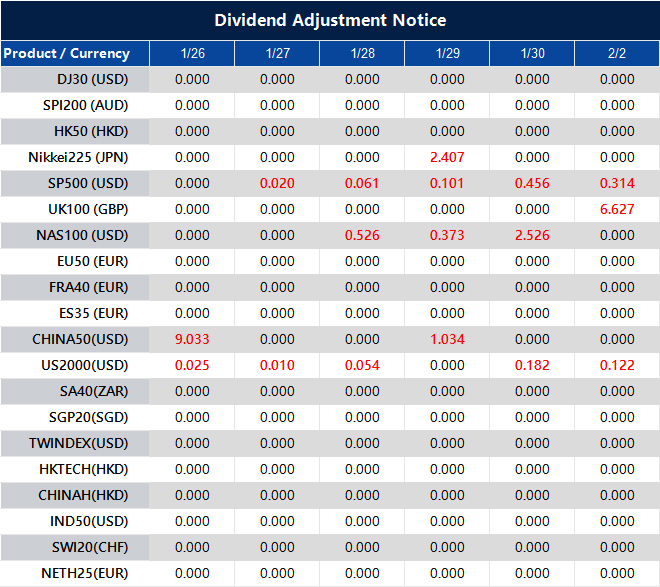
The above data is for reference only, please refer to the MT4/MT5 software for specific data.
If you’d like more information, please don’t hesitate to contact [email protected].







