Back

Dividend Adjustment Notice – Feb 11 ,2026

Dear Client,

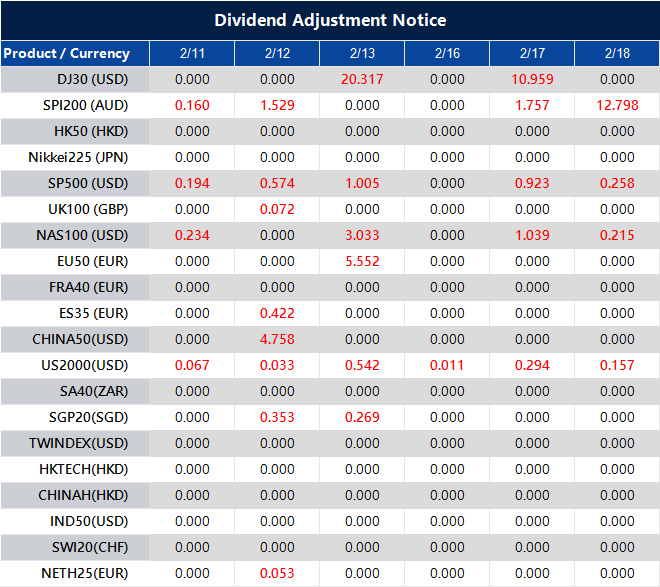
Please note that the dividends of the following products will be adjusted accordingly. Index dividends will be executed separately through a balance statement directly to your trading account, and the comment will be in the following format “Div & Product Name & Net Volume”.

Please refer to the table below for more details:

Dividend Adjustment Notice

The above data is for reference only, please refer to the MT4/MT5 software for specific data.

If you’d like more information, please don’t hesitate to contact [email protected].

Wall Street Journal reports that House lawmakers rejected Johnson’s bid to stop votes disapproving of President Trump’s tariffs

The US House of Representatives rejected an effort by Speaker Mike Johnson to block votes on resolutions that would overturn President Donald Trump’s tariffs, the Wall Street Journal reported on Tuesday. This opens the door to votes that could challenge the tariff policy and allow Democrats to push to remove US tariffs on Canada. The procedural vote failed 217 to 214. Three Republicans joined 214 Democrats in voting against it. In markets, the US Dollar Index (DXY) was near 96.65 at the time of writing, down 0.22% on the day. The uncertainty around US tariff policy points to higher market volatility. The quick drop in the US Dollar Index suggests markets expect a weaker dollar if protectionist policies are rolled back. This new political setup supports buying volatility using options. With Canada in focus, we are watching USD/CAD closely. The pair has broken below the 1.3400 support level that held through late 2025. The move could accelerate if the chance of removing tariffs increases. Derivatives traders may consider Canadian dollar call options to position for more strength versus the US dollar. This shift is likely positive for US equities, especially multinational firms hurt by trade restrictions. The CBOE Volatility Index (VIX) has jumped from 14 to above 17 in the last day, showing that investors expect more turbulence ahead. One way to express a moderately bullish view while limiting risk is to sell out-of-the-money put spreads on the S&P 500. The trade disputes of 2018–2019 showed how sensitive markets can be to tariff headlines. Markets often rallied sharply on any sign of de-escalation. That period also showed that political news can overpower economic data in the short term. This pattern may return, so it is important to track legislative updates closely. Recent data shows US exports to Canada fell 4% year over year in the last quarter of 2025, largely blamed on trade frictions. Rolling back these policies would likely help key sectors such as autos and agriculture. For more targeted exposure, call options on sector ETFs could be a practical approach.

here to set up a live account on VT Markets now

Traders await US NFP as USD/CAD slips to 1.3525–1.3520, lifting the Canadian dollar to near two-week highs

USD/CAD fell for a fourth straight day, sliding to a near two-week low around 1.3525–1.3520 in Asia. The pair had traded both ways the day before, but a softer US Dollar and firmer crude oil helped lift the Canadian Dollar. Attention now turns to the US Nonfarm Payrolls report as the next major catalyst. The US Dollar has been under pressure as markets price in more Federal Reserve rate cuts and worry about the Fed’s independence. On the charts, USD/CAD is trading below the 50-day EMA (1.3757) and the 200-day EMA (1.3854) after topping near 1.3928 in early January. The pair fell 0.25% on Tuesday to 1.3525. Key support sits at 1.3481, then 1.3500, while resistance is around 1.3600–1.3650. The early-February rebound stalled near 1.3700. The Stochastic Oscillator (14, 5, 5) has also turned down from the midline. In Canada, January unemployment dropped to 6.5% and wage growth held at 3.3%. In the US, Retail Sales were flat (0.0%) versus a 0.4% forecast, and the Employment Cost Index rose 0.7% versus 0.8% expected. We view CAD strength versus USD as a trend that still has room to run, driven by mixed signals between the two economies. The technical setup also supports this view: USD/CAD is in a clear downtrend channel and trading well below key moving averages. That keeps “sell-on-rallies” as the preferred approach, even on small rebounds. Higher crude oil prices are an important part of this story. West Texas Intermediate has recently held above $80 a barrel, which supports the commodity-linked Canadian dollar and puts added pressure on USD/CAD. This outside support for the loonie makes short USD/CAD positions more attractive. The next major event risk is the US Nonfarm Payrolls report. With volatility elevated, options may be a better way to express a bearish view while controlling risk. For example, buying USD/CAD put options could benefit from further downside, especially if the jobs data is weaker than expected. Late-2025 data already pointed to this split. The US economy showed signs of slowing, while Canadian labour markets stayed tight. The US added 216,000 jobs in December 2025, but underlying details hinted at cooling. That backdrop has continued and supports the case for future Fed rate cuts. Canada looks different. January inflation came in at a still-firm 2.9%, which can keep the Bank of Canada more cautious. This policy divergence is the core theme. As the gap widens between US and Canadian rate expectations, USD/CAD should stay under downward pressure. From a technical standpoint, 1.3481 is the key support level. A clean break below it would raise the odds of a move toward 1.3400. Bearish option structures, such as put debit spreads, could target that next leg lower with strictly defined risk. History suggests this may not be a quick move. When central bank policy paths diverge, trends can last for months, as seen in 2015–2017. The current setup looks similar, so positioning for further downside in USD/CAD over the coming weeks still appears to be the more prudent approach.

here to set up a live account on VT Markets now

RBA deputy governor Hauser says inflation is still too high and pledges the central bank will act to bring it back within its target band

RBA Deputy Governor Andrew Hauser said inflation is still too high, and the bank will take whatever action is needed to bring it back into the target band. He added that some price increases may ease, while others seem tied to supply constraints. At the time of writing, AUD/USD was near 0.7095, up 0.29% on the day. The RBA targets inflation of 2–3% by adjusting interest rates. It can also use quantitative easing or tightening to influence credit conditions.

Australian Dollar Key Drivers

The Australian Dollar is mainly driven by RBA interest rate policy and commodity prices, especially iron ore. Iron ore is Australia’s biggest export, worth $118 billion a year based on 2021 data, and China is the main buyer. China is Australia’s largest trading partner, so China’s growth affects demand for Australian exports and the AUD. The trade balance matters too: when export earnings are stronger than import costs, it usually supports the currency. The RBA’s message is clear: inflation is too high, and it will do what it takes to bring it down. Inflation stayed above the target band through the last quarter of 2025, reaching 3.9%. This points to interest rates staying higher for longer, and it leaves open the possibility of another hike. Higher rates are typically supportive for the currency. That hawkish tone is also backed by iron ore prices. In recent weeks, prices have held above $125 a tonne on the Singapore Exchange. Strong iron ore prices can improve the trade balance and provide fundamental support for the Australian dollar.

China Demand And Trading Approach

Even so, demand from China needs close attention. China’s economy reportedly grew 5.1% in 2025, but the latest manufacturing PMI readings have been near the 50 level. This suggests the recovery remains uncertain. Any clear slowdown could weigh on the Aussie dollar. With the RBA focused on inflation, traders may want to be positioned for possible AUD strength in the weeks ahead. With AUD/USD already near 0.7095, buying call options may offer a way to gain upside exposure while limiting downside risk if weak Chinese data surprises the market. Pullbacks in the currency could be viewed as potential buying opportunities, since the domestic policy direction still looks firm. Create your live VT Markets account and start trading now.

here to set up a live account on VT Markets now

As China’s January CPI rises, the Australian dollar holds firm; AUD/USD rebounds near 0.7090 in Asia

AUD/USD traded near 0.7090 during Asian trading on Wednesday, recovering from earlier losses. The rebound followed China’s January CPI, which rose 0.2% year-on-year. That was down from 0.8% in December and below the 0.4% forecast. China’s CPI rose 0.2% month-on-month in January. This matched the previous reading but missed the 0.3% expectation. In Australia, Westpac Consumer Confidence fell 2.6% month-on-month to 90.5 in February, the lowest level in 10 months, after a 25 basis-point rate hike.

Australian Data And Us Demand Signals

NAB’s Business Confidence Index rose to 3 in January from a downwardly revised 2, its highest level since October. In the US, Retail Sales were flat at $735 billion in December after rising 0.6% in November. Markets had expected a 0.4% increase. US Retail Sales rose 2.4% year-on-year. Total sales for October–December 2025 increased 3.0% (±0.4%) from a year earlier. Markets are pricing in 70,000 jobs in January Nonfarm Payrolls, with the unemployment rate expected to stay at 4.4%. Key drivers of the Australian dollar include RBA interest rates, China’s economic outlook, and iron ore prices. Iron ore is Australia’s largest export, worth about $118 billion a year (2021 data). The trade balance can also influence the currency. The Aussie is holding near 0.7090, but the tone looks fragile. China’s January inflation was only 0.2%, missing forecasts and slowing from December. This points to softer demand from Australia’s biggest trading partner. Attention now turns to the upcoming US jobs report, where the market expects just 70,000 new jobs. In late 2025, job growth was much stronger, so this forecast signals a sharp shift in expectations for the US economy. Any meaningful surprise versus this low bar could drive the next major move in the US dollar.

Commodity And China Growth Headwinds

Commodity prices are another important factor for the Aussie. Iron ore has recently slipped back below $130 per tonne, down from the highs seen in late 2025. This pullback reflects weaker demand from China’s property and construction sectors. China’s soft inflation print also fits a broader pattern. The official Manufacturing PMI for January came in at 49.3, staying in contraction for a fourth straight month. Ongoing weakness in industrial activity may limit how far the Australian dollar can rise. Conditions at home are mixed, which supports a cautious view. Business confidence improved slightly, but the recent rate increase pushed consumer confidence to a 10-month low. This suggests the Reserve Bank of Australia is tightening policy as consumers lose momentum. With these cross-currents, volatility may rise in the coming weeks, especially around US jobs data. Options strategies such as buying straddles or strangles on AUD/USD may allow traders to position for a sharp move without choosing a direction. The current calm looks unstable and may not last. Create your live VT Markets account and start trading now.

here to set up a live account on VT Markets now

China’s annual CPI inflation slowed to 0.2% in January, below the 0.4% forecast, official data showed

China’s CPI rose 0.2% year-on-year in January, down from 0.8% in December, according to the National Bureau of Statistics of China. The market forecast was 0.4%. Month-on-month, CPI rose 0.2% in January. This matched the prior 0.2% increase and came in below the 0.3% forecast. PPI fell 1.4% year-on-year in January, after a 1.9% drop in December. The forecast was -1.5%. After the release, AUD/USD was up 0.20% on the day at 0.7087. The report also noted earlier expectations for January: CPI at 0.4% year-on-year and PPI at -1.5%. December’s readings were 0.8% and -1.9%. CPI tracks inflation and shifts in buying patterns. It is reported year-on-year and month-on-month. PPI tracks the price changes producers face. The cited technical levels for AUD/USD were 0.7100, 0.7129, and 0.7158 on the upside, and 0.7007, 0.6908, and 0.6834 on the downside. A delayed US January jobs report was tied to a recent four-day government shutdown. China’s latest data raises new growth concerns. Consumer prices fell 0.3% in January from a year earlier. This move into deflation follows a flat reading in December 2025 and is far weaker than the market expected. Producer prices also dropped a steep 2.5%, pointing to ongoing weakness in the factory sector. This extends a worrying multi-year trend. In January 2025, producer prices fell 2.0%. In early 2023, CPI growth was only 0.2%. The early-2026 data suggests the post-pandemic rebound has not created lasting inflation pressure. For derivatives traders, this supports a bearish view on the Australian dollar, which often moves with China’s economic outlook. AUD/USD, trading near 0.6550, could fall further as demand for Australian commodities softens. There is little near-term support for the Aussie. One simple approach for the next few weeks is to buy AUD/USD put options. For example, March-expiry puts with a strike near 0.6400 can limit risk while positioning for a move back toward the late-2025 lows. This trade can benefit from a weaker spot rate and from rising volatility. There may also be opportunities in options on commodity futures, especially iron ore and copper. Ongoing deflation in China’s producer prices points to weaker demand for industrial materials. Buying put options on these commodities is a direct way to trade slower Chinese construction and manufacturing. The main risk to this bearish case is a major stimulus move from Beijing. Watch closely for policy actions from the People’s Bank of China or new fiscal spending aimed at lifting domestic demand. A stronger-than-expected response could trigger a sharp, even if temporary, rebound.

here to set up a live account on VT Markets now

China’s CPI rose 0.2% in January, missing the 0.3% forecast

China’s consumer price index rose 0.2% month on month in January. This was below the expected 0.3%. This data shows that monthly consumer price growth was weaker than forecast. The report did not include more detail. The softer inflation reading suggests that domestic demand in China is still weak. This raises the chance that the People’s Bank of China will add more stimulus in the next few weeks, such as an interest rate cut or a reserve requirement ratio cut. At the same time, the Producer Price Index remains in deflation. That adds to concerns about slowing economic momentum. For FX traders, this outlook points to fresh pressure on the yuan. We should look at options strategies that profit from a weaker CNH. This could also weigh on commodity-linked currencies like the Australian dollar. AUD/USD has been sensitive to China data, and we saw a similar move in late 2025, when weak industrial output was followed by a notable drop in the Aussie dollar. This weak consumer signal is negative for industrial commodities tied to Chinese demand. Copper and iron ore futures may face headwinds. The data implies that construction and manufacturing may not rebound as strongly as hoped. Traders could buy puts on commodity ETFs or futures to hedge, or to position for further downside. Chinese equities now face two-way risk, so volatility may be the main theme. Stimulus hopes could drive a short-term rally in indices like the Hang Seng. But the data also points to a real slowdown, which can hurt earnings. Because of this split, options straddles on major China ETFs could be a practical way to trade the large move that may follow any central bank announcement. Globally, we should re-check companies that rely heavily on China for revenue. European luxury brands and German automakers look especially exposed. In their late-2025 quarterly reports, many already warned about slowing sales in the region. Buying puts on these stocks could be a focused way to prepare for weaker forward guidance.

here to set up a live account on VT Markets now

China’s producer prices fell 1.4% year on year in January, beating forecasts of a 1.5% drop

China’s producer price index (PPI) fell 1.4% year on year in January. This was slightly better than the expected 1.5% drop. This means producer prices fell a little less than forecast. The figure compares January with the same month last year.

China Producer Prices Remain In Deflation

China’s factory gate prices fell again in January. This is the 16th month in a row of declines. While the -1.4% reading was slightly better than expected, it still shows that deflation remains a major challenge for the economy. Ongoing price weakness suggests soft domestic demand and adds pressure to company profits. Persistent deflation also increases the chance that the People’s Bank of China will cut interest rates soon. This matters because the central bank disappointed markets last month by keeping policy unchanged. If rate cuts become more likely, the Chinese yuan could weaken further against the US dollar. Traders may use options on USD/CNH to position for a move higher, with the 7.35 area as a possible target based on levels tested in late 2025. This weakness in manufacturing can also weigh on industrial commodities that China buys in large amounts. Iron ore has already fallen from above $140 in late 2025 to around $125 per ton on these concerns. Selling call options on copper and other base metals may help hedge against further declines or benefit if upside remains limited. For equity index traders, the outlook for products like the FTSE China A50 index is mixed. Weak data is bearish, but expectations of government support can drive short-term rallies. This type of market can suit option strategies such as straddles, which may profit from a large move in either direction after a policy announcement.

Trading Implications Across Currencies Commodities And Equities

Create your live VT Markets account and start trading now.

here to set up a live account on VT Markets now

China’s annual CPI rose 0.2% in January, below the forecast 0.4% increase

China’s consumer price index (CPI) rose 0.2% year on year in January. This was below the 0.4% rise analysts expected. The figures show inflation is starting the year weaker than forecast. The report compares prices in January with the same month last year.

Deflation Risks And Policy Response

Weak inflation in January 2026 points to ongoing deflation pressure and soft domestic demand. This makes further easing by the People’s Bank of China (PBOC) more likely. Possible steps include interest-rate cuts or a reduction in the reserve requirement ratio. We see this as a continuation of the problems seen through 2025. Other recent data supports this view. The Caixin Manufacturing PMI for January 2026 came in at 49.5, the third straight month below 50, which signals contraction. The Producer Price Index also stayed in deflation, falling 1.8% year on year. Together, weaker factory activity and lower factory-gate prices suggest the economy is cooling. In this environment, trades that benefit from a weaker yuan may perform well, especially as policy differences grow between the PBOC and a more hawkish US Federal Reserve. Derivatives traders could consider buying call options on USD/CNH, expecting the pair to rise in the coming weeks. Markets are now pricing in more than a 70% chance of a PBOC Loan Prime Rate cut before the end of Q1. This data is also negative for industrial commodities that depend heavily on Chinese demand. We are considering selling futures or buying put options on copper and iron ore. This looks similar to the long commodity downturn in 2024 and early 2025, when deflation fears weighed on the market.

Equity Strategy And Sector Impact

For equities, the picture is mixed. Stimulus could lift markets in the short term, even if the underlying economy stays weak. We believe risks still lean to the downside for Chinese equities, especially consumer discretionary and real estate. Traders could consider buying put options on broad indices such as the CSI 300 or the Hang Seng Index, either as a hedge or as a bearish position. Create your live VT Markets account and start trading now.

here to set up a live account on VT Markets now

EUR/USD hovers near 1.1900 in Asia as traders await US payrolls data for direction

EUR/USD traded in a narrow range near 1.1900 during Wednesday’s Asian session. Trading was cautious ahead of the US Nonfarm Payrolls (NFP) report. Direction may also depend on US inflation data due on Friday. Markets repriced after weak US Retail Sales figures. This strengthened expectations for multiple Federal Reserve rate cuts this year. The European Central Bank has stayed on hold since it ended a year-long run of rate cuts in June last year, as firmer growth has reduced the need for more easing. Comments about Fed independence also weighed on the US Dollar. US President Donald Trump said he might sue Fed chair nominee Kevin Warsh if rates were not lowered. Fed Governor Stephan Miran added that complete central bank independence is impossible. The Euro is used by 20 EU countries in the Eurozone. It made up 31% of global FX transactions in 2022, with average daily turnover above $2.2 trillion. EUR/USD accounts for about 30% of all FX transactions, followed by EUR/JPY (4%), EUR/GBP (3%), and EUR/AUD (2%). The ECB holds eight policy meetings each year. It targets price stability with a 2% inflation goal, measured by HICP. Germany, France, Italy, and Spain make up about 75% of the Eurozone economy. Trade balance data can also move the Euro. Last year, the fundamentals clearly favored a higher EUR/USD. Markets expected several US Federal Reserve rate cuts, while the ECB was seen staying on hold. This policy gap supported the Euro, so many traders viewed pullbacks as buying opportunities. Now, as of February 11, 2026, the story has flipped. The pair is trading near 1.0750. The US economy has been more resilient than expected, and January’s NFP report showed a strong gain of 255,000 jobs. This strength has pushed the Fed toward a “higher for longer” stance on rates. Meanwhile, the Eurozone outlook has weakened from what we saw in 2025. Recent data showed the economy shrank by 0.1% in the final quarter of 2025. This has increased expectations that the ECB could be the first major central bank to cut rates this year. The resulting policy divergence now favors the US Dollar. Inflation data supports that view. The latest US CPI for January came in hotter than expected at 3.4%. This is well above the Eurozone’s latest inflation reading of 2.7%. That gives the ECB more room to ease sooner than the Fed. For traders, this suggests downside remains the easier path. Because of this shift, the “buy the dip” approach from last year may no longer fit. A better approach in the coming weeks could be to sell rallies. Traders could consider using call options with strikes around 1.0850 or 1.0900 to hedge or to express a bearish view, treating those levels as potential resistance. This can capture downside while limiting risk. With central bank meetings approaching, implied volatility may rise. Traders who expect EUR/USD to stay in a lower range could look at selling option strangles. This would be a change from last year’s more directional positioning, when political pressure around Fed independence was a key driver but is now a less immediate factor.

here to set up a live account on VT Markets now

Back To Top
server

Hello there 👋

How can I help you?

Chat with our team instantly

Live Chat

Start a live conversation through...

  • Telegram
    hold On hold
  • Coming Soon...

Hello there 👋

How can I help you?

telegram

Scan the QR code with your smartphone to start a chat with us, or click here.

Don’t have the Telegram App or Desktop installed? Use Web Telegram instead.

QR code