



Gold prices rise today in the Philippines based on data from multiple sources.
Gold prices in the Philippines rose on Friday. According to FXStreet, the price per gram increased from 9,060.41 Philippine Pesos (PHP) to 9,086.12 PHP. The price per tola also went up from PHP 105,678.80 to PHP 105,976.40.
Here are the current gold prices in various units:
– 9,086.12 PHP per gram
– 90,859.16 PHP for 10 grams
– 282,609.60 PHP per troy ounce
FXStreet adjusts international gold prices to fit the local currency, updating them based on daily market rates.
US Dollar Index drops below 98.00, now trading around 97.90 after two days of gains
The US Dollar Index fell below 98.00 due to signs of a weakening job market in the US. This data raised expectations for a more relaxed monetary policy from the Federal Reserve. According to the CME FedWatch, there is a 77.3% chance that there will be no rate change in March, with the first rate cut expected in June.
Recent labor statistics show a decline, with Initial Jobless Claims hitting 231,000 at the end of January. The ADP report indicated only 22,000 new private payrolls, which was below forecasts. These numbers impact the dollar’s value against six major currencies, as measured by the DXY.
Market watchers are eager for February’s Michigan Consumer Sentiment Index to gain more insight into economic trends. The nomination of Kevin Warsh as Fed Chair raises hopes for a measured approach to rate cuts and eases concerns about the Fed’s independence.
Understanding the role of the US Dollar and the Federal Reserve’s management is key to grasping financial market movements. The Fed changes interest rates to control inflation and unemployment. In unusual situations, it may use quantitative easing to stabilize the financial system, which can weaken the US Dollar. On the other hand, quantitative tightening can strengthen it.
Currently, the US Dollar Index has dipped below 98.00 as markets react to signs of a slowing labor market. This drop is fueled by the belief that the Federal Reserve might have to cut interest rates sooner, with the first reduction expected in June.
However, caution is warranted. The latest Nonfarm Payrolls report from February 2nd showed a surprising addition of 353,000 jobs, far exceeding expectations. This contradicts weaker ADP and jobless claims data, adding uncertainty about the economy’s true condition. Such conflicting data could lead to volatility in the coming weeks.
This strong jobs report, along with Core PCE inflation still near 2.9%, suggests that the Federal Reserve may delay rate cuts. Last year’s persistent inflation pressures will make policymakers cautious about cutting rates too early. The divergence between the market’s hopes for cuts and the Fed’s careful approach should be central in any trading strategy.
Given this uncertainty, making big bets on a weaker dollar through futures is risky at the moment. A more prudent strategy would be to use options to trade on the expected rise in volatility. Buying straddles or strangles on major currency pairs like EUR/USD or USD/JPY could allow you to benefit from significant price movements in either direction.
Looking at the Cboe Volatility Index (VIX), it has recently increased from around 12 to just over 14, though it remains historically low. This suggests that the cost of buying options, or the “premium,” is still relatively affordable. Such conditions present a good chance to position for the price shifts likely to follow the Fed’s March meeting.
The upcoming preliminary Michigan Consumer Sentiment data will be the next indicator for market direction. More importantly, the Consumer Price Index (CPI) report set for February 13th will be crucial. A surprise in that inflation data could spark the volatility we expect.
USD/CAD stabilizes around 1.3700 during Asian hours as oil prices recover
USD/CAD is pulling back as the Canadian Dollar strengthens due to rising oil prices. The pair is trading around 1.3700 after losing daily gains during Friday’s Asian session. The price of West Texas Intermediate oil has rebounded to about $63.50, but its increase may be limited by ongoing US-Iran talks in Oman.
US-Iran Discussions and Market Effects
Iran and the United States are set to discuss issues like Iran’s nuclear program, ballistic missiles, regional support, and human rights. The US Dollar Index is holding near a two-week high, supported by slower potential rate cuts from the Federal Reserve. Fed Governor Lisa Cook has expressed more concern about falling prices than weaknesses in the job market. Kevin Warsh’s nomination as Fed chair has lessened concerns about the Fed’s independence, supporting a smaller balance sheet. Recent US job data suggests a cooling job market and aligns with dovish expectations from the Fed. Markets are expecting two rate cuts this year, starting in June, with another possible in September. The value of the Canadian Dollar depends on Bank of Canada (BoC) interest rates, oil prices, economic health, inflation, and trade balance. The BoC impacts the CAD through interest rates aimed at controlling inflation between 1-3%. Since oil is Canada’s main export, its price strongly influences the CAD. High inflation and positive economic data usually boost demand for the Canadian Dollar. Looking back to early 2025, the USD/CAD pair was around the 1.3700 level, influenced by a hawkish Fed and recovering oil prices. Now, in February 2026, the situation has changed, with the pair trading lower at about 1.3350. This presents a fresh opportunity for derivative traders.Oil Prices and Canadian Dollar Strength
One of the biggest changes has been in oil prices, which are crucial for the Canadian dollar. West Texas Intermediate, which was around $63.50 a barrel back then, is now over $85, driven by steady global demand and ongoing geopolitical tensions in the Middle East. This robust performance in Canada’s largest export provides important support for the loonie. Central bank policies have also shifted from what was expected in 2025. The Bank of Canada has kept its key interest rate at 4.75% after a higher-than-expected inflation rate of 2.9% for January 2026. In contrast, the U.S. Federal Reserve, after two rate cuts in late 2025, has maintained its rate at 4.50%, resulting in a beneficial rate difference for Canada. Given this backdrop, options strategies that favor further Canadian dollar strength appear sensible for the upcoming weeks. Traders may want to explore buying CAD call options or selling out-of-the-money USD/CAD call spreads to take advantage of potential further declines in the pair. This strategy allows participation in the pro-CAD movement while managing risks if U.S. economic data unexpectedly strengthens the dollar. Create your live VT Markets account and start trading now.As US-Iran discussions near, WTI struggles to stay above $63, hovering around $62.85
The price of West Texas Intermediate (WTI) crude oil fell to $62.85 during Friday’s Asian trading session. This drop coincides with upcoming talks between the United States and Iran in Oman, as well as ongoing negotiations between Russia and Ukraine. The US Energy Information Administration (EIA) reported a decrease of 3.455 million barrels in US crude inventories last week, which was more than the expected 2 million barrel decline.
Focus On US-Iran Talks
The discussions between the US and Iran are focused on Iran’s nuclear program. The US is also interested in addressing Iran’s missile activities and regional influence. President Trump has suggested that military strikes may occur if a deal isn’t reached. Traders are closely monitoring these talks, as any reduction in US-Iran tensions could affect WTI prices. WTI oil is a high-quality crude oil from the US that often impacts global oil prices. WTI prices are influenced by factors such as global supply and demand, political developments, and actions by OPEC, which can adjust oil production levels. Weekly reports on US oil inventories from the American Petroleum Institute (API) and the EIA also play a role in affecting WTI prices by showing changes in supply and demand. Reflecting on market conditions in early 2025, we can see how quickly things have changed. The price drop below $63 a barrel was due to hopes for US-Iran talks, a sentiment that now feels misguided as we assess the situation on February 6, 2026. Currently, WTI is trading around $81.50, indicating a higher level of geopolitical risk. Skepticism about the 2025 negotiations was warranted, as they didn’t lead to progress, and tensions have since increased. Ongoing conflicts in the Middle East and Ukraine have helped stabilize prices. For traders, buying protective put options might be a wise choice to guard against sudden, unexpected de-escalation, even if it seems unlikely.Shifting Market Focus
It’s also important to compare supply data from then and now. In late January 2025, a significant decline of 3.455 million barrels in crude inventory helped limit price losses. However, the latest EIA report indicated an inventory increase of 1.2 million barrels, which typically suggests lower demand but hasn’t significantly impacted current prices. This shift shows that the market is now more focused on long-term strategies of major producers rather than short-term inventory changes. OPEC+ has demonstrated strong discipline, recently agreeing to extend voluntary production cuts of 2.2 million barrels per day through the first quarter of 2026 to support the market. This commitment suggests that traders should be careful about taking large short positions, as supply remains tightly controlled. Create your live VT Markets account and start trading now.Kazuyuki Masu from the BoJ says Japan’s inflation needs more rate increases for policy normalization.
Kazuyuki Masu, a member of the Bank of Japan’s policy board, recently stated that Japan is facing inflation as the central bank moves toward normalizing its policies. The Bank of Japan is closely watching inflation caused by a weak yen and its effects on the economy and prices, as well as fluctuations in the foreign exchange market.
If economic and price forecasts are accurate, interest rates may rise. Underlying inflation is approaching 2%, so rate increases need to be timely to ensure inflation doesn’t exceed this level. However, raising rates too much could disturb the current cycle of moderate inflation and wage growth. The Bank of Japan must carefully monitor market movements and adjust its bond-buying strategies as needed.
Japan’s Interest Rate Outlook
Japan’s real interest rate is significantly negative, as the policy rate is nearing the neutral range. This calls for thorough monitoring of price, job, and financial market conditions. More interest rate hikes are necessary to complete the normalization process. Currently, the USD/JPY currency pair has dropped by 0.28% to 156.60. The Japanese Yen is greatly influenced by the Bank of Japan’s policies, the difference between Japanese and US bond yields, and trader sentiment. During times of market stress, the yen is viewed as a safe-haven investment, increasing its value against riskier currencies. The Bank of Japan’s plan to normalize policies continues, with indicators suggesting this will carry on into 2025. The central bank has already raised rates twice by 25 basis points, bringing the current policy rate to 0.50%. This trend shows that the cautious but clear hawkish approach is still in place.Further Tightening and Inflation Solidification
The case for further tightening is becoming stronger, as Japan’s core Consumer Price Index (CPI) for January 2026 showed a rise to 2.1%. This marks three consecutive months that inflation has stayed above the Bank’s 2% target. This suggests that inflation is no longer just a supply-side issue caused by a weak yen. For derivatives traders, this indicates ongoing strength in the Japanese Yen. The interest rate gap with the US is closing, especially since the Federal Reserve kept rates steady at its most recent meeting. This environment favors strategies that profit from a lower USD/JPY, such as purchasing JPY call options. Additionally, we can expect more upward pressure on Japanese government bond yields as the Bank of Japan moves away from its negative interest rate history. Traders should consider strategies that prepare for this shift, such as shorting Japanese Government Bond (JGB) futures. The central bank has also indicated that it will keep a close eye on its bond-buying program, contributing to potential yield volatility. Furthermore, initial results from the ‘Shunto’ wage negotiations show an average wage increase exceeding 4.5% for 2026. This strong wage growth gives the Bank of Japan the ability to continue raising rates without harming the economic recovery. It confirms that the positive cycle between wages and prices, which we anticipated for 2025, is indeed materializing. Create your live VT Markets account and start trading now.Japan’s foreign reserves increased to $1,394.8 billion in January, up from $1,369.8 billion.
Japan’s foreign reserves increased from $1,369.8 billion to $1,394.8 billion in January, reflecting changes in the financial markets.
Gold prices are rising, with a target of $4,900 in sight. This boost is driven by investors seeking safety, possible Federal Reserve rate cuts, and a drop in the value of the USD. The GBP/USD currency pair has fallen to around 1.3500 due to ongoing US Dollar buying in response to losses from the Bank of England’s recent actions.
In the cryptocurrency market, Bitcoin, Ethereum, and Ripple have hit multi-month lows. Bitcoin is at $60,000, Ethereum at $1,750, and Ripple at $1.11. All these cryptocurrencies have lost their gains since November 2024, with Bitcoin experiencing a structural decline after a drop below $65,000 in just 24 hours, marking an 11% decrease.
The EUR/USD pair is attempting to rise, hovering around 1.1770, as the market anticipates dovish moves from the Federal Reserve. Meanwhile, the USD/CHF pair has fallen to about 0.7760 while the US Dollar’s rally has slowed. The GBP/JPY pair is moving toward the mid-212.00s, but it faces limits due to the stronger JPY.
Market-wide risk aversion suggests that we can expect increased volatility in the next few weeks. The selloff in technology and cryptocurrencies points to a significant exit from high-risk assets. It’s crucial to focus on protecting capital and find opportunities in safe-haven assets.
The tech sector’s “AI mirror” selloff indicates a deep reevaluation of recent valuations, signaling more than just a correction. Buying put options on the Nasdaq 100 can help hedge against further drops since the index has already lost over 10% from its January high. Another strategy could be to sell out-of-the-money call spreads on previously popular AI stocks.
Gold is reaffirming its status as a safe haven, with strong support from dip-buyers. The push toward $4,900 seems likely, reminiscent of the early 2025 surge. We can consider buying call options on gold futures or related ETFs to benefit from upside potential with defined risk.
The US Dollar is currently stable, mainly because the market anticipates a high chance of a Federal Reserve rate cut in March. Fed funds futures show an over 85% probability of a cut next month, which could weaken the dollar. Therefore, we should be careful about holding long positions in the dollar against currencies with more hawkish central banks.
Japan’s growing foreign reserves and the Bank of Japan’s confidence in inflation suggest that the Yen will remain strong. There’s potential to go long on the Japanese Yen, especially against currencies with softer central banks, like the British Pound. The significant $25 billion monthly increase in Japan’s reserves supports a stronger Yen.
The recent crash in the crypto market seems to be a structural deleveraging event rather than a short-term dip. With Bitcoin breaking through support and giving up all gains since the November 2024 elections, it’s wise to avoid trying to catch a falling knife. This deleveraging is similar to the leverage flush of late 2025, indicating we should think about buying puts on major crypto assets to guard against further declines.
Japan’s foreign reserves dropped to $1 billion in January, down from $1,369.8 billion.
**The Decline of Japan’s Foreign Reserves**
Japan’s foreign reserves fell to $1 billion in January, dropping from $1,369.8 billion. This is a significant shift in the country’s finances.
In the currency market, GBP/USD traded above 1.3500, while USD/CHF fell close to 0.7760. The Japanese Yen remained strong against a weakening USD, though it has little room to improve.
The EUR/USD pair tried to recover near 1.1770 amid speculation about a possible Federal Reserve interest rate cut in March. The GBP/USD reached a two-week low around 1.3500, driven by increased buying of the USD.
Gold prices dipped to around $4,650, but buyers stepped in as the USD pulled back from its recent highs. Despite recent drops, Gold’s overall positive trend continued.
Bitcoin, Ethereum, and Ripple dropped to multi-month lows. Bitcoin fell to $60,000, Ethereum to $1,750, and Ripple to $1.11. This decline wiped out gains made since the US election in November 2024.
**AI Concerns Affect Cryptocurrency**
The market experienced a selloff driven by AI concerns rather than traditional economic factors. Bitcoin’s price dropped below $65,000, marking its biggest decline since October.
The news about Japan’s foreign reserves being nearly exhausted is a major shock to the markets. It indicates a failure by the Ministry of Finance to support the yen, leaving the currency very weak. We should brace for a period of significant volatility and weakness in the Japanese yen.
Traders in derivatives might see this as a key event to respond to in the upcoming weeks. The best strategy is to prepare for a much weaker yen by buying options on currency futures. We recommend purchasing out-of-the-money call options on USD/JPY, expecting a swift movement that could outpace past market shocks.
Looking back, we noted substantial government spending in 2022 and 2023 to support the yen when it neared the 150 mark against the dollar. With reserves now depleted, those past efforts are ineffective, and there’s no support to halt a potential rise toward 200 or even higher. Implied volatility on yen options is likely soaring, with the Cboe/CME FX Yen Volatility Index (JYVIX) reaching new highs, showing the market’s intense concern.
This crisis will also impact Japanese equities, making put options on the Nikkei 225 an appealing hedge. While a weak yen can benefit exporters, a serious currency collapse could lead to significant economic distress that overshadows any potential export advantages. After the Nikkei increased by over 20% in 2025, it now faces a severe downturn due to this domestic crisis.
Globally, such instability will drive investors toward safer assets, overriding other market trends like a dovish Federal Reserve. We should expect the US dollar to strengthen overall, making call options on the US Dollar Index (DXY) a smart choice. The movement toward the dollar as a safe haven will be intensified by the yen’s collapse, which is no longer seen as a safe currency.
Finally, this risk-averse environment is very positive for gold, which is already experiencing strong buying after price dips. With a major G7 currency in freefall, hard assets are critical. We should expect gold prices to rise well beyond current levels, and buying call options on gold futures or related ETFs could yield profits amid growing global uncertainty.
Create your live VT Markets account and start trading now.
In the fourth quarter, Australia’s National Australia Bank reported an increase in business confidence to 3.
The National Australia Bank has reported an uptick in its business confidence index, rising to 3 in the fourth quarter from the previous reading of 2. This increase indicates that Australian businesses are feeling slightly more optimistic about the economy, despite ongoing global and domestic challenges.
The business confidence index is a key indicator of how companies perceive current and future economic conditions. A positive reading typically signals expectations of economic growth, which can affect investment and hiring decisions.
Factors Contributing to the Confidence Rise
Several reasons may explain the rise in confidence. These include strong consumer spending, solid economic fundamentals, and expectations that inflation rates might stabilize. However, businesses are still being cautious due to external economic pressures and potential changes in government policies that could affect their operations. Overall, this data shows mixed economic signals in Australia. While businesses are a bit more confident, there are still significant challenges in the economy. At the end of 2025, business confidence rose slightly to 3, bringing a brief sense of optimism. This minor improvement indicated that the economy was steady, rather than gearing up for major growth. The market largely factored this in, seeing it as a continuation of a robust yet cautious business environment.Impact of Recent CPI Reading
This older data contrasts with the more urgent January CPI reading, which was reported at 3.8% last week, exceeding forecasts. This new figure prompts us to rethink when the Reserve Bank of Australia might consider cutting rates. The stubborn inflation suggests that price pressures are not easing as quickly as hoped. As a result, the RBA decided to keep the cash rate steady at 4.35% during its meeting this week. The bank’s statement maintains a firm, hawkish tone, indicating that it is currently more focused on inflation than slowing growth. This dampens expectations of a more relaxed monetary policy in the first half of 2026. For currency traders, this creates a complicated situation for the Australian dollar. While a hawkish RBA generally supports the currency, the ongoing strength of the US dollar—due to the Federal Reserve’s own rate hold—limits any major gains for the AUD/USD pair. We saw a similar trend throughout 2023, with the pair hovering in a range from about 0.64 to 0.68. This mixed environment suggests that options strategies benefiting from range-bound markets or implied volatility could be advantageous. With the ASX 200 struggling for direction amidst rate uncertainty, strategies like selling strangles or iron condors on the index might be effective in taking advantage of sideways movement. The expectation is for erratic trading rather than a strong breakout in the coming weeks. Create your live VT Markets account and start trading now.USD/JPY rises to a two-week high near 157.00 ahead of Japan’s snap election
The USD/JPY has risen to a two-week high close to 157.00, driven by selling pressure on the Japanese Yen as Japan gets ready for a snap general election. Analysts believe that if Prime Minister Sanae Takaichi wins, she may introduce broader fiscal policies, including a two-year pause on the 8% consumption tax for food and beverages by fiscal 2026.
In the US, labor market data shows a decline, with job openings falling in December to the lowest levels since 2020, while layoffs increased. January brought the highest job cutbacks since 2009, leading to more applications for unemployment benefits than predicted. The release of January’s Nonfarm Payrolls data, delayed by a partial government shutdown, is now set for February 11.
Factors Impacting the Japanese Yen
The Japanese Yen’s value is influenced by several factors, such as the Bank of Japan’s policies, bond yields, and global market sentiment. The BoJ’s shift away from its long-term loose monetary policy (2013-2024) is starting to support the Yen. As a safe-haven currency, the Yen often attracts investments during times of market uncertainty, which can boost its value against riskier currencies. Looking at events from February 6, 2026, compared to a year ago offers useful insights. In early 2025, USD/JPY approached 157.00 ahead of Japan’s snap election, fueled by expectations of fiscal stimulus. Currently, as the pair trades around 162.50, these underlying factors have intensified, continuing to influence the market. Prime Minister Takaichi’s victory in the 2025 election and her economic policies have contributed to Japan’s growing debt and persistent inflation, which is now at 2.8%. The Bank of Japan’s slow move away from its ultra-loose policy leaves its benchmark rate at 0.50%, insufficient to counter the forces that weaken the Yen. This results in a challenging situation for the currency. Moreover, the significant interest rate difference with the US continues to support a strong dollar against the yen. While the Federal Reserve has paused interest rate hikes, its policy rate is still high at 4.75%. This creates a notable yield advantage that encourages carry trades, which we believe is why the USD/JPY has risen significantly since last year.Impact of US Economic Data
Recent US economic data indicates a slowdown that might affect future actions by the Fed, though not immediately. Job openings have dropped to 8.47 million, and weekly jobless claims remain around 224,000, showing a softening labor market but not a collapse. This suggests that while the Fed might consider cuts, it is unlikely to act in the next few months. For derivative traders, this situation hints that the uptrend in USD/JPY could continue, yet downside risks are increasing. One strategy is to buy call options with one-to-three-month expirations and strike prices around 164.00 to benefit from potential gains. This strategy offers upside exposure while limiting losses if there’s a sudden risk shift or a change in Fed policy. It’s important to remember the Yen’s role as a safe-haven asset, which was relevant in 2025 and still holds true today. Any unexpected rise in global market volatility could lead to a rush toward safety, quickly strengthening the JPY. This reinforces the use of options, as they provide a clear risk profile against unpredictable events. Create your live VT Markets account and start trading now.Dividend Adjustment Notice – Feb 06 ,2026
Dear Client,
Please note that the dividends of the following products will be adjusted accordingly. Index dividends will be executed separately through a balance statement directly to your trading account, and the comment will be in the following format “Div & Product Name & Net Volume”.
Please refer to the table below for more details:
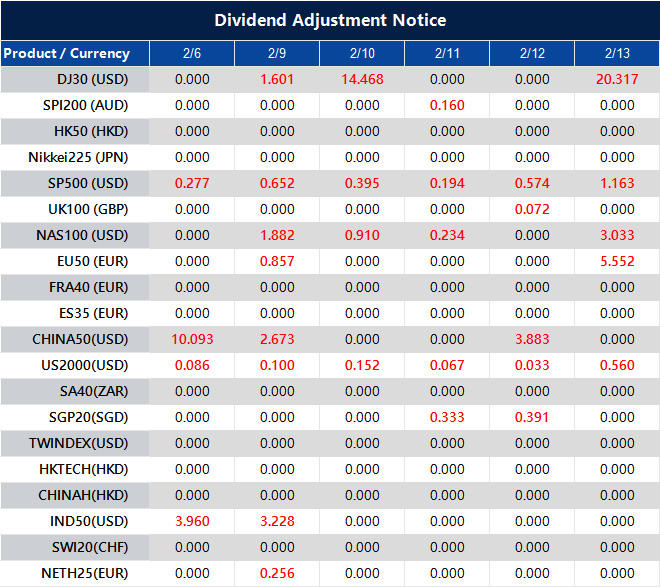
The above data is for reference only, please refer to the MT4/MT5 software for specific data.
If you’d like more information, please don’t hesitate to contact [email protected].







