



Societe Generale highlights market sensitivity to tightening in January’s BoK MPC minutes
The January Monetary Policy Committee (MPC) minutes from the Bank of Korea (BoK) reveal a more aggressive stance on interest rates. This change shows that the market is more sensitive to the possibility of policy tightening.
Despite mixed signals — like a lower USD/KRW exchange rate and increasing property prices — the committee has not changed its overall view. The current data still doesn’t push any members towards a stricter policy approach.
Gold Rebounds As Middle East Risk Intensifies
Gold prices staged a solid recovery on Tuesday, erasing earlier losses as renewed tensions in the Middle East revived demand for traditional safe-haven assets.
The turnaround reflected a rapid shift in market mood after fresh security developments highlighted the region’s ongoing fragility.
Spot gold rose 2.1% to $5,051.59 per ounce, reclaiming the psychologically important $5,000 level after dipping below it earlier in the session.
The rebound followed reports that the United States intercepted an Iranian drone allegedly targeting the aircraft carrier USS Abraham Lincoln, while a US-flagged vessel narrowly avoided being stopped by armed Iranian patrol boats.
From a risk perspective, as long as geopolitical stress in the region remains elevated, downside pressure on gold is likely to be limited despite recent bouts of volatility.
Macro Drivers Continue To Support Gold
Beyond geopolitics, broader macroeconomic conditions remain constructive for bullion. High global debt levels, combined with uncertainty surrounding US fiscal and monetary policy, have encouraged investors to retain exposure to hard assets as protection against systemic risks.
While recent trading has been marked by sharp pullbacks followed by swift recoveries, the broader price behaviour points to sustained interest rather than large-scale capitulation.
Importantly, demand driven by portfolio diversification rather than short-term speculation appears to be playing an increasingly significant role in underpinning prices.
In the near term, a cautious outlook suggests gold may continue to consolidate above $5,000, provided geopolitical developments remain supportive and the US dollar does not embark on a prolonged recovery.
Technical Analysis
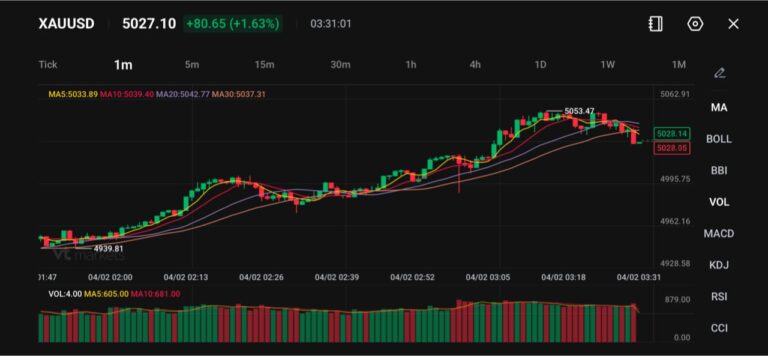
XAUUSD surged to 5027.10, posting a gain of 1.63% and reaching an intraday high of 5053.47, as bullish momentum pushed prices beyond the previous range high at 4939.81.
On the one-minute chart, a clear uptrend is evident, reinforced by the close alignment of short-term moving averages (MA5–MA30), before a modest pullback emerged.
Despite this minor retracement, prices remain well supported above the 5027–5030 moving average cluster. The spike in volume ahead of the session high points to strong buying conviction, although fading volume and a brief dip below MA10 signal some near-term caution.
If buyers continue to defend this area, a retest of 5053.47 and a move towards 5062.91 cannot be ruled out. Conversely, a sustained break below 5025 could expose the downside towards 4995.75, opening the door to a deeper corrective phase.
A 25 basis point interest rate hike by the RBA indicates potential ongoing inflation pressures ahead
The Reserve Bank of Australia raised its interest rate by 25 basis points to 3.85%. More increases are expected as inflation pressures continue. In Tehran, there are hopes of restarting nuclear talks with the US, which could ease regional tensions.
In the US, a partial government shutdown has delayed the January jobs report. This has led to a focus on private-sector data, such as the ADP Employment Change report. The US Dollar Index is holding steady around 97.40 during the shutdown.
Currency Movements
The US Dollar has softened slightly against the Euro and Yen but gained against the British Pound. The EUR/USD is near 1.1820, while GBP/USD is around 1.3690, adjusting as the USD weakens. The Canadian Dollar is trading at 1.3650 against the USD, and AUD/USD is at 0.7000 after the RBA’s decision. USD/JPY is approaching weekly highs of 155.80, and gold prices have bounced back to about $4,910. Upcoming data includes Eurozone inflation, retail sales, US employment changes, and monetary policy decisions from the ECB and BoE. Gold continues to be a safe investment during uncertain times and is inversely related to the US Dollar and Treasuries. Its price is impacted by geopolitical risks and interest rates. The Reserve Bank of Australia is hinting at more rate hikes, which should bolster the Aussie dollar. It may be wise to buy AUD/USD call options to take advantage of potential gains, especially as the pair tests the important 0.7000 level. This strategy is backed by persistent inflation seen in late 2025, which was at 4.5%, pushing the RBA to act.US Jobs Report Uncertainty
The delay in the US jobs report due to the government shutdown brings notable uncertainty. When the official numbers are released, we may see increased volatility in the US Dollar Index (DXY). Buying straddles or strangles on major USD pairs could be an effective strategy to handle this expected price change, regardless of direction. With the official jobs report postponed, today’s ADP employment data will have a significant impact on the market. In recent months, like December 2025, the ADP numbers influenced market sentiment even when they later differed from the official BLS figures. Traders might make short-term bets based on this information, so we should prepare for intraday volatility around its release. The possibility of renewed nuclear discussions between the US and Iran could lessen geopolitical risks, potentially stabilizing oil prices and easing some inflation pressures. This might slightly reduce the US dollar’s appeal as a safe haven in the short term. A similar effect was observed in mid-2025 when initial talks caused a brief 1% drop in the DXY over two trading sessions. Gold is gaining from the US government shutdown and the uncertainty surrounding the dollar. Given its high price close to $4,910, using strategies like bull call spreads can provide a cost-effective way to gain bullish exposure while managing risk. This is strongly supported by the ongoing aggressive gold purchases from central banks throughout 2025, which totaled over 1,000 tonnes. The strength of USD/JPY, nearing 155.80, shows a clear divergence despite widespread dollar uncertainty. The significant interest rate gap of more than 400 basis points is fueling the carry trade, making it lucrative to hold this pair. We should keep an eye on this trend as recent data from late 2025 indicated a drop in Japanese household spending, giving the Bank of Japan little reason to change its policy. As we approach the end of the week, the decisions from both the Bank of England and the European Central Bank on Thursday create event risk for GBP and EUR pairs. Implied volatility for one-week options on EUR/USD and GBP/USD has already increased by 15% this week. We can expect significant movements, especially if their statements on future rate paths differ from current market expectations. Create your live VT Markets account and start trading now.TD Securities’ Alex Loo urges caution on the potential revaluation of the Chinese Yuan in 2026
A report from TD Securities expects the Chinese Yuan (CNY) to remain stable by 2026, despite being undervalued now. The target for the USDCNY exchange rate is 6.7 by the end of the year.
The People’s Bank of China (PBoC) is likely to keep things steady, with no significant changes anticipated. The report highlights that recent sell-offs in the US dollar did not lead to any major shifts in the Yuan’s value, thanks to the PBoC’s daily fixings.
Historical Perspective On CNY Gains
Since 2014, the gains of the CNY have not outstripped the overall drops of the USD. This suggests that moving towards a USDCNY rate of 6.7 fits with President Xi’s goal for a stable exchange rate. Since a major revaluation of the Yuan is unlikely this year, we should be careful when anticipating strong CNY performance. The PBoC has shown a clear preference for stability, limiting how much the Yuan can appreciate in the short term. Any increase towards the target of 6.7 will likely be slow and managed. Recent statistics reinforce this cautious outlook. For January 2026, China’s export growth was only 2.5% compared to last year, making it hard for authorities to support a stronger currency that might hurt trade competitiveness. Additionally, in the last two weeks, the PBoC has consistently set the USDCNY daily fixings slightly above market expectations. This indicates a preference for guidance rather than letting the Yuan soar.Opportunities For Derivative Traders
For those trading derivatives, the current environment of controlled appreciation and low volatility makes selling options a good move. Since the beginning of the year, one-month implied volatility on USDCNY has dropped from about 5.2% to 4.7%. Selling out-of-the-money puts on USDCNY (or calls on CNH) allows traders to earn premium while betting that the currency won’t rise too quickly beyond certain levels. This matches the expectation of a slow decline in the dollar-yuan pair instead of a sudden drop. Looking back at the US dollar sell-off in late 2025, there was a prime chance for Beijing to let the CNY rally sharply, but it chose not to. This trend is in line with what we have seen since 2015, where the Yuan’s gains have not significantly outpaced declines in the broader dollar index. We can expect this focus on stability to continue in the coming weeks. Create your live VT Markets account and start trading now.After a recent dip, silver buyers increase its value to about $85.30, up 6.50%
Silver saw a strong jump on Tuesday, climbing about 6.50% to around $85.30. Buyers were eager to take advantage of a recent price drop, which was mainly due to technical factors rather than any fundamental shifts. This price drop led to position unwinding and margin-related liquidations.
Even with a stronger US Dollar, which can limit price increases, expectations of monetary easing are still supporting Silver. Market hopes for more rate cuts by the Federal Reserve help non-yielding assets like Silver, even as the short-term lift for the US Dollar fades following Kevin Warsh’s nomination.
The US Dollar Index is close to recent highs, which could affect Silver’s price growth. A stronger Dollar makes Silver more expensive for buyers outside the US. Improved ties between the US and Iran and a trade deal with India have eased tensions, lowering safe-haven demand for Silver, which might lead to a consolidation phase.
The partial shutdown of the US federal government is slowing the release of economic data, which is adding uncertainty to the economic outlook. Nevertheless, movements in the US Dollar and expectations for monetary policy will likely shape Silver’s future. Silver trading is affected by geopolitical issues, interest rates, and industrial demand in major economies such as the US, China, and India.
Looking back at the sharp rebound in silver we saw in 2025, the current situation feels similar. That rebound followed a “violent correction” and showed a strong desire to buy on dips, a trend that continues today. With silver currently consolidating, any signs of weakness should be viewed as a chance to buy more rather than a reason to worry.
Last year’s expectations for monetary easing have come true, with the Federal Reserve cutting rates by 75 basis points through the end of 2025. This has kept real yields low, supporting the case for non-yielding assets. The Fed’s current pause provides a favorable environment for silver prices.
Industrial demand, which is often overlooked, has increased since last year. Global solar panel installations exceeded 440 gigawatts in 2025, maintaining a trend that uses over 15% of the annual silver supply. This strong demand from industries helps keep the price stable.
The Gold/Silver ratio also indicates that silver is still undervalued. It’s currently around 85, significantly higher than historical averages, similar to what we saw in 2025. This suggests that silver could perform much better than gold in any upcoming rally for precious metals.
Given the high volatility mentioned last year, outright long positions can be risky. A smarter approach for the next few weeks is to use options to benefit from potential upside. Buying call spreads allows for participation in a rally toward the 2025 highs near $85 while keeping downside risk well-defined.
Australian Dollar strengthens against US Dollar after Reserve Bank of Australia increases interest rates
The Australian Dollar is gaining strength after the Reserve Bank of Australia (RBA) raised interest rates by 25 basis points. The currency is currently trading well against the US Dollar, reaching a peak of around 0.7011, just below its highest point for the day.
The RBA has increased the cash rate to 3.85% in response to rising inflation. Their policy statement highlights that, although inflation has been decreasing since 2022, it saw an uptick again in late 2025 and is expected to remain above the target of 2-3% for some time.
Drivers Of Inflation
The bank sees some of the inflation as temporary. However, strong private demand and a tight labor market are leading to quicker growth than expected. Governor Michele Bullock emphasizes that the focus will remain on new data, without giving any future guidance, while the economy faces supply constraints. A BHH report suggests there’s an 80% chance of a rate hike in May, with total tightening expected to reach 60 basis points over the next year. The difference in policies between the RBA and the Federal Reserve may keep the AUD/USD trending upward. Upcoming Australian employment data and the Services PMI could sway the currency’s direction. In the U.S., the delay of the Nonfarm Payrolls report due to a government shutdown shifts attention to other indicators like ADP Employment Change and Services PMI.Impact Of Policy Divergence
The recent rate hike by the Reserve Bank of Australia has significantly impacted the Aussie dollar. We observed the currency gain strength right after the 25 basis point increase to 3.85%, showing how sensitive the market is to a more assertive central bank. This increase, the first since 2023, indicates that the battle against inflation is ongoing. In the coming weeks, the key factor for AUD/USD will be the growing policy gap between the RBA and the U.S. Federal Reserve. The RBA is reacting to ongoing domestic price pressures, while futures markets expect rate cuts from the Fed this year. Currently, the CME FedWatch tool shows over a 70% chance of at least one Fed rate cut by mid-year. This difference in policies is backed by strong data from Australia, allowing the RBA to maintain its position. Recent stats reveal that the unemployment rate stays close to a historic low of 3.9%, while quarterly inflation data remains above the RBA’s 2-3% target. These conditions support the central bank’s consideration of further tightening. For traders in derivatives, this environment suggests that buying AUD/USD call options is a smart move to capture potential upsides while managing risk. With swaps markets indicating an 80% chance of another rate hike, implied volatility may rise, making options a useful tool for managing sudden price changes. Any dips in the currency pair could be seen as good buying opportunities. Looking back to the period from 2009 to 2011 highlights how significant this setup can be. During this time, a proactive RBA raised rates after the financial crisis, while the U.S. Fed engaged in quantitative easing, pushing AUD/USD to its all-time highs above 1.10. Although history doesn’t repeat exactly, it offers a clear example of what can happen when these two central banks act in opposite directions. Create your live VT Markets account and start trading now.VT Markets Advances Growth in 2026 Building on Strong Performance Momentum From the Past Decade

3 FEBRUARY 2026, SYDNEY, AUSTRALIA – VT Markets, a leading global online trading platform, today shares its performance highlights in 2025, marking a milestone year of record-breaking trading activity, client base growth, and global expansion.
Throughout 2025, VT Markets set new benchmarks for monthly trading activity. In April, transaction volumes reached USD 720 billion, before surpassing that figure in October 2025 with USD 1.2 trillion trading volume, underscoring sustained client engagement and increased market participation across global markets.
Client growth surged significantly toward the end of the year, with daily active users doubling in December 2025. This underscores the platform’s increasing relevance among active traders globally. Additionally, VT Markets continued to deliver high-quality service and a steadfast experience to its customer base, as reflected in its 4.3-star Trustpilot rating, supported by over 1,500 5-star reviews.
In support of long-term client development, VT Markets relaunched VT Academy in 2025, offering over 40 educational courses in more than five languages. These courses are designed to enhance trading knowledge, serve a diverse range of clients, from new traders seeking financial knowledge to institutional clients focused on business growth and volume, and support more informed market participation.
Regional markets delivered strong year-on-year growth, driven by targeted expansion strategies and deeper local engagement. In parallel with regional expansion, VT Markets strengthened its industry presence throughout 2025, participating in 54 regional and global industry events and earning more than 32 industry awards, reflecting continued recognition across both retail and professional trading segments.
To support this expansion, VT Markets continued to scale its global organisation. Team size increased by 135% year-on-year, with presence across 10 offices worldwide including new regional hubs in Dubai and Mexico to strengthen operational capacity, technology development, and client support functions.
As VT Markets moves forward in 2026, the company is focused on building on the scale achieved in 2025 through continued investment in platform performance, regional market development, and organisational capability. Supported by record trading activity, accelerating client engagement, and expanded global operations, VT Markets enters the new year positioned to pursue exceptional growth while maintaining the performance standards expected by its global client base.
At the start of 2026, the Japanese Yen experienced significant fluctuations but ended the month strong.
The Japanese Yen (JPY) saw significant fluctuations at the beginning of 2026, moving between 153 and 159. By the end of the month, it showed some strength. Analysts from the National Bank of Canada predict that the yen will strengthen in the latter half of 2026, influenced by trends in the U.S. dollar and potential interest rate hikes from the Bank of Japan.
Experts believe that the yen’s rise in January stemmed from market adjustments and stabilization efforts rather than renewed faith in Japan’s economy. While there are cautious outlooks for the next six months, many anticipate the yen will gain strength later in the year, depending on the behaviors of the U.S. dollar and the renminbi.
Market Analysis And Outlook
The FXStreet Insights Team, made up of journalists and analysts, gathers insights from market experts. Their reports combine information from commercial sources and various analysts to give a full picture of market trends. With the yen trading between 153 and 159 in January, its recent strength appears more linked to market adjustments than to any fundamental changes. In the coming weeks, it seems likely that the currency will remain in this range, as traders wait for clearer signals. This situation is not ideal for making strong directional bets. Given this short-term uncertainty, traders might consider selling volatility through options strategies. For example, creating an iron condor on USD/JPY could benefit from the expectation that the pair will trade within a steady range for the next month or two. While implied volatility in one-month options shot up to over 12% in January, it has now settled around 9.5%, which could still provide appealing premiums for sellers.Strategies For Yen Appreciation
Looking ahead, there is growing support for yen appreciation in the second half of the year. The latest U.S. non-farm payrolls report from January 2026 showed slower job growth than expected, indicating that the Federal Reserve might ease policies later this year. We remember that the dollar’s weakness also helped lift other currencies in late 2025. On Japan’s side, the Bank of Japan may have more reasons to consider an interest rate hike later in 2026. National core inflation in Japan has stayed at or above 2.4% for three consecutive months through January 2026. This ongoing inflation provides the central bank with room to act when global conditions, particularly in the U.S. and China, become more stable. For those looking to benefit from potential yen appreciation in the second half of the year, buying long-dated JPY call options with expiration dates in the third or fourth quarter of 2026 could be a smart strategy. This allows traders to prepare for expected changes while managing their risks in the near term, reducing potential losses if the yen takes longer to consolidate than expected. Create your live VT Markets account and start trading now.Elliott Wave analysis indicates a potential bull run for Nifty following a 1000-point rally from 24,500.
The Nifty index recently climbed 1,000 points from 24,500, which was accurately predicted using Elliott Wave analysis. The rise was supported by the US-India Trade Deal, serving as both a fundamental driving force and a part of a technical framework.
Wave Patterns in Key Stocks
We looked at the wave patterns of Tata Steel and KNR Constructions. The analysis raises questions about whether it’s wise to take profits or keep investing, along with predictions for the days ahead. Experts in Elliott Wave Theory are continuously monitoring the market to evaluate possible future targets for the Nifty and Bank Nifty. In other market news, EUR/USD is stable above 1.1800 while traders wait for Eurozone data. USD/JPY has gained strength amid political uncertainties in Japan. Gold prices have bounced back above $4,950 after a sell-off, driven by safe-haven demand amid US-Iran tensions. In the crypto space, Ripple is down slightly, trading just under $1.60. The overall market has been declining since January 2025. FXStreet remains a go-to source for financial updates, though it does not offer investment advice, emphasizing the risks of open market investments. We successfully identified the reversal from the 24,500 low, and the subsequent 1,000-point rally shows that a strong market advance is underway. This indicates the start of a new bull market rather than just a temporary bounce. For derivative traders, this is a moment to switch from a defensive to an offensive approach in the coming weeks.The Impact of the US-India Trade Deal
The recent US-India Trade Deal is a key factor driving this technical setup. This positive momentum is reinforced by a surge in Foreign Institutional Investor (FII) inflows, which exceeded $6 billion in January 2026, marking a strong rebound from the outflows seen in late 2025. This influx of capital, along with a manufacturing PMI that remains above 57, suggests a robust economic climate that supports higher index values. Traders should consider purchasing Nifty call options with strike prices of 26,000 and 26,500 for the February and March expiries, given the strong upward trend. For those holding futures, it’s wise to stay in the market and avoid taking profits now. The strong breakout indicates that any pullbacks are likely to be minor and could provide additional buying chances. However, geopolitical risks persist; for example, gold prices remain around $4,985 amid ongoing US-Iran tensions. To hedge against unexpected market downturns, cautious traders might want to buy out-of-the-money Nifty put options, like the 25,000-strike puts. This offers a cost-effective safety net. In terms of volatility, the India VIX has decreased since late 2025 but is still above its historical average, making direct long options more costly. In this context, bull call spreads become attractive as they limit maximum losses and lessen the impact of high implied volatility. We expect volatility to continue decreasing as the Nifty heads toward its next significant targets, benefiting those holding long option positions. Create your live VT Markets account and start trading now.Standard Chartered predicts China’s year-on-year PPI deflation will drop to 1.5% due to rising metal and energy prices.
In January, China’s Producer Price Index (PPI) deflation is expected to have eased to 1.5% year-on-year. This change is due to month-on-month increases in metal and energy prices. The Consumer Price Index (CPI) inflation likely dropped by 0.2 percentage points to 0.6% year-on-year for the same period, which can be attributed to base effects.
The report predicts a 0.3% monthly rise in the PPI, driven by higher metal and energy prices. The core CPI seems to have risen, influenced by gold prices and seasonal factors.







