



Turkey’s annual Consumer Price Index reached 30.65% in January, surpassing the expected 30%
Turkey’s Consumer Price Index (YoY) reached 30.65% in January, which is higher than the expected 30%. This raises concerns about inflation in the country.
The EUR/USD is holding steady above 1.1800 due to a weakening US Dollar caused by mixed economic data and easing geopolitical tensions. Meanwhile, GBP/USD is making gains and is trying to hit the 1.3700 level during the European session, as the Pound strengthens with a positive market outlook.
The pound strengthens against the dollar, trading at around 1.3685 ahead of the BoE’s decision.
GBP/USD rose to 1.3685 during the early European session. The Bank of England is expected to keep policy rates unchanged at its meeting on Thursday. In the U.S., the Manufacturing PMI showed strong growth in January.
The GBP/USD pair is staying above 1.3650 as the Bank of England’s decision nears. In December, the Monetary Policy Committee voted 5-4 to lower rates, marking the fourth reduction in 2025. Economists predict the central bank will hold the rate at 3.75% due to ongoing inflation.
On the other hand, the U.S. Manufacturing PMI climbed to 52.6 in January, up from 47.9 in December. This indicates that the U.S. Federal Reserve might keep rates stable for a while.
The Pound Sterling, the UK’s official currency, ranks as the world’s fourth most traded currency. The Bank of England influences its value through monetary policy, aiming to meet inflation targets.
Economic indicators like GDP, PMIs, and employment rates affect the Pound’s value. A strong economy can attract foreign investments, impacting the Bank of England’s interest rate decisions.
The Trade Balance, which measures the difference between exports and imports, can also influence the Pound. A positive balance suggests higher demand for the currency.
The Pound Sterling is holding steady against the dollar, trading around 1.3685 ahead of the Bank of England’s decision on Thursday. The main concern for traders is the Bank of England’s reluctance to cut rates further, which contrasts with a strong U.S. economy that supports the dollar. This creates a potential for significant movement after the announcement.
Previously, the Bank of England cut rates four times in 2025, but the latest vote in December was a narrow 5-4, indicating a division. Recent data reinforces this caution, as the UK’s Consumer Price Index (CPI) unexpectedly rose to 3.1% in January, well above the 2% target. This ongoing inflation makes it likely the Bank of England will maintain rates at 3.75% for now.
Conversely, strong U.S. economic data poses challenges for further GBP gains. The ISM Manufacturing PMI rose to an expansionary 52.6, and last week’s jobs report showed the U.S. economy added over 250,000 jobs. This solid performance gives the Federal Reserve more flexibility to keep rates steady, supporting the U.S. Dollar.
Given this uncertainty, we can expect an increase in implied volatility for GBP/USD options this week. Historically, implied volatility jumps over 15% before a contentious Bank of England meeting, and this time is likely no exception. Options premiums will rise, reflecting the chance of a sharp price movement after the announcement on Thursday.
For those expecting significant changes, buying long straddles or strangles could capitalize on the volatility, irrespective of direction. These strategies involve purchasing both a call and a put option to benefit from major movements. Alternatively, if we think the market has already priced in a hold, the higher premiums might make selling options appealing for income generation.
Traders with existing positions should consider using options to protect against unfavorable movements. Key levels to monitor include the 1.3650 support level, which has held strong, and potential resistance near 1.3800. A clear break beyond these levels after the Bank of England’s announcement could set the trend for the upcoming weeks.
EUR/USD rises above 1.1800 but faces potential bearish reversal in an ascending channel
The EUR/USD pair has moved above 1.1800, targeting the nine-day EMA at 1.1836. The 14-day Relative Strength Index (RSI) now stands at a neutral 53, showing improved momentum. Initial support is at the 50-day EMA level of 1.1737.
After two days of losses, the pair is trading around 1.1810 in Asian markets on Tuesday. However, there are signs of a possible bearish reversal as it stays just within the upward channel. The nine-day EMA is the first resistance level, and the short-term average is above the medium-term average, which keeps a bullish outlook in place.
The EUR/USD remains above the 50-day EMA but is under pressure from the nine-day EMA, which limits further gains. If it manages to move above the nine-day EMA, the next target could be 1.2082, the highest point since June 2021, and potentially up to the upper channel limit at 1.2290. A drop to 1.1737 could bring risks toward the two-month low of 1.1578.
The Euro, used in the Eurozone, is the second most traded currency after the US Dollar. The European Central Bank (ECB) affects the Euro with its monetary policy and interest rate decisions. Higher interest rates, or expectations of increases, usually support a stronger Euro.
Currently, the EUR/USD is approaching the 1.1836 resistance. A consistent break above this level could signal a strong buying opportunity in the coming weeks. Traders may look at call options with strike prices around 1.1900, aiming for the 1.2082 area. Recent inflation data for January showed a growth of 2.1% in the Eurozone, further supporting a stronger Euro and adding pressure on the ECB.
On the other hand, if the nine-day EMA resistance holds firm, we could see the pair retreat to the 50-day EMA support at 1.1737. A significant break below this level would indicate a bearish trend, making put options at a 1.1700 strike price appealing. In late 2025, we witnessed similar situations where disappointing German industrial data led to lower supports, as seen with a recent manufacturing PMI of 49.5.
The neutral RSI of 53 and the narrow range between key moving averages suggest a possible consolidation phase before a bigger move. With one-month implied volatility around 7.5%, strategies like buying a straddle could be beneficial for traders anticipating a breakout but uncertain about the direction. This approach allows for potential profits from large price movements in either direction.
It’s also important to note that the US Dollar is currently experiencing a broad decline, which supports the EUR/USD pair and reinforces the bullish case. The market is still adjusting to the effects of the recent partial US government shutdown on economic data, creating uncertainty that weakens the dollar. Traders should keep these external factors in mind, as they can affect the direction of the pair.
Michele Bullock, Governor of the RBA, explains the reasons for the 25 basis point interest rate increase.
The Reserve Bank of Australia (RBA) has raised the Official Cash Rate (OCR) by 25 basis points to 3.85% after the February monetary policy meeting. This increase was expected and aims to tackle strong inflation, which is likely to stay above target for a while.
RBA Governor Michele Bullock highlighted the need for this action to keep inflation under control. The RBA board will keep monitoring economic data, aware of uncertainties around the economy and inflation. Inflation surged in the second half of 2025 due to increased demand and capacity pressures.
Impact On The Australian Dollar
As a result, the Australian Dollar rose by 0.75% against the US Dollar, trading above 0.7000. This rise shows how sensitive the currency is to changes in interest rates and inflation forecasts. The RBA aims to balance demand and supply, with a target of a 3.9% cash rate by June and 4.2% by December. Revised inflation projections now extend to 2027. The RBA’s goal is to manage rising inflation while many other global rates have decreased in recent years. Positive indicators, like a drop in the unemployment rate to 4.1% and stronger private demand, support the expectation of rate hikes. The RBA’s decision underlines that inflation is still the main concern. The surge in inflation during late 2025 was more significant than predicted. This shift means a need to prepare for a higher interest rate environment in Australia soon. The strength of the Australian dollar, pushing AUD/USD above 0.7000, is expected to last. We suggest buying call options on the AUD/USD with strike prices around 0.7100 and 0.7150 to capture potential gains from the RBA’s firm stance, while limiting risk.Market Reactions And Predictions
The RBA now forecasts the cash rate could reach 4.2% by December, which is a notable increase. This may lead to a further drop in Australian 3-year government bond futures as the market anticipates more rate hikes. Shorting these futures contracts is a straightforward way to position for this tightening cycle. This aggressive outlook is backed by new data showing a quarterly trimmed mean CPI of 0.9% in the fourth quarter of 2025, higher than expected, along with a tight labor market where the unemployment rate fell to 4.1% in December. Additionally, with iron ore prices exceeding $130 per tonne, the currency gains strong external support. Despite this strong tone, Governor Bullock’s remarks about being “cautious” and “data-dependent” suggest we should brace for volatility around key data releases. Traders might consider buying options straddles on the AUD/USD before the next monthly CPI report to profit from potential large price swings and to hedge against a possible pause from the RBA if new data is weaker than anticipated. As the RBA diverges from a global trend of easing rates, the Australian dollar is likely to outperform currencies with more lenient central banks. We are exploring pairs like AUD/CAD or AUD/EUR for potential long positions. The growing yield gap between Australian and other government bonds, like the over 50 basis point premium on Australian 10-year bonds compared to U.S. Treasuries observed in late 2025, makes these carry trades increasingly appealing. Create your live VT Markets account and start trading now.The Chinese Yuan gains strength against the US Dollar, lowering USD/CNH to around 6.9310
The USD/CNH currency pair has dropped to 6.9350 in the late Asian trading session, getting close to a 33-month low of 6.9310. This decline is mainly due to the Chinese Yuan performing well against the US Dollar, driven by seasonal demand.
With the upcoming spring festival and a weaker dollar trend, the Yuan is well-supported. At the same time, the US Dollar Index (DXY) has slightly decreased to 97.45, nearing its weekly high of 97.73.
US Federal Shutdown and Economic Data
The US federal shutdown may interrupt the release of important economic data, causing the Dollar to dip slightly. Nevertheless, positive news from January’s ISM Manufacturing PMI, which returned to growth at 52.6, is helping to stabilize the Dollar. The US Dollar is the world’s main currency, making up over 88% of global foreign exchange activity, with daily transactions averaging $6.6 trillion. The Federal Reserve’s monetary policy significantly affects its value, mainly through changes in interest rates. Quantitative easing (QE) and quantitative tightening (QT) also impact the Dollar’s strength. QE usually weakens the Dollar, while QT tends to strengthen it. These macroeconomic strategies play a crucial role in global currency dynamics. Looking back to early 2025, the Yuan strengthened considerably against the Dollar, pushing USD/CNH down to about 6.93. This shift was driven by high demand for the Yuan ahead of the Lunar New Year holiday. Additionally, factors like a partial US government shutdown and speculation about a hawkish new Fed chair also played a role.Today’s Seasonal Patterns and Market Strategies
Today, we are experiencing a similar seasonal pattern as the holiday approaches on February 17th. The People’s Bank of China reported a 1.2% rise in yuan-denominated deposits for January 2026, indicating strong domestic cash demand. With USD/CNH trading near 7.15 now, the memory of last year’s lows is affecting short-term market sentiment. The US economic backdrop is different from the strong ISM manufacturing report of January 2025. Last week, US data showed a slight slowdown in the services sector, with the ISM Non-Manufacturing PMI dropping to 51.9 from 53.4. This has limited expectations for aggressive Federal Reserve policies, keeping dollar strength in check for the time being. For derivative traders, this presents an opportunity to bet on further, but likely short-lived, Yuan strength. Buying USD/CNH put options with a strike price near 7.05 could be a way to benefit from a move towards historical support levels. These positions should ideally expire in late February or March to adjust for market changes after the holiday. However, the broader US Dollar Index (DXY) has remained steady, fluctuating around the 103.50 mark for weeks. This indicates that the Yuan’s strength is more of a seasonal event rather than a broad collapse of the dollar. Therefore, traders might want to consider using DXY call options to hedge against any unexpected strength in upcoming US inflation data. Create your live VT Markets account and start trading now.Current gold prices in Malaysia have increased, according to reliable data.
Gold prices in Malaysia rose on Tuesday, reaching 608.89 Malaysian Ringgits (MYR) per gram, up from MYR 589.12 the previous day. The price per tola increased to MYR 7,101.94, compared to MYR 6,871.41 the day before.
FXStreet offers daily updates on gold prices by converting international rates into local currency and units. These prices serve as guidelines and may vary from local rates.
Gold is prized for its long history as a store of value and a means of exchange. It’s seen as a safe investment during uncertain times and a safeguard against inflation and falling currency values.
Central banks are significant gold buyers, acquiring 1,136 tonnes in 2022—the highest amount ever purchased in a year—to strengthen their economies. Countries like China, India, and Turkey are quickly building their gold reserves.
Gold often moves in the opposite direction of the US Dollar and Treasury yields. Its price tends to increase when the Dollar weakens, and is influenced by factors such as political instability, fears of recession, and interest rates. A strong Dollar can keep gold prices low, while a weaker Dollar usually lifts prices.
Currently, gold prices are on the rise globally, trading at about $2,150 per ounce. This trend reflects growing concerns about the future of the global economy, as traders look for secure investments.
The latest US inflation report showed a higher-than-expected rate of 3.1%, raising doubts about the Federal Reserve’s ability to lower interest rates this year. Persistent inflation and uncertain monetary policy usually boost gold prices. We should consider long-term call options to take advantage of this potential increase while managing our risk.
We’ve also observed the US Dollar Index (DXY) sliding to about 102, which benefits dollar-based assets like gold. This decrease in the Dollar coincides with rising volatility in stock markets, which have struggled to keep their momentum since a strong rally in late 2025. Investors are shifting funds from stocks into safer options.
Geopolitical tensions are ongoing, further supporting gold prices in the weeks ahead. Additionally, central banks continued to buy gold in 2025, with net purchases exceeding 800 tonnes, indicating strong interest in the physical market and supporting futures prices.
Given this situation, we should consider taking bullish positions in the derivative markets. A bull call spread on gold futures could be a smart strategy, allowing us to profit from rising prices while limiting our risk. This approach seems wise until we receive clearer insights from upcoming central bank meetings.
US Dollar Index trades around 97.50, falling after recent gains, as the 10-year yield rises
The US Dollar Index is currently around 97.50, influenced by rising 10-year Treasury yields and changing expectations from the Federal Reserve (Fed). The ISM Manufacturing PMI unexpectedly increased to 52.6, showing strong activity in US factories and exceeding market forecasts.
President Trump’s pick of Kevin Warsh as the new Fed Chair indicates a careful approach to monetary easing. The yield on the 10-year US Treasury bond rose to nearly 4.27% after a big jump in the previous session, spurred by strong economic data and the possibility of a hawkish shift from the Fed.
An agreement in the US Senate about a government funding package boosted investor confidence. Moreover, a new trade deal with India aimed at lowering tariffs and halting Russian oil purchases by New Delhi.
St. Louis Fed President Alberto Musalem is against further rate cuts, calling the current policy range neutral, while Atlanta Fed President Raphael Bostic advocates for a balanced approach.
The USD makes up over 88% of global foreign exchange activity and is heavily influenced by Fed decisions and interest rate changes. When the Fed implements quantitative easing, it often weakens the USD by increasing the amount of dollars in circulation. Conversely, quantitative tightening can strengthen the dollar by decreasing bond buying.
Reflecting back to 2025, the US Dollar was strong, with the DXY close to 97.50, driven by rising Treasury yields and unexpectedly strong factory data. The market was responding to a hawkish change from the Federal Reserve, highlighted by significant appointments and policy comments, which contributed to a trend of dollar strength based on economic resilience.
However, as we enter early 2026, the situation has changed. The 10-year Treasury yield has dropped from 4.27% to about 3.85% due to worries about an economic slowdown. This shift implies that last year’s aggressive policies may have slowed the economy more than anticipated.
Recent data shows this change, sharply contrasting the unexpected growth in the manufacturing sector we observed in 2025. The January jobs report revealed that non-farm payrolls were weaker than expected at 155,000, falling short of the 200,000 forecast. Additionally, the latest CPI inflation data for January 2026 reported a decline to 2.2%, suggesting that price pressures are easing toward the Fed’s target.
These developments have changed expectations for the Fed’s upcoming decisions, with the market now considering a potential rate cut by mid-year. The hawkish warnings from officials last year have shifted to a more cautious and data-dependent tone from Chair Warsh’s Fed. This change in strategy has weakened the dollar, with the DXY now around 95.20.
For traders in derivatives, this climate indicates that long-dollar positions are risky. Increased uncertainty about when the Fed might cut rates has led to greater volatility in the bond market, as reflected in the MOVE index, which rose from 95 to 110 in the past month. Traders should think about purchasing options to guard against sudden market shifts, such as puts on the dollar index or calls on Treasury bond futures.
Strategies betting on further dollar weakness against currencies with more stable or hawkish central banks, such as the Euro or Australian Dollar, look more appealing now. Selling call options on the DXY above the 96.00 level may provide a way to earn income while acknowledging that the dollar’s rally from 2025 has likely ended. However, attention must be paid to the upcoming February inflation report, as any surprising increase could quickly reverse these dovish expectations.
AUD/JPY rises above 108.85 during trading hours due to RBA’s interest rate increase
The AUD/JPY climbed to about 108.85 during Asian trading on Tuesday after the Reserve Bank of Australia raised its Official Cash Rate by 25 basis points to 3.85%. This is the first rate increase in over two years. Traders are looking forward to more information from the RBA press conference later, which may affect the strength of the Australian Dollar.
In Japan, political uncertainty is rising as Prime Minister Sanae Takaichi has called for a snap general election on February 8. While Takaichi has previously supported a weaker yen, concerns about intervention from Japanese authorities could strengthen the yen, countering the recent gains of the AUD against the JPY.
The Role of the Reserve Bank of Australia
The Reserve Bank of Australia’s main job is to manage monetary policy, mainly by adjusting interest rates. Changes in inflation data can lead to shifts in interest rates that influence the value of the Australian Dollar. Additionally, the RBA uses Quantitative Easing (QE) and Quantitative Tightening (QT) as tools, with QE generally weakening the Australian Dollar and QT strengthening it. Economic factors like GDP and employment numbers also affect the AUD. A year ago, in February 2025, the AUD/JPY reached nearly 109.00 after the RBA increased its rate to 3.85%. Now, with the RBA at 4.35% and the Bank of Japan having ended negative rates late last year, the situation has changed. The pair is currently trading around 105.50 because the yield advantage for the Aussie has decreased. The RBA is likely to stay on pause for a while, especially after the recent Q4 2025 inflation report showed a cooling to an annual rate of 3.5%. This suggests limits on the Aussie’s strength, restricting any further rise for AUD/JPY. Traders might consider selling out-of-the-money call options to earn premium, betting that the pair won’t significantly rise in the coming weeks.Focus on the Bank of Japan’s Next Move
For the Yen, all eyes are on the Bank of Japan’s next steps following their policy shift in November 2025. With January inflation in Tokyo steady at 2.5%, there is growing speculation about another small rate hike by mid-year. This potential tightening may keep implied volatility high, making long volatility strategies on the pair worth exploring. The attractive carry trade that defined early 2025 has lost its luster due to this policy shift. The risk for AUD/JPY in the short term seems tilted downward, influenced more by potential actions from the BoJ than surprises from the RBA. Thus, it seems wise to structure trades that profit from a declining spot price, such as buying put spreads to manage risk in the upcoming weeks. Create your live VT Markets account and start trading now.RBA raises rates to 3.85%, pushing AUD/NZD closer to 1.1630 during trading
Inflation and Interest Rates
The Reserve Bank of Australia (RBA) kept its Official Cash Rate steady at 3.6% during the December meeting. Governor Michele Bullock mentioned that there won’t be any rate cuts soon. The upcoming Australian Trade Balance data could influence the Australian Dollar’s future. At the same time, the New Zealand Dollar remained strong against other currencies as the market awaited the Q4 employment data. Analysts expect a 0.3% increase in employment and an unemployment rate that stays at 5.3%. The RBA usually decides on interest rates during eight meetings each year. A rate increase generally helps the Australian Dollar, while a more cautious approach can weaken it. With the RBA raising its rate to 3.85%, there is a noticeable difference in monetary policies compared to other central banks. This has driven the AUD/NZD exchange rate to a multi-year high near 1.1630, supporting the Australian dollar’s strength against the Kiwi in the upcoming weeks.Economic Indicators
Australian inflation rose to 3.8% in December 2025, prompting the RBA’s recent decision. On the other hand, New Zealand’s inflation data from late 2025 showed a slight decline to 4.5%, indicating that the Reserve Bank of New Zealand can take its time. The widening gap between rising Australian inflation and declining New Zealand inflation is a major factor for traders. Next up is New Zealand’s employment data for the fourth quarter of 2025, expected tomorrow. A disappointing report that confirms an easing economy could lead to another surge in the AUD/NZD exchange rate. Traders might consider buying short-term call options on the AUD/NZD pair to take advantage of this upward potential. On Thursday, Australia will release its trade balance for December 2025, with predictions suggesting a strong surplus near A$11 billion, similar to last year’s figures. A number this strong would support the view of a strong Australian economy, giving the RBA more reasons to stay cautious. This indicates that the current strength of the Aussie dollar is based on solid fundamentals and not just a temporary reaction. Create your live VT Markets account and start trading now.Dividend Adjustment Notice – Feb 03 ,2026
Dear Client,
Please note that the dividends of the following products will be adjusted accordingly. Index dividends will be executed separately through a balance statement directly to your trading account, and the comment will be in the following format “Div & Product Name & Net Volume”.
Please refer to the table below for more details:
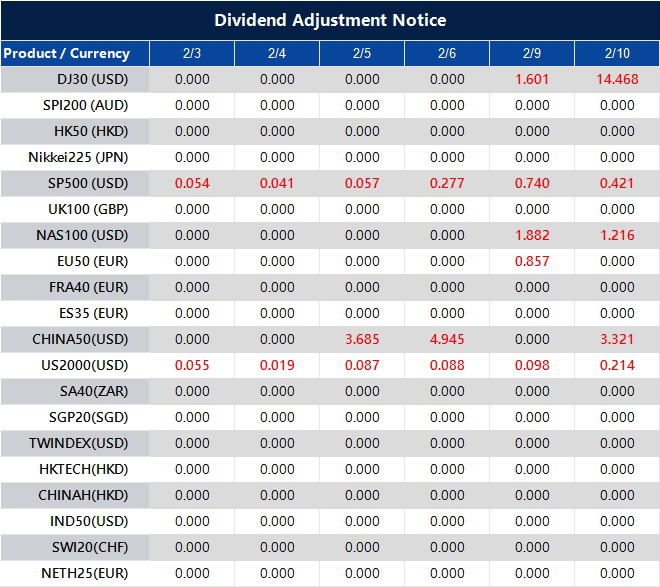
The above data is for reference only, please refer to the MT4/MT5 software for specific data.
If you’d like more information, please don’t hesitate to contact [email protected].







