



Gold prices increase in Malaysia today, according to official data.
Gold prices in Malaysia have increased, according to FXStreet data. The price per gram is now 660.21 Malaysian Ringgits (MYR), up from 652.26 MYR on Tuesday. The price per tola has risen from 7,607.82 MYR to 7,700.23 MYR.
FXStreet calculates these prices by adjusting international rates to the local currency and units. These prices are updated daily based on market rates, but local prices may vary slightly.
WTI rises to about $62.65 during Asian trading hours amid US production concerns
WTI is trading at about $62.65 during the Asian session on Wednesday. This drop is due to fears of production losses from a winter storm in the US, which has disrupted around 2 million barrels per day, about 15% of the country’s total output.
Crude exports from US Gulf Coast ports stopped on Sunday, adding to the supply worries. Additionally, tensions in the Middle East may also affect WTI prices.
EIA Report’s Potential Impact
The EIA’s crude oil stockpile report, expected later today, could influence prices based on the inventory levels reported. If stockpiles decrease, it suggests strong demand, which may drive prices up. Conversely, an increase in stockpiles might indicate weak demand, leading to lower prices. WTI Oil is a high-quality crude oil mainly produced in the United States. Its price is affected by supply and demand, geopolitical issues, and the value of the US dollar. Weekly oil inventory reports from the API and EIA are closely monitored, with the EIA considered more reliable. OPEC’s choices on production can also significantly sway WTI prices, changing global supply levels.Weather-Related Volatility
West Texas Intermediate is holding near $62.65 as we evaluate the effects of the US winter storm. The extreme weather has impacted production, with recent estimates indicating over 700,000 barrels per day were offline in Texas and North Dakota. This supply shock raises the risk of price increases, making short-term call options appealing. We will be watching the EIA stockpile report released later today for signs of tightening supply. If there is a larger-than-expected drop in crude inventories, it will support the bullish outlook and may push WTI towards higher resistance levels. This report is critical for this week, as it will influence short-term price movements. Since weather disruptions are temporary, we expect increased volatility in the upcoming weeks. Traders might use options to navigate this uncertainty as the market balances short-term supply losses against the overall economic picture. This scenario favors tactical trades rather than long-term bets. In addition to the storm, rising geopolitical tensions are bolstering the market. Shipping risks in the Red Sea, where traffic through the Suez Canal dropped by over 40% in late 2025 compared to the previous year, provide price support. These issues limit potential declines, even when US production rebounds from the freeze. However, we also need to think about demand. Recent manufacturing data from China was slightly below expectations, and the latest US inflation report indicated core inflation remains steady at 2.9%. These factors could dampen any significant price increases, suggesting that global demand may not be strong enough to maintain higher prices. As seen with similar weather events in previous years, price spikes can reverse once production normalizes. However, with OPEC+ committed to production cuts through the first quarter of 2026, the overall supply remains tight. This commitment magnifies the effects of any unexpected outages like the current one. Create your live VT Markets account and start trading now.US Dollar Index (DXY) rises to 96.00 after recent declines amid repositioning
The US Dollar Index (DXY) has bounced back to 96.00 after a downturn. Traders are adjusting their positions ahead of the Federal Open Market Committee (FOMC) meeting. The dollar gained against the New Zealand Dollar but weakened against the Euro and the British Pound.
Impact of the Federal Reserve
The Federal Reserve is expected to keep interest rates steady, but all eyes are on Fed Chair Jerome Powell for hints about future moves. Many in the market anticipate more rate cuts in 2026, which could influence the dollar’s value. Concerns about the Fed’s independence and possible actions from President Trump may also restrict the dollar’s strength. We are observing some adjustments in the US Dollar Index as the Fed decision approaches, bringing it back to the 96.00 mark. This appears to be short-covering, not a significant change in sentiment, as the overall outlook remains negative. Derivative traders might see this increase as a chance to set up new short positions at better levels. The market is eager for signs of at least two more rate cuts this year, supported by recent economic data. The December 2025 Consumer Price Index (CPI) report indicated that inflation has cooled to 2.8%, giving the Federal Reserve room to lower policies further. The CME FedWatch Tool shows a greater than 70% probability of a rate cut by the March meeting, indicating ongoing pressure on the dollar. Political uncertainty adds more risk, which could limit any significant rallies for the dollar. Concerns about the Federal Reserve’s autonomy and recent hints from the administration about restarting trade tariff talks with the European Union are dampening market sentiment. This can shift investments towards safer options like the Japanese Yen and Swiss Franc, skipping the dollar.Planning Currency Strategies
With potential for increased volatility after the Fed announcement and ongoing political events, buying put options on USD-related pairs like USD/JPY may be a wise move. This strategy helps traders benefit from a fall in the dollar while clearly defining their maximum risk. Consider options that expire after the March FOMC meeting to take advantage of the anticipated first rate cut. The dollar is showing general weakness against major currencies, especially the Euro and Japanese Yen. Traders might think about selling DXY futures contracts if the index struggles to stay above 96.00 after the Fed’s announcement. Another approach is to consider currency pairs that exclude the dollar, such as going long on EUR/JPY, which could help benefit from overall market trends while avoiding the risks tied to US events. This situation mirrors what we saw in late 2020 and early 2021, when a very supportive Fed policy led to a prolonged period of dollar decline. Last week’s technical drop below the important 97.00 support level strengthens this negative outlook. Historical trends suggest that the dollar’s path likely leans downward in the coming weeks. Create your live VT Markets account and start trading now.S&P 500 reaches all-time high, confirming bullish momentum and potential for further gains
The S&P 500 (SPX) has reached a new high, reflecting strong upward movement since its low in November 2025. This rise follows a five-wave pattern similar to Elliott Wave analysis.
Wave Pattern Analysis
The first wave, ((i)), ended at 6986.33, marking the start of the upward trend. Wave ((ii)) formed a zigzag pattern and concluded at 6788.03, indicating a significant level of completion. Next, wave ((iii)) took the index higher, reaching 6988.82 after several ups and downs. While we expect some short-term corrections, the overall trend remains positive as long as the index stays above 6788.03. Market resistance appears weak, with buyers likely to step in during corrections, typically in three, seven, or eleven swings. This shows that the market remains strong. The article also covers other financial assets, such as gold, which is performing well ahead of Federal Reserve decisions. Additionally, it examines currency pairs like EUR/USD and GBP/USD, as well as cryptocurrencies like Bitcoin Cash and Avalanche. There is also advice on selecting brokers and trading strategies for 2026, addressing various needs from low spreads to high leverage in different market segments.Market Trends And Opportunities
The S&P 500 achieving an all-time high confirms the bullish trend that started in November 2025. This upward movement is backed by positive economic data, like the recent report showing a solid 2.5% annualized growth in Q4 2025 GDP. This suggests that the upward momentum is well-supported. We anticipate a brief pullback in the current rally before hitting new highs, completing a short-term wave structure. For derivative traders, this dip provides a chance to start or increase bullish positions, such as buying call options or selling cash-secured puts. With the VIX currently around 13.5, option premiums are not excessively high, enhancing the appeal of these strategies. A key level to monitor is 6788.03; as long as the index remains above this mark, any pullbacks should be seen as temporary corrections. This strong market structure is further supported by easing inflation, with the December 2025 CPI at 2.8%, reducing pressure on the Federal Reserve. As a result, market expectations, indicated by the CME FedWatch Tool, show over a 90% likelihood that the Fed will maintain current interest rates at its next meeting. Historically, we have seen similar strong uptrends, such as in 2023, where momentum sustained the market even amid concerns about valuations. The current rally is also validated by a robust earnings season, with major tech and growth stocks exceeding revenue forecasts for the last quarter of 2025. This trend suggests that buyers will likely continue to appear during any market dips as they seek to benefit from ongoing growth. Create your live VT Markets account and start trading now.Dividend Adjustment Notice – Jan 28 ,2026
Dear Client,
Please note that the dividends of the following products will be adjusted accordingly. Index dividends will be executed separately through a balance statement directly to your trading account, and the comment will be in the following format “Div & Product Name & Net Volume”.
Please refer to the table below for more details:
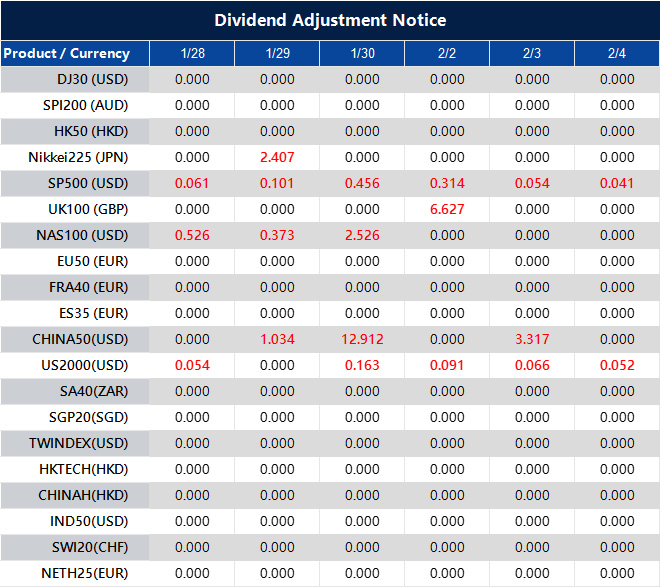
The above data is for reference only, please refer to the MT4/MT5 software for specific data.
If you’d like more information, please don’t hesitate to contact [email protected].
Silver rises toward $113.50 amid economic uncertainties, as focus turns to the Fed’s interest rate decision
Silver prices rose to about $113.50 during the Asian session on Wednesday, increasing by 1.30%. This surge is mainly driven by economic and geopolitical uncertainties, as well as expectations of US interest rate cuts.
The US Dollar has dropped to its lowest level since February 2022, influenced by remarks from US President Donald Trump. A weaker dollar supports silver, which is priced in USD.
Talks about the US Federal Reserve’s interest rates and the potential appointment of a new Chair, possibly Rick Rieder from BlackRock, also impact silver prices. The Fed is expected to keep interest rates stable after earlier cuts at the end of 2025.
Analysts predict a high chance of rate cuts in the second half of 2026, possibly in June. Lower interest rates could benefit silver since it doesn’t yield interest, reducing opportunity costs for investors.
Silver has seen over a 200% increase in value over the past year. However, some investors may take profits. Many view silver as a good alternative to gold for diversifying portfolios, thanks to its intrinsic value and performance during inflation.
Silver prices can change due to various factors such as geopolitical unrest, interest rates, and the strength of the US Dollar. Industrial demand and the price movements of gold also affect silver’s value.
Currently, silver prices are nearing $113.50, driven by a weaker US Dollar and safe-haven investment demand. The market is closely watching the Federal Reserve’s interest rate decision today, which could create significant price volatility. This is a crucial moment for traders in the coming weeks.
Recently, the US Dollar Index fell below 90.00 for the first time since early 2022, providing a boost to silver. Traders expecting further price gains might consider buying call options with strike prices around $115 or $120. This approach allows them to benefit from the current trend with controlled risk if the Fed indicates a softer stance in its upcoming decisions.
However, we must remember that silver has increased over 200% since last year, leading to overbought conditions not seen since 2011. This extreme movement suggests a potential sharp reversal, especially if the Fed takes a hawkish position. Buying put options with strike prices below $110 could serve as a smart hedge or a direct bet on a significant price drop.
Given the uncertainty of the Fed’s comments, a sharp price swing could happen in either direction. Traders can consider options strategies like a long straddle, which involves buying both a call and a put option at the same strike price. This strategy profits from significant price changes, no matter which direction it goes.
The Gold/Silver ratio has also dropped significantly to nearly 45:1, well below its average of about 65:1 in the 21st century. This suggests that silver may be overvalued compared to gold in the short term. We should watch for this ratio to balance out, either through a decrease in silver prices or an increase in gold prices.
Additionally, there are reports indicating that industrial demand weakened in the last quarter of 2025 due to high input costs. Recent data from the China Federation of Logistics & Purchasing showed a slight decline in manufacturing PMI, pointing to a fundamental challenge that the current speculative excitement may be overlooking.
Gold rises above $5,220 during Asian trading due to a falling dollar and geopolitical tensions.
Gold price (XAU/USD) has reached a new high of around $5,220 during Asian trading on Wednesday. This rise is due to a weaker US Dollar, geopolitical tensions, and economic uncertainty, as traders await the Federal Reserve’s interest rate decision.
US President Donald Trump stated that the Dollar is strong, which caused the US Dollar Index to drop to its lowest point since February 2022. This decline helps commodities priced in USD, like Gold, providing extra support.
Global Instability and Safe Haven Demand
Amid global instability and trade threats, the demand for Gold as a safe-haven asset has increased. In January, Trump threatened Europe with tariffs and indicated aggressive actions regarding Greenland and Venezuela. He also recently warned about tariffs on Canadian goods if they cooperate with China. The Federal Reserve is expected to keep its interest rate between 3.50% and 3.75%. Although the Fed cut rates three times last year, traders are looking to Fed Chair Powell’s comments for clues about future policies. A hawkish tone could prevent further losses for the Dollar and put pressure on Gold prices. “Risk-on” means investing in riskier assets, which usually boosts stock markets and most commodity prices, except Gold. “Risk-off” leads to increases in Bonds, Gold, and safe-haven currencies like USD, JPY, and CHF, due to their stability in crises. Gold pushing past $5,220 indicates a strong risk-off sentiment in the markets. The CBOE Gold Volatility Index (GVZ) is hovering near 25.5, the highest level since the banking concerns in March 2025. This high volatility suggests that sharp price changes are likely, leading to increased option premiums.Federal Reserve Decision and Market Reaction
All attention is on the Federal Reserve’s decision later today, which is crucial for the coming weeks. While the CME FedWatch Tool shows a 98% chance that rates will stay at 3.75%, the real impact will come from Jerome Powell’s press conference. Any indication of a hawkish approach to tackle ongoing inflation, which rose to 4.1% last month, could cause a sharp sell-off in gold. With gold at these record heights, outright call options are expensive due to high volatility. A smarter strategy might involve vertical spreads to limit risk, such as bull call spreads to aim for a move towards $5,300. Alternatively, buying put options can be a cost-effective way to protect against a potential dip if the Fed comments unexpectedly aggressively. The US Dollar Index (DXY) is a significant boost for gold, having dropped over 3% since the year began, now trading below 99.50. We see this weakness as a long-term issue, influenced by ongoing political discussions and trade threats that won’t resolve quickly. This situation should provide a solid support level for gold prices, making any downturn caused by the Fed a buying opportunity for long-term investors. Create your live VT Markets account and start trading now.The People’s Bank of China sets the USD/CNY central rate at 6.9755, changing from 6.9858
On Wednesday, the People’s Bank of China (PBoC) set the USD/CNY central rate at 6.9755. This is lower than Tuesday’s rate of 6.9858 and below the Reuters estimate of 6.9231. This move is part of the PBoC’s goal to keep prices stable, including exchange rates, while also promoting economic growth.
The PBoC, owned by the People’s Republic of China, is run by the Chinese Communist Party Committee Secretary, not just the governor. Mr. Pan Gongsheng currently holds both roles. The central bank uses various monetary policy tools, such as the seven-day Reverse Repo Rate, the Medium-term Lending Facility, and the Reserve Requirement Ratio, with the Loan Prime Rate serving as the main interest rate.
China’s Banking Sector
China’s financial sector has 19 private banks, which make up a small part of the system. Well-known digital banks like WeBank and MYbank became key players after 2014 reforms allowed domestic lenders with private funding to enter the mostly state-controlled market. The PBoC set a reference rate that is stronger than the day before, but still weaker than market expectations. This likely aims to stabilize the yuan without allowing it to rise too quickly. Traders should see this as a sign of managed stability rather than a major policy change. China’s GDP growth for Q4 2025 was a bit lower than expected at 4.9%. The latest Caixin Manufacturing PMI for December 2025 was just above the 50.1 mark, indicating minimal expansion. A significantly stronger yuan could hurt the already weak export sector, which the central bank wants to protect. Thus, betting on the yuan becoming much stronger in the coming weeks seems risky. This trend of a strong but not *too* strong fix recalls times in 2023 when the PBoC defended the currency amid mixed economic data. For derivative traders, this suggests strategies that profit from low volatility in the USD/CNH pair, as the central bank is expected to keep it within a narrow range. Options strategies such as selling straddles or iron condors might take advantage of this anticipated stability.Monetary Policy Tools
The PBoC has many tools, like the Reserve Requirement Ratio and Medium-term Lending Facility, to manage liquidity and promote growth. We don’t expect aggressive cuts to the Loan Prime Rate right now, as this could put more pressure on the currency. Instead, traders should look for targeted liquidity injections as the main form of support. Create your live VT Markets account and start trading now.CPI inflation rose to 3.6% year-on-year, as expected, according to the Australian Bureau of Statistics.
Australia’s Consumer Price Index (CPI) rose by 3.6% year-over-year in December, according to the Australian Bureau of Statistics. This increase follows a revision of the previous rate, now adjusted to 3.5% from 3.4%. The monthly CPI also saw a rise, climbing to 1.0% in December from 0%, which was higher than the predicted 0.7% gain. The Trimmed Mean CPI recorded a monthly increase of 0.2% and an annual increase of 3.3%.
Quarterly CPI results showed a 1.0% rise from the previous quarter and a 3.8% increase year-over-year in the fourth quarter. The Reserve Bank of Australia’s Trimmed Mean CPI went up by 0.9% quarterly and 3.4% annually, exceeding market expectations. The Australian Dollar experienced a slight gain, with the AUD/USD pair increasing by 0.04% to trade at 0.7010.
Interest Rate Expectations
Data indicates that the Reserve Bank of Australia might raise interest rates. As inflation rates surpass the RBA’s target of 2%-3%, the likelihood of a rate hike has risen to 63%. Additionally, Australia added 62,500 jobs in December, leading the unemployment rate to drop to 4.1%. These factors have strengthened the Australian Dollar against the US Dollar amid growing uncertainty regarding the latter. Reflecting back to early 2025, inflation data suggested a hawkish stance from the Reserve Bank of Australia. The CPI had risen to 3.6%, heightening expectations for a rate hike cycle that many traders were preparing for. At that time, the Australian Dollar was strong against a weak US Dollar, moving toward the 0.7000 level. Today’s situation is quite different, as the aggressive rate hikes of 2025 have helped to cool the economy. The latest quarterly CPI for Q4 2025 indicates that inflation has dropped to 2.9%, falling back within the RBA’s target range. This change effectively eliminates the possibility of further rate hikes for the foreseeable future. The RBA cash rate has remained steady at 4.35% over the last three meetings, shifting the market’s focus. Employment figures from a year ago have softened, with unemployment inching up to 4.3% in December 2025. This change eases the dual pressures that previously pushed the RBA towards a hawkish approach.Market Implications
In this new environment, the potential for AUD/USD to rise appears limited. The bullish movement towards 0.7000 in early 2025 has reversed, with the pair now closer to 0.6650. The interest rate advantage expected to elevate the Aussie has already been accounted for by the market. External factors are also creating challenges that weren’t as pronounced last year. Slower growth data from China, an important trading partner, has affected market sentiment. This is evident in the price of iron ore, which has dropped from over $130 per tonne in early 2025 to around $110 per tonne recently. For traders, this suggests a shift in strategy from betting solely on Australian strength to more careful positioning. Selling out-of-the-money call options or using call spreads on AUD/USD could be a smart way to collect premiums, based on the belief that significant gains are unlikely. This approach could profit in a stable or slightly declining currency environment. Given the uncertainty in global growth, buying protective puts on the Australian Dollar may be a useful hedge against a potential downturn. Volatility might rise around future Chinese data releases or RBA announcements, even if policy remains unchanged. As a result, positions designed to benefit from possible spikes in implied volatility, like long straddles, should be considered during significant events. Create your live VT Markets account and start trading now.The AUD/JPY currency pair stays around 107.00 as positive Aussie CPI results attract buyers
The AUD/JPY stays strong around 107.00 thanks to solid Australian inflation data, which raises expectations for an interest rate hike by the RBA. This, along with negative feelings towards the Japanese Yen, supports the currency pair.
The pair has risen from about 106.00, a one-week low, attracting buyers for the second day. Although prices showed slight gains after the Australian inflation news, they remain muted.







