



In the Netherlands, the year-on-year Consumer Price Index fell from 2.9% to 2.8%
The Consumer Price Index (CPI) in the Netherlands dropped in December. The year-on-year CPI was 2.8%, down from 2.9% the month before.
This small decline shows that the rate at which consumer prices are rising has slowed a bit compared to last year. The data gives us insight into inflation trends in the country.
EUR/JPY stays above 185.00, maintaining upward momentum in early European trading
The EUR/JPY pair remains strong, trading above 185.20 in the early European session. There are ongoing worries about when the Bank of Japan (BoJ) will raise interest rates, which is putting pressure on the Japanese Yen. Additionally, political uncertainty in Japan, including the possibility of early elections, further affects the Yen.
The BoJ’s monetary policy plays a key role in the Yen’s performance. The market perceives the Bank’s approach as cautious. Potential verbal interventions from Japanese officials may prevent the Yen from falling too much. Finance Minister Satsuki Katayama voiced worries about the Yen’s weakness.
Bullish Momentum and Technical Indicators
The EUR/JPY pair shows strong bullish momentum, staying above the 100-day Exponential Moving Average (EMA) at 178.68. The Relative Strength Index (RSI) suggests solid but not overly bought conditions. The pair has moved above the upper Bollinger Band at 185.15, indicating an extended upward movement. Lower volatility could signal a market breakout or a return to average. The Yen’s value is closely tied to Japan’s economic situation and the BoJ’s policy. Currency interventions are uncommon because of concerns from trading partners. The previous loose monetary policy has affected the Yen’s value against other currencies, but potential changes in 2024 could offer some support. Differences in bond yields between Japan and the US also impact the Yen’s exchange rate. The US Dollar has benefited from this disparity in the past, but recent adjustments in BoJ policy are narrowing the gap.Trading Strategy and Market Outlook
The overall trend for EUR/JPY is upward. Currently trading around 185.20, the momentum is strong, mainly due to the weak Yen and the BoJ’s slow approach to interest rate increases. Last quarter, Japan’s core inflation slightly decreased to 2.1%, giving the BoJ more reason to maintain its cautious pace. Given the positive momentum, purchasing call options on EUR/JPY is a straightforward way to capitalize on this trend. The Relative Strength Index is still below the overbought level at 66.82, indicating there is still potential for price increases before a significant pullback. This strategy allows for gains while limiting risk to the cost of the option. Caution is advised regarding a possible pullback, especially since the price has reached the upper Bollinger Band. Warnings about the Yen’s weakness from Japanese officials could pose a risk; previous interventions in late 2024 serve as a reminder of this danger. Therefore, traders might think about buying protective put options, with a strike price around the initial support level of 183.77. The narrowing of the Bollinger Bands shows that market volatility has been low recently. This situation makes option premiums more affordable, providing an opportunity to position for increased volatility in the future. An upcoming early election in Japan could serve as a trigger for a sharp market breakout. It’s also crucial to note the Euro’s stability in this pair. Recent data from Eurostat revealed that Eurozone GDP grew by a modest 0.2% last quarter, with inflation slightly above the European Central Bank’s 2% target. This indicates that the ECB is likely to maintain its current policy, supporting the Euro against a fluctuating Yen. Create your live VT Markets account and start trading now.Swiss Franc strengthens during Asian hours, causing USD/CHF to drop near 0.7950
The USD/CHF pair is dropping as safe-haven demand increases for the Swiss Franc. This is due to geopolitical tensions and concerns about the Federal Reserve’s independence. The exchange rate is falling to around 0.7950, with trading near 0.7970 during Tuesday’s Asian market.
US President Trump has stated that Iran is open to negotiations after military threats but hinted at possible action before any talks. The Swiss Franc is benefiting from its reputation as a safe haven, especially with worries about the Fed. Upcoming CPI data could also have an impact on the US Dollar.
Projections and Economic Influences
Experts predict two Federal Reserve rate cuts this year, although inflation surprises could change that. The FedWatch tool shows a 95% chance that rates will stay the same in January. December’s Nonfarm Payrolls support a dovish outlook. Several factors affect the value of the Swiss Franc, including market sentiment, Swiss National Bank actions, and economic conditions. Switzerland’s economy is closely linked to the Eurozone, which influences the Franc’s value in relation to the Euro. Economic data releases matter a lot, as a stable economy boosts the Franc, while weak indicators could lower its value. Decisions made by the Swiss National Bank, especially on interest rates, also play a key role in the Franc’s strength.Impact of Geopolitical Tensions and Market Strategies
The USD/CHF pair is now around 0.7970 as traders are shifting towards the Swiss Franc for safety. This is driven by rising tensions in the Middle East and new concerns about the US Federal Reserve’s independence. These factors make the US Dollar less attractive compared to the stable Franc. The recent catalyst is President Trump’s comments about possible military action against Iran, leading to global uncertainty. This type of geopolitical risk usually increases the demand for safe-haven assets, making the Swiss Franc a top choice. We’ve seen similar patterns during past tensions in the Middle East since 2025. Adding to the dollar’s decline are worries about the Fed. Political pressure on Chair Jerome Powell is causing unease in the markets, making it riskier to hold dollars. This environment suggests more volatility in the coming weeks. For derivative traders, strategies that take advantage of price swings are favored. Buying put options on USD/CHF is a straightforward way to bet on further declines, while minimizing risk. The Swiss Franc Volatility Index (SFVIX) has risen over 12% in the past week, now at 11.2, a level we haven’t seen since last summer’s market jitters. We need to keep a close eye on the upcoming US Consumer Price Index (CPI) data. A surprisingly high inflation rate could lower the likelihood of Fed rate cuts, giving the dollar a temporary lift. Currently, the market is anticipating two rate cuts for the year, so any data that contradicts this will likely trigger a reaction. Remember how quickly the Franc can move, such as when the Swiss National Bank dropped its Euro peg in January 2015. The currency surged dramatically in mere minutes, showing the risks of short volatility. This history suggests that owning options might be a wise way to navigate the current uncertainty. Create your live VT Markets account and start trading now.January Futures Rollover Announcement – Jan 13 ,2026
Dear Client,
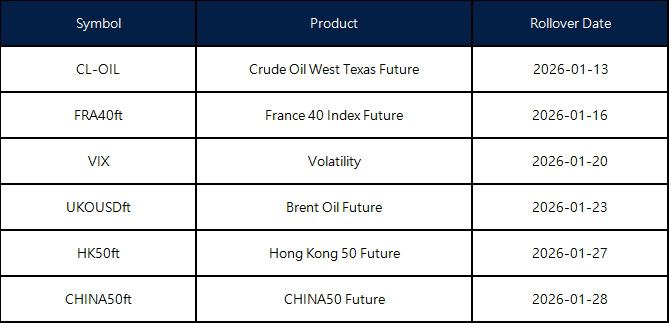
New contracts will automatically be rolled over as follows:
Please note:
• The rollover will be automatic, and any existing open positions will remain open.
• Positions that are open on the expiration date will be adjusted via a rollover charge or credit to reflect the price difference between the expiring and new contracts.
• To avoid CFD rollovers, clients can choose to close any open CFD positions prior to the expiration date.
• Please ensure that all take-profit and stop-loss settings are adjusted before the rollover occurs.
• All internal transfers for accounts under the same name will be prohibited during the first and last 30 minutes of the trading hours on the rollover dates.
The above data is for reference only. The actual rollover date shall be subject to the Liquidity Provider’s determination.
If you’d like more information, please don’t hesitate to contact [email protected]
Dividend Adjustment Notice – Jan 13 ,2026
Dear Client,
Please note that the dividends of the following products will be adjusted accordingly. Index dividends will be executed separately through a balance statement directly to your trading account, and the comment will be in the following format “Div & Product Name & Net Volume”.
Please refer to the table below for more details:
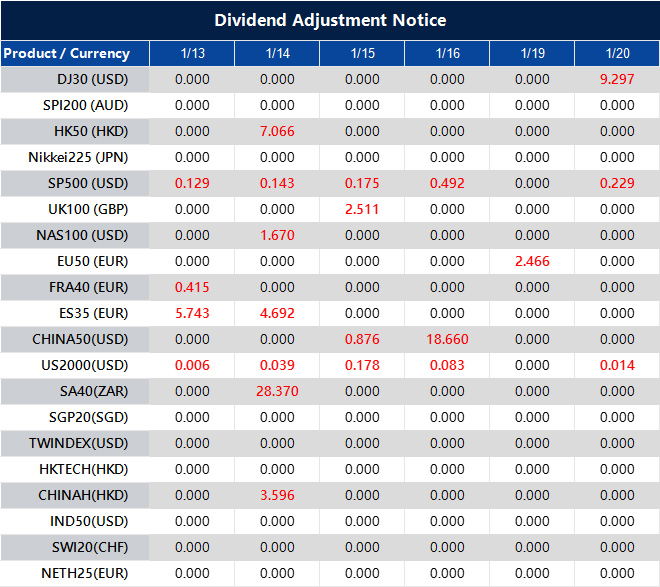
The above data is for reference only, please refer to the MT4/MT5 software for specific data.
If you’d like more information, please don’t hesitate to contact [email protected].
Gold prices in India showed little change today, remaining generally stable according to compiled data.
Gold prices in India stayed stable on Tuesday, according to FXStreet data. The price per gram was INR 13,367.03, slightly up from INR 13,354.78 on Monday.
The price for gold per tola reached INR 155,910.10, a modest change from INR 155,767.50 the day before. These prices are based on international rates adjusted to local currency and units.
Gold As A Safe Haven
Gold has historically served as a reliable store of value and a medium of exchange. It is seen as a safe-haven asset and helps protect against inflation and currency decline because it is not linked to any government. Central banks, looking to strengthen their economies, are the biggest holders of gold. In 2022, they bought 1,136 tonnes valued at about $70 billion, marking the highest annual purchases on record. Gold prices move in the opposite direction of the US Dollar and US Treasuries. A rising stock market may lower gold prices, whereas market declines often increase them. Several factors affect gold prices, including geopolitical instability and interest rates. Generally, when the US Dollar weakens, gold prices go up, and when the Dollar is strong, gold prices tend to fall. Gold prices are currently stable, but we see this as a period waiting for the next big move. A major factor to follow is the U.S. Federal Reserve’s decision to cut interest rates by 25 basis points in December 2025—the first reduction in over two years. This change suggests a new environment for non-yielding assets like gold.Market Positioning And Strategy
Since that decision, the US Dollar Index has weakened, falling from around 105 in late 2025 to about 101.80 this month. Recent U.S. inflation data showed a drop to 2.9%, but it had remained above 3.5% for most of last year, supporting gold as a protective asset. Derivative traders should prepare for continued dollar weakness, expecting at least two more rate cuts by July. Strong demand from central banks supports gold prices, as purchases remained high throughout 2025. Following a trend of adding over 1,000 tonnes to reserves in both 2023 and 2024, last year saw aggressive buying from emerging economies. This steady demand helps maintain price stability even during significant dips. In this context, implied volatility in the options market is relatively low, indicating some market complacency. This presents an opportunity to buy medium-term call options expiring in April or May 2026 to potentially benefit from upward movements. This approach allows traders to prepare for a price rally with limited risk. Additionally, we cannot overlook the ongoing geopolitical risks that have persisted into late 2025, particularly involving key shipping routes. Any resurgence of global tensions could lead to a rush for safety, significantly benefiting gold. This risk factor adds another potential catalyst that isn’t fully factored into the current stable prices. Create your live VT Markets account and start trading now.Recent market data shows that gold prices have increased in Malaysia.
Gold prices in Malaysia rose on Tuesday, according to FXStreet. The price per gram went up to 599.64 Malaysian Ringgits (MYR) from MYR 599.04 the day before.
The cost per tola increased to MYR 6,994.10 from MYR 6,987.04. A troy ounce of gold is now priced at MYR 18,650.91. FXStreet updates these prices daily, using international USD/MYR rates to inform local costs.
Gold As A Safe Haven Asset
Gold has long been valued as a medium of exchange and remains a popular safe-haven asset. Central banks are among its biggest holders; they bought 1,136 tonnes in 2022 to diversify their reserves. Gold’s value often rises when the US Dollar and Treasuries decline. It serves as a hedge during economic uncertainty or inflation. Gold prices can also be affected by interest rates and geopolitical stability. Lower interest rates usually increase gold’s appeal, while a strong US Dollar may keep prices down. Additionally, geopolitical tensions can raise gold prices due to its safe-haven status. The recent small increase in gold prices to nearly 600 MYR per gram highlights a positive trend. It’s not just about today’s price, but also about its role in the larger economic picture. This steady rise shows strong market foundations, suggesting that traders should prepare for this momentum.Central Bank Accumulation
Gold is performing as a traditional safe-haven asset, especially with weak global manufacturing PMI data from the fourth quarter of 2025 and ongoing geopolitical issues. Such uncertainty is likely to create more volatility, making long-dated call options a good way to benefit while managing risk. We think the market is currently underestimating the chances of a significant risk-off event in the first half of this year. We also see the consistent accumulation of gold by central banks, a trend that began in earnest in 2022 and continues to grow. After record purchases in 2023 and 2024, central banks added another 950 tonnes to their reserves in 2025, ensuring strong demand. This creates a solid price foundation, making short selling or selling uncovered calls very risky. Right now, the outlook for interest rates is crucial. The U.S. Federal Reserve has indicated a shift away from its previous tightening. Market expectations now suggest a 75% chance of at least one rate cut by the third quarter of 2026. As a non-yielding asset, gold becomes more attractive when interest rates are set to drop. This expectation is also weakening the U.S. Dollar, a key factor in gold’s strength. The Dollar Index (DXY) has been trading below 102, which is significantly lower than previous highs. This negative correlation offers strong support for gold. In this environment, strategies like bull call spreads can help us take advantage of a steady rise in gold prices. Create your live VT Markets account and start trading now.EUR/USD declines to around 1.1660 after modest gains, showing bearish momentum
Eurozone Economic Indicators
Resistance is found at the 50-day EMA of 1.1679, which is close to the nine-day EMA at 1.1681. If the daily price closes above these levels, we could see renewed momentum, targeting 1.1808 and possibly 1.1918, highs last reached in December 2021. The Euro, used by 20 EU countries, is the second most traded currency in the world. The European Central Bank (ECB), based in Frankfurt, influences the Euro’s value through interest rates and monetary policy. Inflation and key economic reports, like GDP and PMI data, also affect the Euro. Additionally, a positive Trade Balance can help boost the currency’s strength. Currently, the EUR/USD pair appears to be bearish, trading below crucial moving averages near 1.1680. The Relative Strength Index (RSI) is not yet oversold, indicating there may still be potential for a short-term decline. This scenario favors strategies that benefit from a drop, with an initial target set at the 1.1589 low from last December. The recent economic data supporting the US Dollar adds to this bearish outlook. The latest US Non-Farm Payrolls report, released on January 2nd, showed job growth significantly exceeding expectations, enhancing confidence in the US economy. In contrast, last week’s German Industrial Production figures for November 2025 fell short of predictions, raising concerns about slowing growth in the Eurozone’s largest economy.Derivative Trading Strategies
For those trading derivatives, it might be wise to consider buying put options with strike prices at or below 1.1600. Options that expire in late January or February could allow sufficient time for the trade to reach the 1.1589 support level. Selling call options or creating bear call spreads with a strike above the 1.1700 resistance could also be effective for gathering premium while holding a bearish stance. It’s important to manage the risk of a market reversal. While the uptrend is weakening, it is not completely broken. A daily close above 1.1681 would challenge the current bearish outlook and may lead to a squeeze. Setting alerts at this resistance level is key for traders to modify or exit their short positions if necessary. Looking back to mid-2022, we noted a similar decline in momentum when the EUR/USD struggled to stay above its 50-day moving average, leading to a sustained drop. This historical pattern suggests that, if downward momentum strengthens below these key averages, it could lead to significant follow-through. If we break the 1.1589 level, the next crucial support to watch would be the 1.1468 low from last August. Create your live VT Markets account and start trading now.Silver price nears all-time high during early European trading amid Fed uncertainty
Silver is currently trading around $85.75, supported by uncertainty about the US central bank and ongoing geopolitical tensions. Traders are flocking to safe-haven metals as the Fed could be pressured to lower interest rates. Fed Chair Jerome Powell mentioned the involvement of the US Department of Justice, which might impact market trends.
Geopolitical tensions could also raise Silver’s value, especially as protests in Iran create concerns. These developments, combined with the upcoming US December CPI inflation data, could greatly affect Silver’s future. If the CPI is higher than expected, it might strengthen the US Dollar, potentially affecting Silver’s short-term performance.
Silver is a favored precious metal for diversifying portfolios. Its price is affected by many factors, including political instability, interest rates, and the movements of the US Dollar. A strong Dollar can lower Silver prices, while a weaker Dollar could elevate them.
The industrial demand for Silver is crucial, with heavy reliance in sectors like electronics and solar energy. Global economic trends, particularly in the US, China, and India, can cause price changes. Silver often follows Gold, as both are seen as safe-haven assets and assessed using the Gold/Silver ratio.
With current uncertainties, we should expect significant fluctuations in silver prices, which are approaching record highs near $85.75. The immediate focus is on today’s US December CPI inflation report, as this will be a key factor. A lower-than-expected CPI could lead to new all-time highs, while a higher number may strengthen the Dollar and trigger a sharp pullback.
The ongoing political pressure on the US Federal Reserve is a strong bullish factor that we believe will support silver in the coming weeks. This threat to the central bank’s independence is increasing expectations of earlier interest rate cuts, which could weaken the Dollar and support non-yielding assets like silver. We see this shift as a possibility to maintain prices at these elevated levels for a while.
Current market data shows heightened awareness, with the Silver Volatility Index (VXSLV) reaching levels not seen since early 2025 during regional banking stress. Additionally, the CME FedWatch tool indicates nearly a 70% chance of a rate cut by March, up from 40% a month ago. This suggests traders are positioning for a more accommodating Fed policy due to the new political pressures.
Apart from financial market changes, strong industrial demand offers a solid price floor for silver. Reports for 2025 indicate global industrial silver consumption rose over 4%, mainly driven by increased use in solar panel and electric vehicle production. This strong demand, alongside safe-haven investments due to geopolitical risks like unrest in Iran, creates a positive environment for silver.
Given these considerations, managing risk through options is wise for the coming weeks. We believe buying long-dated call options or call spreads allows for potential gains above the record high while controlling downside risk ahead of the CPI data. The gold-to-silver ratio is around 75:1, which is historically high. This suggests that silver may still have room to appreciate compared to gold if this rally continues.
NZD/USD pair nears 0.5800 during Asian hours following gains in business confidence
NZD/USD Rises with Stronger New Zealand Business Confidence
The NZD/USD pair is trading around 0.5780 during Tuesday’s Asian hours, gaining support from an increase in Business Confidence, which rose from 18% last quarter. Traders are now looking ahead to upcoming US CPI data for insights into Fed policy, as the US Dollar also ticks higher.
Markets are expecting two rate cuts from the Federal Reserve in 2025, beginning in June, unless inflation unexpectedly rises. The December Nonfarm Payrolls data fell short of expectations, reinforcing a dovish outlook for the Fed. Currently, Fed funds futures show a 95% chance that rates will remain unchanged during the meeting on January 27–28.
Traders are cautious due to concerns about Fed independence and ongoing legal issues concerning Fed Chair Jerome Powell. Additionally, an expected US Supreme Court ruling on President Trump’s tariffs adds uncertainty.
Impact on the New Zealand Dollar
The value of the New Zealand Dollar is shaped by the domestic economy, RBNZ policies, and external factors like the Chinese economy and dairy prices. Positive economic data and global market sentiment also play a role in NZD/USD movements.
The strong New Zealand business confidence survey from the fourth quarter of 2025 revealed the highest levels since 2014. This data gave the Kiwi a significant boost, setting a positive tone for the NZD/USD pair as we started the new year. New Zealand’s economic recovery seems to be picking up speed faster than anticipated.
Pending US inflation data for December 2025 came in slightly above expectations at 3.3% year-over-year. This creates a mixed picture in the market, especially compared to the weaker Nonfarm Payrolls report from that same month. This has tempered some aggressive bets on early Federal Reserve rate cuts that were building at the end of last year.
This disparity in economic surprises hints at a change in outlook for central bank policies. The Reserve Bank of New Zealand may have less incentive to cut rates, given the domestic strength. Recent Global Dairy Trade auctions in early January 2026 showed prices rising by over 3%. Meanwhile, the Fed may need to hold off on easing, with market expectations now suggesting the first cut is more likely in the third quarter instead of June.
Trading Opportunities and Risk Management
For traders, this presents an opportunity to position for NZD strength against the USD. Consider buying NZD/USD call options expiring in March or April 2026 to take advantage of New Zealand’s positive momentum. A target strike price around 0.5950 seems reasonable, allowing for potential appreciation as the situation evolves.
To manage risk, keep an eye out for any signs of a global risk-off sentiment or a more hawkish stance from the Fed. Hedging long positions by purchasing shorter-dated put options with a strike near 0.5700 can protect against sudden pullbacks. This strategy allows us to maintain a bullish outlook while safeguarding the portfolio from unexpected strength in the US dollar.
Create your live VT Markets account and start trading now.







