
Back

Gold retains gains in Europe, but fresh US dollar demand and hawkish banks curb further advances

Gold held a mild upward tone in early European trade on Friday, but gains were limited as the US Dollar strengthened. Markets reacted to news that Donald Trump delayed strikes on Iran’s energy assets and extended the deadline to reopen the Strait of Hormuz to 6 April, then attention shifted as peace-talk messages conflicted. Traders now expect major central banks, including the Federal Reserve, to keep policy tight as higher energy prices add to inflation worries. Markets have removed expectations of further Fed rate cuts and have increased pricing for a rate rise by the end of the year, lifting US Treasury yields and supporting the Dollar, which can weigh on non-yielding gold.

Geopolitical Headlines And Dollar Demand

Headline risk from the US-Iran dispute remained, with Trump saying Iran was seeking a deal while Iranian officials denied talks and rejected the chance of an agreement. Reports of extra US troop deployments also raised speculation about a ground operation, keeping safe-haven demand for the Dollar firm. Technically, gold remains under pressure after breaking below the rising 100-day SMA and failing near it this week. The MACD is negative, RSI is in the low-30s, resistance sits near $4,630 and $4,820, support is around $4,380 then the 200-day SMA near $4,120; $5,000 is in view only after a daily close above $4,820. Central banks often target about 2% inflation, cutting rates below that and raising rates when inflation is well above it. Higher rates tend to support the currency and can reduce gold demand, while the Fed funds rate is an overnight interbank range tracked by CME FedWatch. We are seeing gold struggle to gain any real traction, as the strong US Dollar continues to dominate markets. While geopolitical risks surrounding Iran would typically boost gold, right now they are mainly reinforcing the dollar’s safe-haven status, with the Dollar Index (DXY) hitting a fresh 12-month high of 107.50 earlier this week. This creates a significant headwind for the precious metal.

Rates Inflation And Gold Positioning

The approaching April 6th deadline for the Strait of Hormuz is causing significant tension, keeping energy prices high and fueling inflation concerns. Brent crude futures have remained elevated above $95 a barrel, and this sustained pressure supports the view that global central banks must maintain a hawkish stance. This environment makes it difficult for gold to sustain any rally. Looking back at the sentiment shift in 2025, we see a continuation of the market pricing in higher interest rates for longer. The CME FedWatch tool currently indicates a 75% probability of another 25-basis-point Fed rate hike by June, a stark contrast to the rate cut hopes we saw this time last year. With the 10-year US Treasury yield pushing 4.85%, the opportunity cost of holding non-yielding gold is simply too high for many investors. For derivative traders, this suggests that any bounces in the gold price should be viewed with skepticism. The area around the 100-day moving average, near $4,630, represents a significant resistance level where selling pressure is likely to resume. A strategy of buying put options on any show of strength towards that level could prove effective in the coming weeks. If gold fails to hold support at its recent low of around $4,380, it would reinforce the bearish trend and likely trigger a new wave of selling. A decisive break below this level would open a path toward the next major support zone at the 200-day moving average near $4,120. Given the fundamental backdrop, positioning for further downside seems more prudent than betting on a sustained recovery. Create your live VT Markets account and start trading now.

Start trading now – Click here to create your real VT Markets account
Patsalides says policymakers should avoid hasty monetary policy changes until the ECB has enough information

Christodoulos Patsalides, an ECB policymaker and Cyprus central bank governor, said there was no need to hurry with monetary policy changes until more information is available. He said the ECB does not yet have enough data to decide whether current developments should be ignored or should affect interest rate decisions. He said only two weeks have passed since the projections cut-off date. He said there has been no change in the duration or intensity of the war since then, and he described the situation as still in line with the baseline.

Waiting For More Data

He said decisions should not be made on gut feeling, and that more information is needed before acting. He also said he would not rush into any decision. The euro showed little response to the remarks. At the time of writing, EUR/USD was marginally lower near 1.1520. The ECB is the Eurozone’s reserve bank, based in Frankfurt, and aims to keep inflation at around 2% using interest rates. Monetary policy decisions are made eight times a year by the Governing Council, made up of national central bank heads and six permanent members, including President Christine Lagarde. Quantitative easing involves creating euros to buy assets such as government or corporate bonds, and it usually weakens the euro; it was used in 2009-11, 2015, and during the covid pandemic. Quantitative tightening ends net bond buying and stops reinvesting maturing principal, and it is usually supportive for the euro.

Market Implications Ahead

We are seeing that ECB policymakers are signaling a period of inaction. They are emphasizing a need for more data before considering any changes to interest rates. This suggests that for the next few weeks, we should not position for any surprise rate hikes or cuts. The latest flash estimate for Eurozone inflation is holding stubbornly at 2.4%, which is still above the central bank’s 2% target. At the same time, recent GDP growth forecasts have been revised down to a sluggish 0.1%, creating a difficult situation for policymakers. This conflict between sticky inflation and faltering growth explains the desire to wait for more clarity. This cautious stance is likely to dampen short-term interest rate volatility in the Eurozone. We see this reflected in the VSTOXX volatility index, which is hovering around 18, indicating underlying uncertainty but not immediate panic. Therefore, strategies that profit from a range-bound market, such as selling short-dated options straddles on currency pairs like EUR/USD, could be considered. The Euro is likely to remain directionless against the US Dollar, currently trading near 1.0850. With the ECB on hold, there is no immediate catalyst to push the currency significantly higher through interest rate differentials. This lack of a clear policy path from Frankfurt will likely keep the EUR/USD pair contained within its recent trading range. We remember the series of cautious rate cuts the ECB delivered through much of 2025 as inflation receded from its post-pandemic peaks. However, the current pause indicates that the easy part of the disinflationary process is over. This recent history suggests the bar for further policy moves, in either direction, is now considerably higher. Create your live VT Markets account and start trading now.

Start trading now – Click here to create your real VT Markets account

Following Trump’s Iran deadline extension to 6 April, oil steadied, retaining a geopolitical risk premium after pressures eased

Oil prices steadied after US President Donald Trump extended the Iran energy deadline to 6 April. This reduced near-term pressure but kept a geopolitical premium in prices. About 8 million barrels per day of supply is already offline. Oil flows through the Gulf remain vulnerable, so the risk of further supply disruption continues.

Regional Conflict Keeps Supply Risk Elevated

Attacks have continued on both sides, and the US has reportedly reinforced its military presence in the region. This has kept concerns about supply interruptions high. In LNG, a tropical cyclone forced production cuts at three Australian LNG plants. Together, these account for around 8% of global LNG supply. These LNG disruptions follow earlier shocks from the closure of the Strait of Hormuz. They also follow the shutdown of Qatar’s largest liquefaction facility after attacks, tightening supply and raising price pressure for Asian buyers. Oil prices have steadied after the US President extended the Iran energy deadline to April 6th, but we see this as a temporary pause. The risks for an upward price shock remain significant as the core geopolitical issues are unresolved. This extension takes some immediate heat out of the market, but the overall trend still points higher.

Market Implications For Oil And LNG Traders

The scale of supply at risk is massive, with millions of barrels already offline and the vast flows through the Gulf still vulnerable. We have seen Brent crude prices climb steadily through early 2026, recently touching over $90 a barrel, reflecting this persistent geopolitical premium. With continued regional attacks and a reinforced US military presence, we do not expect this premium to fade. We only need to look back to the market reaction in 2022 to understand how quickly geopolitical events can send prices soaring well above $100. The current tensions echo previous periods of instability, suggesting the market is under-pricing the risk of a sudden supply disruption. History shows that in these situations, volatility is the only guarantee. This energy crunch is not limited to oil, as the market for liquefied natural gas (LNG) is also under intense pressure. Supply risks have grown after a tropical cyclone forced cuts at Australian LNG plants, which account for roughly 8% of global supply. This comes on top of the attacks and facility shutdowns that disrupted Qatari exports last year, further tightening the market. These disruptions are directly impacting prices for major Asian buyers who depend on these supplies. We have seen Asian JKM spot prices rise more than 15% in the last month alone, reflecting the growing fear of a supply shortage ahead of peak demand seasons. The market is fragile, and any further supply shock could cause a dramatic price spike. For derivative traders, this environment suggests positioning for upward volatility in the coming weeks. We believe purchasing long-dated call options or establishing bull call spreads on WTI and Brent futures could be a prudent way to capture potential upside. These strategies offer a defined-risk way to profit from the sudden price spikes that seem increasingly likely. Create your live VT Markets account and start trading now.

Start trading now – Click here to create your real VT Markets account

Spain’s annual HICP inflation undershot forecasts, easing to 3.3% versus the expected 3.9%

Spain’s Harmonised Index of Consumer Prices (HICP) annual rate came in at 3.3% in March. This was below the expected rate of 3.9%. The data indicates that consumer price growth eased compared with forecasts. The release provides an updated measure of inflation across Spain using the HICP standard.

Dovish Signal For The ECB

The lower-than-expected Spanish inflation figure of 3.3% is a significant dovish signal for the European Central Bank. This data suggests that price pressures in the Eurozone may be easing faster than markets had priced in. It immediately leads us to believe the ECB will have less pressure to maintain its restrictive monetary policy. This soft inflation print challenges the ECB’s recent messaging, which has been focused on waiting for conclusive evidence that inflation is returning to its 2% target. Looking back at 2025, we saw the central bank hold rates steady throughout the year, and this new data could accelerate the timeline for the first rate cut. The market is now likely to increase its bets on a cut happening as early as the June meeting. For interest rate traders, this points towards positioning for lower rates through instruments like EURIBOR futures. We are seeing the December 2026 three-month EURIBOR futures contract already pricing in an additional 10 basis points of cuts this morning. This environment makes receiving fixed payments in interest rate swaps an increasingly attractive trade. Lower rate expectations are typically bullish for equities, as they reduce borrowing costs and boost valuations. Therefore, we should consider buying call options on European indices like the Euro Stoxx 50 or Spain’s IBEX 35. A recent poll of fund managers showed a growing allocation to European stocks, and this inflation news will only strengthen that conviction.

Implications For The Euro

A more dovish ECB makes the Euro less attractive, especially as the US Federal Reserve signals it will hold rates steady. We anticipate a move lower in the EUR/USD exchange rate from its current level near 1.0950. Traders should look at buying put options on the EUR/USD, as data shows that one-month risk reversals are already showing a stronger bias for Euro puts. Create your live VT Markets account and start trading now.

Start trading now – Click here to create your real VT Markets account

DBS analysts say conflict-driven safe-haven flows and higher oil prices have paused the dollar’s wider decline

DBS analysts Philip Wee and Chang Wei Liang argue the US dollar’s broader downtrend has paused, supported by conflict-driven demand for safe assets and higher oil prices, while warning that doubts about Federal Reserve independence and US fiscal sustainability remain key risks. They describe a temporary geopolitical support level for the dollar tied to “Operation Fury” and say elevated oil prices have delayed a “USD mutiny.”

Allied Rift And Reserve Status

They note the US-Israel strikes were conducted without wider consultation and that some G7 allies have not provided naval support, citing France, Germany, and Italy, which they frame as a move away from the American security umbrella. They link US isolation and renewed global inflation pressure to a potential Strait of Hormuz closure, arguing this has pushed market participants to reassess US Treasury bonds as a truly risk-free asset. They add that once oil flows resume, capital may rotate toward currencies with stronger fundamentals; the article also notes it was produced with the help of an AI tool and reviewed by an editor. We have seen the predicted war-driven haven demand play out in recent months, lifting the Dollar Index toward multi-year highs near 115 as Brent crude topped $140 a barrel in January, but that temporary geopolitical floor now appears to be weakening as the USD pulls back toward 110 with diplomacy cautiously reopening and supply concerns easing.

Positioning For A Dollar Reversal

The underlying structural risks identified earlier are becoming more visible in capital flows, with Treasury data for January 2026 showing a $50 billion net outflow from foreign official accounts—the largest since the 2020 pandemic scare—signaling growing investor reassessment of US debt amid fiscal sustainability concerns. The unilateral nature of US actions in late 2025 has widened rifts among allies, and last week’s G7 finance ministers’ statement omitted any mention of coordinated policy support, a notable break from historical precedent that underscores a weakening of the dollar’s standing as the unquestioned global reserve. Given this setup, traders could consider positioning for a reversal of the dollar’s recent strength, for example by buying out-of-the-money put options on the USD Index (DXY) with 3- to 6-month expirations as a defined-risk way to express a bearish view. Opportunities may also emerge in currencies with stronger fundamentals that were suppressed by the dollar rally, including call options on EUR/USD alongside resilient Eurozone PMI data, and potentially shorting USD/JPY via futures if a global risk-on turn drives broad USD weakness versus the yen. Create your live VT Markets account and start trading now.

Start trading now – Click here to create your real VT Markets account

After four losing sessions, AUD/JPY recovers towards 110.20, yet remains bearish within a descending channel

AUD/JPY edged higher after four days of losses, trading near 110.20 during European hours on Friday. The daily chart points to a bearish bias, with price moving lower inside a descending channel. The pair pulled back from around 113.00 and moved below its nine-day Exponential Moving Average (EMA). It remains above the rising 50-day EMA, which suggests the broader uptrend is still in place.

Technical Momentum Signals

The 14-day Relative Strength Index (RSI) has eased towards the mid-40s after leaving overbought territory. This signals weaker upside momentum and the potential for consolidation or a retracement. Support is seen at the lower channel boundary near 109.80, then the 50-day EMA at 109.67. A further drop could open the way to the psychological level at the seven-week low of 107.73. On the upside, resistance sits at the nine-day EMA near 111.00 and the upper channel boundary around 112.10. A break above the channel could lift AUD/JPY towards the all-time high of 113.96, set on 11 March. Looking back at the analysis from March 2025, we saw the AUD/JPY pair trading in a descending channel around 110.20. That period of consolidation was important, as the key support near the 50-day EMA was tested but ultimately held. This confirmed the broader uptrend remained intact for much of the rest of that year.

Macro Policy Divergence

The environment has shifted significantly since we looked at those charts in 2025. The Bank of Japan is no longer a passive player, having signaled a clear move away from its ultra-loose policy late last year. With Japan’s core inflation holding at 2.8% in February, expectations are growing for another rate hike, which will likely add strength to the Yen. On the other side, we see the Reserve Bank of Australia holding its cash rate steady at 4.35% for the fifth consecutive meeting, suggesting policy has peaked. This policy divergence, where Japan is tightening while Australia is on hold, fundamentally caps the upside for the AUD/JPY cross. We believe this pressure will keep the pair from revisiting the highs we saw in early 2025. For the coming weeks, we are considering buying put options to hedge against or profit from a potential downturn. This strategy allows us to define our risk while gaining exposure to downside movement driven by a stronger Yen. We see value in puts with strike prices below the current support levels, targeting a move back toward the 108.00 handle. Alternatively, for those holding long positions, we think selling out-of-the-money call options is a prudent strategy to generate income. With the fundamental picture limiting significant upward momentum, collecting premium from calls with strike prices near last year’s highs around 113.00 could enhance returns. This approach benefits from the expected range-bound price action in the near term. Create your live VT Markets account and start trading now.

Start trading now – Click here to create your real VT Markets account

During sell-offs, companies fall together; quality stocks stand out through fundamentals, not mere price weakness

In a market sell-off, prices often fall across the board, so screening can help separate weaker prices from weaker businesses. The aim is to find firms that can still grow, protect margins, generate cash, and fund operations without strain. The screen used large, liquid shares: US-listed firms above USD 25 billion in market value, and firms in Western Europe, Asia, and Canada above USD 10 billion. It then filtered for a 52-week high change below 20 and 5-year revenue CAGR above 10.

Quality And Balance Sheet Filters

It required operating margin above 20, return on invested capital above 10, and return on common equity above 15. It also set free cash flow yield above 2% (US) and above 4% (non-US), plus net debt to EBITDA below 2. Valuation checks were forward 12-month P/E below 25 and forward 12-month PEG below 1.5. The US screen narrowed to 8 names: Nvidia, Microsoft, Meta Platforms, Micron Technology, AppLovin, Newmont, Adobe, and Autodesk. The non-US screen narrowed to 10 names: Novo Nordisk, Zijin Mining Group, Barrick Mining, Pop Mart International, Experian, Kinross Gold, Pan American Silver, Evolution Mining, Genmab, and Endeavour Mining. The output is a shortlist for further research, not a decision tool. The market’s recent 15% pullback from the January highs has pushed the CBOE Volatility Index (VIX) above 28, creating a nervous environment for the coming weeks. In times like these, we should not treat all falling stocks the same. This sell-off creates opportunities if we can separate strong businesses whose prices are temporarily weak from businesses that are fundamentally weaker.

Using Volatility To Express Views

Companies like Nvidia and Microsoft are seeing their implied volatility rise with the market, which makes selling their options premiums more attractive. We saw how these companies protected their strong operating margins above 20% throughout the 2025 consolidation, giving us confidence now. Selling cash-secured puts on these names could be a way to either collect rich premium or acquire quality assets at a further discount if the market falls more. The key is to focus on relative strength rather than trying to call the absolute bottom for the market. Data from the last major downturn in 2022 showed that companies with high returns on capital and low debt fell significantly less than the broader Nasdaq 100 index. This suggests using options to bet on these quality names outperforming weaker peers or the index itself. The non-US list highlights a different kind of quality, with names like Novo Nordisk and Barrick Gold. With the February 2026 inflation print coming in hotter than expected at 3.8%, there is a renewed case for owning businesses with pricing power or exposure to hard assets. Call options on gold miners can serve as an effective hedge if these inflation fears continue to drive the sell-off. We must pay close attention to the balance sheet filter, keeping net debt to EBITDA below 2. The recent credit tightening from central banks means highly leveraged companies are at much greater risk of financing stress. This makes them poor candidates for long positions and potentially attractive targets for bearish option strategies. Even with quality names, valuation discipline is critical, which is why the forward P/E filter is important. Selling puts on a high-quality name is a less risky strategy if its valuation has already compressed significantly from its highs. We are not looking for the most beaten-down stocks, but rather the strongest businesses that are now trading at more reasonable prices. Create your live VT Markets account and start trading now.

Start trading now – Click here to create your real VT Markets account

Weekly Dynamic Leverage Schedule Notification  – Mar 27 ,2026

Dear Client,
To ensure fair trading conditions and manage market volatility during major economic announcements, VT Markets will apply temporary leverage adjustments on certain trading products during specific news periods and market opening/closing.
These adjustments are designed to protect clients from abnormal market fluctuations, sudden liquidity changes, and extreme price movements that may occur during high-impact news releases.

1.Products Affected

The temporary leverage adjustment may apply to the following products:
• Forex
• Gold
• Silver
• Oil
• Indices
• Commodities (including XPT and XPD)

2. Adjusted Leverage During News Releases and Market Opening/Closing

During the specified news period, maximum leverage will be adjusted as follows:
Forex: 200
Gold: 200
Silver: 50
Oil: 20
Indices: 50
Commodities: 5

Please note that each product with leverage already below the above will not be affected.

3. News Events That Can Trigger the Adjustment

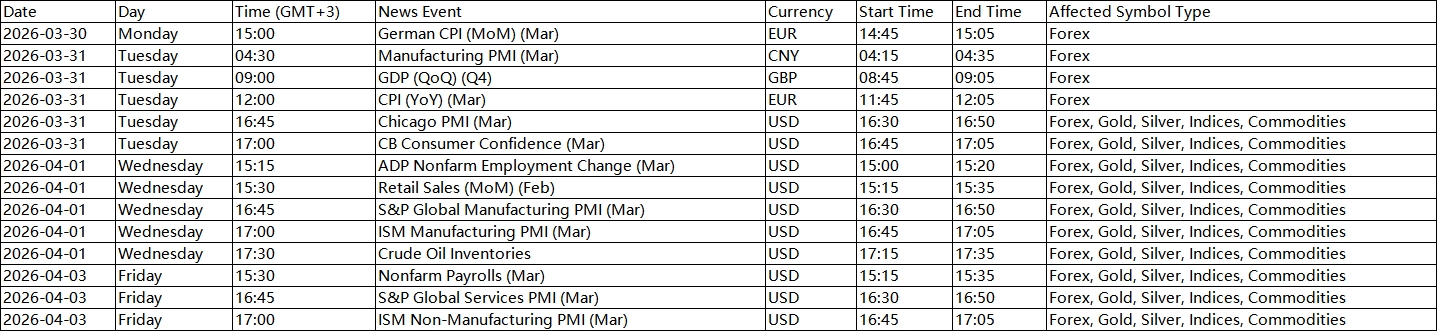
Leverage adjustments may be applied during major economic announcements including:
• FOMC Interest Rate Decisions
• CPI (Consumer Price Index)
• GDP
• PMI / NMI
• PPI
• Retail Sales
• Non-Farm Payroll (NFP)
• ADP Employment Data
• Crude Oil Inventories

The above data is for reference only. Other significant macroeconomic releases from major economies may also be included.

Please refer to the table below for details of the upcoming events and affected instruments:

All dates and times are stated in GMT+3 (MT4/MT5 server time).

4. Affected Period of News Releases and Market Opening/Closing

Temporary leverage adjustments apply during the following periods:
Economic News Period
• 15 minutes before the announcement
• 5 minutes after the announcement
Market Opening / Closing Period
• 3 hours before the weekly market closing (Friday)
• 30 minutes after market reopening (Monday)
• 30 minutes before daily market closing (Monday – Thursday)

After the above period ends, leverage will automatically return to the original leverage.

5. Important Rules

• The adjustment only affects new positions open during the adjustment period.
• Positions opened before the adjustment period will not be affected.
• Once the adjustment period ends, original leverage will resume automatically.

We strongly encourage clients to take these temporary leverage adjustments into account when planning trading strategies during high-impact economic events.
If you have any questions, please contact our support team: [email protected].

Danske expects Norges Bank’s hawkish 4.00% hold to bolster NOK, projecting two hikes, 2027 cuts

Norges Bank held its key policy rate at 4.00%. Committee records showed debate over an immediate rise versus waiting for more inflation data. The published rate path was raised by 20–45bp. The new forecast includes two 25bp hikes in June and September, followed by four 25bp cuts in 2027 and one 25bp cut in 2028.

Market Reaction And Immediate Impact

EUR/NOK dropped and briefly reached 11.10 after the decision and guidance. It then partly reversed as weaker equities weighed on the Norwegian krone. Looking back at the hawkish hold in late 2025, we see that subsequent data has only reinforced that view. Core inflation has remained stubbornly above target, with the February 2026 print coming in at 4.2%. This validates the central bank’s upward revision of its rate path and makes the forecasted June rate hike highly probable. This creates a clear policy divergence with the European Central Bank, which continues to signal a more cautious, data-dependent approach with potential cuts later in the year. As a result, the interest rate differential between Norway and the Eurozone is set to widen further. This policy gap is a primary driver for expecting renewed Norwegian Krone strength. For derivatives traders, this points towards positioning for a lower EUR/NOK in the coming weeks leading up to the June meeting. Buying EUR/NOK put options with June or July expiries could be an effective way to capitalize on the expected move. This strategy allows for defined risk while targeting levels below the 11.10 mark seen briefly in 2025.

Key Risks And Positioning Considerations

We must, however, remain mindful of the risk factors that caused the NOK’s reversal back in 2025. A significant downturn in global equity markets, or a sharp fall in Brent crude prices from their current stable position above $85 per barrel, could easily overwhelm the positive rate differential story. Therefore, monitoring broader risk sentiment is crucial when structuring any NOK-long positions. Create your live VT Markets account and start trading now.

Start trading now – Click here to create your real VT Markets account

Investors anticipate prolonged Iran conflict, lifting WTI above $93.50 as crude recovers earlier losses in Europe

Crude Oil prices recovered above $93.50 per barrel at the start of Friday’s European session. The US benchmark WTI continued its two-day rise and moved towards $100 amid expectations that the Iran war may not end soon. WTI fell to $88.93 during Thursday’s US session after reports that Iran allowed 10 oil tankers to pass. Prices later rebounded during Friday’s Asian session as fighting continued.

Iran Conflict Keeps Oil Bid

US President Trump extended the deadline to attack Iran’s energy sites into April. Reports on negotiations remained mixed, with the US saying talks are going “very well” and Iranian leaders saying they await a US response to ceasefire conditions. Israel reported intercepting missiles from Iran overnight. Israel also carried out air strikes on targets in Beirut and Tehran. The Wall Street Journal reported that the Pentagon is considering sending 10,000 additional troops to the Middle East. A longer conflict and continued disruption risks could keep Oil prices near $100 or higher for most of 2026, alongside concerns about the Strait of Hormuz remaining closed. The fading hope for a swift end to the Iran war suggests we should maintain a bullish bias on crude oil. We see traders positioning for a move towards, and beyond, the psychological $100 level by buying call options for May and June 2026 contracts. This view is strengthened by the latest Energy Information Administration report, which showed a larger-than-expected crude inventory draw of 4.2 million barrels, signaling tight underlying supply.

Options Strategies In High Volatility

The constant contradictory headlines are creating significant price swings, which is pushing implied volatility on oil options to its highest levels since the initial conflict began in late 2025. This environment makes buying simple call or put options very expensive. Therefore, we believe using debit or credit spreads is a more prudent way to express a directional view while managing the high costs associated with this volatility. We remember how prices surged in 2022 following the invasion of Ukraine, with WTI briefly touching over $130 per barrel on fears of supply disruption. The current military escalation and the potential for a full ground invasion mirror the conditions that created that historic price spike. The market is pricing in a similar “war premium,” which is likely to expand significantly if the additional 10,000 U.S. troops are confirmed for deployment. The most critical factor remains the Strait of Hormuz, through which about a fifth of the world’s oil passes. Recent maritime intelligence data shows that tanker insurance premiums for the region have tripled in the last month, and traffic is down nearly 40% from pre-conflict levels. Any direct confrontation in this chokepoint would immediately threaten the physical supply of millions of barrels and could send prices well north of $120 almost instantly. Create your live VT Markets account and start trading now.

Start trading now – Click here to create your real VT Markets account

Back To Top
server

Hello there 👋

How can I help you?

Chat with our team instantly

Live Chat

Start a live conversation through...

  • Telegram
    hold On hold
  • Coming Soon...

Hello there 👋

How can I help you?

telegram

Scan the QR code with your smartphone to start a chat with us, or click here.

Don’t have the Telegram App or Desktop installed? Use Web Telegram instead.

QR code

