



Turkey’s current account balance in November was worse than expected, reaching a deficit of $3.996 billion.
Turkey’s current account balance for November showed a deficit of $3.996 billion, which is higher than the expected $3.3 billion. This situation raises concerns about Turkey’s economy, which is facing increasing external pressures.
The current account balance is key to understanding economic health. It reflects the difference between exports and imports. A growing deficit indicates more reliance on borrowing from abroad, which can weaken Turkey’s financial stability.
Australian dollar weakens against the US dollar as consumer confidence drops
The Australian Dollar fell against the US Dollar after Westpac Consumer Confidence dropped by 1.7% in January, reaching a three-month low of 92.9. This follows a steep 9.0% decline in December due to shifting expectations for interest rates.
In December, ANZ Job Advertisements in Australia decreased by 0.5%, following a revised 1.5% drop from the previous month. Meanwhile, household spending increased slightly by 1.0% in November. The policy outlook from the Reserve Bank of Australia (RBA) remains unclear, with mixed CPI results for November. Deputy Governor Andrew Hauser mentioned that inflation data met expectations, making interest rate cuts unlikely.
The US Dollar Steady Amid CPI Data
The US Dollar Index remained stable around 98.90, waiting for December’s CPI data for guidance on Federal Reserve policy. Recent US Nonfarm Payrolls saw a modest rise of 50,000, while the unemployment rate fell to 4.4%. Average hourly earnings increased by 3.8% year-over-year. AUD/USD traded near 0.6710, with signs of upward movement. The Relative Strength Index supports this at 60.55. Immediate support is at the nine-day Exponential Moving Average (EMA) of 0.6705, and further declines may test the 50-day EMA at 0.6634. The forex market’s movement depends on interest rates, resource prices like Iron Ore, and trade balances, which all affect the Australian Dollar’s strength. There are clear signs of a slowing Australian economy. Consumer confidence has hit a three-month low and job advertisements have declined for two straight months. With the RBA unlikely to lower rates soon, attention turns to the quarterly CPI report due on January 31. If inflation is lower than expected, it could pressurize the RBA’s firm stance and hurt the Australian Dollar.US Dollar Holds Strong Amid Inflation Concerns
The US Dollar remains strong ahead of the important US Consumer Price Index data, set to be released today. Recent figures show US Nonfarm Payrolls for December 2025 were softer than expected at 50,000, but an unexpected rise in the annual inflation rate to 3.5% complicates predictions of two Fed rate cuts this year. This higher inflation makes the US Dollar more appealing in the short term. External factors are also impacting the Australian Dollar. Iron ore prices, a significant export for Australia, fell in the last quarter of 2025 from around $125 to $115 per tonne. Additionally, China’s official Manufacturing PMI for December 2025 was 49.8, marking three consecutive months of contraction and indicating weaker demand from Australia’s largest trading partner. From a technical point of view, the AUD/USD pair is hovering just above the critical nine-day EMA support at 0.6705. Although the pair remains in a broader uptrend channel, negative economic data and a stronger US Dollar suggest this support may be at risk. A significant drop below this level could lead to a swift move towards the 50-day EMA at 0.6634. Considering the mixed technical signals and the major event risk from inflation data in both countries, implied volatility is likely to rise. Traders should explore strategies that can benefit from large price moves, such as buying options straddles. This lets them capitalize on potential breakouts in either direction once the market reacts to the upcoming inflation reports. Create your live VT Markets account and start trading now.GBP/USD pair strengthens above 1.3450 and approaches 1.3470 amid US dollar pressure
The GBP/USD pair has climbed to around 1.3470 in early European trading. Concerns about the independence of the US Federal Reserve are putting pressure on the US dollar. This comes after the US Department of Justice announced plans to potentially charge Fed Chair Jerome Powell due to his remarks about a renovation project.
Powell received subpoenas from the Justice Department regarding his comments about cost overruns on a $2.5 billion renovation at the Federal Reserve’s headquarters. He believes these actions are attempts to pressure the Fed into lowering interest rates, which raises questions about its independence and weakens the dollar.
Bank Of England’s Monetary Policy
The Bank of England (BoE) cut its interest rate to 3.75% in December and may lower it again by 2026. Analysts think the BoE could keep rates stable in February but might consider a 0.25% cut in March or April. Traders are closely watching the US Consumer Price Index (CPI) data set to be released later today. A forecasted 2.7% year-over-year increase could provide clues about future US interest rate movements. The Pound Sterling (GBP) is the oldest currency in the world and is greatly influenced by BoE policies. Economic reports, such as GDP and trade balance data, also impact its value, with a positive trade balance likely strengthening the currency. On January 13, 2026, the pressure on the US dollar due to concerns over the Federal Reserve’s independence is a key focus. The potential indictment of the Fed Chair represents significant political uncertainty, affecting the GBP/USD pair, which has gained strength above 1.3450 as a result.US Consumer Price Index And Its Impact
Traders should be ready for the US CPI data release later today, with expectations for a 2.7% year-over-year increase. The November 2025 figure was 2.9%, so a 2.7% reading would indicate a continuing disinflation trend. This could support the argument for Federal Reserve rate cuts later this year and lead to further dollar weakness. The combination of political uncertainty and important data is increasing implied volatility in GBP/USD options. A strategic approach in the next few days might involve using long straddles to take advantage of potential price swings, allowing traders to profit from significant moves in either direction without making a specific bet on the CPI report or the political situation. It’s also crucial to remember the Bank of England’s dovish stance, evidenced by its rate cut to 3.75% in December 2025. With UK unemployment rising to 4.5% in the last quarter, the central bank has solid reasons to consider further cuts in March or April. This economic weakness may limit any significant, long-term rallies for the pound. Given the current environment, short-term bullish strategies on GBP/USD may be beneficial due to the political challenges faced by the dollar. Buying near-term call options or call spreads could allow traders to capture potential upward movements following today’s news. However, we should remain cautious about the pound’s longer-term outlook given the weak economic situation in the UK. This scenario, in which political pressure is applied to the central bank, has historical parallels to events in the US during the 1970s. Those situations ultimately resulted in poor monetary policy and diminished long-term confidence in the currency. Consequently, while we navigate short-term fluctuations, we must monitor whether these threats to the Federal Reserve’s independence evolve into a more consistent concern. Create your live VT Markets account and start trading now.Minoru Kiuchi calls for quick parliamentary approval of Japan’s 2026 fiscal budget to boost the economy
Japan’s economy minister, Minoru Kiuchi, stressed the importance of quickly passing the 2026 fiscal budget in parliament. He assured that the government aims for responsible fiscal policy without reckless spending.
Market movements are influenced by various factors, including foreign exchange rates and long-term interest rates, not just fiscal policy. To prevent a return to deflation, sustaining wage growth will be essential. Japan has yet to fully emerge from deflation.
The Impact of Currency Interventions
At the time of writing, the USD/JPY rate rose by 0.45%, reaching 158.90. The Japanese Yen is affected by the Bank of Japan’s policies and the differences in bond yields with the US. The Bank of Japan often intervenes in currency markets to lower the Yen’s value for economic reasons. The shift away from ultra-loose monetary policy by the Bank of Japan has begun to help the Yen. Historically, the difference in bond yields between Japan and the US has affected the Yen. Recent policies have narrowed this gap. During market stress, the Yen is seen as a safe-haven investment, attracting more funds.The Outlook for Yen Traders
The government’s cautious approach emphasizes fiscal discipline while tackling the risk of deflation. As of January 13, 2026, officials have not declared victory over falling prices, indicating that the Bank of Japan will likely be slow to raise interest rates. This stance supports the ongoing weakness of the Yen. This policy keeps a significant interest rate gap between the US and Japan. Currently, the US 10-year Treasury yield is near 3.8%, while the Japanese 10-year government bond struggles to stay above 1.2%. This difference heavily favors the dollar and will continue to pressure the Yen until a significant change occurs from the Bank of Japan. For traders, this environment suggests that betting on Yen strength in the short term is risky. With USD/JPY nearing 158.90, derivative plays that benefit from the pair staying high or moving toward 160 seem attractive. This could involve purchasing near-term USD/JPY call options or structuring call spreads to reduce costs. However, we must remember what happened in late 2024 when the currency pair crossed the 160 mark, prompting direct market intervention from the Ministry of Finance. The likelihood of a quick reversal by officials is now much higher, making it risky to sell the Yen outright. With the potential for continued Yen weakness and the chance of sudden government intervention, volatility is the most certain trade. Implied volatility on Yen options has risen to a six-month high of 12.5%, indicating that the market anticipates significant movements. Strategies such as buying straddles or strangles, which profit from large price swings in either direction, should be considered in the coming weeks. The minister’s focus on sustainable wage growth highlights the upcoming catalyst. We will closely monitor the preliminary results of the “Shunto” spring wage negotiations, expected in mid-February, for signs of strength. If there are another year of wage gains below inflation, like in 2025, the Bank of Japan will have strong reasons to maintain its cautious approach. Create your live VT Markets account and start trading now.GBP/JPY breaks three-week range and hits 214.00, the highest since August 2008
GBP/JPY is gaining strength, hitting 214.00, the highest it’s been since August 2008, mainly due to a weaker Yen. Several factors are contributing to this, including uncertainty about the Bank of Japan, tensions with China, and discussions about a possible snap election in Japan.
Japan’s Prime Minister Sanae Takaichi might call a snap election to take advantage of her approval ratings, which adds to fears about fiscal policy. At the same time, global tensions are reducing demand for the Japanese Yen as a safe-haven currency.
Concerns About Yen Intervention
The Japanese Yen seems unresponsive to possible intervention by Japanese authorities aimed at preventing further decline. Finance Minister Satsuki Katayama has raised concerns about the Yen’s drop, but the Bank of Japan (BoJ) has maintained its stance, allowing the GBP/JPY to rise. The British Pound is benefiting from a decrease in US Dollar demand, keeping its outlook positive. A recent rise past the 212.15 level supports this, even though overbought signals indicate caution. People are eager to hear from Bank of England Governor Andrew Bailey regarding future interest rates. The Yen is sensitive to BoJ policies, bond yield differences, and overall market sentiment. Its value is influenced by economic performance, and its role as a safe-haven currency depends on current market conditions. The BoJ’s past policies, known for being ultra-loose, contributed to the Yen’s depreciation. The rise to 214.00 in GBP/JPY clearly shows significant Yen weakness, a trend that has been prominent since we wrapped up 2025. The Yen has already lost over 5% against the Pound in just the first two weeks of this year, suggesting upward movement is likely. Our strategy is to align with this strong upward trend.Impact of Policy Differences
This trend is solidly backed by the stark differences in policy between the Bank of Japan and the Bank of England. Last year, UK inflation remained above 3%, while Japan struggled to keep core inflation over 1%. This significant interest rate gap fuels carry trades, where we borrow in Yen to invest in higher-return Sterling assets. However, the Relative Strength Index (RSI) is now indicating overbought conditions, making direct long positions risky due to the potential for a sharp pullback. We see value in using derivatives, like buying call options, to stay invested in further gains while clearly setting our maximum loss. The high cost of these calls is a reflection of their demand, and it’s a price worth paying for effective risk management. It’s important to note that the last time GBP/JPY was at these levels was just before the 2008 financial crisis, when it plummeted from over 250 to below 120. Although the fundamentals are different now, this serves as a clear reminder of how quickly market sentiment can change. This historical context strengthens the case for using options instead of heavily leveraged positions. In the short term, we are cautious ahead of the US CPI inflation report coming out later today, as well as the upcoming speech from BoE Governor Bailey. These events could cause significant market fluctuations, possibly creating a better entry point with any temporary drop. We will be attentive to any shifts in the BoE’s tone regarding the expected two rate cuts this year. Create your live VT Markets account and start trading now.EUR/GBP hovers around 0.8650 as investors await UK GDP data and assess monetary policy
The EUR/GBP currency pair is currently around 0.8650 as market participants await the UK’s GDP report. The Bank of England may continue on its current course due to weak job market conditions, while the European Central Bank is likely to keep interest rates steady for now.
During European trading, the EUR/GBP pair remains stable. Attention is on the policies of both the Bank of England and the European Central Bank. Ongoing risks in the UK job market could affect the Bank of England’s policy, especially since inflation is above their 2% target.
Surveys Show Low Labour Demand
Recent surveys show low demand for workers. Wage growth is picking up as companies slow their hiring due to rising social security costs. Stakeholders are looking to the UK’s GDP report for November, which might show stagnation after a 0.1% decline in October. Data on Industrial and Manufacturing Production will also be released. Despite economic struggles, the European Central Bank is not expected to change its policy soon since inflation is close to their target. The UK releases GDP figures monthly and quarterly, with the next report set for January 15, 2026. A rise in GDP is usually seen as good news for the Pound Sterling. Currently, the EUR/GBP pair is calm, but pressure against the Pound is rising. The key difference is that the European Central Bank is expected to keep rates steady, while the Bank of England is hinting at future cuts. This divergence suggests that the Euro may outperform Sterling in the coming weeks. Looking back to late 2025, data pointed to weaknesses in the UK economy. For instance, the Office for National Statistics (ONS) reported a sharp 1.9% drop in UK retail sales over the three months ending in November 2025, reflecting weak consumer confidence. This trend supports our belief that the Bank of England might need to lower rates sooner rather than later.Trading Strategy Before GDP Release
With the UK’s November GDP numbers due on January 15, we should consider buying call options on EUR/GBP. If the report confirms economic stagnation or is worse than expected, the pair could rise. We can aim for options that expire in late February, giving the trade time to develop beyond the initial data release. Of course, surprises can happen, and a stronger-than-expected GDP figure could lead to a short-term drop in EUR/GBP. However, implied volatility for one-month options has risen to 6.2% from 5.8% last month, indicating the market is preparing for a move. This makes using options to manage risk a smart strategy. We recall a similar situation in the third quarter of 2025, when multiple weak UK purchasing managers’ index (PMI) readings led to a significant drop in the Pound. The current weak employment and production figures are following this familiar pattern. A flat or negative GDP report this week would likely result in a similar move, pushing EUR/GBP towards the 0.8700 level. Create your live VT Markets account and start trading now.In the Netherlands, the year-on-year Consumer Price Index fell from 2.9% to 2.8%
The Consumer Price Index (CPI) in the Netherlands dropped in December. The year-on-year CPI was 2.8%, down from 2.9% the month before.
This small decline shows that the rate at which consumer prices are rising has slowed a bit compared to last year. The data gives us insight into inflation trends in the country.
Importance of CPI Data
This information is crucial for economic planning and decision-making. Even with the decrease, the CPI remains stable, reflecting ongoing changes in prices. With the Dutch CPI at 2.8% in December 2025, we see more evidence that inflation pressures in the Eurozone are lessening. This single statistic supports the broader trend of disinflation noticed in the last quarter of last year. It strengthens the view that the European Central Bank’s earlier rate increases are successfully cooling the economy. This cooling effect makes the ECB more comfortable as it heads into future meetings. Money markets now see a higher than 75% chance of a rate cut by the end of the first quarter of 2026. This is a significant change from the cautious outlook we had just a few months ago.Market Impact and Strategies
Given this, we may want to prepare for lower interest rates in the coming weeks. This could involve buying futures contracts linked to the EURIBOR, which can lock in a lower rate. During the disinflationary period of 2023-2024, similar strategies led to profitable movements in short-term interest rate futures. Expectations for lower rates usually support stock prices, making a positive outlook on European stock indices reasonable. We might consider purchasing call options on the Dutch AEX or the larger Euro Stoxx 50 index to take advantage of potential gains. Historically, periods of declining inflation and expected rate cuts, like in 2019, have resulted in strong stock market performance. Lower rate expectations could also weaken the Euro against currencies like the US dollar. We expect the EUR/USD pair might test lower levels, with some analysts predicting a drop to around 1.07 soon. Traders may want to buy put options on the EUR/USD to benefit from this potential decline. This data reinforces the ECB’s clear path, which may lead to less interest rate volatility. As uncertainty decreases, prices for options on rate-sensitive instruments may drop. It’s important to note that the VSTOXX, a key measure of European equity volatility, is already trading near one-year lows around 15, indicating that some calm has already been priced in. Create your live VT Markets account and start trading now.EUR/JPY stays above 185.00, maintaining upward momentum in early European trading
The EUR/JPY pair remains strong, trading above 185.20 in the early European session. There are ongoing worries about when the Bank of Japan (BoJ) will raise interest rates, which is putting pressure on the Japanese Yen. Additionally, political uncertainty in Japan, including the possibility of early elections, further affects the Yen.
The BoJ’s monetary policy plays a key role in the Yen’s performance. The market perceives the Bank’s approach as cautious. Potential verbal interventions from Japanese officials may prevent the Yen from falling too much. Finance Minister Satsuki Katayama voiced worries about the Yen’s weakness.
Bullish Momentum and Technical Indicators
The EUR/JPY pair shows strong bullish momentum, staying above the 100-day Exponential Moving Average (EMA) at 178.68. The Relative Strength Index (RSI) suggests solid but not overly bought conditions. The pair has moved above the upper Bollinger Band at 185.15, indicating an extended upward movement. Lower volatility could signal a market breakout or a return to average. The Yen’s value is closely tied to Japan’s economic situation and the BoJ’s policy. Currency interventions are uncommon because of concerns from trading partners. The previous loose monetary policy has affected the Yen’s value against other currencies, but potential changes in 2024 could offer some support. Differences in bond yields between Japan and the US also impact the Yen’s exchange rate. The US Dollar has benefited from this disparity in the past, but recent adjustments in BoJ policy are narrowing the gap.Trading Strategy and Market Outlook
The overall trend for EUR/JPY is upward. Currently trading around 185.20, the momentum is strong, mainly due to the weak Yen and the BoJ’s slow approach to interest rate increases. Last quarter, Japan’s core inflation slightly decreased to 2.1%, giving the BoJ more reason to maintain its cautious pace. Given the positive momentum, purchasing call options on EUR/JPY is a straightforward way to capitalize on this trend. The Relative Strength Index is still below the overbought level at 66.82, indicating there is still potential for price increases before a significant pullback. This strategy allows for gains while limiting risk to the cost of the option. Caution is advised regarding a possible pullback, especially since the price has reached the upper Bollinger Band. Warnings about the Yen’s weakness from Japanese officials could pose a risk; previous interventions in late 2024 serve as a reminder of this danger. Therefore, traders might think about buying protective put options, with a strike price around the initial support level of 183.77. The narrowing of the Bollinger Bands shows that market volatility has been low recently. This situation makes option premiums more affordable, providing an opportunity to position for increased volatility in the future. An upcoming early election in Japan could serve as a trigger for a sharp market breakout. It’s also crucial to note the Euro’s stability in this pair. Recent data from Eurostat revealed that Eurozone GDP grew by a modest 0.2% last quarter, with inflation slightly above the European Central Bank’s 2% target. This indicates that the ECB is likely to maintain its current policy, supporting the Euro against a fluctuating Yen. Create your live VT Markets account and start trading now.Swiss Franc strengthens during Asian hours, causing USD/CHF to drop near 0.7950
The USD/CHF pair is dropping as safe-haven demand increases for the Swiss Franc. This is due to geopolitical tensions and concerns about the Federal Reserve’s independence. The exchange rate is falling to around 0.7950, with trading near 0.7970 during Tuesday’s Asian market.
US President Trump has stated that Iran is open to negotiations after military threats but hinted at possible action before any talks. The Swiss Franc is benefiting from its reputation as a safe haven, especially with worries about the Fed. Upcoming CPI data could also have an impact on the US Dollar.
Projections and Economic Influences
Experts predict two Federal Reserve rate cuts this year, although inflation surprises could change that. The FedWatch tool shows a 95% chance that rates will stay the same in January. December’s Nonfarm Payrolls support a dovish outlook. Several factors affect the value of the Swiss Franc, including market sentiment, Swiss National Bank actions, and economic conditions. Switzerland’s economy is closely linked to the Eurozone, which influences the Franc’s value in relation to the Euro. Economic data releases matter a lot, as a stable economy boosts the Franc, while weak indicators could lower its value. Decisions made by the Swiss National Bank, especially on interest rates, also play a key role in the Franc’s strength.Impact of Geopolitical Tensions and Market Strategies
The USD/CHF pair is now around 0.7970 as traders are shifting towards the Swiss Franc for safety. This is driven by rising tensions in the Middle East and new concerns about the US Federal Reserve’s independence. These factors make the US Dollar less attractive compared to the stable Franc. The recent catalyst is President Trump’s comments about possible military action against Iran, leading to global uncertainty. This type of geopolitical risk usually increases the demand for safe-haven assets, making the Swiss Franc a top choice. We’ve seen similar patterns during past tensions in the Middle East since 2025. Adding to the dollar’s decline are worries about the Fed. Political pressure on Chair Jerome Powell is causing unease in the markets, making it riskier to hold dollars. This environment suggests more volatility in the coming weeks. For derivative traders, strategies that take advantage of price swings are favored. Buying put options on USD/CHF is a straightforward way to bet on further declines, while minimizing risk. The Swiss Franc Volatility Index (SFVIX) has risen over 12% in the past week, now at 11.2, a level we haven’t seen since last summer’s market jitters. We need to keep a close eye on the upcoming US Consumer Price Index (CPI) data. A surprisingly high inflation rate could lower the likelihood of Fed rate cuts, giving the dollar a temporary lift. Currently, the market is anticipating two rate cuts for the year, so any data that contradicts this will likely trigger a reaction. Remember how quickly the Franc can move, such as when the Swiss National Bank dropped its Euro peg in January 2015. The currency surged dramatically in mere minutes, showing the risks of short volatility. This history suggests that owning options might be a wise way to navigate the current uncertainty. Create your live VT Markets account and start trading now.January Futures Rollover Announcement – Jan 13 ,2026
Dear Client,
New contracts will automatically be rolled over as follows:
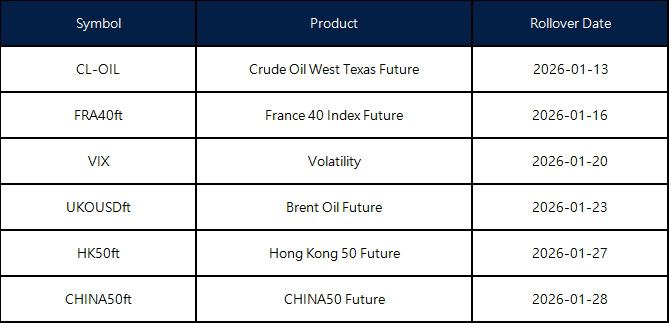
Please note:
• The rollover will be automatic, and any existing open positions will remain open.
• Positions that are open on the expiration date will be adjusted via a rollover charge or credit to reflect the price difference between the expiring and new contracts.
• To avoid CFD rollovers, clients can choose to close any open CFD positions prior to the expiration date.
• Please ensure that all take-profit and stop-loss settings are adjusted before the rollover occurs.
• All internal transfers for accounts under the same name will be prohibited during the first and last 30 minutes of the trading hours on the rollover dates.
The above data is for reference only. The actual rollover date shall be subject to the Liquidity Provider’s determination.
If you’d like more information, please don’t hesitate to contact [email protected]







