
Back

During European trading, the BoJ report estimated Japan’s natural interest rate between roughly -0.9% and +0.5%

The Bank of Japan released a review on developments in the natural rate of interest and how it assesses the degree of monetary accommodation. It said that as the policy rate nears the neutral range, it is more important to gauge how monetary accommodation is changing. The BoJ said it will examine data on spending by firms and households, and the financial conditions that affect that spending. It re-estimated the natural rate of interest using the latest data.

Natural Rate Interest Estimates

Using the latest figures, the estimated natural rate of interest in Japan was around -0.9% to +0.5%. The range was broadly unchanged, but many estimates have recently risen moderately. The BoJ linked the rise in estimates to higher potential growth and a higher risk appetite among market participants. It said the natural rate is hard to pin down in advance. The BoJ said it is adjusting monetary accommodation towards the sustainable and stable achievement of its 2% price target. It said assessment should be comprehensive, covering activity, prices, and financial developments. It said funding costs are rising after policy rate changes, but overall funding demand remains firm. It said it will keep adjusting policy while monitoring how the economy and prices respond to short-term rates changes.

Trading And Market Implications

The Bank of Japan’s recent report signals a clear, if cautious, direction for monetary policy. Its updated estimates show the natural rate of interest is rising, suggesting the economy can sustain higher borrowing costs than previously thought. This gives the central bank more room to continue its path of normalization, which we have seen evolve since the initial rate hike back in March 2024. This subtle hawkish tilt is supported by recent economic data that has been released over the past few months. We’ve seen core inflation remain stubbornly above the 2% target, with the latest figures for February 2026 showing a 2.3% year-on-year increase. This persistence, combined with the strong wage growth secured during the 2025 spring negotiations, creates a compelling case for the BoJ to act again to cool price pressures. For traders focused on currency derivatives, this strengthens the argument for a stronger yen in the medium term. With the USD/JPY exchange rate having lingered above the 155 level through late 2025 and into this year, there is significant room for yen appreciation. We should therefore consider positioning for a lower USD/JPY, potentially through buying JPY call options or selling out-of-the-money USD/JPY calls to capitalize on a policy shift. The implications for interest rate derivatives are just as significant. The report’s message points toward higher yields for Japanese Government Bonds (JGBs). We should anticipate the JGB yield curve to steepen further, and traders can position for this by paying the fixed rate on Japanese interest rate swaps or by purchasing put options on JGB futures. However, the BoJ emphasized its data-dependent approach and the uncertainty surrounding its estimates. This means we should expect continued volatility as the market reacts to every key data release, from inflation reports to GDP figures. While the overarching bias is for higher rates and a stronger yen, any signs of economic weakness could quickly unwind these positions, making defined-risk option strategies particularly attractive. Create your live VT Markets account and start trading now.

Start trading now – Click here to create your real VT Markets account
UOB analysts see GBP/USD slipping near 1.3340, downside capped at 1.3305, resistance 1.3355/1.3375

GBP/USD eased to about 1.3340. The intraday bias stayed lower, but momentum was not strong enough to suggest a deeper fall. Further losses were seen as limited to a test of 1.3305. Resistance levels were placed at 1.3355 and 1.3375.

Downside Bias And Key Levels

A move above 1.3375 would indicate the downside bias has faded. Over the next one to three weeks, the outlook remained mixed, with price action expected to stay within a range. The projected range was set between 1.3220 and 1.3480. A weekly close below 1.3300 was noted as a trigger for a potential move down towards the 1.2945/1.3010 support zone. Looking back at the analysis from 2025, we recall the mixed outlook for GBP/USD, which suggested range trading between 1.3220 and 1.3480. That period of low momentum was a key feature of the market then. The critical warning was a weekly close below the 1.3300 support level. That break did occur late last year, and the pair has not recovered since, now trading around 1.2550. The divergence in central bank policy has been the primary driver, with the Bank of England signaling a potential rate cut this summer as UK inflation has fallen to 2.4%. Meanwhile, the US Federal Reserve remains cautious, with core inflation proving sticky at 3.2%, suggesting rates there will stay higher for longer.

Options Strategies For Continued Weakness

For the coming weeks, we see continued downside pressure on the pound. Derivative traders should consider strategies that profit from a further slide or from stagnant prices, such as buying put options with a strike price near 1.2400. This provides exposure to a potential drop toward the 2024 lows while clearly defining the maximum risk. Alternatively, for those expecting a slow grind lower rather than a sharp drop, selling out-of-the-money call spreads could be effective. A bear call spread with strike prices above the 1.2650 resistance level would generate income if the GBP/USD fails to rally past that point. This strategy benefits from both a falling price and time decay. Implied volatility in GBP/USD options has been climbing ahead of next month’s UK GDP data and the Fed’s policy meeting. This makes selling options premium more attractive but also signals the market is bracing for a move. We believe any rallies should be viewed as opportunities to position for further weakness. Create your live VT Markets account and start trading now.

Start trading now – Click here to create your real VT Markets account

Michael Barr warned Iran’s oil-shock may lift inflation expectations, delay rate cuts, despite economic resilience

Fed Governor Michael Barr said the US economy has stayed resilient through a series of shocks, but these have made it harder for the Federal Reserve to reach its 2% inflation target. He warned that the longer inflation stays above 2%, the higher the risk that it becomes entrenched. He said the economic impact of the Middle East conflict could be limited if it ends soon, but wider effects are possible if it continues. He also warned that another price shock could alter inflation expectations and increase inflation persistence.

Fed Caution And Financial Stability Risks

Barr said it is sensible for the Fed to take time to assess economic developments before making further policy changes. He also said recent regulatory changes and staff cuts are reducing confidence in financial system stability and making banks less resilient. He said job growth and labour force growth appear broadly in balance, but low hiring leaves the labour market exposed to shocks. The report added that these comments supported the US dollar, with ongoing geopolitical uncertainty linked to the Middle East conflict. We see the Federal Reserve signaling a prolonged pause, which means traders should reconsider bets on imminent rate cuts. With the latest February 2026 CPI data still showing inflation at 3.1%, well above the 2% target, the market’s pricing for rate cuts looks overly optimistic. Derivative plays that profit from interest rates remaining at their current levels, like selling call options on SOFR futures, are looking more attractive. The comments highlight a fragile situation, with potential shocks from geopolitics and the financial sector creating a case for higher market volatility. The CBOE Volatility Index (VIX) is currently trading near 15, a level that historically has not sustained when uncertainty is rising. We should consider buying VIX call options or structuring S&P 500 option straddles to position for a potential spike in volatility in the coming weeks.

Positioning For Dollar Strength

The persistent bid for the US Dollar is a clear signal, driven by both the Fed’s cautious stance and its safe-haven appeal. With the U.S. Dollar Index (DXY) pushing towards the 106 level, a high we haven’t consistently seen since late 2025, using currency derivatives to maintain a long USD position seems prudent. Traders could look at buying DXY call options or shorting currency pairs like the EUR/USD through futures contracts. We should pay close attention to the vulnerability in the labor market, where the hiring rate in the last JOLTS report fell to 3.5%, a low not seen since the slowdown in 2025. A negative shock could quickly increase unemployment, hurting consumer spending and corporate profits. This environment justifies hedging long stock portfolios by purchasing put options on broad market indices like the SPX or NDX. The explicit warning about the Middle East conflict is a direct prompt to watch energy markets for sudden price shocks. WTI crude oil is currently trading around $85 a barrel, and any escalation could easily send it past the $100 mark we saw during previous periods of tension in 2025. Buying out-of-the-money call options on WTI or Brent futures offers a low-cost way to profit from such a high-impact event. Create your live VT Markets account and start trading now.

Start trading now – Click here to create your real VT Markets account

Fed Governor Miran says a smaller balance sheet would ease rate-setting; sceptics of shrinkage lack imagination

Fed Governor Stephen Miran said shrinking the Federal Reserve balance sheet can make interest rate policy easier. He said there is a path to cut Fed holdings by $1 trillion to $2 trillion. He said a smaller balance sheet would take several years to achieve. He added that the ability to reduce holdings depends on changes in demand for reserves.

Smaller Balance Sheet More Policy Flexibility

Miran said a smaller balance sheet would give the Fed more options during the next crisis. He said a large balance sheet can distort markets and create problems for the Fed. He said he does not see a case to sell any Fed holdings. He also said he is not calling for a return to a scarce reserves system. He said more active Fed market interventions could help manage balance sheet size. He said the Fed should reduce stigma around repo operations and use of the discount window. The comments did not move the US Dollar much. Markets remained focused on conflict developments in the Middle East.

Trading Implications Over The Medium Term

We are hearing signals that the Federal Reserve wants to shrink its holdings over the next few years. This is a gradual process aimed at reducing their balance sheet by one to two trillion dollars. For now, the market is distracted by global events, creating a potential opening for traders who are looking further ahead. This long-term tightening bias comes as the Fed’s balance sheet has already declined from its peak above $8.9 trillion in 2022 to roughly $7.2 trillion today. When we look back at the data from 2025, we saw core inflation prove stubborn, remaining above the 2.5% mark for most of that year. This persistent inflation gives officials a reason to continue slowly draining liquidity from the system. This outlook suggests a steeper yield curve over time, putting upward pressure on long-term interest rates. Derivative traders might consider positions that benefit from higher yields, like selling long-dated Treasury bond futures. The “several years” timeline means this is not an immediate trade but a strategic positioning for the medium term. A smaller Federal Reserve balance sheet is fundamentally supportive of the US Dollar. While geopolitical risks are currently suppressing the dollar’s reaction, this underlying strength could re-emerge quickly. Options strategies that bet on a stronger dollar in the coming months, once current headlines fade, could be attractive. We must remember that removing liquidity from the financial system has historically created volatility. The process of shrinking the balance sheet from 2017 to 2019 eventually led to stress in the repo market. Traders should consider the possibility of similar bumps ahead, making long volatility positions via options a sensible hedge. Reduced market liquidity generally acts as a headwind for equity valuations, particularly for growth-oriented sectors. This long-term policy direction suggests caution is warranted for broad market indices. Hedging long stock portfolios with longer-dated index put options seems like a prudent strategy. Create your live VT Markets account and start trading now.

Start trading now – Click here to create your real VT Markets account

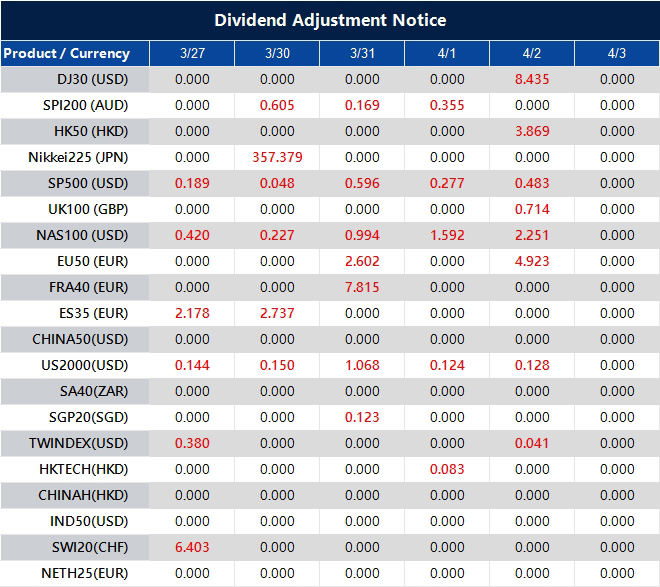
Dividend Adjustment Notice – Mar 27 ,2026

Dear Client,

Please note that the dividends of the following products will be adjusted accordingly. Index dividends will be executed separately through a balance statement directly to your trading account, and the comment will be in the following format “Div & Product Name & Net Volume”.

Please refer to the table below for more details:

Dividend Adjustment Notice

The above data is for reference only, please refer to the MT4/MT5 software for specific data.

If you’d like more information, please don’t hesitate to contact [email protected].

Amid Iran oil shock, GBP/USD edges down to 1.3340, obscuring Bank of England rate outlook in choppy trade

GBP/USD fell about 0.1% on Thursday to about 1.3340 after a choppy session. It has stayed in a roughly 200-pip band of 1.3230 to 1.3430 for most of March, with lower highs since a late-January peak near 1.3820. During the US session, the pair briefly dipped towards 1.3310 before recovering. The Bank of England kept Bank Rate at 3.75% on 19 March in a unanimous vote, compared with a 5-4 split in February.

Central Bank Signals And Market Pricing

CPI inflation held at 3% in February, and the BoE said it could rise to 3.5% in coming quarters. Markets that had priced two cuts now expect rates to hold through 2026 or potentially rise. UK data due include February retail sales (consensus -0.8% month-on-month) and March GfK consumer confidence, which was -21 versus a -24 consensus. In the US, the Fed held rates at 3.50% to 3.75% and its dot plot showed one cut this year. Initial jobless claims were 210K, matching forecasts. Next US releases include UoM sentiment (consensus 54, prior 55.5) and one-year inflation expectations (consensus 3.4%). On charts, levels cited include 1.3335, 1.3330, 1.3320, 1.3342, 1.3350, 1.3370, 1.3430, 1.3500, and 1.3250. The Pound dates to 886 AD and is the fourth most traded currency, accounting for 12% of FX, or about $630 billion a day in 2022; GBP/USD is 11%, GBP/JPY 3%, and EUR/GBP 2%. We see the GBP/USD pair stuck between conflicting forces, creating a choppy trading range. The Bank of England’s hawkish turn is providing a floor under the pound, but the series of lower highs since late January suggests an underlying weakness. Traders should therefore be cautious about betting on a strong directional breakout in the immediate future.

Geopolitics Energy And Sterling Volatility

The war in the Middle East has completely changed the outlook for UK interest rates. We’ve seen Brent crude futures surge 18% over the past four weeks to over $95 a barrel, a level not seen since late 2024. This supply-side shock is forcing the BoE to consider holding rates high despite a weakening economy, with markets now pricing in zero cuts for 2026. This morning’s data will likely confirm the strain on the UK consumer, with retail sales for February expected to be negative. This follows a disappointing 0.5% contraction in January, painting a picture of a consumer squeezed by rising energy costs and stagnant wage growth. This dynamic of high inflation and low growth creates a difficult puzzle for the central bank and for sterling. On the other side of the pair, the US dollar remains on a solid footing. The Federal Reserve’s position appears more straightforward, with their dot plot from last week still signaling one rate cut for 2026. A high inflation expectations number from today’s University of Michigan report would reinforce the Fed’s cautious stance, likely strengthening the dollar and pushing GBP/USD towards the lower end of its recent range. Given the tight range between roughly 1.3230 and 1.3430, selling short-dated call options with strike prices above 1.3450 could be an effective strategy to collect premium. This approach capitalizes on the view that upside momentum is fading, as shown by the pattern of lower highs we’ve observed since the pair peaked near 1.3820 earlier in the year. This strategy benefits from both a drop in price or sideways consolidation. Alternatively, the heightened geopolitical risk suggests an increase in implied volatility is likely. We saw a similar pattern during the initial phases of the Ukraine conflict in 2022, where currency volatility spiked before the market established a new equilibrium. This makes long volatility strategies, such as buying a straddle, attractive for traders anticipating a sharp breakout from the current narrow range. For those trading more direct instruments, we should watch the 1.3430 level, which lines up with the 50-day moving average, as a key area to initiate short positions. A failure to break convincingly above this technical resistance would reinforce the bearish outlook. This keeps the focus on an eventual move back towards the 1.3250 support zone in the coming weeks. Create your live VT Markets account and start trading now.

Start trading now – Click here to create your real VT Markets account

In March, UK GfK consumer confidence outpaced forecasts, rising to -21 rather than -24 expected

GfK’s UK Consumer Confidence Index improved in March. It rose from -24 to -21. The March reading was above expectations. The expected figure was -24.

Consumer Confidence Still Negative

The index remains below zero. This indicates overall consumer sentiment is still negative. The unexpected rise in UK consumer confidence to -21 suggests a less pessimistic outlook among households. This could translate into stronger retail sales, which were reported as mostly flat in the latest data for February 2026. We see this as a positive leading indicator for the UK’s domestic economy in the second quarter. We believe this data complicates the Bank of England’s path to cutting interest rates in the near future. With inflation still hovering at 2.3%, stubbornly above the 2% target, this consumer resilience may push the timeline for any policy easing further out. Traders should therefore consider that SONIA futures markets may need to price out the probability of a summer rate cut. This positive sentiment is particularly relevant for domestically-focused companies. We anticipate that call options on the FTSE 250 index could offer better value than on the more internationally-exposed FTSE 100 over the next few weeks. The renewed confidence supports sectors like retail and hospitality, which feature more prominently in the mid-cap index.

Sterling Outlook And Market Implications

A more hawkish Bank of England outlook typically provides a tailwind for the pound. We therefore see potential for sterling to strengthen against currencies whose central banks are signaling a clearer path to easing. Options strategies betting on a higher GBP/USD exchange rate could be a tactical play for the coming weeks. Looking back from 2025, we recall how fragile sentiment was, especially when compared to the historic low of -49 reached in September 2022. The current reading, while still in negative territory, marks a significant improvement from the lows of the post-pandemic inflation surge. This suggests a more resilient consumer base than previously assumed. Create your live VT Markets account and start trading now.

Start trading now – Click here to create your real VT Markets account

In March, Ireland’s consumer confidence fell to 56.7 from 65.2, reflecting weaker sentiment overall

Ireland’s consumer confidence fell to 56.7 in March. It was 65.2 in the previous reading. The change means confidence dropped by 8.5 points month on month. The March level is lower than the earlier figure.

Implications For Domestic Spending

The significant drop in Irish consumer confidence from 65.2 down to 56.7 is a clear signal for us to anticipate reduced domestic spending. This is the largest monthly fall we have seen since the energy crisis began back in 2022, suggesting households are becoming nervous about the economic outlook. We should expect companies reliant on discretionary spending, particularly in retail and hospitality, to face headwinds in the coming quarter. This sentiment decline is happening even as we’ve seen headline inflation ease to 3.9% in the latest figures, which points to concerns beyond just prices, likely focused on job security and the global economic slowdown. Recent retail sales data from January already showed a 1.1% volume decrease, and this confidence report indicates that trend is likely to worsen. The weakness in consumer demand will probably become more evident in corporate earnings reports later this year. Given this, we should consider buying put options on the ISEQ 20 index as a direct hedge against a broad market decline in Dublin. Specific weakness could be targeted by shorting futures contracts tied to the Irish consumer discretionary sector. These positions would profit if falling confidence translates, as we expect, into lower equity valuations over the next several weeks. This consumer pessimism also puts pressure on the European Central Bank, which we’ve seen hold interest rates at 4.5% in their last meeting. If this trend of economic weakness continues across the Eurozone, it makes future rate hikes less likely and could even bring forward discussions of rate cuts. Therefore, we should look at long positions in German bund futures, as they typically rally when the market anticipates a more accommodative central bank policy.

Positioning For Higher Volatility

This uncertainty is a recipe for higher market volatility, a shift from the relative calm we experienced at the end of 2024. Traders should consider purchasing straddles on key Irish bank stocks, which are sensitive to both interest rate expectations and the health of the domestic economy. This strategy allows for profiting from a large price move in either direction, which is highly probable given the current environment. Create your live VT Markets account and start trading now.

Start trading now – Click here to create your real VT Markets account

Amid crude oil turmoil, USD/JPY nears 160, rising to 159.70 after a three-week surge from 152.10

USD/JPY rose about 0.1% on Thursday to around 159.70, after touching near 159.85. It has climbed from about 152.10 in early March, a move of roughly 770 pips in under three weeks. The US-Israeli conflict with Iran and disruption in the Strait of Hormuz are pushing up energy prices. Brent crude has averaged about $97 a barrel in March, up 33% from February, and the disruption affects roughly 20% of global oil supply.

Japan Energy Exposure And Intervention Risk

Japan is exposed because about 95% of its crude imports come from the Middle East. Reuters said Japan’s Finance Ministry is weighing intervention in oil futures markets to slow yen weakness. The Bank of Japan kept rates at 0.75% on 19 March. A Bloomberg survey shows 37% of economists expect an April hike, up from 17% two months ago, and Japan’s two-year yields hit their highest since 1996. The Federal Reserve kept rates at 3.50% to 3.75% on 18 March, with the dot plot pointing to one cut this year. The Fed’s core PCE forecast for 2026 was revised up to 2.7%, and Friday’s University of Michigan sentiment and one-year inflation expectations data are due. We remember this time last year, in March 2025, when the intense pressure from the Strait of Hormuz disruption pushed crude oil prices to nearly $100 per barrel. This shock, combined with a wide interest rate gap, sent USD/JPY surging toward the 160.00 level. The market was on high alert for intervention from Tokyo, which was being forced to consider unusual policy responses.

Strategic Implications For Yen And Volatility

A lot has changed since Japanese authorities stepped in to defend the yen last year. The USD/JPY is now trading around 153.50, well off those highs, as tensions in the Middle East have eased and the immediate energy crisis has passed. Recent data from the U.S. Energy Information Administration shows Brent crude prices have stabilized, averaging around $86 a barrel this month, significantly reducing a key source of pressure on the yen. The policy landscape has also shifted dramatically, narrowing the interest rate differential that fueled the dollar’s rally. We have seen the Bank of Japan slowly continue its path toward normalization, with its policy rate now at 1.00%. Meanwhile, the Federal Reserve has delivered two quarter-point cuts since last year, bringing the fed funds rate to a target range of 3.00% to 3.25%. Given this new environment, we believe selling volatility is an attractive strategy for the coming weeks. With the risk of imminent intervention much lower and central bank paths more aligned, the wild swings of 2025 are behind us. We are looking at selling USD/JPY strangles with strikes around 150.00 and 156.00, as one-month implied volatility has fallen from over 14% last year to just under 9% today. For those with a more directional view, positioning for further yen strength seems prudent as the long-dollar carry trade continues to unwind. Buying USD/JPY puts with a 150.00 strike for late April or May expirations offers a defined-risk way to capitalize on this trend. The fundamental drivers that once pushed the pair to 160.00 have clearly reversed course. A more nuanced approach would be to structure bearish risk reversals, which involves buying a USD/JPY put and financing it by selling an out-of-the-money call. This allows us to position for a gradual decline in the pair at a low or even zero cost. This trade structure benefits from the shift in market sentiment, which now sees more risk to the downside than a return to the highs of 2025. Create your live VT Markets account and start trading now.

Start trading now – Click here to create your real VT Markets account

For a second session, GBP/JPY hovers near 213.00, slipping 0.09%, while traders test resistance at 213.31

GBP/JPY is consolidating near 213.00 for a second day and is down 0.09%. It has ended a four-day run of gains and remains capped below the March 11 peak at 213.31. The pair has traded in a 211.00 to 213.00 range for the past 9 days. Price action also fits a bearish flag pattern, which points to downside risk if support gives way.

Technical Momentum Signals

The Relative Strength Index (RSI) is in bullish territory, but its slope is falling. This suggests neither side has control. If GBP/JPY moves above 213.00, it would then aim for the year-to-date high at 215.00. A move below 212.00 would bring focus to the 50-day Simple Moving Average at 211.42, then the March 16 swing low at 210.81. Looking back a year ago, we saw the GBP/JPY pair stalled below 213.31, coiling within a tight range for over a week. At that time, in March 2025, technical analysis pointed toward a bearish flag pattern, suggesting a potential breakdown was imminent. This period of consolidation created significant tension as the market lacked a clear fundamental driver. That bearish scenario never materialized, as the flag pattern failed when UK inflation data for the second quarter of 2025 surprised to the upside, remaining above 3.5%. This forced the Bank of England to delay its anticipated interest rate cuts, causing the pound to strengthen significantly against the yen. The subsequent breakout above 213.50 triggered a rally that pushed the pair toward the 220.00 handle by late 2025.

Positioning For A Volatility Break

Today, we observe a similar, though less defined, consolidation around the 218.00 level. Learning from the events of 2025, traders should prepare for a decisive move rather than getting caught in the range. The key difference now is the Bank of Japan, which ended its negative interest rate policy earlier this year and is signaling further tightening, with government bond yields rising to their highest levels since 2013. Given the current setup, derivative traders should consider strategies that profit from a sharp increase in volatility. Buying options straddles, with strike prices bracketing the current 217.00-219.00 range, could position a portfolio to capitalize on a breakout in either direction. This allows traders to benefit from the eventual move without needing to predict its direction, which proved difficult during the consolidation phase last year. Create your live VT Markets account and start trading now.

Start trading now – Click here to create your real VT Markets account

Back To Top
server

Hello there 👋

How can I help you?

Chat with our team instantly

Live Chat

Start a live conversation through...

  • Telegram
    hold On hold
  • Coming Soon...

Hello there 👋

How can I help you?

telegram

Scan the QR code with your smartphone to start a chat with us, or click here.

Don’t have the Telegram App or Desktop installed? Use Web Telegram instead.

QR code

