



Medpace (MEDP) stock dropped by 2.13% to $600.02 despite the market rise.
Medpace (MEDP) stock dropped by 2.13%, while the wider market had mixed results: the S&P 500 gained 0.01%, the Dow rose by 0.55%, and the Nasdaq fell by 0.44%. Prior to this session, Medpace’s stock had increased by 9.33%, outperforming the Medical sector’s 2.01% gain and the S&P 500’s 0.86% rise.
Medpace is expected to report earnings of $4.18 per share on February 9, 2026. This represents a 13.9% growth from last year. Anticipated revenue is $681.17 million, a 26.94% increase. For the full year, projections suggest earnings of $14.8 per share and revenue of $2.5 billion.
Recent analyst updates show optimism about Medpace’s future. Changes in estimates often connect with stock price performance, according to the Zacks Rank model. Medpace currently has a Zacks Rank of #2 (Buy), and there has been no change in the EPS estimate.
Medpace’s Forward P/E ratio is 36.88, which is higher than the industry average of 15.62, with a PEG ratio of 2.06. The Medical Services sector, including Medpace, holds a Zacks Industry Rank of 175, putting it in the bottom 29% of over 250 industries.
After a strong month, Medpace’s recent stock drop could be profit-taking before the earnings report on February 9, 2026. This date is crucial for the stock in the near future, potentially offering entry points for new investors.
Market expectations are high, with predictions of 13.9% year-over-year earnings growth and a 26.94% revenue increase. Positive analyst sentiments may be driving up implied volatility for options expiring after the report, increasing the cost of both call and put options as the announcement date nears.
Looking back to Medpace’s performance in 2025, the stock typically moved an average of +/- 11% following earnings calls. The healthcare services sector showed increased volatility late in 2025, suggesting a sharp price swing is likely. Currently, the CBOE Volatility Index (VIX) is around 14.5, indicating a calm market that may not be accounting for individual stock risks like Medpace.
The main risk is the stock’s high valuation, with a Forward P/E ratio of 36.88, significantly above the industry average. This premium means there’s little margin for error. Any disappointing results or guidance for the remainder of 2026 could lead to a sharp sell-off.
This creates a classic volatility scenario leading up to February 9. Traders may want to consider strategies like long straddles or strangles using February or March options to take advantage of potential price movement. It’s important to position these strategies before implied volatility increases further, which could reduce profits.
Alternatively, if you think the market’s expectation for a big move is exaggerated, selling premium could be a viable option. An iron condor strategy could be set up to profit if MEDP’s price remains within a specific range after the earnings report. This approach bets that despite high expectations, the stock’s reaction will be less dramatic than what current options pricing suggests.
Germany’s imports in November exceeded forecasts with a 0.8% month-on-month increase
Germany’s imports in November increased by 0.8%, beating the expected 0.2%. This shows strong demand for foreign goods, which is different from what analysts had predicted.
In the eurozone, retail sales went up by 2.3% year-on-year in November, surpassing the expected 1.6%. This indicates that consumers are still buying despite economic uncertainties.
US Nonfarm Payrolls Outlook
The United States will release its Nonfarm Payrolls for December soon. Analysts expect the addition of 60,000 jobs, following a 64,000 rise in November. This points to moderate growth in the job market. The EUR/USD pair is weak at around 1.1650, driven by a strong US Dollar and cautious market sentiment. Meanwhile, the GBP/USD pair trades below 1.3450 as traders await important US economic data. Gold is stable at around $4,475, with traders looking to the US Nonfarm Payrolls report for direction. The upcoming employment figures could impact the Federal Reserve’s decisions on interest rates. The current economic situation shows divergence, creating opportunities. Strong German import data and solid Eurozone retail sales suggest resilience in Europe. This stands in contrast to the US, where the job market is slowing down.Currency and Commodities Market Implications
Everyone is focused on the US Nonfarm Payrolls (NFP) report for December today. Analysts expect a weak print of around 60,000 jobs, following a trend of slowing job growth in late 2025. This report is important as it will affect the Federal Reserve’s thoughts on when to cut interest rates. For currency traders, this could be a turning point for the EUR/USD. Despite its weakness, a weak US jobs number could shift sentiment against the dollar and push the euro towards the 1.1700 level. Options could be a good way to position for a breakout from the current tight range around 1.1650. The current calm in the markets before the NFP release suggests pent-up pressure, making volatility derivatives appealing. Implied volatility is high, with the VIX index over 15, indicating that traders expect a significant move. A long straddle strategy on major indices or currency pairs could be effective for profiting from price swings after the announcement, no matter the direction. Gold traders should stay alert, as gold prices are sensitive to expectations of Fed rate cuts. A weak NFP report could strengthen bets for a rate cut in the first quarter, with futures already indicating a strong chance of a March cut. This scenario could lead to gold breaking decisively above $4,500 per ounce. Looking back at 2025, it was a year of significant changes that didn’t cause a crisis right away, but now we see their effects. The slowing US job market may be a delayed response to events from last year. We should be prepared for these delayed impacts to shape market trends in the coming weeks. Create your live VT Markets account and start trading now.Germany’s exports fell by 2.5% in November, missing expectations for no change.
Germany’s exports dropped by 2.5% in November, which was unexpected since no change was predicted. This decline might indicate problems with global demand or other economic factors impacting Germany’s trade. As Germany relies heavily on exports, this could affect the wider Eurozone economy.
These export numbers may impact the European Central Bank’s (ECB) decisions on monetary policy. Analysts will keep an eye on how this data aligns with other economic indicators and the overall economic situation in Germany and the Eurozone. Markets often respond to these signs, which provide insights into economic health and future regulations.
A Slowing Economy
The 2.5% drop in German exports for November 2025 is a clear sign of a slowing economy, raising concerns about global demand. This figure is much lower than the expected flat growth, suggesting the Eurozone’s economic engine is stalling. We can expect continued pressure on the EUR/USD exchange rate in the coming weeks. This weakness in exports isn’t just a one-time event; it follows a report from Destatis in late December 2025 showing a 0.7% decline in German factory orders. Additionally, Eurostat’s initial Consumer Price Index (CPI) estimate for December 2025 dropped to 1.9%, falling below the ECB’s target. This increases the chance that the ECB will adopt a more relaxed approach. The combination of slow growth and low inflation paints a gloomy picture for the Euro. For those trading equity derivatives, it may be wise to adopt a defensive stance on the German DAX index. Buying put options on DAX futures or on major export-heavy stocks, like those in the automotive industry, could be beneficial. Implied volatility on the index has risen from 14% to 16.5% in the past month, suggesting that the market is starting to factor in higher risk.Currency And Market Implications
In the currency options market, it seems smart to prepare for a weaker Euro. Investors might consider buying put options on EUR futures to benefit from any downturns towards the 1.05 level. Historically, during the 2019 industrial slowdown, similar weak data in Germany led to a prolonged decline in the EUR/USD pair. With weak economic data, the likelihood of future ECB rate hikes is decreasing. This scenario is favorable for German government bonds, making long positions in Bund futures potentially profitable. If equity markets become anxious, investors may shift to safer options, which would further support this trade. Looking ahead, important data to track will be the preliminary German GDP for the fourth quarter of 2025 and the January ZEW Economic Sentiment survey. Any further negative surprises in these reports could speed up the bearish trends we are seeing. However, a strong positive report would require us to rethink this cautious outlook. Create your live VT Markets account and start trading now.US Dollar strengthens its weekly gains ahead of key NFP data
The US Dollar is gaining strength as we approach important economic reports, including the Nonfarm Payrolls (NFP), Unemployment Rate, and wage inflation data from the US Bureau of Labor Statistics. Additionally, the University of Michigan will release the preliminary Consumer Sentiment Index data for January. Recent data from Thursday showed that the US trade deficit decreased to $59.1 billion in October, and Weekly Initial Jobless Claims were slightly lower than expected, coming in at 208,000.
The USD Index is still positive, continuing its climb for the third day. Analysts predict that December’s Nonfarm Payrolls will rise by 60,000, with the Unemployment Rate possibly dropping to 4.5%. Meanwhile, China’s National Bureau of Statistics reported a 0.8% rise in the Consumer Price Index for December, which is a bit below expectations. Major currency pairs like AUD/USD, EUR/USD, and GBP/USD are experiencing slight declines.
Nonfarm Payrolls Influence
Nonfarm Payrolls show employment changes in the US and can affect the Federal Reserve’s decisions on monetary policy. A high NFP number indicates more jobs and could lead to higher interest rates. Typically, a stronger NFP correlates with a stronger US Dollar and a weaker Gold price. This happens because higher NFP figures increase the appeal of the USD and raise interest rates, which pressures Gold prices. However, the market’s reaction to NFP data can sometimes be surprising, especially if other report details influence perceptions. The US Dollar is building on its weekly gains as we await today’s important Nonfarm Payrolls report. The market expects a modest increase of 60,000 jobs, notably down from the 110,000 reported for November 2025. This slowdown in job growth makes today’s data crucial for the Federal Reserve’s future actions. Due to this uncertainty, traders are considering options strategies to take advantage of potential volatility. If the NFP report shows a surprising increase above 100,000 jobs, the USD Index could break through the 99.00 resistance level. On the other hand, a disappointing report could raise expectations for an earlier Fed rate cut. Buying straddles on major pairs like EUR/USD could be a good strategy to profit from significant price movements in either direction.Federal Reserve Considerations
The Federal Reserve is closely watching data, and this jobs report will be vital for its next decision. Currently, the CME FedWatch Tool indicates a roughly 40% chance of a rate cut by the March 2026 meeting. If today’s NFP number is weak, those odds could rise above 50%, putting pressure back on the dollar. For those trading USD/JPY, a strong jobs report could push the pair above 157.50 as interest rate differences shift in favor of the US. Conversely, gold traders should be cautious, as a solid job market would reduce gold’s attractiveness. Remember how Gold faced difficulties throughout much of 2025 whenever inflation data was strong, leading to reduced expectations for rate cuts. Create your live VT Markets account and start trading now.Australian dollar weakens against US dollar amid crucial Chinese economic data release
The Australian Dollar is weakening due to a stronger US Dollar and new economic data from both China and Australia. In December, China’s Consumer Price Index (CPI) increased by 0.8% year-over-year, which is below the expected 0.9%. At the same time, Australia’s Trade Surplus dropped to 2,936M in November, with exports down by 2.9% and imports slightly rising.
Inflation data from Australia is mixed, leaving the Reserve Bank of Australia uncertain about its future policies. Attention now turns to upcoming quarterly CPI data. In the US, the Dollar is gaining strength due to strong job market statistics. The US Dollar Index is around 98.90, boosted by US labor reports ahead of the Nonfarm Payrolls.
US Labor Market and PMI Data
Job growth is expected to be around 60,000 for December, slightly lower than the 64,000 seen in November. The US Department of Labor reports that Initial Jobless Claims have risen to 208,000, along with higher Continuing Jobless Claims. At the same time, the US Services PMI has increased to 54.4. The Australian Dollar is facing resistance after dropping below 0.6700, suggesting it may weaken further. The value of the AUD is also affected by the price of iron ore, a significant Australian export, and China’s economic situation. Australia’s CPI stayed stable month-on-month in November, with building permits seeing a sharp increase. With the Australian Dollar struggling against a rising US Dollar, this trend may continue as we await crucial US job data. We’re anticipating further weakness in the AUD/USD pair in the upcoming weeks. The lower-than-expected inflation in China for December 2025 raises concerns about their economic recovery, which directly affects confidence in the AUD. This slow performance is evident in other figures, as China’s Caixin Manufacturing PMI for December 2025 shows a slight increase at 50.8, indicating only marginal growth. The economic weakness in Australia’s biggest trading partner is a significant challenge. As a result, iron ore prices have dropped, currently trading around $136 per tonne, down from late 2025 highs. This decrease weakens support for the Australian Dollar. We are monitoring this situation closely, as any further decline in commodity prices will put more pressure on the currency.US Economic Strength
In contrast, the US Dollar is gaining strength thanks to a strong services sector and a solid labor market. Even though weekly jobless claims have slightly increased, the overall numbers indicate a tight job market, supported by consistently low unemployment over the past two years. This robust economy creates challenges for risk-sensitive currencies like the AUD. The market is preparing for the upcoming US Nonfarm Payrolls report, which often causes a lot of volatility. Looking back to early 2024, a much better-than-expected jobs report changed expectations for the Fed and drove the dollar higher. This makes strategies like short-term options, such as straddles, an interesting approach to take advantage of potential market shifts. The Reserve Bank of Australia is signaling that rate cuts are not on the horizon, which should support the currency. However, the market is more focused on the Federal Reserve, which is anticipated to maintain rates while some may call for easing. This difference in narrative currently favors the US dollar’s appeal as a safe haven. Technically, we see the AUD/USD pair testing support at the 0.6690 level. A decisive break below this could lead to a move toward the 50-day moving average near 0.6628. Buying put options with a strike price around 0.6650 may be a good strategy to benefit from this potential downturn. On the flip side, if the US payroll data disappoints significantly, we may see a sharp reversal and a squeeze on short positions. A return above the 0.6700 level would signal a restart of bullish momentum. In that case, call options could be used to profit from a rebound towards the 0.6760 resistance area. Create your live VT Markets account and start trading now.EUR/USD stays near 1.1650 as bearish RSI shows decreasing momentum
EUR/USD is steady around 1.1650 after five days of losses. The 14-day RSI sits at 39, suggesting a loss of momentum rather than an oversold condition.
On the daily chart, the EUR/USD pair is trading below the nine- and 50-day EMAs, which are at 1.1696 and 1.1680 respectively. Although the crossover looks positive, the absence of support from moving averages makes the short-term outlook unclear.
Possible Test of Six-Week Low
The pair could test the six-week low at 1.1589. A daily close below this level might lead to support around 1.1468, the lowest point since August 2025. Initial resistance lies at the 50-day and nine-day averages of 1.1680 and 1.1696. If the pair closes above these levels, it might reach the three-month high of 1.1808 from December 24, then possibly 1.1918, the highest since June 2021. Different currencies have shown slight changes against one another, pointing to small movements in the forex market. These shifts indicate minor fluctuations, with several currencies experiencing slight declines.Potential Increase in Price Swings
At the end of 2025, EUR/USD struggled around 1.1650 as momentum faded. This trend was reinforced by this week’s US Non-Farm Payrolls report, which revealed the addition of 210,000 jobs in December—more than expected. This data supports a hawkish approach from the Federal Reserve, strengthening the dollar. Bearish signals from late last year, like the RSI dropping to 39, are still relevant. With the pair remaining below the crucial 1.1680 and 1.1696 moving averages, the most likely direction seems to be downward. Traders should keep an eye on the 1.1589 support level, the low from early December 2025, as an important benchmark. Adding to the pressure is the recent Eurozone flash CPI data, showing inflation unexpectedly dropping to 1.8%. This decreases any urgency for the European Central Bank to tighten policy, creating a clear divergence with the Fed. This situation makes selling rallies a potentially effective strategy in the short term. Given this backdrop, strategies that profit from further declines or sideways movement seem promising. Buying put options with strike prices below 1.1589 could target the August 2025 low around 1.1468. Alternatively, selling call spreads above the 1.1808 resistance could capitalize on time decay and the low chance of a rapid reversal. We’ve seen similar policy divergences in the past, like in 2014-2015, which led to prolonged dollar strength. Implied volatility in EUR/USD options may increase as the pair nears these critical support levels. Traders should be ready for potential price swings if the 1.1589 level is decisively broken in the weeks ahead. Create your live VT Markets account and start trading now.Gold prices decline in Saudi Arabia according to recent sources.
Gold prices in Saudi Arabia have dropped, as reported by FXStreet. The price per gram decreased from 539.68 SAR to 538.27 SAR, while the price per tola went down from 6,294.74 SAR to 6,279.06 SAR.
FXStreet calculates gold prices by converting international prices (USD/SAR) into the Saudi currency. These prices are updated daily and may differ from local rates.
Gold As A Hedge Against Inflation
Gold has long been a safe-haven asset and a reliable store of value. It is often seen as a shield against inflation and currency devaluation since it is not linked to any government or issuer. Central banks are the biggest holders of gold, having bought a record 1,136 tonnes in 2022. Countries like China, India, and Turkey are rapidly boosting their gold reserves. Gold prices move in the opposite direction of the US Dollar and US Treasuries. When the Dollar weakens, gold prices typically rise, but when the Dollar is strong, gold prices can fall. Gold’s value is also affected by factors like geopolitical instability, fears of recession, and interest rates. Generally, gold prices increase when interest rates are low and decline when rates rise. Since gold is priced in dollars, its value closely follows the Dollar’s performance. The recent drop in Saudi gold prices should be seen in the broader economic context. As gold has an inverse relationship with the US Dollar, the recent weakness of the Dollar is significant for investors to monitor.Central Bank Demand And Geopolitical Factors
In late 2025, the US Federal Reserve hinted at a more relaxed monetary policy, which weakened the dollar. During that time, the yield on US 10-year Treasuries dropped from over 4.2% to below 3.7%, making gold, a non-yielding asset, more appealing. This suggests that recent price dips may just be temporary pauses in a new upward trend. Central bank demand continues to support gold prices. After buying 1,136 tonnes in 2022, central banks added over 950 tonnes to their reserves through 2025, according to the latest data from the World Gold Council. This ongoing buying from major institutions reflects a long-term faith in gold’s value. Geopolitical issues are also becoming more significant after a quieter year. Increased trade tensions and regional instability are enhancing gold’s status as a safe-haven asset. While stock markets remain steady, investors are gradually increasing their gold investments as a hedge against possible market disruptions. For derivative traders, this situation indicates that buying during dips is a smart approach. With rising volatility, call options can be an effective way to profit while minimizing risk. It’s wise to consider building long positions on pullbacks instead of chasing after price increases. Ultimately, gold’s price shifts will largely depend on the US Dollar. The policy changes we observed in late 2025 have created a weaker outlook for the currency. As long as this trend continues, gold should find solid support and may resume its rise. Create your live VT Markets account and start trading now.Japan’s Coincident Index declines from 115.9 to 115.2 in November
The Japan coincident index dropped to 115.2 in November, down from 115.9 the month before. This decline may signal a slowdown in economic activity within the country.
The coincident index is an important economic measure that shows the current state of the economy. It provides insights into overall economic performance, and watchers are keen to spot further signs of Japan’s economic growth.
The Economic Outlook
The fall in Japan’s coincident index to 115.2 for November 2025 confirms our belief that the economy was losing momentum late last year. This information, along with the December Tankan survey showing business confidence falling from +12 to +8, suggests that domestic activity is weakening. This trend indicates that corporate earnings might not meet expectations in the upcoming reporting season. Because of this slowdown, we think the Bank of Japan will keep its supportive monetary policy at its meeting later this month. December’s core Consumer Price Index (CPI) data, which came in at 2.2%, was lower than expected and supports the idea that the BoJ doesn’t need to tighten policies just yet. As a result, the interest rate gap between Japan and major economies like the U.S. will likely remain large. For currency traders, this strengthens the argument for holding long positions in pairs such as USD/JPY and EUR/JPY. In a similar situation back in 2022, the USD/JPY pair rose over 15%, and current conditions feel similar. The yen is expected to weaken further in the first quarter of 2026.Equity Market Strategy
In the equity markets, we should be wary of the Nikkei 225. A slowing economy is a challenge for Japanese stocks, so we are thinking of buying put options on Nikkei futures to protect against a potential drop. This approach lets us benefit from a downturn while keeping our initial risk limited to the cost of the options. Create your live VT Markets account and start trading now.In November, Japan’s Leading Economic Index reached 110.5, surpassing the expected 110.4.
Japan’s leading economic index rose to 110.5 in November, beating expectations of 110.4. This indicates a positive economic outlook for the country as it approaches 2026.
In the currency market, the EUR/GBP remained steady below 0.8690 due to mixed data from Germany, while the USD/JPY increased as the Japanese yen weakened. The US is set to release its Nonfarm Payrolls, which are expected to show a growth of 60,000 jobs in December, down from an increase of 64,000 in November.
Gold Prices and Crypto Market
Gold prices stayed around $4,475 as the market awaited the US jobs report, which might impact the Federal Reserve’s decisions on interest rates. In the crypto world, Pepe’s price fell after a recent surge of 72%, indicating some profit-taking. The financial sector is closely monitoring brokers for 2026 to find the best options for trading various assets. This includes looking at spreads, leverage, and trading platforms. FXStreet emphasizes the importance of careful research and risk management before entering the market. Everyone is focused on the US Nonfarm Payrolls (NFP) report for December, due to be released later today. With expectations of a weak report around 60,000 jobs, any significant change could lead to high volatility across different markets. We think a number below this forecast might strengthen beliefs in a slowing US economy and quicken the timeline for Federal Reserve rate cuts. This situation highlights the importance of interest rate derivatives, as a weak jobs report would likely boost the value of contracts predicting earlier Fed easing. Market pricing now resembles what we saw in late 2023, with traders positioning aggressively for rate cuts due to declining inflation and employment data. Options on SOFR futures might be a good way to speculate on a dovish Fed response in the weeks ahead.Foreign Exchange and Market Reactions
For foreign exchange traders, the current strength of the US Dollar presents a clear opportunity. If the NFP data confirms economic weakness, we expect the dollar to drop, pushing pairs like EUR/USD and GBP/USD higher. Traders might think about using call options on these pairs to gain potential upside with limited risk before the data is released. The slightly positive Japanese Leading Economic Index has been overshadowed by attention on US developments, explaining the yen’s ongoing weakness. The USD/JPY reaching a multi-week high shows the dollar’s strength and the significant interest rate gap between the US and Japan. A weak NFP report could be one of the few triggers for a major reversal in this pair. Gold is tightly wound around the $4,475 level, waiting for clear signals about the Fed’s plans. Historically, lower real yields have strongly supported gold prices, as seen in 2019 when the metal broke out of a multi-year range during an easing cycle. A weak jobs report could trigger a similar rise, making gold futures or call options appealing. In addition to immediate economic data, we must also be aware of political risks, such as the Supreme Court’s pending decision on tariff powers. This uncertainty could increase volatility, regardless of the NFP results. Purchasing protection through VIX futures or index put options might be a wise strategy to guard against unexpected shocks in this climate. Create your live VT Markets account and start trading now.Dividend Adjustment Notice – Jan 09 ,2026
Dear Client,
Please note that the dividends of the following products will be adjusted accordingly. Index dividends will be executed separately through a balance statement directly to your trading account, and the comment will be in the following format “Div & Product Name & Net Volume”.
Please refer to the table below for more details:
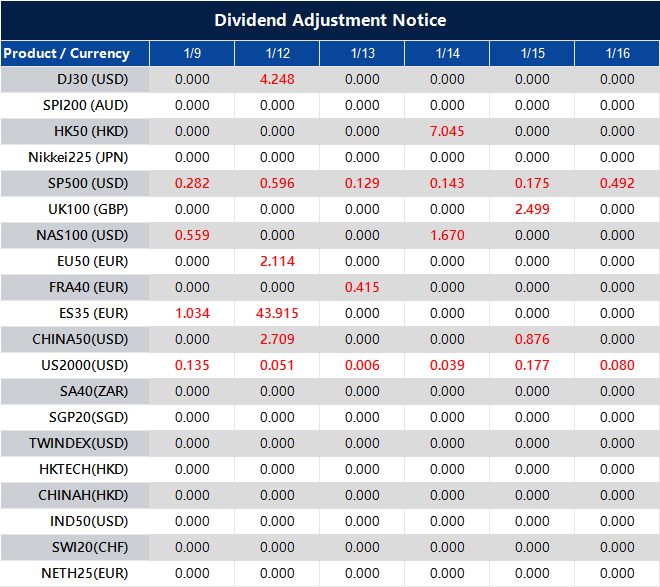
The above data is for reference only, please refer to the MT4/MT5 software for specific data.
If you’d like more information, please don’t hesitate to contact [email protected].







