
Back

Commerzbank says AUD/USD fell to 0.6950 as RBA weighs stagflation, with energy shocks lifting inflation

AUD/USD slipped 50 pips to 0.6950 as Australia faces stagflation risks. Markets are pricing a 54% probability of a Reserve Bank of Australia rate rise in May. Australia’s February core inflation, measured before the war, was unchanged at 3.3%. A Middle East energy shock may lift inflation in the coming months.

Market Pricing And Stagflation Risk

Consumer confidence has fallen to record lows. Services PMIs have moved into contraction. The RBA is weighing weaker growth and recession risk against higher fuel costs and wider price pressures. The report links the currency’s steadiness to expectations of tighter policy. Looking back at the situation in early 2025, we can see the severe dilemma the Reserve Bank of Australia faced. The market was pricing in a rate hike even as the economy was showing clear signs of weakness, with the AUD/USD hovering near 0.6950. This kind of uncertainty is where significant volatility is born, creating opportunities for options traders. As we now know, the RBA did proceed with two more rate hikes in mid-2025 to combat the energy-driven inflation, which ultimately peaked at 4.5% in the third quarter of last year. This aggressive stance, similar to what we saw globally in 2022, was a clear signal that containing prices was the primary objective. These actions tipped the economy into a mild technical recession in the second half of 2025.

Trading Implications For The Aussie Dollar

The consequence of prioritizing inflation was a predictable drag on the Australian dollar, which has since fallen to trade around 0.6580. The recent data confirms Australia’s GDP contracted by 0.2% and 0.1% in the last two quarters of 2025, respectively. This outcome shows how currencies often weaken when a central bank is forced to hike rates into a slowing economy. With the latest February 2026 inflation figures showing a welcome drop to 3.1%, the RBA has now shifted its stance completely. The bank initiated its first rate cut of this cycle earlier this month, bringing the cash rate down to 4.10% from its 4.60% peak. This pivot from tightening to easing has fundamentally changed the trading landscape for the Aussie dollar. For the coming weeks, the focus should be on the pace of these RBA rate cuts rather than on inflation risks. Implied volatility in AUD/USD options has decreased from last year’s highs, suggesting the market expects a more orderly decline. The primary risk is no longer a surprise hike but a more aggressive series of cuts if economic data continues to disappoint. Therefore, traders should consider strategies that benefit from a continued, but perhaps slower, decline in the AUD/USD. Buying medium-term put options offers a clear directional play with defined risk, protecting against a slide towards the 0.6400 level. Alternatively, selling out-of-the-money call options could be an effective strategy to generate income, as significant Aussie dollar strength seems highly unlikely while the RBA is actively easing policy. Create your live VT Markets account and start trading now.

Start trading now – Click here to create your real VT Markets account
GBP/USD lingers near 1.3360 in early European trade, as markets await clarity on an Iran ceasefire claim

GBP/USD traded in a tight range near 1.3360 in early European trading on Thursday. The pair held steady as markets awaited more information on whether Iran plans to pursue a ceasefire. On Wednesday, US President Donald Trump said Iran wanted a deal but was afraid to say so publicly, according to the Associated Press. Iran’s Foreign Minister Abbas Araghchi said there had been no ceasefire talks with the US and there were no plans for negotiations.

Market Focus And Geopolitical Backdrop

Iranian state TV said Tehran would end the war when it chooses and when its conditions are met, and would keep fighting across the region until then, The Guardian reported. The US Dollar Index (DXY) hovered near 99.65. GBP/USD was almost flat around 1.3360 at the time of writing. Price sat near the flattened 20-day Exponential Moving Average, which capped upside near 1.34, while the 14-day RSI stayed in the 40.00–60.00 range. Resistance was seen near 1.3390 and then 1.3480, the March 23 high. Support levels were 1.3257 and 1.3220, with lower levels pointing towards 1.31 if 1.3220 breaks. We recall a similar period of consolidation back in early 2025, when geopolitical headlines surrounding the US and Iran kept the GBP/USD pair locked in a tight range. That uncertainty created a holding pattern, as traders waited for a clear signal before committing to a direction. Today, we are seeing a parallel situation, not with Iran, but with the stalled UK-EU trade negotiations over financial services equivalency.

Options Strategies And Volatility Positioning

Currently, the GBP/USD is hovering around 1.2720, significantly lower than the levels seen back then, reflecting a different economic landscape. The latest UK inflation data came in at a stubborn 2.8%, keeping the Bank of England from signaling any rate cuts and capping the pound’s potential. This economic pressure is creating a bearish undertone, much like the technical setup we observed in 2025. On the other side of the pair, the US dollar remains firm after the last Non-Farm Payrolls report showed a stronger-than-expected 210,000 jobs added. This has reinforced the view that the Federal Reserve will hold interest rates steady through the summer. The strength of the US economy is putting consistent, gentle pressure on the cable. Given the potential for a sudden move once trade headlines break, derivative traders should be wary of selling volatility. The British Pound Volatility Index (BPVIX) has already ticked up 15% this past month to 9.2, indicating that options markets are anticipating a breakout from the current range. This suggests buying options may be a more prudent strategy than selling them. For those with a bearish conviction, buying GBP/USD put options with a strike price below the key 1.2650 support level seems appropriate. These positions could prove profitable if trade talks sour over the next few weeks, which would likely push the pair towards the 1.2500 psychological level. Historically, disappointments in UK-EU negotiations have led to sharp, multi-day declines in the pound. Alternatively, for traders who believe this tight range will persist for a few more weeks, an iron condor could be a suitable strategy. This would involve selling a call spread above the 1.2850 resistance and a put spread below the 1.2650 support. The aim would be to profit from the continued consolidation and time decay as long as the pair remains range-bound. Create your live VT Markets account and start trading now.

Start trading now – Click here to create your real VT Markets account

After three losing sessions, AUD/JPY hovers near 111.00 as RBA Kent boosts the Australian Dollar

AUD/JPY traded near 110.90 in Asian hours on Thursday, after three days of declines. The pair stayed close to 111.00 as the Australian Dollar found support from comments by RBA Assistant Governor Christopher Kent about managing inflation risks linked to higher energy prices. Kent said the RBA remains focused on low, stable inflation and full employment. He said policy may need to be tighter to stop short-term price rises from lifting longer-term inflation expectations.

Australian Inflation Data Pressures The Aussie

The Australian Dollar also faced pressure after softer inflation data. Australia’s annual CPI eased to 3.7% year on year in February from 3.8% in January, while trimmed mean CPI was 3.3% versus a 3.4% forecast and matched January’s revised result. AUD/JPY was also influenced by a firmer Japanese Yen on expectations of a near-term Bank of Japan rate rise. The BoJ kept its policy rate unchanged in March, and Governor Kazuo Ueda indicated a move in April remains possible. Japanese government bond yields rose on Thursday, with the 10-year at 2.27% after a two-day fall. Two-year yields reached three-decade highs and five-year yields hit record levels. We are seeing a familiar setup in AUD/JPY, though the cross is now trading significantly higher around 115.50. This is a stark contrast to the sideways grind near 111.00 we observed at this time in 2025. The core tension between a hawkish Reserve Bank of Australia and a cautious Bank of Japan continues to be the main driver.

Policy Divergence Supports Further Upside

Looking back, RBA Assistant Governor Kent’s warnings in early 2025 about inflation proved to be accurate. Despite the softer CPI data seen in February 2025, inflation has accelerated, with the latest Q1 2026 figures showing an annual rate of 4.1%. This persistence in price pressures suggests the RBA may deliver another rate hike in the second quarter. On the other side, the Bank of Japan did follow through on the market’s expectations, delivering its historic rate hike in April 2025. However, officials have since remained on the sidelines, signaling a prolonged pause to assess the impact on the economy. We’ve seen 10-year Japanese government bond yields retreat to 2.15%, down from the peak of 2.27% we saw in March of last year. This growing policy divergence strongly favors further upside in the AUD/JPY. We believe traders should position for a continued move higher by purchasing call options. Buying June 2026 calls with a strike price around 117.00 appears to be a prudent strategy to capture the next leg up. Furthermore, the Australian Dollar now has a tailwind that was less prominent last year. A resurgence in demand has pushed iron ore prices back above $130 a tonne, a level not consistently held in 2025. This fundamental support from commodities reinforces the bullish case for the AUD against a JPY backed by a central bank on hold. Create your live VT Markets account and start trading now.

Start trading now – Click here to create your real VT Markets account

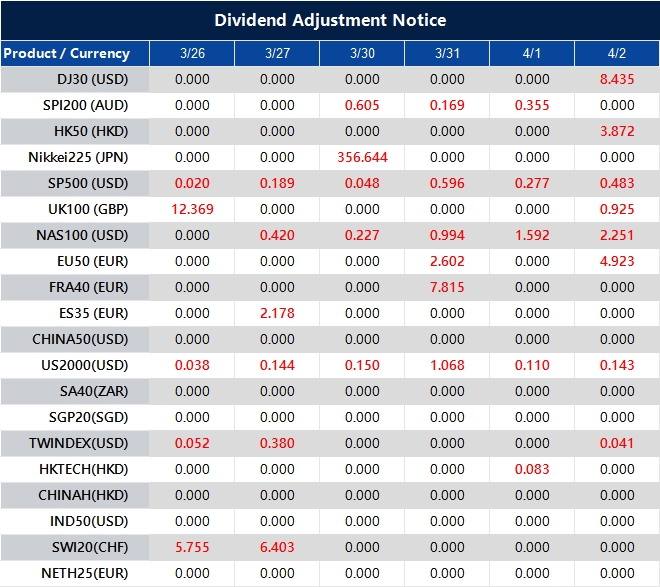
Dividend Adjustment Notice – Mar 26 ,2026

Dear Client,

Please note that the dividends of the following products will be adjusted accordingly. Index dividends will be executed separately through a balance statement directly to your trading account, and the comment will be in the following format “Div & Product Name & Net Volume”.

Please refer to the table below for more details:

Dividend Adjustment Notice

The above data is for reference only, please refer to the MT4/MT5 software for specific data.

If you’d like more information, please don’t hesitate to contact [email protected].

According to compiled data, gold prices in the United Arab Emirates increased as bullion rose

Gold prices in the United Arab Emirates rose on Thursday, based on FXStreet data. Gold was priced at AED 533.78 per gram, up from AED 532.08 on Wednesday. The price per tola increased to AED 6,225.61 from AED 6,206.13 a day earlier. FXStreet also listed AED 5,337.83 for 10 grams and AED 16,602.45 per troy ounce.

How Fxstreet Calculates Uae Gold Prices

FXStreet calculates UAE gold prices by converting international prices using the USD/AED rate and local units. The figures are updated daily at the time of publication and are for reference, as local rates may vary slightly. Central banks are the largest holders of gold. World Gold Council data says central banks added 1,136 tonnes of gold worth about $70 billion in 2022, the highest annual purchase on record. Gold often moves in the opposite direction to the US Dollar and US Treasuries. Prices can also react to geopolitical stress, recession fears, interest-rate changes, and shifts in the US Dollar because gold is priced in dollars (XAU/USD). Given the current market environment on March 26, 2026, the recent price action in gold is a clear signal. The Federal Reserve’s commentary last week has shifted market expectations, with pricing now indicating a 75% probability of a 25-basis-point interest rate cut by June. As a yield-less asset, gold becomes more attractive when interest rates are poised to fall.

Implications For Traders And Portfolio Hedges

This outlook is reinforced by the weakening US Dollar, which has dipped below the 102 level on the DXY. The latest Consumer Price Index (CPI) data showed headline inflation moderating to 2.8% year-over-year, giving the Fed room to ease policy and further pressuring the dollar. This continues the inverse relationship we have consistently observed, where a weaker dollar provides a direct tailwind for gold prices. We are also seeing growing demand for gold as a safe-haven asset amid slowing global growth indicators. Looking back at the market volatility we experienced in the second half of 2025, investors are now positioning for a potential economic downturn. This flight to safety is creating a strong floor for the precious metal, independent of monetary policy. The demand from central banks also remains a powerful underlying factor. Data from the World Gold Council showed that net purchases in the fourth quarter of 2025 reached 290 tonnes, continuing the robust trend of diversification by emerging economies. This consistent buying provides a structural support level for the market, suggesting dips will be well-supported. For derivative traders, this environment favors establishing bullish positions. Buying call options or implementing bull call spreads on gold futures could capture the expected upward momentum while defining risk. With implied volatility ticking up, these strategies allow for participation in a rally without the full capital outlay of a futures contract. Furthermore, traders should consider using gold derivatives as a portfolio hedge. Gold’s inverse correlation to risk assets, like equities, makes it an effective tool for protection against a potential stock market sell-off. Long positions in gold futures or ETFs can help cushion portfolios during the turbulent times we anticipate ahead. Create your live VT Markets account and start trading now.

Start trading now – Click here to create your real VT Markets account

Amid uncertain US-Iran negotiations, the Dollar Index slips to around 99.60, prolonging losses near 99.50

The US Dollar Index (DXY), which tracks the US Dollar against six major currencies, edged lower after two days of gains. It traded near 99.60 in Asian hours on Thursday. Markets monitored Middle East developments amid uncertainty over efforts to end the Iran conflict. The White House said talks were ongoing, and the Trump administration reportedly sent a 15-point proposal to Iran via Pakistan.

Middle East Conflict And Dollar Reaction

Senior Iranian officials were reviewing the US proposal but indicated no readiness to talk with Washington. Tehran also said it would reject a US ceasefire offer and set out a five-point plan that includes sovereign control over the Strait of Hormuz. TD Securities said the Federal Reserve faced mixed signals as the conflict added an oil shock. They said the US economy remained uneven, and expected the Fed to stay on hold in the near term, with possible rate cuts later in 2026 if conditions allow. Conflict-linked disruptions lifted energy prices, raising inflation concerns and supporting expectations that US rates stay unchanged this year. Markets awaited Thursday’s weekly Initial Jobless Claims for new labour market data. We recall this period in 2025 when the US Dollar Index was trading below 100 as geopolitical tensions in the Middle East created uncertainty. Fast forward to today, March 26, 2026, the DXY is significantly stronger, trading around the 104.3 level. This strength is a direct result of the Federal Reserve maintaining its restrictive monetary policy throughout the past year.

Rates Inflation And Positioning

The energy price shock we saw in 2025 did fuel persistent inflation, which has only recently started to show signs of easing. The latest Consumer Price Index (CPI) reading for February 2026 came in at 3.2%, which remains stubbornly above the Fed’s 2% target. This data reinforces our expectation that any potential rate cuts are likely pushed to the second half of this year. The labor market also remains surprisingly robust, giving the Fed more room to wait. Last week’s initial jobless claims were a low 210,000, continuing a trend that has defied predictions of a significant economic slowdown. For derivative traders, this sustained economic strength suggests that the “higher for longer” interest rate environment is the base case scenario for now. Considering this, we are seeing traders position for a patient Fed through options on Secured Overnight Financing Rate (SOFR) futures. Many are selling calls or establishing put spreads on the September 2026 contracts, betting that a summer rate cut is now off the table. This strategy benefits from rate expectations remaining anchored at current levels in the near term. In the currency space, this implies continued dollar strength against currencies whose central banks may cut rates sooner, like the Euro or Swiss Franc. Traders could consider call options on the DXY or put options on the EUR/USD pair. However, it is wise to buy some protection against unexpected volatility, as any surprising inflation data could shift market sentiment rapidly. Create your live VT Markets account and start trading now.

Start trading now – Click here to create your real VT Markets account

FXStreet data shows gold prices in Pakistan increased, with gains reported and values rising according to compiled figures

Gold prices in Pakistan rose on Thursday, based on FXStreet data. Gold was priced at PKR 40,695.13 per gram, up from PKR 40,580.27 on Wednesday. The rate per tola increased to PKR 474,660.00 from PKR 473,320.30 a day earlier. Other listed prices were PKR 406,951.30 for 10 grams and PKR 1,265,804.00 per troy ounce.

Local Pricing Method

FXStreet derives local gold prices by converting international rates using USD/PKR and applying local units. The figures are updated daily at the time of publication and are provided for reference, with local market rates possibly differing slightly. Central banks are the largest holders of gold. World Gold Council data shows central banks added 1,136 tonnes of gold worth around $70 billion in 2022, the highest annual total since records began. Gold prices are often inversely related to the US Dollar and US Treasuries, and can also move against risk assets such as equities. Prices may also react to geopolitical events, recession concerns, and changes in interest rates, with gold typically priced in US dollars (XAU/USD). Given the current environment on March 26, 2026, we see gold acting as a key safe-haven asset. Geopolitical tensions in several key shipping lanes are creating uncertainty, and this is happening alongside a weakening of the US Dollar. These factors are supporting gold’s value, reinforcing its traditional role during turbulent times.

Market Outlook And Strategy

Central bank activity continues to provide a strong floor for prices, a trend we’ve observed for several years. World Gold Council data showed that central banks collectively purchased over 1,000 tonnes again in 2025, signaling a persistent strategy to diversify away from sovereign debt. This consistent buying pressure suggests that any significant dips in price will likely be met with strong institutional demand. Interest rate uncertainty in the United States is another major catalyst for derivative traders. After the series of cuts throughout 2025, the Federal Reserve’s current pause has markets guessing its next move, which increases gold’s appeal as a non-yielding asset. February 2026’s slight uptick in the Consumer Price Index to 3.1% has only added to this speculation about future policy. This uncertainty is creating opportunities in the options market, as implied volatility on gold has been rising. The Gold VIX (GVZ) is now trading near 19, up from lows of around 14 we saw late last year. Traders should consider strategies like long straddles or strangles to profit from a significant price move in either direction over the coming weeks. For those with a directional bias, the fundamental picture appears to favor bullish positions. The Dollar Index (DXY) has struggled to stay above the 98 level, and further weakness could propel gold higher. Buying call options or implementing bull call spreads can offer a capital-efficient way to gain upside exposure while defining risk. We are also seeing gold’s inverse correlation with equities become more pronounced again. With major stock indices testing all-time highs after a strong recovery in 2025, using gold futures or options as a portfolio hedge is a prudent strategy. A downturn in risk assets would likely trigger a flight to safety, directly benefiting gold positions. Create your live VT Markets account and start trading now.

Start trading now – Click here to create your real VT Markets account

According to compiled data, gold prices in India increased, with figures showing a rise on Thursday

Gold prices in India rose on Thursday, based on FXStreet data. Gold was priced at INR 13,705.30 per gram, up from INR 13,662.52 on Wednesday. Gold increased to INR 159,855.70 per tola from INR 159,356.90 a day earlier. Listed reference prices were INR 137,058.10 for 10 grams and INR 426,282.70 per troy ounce.

India Gold Pricing Method

FXStreet derives India gold prices by converting international rates using USD/INR and local unit measures. Prices are updated daily using market rates at publication time, and local prices may vary slightly. Central banks are the largest holders of gold. They added 1,136 tonnes worth around $70 billion in 2022, the highest annual purchase since records began, according to the World Gold Council. Gold often moves inversely to the US Dollar and US Treasuries, and can also move opposite to risk assets such as equities. Prices can be influenced by geopolitical risks, recession fears, interest rates, and shifts in the US Dollar because gold is priced in dollars (XAU/USD). The current high price of gold reflects its value as a hedge against inflation and currency depreciation. We see this confirmed by the latest US Consumer Price Index data for February, which showed inflation remaining persistent at 3.8%. This environment makes holding non-yielding assets like gold more attractive.

Market Drivers And Outlook

A major driver continues to be demand from central banks, which have extended the massive buying spree we witnessed back in 2022. Data from the last quarter of 2025 showed that emerging economies added another 290 tonnes to their reserves. This consistent buying provides a strong underlying bid for the market. Gold’s inverse correlation with the US Dollar is critical right now. The futures market is pricing in a 75% probability of a Federal Reserve interest rate cut by the third quarter, which is putting pressure on the dollar. A weaker dollar and lower expected yields make gold mathematically more appealing. For traders, this implies that implied volatility in options markets will remain elevated, making long-dated call options a viable strategy to capture further upside. Looking back at the price action in 2025, we recall how gold broke through resistance after long periods of consolidation. Therefore, using put options as a portfolio hedge against any sharp, unexpected reversal is also a prudent consideration. We must also factor in ongoing geopolitical instability, which is underpinning gold’s role as a safe-haven asset. Any escalation of current global tensions would likely trigger another leg up in price. This risk premium is keeping traders from taking on significant short positions. Create your live VT Markets account and start trading now.

Start trading now – Click here to create your real VT Markets account

Notification of Server Upgrade – Mar 26 ,2026

Dear Client,

As part of our commitment to provide the most reliable service to our clients, there will be maintenance this weekend.

Maintenance Details:

Notification of Server Upgrade

Please note that the following aspects might be affected during the maintenance:
1. The price quote and trading management will be temporarily disabled during the maintenance. You will not be able to open new positions, close open positions, or make any adjustments to the trades.
2. There might be a gap between the original price and the price after maintenance. The gaps between Pending Orders, Stop Loss, and Take Profit will be filled at the market price once the maintenance is completed. It is suggested that you manage the account properly.
3. During the maintenance period, VT Markets APP will not be available. It is recommended that you avoid using it during the maintenance.
4. During the maintenance hours, the Client portal will be unavailable, including managing trades, Deposit/Withdrawal and all the other functions will be limited.

The above data is for reference only. Please refer to the MT4/MT5 software for the specific maintenance completion and marketing opening time.

Thank you for your patience and understanding about this important initiative.

If you’d like more information, please don’t hesitate to contact [email protected]

FXStreet’s compiled data shows gold prices in Malaysia increased, with bullion gaining value in Thursday trading

Gold prices in Malaysia rose on Thursday, based on FXStreet data. Gold was priced at MYR 580.71 per gram, up from MYR 578.74 on Wednesday. Gold increased to MYR 6,773.21 per tola from MYR 6,750.28 a day earlier. The listed prices were MYR 5,807.03 for 10 grams and MYR 18,061.91 per troy ounce.

Malaysia Gold Price Update

FXStreet derives Malaysia’s gold prices by converting international rates using USD/MYR and local measurement units. The figures are updated daily using market rates at the time of publication, and local prices may vary slightly. Central banks were reported as the largest gold holders. World Gold Council data said central banks added 1,136 tonnes of gold worth around $70 billion in 2022, the highest annual total since records began. Gold is described as inversely correlated with the US Dollar and US Treasuries, and also with risk assets such as equities. Gold price movements are linked to factors including geopolitical instability, recession concerns, interest rates, and US Dollar strength because gold is priced in dollars (XAU/USD). Given the slight increase in gold prices, we should focus on the underlying factors that support the precious metal as a safe-haven asset. Last year, in 2025, we saw global economic growth slow more than anticipated, and early 2026 data suggests this trend is continuing. This environment, coupled with persistent inflation that averaged over 3.5% in the US during the final quarter of 2025, strengthens the case for holding gold as a hedge.

Key Drivers To Watch

Central bank demand continues to be a major supportive factor, providing a solid floor for prices. Following the record-breaking purchases of the early 2020s, central banks collectively added another 980 tonnes to their reserves in 2025, with the People’s Bank of China and the Reserve Bank of India leading the buying. This institutional demand suggests that any significant price dips will likely be met with strong buying interest. The inverse relationship with the US Dollar is critical for our strategy in the coming weeks. The dollar has weakened by about 2% against a basket of currencies since the start of March 2026, creating a direct tailwind for gold priced in USD. As we monitor the Federal Reserve’s language for any hints of a more dovish stance, this dollar weakness could accelerate. For derivative traders, this environment of conflicting signals—high interest rates versus slowing growth—suggests an increase in volatility. Consider using options strategies like straddles to play a potential sharp price move, regardless of direction, as geopolitical tensions in the South China Sea continue to simmer. For those with a bullish outlook, buying call options on gold futures offers leveraged exposure while defining risk. However, we must remain cautious about the impact of high interest rates, which typically act as a headwind for a non-yielding asset like gold. While the market has priced in the current rate environment, any indication from central banks that rates will stay higher for longer than expected could cap the upside. Therefore, using strategies like bull call spreads could be prudent to limit premium costs and define profit potential in a potentially range-bound market. Create your live VT Markets account and start trading now.

Start trading now – Click here to create your real VT Markets account

Back To Top
server

Hello there 👋

How can I help you?

Chat with our team instantly

Live Chat

Start a live conversation through...

  • Telegram
    hold On hold
  • Coming Soon...

Hello there 👋

How can I help you?

telegram

Scan the QR code with your smartphone to start a chat with us, or click here.

Don’t have the Telegram App or Desktop installed? Use Web Telegram instead.

QR code

