



As momentum declines, EUR/JPY drops below 183.00, trading around 182.80 during European hours.
EUR/JPY has fallen below 183.00, hitting a near three-week low of 181.57. The 14-day Relative Strength Index is at 50.96, showing weak momentum. The main resistance level is at the nine-day EMA of 183.44.
On Wednesday, EUR/JPY traded around 182.80, marking its fourth straight session of losses. This decline follows Germany’s Retail Sales report, which indicated a 1.1% increase year-over-year in November. However, monthly sales decreased by 0.6%, worse than the 0.3% drop in October and below the market’s 0.2% growth expectation.
Consumer confidence in France meets expectations, scoring 90 in December
**Current Events in Venezuela**
Aave’s price is at $172 as of Wednesday, close to the upper trendline of its current pattern. If it breaks from this pattern, it could mean potential gains for buyers.
The author of this article and FXStreet do not provide registered investment advice. This article should not be seen as investment guidance.
Looking back at last month, the stable French consumer confidence reading of 90 in December 2025 shows a calm outlook for European markets. While still below the long-term average of 100, this number suggests that consumers are not panicking. For traders, this might reduce the appeal of buying protection on indexes such as the CAC 40. Instead, strategies that benefit from low volatility, like selling covered calls, could become more appealing.
**The US ADP Employment Report**
This week, the US ADP employment report for December 2025 drew attention, as it showed a disappointing increase of +25,000 jobs, falling short of the +45,000 forecast. This weak figure, coming after job losses in November, indicates a rapidly cooling labor market. It strengthens the likelihood that the Federal Reserve may consider cutting rates sooner than expected. This outlook makes futures contracts anticipating lower interest rates an attractive trade, and suggests that the US dollar could weaken against major currencies.
While we are not changing our main forecasts due to events in Venezuela, we shouldn’t overlook the political uncertainty there. Historically, instability in major oil-producing nations can lead to unexpected supply issues and price spikes, similar to past unrest in the early 2000s. Traders might want to consider buying inexpensive, long-dated call options on crude oil futures as a budget-friendly way to protect against sudden disruptions that the wider market may be ignoring.
In the digital asset space, Aave was testing key resistance around $172 in December 2025. Given the high volatility in crypto, a breakout above a clear pattern often signals a sharp move up, like what we saw across the sector in early 2025. This setup suggests that buying call options on AAVE or related assets could lead to significant gains if the market’s bullish trend continues in the coming weeks.
Create your live VT Markets account and start trading now.
Market participants expect Eurozone inflation figures and U.S. employment statistics.
On Wednesday, markets expect potential fluctuations due to significant economic data releases. Eurostat will provide December inflation numbers, while the US will share the ADP Employment Change for December, JOLTS Job Openings for November, and the ISM Services PMI for December.
The US Dollar Index rose on Tuesday after a decline on Monday, settling around 98.50 early Wednesday. In Germany, December’s annual inflation decreased to 1.8% from November’s 2.3%, causing the Euro to lose nearly 0.3% against the US Dollar.
Australia’s Economic Performance
Australia reported a yearly CPI rise of 3.4% for November, which is lower than the expected 3.7%. This keeps AUD/USD strong near 0.6750. GBP/USD slipped after reaching a September high and now stabilizes near 1.3500. USD/JPY remains steady at about 156.50, with Japan’s Labor Cash Earnings data set for release on Thursday. Gold gained 1%, staying above $4,450, while Silver’s two-day rally increased by over 10%, trading above $80. Employment levels affect currencies—higher employment boosts a local currency’s value, while inflation influences monetary policy. Wage growth impacts consumer spending and inflation, guiding central banks’ decisions. Central banks view employment as a key indicator of economic health and its link to inflation. Last year, in January 2025, we prepared for volatility from key Eurozone inflation and US employment reports. The US Dollar was gaining strength around 98.50, and there was significant interest in how central banks would respond to the data. Many themes from that time have since evolved, creating new opportunities. Looking back, the US labor market began to cool throughout 2025, a crucial development we were monitoring. For example, the December 2025 Non-Farm Payrolls report showed job growth slowing to 155,000, falling short of expectations and confirming easing wage pressures. This shift changed the Federal Reserve’s outlook, suggesting that rate cuts are a matter of when, not if, leading the Dollar Index closer to 101.50.Persistent Inflation in Europe
In Europe, the inflation situation has proven to be more stubborn than the 2% forecast from last year. The flash estimate for Eurozone core HICP in December 2025 was a steady 2.7%, putting pressure on the European Central Bank to keep a tight monetary policy. This divergence in policy has seen EUR/USD drop from around 1.1700 in early 2025 to the 1.0800 range today. Traders may want to consider strategies that can benefit from this ongoing tension. The impressive rally in precious metals in late 2024 and early 2025, with Gold exceeding $4,450, eventually faded as high interest rates impacted the market over the past year. However, with the possibility of declining US rates soon, these non-yielding assets are becoming appealing again. Derivative traders should consider buying call options on gold and silver in anticipation of a potential comeback in the first half of 2026. With shifts in central bank expectations, implied volatility in currency and bond markets is likely to increase in the coming weeks. We expect significant movements in pairs sensitive to US interest rates, such as USD/JPY, currently around 147.00. Traders may consider purchasing put options on USD/JPY as a strategy to prepare for the Fed indicating imminent rate cuts. Create your live VT Markets account and start trading now.Gold prices decline in Saudi Arabia, according to recent market information.
Gold prices in Saudi Arabia dropped on Wednesday. The price per gram is now SAR 538.29, down from SAR 541.86 on Tuesday. The price per tola also fell to SAR 6,278.45, down from SAR 6,320.11 the previous day.
Gold prices are based on international market prices converted to Saudi Arabian Riyals (USD/SAR), and these prices are updated daily. Local rates may vary slightly from these averages.
Gold As A Safe Haven
Gold has historically been a reliable store of value and is now considered a safe asset, especially in uncertain times. It protects against inflation and currency loss. Central banks are the biggest buyers of gold. In 2022, they purchased 1,136 tonnes, with countries like China, India, and Turkey increasing their reserves. Central banks buy gold to show economic stability. Gold prices move in the opposite direction of the US Dollar and Treasuries. When the Dollar weakens, gold prices usually rise. Lower interest rates can also boost gold prices. Economic and geopolitical events can affect gold’s value since it is a safe-haven asset. The recent drop in gold prices is likely just a slight correction rather than the start of a long-term decline. We see this as a brief pause before a potential rise, influenced by the current economic conditions. This dip could be a good opportunity for traders looking to benefit in the short term.Interest Rate Effects
Our outlook is influenced by expectations for monetary policy, especially following the interest rate increases throughout much of 2025. Current market data from the CME FedWatch Tool shows a greater than 70% chance of at least one interest rate cut by the U.S. Federal Reserve in the second half of 2026. This situation makes non-yielding assets like gold more attractive, suggesting that long positions through futures or call options could be beneficial. The changing expectations for interest rates are also impacting the U.S. Dollar. The Dollar Index (DXY) has decreased from its late 2025 highs and is now close to a six-month low, which helps gold prices. Since gold is priced in Dollars, a weaker Dollar makes it more affordable for those using other currencies, increasing demand. We must also consider the ongoing demand from central banks, which supports gold prices. Official figures from the World Gold Council indicate that central banks bought over 800 tonnes in the first three quarters of 2025, maintaining a high buying rate. This institutional buying helps stabilize prices and limits significant drops. Lastly, ongoing geopolitical uncertainty and concerns about a slowing global economy are strengthening gold’s position as a safe-haven asset. Gold surged over 10% during a similar period of economic uncertainty in early 2023. Traders should keep an eye on market volatility, as a rush to safety could significantly raise gold prices. Create your live VT Markets account and start trading now.Gold prices in the Philippines recently declined, according to data analyses.
Gold prices in the Philippines dropped on Wednesday, according to FXStreet data. The price per gram fell to 8,510.35 Philippine Pesos (PHP), down from 8,567.24 PHP the day before. The price per tola also decreased to PHP 99,263.27, down from PHP 99,926.58.
Gold prices in the Philippines reflect international prices, adjusted using the USD/PHP exchange rate. These rates are updated daily and can vary locally.
The Role of Gold as a Store of Value
Gold has been a reliable store of value throughout history, especially in uncertain times. In 2022, central banks, the biggest buyers, purchased 1,136 tonnes of gold worth about $70 billion—the highest annual increase ever. Gold typically moves in the opposite direction of the US Dollar and Treasuries. When the Dollar weakens, gold’s value usually rises, offering diversification during market turbulence. Prices can be influenced by factors like geopolitical issues and interest rates. A weaker Dollar generally boosts gold prices, while a stronger Dollar can bring them down. Recently, local gold prices saw a slight dip, but this is likely a temporary blip in a larger global trend. The main factor driving gold prices is its value in US dollars, affected by major economic influences. For traders, focusing on these daily fluctuations is crucial for positioning themselves over the coming weeks. The market is now fully expecting the Federal Reserve to keep cutting rates, a trend that began in late 2025. However, the latest inflation data from December 2025 revealed that core CPI remained stubborn at 3.2%, surprising analysts who anticipated a figure closer to 3.0%. This mix of expected lower rates and enduring inflation supports a non-yielding asset like gold.Pressure on the US Dollar
This situation has put ongoing pressure on the US dollar, a significant factor in driving gold prices higher. We have seen the US Dollar Index (DXY) decline from its 2025 highs above 104 to consistently trading below 100 this year. A weaker dollar makes gold more affordable for foreign buyers, providing a boost for the metal. Additionally, we can’t overlook the strong demand from central banks. After record purchases in previous years, final data for 2025 showed that central banks added over 1,000 tonnes to their reserves, with emerging markets leading the shift away from the dollar. This consistent buying underpins gold prices and reflects confidence from major institutions worldwide. With riskier assets like the S&P 500 struggling to gain momentum after a strong rally in late 2025, traders should consider gold as a key protective asset. Ongoing geopolitical tensions from last year also keep demand for safe-haven assets high, making gold derivatives a smart choice for portfolio protection. Thus, we believe traders should use this slight dip as a chance to buy long-dated call options to capture potential gains in the spring. Using gold futures for leveraged long positions is also a strategic option, especially with important inflation reports and Fed meetings approaching. Any additional weakness in the Dollar should be viewed as a solid opportunity to increase exposure. Create your live VT Markets account and start trading now.Geopolitical tensions and dovish Fed comments weaken USD/CHF to around 0.7950
The USD/CHF currency pair dropped to around 0.7950 during early trading in Europe. This decline is happening as geopolitical tensions rise and US Federal Reserve officials hint at possible “aggressive” rate cuts.
The US Dollar is under pressure against the Swiss Franc due to the complicated situation in Venezuela. Recently, the US military detained Venezuelan leaders, which has increased demand for safe-haven assets, like the CHF.
Influence of Geopolitical Tension
As the US takes action, its President has declared control over Venezuela. Russia’s military movements near Venezuela are being closely monitored, as they may further influence the USD/CHF pair. The USD is also facing pressure from dovish signals from the Federal Reserve. Stephen Miran stressed the need for significant rate cuts, and Neel Kashkari shared concerns about rising unemployment rates. The Swiss Franc is seen as a top safe-haven currency because of Switzerland’s stable economy and neutral policies. The Swiss National Bank’s decisions, Switzerland’s economic data, and policies from the Eurozone heavily impact the CHF. Switzerland’s close ties to the Eurozone mean changes there can significantly affect the Swiss Franc. The relationship between the CHF and EUR highlights Switzerland’s economic connections to the larger EU markets.Market Impact of Safe Haven Dynamics
With the ongoing Venezuela crisis and dovish comments from the Fed, we are seeing a flight to safety that favors the Swiss Franc. The recent deployment of Russian naval assets near Venezuela has heightened market anxiety. This geopolitical tension is the main factor pushing USD/CHF closer to the 0.7900 level. Pressure on the US Dollar is both external and internal. Governor Miran’s call for aggressive rate cuts comes after a slowdown in the economy observed in late 2025, where GDP growth dipped to just 0.9%, and the December jobs report showed the first net payroll loss in over a year. Traders should expect continued weakness in the dollar, regardless of safe-haven flows. It’s crucial to keep an eye on the Swiss National Bank (SNB), as a rapidly rising Franc poses a threat to their export-driven economy. This brings to mind the market turmoil in 2015 when the SNB unexpectedly dropped the EUR/CHF peg. The bank will likely avoid a repeat of that chaos, so expect verbal interventions if the pair falls sharply below 0.8000. This situation creates a tense and uncertain environment, evident in derivatives pricing. Implied volatility on one-month USD/CHF options has surged to over 12%, a level last seen during regional banking stresses in 2023. This suggests traders might want to explore strategies for profit from large price swings, like long straddles, instead of making simple directional bets. Looking ahead, today’s US ISM Services PMI report will be key for gauging the economy’s health. A weaker-than-expected report could worsen the dollar’s decline and push USD/CHF to test its 2025 lows. Conversely, a surprisingly strong report might temporarily boost the dollar, but it’s unlikely to alter the overall trend while the Venezuela situation remains unresolved. Create your live VT Markets account and start trading now.NZD/USD remains steady around 0.5785 ahead of US data release
Key US Economic Data Releases
Today, important US economic data will be released, including ADP Employment Change, ISM Services PMI, and JOLTS Job Openings. Employment numbers are vital for the Federal Reserve’s monetary policy. ADP is predicted to report 45,000 new private sector jobs, contrasting with November’s decrease of 32,000 jobs. Total job openings are expected to be around 7.64 million, similar to October’s figure of 7.67 million. If labor demand improves, it may lower expectations for more interest rate cuts by the Fed. Last year, the Fed reduced rates by 75 basis points to help a struggling job market. This week, we also await China’s Trade Balance data, which affects the New Zealand Dollar. New Zealand’s economy heavily depends on exports to China. The ADP Employment Change, a measure by Automatic Data Processing Inc., can influence consumer spending and economic growth. Traders often see it as a signal of the Bureau of Labor Statistics’ Nonfarm Payrolls report.Market Reactions and Strategies
Today, January 7th, 2026, the NZD/USD pair is trading quietly around 0.5785. Our main focus is on the key US economic data being released. As the market rebounds after the holiday season, these figures will guide our actions for the upcoming weeks. We are looking for indicators of strength or weakness in the US labor market. The first report, the ADP Employment Change for December, exceeded expectations with a strong gain of 95,000 jobs, which is more than double the anticipated 45,000. This challenges the previous belief that the US job market was rapidly weakening in the latter half of 2025. This positive news bolsters the outlook for the US Dollar. Last year, the Federal Reserve cut interest rates by 75 basis points to support a slowing labor market. The stronger-than-expected job creation lowers the chance of further significant cuts in the first quarter. Consequently, the US Dollar Index is rising, putting pressure on pairs like NZD/USD. Meanwhile, we are cautious about the New Zealand Dollar as we await China’s trade data this week. Recent satellite data and port traffic from late December suggest a possible slowdown in Chinese exports. Given New Zealand’s heavy reliance on exports to China, any confirmation of this weakness may negatively impact the Kiwi dollar. For those trading derivatives, this situation indicates a bearish outlook for NZD/USD. Buying put options with expiration dates in late February or March is a solid strategy to benefit from a potential drop below the 0.5700 support level. This approach limits risk to the premium paid and allows for significant gains if the pair declines as expected. We should also brace for increased implied volatility ahead of the official Nonfarm Payrolls data later this week. If ADP’s strong numbers are confirmed, it could lead to a larger movement in the currency pair. Traders might want to consider strategies that take advantage of major price swings, regardless of direction, if they feel uncertain about the NFP results. Create your live VT Markets account and start trading now.Gold prices have decreased in the United Arab Emirates, according to recent market data.
**Gold As A Safe Haven**
Gold prices in the United Arab Emirates fell on Wednesday, according to FXStreet data. The price per gram dropped to 527.18 AED from 530.61 AED on Tuesday. The price per tola decreased to 6,148.97 AED, down from 6,188.90 AED.
FXStreet calculates these UAE gold prices by adjusting international prices to local currency and measurement units, updating daily. These prices serve as a reference; local rates may vary slightly.
Gold has long been recognized as a way to store value and as a method of exchange. Besides its use in jewelry, it acts as a safe-haven asset and a hedge against inflation and currency loss, especially during economic turmoil.
Central banks, which hold the most gold, use it to diversify their reserves, strengthening their economies. In 2022, central banks added 1,136 tonnes of gold—worth about $70 billion—to their reserves, marking the largest annual purchase ever recorded.
Gold prices often move in the opposite direction of the US Dollar and US Treasuries. When these decrease, gold prices generally increase. Its value is influenced by geopolitical unrest, economic concerns, interest rates, and the behavior of the dollar; typically, a strong dollar puts pressure on gold prices.
**Gold Price Trends**
Gold prices recently dipped to 527.18 AED per gram. We see this as a minor fluctuation rather than a shift in trend. This small pullback could be a chance for traders to prepare for the upcoming weeks. The main market drivers continue to support gold.
A key factor is the inverse relationship with the US Dollar, which is currently under pressure. The DXY index has dropped from its peak in late 2025 to around 103.5, benefiting gold prices. We anticipate this trend will persist, especially as discussions about possible Federal Reserve rate cuts later this year gain traction.
Speculation about interest rates arises from recent data showing US inflation has cooled to 2.5% and the unemployment rate has slightly increased in the last quarter of 2025. In a climate of falling interest rates, gold becomes more attractive as it does not yield interest. This economic backdrop points to a positive outlook for the weeks ahead.
We also need to consider the steady demand from central banks, which provides strong support for prices. Following record purchases in previous years, the World Gold Council reported that another 950 tonnes were added to official reserves by the end of 2025. This ongoing institutional buying helps reduce major downside risk for traders.
In this context, we view the current price dip as an opportunity to enter or increase bullish positions. Purchasing call options might be a smart move to take advantage of potential upside while managing risk. We are monitoring key technical levels, and a return above recent highs would confirm that the uptrend is resuming.
Create your live VT Markets account and start trading now.
Gold prices in Pakistan decreased today, according to market data reported by analysts.
Gold prices in Pakistan fell on Wednesday. The price was 40,245.19 Pakistani Rupees (PKR) per gram, down from 40,487.64 PKR the day before. The cost per tola also dropped to PKR 469,412.00 from PKR 472,239.90.
FXStreet adjusts international prices to reflect local currency and units, updating them daily. However, local market prices can vary slightly from these references.
Gold as a Hedge Against Inflation
Gold is often seen as a safe investment and a way to protect against inflation and currency loss. Central banks hold a lot of Gold, with 1,136 tonnes added to global reserves in 2022, making it the largest yearly purchase ever. Gold prices tend to move opposite to the US Dollar and Treasuries. A weaker Dollar can lead to higher Gold prices, especially when interest rates are low. Economic issues like geopolitical unrest or fears of recession can quickly change Gold’s value, as it is viewed as a safe choice. Factors like geopolitics and interest rates, especially concerning the US Dollar, greatly impact Gold prices. A strong Dollar generally keeps Gold prices down, while a weak Dollar can push them up. Currently, we are experiencing a small drop in gold prices, which seems to be a temporary fluctuation rather than a long-term trend. The main influence on Gold in the coming weeks is the outlook for U.S. interest rates. According to the CME FedWatch Tool, traders see over a 70% chance of a Federal Reserve rate cut by the second quarter, which could weaken the Dollar and boost Gold.Inflation and Gold Sensitivity
In 2025, persistent inflation concerns kept Gold appealing as a safe investment, even though the U.S. headline CPI averaged 3.1% for the year. This suggests that any signs of economic instability could quickly increase Gold demand. For traders, this means Gold is highly sensitive to political news and fears of recession. A major factor supporting Gold is the ongoing purchasing by central banks, which surged remarkably after record purchases in 2022 and 2023. Data from the World Gold Council shows that strong buying from official sectors continued into 2025, led by emerging market banks. This steady demand creates a solid price floor, reducing the immediate risk of price drops. Gold’s opposite relationship with riskier assets is also essential now, particularly after the S&P 500’s strong performance through the end of 2025. With stock markets near their all-time highs, Gold offers a relatively undervalued hedge against potential downturns in equities. Weakness in stock prices can signal strength in Gold. Given these factors, derivative traders should see current price levels as a good chance to take bullish positions. Using long-term call options, ideally expiring in the second or third quarter, could effectively leverage anticipated rate cuts. This method allows traders to benefit from a weaker Dollar while managing risk. Create your live VT Markets account and start trading now.Dividend Adjustment Notice – Jan 07 ,2026
Dear Client,
Please note that the dividends of the following products will be adjusted accordingly. Index dividends will be executed separately through a balance statement directly to your trading account, and the comment will be in the following format “Div & Product Name & Net Volume”.
Please refer to the table below for more details:
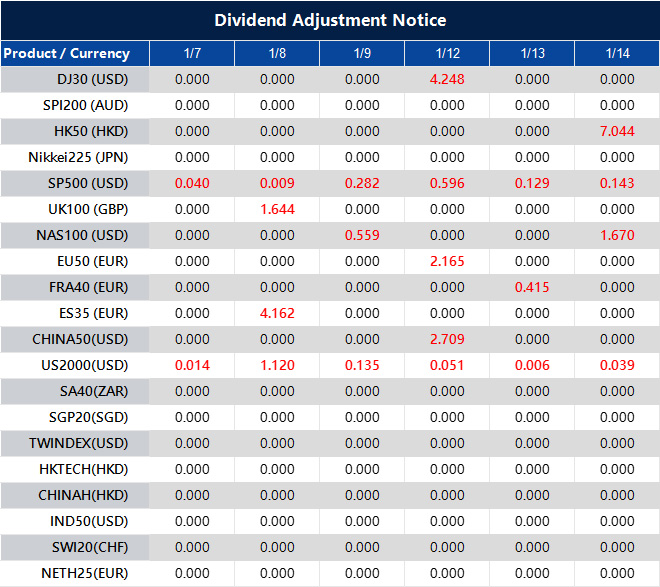
The above data is for reference only, please refer to the MT4/MT5 software for specific data.
If you’d like more information, please don’t hesitate to contact [email protected].







