



EUR/USD struggles near 1.1760, showing a weakening bullish trend while testing support levels
**EUR/USD Positive Indicators**
The 14-day RSI stands at 63.92, indicating positive momentum as it remains above the midpoint. While it has cooled from recent highs, it still suggests buyers are in control.
The nine-day EMA has moved above the 50-day EMA, reinforcing a bullish trend. EUR/USD remains above both averages, maintaining a short-term uptrend.
The upward-sloping nine-day EMA offers dynamic support. Staying above it keeps the path to higher prices open.
EUR/USD may reach 1.1800 and possibly hit a three-month high of 1.1808. Further gains could aim for 1.1918, the highest level since June 2021, followed by 1.1930.
On the downside, breaking below the nine-day EMA and the lower channel boundary could weaken momentum. This might test the 50-day EMA at 1.1673 and potentially the three-week low of 1.1589.
**Euro Market Context**
Today, the Euro is weakest against the Australian Dollar. Percentage changes of the Euro against major currencies are noted.
As of December 29, 2025, the EUR/USD pair is testing a crucial support level near the nine-day EMA at 1.1757. Although the overall trend has been bullish, momentum has been slowing for four sessions, indicating a crucial moment ahead in the coming weeks.
This weakness in the Euro may be supported by recent data showing a gap between central bank views. The latest December 2025 estimates reveal Eurozone inflation has dropped to 2.1%, almost at the ECB’s target, possibly leading to rate cuts in 2026. In contrast, US core PCE inflation remains steady at 2.8%, backing the Fed’s stance on keeping rates high for longer.
The strong US non-farm payroll report from early December 2025, which added over 200,000 jobs, supports the dollar’s strength. Given this economic situation, breaking below the 1.1757 support level seems likely. Traders should closely monitor this level for signs of a deeper correction.
For those expecting a bounce, buying call options with a strike price above 1.1800 could be a low-risk strategy to profit from a move towards the December 24th high. This plan relies on the nine-day EMA holding strong. The Relative Strength Index is lower but still above 50, indicating some buying power remains.
On the other hand, if the pair breaks decisively below 1.1757, buying put options may be a wise move. This strategy would target a decline towards the 50-day EMA at 1.1673, aligning with fundamental pressures from the differing US and Eurozone economies.
**Market Liquidity and Speculator Behavior**
It’s important to note that market liquidity is currently low due to the holiday season, but it is expected to rebound in the first full week of January 2026. Historically, this increase in volume can lead to significant market movements as new positions are opened for the year. Recent CFTC data from before Christmas indicated that large speculators have started to reduce their net-long Euro positions, suggesting a shift in sentiment may be underway.
Create your live VT Markets account and start trading now.
Gold prices in Saudi Arabia have recently declined, according to market data.
Gold prices in Saudi Arabia fell on Monday, according to FXStreet data. The price dropped to 544.27 Saudi Riyals (SAR) per gram from SAR 546.41 on Friday. For one tola of gold, the price decreased from SAR 6,373.19 to SAR 6,348.17.
The cost for 10 grams of gold was SAR 5,442.65, and a Troy ounce was priced at SAR 16,928.90. FXStreet updates these prices daily, adjusting international rates to the local currency using USD/SAR values. There might be slight variations in local markets.
Store Of Value And A Hedge Against Volatility
Gold acts as a store of value and protects against market fluctuations and inflation. Central banks, the biggest gold holders, bought 1,136 tonnes worth $70 billion in 2022—setting a record for annual purchases. Countries like China, India, and Turkey are increasing their gold reserves significantly. Gold prices can change due to geopolitical events and economic factors. Typically, lower interest rates lead to higher gold prices, while higher rates can bring them down. Additionally, a strong US Dollar negatively affects gold prices globally. We are currently seeing a slight drop in gold prices, which seems to be a healthy correction after recent record highs. Profit-taking is normal as we near the end of the year. The key question is whether this decline is temporary or the start of a larger downward trend. Central bank purchases have remained strong throughout 2025, following the significant buying seen in 2022. Recent World Gold Council data for the third quarter of 2025 revealed that global central banks added another 337 tonnes to their reserves. This ongoing demand from these institutions suggests a solid price floor for gold.Impact Of US Inflation And Trading Opportunities
The latest US inflation data for November 2025 showed a slightly lower-than-expected rate of 2.8%. This raises the chances that the Federal Reserve may pause rate hikes in early 2026. A weaker US Dollar typically boosts gold’s appeal, as it has historically helped elevate gold prices. For derivative traders, this price dip offers a chance to buy call options expiring in March 2026 at a lower premium. Implied volatility has dropped from its recent highs, making these options more budget-friendly. This strategy allows for potential gains while limiting possible losses. With equity markets showing signs of slowing down after a strong 2025, investors may turn to safe-haven assets in the new year. When reviewing futures contracts, the $2,280 per ounce level, which was resistance in October 2025, is now a key support area. We should monitor whether prices remain above this critical level. Create your live VT Markets account and start trading now.Dividend Adjustment Notice – Dec 29 ,2025
Dear Client,
Please note that the dividends of the following products will be adjusted accordingly. Index dividends will be executed separately through a balance statement directly to your trading account, and the comment will be in the following format “Div & Product Name & Net Volume”.
Please refer to the table below for more details:
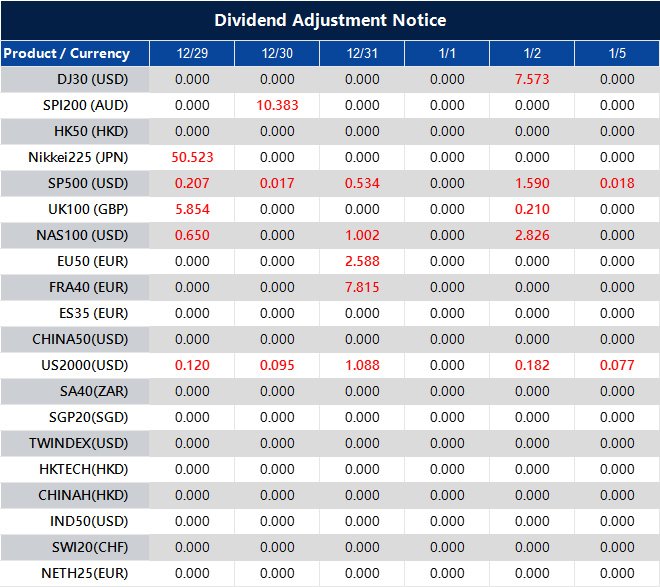
The above data is for reference only, please refer to the MT4/MT5 software for specific data.
If you’d like more information, please don’t hesitate to contact [email protected].
Gold prices in the Philippines decline today, according to recent data
Gold prices in the Philippines fell on Monday, according to FXStreet data. The price per gram dropped to 8,544.30 PHP from 8,573.07 PHP on Friday. Similarly, the price per tola decreased to 99,662.10 PHP from 99,994.55 PHP.
FXStreet Overview
FXStreet updates international gold prices daily, converting them to Philippine Pesos based on current market rates. These prices are for guidance and may experience slight local variations. Gold has long been a safe store of value and a means of exchange. Today, it is viewed as a secure investment during economic instability and serves as a protection against inflation and falling currencies. Central banks are the biggest buyers of gold, which strengthens economies and currencies. In 2022, they added 1,136 tonnes of gold, about $70 billion, to their reserves. Key buyers include central banks from China, India, and Turkey. Gold typically rises in value when the US Dollar weakens and tends to go down when risk assets like stocks are doing well. Factors like geopolitical tensions or concerns about a recession can drive gold prices higher, along with lower interest rates. The recent slight drop in gold prices might be seen as an opportunity rather than a sign of weakness. This small decline could be just background noise before a potential increase in the coming weeks. Gold remains a key investment to guard against currency decline, especially in the current economic climate.Impact of US Federal Reserve Decisions
As we approach the end of 2025, we are closely monitoring the US Federal Reserve. After the significant rate hikes in 2023 and 2024, the Fed’s recent meetings suggest a shift towards lower rates, with markets expecting at least two rate cuts in the first half of 2026. Gold, which does not yield interest, tends to do well when rates are likely to fall. This expected change in monetary policy is putting pressure on the US Dollar. The Dollar Index (DXY) has fallen below 98, down from highs above 105 in prior years. A weaker dollar typically increases gold’s appeal, making it cheaper for foreign buyers. Demand from central banks continues to support gold prices. While not at the record levels of 2022, the World Gold Council’s Q3 2025 report showed that central banks, especially from emerging markets, have added over 800 tonnes to their reserves this year. This trend of moving away from the dollar shows that institutional investors continue to favor gold. In broader markets, stock rallies seem to be slowing, with the S&P 500 moving sideways for the last quarter. This indicates growing caution among investors as we move into 2026. A sell-off in riskier assets often leads to increased interest in safe assets like gold. Create your live VT Markets account and start trading now.The US dollar recovers daily losses, keeping NZD/USD around 0.5830
Federal Reserve Cuts Interest Rates
In December, the Federal Reserve reduced interest rates by 25 basis points, bringing the target range down to 3.50%–3.75%. Throughout 2025, interest rates decreased by a total of 75 basis points as the job market softened and inflation stayed high. The New Zealand Dollar (NZD) may see some support due to expectations of a potential rate hike by the Reserve Bank of New Zealand (RBNZ). Economic growth showed a rebound in the third quarter, and interest rates are likely to remain steady for some time. The value of the NZD is shaped by New Zealand’s economic performance and the decisions of its central bank. Additionally, China’s economy plays a role because of its trading relationship with New Zealand. Changes in dairy prices, which are vital exports for New Zealand, also have an impact on the NZD. Data releases about New Zealand’s economy can influence the NZD’s value. Strong economic growth often attracts investment and might encourage the RBNZ to raise interest rates, which would boost the NZD.The Potential Buying Opportunity in NZD/USD
As we approach the new year, the NZD/USD is struggling below 0.5850 due to a brief recovery in the US Dollar. We will keep a close eye on the FOMC Meeting Minutes released tomorrow, which should clarify the Federal Reserve’s outlook for 2026. This could lead to some market movement. Overall, the US Dollar appears weak as we enter 2026, which should benefit the NZD/USD pair. The Federal Reserve has already cut rates three times in 2025, a total of 75 basis points, to address a slowing economy, while inflation in November was still at 2.8%. The market is now predicting at least two more rate cuts from the Fed in the upcoming year. In contrast, the New Zealand Dollar finds itself on a stronger footing. The RBNZ is keeping rates stable and might even consider a hike due to an unexpected rebound in the economy during the third quarter. The growing interest rate gap between the US and New Zealand is a significant trend to watch. This optimistic view for the Kiwi is also backed by strong external factors. Dairy prices, a key export for New Zealand, have been rising steadily, with the recent Global Dairy Trade auction in mid-December reaching a yearly high. Additionally, recent manufacturing data from China, New Zealand’s top trading partner, revealed slight growth, boosting overall market sentiment. For traders, this indicates that any weakness in the NZD/USD over the next few weeks could present a buying opportunity. We believe strategies that benefit from a rising NZD/USD, such as buying call options, may prove to be effective, especially given the differing central bank policies. Options can also help manage risk from any unexpected news in tomorrow’s FOMC minutes. Create your live VT Markets account and start trading now.Gold prices decreased in the United Arab Emirates, according to the latest compiled data.
Gold prices in the United Arab Emirates fell on Monday, according to FXStreet. The price for 1 gram dropped to 533.13 AED, down from 535.02 AED on Friday. The price for 1 tola also decreased to 6,218.31 AED from 6,240.31 AED.
Here are the current prices:
– 1 gram: 533.13 AED
– 10 grams: 5,331.29 AED
– 1 tola: 6,218.31 AED
– 1 troy ounce: 16,582.26 AED
FXStreet updates the gold prices in USD/AED daily, using current market rates. Local prices may differ slightly from these reference rates.
Gold As A Stable Asset
Gold is prized for its stability and serves as a reliable store of value, especially in uncertain times. Central banks hold the largest gold reserves, adding 1,136 tonnes in 2022. Countries like China, India, and Turkey have been increasing their reserves. Gold prices usually go up when the US Dollar weakens or during market declines. Factors like geopolitical issues, interest rates, and Dollar strength also affect gold’s price, as it is priced in dollars (XAU/USD). The recent drop in gold to 533.13 AED per gram seems connected to lower trading volumes during the holiday season as we wrap up 2025. This small decline shouldn’t be seen as a major trend change. Instead, it’s a good time to consider larger factors that will shape the market in the coming year. A key factor to watch is the outlook for U.S. interest rates in 2026. After significant inflation in 2023 and 2024, recent data suggests a slowdown. This has led to speculation that the Federal Reserve might shift to a more neutral or even dovish approach. Since gold doesn’t earn interest, it usually benefits when rates are lower.Impact Of Monetary Policy And Geopolitical Risks
Expectations around monetary policy are also affecting the U.S. Dollar. The Dollar Index (DXY) has softened in the fourth quarter of 2025, which historically tends to boost gold prices. A weaker Dollar makes gold more affordable for other currency holders, potentially increasing demand. We should also consider the strong ongoing demand from central banks. This trend, which included record purchases in 2022, continued through 2023 and 2024. Reports from the World Gold Council have shown that emerging markets are still diversifying their reserves, providing solid support for prices. Geopolitical tensions are also a concern, especially with ongoing trade talks among major economic groups creating uncertainty. Gold, viewed as a safe-haven asset, often rises in value during global instability. Any escalation in these tensions could lead to increased interest in gold, benefiting our long positions. Given the current market situation, we see low implied volatility in options as a chance to invest. This calm could be an opportunity to establish positions, such as buying call spreads, to take advantage of a possible price increase in January. These strategies allow for limited risk while preparing for upcoming economic data releases. Create your live VT Markets account and start trading now.The US Dollar Index stays stable near 98.00 amid expectations of interest rate cuts and uncertainty
The US Dollar Index (DXY) is steady around 98.00 in early European trading on Monday. This index tracks the USD against six major currencies and shows that traders are anticipating rate cuts by the US Federal Reserve in 2026. There’s also uncertainty about who will be the next Fed Chair.
Recently, the Federal Reserve lowered the federal funds rate by 25 basis points, bringing it to a range of 3.50%-3.75%. Many traders expect more rate cuts in 2026 due to a slowing job market and decreasing inflation, which could impact the US Dollar. The CME FedWatch tool shows there is an 18.3% chance of interest rate cuts in January.
Impact Of Presidential Remarks
President Trump has suggested appointing a Fed chair who favors lower rates, which might affect how people view the Fed’s independence. Geopolitical issues, like US-Ukraine negotiations, might also change demand for safe-haven assets, possibly supporting the USD. Quantitative easing (QE) is a tool used by the Fed that increases the money supply to boost the economy. This usually weakens the dollar. On the other hand, quantitative tightening (QT) involves cutting back on bond purchases and reinvestments, which generally makes the dollar stronger. The market is closely watching these policies and any economic data that could impact the dollar. Currently, the US Dollar Index hovers around 98.00, but we believe this calm is just temporary given the slow holiday trading. Recent data shows the economy is cooling down, with November 2025’s Non-Farm Payrolls report indicating job growth slowed to 155,000, and the latest CPI inflation figure dropped to 2.7%. These trends support our expectation that the Federal Reserve will continue cutting rates into next year. Having slashed rates three times in 2025, it seems likely the dollar will weaken. We suggest preparing for this by considering strategies like buying puts on the DXY or on currency ETFs. The CME FedWatch tool shows an 18.3% chance of another cut in January, indicating the market has yet to fully account for the most aggressive dovish scenarios.Potential Volatility From Fed Chair Appointment
The announcement of a new Federal Reserve Chair could lead to significant volatility. President Trump’s calls for lower interest rates indicate he plans to appoint a dovish candidate, which would likely further weaken the dollar. We see this as a major bearish factor for the first quarter of 2026. Despite this, we must remain cautious of geopolitical risks that may unexpectedly boost the dollar due to increased safe-haven demand. While there has been some progress in peace talks about the Ukraine conflict, unresolved territorial issues could easily disrupt these discussions. This ongoing uncertainty suggests we should hedge against overly negative dollar positions. Reflecting on the strong dollar environment from aggressive rate hikes in 2022 and 2023, we find ourselves in the opposite scenario now. Therefore, using options to create a bearish position can help us manage risks from short-term news while still benefiting from the broader downward trend. This strategy seems wise as we approach January. Create your live VT Markets account and start trading now.Gold prices decline in Pakistan, according to market data.
Gold prices in Pakistan fell on Monday. The price per gram decreased to 40,666.05 Pakistani Rupees (PKR) from 40,814.31 PKR on Friday. The cost for one tola also went down, dropping to 474,316.10 PKR from 476,050.10 PKR.
In troy ounces, the price was recorded at 1,264,854.00 PKR. FXStreet adjusts international gold prices to reflect PKR and local measurement units based on current market rates.
Gold As A Hedge Against Inflation
Gold continues to be a safe investment, especially during uncertain economic times. It’s seen as a good protection against inflation, regardless of country governance. Central banks are major buyers of gold, looking to diversify their reserves. In 2022, they bought 1,136 tonnes worth around $70 billion, with countries like China, India, and Turkey increasing their gold holdings. Gold prices usually move opposite to the US Dollar and US Treasuries. Events like geopolitical tensions or economic downturns can affect gold prices. Generally, when the dollar weakens, gold’s value tends to rise. The recent small drop in gold prices isn’t viewed as a weakness but rather a possible buying opportunity. Current market trends are influenced by larger economic forces, so this dip could be a chance to make strategic investments. It’s important to consider this decrease in the context of ongoing global economic patterns as we approach 2026. The Federal Reserve’s policies largely influence gold prices, and we are carefully observing their actions. After several rate cuts in 2024 that brought the Fed Funds rate down to 4.25%, recent inflation data led to a pause, creating uncertainty. This caution from the central bank often drives interest in non-yielding assets like gold, as traders look for safety in unclear monetary policies.Central Bank Demand For Gold
We must recognize the steady demand from central banks, which has supported gold prices for many years. Following record purchases in 2022 and 2023, banks, especially in Asia, have continued to increase their reserves throughout 2025. In Q3, global net purchases exceeded 250 tonnes. This ongoing demand suggests that significant price drops will likely be brief as large institutions buy in. The relationship between gold and the US Dollar is crucial right now. The Dollar Index (DXY) has hovered around 101, weakened by uncertainties regarding the Fed’s next steps. Our experiences during the geopolitical challenges of 2023 and 2024 show that a weaker dollar coupled with global instability boosts precious metals. Given these conditions, we expect gold market volatility to rise in the upcoming weeks. We’re considering options strategies like buying call spreads to benefit from potential gains while minimizing risk. For those looking for bigger movements, a long straddle could be advantageous to profit from significant price changes in either direction before major economic data is released in January. Create your live VT Markets account and start trading now.Gold prices in India have decreased, according to recent market data.
Gold prices in India dropped on Monday, according to FXStreet data. The price reached 13,053.88 Indian Rupees (INR) per gram, down from INR 13,098.08 on Friday. The price for gold per tola also fell to INR 152,261.80, down from INR 152,773.40 on Friday.
FXStreet calculates gold prices in India by adjusting international rates (USD/INR) and updates them daily. These prices are for reference only, so local rates may vary. The price of gold is influenced by various factors, including geopolitical tensions and interest rates, because it is considered a safe-haven asset.
Gold As A Safe Investment
Gold has always been viewed as a reliable store of value and medium of exchange. It is a safe investment during uncertain times and protects against inflation and falling currencies. Central banks, the biggest gold holders, diversify their reserves by buying gold, adding 1,136 tonnes worth about $70 billion in 2022. Gold prices often move opposite to the US Dollar and US Treasuries. When the Dollar weakens, gold prices usually rise. Events like geopolitical tensions or fears of recession can drive up gold prices due to its reputation for safety. We noticed a slight dip in gold prices, with the per-gram rate in India now at 13,053.88 INR. This minor decline shouldn’t signal a major trend change. Instead, it provides an opportunity to reflect on the larger market forces as we approach the new year.Impact Of US Dollar And Interest Rates
Gold prices are closely linked to the US Dollar and expectations about interest rates. The US Dollar Index (DXY) has been stable around 104 for the past month, as markets consider the Federal Reserve’s statements on possible rate changes in 2026. This stability creates uncertainty, which heavily influences derivative pricing. Historically, gold tends to do well when interest rates are forecasted to drop, a trend seen in late 2023 before the expected rate cuts in 2024. With current US inflation around 2.5%, traders are anticipating a dovish shift from the Fed within the next two quarters. This outlook suggests that gold prices could rise in the long term. Strong central bank demand also supports gold prices. After record purchases of 1,136 tonnes in 2022, the World Gold Council reported that banks worldwide added another 290 tonnes in the third quarter of 2025. This ongoing buying from official institutions reflects a long-term confidence in gold as a reserve asset. For derivative traders, this situation signals rising implied volatility. Strategies like selling cash-secured puts on gold ETFs can help collect premiums while setting a lower entry price for a long position. Current market uncertainty means that volatility itself is becoming a tradable asset. Given the strong support for gold prices and potential future rate cuts, using this minor dip to acquire long-dated call options could be a smart strategy. It allows you to benefit from a possible rally through mid-2026 while clearly defining your risk. This positions your portfolio to take advantage of the expected easing of monetary policy. Create your live VT Markets account and start trading now.Gold prices decline in Malaysia, according to today’s market data
**Gold Prices in Malaysia**
Gold prices in Malaysia decreased on Monday, according to FXStreet data. The price fell to 588.56 Malaysian Ringgits (MYR) per gram, down from MYR 590.67 the previous Friday.
The price per tola also went down, reaching MYR 6,864.69, down from MYR 6,889.41. For 10 grams, the price was MYR 5,885.45, and a troy ounce was priced at 18,305.82 MYR.
These prices are based on international rates, converted to local currency and updated daily. FXStreet mentions that these figures serve as a reference and there may be local differences.
**A Popular Asset During Uncertain Times**
Gold is a popular asset because it has historically been used for value storage and exchange. People often choose gold during uncertain times and as a hedge against inflation, as it is not controlled by any government or issuer.
Central banks are the main buyers, adding 1,136 tonnes worth $70 billion to their reserves in 2022. Countries like China, India, and Turkey are increasing their gold reserves to support their economies and currencies.
Gold prices often move inversely to the US Dollar. When the Dollar falls, gold prices usually rise. Conversely, when stock markets do well, gold prices tend to drop. Geopolitical tensions can also increase gold prices.
Gold prices have pulled back from their peak near $4,550, which seems like a brief pause before the next change. This dip is likely caused by thin holiday trading and some profit-taking as the year ends. For traders, this time offers a chance to prepare for increased volatility in early 2026.
The main factor driving gold prices is the cautious outlook for the US Federal Reserve. Current market expectations suggest over a 75% chance that the first interest rate cut will happen by March 2026. As gold does not yield interest, lower rates will likely continue to support its price.
This trend is supported by the ongoing weakness of the US Dollar, which moves inversely to gold. The US Dollar Index (DXY) has dropped below the important 100 level, declining over 5% since its highs earlier in 2025. A weaker Dollar makes gold more affordable for buyers using other currencies, generally boosting demand.
**Political Uncertainty and Central Bank Demand**
Political uncertainty around the Federal Reserve also plays a role. With Jerome Powell’s term ending in May 2026, President Trump’s upcoming nomination of a new Fed chair creates unpredictability in future monetary policy. This type of uncertainty typically increases the attractiveness of safe-haven assets like gold.
Strong demand from central banks continues to underpin the market, seen throughout 2025. Following record purchases in 2022 and 2023, central banks from emerging economies are expected to add over 950 tonnes to their reserves this year, providing a solid price support and reducing significant downside risk.
In the derivatives market, implied volatility remains low, making options strategies appealing. There is an increasing demand for call options with February and March 2026 expiration dates, indicating that traders are betting on a price rise. Buying call spreads could be a cost-effective way to anticipate further increases.
However, a positive economic outlook for 2026 could present challenges if it boosts risk assets. The S&P 500 rose nearly 20% in 2025, and a continued risk-on environment might draw funds away from gold. Therefore, traders may also consider buying protective puts to hedge against a potential economic surprise that strengthens the dollar.
Create your live VT Markets account and start trading now.







