



Gold prices in the United Arab Emirates remained stable throughout the day with little fluctuation.
Gold prices in the United Arab Emirates held steady on Wednesday, with the price per gram at 531.31 AED, slightly up from 531.06 AED on Tuesday. A tola of gold now costs 6,197.09 AED, a small increase from 6,194.23 AED the day before.
In other measurements, gold is priced at 5,313.10 AED for 10 grams and 16,525.46 AED per Troy ounce. FXStreet updates these prices daily, converting international values into local currency.
Gold prices in Pakistan show little variation according to today’s market data.
Gold prices in Pakistan stayed steady on Wednesday, according to FXStreet data. The price of gold per gram was 40,469.35 Pakistani Rupees (PKR), showing little change from the previous day’s price of PKR 40,473.68.
The price for one tola of gold was PKR 472,026.60, slightly down from PKR 472,077.00 the day before. For larger quantities, 10 grams were priced at 404,693.50 PKR, and a troy ounce was sold for 1,258,753.00 PKR.
Gold Pricing Mechanism
FXStreet determines gold prices in Pakistan based on global rates converted to local currency, updated daily according to market conditions. The prices mentioned are indicative, meaning local rates may vary slightly. Gold is often seen as a safe investment and a reliable store of value, especially during uncertain times. Central banks, particularly in emerging economies, buy significant amounts of gold to stabilize their currencies. Gold prices usually rise when the US Dollar weakens. They can also be influenced by geopolitical issues, recessions, and interest rates. A weaker Dollar tends to lead to higher gold prices. As we look toward the new year, gold’s steady prices present a chance for investors. The market is now anticipating potential US interest rate cuts by mid-2026. This outlook is putting pressure on the US Dollar, which has recently dipped below 100 on the DXY index, a level it hasn’t seen in over a year. A weaker dollar and projected lower interest rates make it less costly to hold assets like gold, boosting its appeal.Central Bank Demand
We should also note the ongoing demand from central banks, which has supported gold prices. This trend has continued into 2025, following record purchasing in 2022 and 2023 when central banks added over 1,000 tonnes to their reserves each year. Strong buying from countries like China and India suggests that any significant drops in prices will be met with robust support. Geopolitical uncertainty plays a vital role in maintaining gold’s status as a safe haven, especially as we enter January. Ongoing trade tensions and regional conflicts make investors wary of riskier assets. An increase in these tensions could quickly lead to a rise in gold demand as a protective measure. While inflation has decreased from recent highs, it has remained persistently above central bank targets throughout 2025. This situation reinforces gold’s traditional role as a safeguard against currency devaluation. We expect that if price pressures persist into the first quarter of the new year, investors will continue to flock to gold. The inverse relationship between gold and equities should steer our strategy in the coming weeks. With stock markets showing signs of weakness after a long rally, a pullback could lead to a shift toward safe havens. Using call options could be an effective way to gain exposure to gold while protecting against potential downturns in riskier assets. Create your live VT Markets account and start trading now.Dividend Adjustment Notice – Dec 24 ,2025
Dear Client,
Please note that the dividends of the following products will be adjusted accordingly. Index dividends will be executed separately through a balance statement directly to your trading account, and the comment will be in the following format “Div & Product Name & Net Volume”.
Please refer to the table below for more details:
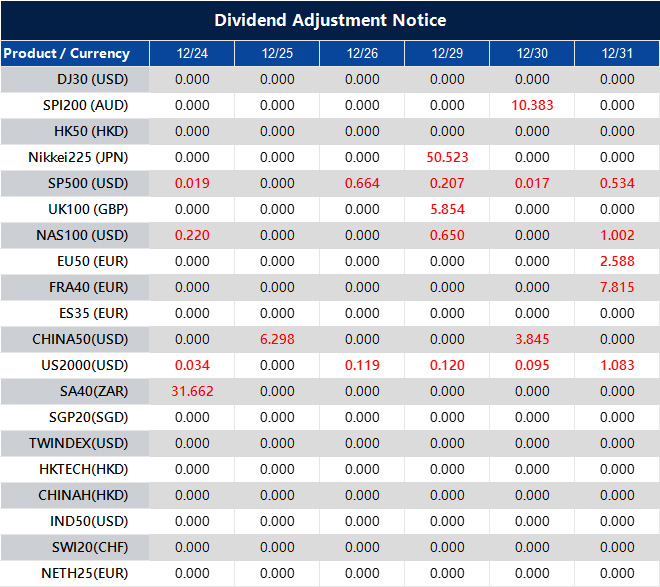
The above data is for reference only, please refer to the MT4/MT5 software for specific data.
If you’d like more information, please don’t hesitate to contact [email protected].
GBP/USD rises above 1.3500 as expectations of gradual monetary easing by the BoE increase
The GBP/USD pair is currently trading positively around 1.3510 in early European trading. This comes as the Bank of England (BoE) plans to gradually ease monetary policy in 2026 after recently lowering the interest rate to 3.75%.
Even with growing expectations for slower easing from the BoE, the upcoming US economic data may present challenges for the GBP. The US GDP grew by 4.3% in the third quarter, exceeding the forecast of 3.3%. Traders are also awaiting the US Initial Jobless Claims report, which is expected to show about 223,000 claims for the week ending December 13.
The Pound Sterling and BoE Policies
The Pound Sterling (GBP) is the oldest currency in the world and makes up 12% of global foreign exchange transactions. The BoE’s interest rate decisions, aimed at achieving a 2% inflation rate, significantly influence the Pound’s value. Higher interest rates attract global investment and strengthen the GBP, while lower rates are used when inflation is too low. Economic data like GDP and PMIs also impact the Pound; strong figures may lead to interest rate hikes to boost its value. Furthermore, a positive Trade Balance, indicating more exports than imports, can enhance currency strength. For the next few days, we can expect a quiet market due to the Christmas holiday, with GBP/USD staying just above 1.3500. With lower liquidity, any movements in the market could be more pronounced until trading normalizes in the new year. Caution is advised when making larger trades this week. The BoE’s recent interest rate cut to 3.75% was anticipated. However, their signal for a slow and steady easing path is what stands out. Although UK inflation has dropped significantly from earlier 2023 peaks (above 7%), it remains around 3.1%, which is well above the 2% target. This ongoing inflation keeps the Pound strong since it makes the central bank wary about cutting rates too quickly.Policy Divergence and Trading Strategies
On the other hand, the US economy is demonstrating surprising strength, as shown by the Q3 GDP growth of 4.3%, which far exceeded expectations. This robust economic performance and a core inflation rate of 3.5% reported by the Bureau of Labor Statistics indicate that the Federal Reserve is unlikely to rush into rate cuts. The differing policies between the easing BoE and the cautious Fed are likely to limit how high the GBP/USD pair can rise. In the upcoming weeks, we could see increased volatility. Conflicting economic indicators may pull the pair in different directions, making strategies that can profit from price changes—like buying straddles—potentially beneficial as we approach January 2026. We anticipate a breakout from the current tight trading range once full liquidity returns. Since the interest rate differential now favors the US dollar, we view any rallies in the Pound as chances to take bearish positions. The Federal Funds Rate stands at 4.50%, creating an advantage for holding short GBP/USD positions. We can consider buying put options to limit our risk while allowing for downside exposure, especially if the pair struggles to maintain gains above the 1.3550 level. Create your live VT Markets account and start trading now.Gold prices in India have stabilised and shown little change, according to recent data.
Gold prices in India stayed stable on Wednesday, based on FXStreet data. The price was 12,972.05 INR per gram, slightly lower than Tuesday’s 12,972.65 INR. For one tola, the price was 151,303.40 INR, almost unchanged from the previous day’s 151,310.50 INR.
FXStreet adapts international prices to the local currency for accuracy. These figures are updated daily and serve as a reference, noting that local variations may occur.
Gold As A Safe Asset
Gold has always been a reliable store of value, often seen as a safe asset during uncertain times. Central banks, especially in emerging markets, buy large amounts. In 2022, they purchased 1,136 tonnes worth around $70 billion, setting a record. Gold prices typically go up when the US Dollar and Treasuries go down. Geopolitical issues and interest rates also impact gold’s value. Prices generally rise when interest rates fall but can drop when rates go up, largely influenced by the strength of the USD. All investment decisions should be made with thorough research, as these activities carry risks. FXStreet is not responsible for any errors or omissions, and the information provided is not meant as investment advice. With gold prices steady around ₹12,972 per gram today, it’s important to consider what factors might influence prices in the coming weeks. The recent Federal Reserve meeting in mid-December 2025 hinted at possible rate cuts in early 2026, which is important because gold, as a non-yielding asset, typically does well when interest rates are expected to drop.Outlook For The US Dollar And Gold
This outlook pressures the US Dollar, which has an opposite relationship with gold. The Dollar Index (DXY) has fallen below 98, a stark contrast to highs seen in 2024. A weaker dollar generally makes gold cheaper for international buyers, increasing demand. For derivative traders, this dollar weakness provides a promising environment for gold as we head into the new year. We also look at the ongoing demand from central banks. The latest World Gold Council data for Q3 2025 shows they have continued the strong buying trend seen since 2022. Even though the November 2025 US CPI report showed inflation decreasing to 2.8%, it still exceeds targets, reinforcing gold’s role as a hedge against inflation. This combination of institutional buying and ongoing inflation worries creates solid support for gold prices. Given the current stability, now might be the right time to build positions for a potential price increase early next year. Although the market may be quiet over the holidays, the conditions suggest higher prices are likely. Traders could consider strategies like buying call options for February or March 2026 to benefit from this anticipated move while managing risk. Create your live VT Markets account and start trading now.USD/CHF rises towards 0.7900 after three months of lows, trading at around 0.7880 during Asia
USD/CHF has bounced back towards 0.7900 after hitting a three-month low of 0.7861. The US Dollar is under pressure due to potential Federal Reserve rate cuts expected in 2026, compounded by lower trading activity during the holiday season.
In the third quarter, the US economy grew unexpectedly fast, with GDP increasing by 4.3%, beating the 3.3% forecast. The PCE Price Index stayed on target at 2.9% quarter-over-quarter. However, analysts warn that this GDP growth might not reflect the true economic situation, as it’s mainly driven by healthcare spending and reduced inventories.
Swiss Economic Indicators And Outlook
The Swiss ZEW Expectations index dropped to 6.2 in December, while the Current Conditions index rose to 16.6. UBS analysts are optimistic about Switzerland’s growth over the next five years, suggesting the Swiss Franc will remain strong. The Swiss Franc is one of the top ten most traded currencies. It’s influenced by market sentiment and actions of the Swiss National Bank (SNB). The Franc is viewed as a safe haven because of Switzerland’s stable economy, robust export sector, and political neutrality. The SNB aims to keep inflation below 2%. It raises rates when inflation is high, which supports the Franc’s strength. Economic data and Eurozone monetary policies greatly affect the Franc’s value, as Switzerland relies on the Eurozone for economic stability. The recent rise of USD/CHF towards 0.7900 appears to be a short-term adjustment. With low trading volumes typical during the Christmas period, this situation presents an opportunity to bet on a further decline. The main driver is the market’s increasing belief that the US Federal Reserve will cut interest rates twice in 2026.Investment Strategies For USD/CHF
There’s strong evidence that the dollar may weaken, despite the 4.3% US GDP growth reported for Q3 2025. Recent data shows the Conference Board Consumer Confidence Index dropped to 99.2, the lowest since July 2025, while weekly jobless claims are rising. This suggests the headline growth figure hides a weakening underlying economy, likely pushing the Fed to relax its policies. Conversely, the outlook for the Swiss franc is improving. UBS analysts report that Switzerland is expected to have its strongest five-year growth outlook since late 2024, and the latest Swiss ZEW survey indicates a noticeable improvement in current economic conditions. Furthermore, Swiss inflation has been consistently above the SNB’s 2% target for much of the second half of 2025, meaning the SNB may be slow to cut rates compared to the Fed. This difference in policy makes buying put options on USD/CHF an appealing strategy in the weeks ahead. Consider options with an expiration date in February 2026, targeting strike prices below the recent low of 0.7861, such as 0.7850 or 0.7800. This strategy offers a clear risk with the potential for a substantial downward movement in the currency pair. For traders who prefer a more conservative strategy or aim to generate income, initiating a bear call spread could be effective. By selling a call option with a strike price around 0.7950 and buying a higher strike call at 0.8000 for protection, we can benefit if the pair stays below our sold strike. This approach takes advantage of the belief that any further USD/CHF strength will be limited in the near term. Create your live VT Markets account and start trading now.Gold prices in Malaysia remain stable, with little change from previous levels today.
Gold Pricing Methodology
Gold prices in Malaysia stayed steady on Wednesday, according to FXStreet. The cost was 586.75 Malaysian Ringgits (MYR) per gram, showing little change from the day before. For larger quantities, gold was priced at 5,867.51 MYR for 10 grams and 6,843.75 MYR per tola. The price per troy ounce was noted at 18,249.98 MYR. FXStreet calculates these prices by converting international costs (USD) into the local MYR and updates them daily. The figures reflect market rates at the time of publication. Gold has always been a reliable store of value and a means of exchange. People often view it as a safe asset during uncertain times, using it to protect against inflation and currency decline. Central banks are the largest owners, adding 1,136 tonnes of gold, worth around $70 billion, to their reserves in 2022. The price of gold often moves opposite to the US Dollar and US Treasuries, rising when the Dollar weakens. Key factors influencing gold prices include geopolitical tensions and fears of recession. Gold usually increases in value when interest rates are low, while a strong Dollar tends to limit its price rise.Gold’s Future Potential
As gold prices hold steady on this calm Christmas Eve in 2025, the market is stabilizing after a recent drop from record highs. Low trading activity during the holidays can create a peaceful environment, but current conditions suggest readiness for a potential price rise in the new year. Traders should see this stability as a chance to prepare for upcoming movements in the next few weeks. The main factor driving prices remains the weakening US Dollar, a trend that has picked up speed throughout 2025. This shift is driven by expectations of interest rate cuts from the US Federal Reserve in the first quarter of 2026, a move anticipated since the Fed’s more relaxed approach began in late 2023. Lower interest rates make non-yielding gold more appealing. There is consistent buying from central banks, especially in emerging markets, creating strong support for prices. This trend has continued since the significant purchases made in 2022 and 2023. The World Gold Council reported that central banks added over 800 tonnes to global reserves in 2024 alone. This accumulation highlights gold’s importance as a reserve asset in a changing global economy. Ongoing geopolitical tensions and concerns about a global economic slowdown in 2026 are increasing gold’s attractiveness as a safe-haven asset. The International Monetary Fund’s latest outlook, released in October 2025, lowered global growth forecasts due to ongoing inflation and tighter credit conditions. This uncertainty makes investors wary, pushing them toward the safety of gold. For derivative traders, this environment supports a bullish outlook, but caution is advised after a recent peak. Purchasing call options for February or March 2026 could be a smart strategy to benefit from potential price increases while managing risk. We also recommend keeping an eye on gold volatility indices, which are currently low but may rise as trading picks up in January. The recent decline from the all-time high near $4,525 per ounce provides an important technical perspective. If prices decisively break above this level, it could signal a continuation of the upward trend, likely resulting in increased buying. We suggest watching the $4,400 level as a key support area in the coming weeks. Create your live VT Markets account and start trading now.The pair trades around 1.1790, maintaining upward momentum in a bullish channel pattern.
EUR/USD is currently strong, trading at about 1.1790 after hitting a three-month high of 1.1808. The 14-day Relative Strength Index (RSI) stands at 71, suggesting it may be overbought, which could limit further gains.
The nine-day Exponential Moving Average (EMA) has crossed above the 50-day EMA, indicating a bullish trend. If the pair breaks the resistance at 1.1800, it may reach targets of 1.1880 and 1.1918, the highest levels seen since June 2021.
Immediate Support
Immediate support is at the nine-day EMA of 1.1745. If this level fails, the 50-day EMA around 1.1660 could be tested, which may lead to a drop to the three-week low of 1.1589 seen earlier. The pair is moving within an ascending channel, and the market outlook is positive as the long-term EMA rises. However, momentum indicators suggest that a consolidation phase may happen before the trend continues. This analysis uses AI for technical insights and is for informational purposes only, not trading advice.Trading Considerations
EUR/USD is testing a three-month high around 1.1808, presenting a key decision point. While the upward trend in its channel is robust, the RSI at 71 suggests it may be overbought, indicating a possible pause or pullback. This situation reflects uncertainty about central bank policies as we move toward 2026. After the Federal Reserve kept rates steady in their December 17 meeting, US inflation data for November showed a rate of 2.5%, justifying their cautious approach. Meanwhile, Eurozone inflation is slightly higher at 2.8%, leading the European Central Bank to be slower in signaling rate cuts, which supports the Euro’s strength. For those expecting the bullish trend to continue, buying call options with strike prices above 1.1810 could be a good tactic. This enables us to potentially benefit from a rise toward the channel’s upper boundary around 1.1880 while limiting our risk. Options expiring in late January or February 2026 would allow time for the trade to develop after the holiday season. On the flip side, due to the overbought RSI and key resistance at 1.1800, it’s wise to consider a pullback risk. Buying put options with strikes near 1.1750 could profit from a move toward key support at the 50-day EMA around 1.1660. This strategy acts as a hedge or a speculative bet on short-term weakness. It’s important to note that trading volumes are usually low between Christmas and New Year’s, which can lead to significant price movements on minimal news. Historically, the post-holiday period, such as early 2024, saw increased volatility as institutional traders returned. A current consolidation might be setting the stage for a more significant move in January. Create your live VT Markets account and start trading now.EUR/JPY dips to around 183.60 during the Asian trading session due to Yen support
EUR/JPY has dropped to about 183.60 as the Yen strengthens due to Japan’s intervention threats. The Bank of Japan (BoJ) did not announce any plans for further monetary tightening in its recent policy update.
During the Asian trading session on Wednesday, EUR/JPY fell by 0.27% to nearly 183.60. The Yen gained strength after Japan’s Finance Minister, Satsuki Katayama, warned of possible intervention against excessive Yen fluctuations.







