



U.S. crude oil stock increased by 2.4 million, reversing a prior decline
The United States saw an increase in API weekly crude oil stocks, which reached 2.4 million barrels on December 19. This is a change from a prior decrease of 9.3 million barrels. This rise in crude stock levels aligns with movements in other markets and commodities.
The EUR/JPY currency pair fell to around 183.60 due to threats of intervention from Japan. Meanwhile, the US Dollar Index dropped to its lowest level since October, sitting at about 97.80, as speculation grows about potential rate cuts by the Federal Reserve. In contrast, the Australian dollar strengthened on hopes of a rate hike from the Reserve Bank of Australia.
The dollar’s decline boosts GBP/USD, increasing by about 0.45%
The GBP/USD pair rose by 0.45% on Tuesday because of lower global US Dollar (USD) flows. The Dollar weakened as expectations grew for further Federal Reserve (Fed) rate cuts into 2026. This decline occurred even with stronger-than-expected US GDP growth of 4.3% in the third quarter.
Market analysts believe the Fed will keep its current position in January but may start cutting rates later. However, they caution that the GDP growth mainly comes from healthcare spending and reducing inventories, indicating less overall economic strength. We see signs of a weakening job market and declining consumer confidence, which could keep pressure on the Dollar into next year.
Sterling Hits 12-Week Highs
The Sterling reached 12-week highs against the Dollar as the US Dollar Index (DXY) dropped to its lowest level since early October. This indicates a change in global rate expectations, suggesting the Dollar may experience its steepest annual decline since 2017. Wednesday is the last main trading day for GBP/USD this week, as US markets will close early and European markets will shut down on December 25 and 26. The Pound Sterling, issued by the Bank of England (BoE), is the official currency of the UK. Its value is affected by BoE’s monetary policy and economic indicators such as GDP and trade balance. A positive Trade Balance usually strengthens the currency. As today is December 24th, 2025, the market shows a clear path for GBP/USD heading into the new year. The US Dollar is weakening across the board, allowing the Pound to reach 12-week highs. This trend continues even in the light trading of this holiday-shortened week. This suggests we should adopt strategies that benefit from the Pound’s continued rise against the Dollar. Buying call options on GBP/USD with an early 2026 expiry appears to be a smart move. This allows us to capture potential gains while managing risk during low market activity.Policy Divergence and Market Strategies
The data underlines the divergence in policies between the US and the UK. In the November 2025 inflation reports, US CPI decreased to 2.5%, while the UK’s remained at 3.8%, which is well above the BoE’s target. As a result, the CME FedWatch Tool reflects that the market expects two Fed rate cuts in 2026, while the Bank of England is likely to keep rates higher for longer. We need to stay cautious as holiday markets can lead to sudden, unpredictable moves on little news. We recall the GBP “flash crash” of October 2016, which happened during low liquidity. Thus, buying options with defined risk is a safer strategy than risking unlimited loss by selling them. The main idea behind this trade is the belief that the Federal Reserve will have to cut rates sooner and more aggressively than the Bank of England. The unexpectedly high 4.3% US GDP growth for the third quarter of 2025 is largely being overlooked, as the underlying details suggest a less robust economy. We think this focus on a slowing US economy will continue to put pressure on the Dollar. Since today marks the last significant trading day of the week, we should concentrate on positioning ourselves for January and February 2026. Purchasing longer-dated options allows us to ride out any potential holiday volatility. This lets us keep our bullish view on GBP/USD without being affected by erratic price movements over the next few days. Create your live VT Markets account and start trading now.EUR/USD pair rises about 0.3% as US Dollar flows ease
The EUR/USD currency pair rose about 0.3% due to a weak US Dollar and expectations of Federal Reserve rate cuts in 2026. Strong GDP data limited the dollar’s losses, but many believe the Fed will stay steady in January, with easing anticipated later in the year.
The Dollar Index hit its lowest level in October, affected by low confidence in US growth and thin holiday trading. While the US GDP grew by 4.3% in the third quarter, this didn’t prevent the dollar from weakening. Markets expect the Fed to hold off on changes in January and ease later on, predicting two rate cuts in 2026.
Ongoing Economic Doubts
Analysts are uncertain about whether GDP figures truly reflect economic health due to strong influences from healthcare and inventory fluctuations. Concerns over a weakening labor market and falling consumer confidence could keep pressure on the dollar, despite the recent growth data. The Euro gained some ground against the USD, with the US Dollar Index slipping to early October lows and likely facing its biggest annual decline since 2017 as global rate expectations change. Wednesday is the last major market day for the Euro this week since US markets close early, and European markets will be closed on December 25 and 26. With the US Dollar struggling, there’s an opportunity in the EUR/USD pair. The market seems to be overlooking the strong Q3 GDP data, focusing instead on the possibility of Federal Reserve rate cuts in 2026. This mindset is driving a noticeable upward trend for the Euro against the dollar. Recent data supports this view by questioning the headline GDP figure. For example, the November jobs report showed only 150,000 new jobs, below expectations, and the Conference Board’s Consumer Confidence Index for December dropped to 98.5. These numbers indicate that the economy may be weaker than it looks, which aligns with the market’s concern about future Fed easing.Trading Strategies for Current Market Conditions
Looking forward, the low holiday trading volume is crucial. Thin liquidity can amplify price swings, meaning the current rise in EUR/USD could speed up with small buy orders. Traders should be ready for increased volatility as 2025 ends and 2026 begins. Given the current environment, buying call options on the EUR/USD may be a smart strategy. This allows traders to benefit from potential gains while limiting risk if the dollar strengthens unexpectedly. The market’s confidence is strong, with the CME FedWatch Tool showing more than a 70% chance of a rate cut by June 2026. Historically, the US dollar tends to weaken before the first rate cut of a new easing cycle. A similar trend occurred in late 2023 when the market started to factor in rate cuts for 2024. The Dollar Index’s recent slide to its lowest since October suggests this historical pattern may be repeating. Thus, positioning for further dollar weakness seems like the easiest path. Another option is to use put options on the Dollar Index (DXY) as a direct hedge against the dollar. However, it’s wise to stay cautious, as unexpectedly strong US data in January could lead to a sudden, though likely temporary, rebound. Create your live VT Markets account and start trading now.Dollar Softens As Rate Cut Expectations Intensify
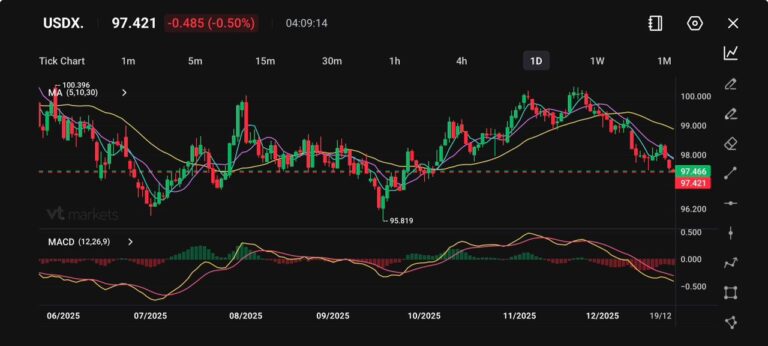
The US dollar remained under strain on Wednesday and is on course for its weakest annual showing in more than twenty years.
Even with a firm US GDP print, the greenback failed to gain traction as market participants continued to prioritise the Federal Reserve’s easing trajectory over signs of near-term economic strength.
Measured against a basket of major currencies, the dollar index slipped to a two-and-a-half-month low of 97.767. It is now heading for a near 9.9% decline in 2025, which would mark its steepest annual fall since 2003.
During Asian trading hours, the dollar stayed subdued, reflecting deeply embedded bearish positioning rather than any response to new economic releases.
Fed Expectations Turn Increasingly Dovish Despite Solid Growth
Markets remain firmly priced for additional policy easing by the Federal Reserve, with traders anticipating around two further interest rate cuts in 2026.
Goldman Sachs’ Chief US Economist, David Mericle, noted that the Federal Open Market Committee may ultimately settle on two extra 25-basis-point reductions, bringing the policy rate into a 3.00–3.25% range. He added that risks are still skewed to the downside as inflationary pressures continue to ease.
The inability of robust GDP data to alter expectations underlines how decisively the market narrative has shifted. Investors appear more focused on disinflation, liquidity conditions and forward-looking policy signals than on historical growth data.
Confidence In US Assets Faces Growing Questions
The dollar’s underperformance this year has also mirrored broader unease surrounding US assets more generally.
Earlier tariff measures introduced by President Donald Trump injected volatility into markets and weighed on investor confidence. At the same time, his increasing influence over the Federal Reserve has sparked debate around the central bank’s independence, adding another layer of uncertainty.
Technical Analysis
The US Dollar Index has extended its downward move, falling to its lowest level since early October and edging closer to a potential break below the key horizontal support around 97.40.
This represents a notable reversal from the late-November highs near 100.40, driven primarily by changing expectations for Fed policy and an improved appetite for risk across markets.
Short- and medium-term moving averages (5, 10 and 30 periods) have started to slope lower, with shorter-term averages crossing beneath longer-term ones, a bearish configuration that reinforces the weakening trend.
Momentum indicators also point lower. The MACD remains firmly negative, with the gap below the signal line widening and red histogram bars expanding, signalling persistent downside momentum.
Near-Term Outlook Remains Cautious
The dollar is likely to stay under pressure as long as expectations for rate cuts remain dominant and concerns over confidence persist. Thin year-end liquidity could amplify price swings, particularly if other major central banks continue to hold comparatively tighter policy positions.
A meaningful rebound in the dollar would probably require a clear shift in Federal Reserve messaging or a sustained resurgence in inflation data. At present, markets see little evidence that either scenario is imminent.
Build-A-Bear Workshop shows positive technical indicators, suggesting potential growth for early Christmas gifts
Build-A-Bear Workshop (NYSE: BBW) is showing signs of a possible upward trend after breaking out from a downward trendline. This change suggests that more investors might be getting interested, especially with the holiday season approaching.
The stock has already gained over 25% since its earnings report earlier this month. Filling in the gap created before the earnings release indicates strong buying interest. As a popular brand for stuffed animals, Build-A-Bear tends to be more recognized during the holidays.
From a technical standpoint, the stock could increase another 11% before hitting its first major resistance level, a high pivot point from October. Knowing these levels is crucial for staying calm during price fluctuations.
However, since Build-A-Bear Workshop is a smaller company, its stock can be more volatile, leading to quicker price changes. Because of this, effective risk management is essential when trading its stock. While there are opportunities, staying disciplined is key for long-term success.
As we approach the end of 2025, Build-A-Bear Workshop shows a promising technical setup. The recent break from its downtrend suggests momentum may be shifting favorably. This is a good time for derivatives traders to consider positioning for a potential rise in the coming weeks, especially with the strong seasonal support.
This positive outlook is backed by the company’s earnings report from early December 2025, which revealed a 4.5% increase in year-over-year revenue and optimistic guidance for the holiday quarter. This aligns with the National Retail Federation’s November 2025 report, forecasting a solid 3.7% growth in holiday spending. The economic climate appears favorable for a specialty retailer like Build-A-Bear.
Given this forecast, one strategy is to buy call options that expire in late January or February 2026. This allows us to benefit from a potential rise toward the October 2025 resistance level while managing our risk. It’s best to choose strike prices just below that key pivot high to maximize returns if the stock continues to climb.
However, we should keep in mind that the stock’s implied volatility is high, currently near 68%, which is at the top of its 52-week range in 2025. This makes buying options more expensive. A smarter approach might be to use a bull call spread, where we buy a call and sell a higher-strike call to offset some of the costs. This strategy limits our potential gains but increases our chances of making a profit.
For traders willing to consider owning the stock at a lower price, selling cash-secured puts is another good option. After the stock’s recent 25% rally from December 2025 lows, we could sell puts with a strike price below the current support level. This way, we can collect premiums while taking advantage of high implied volatility, providing a safety net if the stock takes a dip.
A clear example of trendline dynamics appeared when Phillips 66’s share price fell below its key uptrend.
Phillips 66 (PSX) is experiencing significant changes in its stock price in the downstream energy sector. Recently, the stock broke below an upward support line it had maintained since June, causing concern among technical analysts. This break happened in late December when the stock dropped to around $129.99, falling below a key support level.
Now, this former support line may become resistance, a concept known as polarity shift in technical analysis. If the stock rises back to the $134-136 range, traders should pay close attention. Bearish investors might see this as a chance to open short positions, expecting the stock to decline further. However, if PSX recovers and closes above $136, it could indicate a false breakdown, potentially triggering a bear trap and attracting more buyers.
Bullish and Bearish Strategies
For bearish investors, the plan is to wait for the stock to move back to the $134-136 level before starting short positions, with protective measures set above $137. On the other hand, bullish traders should wait for a solid reclaim of the broken trendline with strong volume before considering long positions. A stable move above $136 would suggest that the bearish outlook is no longer valid. As we near the end of the year on December 24, 2025, the situation with Phillips 66 is crucial. The stock has definitely fallen below its long-term support, raising the question of whether this is a real reversal or just a temporary dip. The next few weeks will be important, especially since holiday trading volume is typically low.Option Strategies on PSX
For those with a bearish outlook, the approach should be to look for a bounce toward the $134-$136 resistance level before making a move. This possible retracement creates a chance to buy put options, possibly with expiration dates in February 2026, and a strike price around $130. Recent EIA data showing a 5% narrowing of crack spreads and an unexpected rise in crude inventories last week supports concerns that refining margins might be under pressure. In contrast, if the stock pushes back above $136 with strong volume, the breakdown would be seen as a failed move or bear trap. In this case, traders might consider call options to take advantage of a potential recovery toward the $145 highs. Some analysts expect a rebound in fuel demand as we enter the first quarter of 2026, supporting this view. With these two distinct but opposing scenarios in mind, implied volatility for PSX options has increased, indicating market uncertainty. This makes options strategies that benefit from substantial price movements in either direction worth considering. A long straddle, for instance, could be used by traders confident in a significant move but unsure whether the breakdown will prove sustainable or not. This technical situation is similar to the volatility the energy sector experienced in 2023 when geopolitical news led to sharp but often temporary trend breaks. Lessons from then highlight the importance of patience, as the initial move following a breakdown can be misleading. Waiting for confirmation of either a failed rally at resistance or a strong reclaim of support remains the sensible approach. Create your live VT Markets account and start trading now.Consumer sentiment index in South Korea falls from 112.4 to 109.9 in December
The consumer sentiment index in South Korea dropped from 112.4 in November to 109.9 in December. This decline indicates a decrease in consumer confidence, which could negatively affect spending and economic growth.
Economic analysts believe this drop is due to various factors. Both local issues and global pressures might have shaped how consumers feel and how they spend their money.
Possible Weakness in Consumer-Focused Sectors
With the consumer sentiment index now at 109.9, we may see weakness in sectors that rely on consumer spending. This index often predicts trends in retail sales and company earnings. A cautious approach seems necessary for the first quarter of 2026, so it’s wise to reassess derivative positions to prepare for increased risk in the short term. We might experience downward pressure on the KOSPI 200 index in the next few weeks. In a similar situation during the summer of 2024, the index went through a consolidation phase and a slight correction before it found support. Traders should consider buying KOSPI 200 put options that expire in January or February 2026 to protect long portfolios or to speculate on potential declines. This drop in sentiment occurs while the Bank of Korea has kept its policy rate at 3.5% for over a year, trying to manage inflation and slow growth. Recent government data showed that industrial production grew by only 0.5% year-over-year, falling short of expectations. This combination of weak production and declining consumer confidence strengthens the case for a bearish outlook on the domestic economy.Possible Effects on Currency and Market Volatility
The South Korean Won may face challenges against the US dollar. A pessimistic domestic economic outlook often leads to capital leaving the country. We’ve seen the USD/KRW exchange rate test the 1,380 level several times in 2025 during uncertain times. It might be wise to use currency futures or options to prepare for a possible decline in the Won. This situation could increase market volatility, which has been fairly low. The VKOSPI, Korea’s volatility index, is currently around 16, but this news may drive it up to the 20 level we saw earlier this year. We might want to take long volatility positions, such as straddles on key export-oriented stocks, which could benefit from significant price movements in either direction. Particularly, we should be careful with consumer discretionary stocks in areas like automotive and retail. Using protective puts to hedge long positions in these sectors seems sensible right now. On the other hand, defensive sectors such as telecommunications and utilities may perform better if the market becomes more cautious. Create your live VT Markets account and start trading now.US stocks rebound as Dow Jones gains 80 points amid pre-holiday optimism
US stocks kept climbing, with major indexes rising for the fourth day in a row. Investors showed strong interest in AI-related companies during this shorter trading week. The S&P 500 went up by 0.3%, remaining near its record high. The Nasdaq Composite jumped about 0.4%, thanks to increases in big tech and AI stocks. The Dow Jones Industrial Average added roughly 80 points, while small-cap stocks lagged behind, with the Russell 2000 dropping around 0.6%.
The market reacted to a delayed report showing the US GDP grew at a 4.3% annualized rate in the third quarter, exceeding expectations. This growth was driven by consumer spending, leading some to wonder when the Federal Reserve might reduce interest rates. Futures markets expect two rate cuts from the Fed by the end of next year. There’s also some attention on possible changes in Fed leadership that might adopt a more lenient approach.
Consumer Confidence Concerns
The Conference Board reported a drop in consumer confidence in December. This decline indicates worries about future economic conditions, even with strong growth. Citadel plans to return $5 billion in profits to investors, showcasing the strength of large alternative asset managers. In the commodities market, gold and silver reached new heights, with gold surpassing $4,530 an ounce and silver rising above $70 an ounce. These increases are fueled by hopes for rate cuts and concerns about inflation. Markets expect a holiday season with stocks nearing record levels, driven by optimism in technology and possible easing of monetary policy. We see a common trend in the market: large-cap tech is thriving while small caps are lagging. This presents opportunities, such as buying call options on the Nasdaq 100 while purchasing puts on the Russell 2000. This approach protects against a broad market downturn while benefiting from the ongoing strength in AI, a trend we’ve observed throughout 2023 and 2024. The market seems to be overlooking strong economic growth and focusing solely on future rate cuts, creating a trading opportunity. With November 2025’s CPI data showing a persistent 2.9%, any tough comments from the Fed in January might surprise traders. We think buying volatility through VIX call options or S&P 500 straddles is a smart way to prepare for potential market adjustments.Warning Signs for Retail Spending
The decline in consumer confidence, despite solid GDP growth, signals trouble for retail and discretionary spending. This follows a three-month drop in the University of Michigan’s sentiment index, indicating that household finances may be under pressure. It could be wise to buy protective put options on consumer discretionary sector ETFs ahead of the upcoming earnings season. Gold and silver hitting record highs is significant, driven by expectations of rate cuts and reports of ongoing central bank purchases throughout the fall of 2025. Similar to the breakout we saw in 2024, this trend could continue, making bullish call spreads on gold miners or the metal’s ETFs appealing. However, since prices have already risen significantly, we should keep our position sizes small to manage the risk of a sudden reversal. We must keep in mind that we are entering a period of low holiday trading volume. This decreased liquidity can cause bigger price swings with minor news, a trend we often see during the last week of the year. It’s wise to tighten stop-losses and consider using defined-risk option strategies rather than holding large speculative positions as we head into the new year. Create your live VT Markets account and start trading now.Canadian dollar reaches a five-month peak, lowering the USD/CAD pair to a 22-week low
The Canadian Dollar has reached its highest level in five months against the US Dollar, with the USD/CAD pair hitting a 22-week low. The US Dollar has weakened as the holiday season approaches, helping other currencies like the Loonie to recover.
The Bank of Canada (BoC) was surprised by the strength of the Canadian economy, despite ongoing trade tensions from the US administration. Canadian economic data has been stronger than expected, though there are still worries about future trade issues.
USMCA Trade Considerations
The USMCA agreement, implemented by President Trump, is set for a review in July 2026. While the agreement was once seen as successful, it now faces criticism and calls for fairer terms. The Canadian Dollar continued to rise, gaining 0.44% against the US Dollar, following a 0.34% increase the day before. The USD/CAD pair has fallen below 1.3700, entering an oversold condition. Key factors influencing the CAD include BoC interest rates, oil prices, and the overall health of the economy. The BoC’s policies, along with oil prices—Canada’s primary export—play a crucial role in the CAD’s performance. Additionally, inflation and economic indicators impact the CAD value, with strong economic results supporting its rise. As of December 24, 2025, the Canadian Dollar is at its strongest in five months against the US Dollar, with USD/CAD below 1.3700. This rise is mainly due to a general weakness in the Greenback, following lower-than-expected US inflation data for November, which was 2.8%. This has increased expectations that the Federal Reserve may cut interest rates in early 2026, as we enter a time of low holiday trading volume.Economic Resilience and Market Dynamics
The Canadian economy has shown surprising resilience, as noted in the recent minutes from the Bank of Canada’s meetings. This strength is supported by the price of Western Canadian Select crude oil, which has stabilized above $70 a barrel, benefiting the Loonie. This is particularly impressive given the minor 0.3% GDP contraction reported in October 2025. The rapid decline in USD/CAD suggests it is now in oversold territory, making a short-term bounce or consolidation more likely. Caution is advised when pursuing this downward trend, as the chance of a rebound towards nearby resistance levels has increased. This situation suggests that options to protect against a rise in USD/CAD (calls) could be relatively inexpensive compared to puts. In the coming weeks, we can expect some profit-taking and a mean reversion that might push the pair higher, even while the general trend remains bearish. Given the typical low liquidity at year-end, any bounce could be sharp. A possible strategy is to sell out-of-the-money call spreads to collect premiums, betting that any potential rally will be limited. Looking ahead to early 2026, a significant challenge will be the six-year review of the USMCA trade agreement in July. President Trump has expressed growing dissatisfaction with the deal, which presents substantial political risk for the Canadian economy. While this may not impact the market immediately, it is a crucial element that could limit the Canadian Dollar’s gains in the first half of the new year. Create your live VT Markets account and start trading now.Bank of Canada’s meeting minutes show increased confidence, but uncertainty about the economy remains.
The Bank of Canada’s December meeting minutes show that confidence in the economy is growing, despite ongoing uncertainty. Policymakers noted that the global economy is doing better than expected, thanks to strong consumer spending in the US and investments in AI. However, there are still risks related to tariffs.
In Canada, updated data indicates a more robust economy for 2025, with GDP growth at 2.6% in Q3, partly due to lower imports. The job market has also improved, with unemployment dropping to 6.5%. However, most of the new jobs are part-time. Inflation decreased to 2.2% in October, while core inflation remains around 2.5%.







