



West Texas Intermediate trades near $57.85, showing upward momentum amid rising geopolitical tensions
WTI oil prices were around $57.85 in early European trading on Tuesday, following stalled US-led peace talks in Ukraine. There was no significant progress made between US President Trump and Ukrainian President Zelenskiy regarding territorial issues.
A recent drone strike accusation by Russia against Ukraine has made peace talks more difficult, which might support WTI prices. Despite these geopolitical tensions, there are worries about an oversupply of global oil, as OPEC+ announced a modest increase of 137,000 barrels per day for December.
Gold prices rise above $4,350 in early European trading after previous losses and speculation about rate cuts.
Gold prices are doing well in early European trading, likely due to expected US rate cuts and a rise in safe-haven demand. After a significant drop of 4.5%, the biggest single-day loss since October, gold has seen a slight recovery. This decline was influenced by higher margin requirements set by the CME Group.
Forecasts suggest that Fed rate cuts in 2026 might limit the drop in gold prices, making it less costly to hold onto. Ongoing global economic uncertainties and geopolitical tensions may also boost interest in traditional assets like gold.
Thin Trading Volumes Expected
As we approach the New Year holidays, trading volumes are likely to be low. Traders are awaiting the release of the Federal Open Market Committee (FOMC) Minutes, which could impact the market. Geopolitical tensions are rising after Russia claimed a Ukrainian drone strike, which Ukraine has denied. These tensions, along with the CME’s increased margin requirements for gold, have affected trading strategies. Currently, gold prices look positive as they stay above the 100-day EMA. Resistance is at $4,520, while support is in the $4,300 range. Central banks, being the largest holders of gold, added a substantial amount to their reserves in 2022. Remember, gold’s price often moves opposite to that of the US Dollar and Treasuries. As December 30, 2025, approaches, thinner trading volumes could lead to sharper price movements. Many traders are closing positions to secure profits and prepare for the upcoming year, urging caution due to the unpredictable nature of low liquidity.Outlook for January and Beyond
In January, derivative markets are indicating a rise in call options with strike prices over $4,500, suggesting some traders are gearing up for a price rally early in the new year. However, with the Relative Strength Index (RSI) at a neutral level, we might see sideways movement until a clear trend forms. The upcoming FOMC minutes will be a key event to watch. The main factor supporting a positive outlook is the growing expectation of Federal Reserve rate cuts in 2026. The CME FedWatch tool shows that markets now predict an over 80% chance of at least one rate cut by the March 2026 meeting. Recent economic data, like the November Core PCE inflation rate at 2.9%, gives the Fed more reasons to start easing its policies. There is also strong support from central banks, creating a solid foundation for gold’s price. Reports from the World Gold Council for 2025 indicate that central banks’ net purchases are set to match the record levels from 2022 and 2023. This strong institutional demand, especially from emerging markets, emphasizes gold’s role as an essential asset for diversifying away from the US dollar. From a trading perspective, we should monitor the $4,300 level for support. A significant drop below this could signal a deeper correction, which might present a better buying opportunity for those looking at long-term gains. On the other hand, a sustained move above the $4,520 resistance is necessary to confirm that the uptrend is returning toward all-time highs. Create your live VT Markets account and start trading now.Russia’s S&P Global Services PMI rises to 52.3 from 52.2
**Gold Price Volatility**
In December, Russia’s S&P Global Services PMI rose slightly to 52.3 from 52.2 the previous month. This indicates growth in the country’s service sector.
Market activities involve various currency pairs and commodities. The AUD/USD pair traded around 0.6700 with a focus on FOMC minutes, while NZD/USD showed a weak recovery above 0.5800. Additionally, the GBP/USD pair returned to 1.3500 during year-end trading, and silver prices are expected to rise sharply by the end of 2025.
Gold was priced near $4,350, recovering from a 4.5% drop caused by higher margin requirements. The crypto market in 2025 displayed volatility but was positively affected by U.S. regulatory changes and asset tokenization.
The economic outlook for 2026-2027 in developed countries looks promising, with expectations of strong performance. Reports highlight the best brokers for 2025, focusing on low spreads and high leverage in regions like Mena and Latam.
FXStreet shares forward-looking insights but warns of potential risks and uncertainties. Readers should do their research before making investment decisions and take full responsibility for any losses.
**Market Sentiment and Trading Strategies**
We are currently in a low holiday trading period, which means that large orders can have a bigger impact on markets. The CBOE Volatility Index (VIX) is around 17, indicating caution among traders as we approach 2026. This environment suggests that using options to manage risk on new positions is a smart strategy.
All eyes are on the upcoming release of the Federal Reserve’s December meeting minutes. During that meeting, the “dot plot” of rate predictions showed notable disagreement among members, making these minutes key to understanding the 2026 outlook. With the federal funds rate stable at 3.75% for the past three months, any indication of a more aggressive stance could lead to a sharp rise in the US Dollar.
Gold’s recent volatility, including a 4.5% drop and subsequent rebound to near $4,350, reflects a jittery market. The sharp decline resulted from increased margin requirements, which forced many speculative long positions to liquidate. This situation presents an opportunity for traders to sell out-of-the-money puts to earn rich premiums, betting that the worst of the selling is over.
Silver has shown impressive year-end gains, outpacing gold in the last quarter of 2025. The gold-to-silver ratio has decreased from over 85 in September to nearly 70 now, indicating a renewed investor appetite for precious metals. We expect this trend to continue, making long silver futures or call options an appealing trade compared to gold.
Currency pairs such as EUR/USD and GBP/USD are stuck in narrow ranges, and we do not anticipate a major breakout until trading volumes increase in January. In terms of options pricing, one-month implied volatility for EUR/USD has dropped to a six-week low of 5.5%, suggesting that the market expects this quiet period to persist. Traders could use strategies like iron condors to profit from this sideways trend.
Russia’s slight increase in services PMI to 52.3 suggests some stability, but geopolitical issues remain the main influence on related assets. European natural gas futures for February have risen by 4% in the past week due to renewed supply concerns related to Ukraine. This ongoing tension affects the Euro and supports the need for protective positions against sudden market downturns.
Create your live VT Markets account and start trading now.
EUR/JPY holds steady near 183.80 as Bank of Japan signals tighter policies
EUR/JPY is steady, trading around 183.80 in early European trading, just below 184.00. Anticipated rate hikes by the Bank of Japan (BoJ) in 2026 could boost the Japanese Yen (JPY) against the Euro (EUR). Markets are quieter as traders prepare for the New Year holiday.
Recently, the BoJ raised its policy rate from 0.50% to 0.75%, marking the highest level in 30 years. Some BoJ officials believe more hikes may be necessary due to a weaker Yen and rising long-term interest rates linked to a lower policy rate compared to inflation.
Japan’s Financial Strategy
Japan’s Finance Minister mentioned that the country can address excessive Yen fluctuations, possibly using verbal interventions to support the JPY. This situation may complicate the EUR/JPY exchange rate. The Euro’s potential decline might be limited as signs show the European Central Bank (ECB) is likely finished with its rate cuts. The ECB has kept rates steady, expected to stay unchanged for a while. ECB President Christine Lagarde said future rate decisions depend on economic data. The Japanese Yen, heavily traded, is influenced by Japan’s economic performance and BoJ strategies. Its value is also affected by the gap between Japanese and US bond yields and overall market sentiment. BoJ decisions are crucial for the Yen. Recent policy changes are starting to bolster it. The previous ultra-loose monetary policy had widened yield gaps with the US, favoring the US Dollar. However, the BoJ’s upcoming policy shifts are reducing this difference. The Yen is usually seen as a safe-haven asset, gaining strength during market turmoil due to its stability.Market Trends and Strategies
As the EUR/JPY pair sits just below 184.00, it signals the BoJ’s intention for tighter monetary policy. Holiday trading is light, but there’s growing pressure on the Yen to strengthen. This suggests we should prepare for possible declines in this pair as the new year approaches. The recent interest rate hike to 0.75% reflects a significant shift by the Japanese central bank, continuing its normalization policy that began in 2024 after years of ultra-loose conditions. With Japan’s core inflation at 2.8% for November 2025, the BoJ has solid reasons to continue raising rates. For traders using derivatives, this outlook favors strategies that profit from a declining EUR/JPY. Consider buying put options with strike prices below 183.50, anticipating a break below current support. Selling call option spreads with a cap around 184.50 could also be effective, given the limited potential for upward movement. The possibility of direct market intervention by Japanese authorities adds weight to a bearish outlook. Past interventions to support the Yen in 2022 show their seriousness, and recent comments from the Finance Minister warn against pushing the pair higher soon. On the Euro side, potential downside risks appear limited. The ECB has maintained its main interest rate at 3.50% and seems to have finished its rate-cutting cycle for now. With a low chance of a rate cut in early 2026, the Euro is likely to hold steady, making a JPY-driven move more likely. The main factor for us is the closing interest rate gap between Europe and Japan. For years, this gap favored holding Euros, but as the BoJ tightens and the ECB holds steady, that advantage is narrowing. This fundamental shift is likely to apply consistent downward pressure on EUR/JPY in the coming weeks. Create your live VT Markets account and start trading now.USD/CAD hovers near 1.3685 during late Asian trading, awaiting FOMC minutes release.
USD/CAD is around 1.3685 as traders wait for the release of the FOMC minutes. The Fed has indicated only one interest rate cut by 2026, while the Bank of Canada (BoC) is likely to keep rates steady in the near future.
During late Asian trading on Tuesday, USD/CAD is stable near 1.3685. The pair is consolidating ahead of the FOMC December meeting minutes in the New York session.
US Dollar Index Analysis
The US Dollar Index (DXY) is fluctuating around 98.00, close to its 12-week low of 97.75. Traders are keenly watching the FOMC minutes for clues on monetary policy. In its recent meeting, the Fed made a third consecutive cut of 25 basis points, bringing rates down to 3.50%-3.75%. They signaled just one rate cut by 2026. The Canadian Dollar’s performance is mixed against major currencies this week, which has low trading volume. The outlook for CAD has improved, as the BoC is not expected to lower interest rates anytime soon. The technical outlook for USD/CAD remains steady at 1.3685. The 20-day EMA is down at 1.3777, showing bearish momentum with the 14-day RSI at 30.6.Market Sentiment Analysis
If USD/CAD drops below the 20-day EMA, losses could extend to 1.3543 if it falls below 1.3640. Currently, the market seems to be processing the different policies between the US and Canada. The Federal Reserve is set to move slowly with future rate cuts, while the BoC is likely to stand firm. This difference supports a downward trend for the USD/CAD pair in the coming weeks. Recent economic data supports a stronger Canadian dollar. In November 2025, Canada added 45,000 jobs, surpassing expectations and lowering the unemployment rate to 5.6%. This data suggests that the BoC doesn’t need to ease its policy soon. In contrast, recent US data has been softer, backing the Fed’s cautious stance. The final Q3 2025 US GDP revision showed a 1.9% growth rate, slightly below the initial estimates. Additionally, consumer confidence has decreased as we enter the new year. This trend limits the US dollar’s chances for a significant rise. We should also consider crude oil prices, which significantly affect the commodity-linked Canadian dollar. WTI crude is currently stable above $86 per barrel, supported by winter demand and OPEC+’s supply management. Earlier this year, oil prices above $80 helped strengthen the loonie. For those trading derivatives, buying USD/CAD put options that expire in February or March 2026 might be a smart move. A drop below the important 1.3640 support level would trigger this strategy, aiming for a price target of 1.3543. This method allows traders to take advantage of potential declines while clearly defining their risk. Alternatively, traders with a more conservative approach might consider selling out-of-the-money call spreads. Setting the short strike above the 20-day EMA resistance around 1.3777 could generate profits from time decay and the pair’s lack of movement upward. This strategy is appealing in a market expected to drift lower rather than crash. Create your live VT Markets account and start trading now.The Swiss Franc strengthens as USD/CHF pulls back from 0.7900, trading around 0.7880 while waiting for data
The USD/CHF exchange rate is falling due to increased demand for safe-haven assets amid ongoing uncertainty in Ukraine and Russia. The US Dollar may struggle as traders expect two Federal Reserve rate cuts in 2026. Many are looking forward to the December Meeting Minutes from the Federal Open Market Committee (FOMC) for guidance on the Fed’s plans.
After two days of gains, the pair is now trading around 0.7880 during the Asian session. The upcoming Swiss KOF Leading Indicator may provide insights into future economic trends.
Geopolitical Tensions and the Swiss Franc
The Swiss Franc is gaining from heightened safe-haven demand linked to geopolitical unrest, particularly the Ukraine-Russia crisis. Instability in Yemen, Iran, and Saudi Arabia also raises concerns, impacting the currency’s value. The USD is under pressure as expectations grow for future rate cuts by the Federal Reserve. According to the CME FedWatch tool, there is an 83.9% chance rates will remain unchanged at the Fed’s January meeting. Traders are being cautious ahead of the FOMC December Meeting Minutes. As a safe-haven currency, the Swiss Franc thrives on stable economic conditions and political neutrality. Its value is influenced by the Swiss National Bank’s interest rates and economic data. Additionally, Switzerland’s ties to the Eurozone mean that Eurozone monetary policy also affects the Franc. The USD/CHF pair is losing momentum around 0.7880, as traders are prioritizing safety. Rising instability in Eastern Europe and the Middle East is driving investments into the Swiss Franc. This trend is likely to continue as long as geopolitical tensions persist.Market Trends and Trading Strategies
We’ve seen this kind of behavior before, especially during the early uncertainties in the Ukraine conflict back in 2022, which prompted a similar shift toward safe assets. The main difference now is the extra instability from renewed conflicts in the Middle East, boosting the Franc’s attractiveness. This broad risk aversion creates a challenging environment for any currency seen as directly involved in these conflicts. On the other hand, the US Dollar is burdened by forecasts of two rate cuts by the Federal Reserve in 2026. The recent November 2025 CPI report, which showed core inflation dropping to 2.8%, provides the Fed with more flexibility to ease monetary policy next year. This expectation of lower US interest rates makes the Dollar less appealing compared to other currencies. For derivative traders, the current climate suggests that implied volatility in USD/CHF could be undervalued. With significant geopolitical risks and essential central bank minutes approaching, buying options like straddles or strangles could be a wise strategy to prepare for a major price swing, regardless of direction. The Cboe Volatility Index (VIX) has already risen above 18 in the past week, indicating growing market anxiety. Those who expect the pair to decline might consider buying puts on USD/CHF or selling call spreads to manage risk and reduce costs. This approach could benefit from a further drop in the exchange rate driven by ongoing demand for the Franc. The upcoming US Initial Jobless Claims data will provide a critical test; a higher-than-expected figure would support the narrative of a slowing US economy and likely accelerate the pair’s decline. Additionally, we must keep an eye on the Swiss National Bank (SNB). With Swiss inflation for November 2025 at just 1.4%, well below the SNB’s 2% target, the central bank may become uneasy with a rapidly rising Franc. They might intervene, either verbally or through other means, to weaken the currency, posing a risk to overly bearish positions. The release of the FOMC’s December meeting minutes later today is the next significant event. We will be on the lookout for any hints about the Fed’s views on the 2026 rate cuts; a surprising hawkish stance could lead to a sharp, short-term bounce in USD/CHF. Traders may want to consider short-dated weekly options to speculate on the immediate response to this news. Create your live VT Markets account and start trading now.The S&P 500 E-Mini Futures show a strong bullish trend, reaching new all-time highs.
The S&P 500 E-Mini Futures (ES) have hit new all-time highs, confirming a strong upward trend that began from a low on November 21, 2025. This rise consists of a five-wave diagonal pattern, which is common in strong markets according to Elliott Wave theory. Wave ((i)) peaked at 6975.25, then a zigzag correction occurred in wave ((ii)). In this phase, wave (a) ended at 6817.5, wave (b) at 6882.50, and wave (c) finished at 6771.75, marking an important support level.
After wave ((ii)), the index surged in wave ((iii)). Wave (i) reached 6872, while wave (ii) dipped to 6857.5. Wave (iii) climbed to 6990, after which it consolidated in wave (iv) at 6974, and wave (v) pushed up to 6994, finishing wave ((iii)). A corrective wave ((iv)) concluded at 6936, suggesting a possible continuation of the upward trend.
Potential Upside Targets
If the support at 6771.75 holds, pullbacks should show support through a 3, 7, or 11 swing sequence. Potential upside targets based on the external retracement levels from wave ((iv)) are between 7007 and 7029. This indicates that gains could continue if corrective patterns remain stable. The S&P 500 E-Mini futures appear set to maintain their bullish momentum into the new year after reaching those fresh all-time highs. This upward trend is supported by a technical structure that began with the November 21 low. Recent economic data further bolsters this outlook, making dips good opportunities for long positions. Looking back at the recent quarter, the November 2025 Consumer Price Index report revealed that core inflation has eased to 2.5%, reducing worries about aggressive rate hikes. With the Federal Reserve taking a more data-driven approach for 2026, market sentiment has improved. This economic environment aligns well with the ongoing ‘Santa Claus Rally’ we are currently experiencing.Trading Strategies and Support Levels
With this positive outlook, traders might consider buying call options or selling out-of-the-money put credit spreads to take advantage of further gains. The key support to monitor is at 6771.75; if this level is breached, our immediate bullish view would be invalidated. Until then, any weakness should be viewed as a potential buying opportunity. The CBOE Volatility Index (VIX) is currently around 13, showing low levels of market anxiety and supporting the case for a continued, steady rise. Our upside targets are set in the range of 7007 to 7029 over the next few weeks. Traders should remain disciplined, as pullbacks to recent support levels like 6936 can still occur even in strong trends. Create your live VT Markets account and start trading now.Bank of England continues gradual rate cuts as GBP/USD pair rises slightly to around 1.3510
The GBP/USD pair is slightly up, trading around 1.3510 in the early European session. The Pound is gaining strength as the Bank of England (BoE) takes a gradual approach to changing its monetary policy.
In December, the UK central bank lowered its interest rate by 25 basis points to 3.75%. The BoE has indicated that further cuts may be possible, with the market expecting at least one cut in the first half of the year, and nearly a 50% chance of a second cut within the year.
GBP/USD Market Activity
GBP/USD is performing well, staying above 1.3500. However, trading volumes may be lower as the year comes to an end, limiting significant price changes. This week, there aren’t many economic data releases from the UK, which could affect market activity. On Monday, GBP/USD was around 1.3490, showing a slight drop of 0.10%. The market is consolidating as the holiday period reduces liquidity. The Pound Sterling (GBP) is facing limited support due to expectations that the BoE will ease its stance, even as UK inflation stays above the 2% target. Annual inflation dropped to 3.2% in November after peaking at 3.8%, leaving the central bank with less flexibility for policy changes. As GBP/USD hovers around 1.3500, the market seems to be pricing in a slow pace for future rate cuts by the Bank of England. The 25 basis point reduction in December brought UK rates down to 3.75%. But with inflation still at 3.2% in November, the BoE’s options remain limited. This situation suggests that the Pound Sterling may have solid support as we move into the new year.U.S. Federal Reserve Policy Divergence
A key factor to watch is the differing policies between the U.S. Federal Reserve and the BoE. The Fed is expected to release minutes soon. U.S. inflation has decreased more effectively, with recent reports indicating a Core PCE figure around 2.8%, giving the Fed more room to ease its policy in 2026. This difference in inflation may create opportunities in the currency pair. With reduced trading during the holidays, we anticipate increased volatility as the market fully engages in the first weeks of January 2026. Historically, January brings significant price adjustments, and this year is expected to continue that trend as new data emerges. Using options like straddles to buy volatility could be a practical way to prepare for a breakout without committing to a specific direction. For a more focused strategy, the BoE’s relatively hawkish stance compared to the Fed supports a stronger Pound Sterling. We see potential in purchasing call options with strike prices above 1.3600, expecting a rise as the market adjusts to the likelihood that UK rates will remain higher for longer than U.S. rates. This approach provides defined risk while allowing for potential gains as liquidity improves. Create your live VT Markets account and start trading now.Gold prices in Saudi Arabia increased according to data compiled earlier this month.
**Gold as a Safe-Haven Asset**
Central banks, especially in emerging economies like China, India, and Turkey, hold a significant amount of gold. In 2022, they bought 1,136 tonnes, the most ever, worth about $70 billion.
Gold’s price often moves in the opposite direction of the US Dollar and US Treasuries. When the Dollar weakens, gold prices usually rise. Global instability can also make gold more valuable because of its safe-haven reputation. Additionally, lower interest rates generally support higher gold prices.
**Rising Gold Prices in Saudi Arabia**
Gold prices are increasing and are now at SAR 526.08 per gram as we end the year. This rise is happening amid slowing global growth and ongoing geopolitical uncertainty across 2025. For traders dealing in derivatives, this price movement indicates a stronger interest in safe-haven assets as we enter the new year.
The market is now predicting possible interest rate cuts from the U.S. Federal Reserve in mid-2026, marking a big change from the rate hikes we saw until the end of 2024. Since gold doesn’t earn interest, it becomes more appealing when rates are low. This situation encourages traders to look at long call options or bull call spreads on gold futures for the next few quarters.
This perspective is supported by the U.S. Dollar Index, which has been staying below the 101 mark for the last month. With U.S. inflation data from November 2025 showing a steady 2.8%, gold’s role as a hedge against both a weak Dollar and inflation is becoming clearer. Any further weakness in the Dollar could boost gold even more.
It’s also important to highlight the strong demand from central banks, which has continued since their record purchases in 2022. The World Gold Council reports that central banks added over 950 tonnes to their reserves in the first three quarters of 2025. This ongoing demand provides a solid support level, reducing downside risk for those with long positions.
As we face economic uncertainties, we can expect higher volatility in the coming weeks. This environment may benefit traders using strategies like long straddles, which can profit from significant price changes in either direction. We will closely monitor implied volatility on gold options during the first quarter of 2026 to identify the best entry points.
Create your live VT Markets account and start trading now.
Dividend Adjustment Notice – Dec 30 ,2025
Dear Client,
Please note that the dividends of the following products will be adjusted accordingly. Index dividends will be executed separately through a balance statement directly to your trading account, and the comment will be in the following format “Div & Product Name & Net Volume”.
Please refer to the table below for more details:
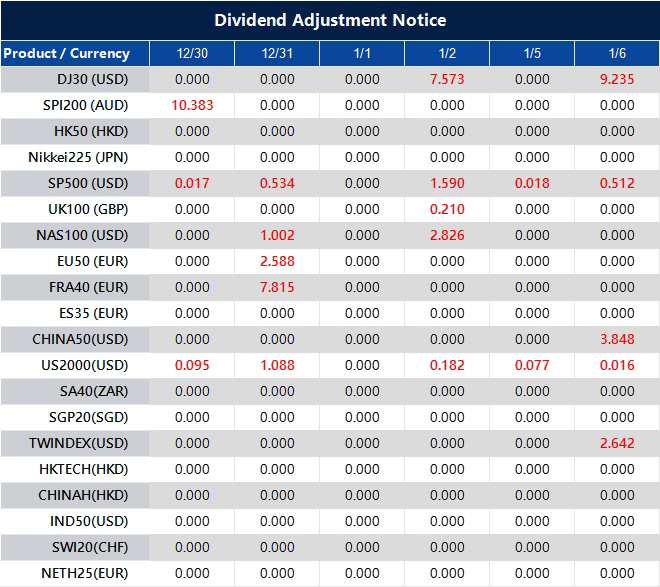
The above data is for reference only, please refer to the MT4/MT5 software for specific data.
If you’d like more information, please don’t hesitate to contact [email protected].







