



Gold prices in the Philippines have decreased, according to recent data analysis.
Gold prices in the Philippines fell on Thursday, according to FXStreet. The price per gram dropped to 8,158.97 Philippine Pesos, down from 8,177.97 PHP the day before.
The price for gold per tola also decreased to 95,164.66 PHP from 95,386.24 PHP. Gold for ten grams is priced at 81,589.73 PHP, while a troy ounce costs 253,781.40 PHP.
Gold prices in the United Arab Emirates have declined, according to recent data.
Gold prices in the UAE dropped on Thursday, according to FXStreet. A gram of gold is now priced at 511.42 AED, down from 512.61 AED the day before.
The cost for one tola fell from 5,978.94 AED to 5,965.15 AED. For ten grams, the price is 5,114.24 AED, and a troy ounce is now 15,906.97 AED.
How Gold Prices are Set
Gold prices in the UAE are based on international market rates, adjusted by the USD/AED exchange rate. Prices are updated daily for reference, but local rates may differ. Gold is a popular way to preserve wealth and is considered a safe investment during times of uncertainty. Many investors use it to protect against inflation and currency loss. Central banks are the biggest buyers of gold, having purchased 1,136 tonnes worth about $70 billion in 2022. Gold usually has an opposite relationship with the US Dollar; when the Dollar weakens, gold prices often rise. Geopolitical issues and economic instability can also drive up gold prices. Since gold doesn’t earn interest, it performs better when interest rates are low, while a strong Dollar can keep prices down.Current Market Trends
Today, gold prices are slightly lower, likely due to a stronger US Dollar. The Dollar Index (DXY) recently approached a three-week high of 106.50 as the market responds to new inflation data. This inverse relationship is crucial to monitor. The latest US Consumer Price Index report for November 2025 showed a slightly higher inflation rate of 3.3%, leading to uncertainty about what the Federal Reserve will do next. After the Fed eased policies last week on December 10th, this uptick in inflation has traders questioning whether further rate cuts in early 2026 are guaranteed. This uncertainty is strengthening the Dollar and limiting gold prices. Despite this short-term pressure, there is strong support for gold that should prevent significant declines. The World Gold Council reported that central banks, especially from BRICS+ countries, continued to buy aggressively in the third quarter of 2025, acquiring over 300 tonnes. This is in line with the record buying seen in 2022 and creates a solid foundation for prices. For traders dealing in derivatives, the tension between a cautious Fed and strong physical demand suggests increased volatility. Implied volatility on gold options has risen, signaling that the market expects bigger price shifts in the coming weeks. In this environment, strategies like straddles or strangles, which profit from large price movements in either direction, may be considered. This situation feels reminiscent of the market fluctuations we saw in late 2023 when traders were continuously adjusting their expectations for Fed policy ahead of a significant shift. At that time, gold experienced sharp but often brief price changes based on new economic data. We can expect similar behavior as we finish the year and approach January 2026. Given this context, using options to manage risk in the coming weeks seems wise. While the strong Dollar might lead to further price consolidation or a drop towards key support levels, ongoing geopolitical tensions and central bank buying indicate that any weakness will likely be treated as a buying opportunity. Look for chances to take long positions while protecting against possible short-term declines. Create your live VT Markets account and start trading now.Tesla reaches a new all-time high, showing strong bullish momentum and possible demand for pullbacks.
Tesla’s stock has hit a new all-time high, reflecting a positive trend in the market. A short-term Elliott Wave analysis shows a completed cycle that began from the low on November 14, 2025, with a clear upward pattern.
– **Wave 1** ended at $423.69.
– Then, wave 2 dropped to $383.76.
– The upward movement continued with **wave 3**, reaching $458.87.
– There was a slight pullback in **wave 4**, which hit $435.
– Finally, **wave 5** peaked at $496.16 before the stock entered a corrective phase in **wave (2)**, forming a zigzag pattern.
Currently, wave A of the zigzag is likely to finish soon, followed by a rebound in wave B, then a decline in wave C. This will complete the corrective wave (2). If the high at $496.16 holds, any rallies might not last. The broader outlook suggests Tesla’s stock will likely move lower, correcting from the rise that started on November 14.
The date is **2025-12-18T07:27:49.492Z**. With Tesla recently hitting $496.16, we see that the strong upward cycle has ended. The analysis indicates we are now in a corrective phase, suggesting any further rallies will probably fail if the price stays below this peak. This creates a good opportunity for traders looking for a short-term pullback.
As a decline is expected, traders should think about taking bearish positions in the coming weeks. The recent rally has caused implied volatility for near-term options to rise above 65%. Strategies like selling call credit spreads with a short strike around or above $500 are particularly appealing. This lets traders profit from the expected price drop and the high volatility premiums.
The analysis predicts a brief bounce, or wave B, before the next major move downward. Traders can use this expected rebound to start new bearish positions at better prices. For example, buying puts during this temporary strength could provide a better risk-reward scenario for the upcoming, larger decline of wave C.
This technical outlook aligns with the fundamentals. Tesla’s forward P/E ratio has surpassed 80, a level that historically indicates a period of consolidation, as seen in late 2023. While optimism over strong Q4 delivery forecasts boosted the stock recently, the put-call skew is steepening, signaling increased demand for downside protection. After the current corrective phase, we expect strong buying interest to emerge, leading to the next major advance.
Today’s gold prices in Pakistan declined, according to information from multiple sources.
Gold prices in Pakistan dropped on Thursday, according to FXStreet. The cost per gram fell to 38,906.76 Pakistani Rupees (PKR) from 39,010.59 PKR the day before.
The price per tola decreased as well, going from 455,011.90 PKR to 453,800.80 PKR. These prices change daily based on international rates and the USD/PKR exchange rate.
Gold As A Stable Investment
FXStreet offers these rates as a guideline, knowing that local prices might vary slightly. Gold is seen as a reliable investment, especially during tough economic times. It helps protect against inflation and currency loss. Central banks are significant holders of gold. In 2022, they added 1,136 tonnes valued at about $70 billion to their reserves. Countries like China, India, and Turkey are increasing their gold holdings too. Gold’s price tends to go up when the US Dollar weakens and drop when interest rates rise. Events around the world or economic challenges can also push prices higher. The strength of the US Dollar plays a big role in how gold performs, influencing its status as a safe-haven asset.Federal Reserve And Market Dynamics
The recent small drop in gold prices seems like a temporary setback rather than a trend change. This dip is mostly related to a short-term rise in the US Dollar. Traders might see this decrease as a buying chance, considering the overall economic picture. We’re closely watching the US Federal Reserve, as officials are indicating a pause in their rate-increase plan in early 2026. Recent inflation data showed the US Consumer Price Index at a lower-than-expected 2.8% in November 2025, increasing the likelihood of a policy shift. This situation is typically positive for gold, making long-term call options an appealing strategy. Demand from central banks remains strong, helping to stabilize prices. The World Gold Council’s report for the third quarter of 2025 revealed that central banks purchased another 250 tonnes, continuing the substantial buying trend seen in 2022 and 2023. This ongoing demand makes shorting gold or selling uncovered calls risky. Geopolitical tensions are also a significant factor that boosts gold’s safe-haven status. Ongoing trade issues and supply chain problems are motivating investors to protect their portfolios. If these issues worsen, prices could rise sharply, prompting traders to consider strategies like straddles for potential volatility. Gold may also gain from signs of weakness in the stock market. The S&P 500 has been stagnant for weeks, struggling to maintain gains above the 5,500 mark as worries about 2026 corporate earnings increase. This could lead to a shift of funds from stocks into hard assets like gold in the first quarter. Create your live VT Markets account and start trading now.Dividend Adjustment Notice – Dec 18 ,2025
Dear Client,
Please note that the dividends of the following products will be adjusted accordingly. Index dividends will be executed separately through a balance statement directly to your trading account, and the comment will be in the following format “Div & Product Name & Net Volume”.
Please refer to the table below for more details:
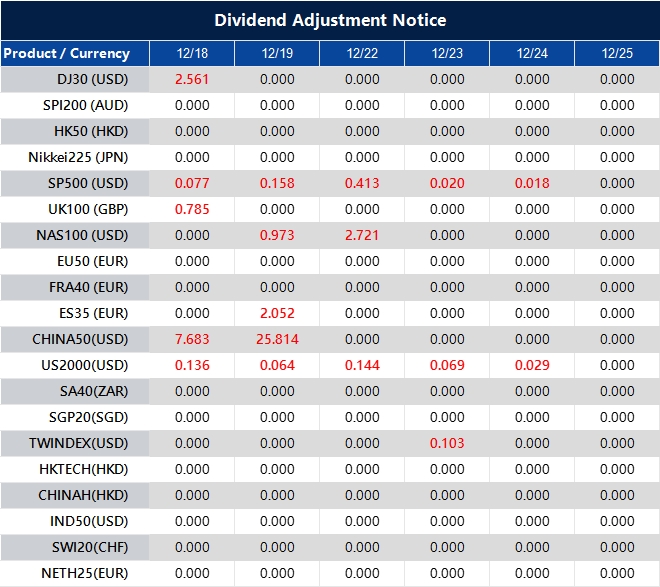
The above data is for reference only, please refer to the MT4/MT5 software for specific data.
If you’d like more information, please don’t hesitate to contact [email protected].
Gold prices in India drop today, according to various sources
Gold prices in India dropped on Thursday, according to FXStreet data. The price per gram fell to 12,586.07 Indian Rupees (INR) from 12,616.25 INR the day before.
The price per tola also went down, now at INR 146,801.50 compared to INR 147,153.50 on Wednesday. For a troy ounce, the price was INR 391,470.10.
How Gold Prices Are Calculated
FXStreet calculates gold prices in India by converting international prices into local currency and units. Prices update daily based on market rates at the time, although local rates can vary. Gold is often seen as a safe investment during economic trouble. It acts as a protection against inflation and currency decline since it isn’t tied to any government. Central banks are significant buyers of gold, adding 1,136 tonnes valued at around $70 billion to their reserves in 2022, marking a record increase. This includes central banks from growing economies like China and India. Gold prices usually move in the opposite direction of the US Dollar and Treasuries. Prices may rise during times of geopolitical tension, falling interest rates, or when riskier assets lose value. The strength of the US Dollar plays a crucial role in global gold pricing.Insights into the Gold Market
On December 18th, 2025, we see a slight dip in gold prices, but it’s important to understand the bigger picture. Prices have surged since early 2024, so some profit-taking is expected. This small decline might just be a pause before another rise or a necessary correction from these record highs. Demand for gold remains very strong, mainly from the world’s central banks. They continued their buying spree throughout 2023 and 2024, with the World Gold Council noting over 1,037 tonnes purchased in 2023 alone. This steady buying helps support prices, making any large sell-offs less likely. Additionally, the market expects major central banks to adopt a more relaxed approach, a trend that started in late 2023. The possibility of lower interest rates makes non-yielding assets like gold more appealing. A weaker US Dollar than its peak a few years ago is also helping gold prices stay stronger. For derivative traders, this environment may lead to increased volatility. The recent stability at high price levels could be temporary, suggesting that strategies like long straddles might be beneficial if a big price move happens. Buying call options during this dip could help position for a return to an upward trend with limited risk. However, record-high prices could pose a risk for a sharp downturn, making protective put options a smart choice for those with existing long positions. More speculative traders might find buying puts a profitable way to capitalize on a potential correction. The key is to monitor whether prices can maintain support at these newfound, higher levels in the weeks ahead. Create your live VT Markets account and start trading now.AUD/JPY pair falls towards 102.70, staying above the 100-day EMA as JPY strengthens
The AUD/JPY pair has dropped slightly, reaching around 102.70 in the early European session on Thursday. Despite this decline, it remains above the 100-day EMA of 99.44, showing an overall upward trend while the RSI is steady at 54.91.
The Bank of Japan is expected to raise interest rates from 0.5% to 0.75% in their upcoming meeting, marking the first increase since January. This change would bring rates to a three-decade high, with potential for future hikes based on economic reactions.
Technical Analysis
Technically, the AUD/JPY is just above the middle Bollinger band at 102.61, suggesting it may keep moving upward. The resistance level for an upward trend is at 104.43, while support is seen at 100.78. Any significant breakout will require more volatility due to the slow expansion of the bands. Gold is experiencing slight declines but continues to receive support from a stronger US Dollar. Meanwhile, the GBP/USD pair remains stable as traders prepare for important central bank events, including the Bank of England’s policy decision. Different markets are anticipating the US CPI report, which may impact currency movements and investor sentiment. With the AUD/JPY pair drifting down toward 102.70, we approach a crucial moment ahead of the Bank of Japan’s decision tomorrow. The market is anticipating a rate hike to 0.75%, which is strengthening the Japanese Yen. This would represent the highest benchmark rate in Japan since the late 1990s. The reasoning for the rate hike is backed by strong domestic data this year. Japan’s core inflation has consistently stayed above the Bank of Japan’s 2% target for over eighteen months, recently reported at 2.7% year-over-year. Additionally, significant wage increases from the spring “Shunto” negotiations, averaging over 5%, are beginning to affect the economy, providing the central bank with justification to act.Impact on Currency Pair
On the flip side, the Australian dollar is facing challenges. The Reserve Bank of Australia has kept rates unchanged for the last two meetings as inflation has cooled to 3.4%, easing the pressure for further tightening. Weak industrial profit data from China, Australia’s largest trading partner, also lowers the AUD’s near-term outlook. Given the high likelihood of a BoJ rate hike, traders should consider positions that benefit from a stronger yen, which would lower the AUD/JPY pair. Purchasing put options with a strike price near 101.00 could provide a profitable opportunity for a confirmed downward move, offering defined risk if the market has already accounted for the BoJ’s action. However, we must also consider a potential “sell the news” reaction, where the yen may weaken if the BoJ’s guidance is less aggressive than expected. A volatility play, such as a long straddle, may be suitable for traders anticipating a sharp movement in either direction but uncertain of the outcome. This involves buying both a call and a put option with the same strike price and expiration. We should recall the market reaction to the BoJ’s historic policy shift in March 2024, when negative interest rates were ended. Following that announcement, the yen initially weakened since the move was largely expected and carried cautious commentary. A similar response may occur if tomorrow’s hike is accompanied by signals that future actions will be gradual and data-driven. Thus, key technical levels to monitor include the lower Bollinger band at 100.78, which could serve as a target for bearish positions. A drop below the 100-day EMA at 99.44 would confirm a notable trend shift. Conversely, if the BoJ disappoints rate hike supporters, a rise toward the upper barrier at 104.43 would negate the immediate bearish outlook. Create your live VT Markets account and start trading now.Gold prices in Malaysia decreased today according to the latest data analysis.
Gold prices in Malaysia fell on Thursday, according to FXStreet data. The price dropped to 569.16 Malaysian Ringgits (MYR) per gram, down from 570.60 MYR on Wednesday.
The price for gold per tola also decreased, moving to 6,638.54 MYR from 6,655.38 MYR the day before. Prices for 10 grams and a troy ounce stand at 5,691.57 MYR and 17,702.76 MYR, respectively.
Data Source and Analysis
FXStreet updates its data daily, converting international prices (USD/MYR) for local currency. The prices provided are for reference and may vary slightly locally. Gold is seen as a safe-haven asset and a way to guard against inflation. It has a long history as a store of value, especially during tough economic times. Central banks are key buyers of gold, amassing 1,136 tonnes valued at $70 billion in 2022. Countries like China, India, and Turkey are increasingly boosting their reserves. Gold prices tend to move inversely to the US Dollar and US Treasuries. Factors like geopolitical instability, recession fears, interest rates, and the strength of the US Dollar can all influence gold prices.Market Sentiment and Realities
Today, gold prices fell slightly, which is intriguing considering the US Dollar’s weakness over the last quarter. This small drop might just be profit-taking as the year wraps up. Traders need to decide if this is a short-term pause or the start of a new trend. Market focus is shifting to upcoming central bank meetings early in 2026, creating uncertainty about future interest rates. Since gold does not provide yield, it’s very sensitive to these policy changes. Recently, implied volatility on gold options has risen, reflecting the uncertainty we faced during the interest rate hikes of 2023 and 2024. It’s essential to remember the strong support for gold due to substantial central bank purchases, a trend that has persisted since they bought a record 1,082 tonnes in 2023. Data from Q3 2025 shows central banks are still net buyers, absorbing over 200 tonnes and providing a solid price floor. This steady demand suggests that any major price drop might be seen as a buying opportunity by large institutions. Given these mixed signals, traders should consider strategies that take advantage of increased volatility. Buying call options can be a cost-effective way to bet on a price rally if the dollar’s weakness continues beyond the holidays. Conversely, buying puts can protect against a sharp price drop if central banks indicate they will maintain higher rates next year. With option premiums high due to current uncertainty, using vertical spreads is a smarter way to manage costs. For example, a bull call spread lowers the entry price for participating in a potential rally, while also capping the maximum profit. This strategy allows traders to clearly define their risk during the typically thin holiday trading volumes. Create your live VT Markets account and start trading now.EUR/JPY trades around 182.90 after recent gains amid concerns about Japan’s fiscal situation
The EUR/JPY pair is around 183.00 amid rising worries about Japan’s financial situation. Japan’s Prime Minister, Sanae Takaichi, is advocating for active fiscal policies to boost economic growth, which contrasts with strict measures that might hinder progress.
After gaining 0.51% last session, EUR/JPY is trading at about 182.90 during Asian hours. The Japanese Yen faces pressure from concerns over the country’s financial outlook.
Fiscal Policy And Economic Growth
Takaichi highlights the importance of sustainable fiscal policies and economic growth driven by higher corporate profits and wages. The Yen could strengthen if the Bank of Japan raises its policy rate by 25 basis points to 0.75% due to surging inflation. Market watchers are keen on comments from BoJ Governor Kazuo Ueda for guidance on future policies. There’s a possibility of rate hikes up to 1% by July. Meanwhile, the Euro has gained strength as Eurozone inflation eases, indicating less need for action from the European Central Bank. The upcoming ECB meeting in December is expected to maintain current policies, with President Christine Lagarde likely to keep rates unchanged into next year. The Bank of Japan plans to move away from ultra-loose monetary policies starting in 2024, as inflation surpasses its 2% target and salary prospects improve. Previous policies led to a decline in the Yen, but changes in 2024 aim to stabilize it.Bank Of Japan Rate Decision
The Bank of Japan’s rate decision is expected tomorrow, with a 25 basis point increase to 0.75% already reflected in market prices. Attention will be on Governor Ueda’s guidance, which will influence the Yen’s direction in the weeks ahead. Any hint of a pause or dovish remarks could weaken the Yen, pushing EUR/JPY higher. Recent data supports this view. Japan’s Core CPI for November 2025 was reported at 2.7%, validating the BoJ’s decision while also showcasing inflation pressures from the government’s spending. In contrast, Eurozone HICP inflation for November 2025 was at 2.3%, allowing the ECB to keep rates steady. As a result, many traders may be preparing for a “sell the fact” scenario on the Yen. Activity in short-term EUR/JPY put options indicates a potential profit if Governor Ueda offers a surprisingly hawkish tone, causing the JPY to appreciate sharply. This strategy suggests the BoJ will want to take a strong stance against the government’s spending plans. However, the ongoing trend of Yen weakness due to fiscal concerns is strong. Traders expecting a dovish outcome from the BoJ are likely buying EUR/JPY call options, betting that the rate hike might be a “one and done” scenario, possibly pushing the pair above 183.00. In the broader options market, implied volatility for EUR/JPY has risen ahead of the meeting, indicating uncertainty. This suggests that strategies like straddles are being used to capitalize on any significant price movement following the event. This approach avoids predicting direction but bets on a substantial post-meeting shift. In the upcoming weeks, the interest rate differential will be crucial. Even with a hike to 0.75%, Japan’s rates remain significantly lower than the ECB’s steady 3.75% after recent cuts. This considerable gap will continue making it appealing to sell Yen to buy Euros. Create your live VT Markets account and start trading now.November Consumer Price Index data will show inflation above the Federal Reserve’s target.
The US Consumer Price Index (CPI) is expected to rise by 3.1% year-on-year in November, slightly higher than September’s figures. Analysts attribute this increase, along with a core CPI inflation estimate of 3%, to rising energy prices.
The Bureau of Labor Statistics will announce the CPI data on Thursday. Due to a government shutdown, monthly numbers will not be available, so the focus will be on the annual data. This inflation report may impact expectations for Federal Reserve rate cuts and the value of the US Dollar.







