



Japan’s Takaichi encourages proactive fiscal policy to boost the nation’s capacity amid tightening measures.
Japanese Prime Minister Sanae Takaichi is advocating for a proactive approach to fiscal policy aimed at strengthening Japan. This approach emphasizes sustainable fiscal measures and improved social welfare through economic growth and wage increases. Former Bank of Japan (BoJ) deputy governor Masazumi Wakatabe has suggested increasing the neutral interest rate in conjunction with fiscal policies and growth strategies while cautioning against raising rates too soon.
The USD/JPY exchange rate rose by 0.24%, now trading at 155.17. The value of the Japanese Yen is primarily influenced by the performance of Japan’s economy, BoJ policies, differences in bond yields, and overall market sentiment. The BoJ’s recent loose monetary policies decreased the Yen’s value, but recent adjustments are providing some support.
The US dollar strengthens as focus shifts to UK inflation figures.
The US Dollar remained steady early Wednesday as traders reassessed the Federal Reserve’s policy after recent employment data. At the same time, the UK awaited inflation figures for November, which could impact the Bank of England’s announcements on Thursday.
The US Bureau of Labor Statistics reported a drop of 105,000 jobs in October, with only a small increase of 64,000 jobs in November. The Unemployment Rate rose to 4.6% in November, while annual wage growth fell to 3.5%. The USD Index dipped below 98.00 but then bounced back to 98.50 early Wednesday. Several Federal Reserve officials are scheduled to speak later today.
Forex Market Updates And Predictions
GBP/USD fell below 1.3400, despite a 0.3% increase on Tuesday, as the UK CPI is predicted to decrease to 3.5% in November. EUR/USD moved above 1.1800 on Tuesday but corrected lower, trading beneath 1.1750 on Wednesday. USD/JPY increased by 0.3%, reaching 155.15. Meanwhile, Gold rose 0.7%, nearing $4,330. Inflation impacts currency values. Generally, higher inflation strengthens a currency as it suggests interest rate hikes are coming. Inflation also affects gold prices, where higher inflation can lead to interest rate increases, making gold less appealing compared to assets that generate interest. The weak US employment report, showing job losses in October and only modest gains in November 2025, should make us wary of the US Dollar’s strength. The rebound to 98.50 on the index feels delicate, as poor data usually points to future rate cuts from the Federal Reserve. Markets are pricing in a strong chance of easing in the first half of 2026, similar to expectations in late 2023 when the CME FedWatch Tool anticipated over 150 basis points of cuts for the coming year. Attention should be on the British Pound ahead of tomorrow’s Bank of England meeting. Today’s inflation data will be crucial. If the Consumer Price Index reads lower than expected, it could prompt the BoE to adopt a more careful stance, posing a downside risk for GBP/USD. Traders might consider buying short-term put options on GBP/USD to guard against a dovish policy statement.Eurozone And Japanese Yen Analysis
The Euro is at a critical juncture, with the European Central Bank meeting tomorrow. The dip of the pair below 1.1750 reflects some uncertainty. Later today, the German IFO business sentiment data will be a significant indicator of the Eurozone’s largest economy’s health. The ECB’s updated economic forecasts will be key, as they will shape expectations for the bank’s policy through 2026. While the Dollar has rebounded today, its performance against the Japanese Yen has been the weakest this week, which is notable. The rise in USD/JPY to 155.15 seems driven by short-term interest rate differences, though this level remains historically high, reminiscent of Japanese officials’ verbal interventions over the past two years. Any dovish comments from upcoming Fed speakers could quickly reverse this trend, making it risky to chase higher. Gold’s rise to nearly $4,330 an ounce makes sense in the current environment and appears to be the most straightforward trade. The weak US jobs report strongly supports holding non-yielding assets, indicating a future of lower interest rates. This increase in gold appears contrary to the US Dollar’s simultaneous recovery, suggesting that the market is uncertain and hedging against a potential economic downturn. Create your live VT Markets account and start trading now.If UK CPI matches forecasts, GBP/USD could stay low, according to the ONS report
The UK Office for National Statistics will soon release the November Consumer Price Index (CPI). It’s expected to show a slight decrease in inflation, dropping to 3.5% from 3.6% in October. Monthly inflation is likely to remain unchanged after a 0.4% increase last month. The core CPI, which excludes food and energy, is predicted to stay at a 3.4% year-on-year rise.
The GBP/USD exchange rate rose to about 1.3425 during the early Asian session, thanks to encouraging preliminary PMI data from the UK. The UK Composite PMI climbed to 52.1, beating estimates of 51.4. The Services and Manufacturing PMIs stand at 52.1 and 51.2, respectively. These stronger-than-expected numbers have supported the Pound Sterling against the US Dollar.
GBP/USD Surge
On Tuesday, GBP/USD surged by 0.42%, driven by weak US jobs data and stable Retail Sales. It traded at 1.3432 after hitting a daily low of 1.3355. The US Nonfarm Payrolls came in at 64K, exceeding the expected 50K, while the Unemployment Rate rose from 4.4% to 4.6%, slightly above the Federal Reserve’s estimate of 4.5%. Right now, we are focused on the UK inflation data coming out today, December 17th. With core inflation expected to remain steady at 3.4%, any unexpected results could lead to significant movements in the pound. This situation is reminiscent of the challenges the Bank of England faced in 2023 when core CPI stubbornly stayed above 6% for months, complicating their monetary policy. On the other hand, the US dollar appears weak after the disappointing jobs report and the unemployment rate increasing to 4.6%. A similar situation occurred in late 2023 when slowing job growth and a rising unemployment rate of 3.9% led to quick adjustments in market expectations for Federal Reserve rate cuts. This suggests that purchasing options to safeguard against further dollar weakness might be a wise choice as we head to year-end. Even with inflation worries, the positive UK PMI data shows economic resilience, with the composite number reaching 52.1. The strength of the services sector offers a solid support for the pound, especially when compared to the weakening US labor market. Traders may see this as a good time to keep their long positions on sterling, possibly using futures contracts to capitalize on this view.Expected Volatility
Given these mixed signals, we anticipate an increase in short-term volatility around the pound. The Cboe Volatility Index (VIX) is currently at about 13.5, a relatively low level historically, indicating that options may be favorably priced. This environment is ideal for option strategies that can benefit from significant price movements after the CPI release, regardless of the direction. Create your live VT Markets account and start trading now.Gold prices in the United Arab Emirates have risen according to recent data.
The Importance of Gold in Financial Markets
Gold has long been valued as a reliable store of value and a means of exchange. It acts as a safe-haven asset and a way to protect against inflation and currency loss. Central banks, especially those in China, India, and Turkey, hold significant amounts of gold. In 2022 alone, they added 1,136 tonnes, worth $70 billion, to their reserves. Gold prices often move in the opposite direction of the US Dollar and Treasuries. Typically, when the Dollar and other risky investments decline, gold prices rise. Events like geopolitical unrest or economic downturns tend to increase gold prices, as do lower interest rates. On the other hand, a strong Dollar usually keeps gold prices in check, while a weaker Dollar helps them rise. Today, December 17, 2025, gold prices are slightly up. This may indicate a growing interest in gold as a safe-haven investment. With rising concerns about inflation and currency devaluation, gold’s importance in our current economic environment is increasing. If these market worries continue, this small increase could lead to a more significant upward trend.Market Trends and Strategies
We think the market is anticipating a possible interest rate cut by the U.S. Federal Reserve in the first half of 2026, which is putting pressure on the Dollar. Since gold does not earn interest, it usually performs better when rate expectations fall. We noticed this pattern during the speculation around policy changes in late 2023. As a result, the U.S. Dollar Index (DXY) has dropped to about 101.5, creating a good environment for rising gold prices. Central bank purchases are also giving solid support to the market. This trend has continued since the significant gold accumulation we observed in 2022. Recent reports from the World Gold Council show that in the third quarter of 2025, central banks, mainly in Asia, increased their global reserves by a net 337 tonnes. This ongoing demand helps create a solid price floor for gold. Additionally, the latest global manufacturing PMI data indicates a decline for the third month in a row, raising concerns about a broader economic slowdown. This uncertainty keeps the CBOE Volatility Index (VIX) above 20, which often leads investors to seek safer assets like gold. The relationship between gold and riskier investments suggests that a drop in stock prices could further push up gold prices. With all this in mind, we should explore strategies that could benefit from a potential rise in gold prices in the coming weeks. Taking long positions through gold futures or purchasing call options could help us take advantage of this expected trend while managing risk. Create your live VT Markets account and start trading now.EUR/USD pair drops to around 1.1730 in early European trading due to USD strength
The EUR/USD falls to about 1.1730 during early European trading on Wednesday due to increased demand for the US Dollar. This drop comes as the ECB is likely to keep interest rates steady for the fourth time, maintaining the key deposit rate at 2% since July.
US labor market data shows some resilience but with signs of slowing. In November, Nonfarm Payrolls grew by 64,000, surpassing predictions of 50,000. However, the unemployment rate rose to 4.6% from 4.4% in October, which could weaken the dollar.
Technical Analysis
Currently, EUR/USD stands at 1.1732, while the 100-day EMA sits at 1.1611, indicating a possible upward trend. The RSI is at 65.58, showing strong momentum. Resistance is at 1.1788, with support levels at 1.1639 and 1.1611. This suggests a bullish outlook unless resistance is encountered. The European Central Bank (ECB), based in Germany, manages monetary policy in the Eurozone, focusing on keeping inflation around 2%. The ECB’s actions, like adjusting interest rates and implementing quantitative easing, significantly influence the Euro’s strength. Quantitative easing, which occurs during financial crises, usually weakens the Euro, whereas quantitative tightening, which stops bond buying, often strengthens the currency.Economic Data and Policy Divergence
Currently, the EUR/USD is around 1.1730 as we await the ECB’s December rate decision. The ECB confirmed expectations last Thursday by keeping its key deposit rate at 2.0%, providing market clarity. This stability has helped the pair break through past technical barriers. Recent economic data paints a clearer picture compared to the mixed US jobs report from November 2025. Latest Eurozone inflation data shows core HICP steady at 2.6%, suggesting that the ECB isn’t planning further rate cuts for the moment. On the other hand, US Core PCE, the Fed’s chosen inflation measure, has recently dipped to 2.8%, raising speculation about a possible rate cut in the first half of 2026. This difference in policies has pushed the pair above the 1.1788 resistance level, which now serves as a potential support zone. In the coming weeks, traders should keep an eye out for a potential test of the 1.2000 psychological level. Buying call options with strikes above 1.1900 could be a good strategy for those looking to capitalize on further gains. With the ECB meeting now completed, implied volatility is likely lower, making options strategies cheaper. Traders might consider entering long positions via futures contracts during pullbacks toward the 1.1788-1.1800 range. Using protective put options below 1.1750 can help manage risks in case of a sudden reversal. Create your live VT Markets account and start trading now.Gold prices in Pakistan increased today, according to data from various sources.
Gold prices in Pakistan rose on Wednesday. The cost per gram increased to 38,987.39 PKR from 38,840.55 PKR on Tuesday. Similarly, the price per tola went up to 454,732.40 PKR from 453,028.60 PKR the previous day.
FXStreet adjusts international gold prices using the Pakistani currency and measurement systems. These gold prices are updated daily based on current market trends, and local rates can vary. Here are the listed prices: 1 gram at 38,987.39 PKR, 10 grams at 389,866.30 PKR, and 1 tola at 454,732.40 PKR.
Gold As A Secure Asset
Gold is a reliable asset during economic instability, protecting against inflation and currency decline. Central banks are significant buyers of gold; in 2022, they added 1,136 tonnes worth $70 billion to their reserves, making it the highest yearly purchase on record. Gold often rises when the US Dollar weakens, providing diversification during turbulent markets. As it does not yield returns, gold usually increases with lower interest rates and drops with higher rates. Its value largely depends on the strength of the US Dollar. The recent increase in gold prices, particularly in the Pakistani Rupee, signals a broader trend of hedging against currency decline and ongoing inflation. This trend suggests that safe-haven assets are becoming more important in the upcoming weeks. Traders should keep an eye on the relationship between gold and the US Dollar. We are closely monitoring the latest inflation data. The US CPI for November 2025 was slightly higher than expected at 3.5%. This ongoing inflation complicates the Federal Reserve’s decisions and creates uncertainty about planned rate cuts in 2026. Such conditions typically favor non-yielding assets like gold.Impact Of The US Dollar On Gold Prices
The US Dollar Index (DXY) has dipped below 102, which helps boost gold prices. Historically, a weaker dollar tends to raise gold prices. Traders should consider this strong inverse relationship when planning their positions for the year-end. This trend is supported by strong demand from institutions, which we have noticed over several years. According to World Gold Council data, central banks, especially in emerging markets, bought an additional 250 tonnes in Q3 2025, following the record purchases in 2022 and 2023, creating a solid market foundation. Geopolitical tensions also significantly affect the market, as renewed trade issues contribute to uncertainty. Economic instability might lead to a rush for safety, and gold is the key beneficiary in such volatile times. We expect any escalations to be immediately reflected in gold futures and options prices. Given the current uncertainty, preparing for increased market volatility seems wise. Using derivatives to invest in gold volatility, such as through straddles on major gold ETFs, could be a smart strategy. This approach allows traders to profit from significant price movements in either direction as economic pressures unfold. We are also seeing a growing skew in the options market, with call option premiums rising compared to puts. This indicates that while overall volatility is anticipated, the market is leaning towards a higher chance of a substantial upward shift. This sentiment provides valuable insights into market expectations for early 2026. Create your live VT Markets account and start trading now.Gold prices in India increased today according to market data.
Gold Price Calculation in India
On Wednesday, gold prices in India rose, according to FXStreet data. The price per gram increased to 12,552.61 Indian Rupees (INR) from 12,501.23 INR the day before. The price for a tola went up to 146,404.30 INR from 145,811.80 INR. Here are the prices in different units: – 1 gram: 12,552.61 INR – 10 grams: 125,520.20 INR – Tola: 146,404.30 INR – Troy ounce: 390,413.90 INR FXStreet calculates gold prices by converting international rates using the USD/INR exchange rate. Prices are updated daily and may differ slightly from local market prices. Gold is seen as a safe-haven investment during financial uncertainty. Central banks hold the most gold, with 1,136 tonnes added to their reserves in 2022, marking the highest yearly purchase. Gold prices typically move in the opposite direction of the US Dollar and US Treasuries. Factors that influence gold prices include geopolitical issues, interest rates, and the Dollar’s strength. A strong Dollar usually puts downward pressure on gold prices, while a weak Dollar can drive them up.Outlook for Gold Prices and Derivatives
The small rise in gold prices reflects a larger trend we are monitoring. As discussions about a global economic slowdown ahead of 2026 increase, gold is reaffirming its status as a leading safe-haven asset. This is what derivative traders should focus on, rather than minor daily price changes. We think that the main factor in the coming weeks will be expectations regarding monetary policy, especially from the US Federal Reserve. After a period of aggressive rate hikes in 2023 and 2024 to manage inflation, markets now anticipate a shift toward lower rates by the second half of 2026. Lower interest rates reduce the cost of holding non-yielding gold, which historically supports higher prices. This expectation is already putting pressure on the US Dollar, which usually moves opposite to gold prices. The dollar index (DXY) has recently fallen below the key level of 100 as traders expect looser monetary policy. Historically, a weaker dollar makes gold cheaper for holders of other currencies, often boosting global demand. Additionally, central banks continue to buy gold, creating a strong support level for prices. Following record purchases in 2022 and 2023, data from the World Gold Council indicates that this trend will likely continue into 2024 and early 2025, with emerging market banks leading the purchases. This steady demand helps provide a foundation that limits downside risk. For derivative traders, this environment suggests focusing on long positions through call options to take advantage of potential gains while managing risk. The ongoing discussions about a slowdown have also pushed the VIX toward the 20 level, indicating that buying options to benefit from rising volatility might be a smart strategy. We should consider contracts that expire in the first and second quarters of 2026 to coincide with the expected policy shift. However, we need to be alert for any unexpectedly strong economic data, such as a surprising rise in the upcoming US Non-Farm Payrolls report. A strong jobs number or higher inflation could delay anticipated rate cuts, leading to a temporary jump in the dollar and a drop in gold prices. This could pose a short-term challenge to bullish positions. Create your live VT Markets account and start trading now.Dividend Adjustment Notice – Dec 17 ,2025
Dear Client,
Please note that the dividends of the following products will be adjusted accordingly. Index dividends will be executed separately through a balance statement directly to your trading account, and the comment will be in the following format “Div & Product Name & Net Volume”.
Please refer to the table below for more details:
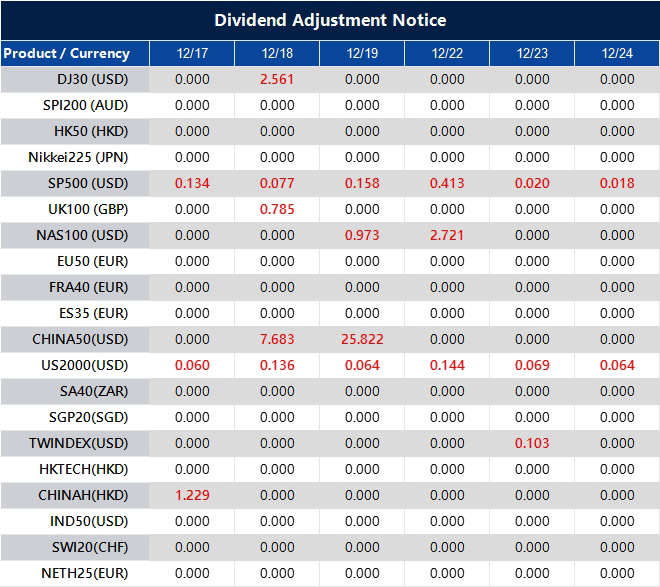
The above data is for reference only, please refer to the MT4/MT5 software for specific data.
If you’d like more information, please don’t hesitate to contact [email protected].
Recent data shows an increase in gold prices in Malaysia, according to analysts.
Gold prices in Malaysia rose on Wednesday, according to FXStreet data. The price per gram went up to 567.79 Malaysian Ringgits (MYR) from 565.44 MYR the day before.
The price for a tola of gold increased to MYR 6,622.75 from MYR 6,595.20. FXStreet calculates gold prices by adjusting international prices to the local currency, updating them based on current market rates.
Safe Haven Asset and Inflation Hedge
Gold is a safe-haven asset and serves as a hedge against inflation. People often buy gold when times are uncertain. Central banks are significant buyers, purchasing 1,136 tonnes worth about $70 billion in 2022. Gold prices usually rise when the U.S. dollar declines, as they have an inverse relationship. Events like geopolitical instability and recession fears drive up gold prices, as it’s seen as a secure investment. In general, gold prices react to changes in interest rates and the strength of the U.S. dollar. Lower interest rates can boost gold prices, while a stronger dollar can hold them back.Local Price Action Reflects Global Market Strength
The recent increase in gold prices in Malaysia points to a broader strength in the global market. This suggests a solid support for gold, confirming a bullish trend likely to continue into early 2026. The rise is mainly fueled by expectations around U.S. monetary policy. After a series of aggressive interest rate hikes in 2023 and a long pause in 2024, the Federal Reserve is indicating a potential shift toward easing as economic growth slows. This outlook is pressuring the U.S. dollar, which historically leads to higher gold prices. We are also seeing strong demand from institutional buyers, which supports the price. In the third quarter of 2025, central banks worldwide added over 220 tonnes to their reserves, keeping up the aggressive purchasing trend that started in 2022. This consistent buying shows that nations prioritize gold as a safe-haven asset amid ongoing geopolitical uncertainty. For derivative traders, this environment is favorable for positioning for more gains. Establishing long positions in gold futures or purchasing call options could be good strategies to benefit from the expected rise. It’s important to watch the key psychological level of $2,500 per ounce; breaking above it could trigger a new wave of buying. Moreover, gold’s attractiveness as an inflation hedge remains strong, especially as core inflation has stayed above the central bank’s 2% target throughout 2025. With equity markets looking over-extended after a strong run, conditions are right for a shift from riskier investments to safe havens. Holding a long position in gold is a wise diversification strategy in the coming weeks. Create your live VT Markets account and start trading now.After two days of losses, EUR/JPY is trading near 181.90 due to a weakening Japan trade balance.
EUR/JPY is holding steady around 181.90 during the Asian session, recovering from two days of losses. This stability follows Japan’s trade balance surplus for November, which came in lower than expected at JPY 62.9 billion, down from JPY 74.0 billion in October.
On a positive note, Japan’s exports in November grew by 6.1%, beating the forecast of 4.8% and marking the fastest growth in nine months. Core machinery orders also performed well, rising by 7%. However, imports only increased by 1.3% year-on-year, which is below the anticipated 2.5%.







