



Gold prices in the United Arab Emirates rise according to recent data.
Gold prices rose in the United Arab Emirates on Tuesday. A gram of gold is now priced at 529.07 AED, up from 524.10 AED on Monday. The cost per tola also increased, reaching 6,170.97 AED, up from 6,112.97 AED the day before.
FXStreet adjusts international gold prices to local currency daily, but local rates may vary slightly.
Dividend Adjustment Notice – Dec 23 ,2025
Dear Client,
Please note that the dividends of the following products will be adjusted accordingly. Index dividends will be executed separately through a balance statement directly to your trading account, and the comment will be in the following format “Div & Product Name & Net Volume”.
Please refer to the table below for more details:
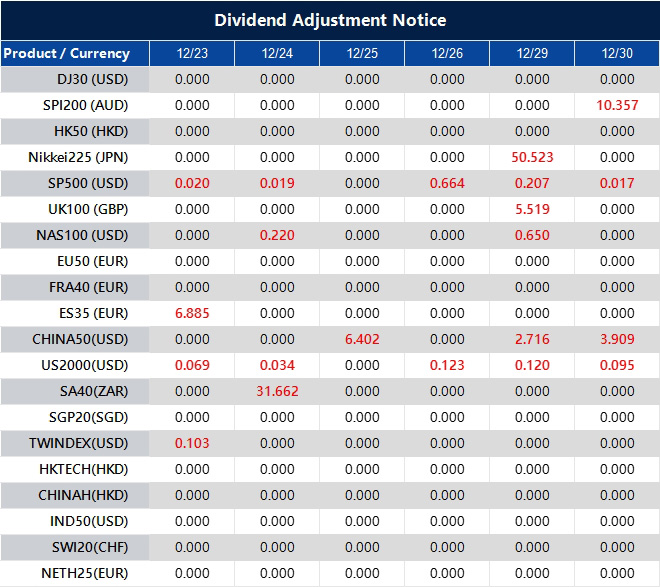
The above data is for reference only, please refer to the MT4/MT5 software for specific data.
If you’d like more information, please don’t hesitate to contact [email protected].
Gold prices rise in Pakistan, according to recent data analysis.
Gold prices in Pakistan increased on Tuesday, according to FXStreet. The cost per gram rose to 40,262.68 Pakistani Rupees (PKR) from 39,830.66 PKR on Monday.
The price for one tola of gold jumped to 469,616.00 PKR, up from 464,577.00 PKR the previous day. Other measures include 10 grams at 402,629.50 PKR and a troy ounce priced at 1,252,310.00 PKR.
How Gold Prices Are Calculated
FXStreet determines gold prices in Pakistan by converting international prices into local currency and measurements. Prices are updated daily to reflect current market rates. Local price variations may occur. Gold is valued as a safe asset and as a currency. It’s particularly sought after during financial instability. Central banks hold most of the world’s gold to back their currencies. Gold prices often move in the opposite direction of the US Dollar and US Treasuries. Factors such as geopolitical instability or economic downturns can also impact gold prices. The strength of the US Dollar significantly affects gold’s price—when the dollar weakens, gold prices rise, and vice versa. The recent rise in gold prices shows a broader trend that we’re monitoring closely. This upward movement is not just temporary but is strongly supported by ongoing purchases from central banks worldwide. This trend has become more pronounced since the record buying in 2022. The World Gold Council’s Q3 2025 report confirmed that emerging market banks added another 250 tonnes of gold, reflecting a growing distrust in fiat currencies.Future Economic Outlook
As the end of the year approaches, the market is anticipating that the US Federal Reserve may cut interest rates in the second half of 2026 to boost a slowing economy. The aggressive rate increases from 2022 and 2023 now seem like a distant memory. Current economic data suggests a shift towards a more relaxed monetary policy. In this environment of declining real yields, holding non-yielding assets like gold appears increasingly appealing. This situation makes long positions on gold derivatives an attractive strategy for the upcoming weeks. With the S&P 500 showing signs of fatigue after its prolonged rally in 2024, using gold call options could provide a safeguard against a potential stock market decline. The inverse correlation between gold and risk assets is becoming clearer as uncertainty about economic growth in 2026 grows. Trading volumes are likely to be low as we head into the new year, which can intensify price movements in response to any geopolitical events. Ongoing tensions in various global hotspots during 2025 could lead to a swift move towards safe-haven assets, benefiting gold. Therefore, we should explore strategies that capitalize on a possible surge in volatility. The trend of gold appreciating against local currencies, like the Pakistani Rupee, has been consistent throughout 2024 and 2025, particularly as the US Dollar has weakened from its peak. A weaker dollar makes gold more affordable for those with other currencies, generally supporting its international value. This trend is part of a global shift to move away from the dollar and invest in hard assets. Create your live VT Markets account and start trading now.AUD/JPY pair experiences selling pressure at 104.05 as Yen strengthens against Dollar
AUD/JPY has dropped to about 104.05 in Tuesday’s early European session due to concerns over Japanese intervention. However, it remains in an upward trend, staying above the 100-day EMA with a strong bullish RSI momentum.
Japan’s Finance Minister hinted that officials could control Yen fluctuations after recent sharp moves. The Reserve Bank of Australia’s firm stance may limit losses for the Aussie Dollar, as discussions of interest rate hikes grow due to inflation worries.
Market Position and Analysis
Currently, the pair sits at 104.06 on the daily chart, well above the 100-day EMA at 99.64. This supports the overall uptrend. The RSI is above 63 and is targeting 104.74; closing above this level could push the pair towards the key mark of 105.00. Support is at the December 19 low of 102.82, while Bollinger Bands indicate lower volatility. A bounce from the upper band may pull the pair back towards 101.44. The strength of the Japanese Yen is affected by Japan’s economic health, Bank of Japan policies, and external factors like bond yield differences. The Yen often gains strength during market instability because it is seen as a safe investment. As tensions rise around the AUD/JPY near the 104.00 mark, we see a classic clash between strong fundamentals and political risks. The Reserve Bank of Australia’s firm stance supports the Aussie Dollar, keeping the longer-term uptrend intact.Strategic Implications for Traders
The main factor driving the strength of the Australian Dollar is the difference in interest rates and ongoing inflation. Australia’s Q3 2025 CPI was reported at 3.9%, still above the RBA’s target of 2-3%. This supports their tough stance. The gap between Australian and Japanese 10-year government bonds is around 375 basis points, making carry trades appealing and boosting the AUD/JPY pair. However, the potential for intervention from Japanese officials is a significant risk. Past actions from the Ministry of Finance in September and October of 2022 to strengthen the Yen serve as a reminder that such warnings can precede real market actions. These comments aim to limit gains and may prompt a quick drop in the pair. For derivative traders, this environment suggests hedging long positions against a sudden strengthening of the JPY. Buying out-of-the-money put options on AUD/JPY is a cost-effective way to protect a portfolio from a sharp decline due to intervention. This approach allows participation in the uptrend while capping potential losses. Alternatively, traders wanting to profit from upward movement while managing risk might consider bull call spreads. By purchasing a call option near the current price and selling another with a higher strike, like 105.00, they can aim for small profits with limited risk. The narrowing Bollinger Bands suggest that volatility is decreasing, which could make option premiums less expensive ahead of a potential breakout. Create your live VT Markets account and start trading now.Gold prices in India increased today, according to data from various sources.
Gold prices in India went up on Tuesday, according to FXStreet. The price hit 12,939.60 Indian Rupees (INR) per gram, rising from INR 12,803.90 on Monday.
The cost for one tola increased to INR 150,781.30, up from INR 149,200.00 the day before. Prices vary based on measurement, with 10 grams costing INR 129,270.00 and a troy ounce priced at INR 402,466.90.
Gold Pricing Methodology
FXStreet determines gold prices based on international rates converted into local currency. Prices are updated daily, but local variations can occur. Gold is not just for jewelry; it acts as a store of value and a medium of exchange. People view gold as a safe-haven asset, especially during tough economic times. Central banks hold most of the world’s gold. In 2022, they bought 1,136 tonnes, the highest recorded. Countries like China, India, and Turkey are also building their gold reserves. Gold usually moves opposite to the US Dollar and US Treasuries. Prices can rise during geopolitical unrest or concerns about recessions. Lower interest rates and a weaker US Dollar often lead to higher gold prices.Gold’s Recent Market Performance
Gold’s increase to over 12,900 INR per gram shows ongoing market worry as we near the end of 2025. This rise highlights gold’s role as a strong hedge against this year’s economic challenges and ongoing inflation. The current momentum suggests we should expect more fluctuations as we enter the new year. Central banks continue to buy aggressively, following a record pace in 2022 and 2023, when they added over 1,000 tonnes to their reserves each year. This steady demand, especially from emerging markets, keeps prices stable. Institutional buying shows no signs of slowing, providing a strong outlook for the coming weeks. The US Dollar’s decline in the second half of 2025 has bolstered gold’s price. As major central banks adopt a more cautious approach amid slowing growth, the appeal of gold, which doesn’t yield interest, has grown. Traders should closely monitor interest rate forecasts in early 2026, as these changes will affect both gold and the dollar. Considering the market’s uncertainty, implied volatility for gold options will likely remain high. Using call options to seek potential gains while managing risk is a smart strategy. We advise caution with direct futures positions due to possible sharp price changes from news events. This year, the inverse relationship with riskier assets has been clear as global stock markets have faced challenges. In the last quarter of 2025, the VIX, a measure of stock market fear, remained above its long-term average near 20. Signs of economic weakness in early 2026 could easily lead to another shift from stocks to gold. Create your live VT Markets account and start trading now.EUR/USD trades at 1.1780, maintaining a bullish trend and targeting the 1.1800 level after recent gains
EUR/USD is close to a two-month high of 1.1804, currently trading around 1.1780 during the Asian session on Tuesday. The 14-day Relative Strength Index (RSI) shows strong demand at 68.89, but there’s a risk if it enters overbought territory.
The pair maintains a bullish trend, staying above the nine-day and 50-day Exponential Moving Averages (EMA), which are both rising. If EUR/USD breaks through the resistance at 1.1800, it could rise further, targeting 1.1870 and 1.1918.
Key Levels And Indicators
If selling pressure comes in, the first support is at the nine-day EMA of 1.1731, followed by the ascending channel boundary at around 1.1720. A drop below these points might test the 50-day EMA at 1.1653 and possibly 1.1589. In recent currency movements, the Euro has increased by 0.19% against the US Dollar, marking its best performance among major currencies today. A heat map shows other currency shifts with various percentage changes across the market. This analysis does not offer investment advice, and it’s essential to do your own research before making any financial choices. The information here is for informational purposes and comes with risks.Outlook And Strategic Considerations
As EUR/USD approaches the key level around 1.1800, we should prepare for a possible breakout in the coming weeks. The upward momentum in the ascending channel indicates a bullish outlook as we reach the end of the year. This strength is supported by the Euro’s recent performance against the US Dollar. This upward movement is also backed by changing interest rate expectations between the US and Europe. Recent data from early December 2025 showed US inflation cooling to 2.9%, raising speculation that the Federal Reserve might cut rates in the first half of 2026. Meanwhile, Eurozone inflation remains steady at 2.7%, leading the European Central Bank to adopt a cautious approach. For those trading derivatives, this presents an opportunity to bet on further gains in early 2026. Buying call options with strike prices of 1.1850 or 1.1900, set to expire in late January or February, could allow for profits if the price exceeds the recent high. This strategy limits risk to the premium paid while offering considerable upside if the trend continues. However, we should keep an eye on the 14-day RSI, which is approaching overbought levels around 69. If EUR/USD fails to break above 1.1804, it may lead to a short-term pullback. To manage this risk, we might consider a bull call spread or set alerts to buy put options if the price drops below the critical support at 1.1731. Recent data from the Commodity Futures Trading Commission (CFTC) supports this outlook, showing that large speculators have been increasing their net long positions in the Euro. This indicates that institutional investors believe in a stronger Euro, adding confidence to the technical analysis. Moreover, the general weakness of the US Dollar reinforces this perspective. We are seeing this weakness reflected in the market, with gold reaching record highs and the British Pound hitting ten-week peaks against the dollar. This suggests a broader shift away from the dollar, benefiting the EUR/USD pair as we head into the new year. Create your live VT Markets account and start trading now.Gold prices in Malaysia rise, as shown in today’s compiled data
Gold as a Safe Investment
Gold prices in Malaysia are rising, as shown by FXStreet data. Currently, gold costs 586.55 Malaysian Ringgits (MYR) per gram, up from 580.33 MYR the day before. The price for a tola increased to 6,841.44 MYR, compared to 6,768.80 MYR just a day earlier. FXStreet updates local gold prices daily, reflecting international rates. Gold is seen as a safe investment and a way to exchange value, especially during economic uncertainty. Central banks are the biggest holders of gold, adding 1,136 tonnes in 2022 to boost their currency reserves. Gold prices often move inversely to the US Dollar and US Treasuries. Prices tend to rise when interest rates are low and the Dollar weakens. Unrest or fears of economic downturns can also push gold prices higher. We are witnessing strong gold performance, with rising prices in Malaysian Ringgit showing a broader trend of a weaker US Dollar. With shorter trading weeks coming up, traders should expect lower activity, which could cause larger price swings. It’s essential to prepare for increased volatility.Central Bank Buying Trends
Strong demand from central banks is helping to keep gold prices stable. This trend is speeding up through 2024 and 2025. In 2023, central banks added a remarkable 1,037 tonnes of gold and have continued to buy steadily in 2024. This points to a global shift away from the dollar, with major buyers like China and Poland supporting gold’s value. This price increase is also driven by expectations of lower interest rates. As the Federal Reserve moves away from rate hikes in late 2024, holding US Treasuries looks less appealing. Since gold doesn’t earn interest, it becomes more enticing when rates drop, which decreases the cost of holding it. This background is crucial for gold’s current positive momentum. For those trading derivatives, buying call options or creating bullish call spreads could be smart strategies to take advantage of potential price increases. However, the Relative Strength Index (RSI) indicates high demand, which usually means higher implied volatility, making options costlier. Using protective puts could help hedge against sudden profit-taking as we wrap up the year. It’s also important to note that gold often suggests nervousness in stock markets. Talk of a possible “regime shift” for 2026 reflects underlying economic concerns that push investors toward safer options. Investors may consider shorting stock indices as a way to balance their long gold positions when protecting against overall market risk. Create your live VT Markets account and start trading now.Australian dollar strengthens against weakening US dollar as hopes for Fed easing grow
The Australian Dollar (AUD) has strengthened after the Reserve Bank of Australia’s (RBA) December meeting minutes were released. There is growing uncertainty about whether monetary policy is still tight, with worries that inflation could remain high for longer.
The AUD also gained because the US Dollar (USD) is struggling, partly due to expectations that the Federal Reserve will ease its policies. President Trump is pushing for lower borrowing costs, adding to these challenges.
US Dollar Index and Economic Indicators
The US Dollar Index is around 98.20 as traders await the US’s third-quarter GDP results. The annual growth rate is expected to be 3.2%, down from 3.8% in the second quarter. Geopolitical tensions between the US and Venezuela are also affecting the USD’s value, along with rising demand for precious metals. The chance of interest rates staying the same at the Fed’s January meeting is 80.0%, with a smaller chance of a rate cut. In Australia, Consumer Inflation Expectations have risen to 4.7%, backing a hawkish position. The AUD/USD pair is trading below 0.6660, with the potential to hit a three-month high. Technical analysis shows bullish conditions, with a Relative Strength Index (RSI) of 63.34. Support is at 0.6633, and a break below could lead to a drop near 0.6414.Central Bank Policy Divergence
The main factor to watch is the clear divide between the central banks. The RBA is worried about persistent inflation and is even considering a potential rate hike in 2026. This is a stark contrast to the US Federal Reserve, which is focused on easing policy and possible rate cuts. This divergence has been developing for a while. Australia’s official Q3 inflation data from October 2025 showed a stubborn 4.9%, supporting the RBA’s tough stance. Meanwhile, the surprising 0.3% drop in US retail sales in October 2025 has reinforced the Fed’s need to ease policy to prevent an economic slowdown. With the US Q3 GDP data coming out today, we are set for a significant market shift. If the GDP figure is below the 3.2% expected, it will strengthen the narrative of a slowing US economy, likely weakening the USD and pushing the AUD/USD pair toward 0.6700. Traders might want to consider short-dated AUD/USD call options to benefit from a potential rise following a disappointing US report. Over the next few weeks, attention will turn to the February 2026 RBA meeting. The futures market currently sees a 27% chance of a rate hike, a scenario that is not on the table for the Fed. This ongoing policy gap suggests that keeping long positions in Australian Dollar futures contracts could be a smart strategy through January. We’ve seen this kind of situation before in early 2024 when unexpected RBA strength against a pausing Fed caused a sharp rally in the AUD. That time, rising volatility benefited options traders ready for larger price swings. Given the current mixed signals, we should prepare for increased volatility as these central bank narratives unfold. Create your live VT Markets account and start trading now.US Dollar Index falls towards 98.00 amid rising expectations of Federal Reserve easing
The US Dollar Index is falling as expectations grow for continued policy easing by the Federal Reserve. Trading at around 98.10 during Asian hours on Tuesday, the dollar faces challenges as Fed officials disagree on future actions.
Stephen Miran, a Fed official, stated that a recession is unlikely soon. He noted that the need for a 50-basis-point cut lessens as rates decrease. The dollar is also losing strength against precious metals, influenced by geopolitical uncertainties.
Geopolitical Tensions and Safe Haven Demand
Recent geopolitical tensions include the US seizing oil off Venezuela’s coast and Ukraine continuing strikes on Russian energy targets. These developments are shifting demand towards safe havens. The US Dollar, which is the most traded currency globally, makes up over 88% of forex transactions, averaging $6.6 trillion daily. The Federal Reserve’s monetary policy plays a major role in its value, using interest rate changes to influence inflation and employment. Quantitative easing (QE) involves the Fed buying US bonds, which increases credit flow but weakens the dollar. On the other hand, quantitative tightening (QT) strengthens the dollar by stopping these purchases. Both strategies significantly affect the dollar’s strength. With an increasing belief that the Federal Reserve will continue its easing policy, we might see further weakness in the US Dollar in the coming weeks. The Dollar Index (DXY) is nearing the 98.00 level, making strategies like buying puts on dollar-tracking ETFs appealing. This sentiment is strengthening even as Fed officials disagree, with some suggesting a pause.Rate Cuts and Defensive Strategies
Expectations for more rate cuts are backed by recent inflation data, which gives the Fed more flexibility. The latest Core PCE numbers from November 2025 show inflation slowing to a 2.8% annual rate, getting closer to the Fed’s target and supporting the case for easing to avert a recession. This environment makes shorting interest rate futures that anticipate a lower Fed Funds Rate a practical strategy through early 2026. There are clear indicators of a flight to safety, drawing investments away from the dollar and into precious metals. Factors like tensions with Venezuela and the ongoing conflict in Ukraine have pushed gold to trade above $2,350 an ounce. Holding long positions in gold or silver futures could be an excellent way to protect against dollar depreciation and global uncertainty. This atmosphere of policy uncertainty and geopolitical risk is increasing market volatility, with the VIX recently rising to around 16. For options traders, this means premiums are becoming pricier, but it also presents an opportunity. Strategies like put spreads on the DXY can help manage risk while betting on the dollar’s continued decline heading into the new year. This situation resembles what we saw in the 2019 monetary policy cycle, where the Fed made a series of “insurance cuts” due to global growth worries. That time also featured a weaker dollar and stronger safe-haven assets. History suggests that when the Fed shifts this way, dollar weakness can continue for several months. Create your live VT Markets account and start trading now.Yen strengthens against the dollar due to safe-haven flows and intervention warnings
The Japanese Yen (JPY) has gained strength against the US Dollar (USD) for two days in a row, bouncing back from earlier losses. Japan’s Finance Minister has promised to take action against speculative trades, which has helped boost the JPY. Meanwhile, ongoing geopolitical tensions have led to increased demand for safe-haven currencies like the Yen.
The Bank of Japan (BoJ) is considering further tightening of its policies, which is different from the expectations of rate cuts by the US Federal Reserve in 2026. Concerns over the credibility of the Fed’s policies are putting pressure on the USD, pushing it to its lowest point in a week. Heightened global tensions continue to support the JPY.







