U.S. Dollar Stays Strong, Rising Bond Yields on Currency Pairs

The focus is intensifying on the U.S. dollar’s interaction with major currency pairs such as EUR/USD, GBP/USD, USD/JPY, and USD/CAD. The EUR/USD pair, for instance, has shown resilience, rebounding from a crucial support at 1.0600 and ascending past 1.0650. Technical indicators set resistance levels at 1.0695 and 1.0725, with potential to reach 1.0820. Should the pair face renewed downward pressures, maintaining above the 1.0600 level will be vital for avoiding a drop towards the year’s low around 1.0450.

The influence of high interest rates on equity markets is complex. Despite prevailing anxieties, increased rates have not uniformly impacted stock market performance. Historical evaluations reveal a mixed impact: the S&P 500, for instance, has yielded higher returns during periods of rising rates, signaling that such environments often accompany strengthening economic conditions. For example, when the 10-year Treasury yield exceeded 6%, the S&P 500’s average annual return escalated impressively to 14.5%.

Bond Yields in April 2024

Presently, the trajectory of bond yields is noteworthy. Since early April, the 10-year Treasury yield has ascended by approximately 40 basis points to about 4.58%, marking its highest since November 2023. This upsurge contrasts with a more than 4% drop in the S&P 500 over the same period, reflecting the market’s sensitivity to interest rate expectations and inflation concerns.

Looking forward, the bond market’s response, coupled with projected economic growth and inflation management, suggests potential positive implications for equities. Analysts, including Brian Belski from BMO, anticipate that if yields stabilise between 4% and 5%, and with strong employment and corporate earnings figures, the stock market could see considerable gains towards the end of the year.

Start trading now — click here to create your live VT Markets account.

Notification of Server Upgrade – April 18, 2024

Dear Client,

As part of our commitment to provide the most reliable service to our clients, there will be server maintenance this weekend.

Maintenance Hours (MT5):
20th April 2024(Saturday): All day
21st April 2024(Sunday): 03:00 – 23:59 (GMT+3)
Maintenance Hours (MT4):
20th April 2024(Saturday): 02:00 – 16:00 GMT+3
21st April 2024(Sunday): 03:00 – 23:59 (GMT+3)

Please note that the following aspects might be affected during the maintenance:

1. The price quote and trading management will be temporarily disabled during the maintenance. You will not be able to open new positions, close open positions, or make any adjustments to the trades.

2. There might be a gap between the original price and the price after maintenance. The gaps between Pending Orders, Stop Loss and Take Profit will be filled at the market price once the maintenance is completed. It is suggested that you manage the account properly.

Please refer to the MT4/MT5 software for the specific maintenance completion and marketing opening time.

Thank you for your patience and understanding about this important initiative.

If you’d like more information, please don’t hesitate to contact [email protected].

APRIL 18: Industrials Rise While Healthcare and Tech Struggle

European stock markets observed a mixed performance with the STOXX 600 index recording a slight increase of 0.2%, amid varying results from key sectors during the ongoing earnings season. The industrial sector, tracked by the .SXNP index, stood out with a 0.7% gain, primarily propelled by Swiss engineering company ABB, whose stock surged nearly 6% following first-quarter earnings that surpassed market expectations.

ABB 2024 Performance

ABB’s performance is significant as it contributes to the overall strength observed in the industrials sector, which often correlates with broader economic trends such as manufacturing and production growth. The positive movement in ABB’s stock price today may encourage investor confidence in the sector, potentially hinting at a stable outlook, barring any unforeseen economic disruptions.

In stark contrast, the healthcare sector, represented by the .SXDP index, experienced a decline of 0.3%. This was influenced heavily by the performance of Sartorius, a Franco-German lab supplies maker, whose shares plummeted by 7.4%. This marked its most significant drop in six months following a quarterly report that fell short of analyst expectations for both order intake and revenue.

Nokia’s Share Slump

Similarly, in the telecommunications sector, Nokia’s shares fell by 2.2% after the company reported quarterly profits that did not meet analysts’ forecasts. This underperformance may signal potential challenges within the sector, possibly due to operational inefficiencies or competitive pressures, which could impact the company’s stock price and investor sentiment in the near term.

Historical performances, such as Nokia’s struggles in the early 2010s, demonstrate how earnings misses can presage longer-term challenges for tech companies facing stiff competition and market saturation.

Start trading now — click here to create your live VT Markets account.

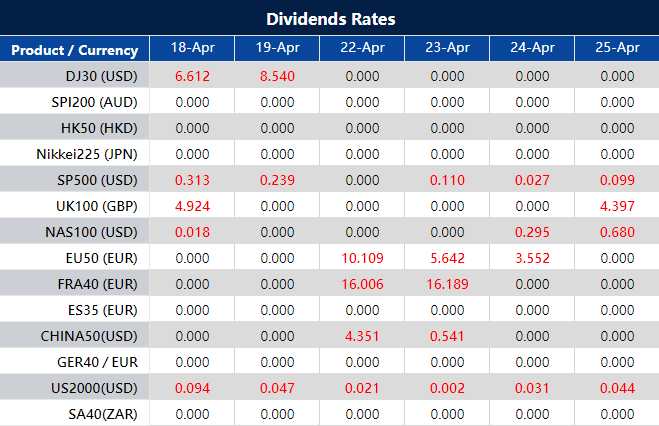
Dividend Adjustment Notice – April 18, 2024

Dear Client,

Please note that the dividends of the following products will be adjusted accordingly. Index dividends will be executed separately through a balance statement directly to your trading account, and the comment will be in the following format “Div & Product Name & Net Volume ”.

Please refer to the table below for more details:

The above data is for reference only, please refer to the MT4/MT5 software for specific data.

If you’d like more information, please don’t hesitate to contact [email protected].

Is Yen Affected by the G7 Consensus?

The dollar softened on Thursday, pulling back as traders digested comments from Federal Reserve officials which implied that U.S. interest rates are likely to remain restrictive. This shift in the dollar’s trajectory, after a period of consistent gains fueled by strong economic indicators and persistent inflation in the U.S., suggests that expectations for near-term rate cuts may be premature. Historically, periods of restrictive monetary policy have often led to a strengthening dollar; however, the current scenario might temper those gains slightly due to the mixed signals about future economic conditions.

Concurrently, the Japanese yen saw a momentary appreciation after Masato Kanda, Japan’s top currency diplomat, indicated that G7 finance leaders are united against excessive currency volatility. This assertion could potentially lead to more aggressive market interventions if the yen continues to weaken, especially as it flirts with a 34-year low against the dollar. A precedent for such interventions was set in 2022 when Japan spent an estimated $60 billion to shore up the yen, signaling a high level of commitment to preventing excessive currency depreciation.

Trilateral Finance Dialogue

The discussions among the U.S., Japan, and South Korea in their first trilateral finance dialogue have emphasised a close consultation on currency market conditions. This initiative underscores the concerns from Tokyo and Seoul regarding their currencies’ sharp declines and raises the possibility of joint interventions if the yen and the Korean won continue to fall against the dollar. Market participants now believe any potential interventions could be triggered should the yen breach the 155 level, adjusted from 152, with some expecting this threshold could even shift to 156.

Despite the greenback‘s slight decline on Thursday, the dollar index, which tracks the U.S. currency against a basket of six major peers, was only down by 0.08% at 105.87, retreating from a five-and-a-half-month high of 106.51 reached earlier in the week. This suggests a consolidation phase as traders re-evaluate the likelihood of the Federal Reserve beginning to cut rates later in the year rather than sooner, with market expectations now seeing cuts totalling 44 basis points, a steep drop from the 160 basis points anticipated at the start of the year.

Euro, AUD, NZD Affected?

In light of these news, the euro has showed resilience, remaining largely unchanged at $1.0676, after a 0.5% gain on Wednesday, which helped it move away from a five-month low. The sterling also posted gains, rising by 0.15% to $1.2465. These movements indicate a slight easing in the dollar’s dominance, potentially offering European currencies some breathing room if the dollar’s bullish momentum stalls.

In contrast, the Australian and New Zealand dollars presented a mixed picture. The Australian dollar was up by 0.12% against the U.S. dollar, at $0.6442, while the New Zealand dollar dipped to $0.5917 after an initial spike of 0.6% on Wednesday.

Start trading now — click here to create your live VT Markets account.

MARKETS TODAY: Global, Regional Indices See Mixed Performance

ICYMI – Market summary for today, 18 April 2024:

Chinese Market Performance

The Hang Seng Index in Hong Kong edged up by 0.2% to 16,281.48 today, showing a modest rise despite opening flat. This minor gain occurs amid a backdrop of cautious investor sentiment following hawkish remarks from Federal Reserve policymakers. These comments hint at ongoing economic challenges which could suggest a possibility of prolonged high-interest rates. This environment has left Hong Kong stocks without clear direction. In response to these market conditions, it would be prudent to anticipate a subdued performance in the near term, especially for sectors sensitive to interest rate changes.

In the decliners’ column, China Hongqiao Group dropped by 3.9%, while PetroChina and Wharf REIT both fell by 2.4%. Conversely, Ping An Insurance, Shenzhou International, and Zhongsheng Group recorded gains of 3.3%, 3.2%, and 2.5% respectively, showing some resilience within certain segments of the market.

Chinese markets too opened lower, notably influenced by downturns in technology and semiconductor stocks. Beijing Kingsoft Office Software and iFlytek saw declines of 1.8% and 1.25% respectively. This sector-wide drop came after ASML, a pivotal player in semiconductor manufacturing equipment, reported weaker-than-expected bookings for the first quarter. However, metal stocks like Baoshan Iron & Steel and Xinyu Iron & Steel bucked the trend, possibly due to potential U.S. tariff increases on Chinese steel and aluminum, rising 1.9% and 0.5% respectively. Overall, the Shanghai Composite Index was down slightly by 0.1% to 3,068.48, while the Shenzhen Composite Index and ChiNext Price Index fell by 0.8% and 1.5%, indicating broader market pressures.

Australian Market Performance

In Australia, the situation appears more grim with more than 10,000 companies expected to enter external administration by the end of June. This is the highest level since the 2012-2013 financial year, marking a significant uptick in business failures. This rise in insolvencies marks a 36% increase from the previous period, reflecting heightened economic strain. The Australian Securities and Investments Commission’s latest data shows 7,742 companies entered external administration from July 1, 2023, to the end of March this year. This could forecast tougher economic conditions ahead, possibly impacting consumer spending and business investment.

Southeast Asia Market Performance

Singapore’s FTSE Straits Times Index recorded a rise of 0.3% to 3,164.00, showing resilience despite an unfavorable lead from Wall Street and ongoing global economic concerns, such as fading hopes for Fed rate cuts and inflation worries. Noteworthy performers include Seatrium, up 1.3%, Singapore Technologies Engineering, which rose 1.0%, and OCBC, gaining 0.7%. Meanwhile, CapitaLand Investment and Hongkong Land were among the significant decliners, dropping 1.6% and 1.5%, respectively.

In Malaysia, the Kuala Lumpur Composite Index remained unchanged at 1,540.04, indicating market caution. Analysts at Malacca Securities suggest a cap on potential upside, driven by recent weakness in Wall Street and possible shifts towards defensive sectors. The predicted support and resistance levels for the KLCI are between 1,520-1,525 and 1,555-1,560. Notable movements included Bumi Armada, down 1.7%, and Mr. D.I.Y. Group, which decreased by 0.7%, whereas Telekom Malaysia and YTL Power International saw increases of 0.8% and 1.0%, respectively.

Regarding commodities, crude palm oil prices are expected to stabilise in the near term, supported by supply constraints. Analysts from UOB KayHian forecast Malaysia’s palm oil inventory to continue its decline into April, with production levels remaining flat and exports remaining robust. Nevertheless, the anticipated increase in soybean supplies from Brazil and Argentina in May could introduce price volatility, particularly as it coincides with a typically higher palm oil production period.

Start trading now — click here to create your live VT Markets account.

Asian Stocks Show Mixed Performance Amid Global Economic Tensions

What you need to know about the markets for 18 April 2024:

Asian markets exhibited a mixed response with the MSCI AxJ index marking a modest increase of 0.3%. However, Japan’s Nikkei stands out with a looming 4% weekly decline, signaling heightened investor caution towards potential risks in the region.

The oil markets are currently experiencing a period of volatility, having faced a 3% drop overnight, the steepest in the last two and a half months. This decline stems from ongoing demand concerns and geopolitical tensions, particularly involving Iran and its implications on global oil supply dynamics. Historically, such geopolitical tensions have led to significant fluctuations in oil prices, similar to what was observed during the Gulf War and the more recent U.S.-Iran escalations in 2020.

TSMC Earnings Report

Taiwan Semiconductor Manufacturing Co (TSMC) is in the spotlight with investors awaiting its earnings report. The outcome could be crucial for tech stocks, particularly if mirrored by the recent dip following ASML’s earnings miss. In December 2018, TSMC’s unexpected earnings beat led to a significant rally in tech stocks, highlighting the influence major tech companies hold on market sentiments.

Globally, markets are still digesting the implications of persistent high U.S. interest rates as indicated by recent Federal Reserve communications. The shift towards a higher interest rate environment has historically resulted in pressure on equities, a scenario reminiscent of the 1980s rate hikes that culminated in Black Monday in 1987.

The dollar’s slight retreat in the current session comes amid new developments in currency diplomacy. A unique trilateral agreement between the U.S., Japan, and Korea hints at possible coordinated interventions to manage dollar strength.

In the bond markets, U.S. Treasury yields showed a notable decrease with 10-year yields dropping by 7.2 basis points to 4.59%. This movement suggests a temporary easing in selling pressures which could provide a brief respite for rate-sensitive sectors like real estate and utilities, which often benefit from lower yield environments.

Downward Pressure on Euro and AUD

The Euro and Australian dollar are facing downward pressures, notably influenced by the European Central Bank’s upcoming policy decisions and unexpected shifts in Australian employment data. Currency fluctuations often have a delayed impact on exports and imports, affecting companies with significant overseas operations.

Looking ahead, market attention will also be directed towards U.S. jobless claims data and notable earnings reports from Blackstone and Netflix. These could provide further clues on the health of the U.S. economy and consumer sentiment, potentially influencing market directions in the short term.

In commodities, while metal prices have temporarily stabilised, the year-to-date surge in copper and stable iron ore prices suggest a continued industrial demand. Gold remains just shy of its record high, underscoring its status as a safe haven amid ongoing market uncertainties.

U.S. Dollar Responds to Fed Chair Powell’s Hawkish Stance and Rising Treasury Yields

The U.S. dollar has strengthened with Federal Reserve Chair Jerome Powell’s hawkish outlook. The U.S. dollar’s ascent correlates with an uptick in U.S. Treasury yields, particularly the 2-year note which is approaching 5.00%. This suggests an enduring appeal of the dollar due to expected higher returns on dollar assets, especially in comparison to other currencies whose central banks may be adopting more accommodative monetary policies.

As expected, Powell’s latest comments introduce a level of caution into the market. His remarks about the persistence of firm price pressures and a slowdown in the rate of disinflation underscore a potential delay in any monetary easing. High borrowing costs will likely remain, bolstering the U.S. dollar as a preferred asset in the short term.

Impact on EUR/USD

The technical outlook for the EUR/USD reflects this broader sentiment, with the currency pair showing a bearish breakdown at 1.0635. The trajectory suggests a possible further decline to the 2023 low near 1.0450. However, should there be a rebound above 1.0635, the pair might encounter resistance at 1.0700, and potentially, this could stretch to 1.0725. The pivotal resistance, if surpassed, could lead to a short-term rally towards 1.0820, where significant moving averages lie.

In discussing inflation, Powell highlighted the longer-than-expected journey towards the Federal Reserve’s 2% inflation target. The Fed is likely to maintain higher interest rates for an extended duration. Such a scenario would continue to support the strength of the U.S. dollar, as investors often favor currencies from countries with higher interest rates.

The persistence of restrictive monetary policies, as Powell indicated, is justified by a strong labor market and modest inflation progress. This approach allows for a more measured decision-making process that could adjust to new economic data. It is indicative of a cautious optimism within the Fed, balancing robust economic indicators against inflation concerns.

First-quarter inflation data, which did not show the progress needed to consider policy easing, plays a crucial role in shaping market expectations. The absence of immediate rate cuts, as previously hinted by Powell, might now be seen as a prudent stance given the unpredictable economic landscape.

Focus on Inflation

Moreover, Powell’s comments on the PCE Price Index, which likely remained stable but above the target, further suggests a continued vigilance on inflation. Recent CPI figures have already caused market turbulence, indicating that investors are sensitive to any signs that could push back the timeline for easing monetary policies.

Finally, the overall economic backdrop, characterized by strong job market data and solid retail sales, points to ongoing economic resilience. However, this strength also brings challenges, particularly in managing inflationary pressures. Similar comments from Fed Vice Chair Philip Jefferson reinforce the narrative of a need for sustained high interest rates if inflation does not subside.

Start trading now — click here to create your live VT Markets account.

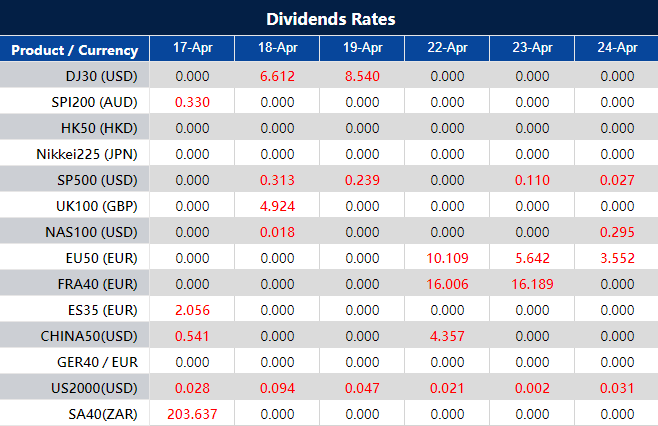
Dividend Adjustment Notice – April 17, 2024

Dear Client,

Please note that the dividends of the following products will be adjusted accordingly. Index dividends will be executed separately through a balance statement directly to your trading account, and the comment will be in the following format “Div & Product Name & Net Volume ”.

Please refer to the table below for more details:

The above data is for reference only, please refer to the MT4/MT5 software for specific data.

If you’d like more information, please don’t hesitate to contact [email protected].

Modifications on All Shares – April 17, 2024

Dear Client,

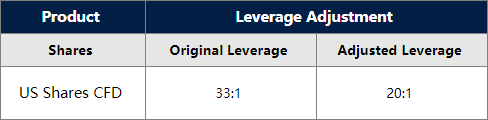
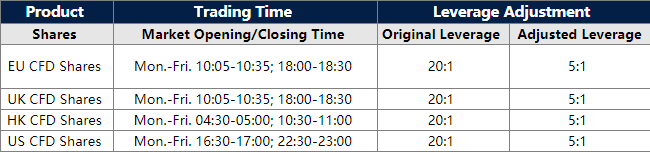
To provide a favourable trading environment to our clients, VT Markets will modify the trading setting of all share CFDs on Apr 22, 2024:

1. All US Shares products leverage will be adjusted to 20:1.

2. MT5 All Shares products: New positions open within 30 minutes before market closing and after market opening will start with a leverage of 5:1. After the mentioned period, the leverage will be resumed to original leverage and will not be adjusted back to 5:1.
MT4 will not be affected.

The above data is for reference only; please refer to the MT4 and MT5 software for specific data.

Friendly reminders:

1. All specifications for Shares CFD stay the same except leverage during the mentioned period.

2. The margin requirement of the trade may be affected by this adjustment. Please make sure the funds in your account are sufficient to hold the position before this adjustment.

If you’d like more information, please don’t hesitate to contact [email protected].

Back To Top
server

Hai 👋

Bagaimana saya boleh membantu?

Segera berbual dengan pasukan kami

Chat Langsung

Mulakan perbualan secara langsung melalui...

  • Telegram
    hold Ditangguh
  • Akan datang...

Hai 👋

Bagaimana saya boleh membantu?

telegram

Imbas kod QR dengan telefon pintar anda untuk mula berbual dengan kami, atau klik di sini.

Tidak ada aplikasi Telegram atau versi Desktop terpasang? Gunakan Web Telegram sebaliknya.

QR code