The recent financial turmoil has led to speculation about a slower pace of tightening from major central banks. To shore up market confidence, regulators worldwide have rushed to take action, and global central banks have united with the Federal Reserve to ease access to supplies of the US currency.
Despite the banking turbulence, there has been no dash for dollars, indicating that the financial system may not be experiencing undue stress. Just a few weeks ago, investors were betting on the Fed raising rates to almost 6%, and the European Central Bank hiking past 4%. However, now the markets imply that the tightening cycles are almost over, and there are expectations for four rate cuts in the US by the end of the year. The overnight indexed swaps price in a 75% chance of a quarter-point hike by the Fed this week.
The S&P 500 benchmark saw all 11 groups gaining, and there was a decrease in the earlier flight-to-safety bid. A gauge of US lenders climbed after last week’s 15% rout. Despite missing out on a rebound by its regional peers led by New York Community Bancorp, UBS Group AG rose as investors focused on the upside of its Credit Suisse Group AG takeover.
On the other hand, the Nasdaq 100, which had the biggest weekly surge since November, underperformed as a recovery in risk appetite sent Treasuries slumping.
Main Pairs Movement
On Monday, the US Dollar experienced its third consecutive session of decline, with the DXY index showing strong bearish momentum throughout the day and closing just below 103.3 – the lowest level of the day. This drop is attributed to the rush to add liquidity to the monetary system, which is seen as a clear negative for the dollar and a sign of financial stress.
In contrast, the GBPUSD pair saw a significant gain of 0.86% on Monday, thanks to the overall weakness of the US Dollar. The pair continued to experience strong upside traction and saw fresh transactions during the European trading session. The EURUSD pair also managed to attract some buying interest during the late UK trading hour and gained 0.48% on Monday.
However, Gold prices saw a decline of 0.52% on Monday after reaching a year-high above the $2000 mark. This drop was attributed to investors trying to recover their optimism after concerns about global financial stability were triggered by various banks’ failures. The XAUUSD pair experienced strong pullback pressure, touching the daily low of $1966 during the early American trading session before regaining positive traction and trading around the $1980 mark.
Technical Analysis
EURUSD (4-Hour Chart)
On Monday, the EUR/USD pair saw a gain of 0.55%, as it continued to build on last week’s rebound from the 1.0520 mark, with the global risk sentiment turning positive. The weaker US Dollar across the board also contributed to the pair staying in positive territory. The market is now pricing in a smaller lift-off of 25 bps at the end of the two-day FOMC monetary policy meeting starting on Tuesday, due to the recent collapse of two mid-sized US banks.
The focus is now on the FOMC decision on Wednesday. In the Eurozone, European Central Bank (ECB) President Christine Lagarde said that inflation is projected to remain too high for too long, which acted as a tailwind for the shared currency.
From a technical standpoint, the RSI indicator currently stands at 61, suggesting that the chances are on the bulls’ side as the RSI rises toward the overbought zone. The Bollinger Bands also indicate that the price is climbing toward the upper band, suggesting that the upside momentum should persist. Therefore, it is expected that the market will be bullish as the pair heads towards testing the 1.0746 resistance line. Technical indicators also advance well above their midlines, supporting higher highs in the upcoming sessions.
Resistance: 1.0746, 1.0790
Support: 1.0637, 1.0542
XAUUSD (4-Hour Chart)
The XAU/USD pair paused its uptrend on Monday after advancing over 10% since March 8 and reaching the round $2,000 level. The pair retreated to $1,967 during the US trading session and is currently trading at $1,978, posting a 0.50% loss on a daily basis. The bearish pressure on the Gold price was due to the positive turn in the 10-year US Treasury bond yield near 3.5% following a sharp decline seen in the European session. The weekend announcement of UBS Bank’s acquisition of Credit Suisse in a historic $3.3 billion deal temporarily reassured investors and stabilized sentiment. However, the risk of contagion spreading across the broader banking sector still remains, leading investors to seek safe-haven assets like Gold.
From a technical standpoint, the RSI indicator currently stands at 75, suggesting that the pair could experience some short-term corrections as the RSI retreats from the overbought section. The failure of the price to climb higher and drop from the upper band in the Bollinger Bands also indicates that some downside movements can be expected. Therefore, it is expected that the market will be slightly bearish as long as the 1,996 resistance line holds. The chances of a new bear trend might start if the pair breaks below the 1,956 support.
The US stock market suffered a setback on Friday as investors grew increasingly concerned about the impact of the banking sector’s turmoil on the global economy. However, amidst this tumultuous week for global markets, technology stocks emerged as the beneficiaries of the situation. The Nasdaq 100 rallied by 5.8%, posting its best performance since November, despite a slump on Friday. Investors flocked to old standby favorites in the tech sector, including Microsoft Corp. and Alphabet Inc., as they bet that the Federal Reserve would take a more moderate approach to its tightening path.
Unfortunately, Credit Suisse Group AG further exacerbated the financial sector’s troubles when Reuters reported that at least four central banks, including Deutsche Bank AG, had curtailed trading with the struggling Swiss lender. As a result, the regional bank gauge fell by 15% over the past five days. First, Republic Bank became the latest US lender to signal stress, plummeting by over 70% during the week, despite larger banks providing a lifeline to the regional lender on Thursday.
While the banking sector dragged the S&P 500 index to a 1.1% drop on Friday, the benchmark still managed to carve out a 1.4% weekly gain. Unfortunately, all eleven sectors of the S&P 500 remained in negative territory, with the financial sector posting a 3.37% daily loss and emerging as the worst-performing sector. The Dow Jones Industrial Average fell by 1.2%, and the MSCI world index slid by 0.6% for the day.
As investors reassessed rate-hike wagers, the policy-sensitive two-year experienced more than a 20 basis point swing for the seventh straight session. Yields fell across the curve on Friday following a softer-than-expected reading on inflation expectations.
Main Pairs Movement
On Friday, the US Dollar experienced a deeper decline of 0.68%, failing to benefit from the weak market sentiment. The DXY index ended the week with its lowest close in five weeks, with the American trading session witnessing intense selling pressures, causing it to close below the critical level of 103.9.
The EURUSD showed an upward momentum, rallying with a daily gain of 0.57% due to the persistent effects of the ECB’s rate hike policy. The pair drew in fresh transactions at the beginning of the US trading hour, peaking at a daily high of 1.0685 level. Similarly, the GBPUSD also experienced some buying activity during the first half of the NY session, despite the broad weakness of the US Dollar. It concluded the day with a daily gain of 0.53% on Friday.
In contrast, the Gold market saw a substantial increase of 3.63% daily. This was fueled by concerns regarding widespread contagion, leading to a surge in haven flows and consequently benefiting the price of Gold. The XAUUSD continued to show a strong bullish momentum throughout Friday, eventually closing at a daily high of $1988 marks.
Technical Analysis
EURUSD (4-Hour Chart)
On Friday, the EUR/USD pair rose due to an increase in buying activity and recovered from the low of 1.0615, which it had reached during the European session. The pair is now trading at 1.0647, with a 0.36% daily gain. The US dollar weakened against other currencies, as the expected rate hike of only 25 basis points (bps) in the upcoming FOMC meeting reduced bets on the greenback and dragged US bond yields lower. Positive news regarding the US and European banking sectors helped to reduce concerns over a potential banking crisis, which supported the EUR/USD pair and improved market sentiment. The European Central Bank increased its key rates by 50 bps on Thursday, and a board member suggested that the terminal rate has not been reached yet and there may be more rate hikes in the future.
Regarding technical analysis, the RSI indicator was at 54, suggesting that the pair is gaining upside momentum as it rises above 50. The Bollinger Bands also indicate some upside movement as the price climbed above the moving average, indicating a potential bullish trend. Overall, the market is expected to be bullish, and the pair may test the resistance level of 1.0685. Technical indicators also suggest a bullish trend.
Resistance: 1.0685, 1.0745, 1.0790
Support: 1.0542, 1.0467
XAUUSD (4-Hour Chart)
On Friday, the XAU/USD pair surged to its highest level since April, rising above the $1,960 mark as renewed selling around equity markets and global risk-aversion boosted demand for safe-haven assets. At present, the Gold price is trading at $1,961, representing a 2.22% gain daily. The decreasing likelihood of more aggressive policy tightening by the US central bank and falling US bond yields both contributed to bearish pressure on the US Dollar, driving investors towards the precious metal. Investors remain concerned about the global banking crisis and its potential for widespread contagion, which could continue to benefit Gold prices.
From a technical standpoint, the RSI indicator currently stands at 74, indicating heavy bullish momentum as the RSI remains above the overbought zone. The price has moved out of the upper band of the Bollinger Bands, indicating a strong continuation of the upside trend. Overall, the market is expected to remain bullish as the pair tests the resistance level of $1,956. A sustained strength above this resistance could potentially lead to further gains.
This week, the financial world eagerly anticipates crucial events, including the FOMC meeting and the BoE Rate Statement. Additionally, vital economic data, including CPI and PPI figures, will be published by major economies like Canada and the UK. Keeping a close watch on these indicators can empower traders to make more well-informed decisions.
Here are key events to watch out for:
Consumer Price Index (CPI) | Canada (March 21)
Canada’s CPI increased 0.5% in January 2023 from the previous month.
Analysts anticipate a 0.3% increase in February.
Producer Price Index (PPI) | UK (March 22)
The PPI in the UK fell 0.6% month-on-month in January 2023, the first decline in a year and the biggest drop since January of 2019.
Analysts expect a 0.5% increase in February.
FOMC Rate Statement (March 23)
The Fed raised the target range for Fed funds by 25bps to 4.5%-4.75% in its February 2023 meeting.
Analysts anticipate the Fed will raise another 25bps to 5% at its next meeting.
Swiss National Bank Rate Statement | Switzerland (March 23)
The SNB brought its interest rate out of the negative territory with two rate hikes in September and December 2022, ending the year with a 1% interest rate. The central bank also indicated that future rate hikes may be required to maintain price stability over the medium term.
Analysts predict that SNB will increase interest rates by 50bps to 1.5% at this month’s meeting.
Bank of England (BoE) Rate Statement | UK (March 23)
During its February meeting, the BoE voted 7-2 to raise interest rates by 50bps to 4%.
Analysts predict that the next increase will be at 25bps to 4.25%.
UK and US Flash Services and Manufacturing PMI (March 24)
In February 2023, the UK Services PMI was revised up to 53.5 from 48.7, and the UK Manufacturing PMI was revised up to 49.3 from 47. Meanwhile, the US Services PMI came in at 50.6 during the same period, above January’s 46.8.
Analysts anticipate lower releases of the UK Flash Manufacturing and Services PMIs for February, at 48.3 and 50.7, respectively. The US Flash Services is expected to be released lower at 50.1.
On Thursday, US stocks saw a surge in prices following the announcement that a rescue package had been secured for First Republic Bank. This news sparked a rebound in shares of embattled regional lenders, which had previously tumbled more than 60% as investors speculated that the bank could be the next to fail after two high-profile demises touched off the crisis last week.
Regional banks closed higher after the biggest banks in the US agreed to contribute $30 billion in deposits to the First Republic. However, the gauge is still down over 20% this March. Despite this, nine out of eleven sectors of the S&P500 stayed in positive territory, showing that the market’s fear of the bank has been eased. In particular, the Information Technology and Communication Services sectors both rallied with more than 2.5% daily gains, surrounded by strong recovery momentum.
Meanwhile, the Dow Jones Industrial Average rose 1.2% and the MSCI world index earned 1.3% on Thursday. The S&P500 notched its largest one-day advance since January, and the Nasdaq 100 jumped 2.7% to a one-month high.
European Central Bank Rate Hike and Comments from ECB President
Markets were also digesting a European Central Bank rate hike and comments from the ECB president that inflation is projected to remain too high for too long. The interest rate decision of 50 basis points (bps) rate hike by the ECB has trimmed the Federal Reserve (Fed)-ECB policy divergence.
The US Dollar retreated with a 0.2% daily loss on Thursday, as major Wall Street banks pledged billions to rescue First Republic Bank, boosting the market risk sentiment. The DXY index was hovering in a range from 104.2 to 104.6 during most of Thursday, and the ECB interest rate decision failed to provide directional traction for the greenback.
The EURUSD rallied with a 0.31% daily gain on Thursday, remaining modestly upside during the US trading session and closing around the 1.0610 level. Meanwhile, the GBPUSD also rose with a 0.43% daily gain on Thursday, witnessing fresh transactions ahead of the American trading hour and closing at the 1.2108 level.
Gold Prices Remain Steady
The Gold market was little changed, up for the day due to the broadly weaker United States Treasury bond yield. Investors remained in a cautious mood ahead of next week’s FOMC monetary policy meeting. The XAUUSD witnessed heavy selling pressures during the American trading session, erasing most of the gains of the day and closing at the $1919 mark on Thursday.
Technical Analysis
EURUSD (4-Hour Chart)
The EUR/USD pair experienced a surge on Thursday, recovering from a monthly low of below 1.0530 that was reached the previous day, as market sentiment towards risk improved. The pair is currently trading at 1.0614, with a daily gain of 0.36%. The US dollar has weakened, as investors’ concerns regarding the banking system were somewhat alleviated after the Swiss National Bank (SNB) announced its plan to lend around $54 billion to Credit Suisse.
In the Eurozone, the European Central Bank (ECB) announced its expected rate hike of 50 basis points (bps) following the March policy meeting, resulting in a small rally for the Euro. However, the Euro’s strength was limited as ECB President Christine Lagarde stated that financial conditions were closely monitored, and the ECB refrained from signaling future interest rate moves.
From a technical perspective, the RSI indicator currently stands at 45, indicating that the pair has lost its upside momentum as the RSI is turning south below the mid-line. The price failed to maintain its upward momentum and has begun to fall, indicating that some downside movement is possible. Therefore, we believe that the market will remain bearish as long as the 1.0624 resistance line holds. Technical indicators have gained bearish traction within negative levels after correcting overbought conditions.
Resistance: 1.0624, 1.0685, 1.0745
Support: 1.0531, 1.0508, 1.0439
XAUUSD (4-Hour Chart)
The price of gold (XAU/USD) has decreased and is currently trading around $1,918, after failing to surpass the previous high of $1,937. This has been attributed to an improvement in market sentiment, as governments and central banks take steps to ensure the credibility of banks and prevent a severe crisis. The Swiss National Bank and the Swiss Financial Market Supervisory Authority have announced that Credit Suisse has met its capital requirements and that liquidity will be provided if necessary, which has brought relief to the market. The European Central Bank has also announced its monetary policy decision, raising interest rates by 50 basis points. President Christine Lagarde has stated that European banks are much stronger than in 2008.
In the short term, the XAU/USD pair has lost some of its bullish momentum, but there are no signs of an imminent decline. In the 4-hour chart, a bullish 20 SMA is providing dynamic support at around $1,910.25 while maintaining its upward slope well above the longer ones. The Momentum indicator is above its 100 level, while the RSI is retreating from overbought readings but remains well into positive territory, currently at 51.
As part of our commitment to provide the most reliable service to our clients, there will be server maintenance this weekend.
Maintenance Hours :
18th of March 2023 (Saturday): 02:00 – 04:00 (GMT+3)
Please note that the following aspects might be affected during the maintenance:
1. The price quote feature on the Client Portal will be temporarily unavailable. You will not be able to open new positions or close existing positions.
2. There might be a gap between the original price and the price after maintenance. The gaps between Pending Orders, Stop Loss and Take Profit will be filled at the market price once the maintenance is completed.
3. Certain features on the Client Portal will be temporarily unavailable.
4. Please refer to MT4/MT5 for the latest update on the completion and market opening time.
Our services will be back online once the maintenance is completed.
Thank you for your patience and understanding about this important initiative.
If you’d like more information, please don’t hesitate to contact [email protected]
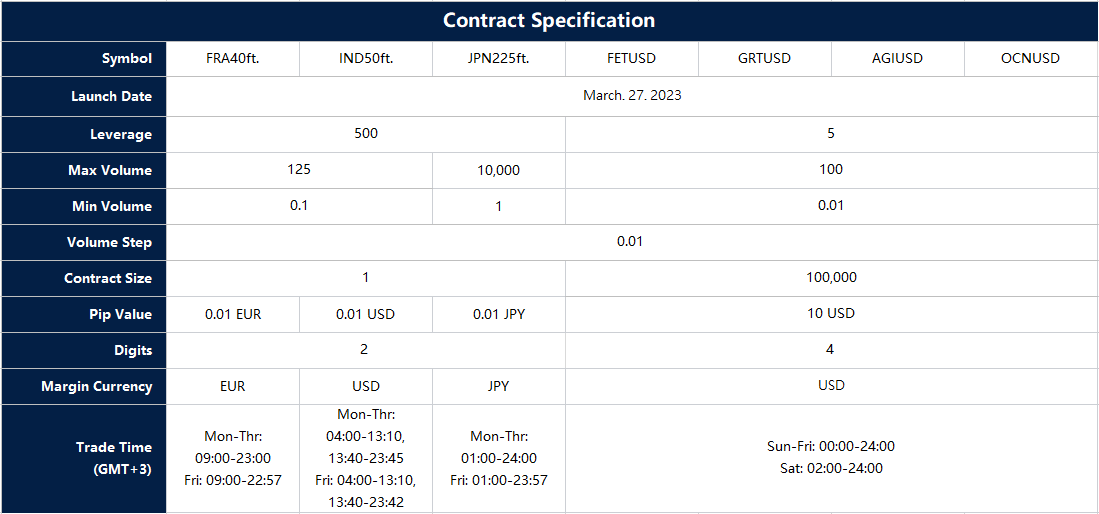
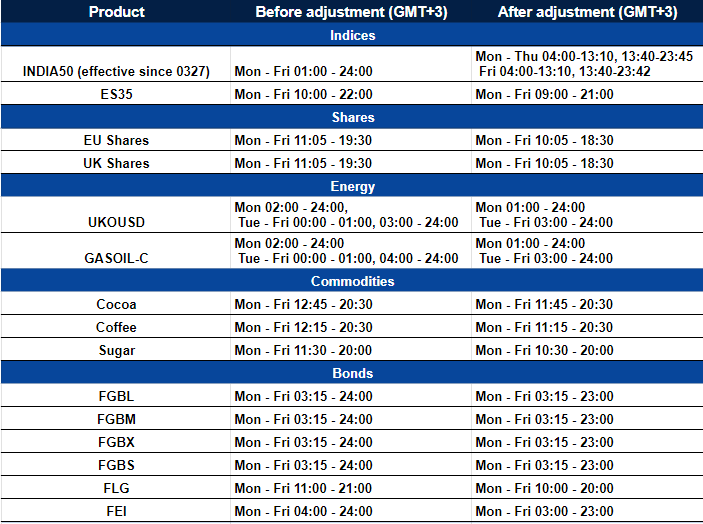
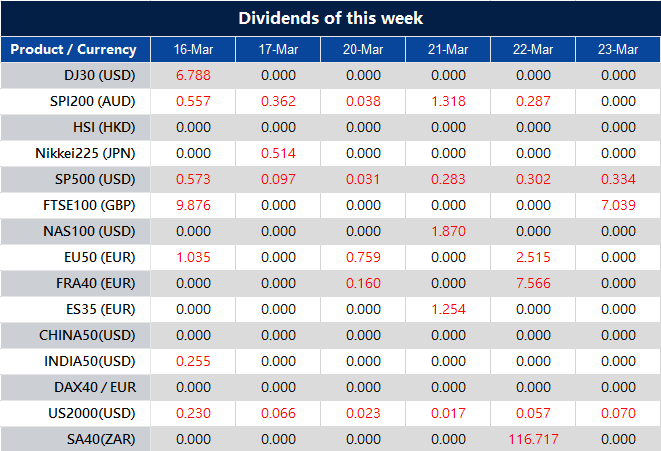
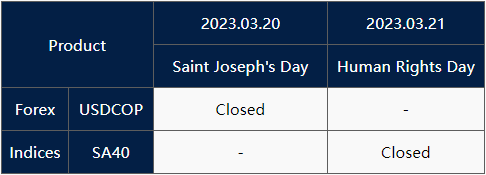
Please note that the dividends of the following products will be adjusted accordingly. Index dividends will be executed separately through a balance statement directly to your trading account, and the comment will be in the following format “Div & Product Name & Net Volume ”.
Please refer to the table below for more details:
The above data is for reference only, please refer to the MT4/MT5 software for specific data.
If you’d like more information, please don’t hesitate to contact [email protected]
Following the recent collapse of several American regional banks and the Credit Suisse Group AG crisis, investors have begun to recall memories of the 2008 financial crisis. Speculation is rife that major central banks may need to provide liquidity support to financial regulators. As a result, the S&P 500 initially plummeted by over 2%. However, the decline was subsequently cut in half. Despite the release of the US Consumer Price Index (CPI) numbers and a rebound in US Treasury yields, the yield on 10-year Treasuries dropped by 22 basis points to 3.47%. Except for the Japanese yen, the dollar rallied against all other developed-market peers.
Meanwhile, Bitcoin continues to make sharp moves, peaking at $26,500, the highest since June 2022, before pulling back to $24,500. Gold and Silver moved sideways, holding onto most of Monday’s gains. This suggests that some investors may have more confidence in cryptocurrency than traditional currency.
In the benchmark, the S&P500 fell by 0.7% due to the banking turmoil rippling through financial markets. Only four out of eleven sectors remained in positive territory. Among all groups, the Communication Service and utility sectors delivered the best performance, surging by 1.5% and 1.34% respectively on a daily basis. The worst-performing sector was Energy, which dropped by 5.42%. USOIL reached its lowest point since 2022, at 68.54.
Main Pairs Movement
On Wednesday, the dollar experienced an upswing due to safe-haven buying. Credit Suisse’s recent stock drop has investors concerned about potential weaknesses in its financial reporting and the possibility of a global banking crisis. The DXY index gained momentum during the European trading session, reaching a daily high of 105.1 at the beginning of the US trading session.
GBPUSD experienced a sell-off after reports of internal “materialistic weaknesses” within Credit Suisse surfaced, causing market sentiment to plummet. The pair slumped during the UK trading hour but managed to find support at the 1.2010 level and rebounded to 1.2070 during the middle of the US trading session. On the other hand, EURUSD dropped significantly with losses of almost 2% during the UK trading hour, and closed the day with a 1.45% loss.
Gold buyers flexed their muscles around $1,920 after reaching the highest levels in 1.5 months following Credit Suisse’s weak financial reporting. The market’s risk profile worsened as the CS episode followed the latest fallout of Silicon Valley Bank (SVB) and Signature Bank. The XAUUSD gained bullish momentum during the UK trading session, climbing above the $1935 mark before losing traction and closing around the $1920 mark.
Credit Suisse’s impact on the market has significantly affected several key currency pairs and gold prices. This event highlights the importance of sound financial reporting and transparency in the banking sector to prevent future crises. It also underscores the need for investors to remain vigilant and informed in their decision-making processes.
Technical Analysis
EURUSD (4-Hour Chart)
The EUR/USD pair experienced a significant decline on Wednesday, marking its worst day in months and hitting a two-month low below the 1.0530 mark. Currently, the pair is trading at 1.0535, reflecting a daily loss of 1.83%. The negative trend continues due to renewed strength in the US Dollar and concerns about the banking sector. The intraday US Dollar rally of over 1% and banking concerns have had a major impact on the EUR/USD pair. The global risk sentiment also took a hit due to negative news about the Swiss lender Credit Suisse, which triggered a sell-off in banking shares worldwide. Additionally, mixed US economic data added to the dismal mood, with the February Producer Price Index (PPI) rising at an annualized pace of 4.6% and Retail Sales declining 0.4% in February. In the Eurozone, concerns about the European banking sector have heightened, leading to a flight-to-safety mood among market participants.
In terms of technical analysis, the RSI indicator currently stands at 32, indicating strong bearish momentum and the potential for the pair to extend its decline as the RSI is around 30. The Bollinger Bands suggest that the price has undergone heavy selling and has moved out of the lower band, suggesting a continuation of the downward trend.
In conclusion, we believe that the market sentiment for the EUR/USD pair will remain bearish, with the pair potentially testing the 1.0531 support level. Traders should remain cautious and keep an eye on any developments in the global banking sector, as well as any economic data releases that could impact the pair’s performance.
Resistance: 1.0624, 1.0745, 1.0791
Support: 1.0531, 1.0467
XAUUSD (4-Hour Chart)
Gold prices have dropped to a new intraday low of around $1,890, and remain stagnant during mid-week inaction while sticking to short-term key support. This is due to the recently widening difference between the US 10-year and two-year Treasury bond yields, which is affecting the XAU/USD price. The inability of global policymakers to convince the market of the risks emanating from the latest fallouts of the Silicon Valley Bank and Signature Bank is also exerting downside pressure on gold prices. Furthermore, the recent run-up in the Fed fund futures, favoring a 0.25% rate hike in March, has made the US dollar more solid, which has further weighed on gold prices.
Despite this, US data relating to Retail Sales, Industrial Production, and Producer Price Index showed that the odds favoring the downtrend have limited upside room for gold trades. At the time of writing, gold is trading at $1,932.
On the technical side, gold has found support above its 200 DMA at $1,775, and further support at the 55 DMA at $1,869. According to strategists at Credit Suisse, a weekly close above $1,890/1900 is needed to clear the way for a retest of $1,973/90. The RSI sits at 75 at the time of typing.