Lesson 3: Understanding the currency pairs

The US Dollar is the most frequently traded currency in the world. As a result, most currencies are quoted against it. However, different types of currency pairs are used when referring to Forex trading, each of which is split into groups depending on the amount of trading activity and liquidity. These are known as majors, minors (or crosses), and exotic pairs.

Major currency pairs

The most traded currency pairs in the world are called the majors. They are generally the most liquid and attractive to all types of Forex traders. The EURUSD is the most traded pair, representing nearly 30% of all daily Forex trades on the entire Forex market.

Currencies not classed as major currencies but are normally traded against a major currency are called minor currencies and crosses.

PAIRCURRENCIES COUNTRIES
EURUSDEuro/US DollarEurozone/United States
GBPUSDBritish Pound/US DollarUnited Kingdom/United States
USDJPYUS Dollar/Japanese YenUnited States/Japan
USDCHFUS Dollar/Swiss FrancUnited States/Switzerland
USDCADUS Dollar/Canadian DollarUnited States/Canada
AUDUSDAustralian Dollar/US DollarAustralia/United States
NZDUSDNew Zealand Dollar/US DollarNew Zealand/United States

Minor currency pairs and crosses

Currency pairs that do not contain the US Dollar are known as ‘crosses’. A currency pair involving a major non-US Dollar currency would also be known as a ‘minor currency pair’.

The most common crosses are pairs derived from the three major non-US Dollar currencies – Euro, Great British Pound, and Japanese Yen. For example, pairs that involve the euro are called ‘euro crosses’. Below is a list of Euro, Pound, Yen, and other crosses.

EURO CROSSES

EURGBPEuro/British Pound
EURCHFEuro/Swiss Franc
EURAUDEuro/Australian Dollar
EURCADEuro/Canadian Dollar

GBP CROSSES

GBPAUDBritish Pound/Australian Dollar
GBPCADBritish Pound/Canadian Dollar
GBPCHFBritish Pound/Swiss Franc
GBPNZDBritish Pound/New Zealand Dollar

YEN CROSSES

GBPJPYBritish Pound/Japanese Yen
EURJPYEuro/Japanese Yen
CHFJPYSwiss Franc/Japanese Yen
CADJPYCanadian Dollar/Japanese Yen
AUDJPYAustralian Dollar/Japanese Yen
NZDJPYNew Zealand Dollar/Japanese Yen

OTHER CROSSES

AUDCADAustralian Dollar/Canadian Dollar
AUDNZDAustralian Dollar/New Zealand Dollar
AUDCHFAustralian Dollar/Swiss Franc
CADCHFCanadian Dollar/Swiss Franc
NZDCADNew Zealand Dollar/Canadian Dollar
NZDCHFNew Zealand Dollar/Swiss Franc

Exotic currency pairs

Trading exotic pairs offer exposure to a wide range of developing and emerging market economies across Asia, the Middle East, and Africa. In general, exotic pairs are not traded as often as majors or crosses, which means they are not very liquid markets and lack consistent market activity.

There are often pros and cons associated with trading exotic currency pairs. Because they are not so widely traded, they can often be subject to higher trading fees; however, when the market moves, they can be subject to wild price fluctuations (suitable for the more experienced trader).

Below is a list of some of the main currency pairs referred to when talking about exotic pairs.

PAIRCURRENCIESCOUNTRIES
USDSEKUS Dollar/Swedish KronaUnited States/Sweden
USDNOKUS Dollar/Norwegian KroneUnited States/Norway
USDTRY                US Dollar/Turkish Lira                     United States/Turkey
USDMXNUS Dollar/Mexican PesoUnited States/Mexico
USDZARUS Dollar/South African RandUnited States/South Africa
USDPLN US Dollar/Polish ZlotyUnited States/Poland
USDSGDUS Dollar/Singapore DollarUnited States/Singapore

Nicknames

In Forex, many currency pairs (especially the majors) have particular nicknames which are commonly used in the market. Many even have an exciting story about why they were nicknamed that in the first place. For example, the FX pair GBPUSD is called ‘cable’.

This dates back to the 19th century when a communications cable ran across the Atlantic Ocean floor to get the exchange rate between the US Dollar and the British Pound.

In some cases, the currency by itself is known by a different name. For example, the US Dollar is often referred to as the ‘greenback’, while you may hear the British Pound referred to as ‘sterling’.

Below is a list of the most popular currency pair nicknames.

CURRENCY PAIR NICKNAME

GBPUSDCable
EURUSDFiber
EURGBPChunnel
USDCADLoonie
AUDUSDAussie
NZDUSDKiwi
GBPJPYGuppy
EURJPYYuppy
USDCHF Swissy

Currency codes

Currencies are often abbreviated to a three-letter currency code. The first two letters symbolize the country’s name, while the third is the country’s currency.

Let’s look at a few examples.

GBP – ‘GB’ stands for Great Britain, while the ‘P’ stands for Pound

USD – ‘US’ stands for the United States, the ‘D’ stands for Dollar

JPY – ‘JP’ stands for Japan, the ‘Y’ stands for Yen

In trading, you will hear a lot about ‘pips’ and ‘spreads’. Learn about pips in Forex and how different factors can influence spreads.

Lesson 2: Why should you trade in the forex?

(In comparison to other markets)

The forex market is the world’s largest, and it offers numerous advantages that attract traders. The following are some of the primary reasons to give forex trading a try.

Unparalleled liquidity

The foreign exchange market is highly liquid, which is another way of saying that other traders are always available to engage. However, why is liquidity so critical?

Assume you’re attempting to sell a Nokia phone manufactured in 2000. If you placed an ad on eBay asking for $1,000, you’re unlikely to receive an offer — and if you do, it’s likely to be for a few hundred dollars (at most) a month later. Essentially, there aren’t many buyers and vendors for that goods.

However, if you were to sell the current iPhone at the price you purchased, you would almost certainly receive multiple offers, most of which would be close to your asking price. This is simply due to the market’s high volume of buyers and sellers. This is a technique for proving enough liquidity.

Volatility

Another reason it is pretty popular is due to the volatility of the FX market. This is related to currency fluctuations, which are determined by the real economy of various countries. Because economic outlooks are constantly changing – due to factors such as recent news and events – the accompanying currency’s value will fluctuate. These movements provide traders with an opportunity to benefit from forex deals.

24-5

The currency market is open twenty-four hours a day, five days a week. This 24-hour trading provides traders in various world regions with numerous changes, depending on which markets are available at particular times. For instance, when trading sessions overlap – as they do during the few hours that the US and European markets are open concurrently – there can be more trading activity, resulting in new chances. The markets’ 24/5 nature also provides traders with flexibility – for example, even if you’re locked in the office all day, you may still conduct a few trades over lunch or while relaxing at home in the evening.

Trading with leverage

One of the beautiful aspects of forex is that it allows for leveraged trading. This indicates that you can use a small amount of capital to undertake a higher-value trade. In effect, leveraged trading will enable you to stretch your money further.

For instance, leverage of 1:100 means that a $1 investment may purchase $100 worth of “forex.” While leverage has the potential to help you earn more money more rapidly, it also has the potential to cause you to lose more money. Therefore, whenever you trade with leverage, proceed with prudence and trade only what you can afford to lose.

Lesson 1: What does “forex” mean?

Forex – often spelled FX – is an abbreviation for “Foreign Exchange.” Fundamentally, it is similar to a stock exchange in that it is a market where one can exchange multiple currencies worldwide. According to a 2019 triennial report from the Bank for International Settlements (a global bank for national central banks), the daily trading volume for Forex reached $6.6 trillion in April 2019.

What Is the Forex Market?

The foreign exchange market is where currencies are traded. Currencies are important because they allow us to purchase goods and services locally and across borders. International currencies need to be exchanged to conduct foreign trade and business.

If you are living in the United States and want to buy cheese from France, then you or the company from which you buy the cheese must pay the French for the cheese in euros (EUR). The US importer would have to exchange the equivalent value of US dollars (USD) for euros.

You’re travelling from Australia to the United States in our scenario. You have AUD 1,000 to spend on your trip and thus visit a currency exchange to convert your Australian dollars to US dollars.

Assume the exchange rate was 1 AUD to 0.7 USD. This means that for each AUD you hand over to the currency broker, you will receive 0.7 USD in exchange. Given that you have 1,000 Australian dollars, you would obtain US$700 in this exchange.

Unfortunately, some things came up before your scheduled flight to New York, and you couldn’t go. As a result, you cancel your vacation and return to the currency dealer to exchange your US$700 for Australian dollars. To your amazement, the dealer hands you AUD 1,100 – a sum greater than the AU$1000 you had paid.

Consider the possibility that the currency broker made an error. Let us re-examine.

In this case, you made a profit of AUD 100. You originally spent AUD 1,000 to purchase US$700, but now you’re paying the same US$700 and receiving AUD 1,100 in return. That is a brief overview of Forex trading; it is not only about exchanging one currency for another but also about attempting to benefit from it.

In this instance, we profited since the US Dollar rose against the Australian Dollar while we held it. This enabled us to convert our original US$700 for more Australian Dollars than we had previously.

One unique aspect of this international market is that there is no central marketplace for foreign exchange. Instead, currency trading is conducted electronically over the counter (OTC), meaning that all transactions occur via computer networks among traders worldwide rather than on one centralized exchange.

The market is open 24 hours a day, five and a half days a week, and currencies are traded worldwide in the major financial centres of Frankfurt, Hong Kong, London, New York, Paris, Singapore, Sydney, Tokyo, and Zurich—across almost every time zone.

This means that the forex market begins anew when the US trading day ends in Tokyo and Hong Kong. The forex market can be highly active anytime, with price quotes changing constantly.

A Brief History of Forex

In its most basic sense, the forex market has been around for centuries. People have always exchanged or bartered goods and currencies to purchase goods and services. However, as we understand it today, the forex market is a relatively modern invention.

After the Bretton Woods accord began to collapse in 1971, more currencies were allowed to float freely against one another. The values of individual currencies vary based on demand and circulation and are monitored by foreign exchange trading services.

Commercial and investment banks conduct most of the trading in forex markets on behalf of their clients. Still, there are also speculative opportunities for trading one currency against another for professional and individual investors.

There are two distinct features of currencies as an asset class:

  • You can earn the interest rate differential between two currencies.
  • You can profit from changes in the exchange rate.

An investor can profit from the difference between two interest rates in two different economies by buying the currency with the higher interest rate and shorting the currency with the lower interest rate. Before the 2008 financial crisis, shorting the Japanese yen (JPY) and buying British pounds (GBP) was expected because the interest rate differential was huge. This strategy is sometimes referred to as a carry trade.

VT Markets Notification of trading adjustment in holiday

Dear Client,

Please note the adjustment on the following products due to the international holiday in April:

The above time is MT4/5 server time. The trading time of other products is not affected. The above data may be subject to change. Please refer to the actual time on MT4/5.

If you have any questions, our team will be happy to answer your questions. Please mail to [email protected] or contact the service online.

VT Markets The Adjustment Of Weekly Dividend Notification

Dear Client:

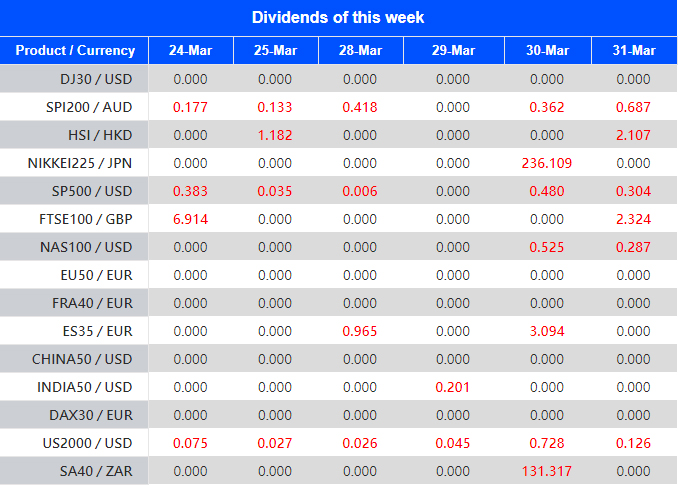
Warmly reminds you that the component stocks in the stock index spot generate dividends. When dividends are distributed, VT Markets will make dividends and deductions for the clients who hold the trading products after the close of the day before the ex-dividend date.

Indices dividends will not be paid/charged as an inclusion along with the swap component. It will be executed separately through a balance statement directly to your trading account, the comment for which will be in the following format “Div & Product Name & Net Volume ”.

Please note the specific adjustments as follows:

Note: The above data is for reference only, the actual execution date may be changed, please refer to the MT4/MT5 software for details.

If you’d like more information, please don’t hesitate to contact [email protected].

VT Markets Notification of US stock trading conditions optimization

Dear clients:

VT Markets continues to optimize the trading environment and expand our global business. We are honoured to announce that the trading fees for some popular US stock products have been optimized recently.

All VT Markets clients can trade the 20 U.S. stock contracts listed in the table below on the preferential terms of 0 commission from March 28th.

Note: The above data is for reference only, the actual execution date may be changed, please refer to the MT4/MT5 software for details.

If you’d like more information, please don’t hesitate to contact [email protected] or contact us via the official website live chat.

VT Markets Notification of Server Upgrade

Dear Client:

As part of our commitment to provide the best reliability and service to our clients, the trading hours of certain products will be adjusted as follows due to the maintenance.

Available trading hours:

2022/03/26 18:00 – 24:00 (Server time)
2022/03/27 00:00 – 24:00 (Server time)

Please note that 24 trading hours will take effect from the 26th of March 2022 onwards.
Please be reminded that the following aspects might be affected during this maintenance period:

1. The functions of client portal operations might be disabled during this period.

2. There might be a gap between the original price and the price after maintenance. Pending orders, Stop Loss, and Take Profit settings within the gap will be filled at the market price after maintenance activity ends.

3. The quotations of products will be paused. Clients may not be able to open new positions or close the held positions.

No action is required by our client. Your service will be back online after the maintenance is completed.

Thank you for your patience and understanding about this important initiative.

If you’d like more information, please don’t hesitate to contact [email protected].

VT Markets The Adjustment Of Weekly Dividend Notification

Dear Client:

<pWarmly reminds you that the component stocks in the stock index spot generate dividends. When dividends are distributed, VT Markets will make dividends and deductions for the clients who hold the trading products after the close of the day before the ex-dividend date.

Indices dividends will not be paid/charged as an inclusion along with the swap component. It will be executed separately through a balance statement directly to your trading account, the comment for which will be in the following format “Div & Product Name & Net Volume ”.

Please note the specific adjustments as follows:

Note: The above data is for reference only, the actual execution date may be changed, please refer to the MT4/MT5 software for details.

If you’d like more information, please don’t hesitate to contact [email protected].

VT Markets The adjustment of EU DST

Dear Client,

With Standard time commencing in the EU on March 28th. Please consider below carefully:

The trading sessions of some products on MT4/MT5 will be changed as follows.
Please find the table below for more information.

If you’d like more information, please don’t hesitate to contact [email protected].

VT Markets The Adjustment Of Weekly Dividend Notification

Dear Client,

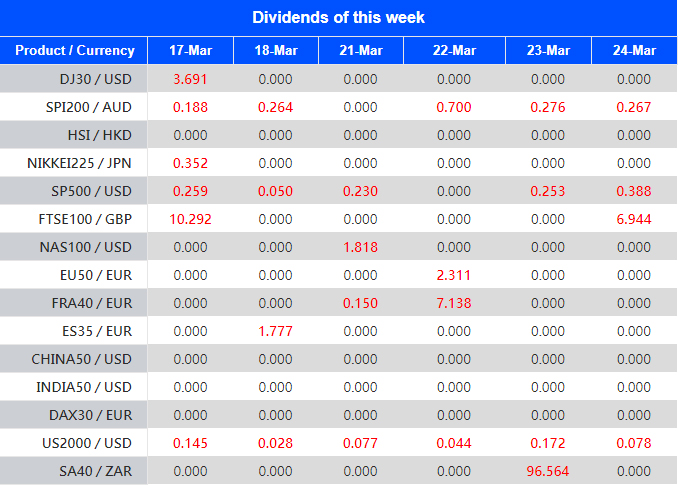
Warmly reminds you that the component stocks in the stock index spot generate dividends. When dividends are distributed, VT Markets will make dividends and deductions for the clients who hold the trading products after the close of the day before the ex-dividend date.

Indices dividends will not be paid/charged as an inclusion along with the swap component. It will be executed separately through a balance statement directly to your trading account, the comment for which will be in the following format “Div & Product Name & Net Volume ”.

Please note the specific adjustments as follows:

Note: The above data is for reference only, the actual execution data may be changed, please refer to the MT4/MT5 software for details.

If you’d like more information, please don’t hesitate to contact [email protected].

Back To Top
server

Hai 👋

Bagaimana saya boleh membantu?

Segera berbual dengan pasukan kami

Chat Langsung

Mulakan perbualan secara langsung melalui...

  • Telegram
    hold Ditangguh
  • Akan datang...

Hai 👋

Bagaimana saya boleh membantu?

telegram

Imbas kod QR dengan telefon pintar anda untuk mula berbual dengan kami, atau klik di sini.

Tidak ada aplikasi Telegram atau versi Desktop terpasang? Gunakan Web Telegram sebaliknya.

QR code