



Gold prices continue to decline, hovering near a one-week low while remaining at $4,000
AUD/JPY hits yearly high near 101.80 before dropping to around 100.00 due to selling pressure.
AUD/JPY is facing downward pressure, dropping for the second straight day. The currency pair has pulled back from a recent high of 101.80, moving closer to the key level of 100.00 during the Asian session.
The Reserve Bank of Australia’s November minutes indicated caution regarding potential rate cuts, which negatively affected the Australian Dollar. Meanwhile, the yen received some support due to concerns from Japan’s Finance Minister about market conditions and a general risk-off sentiment.
Japan’s Fiscal Policy And Economic Challenges
Japan’s Prime Minister intends to start discussions on tax reform to encourage investment. This raises questions about Japan’s fiscal health. Weak GDP figures for Q3 may pressure the Bank of Japan to adjust interest rates, affecting JPY activity. The Reserve Bank of Australia influences the AUD through interest rates, with inflation data impacting its strength. Economic indicators can shift AUD values, as investors often prefer stable, growing economies. Quantitative easing usually weakens the AUD, while quantitative tightening may strengthen it. Recent insights from Haresh Menghani highlight AUD/JPY movements amid the monetary and fiscal situations in Australia and Japan. These fluctuations reflect ongoing economic challenges and policy choices in both countries. As of November 18, 2025, the AUD/JPY pair shows weakness after failing to maintain its recent one-year high. It is now testing the significant 100.00 psychological level, creating uncertainty in the market. This situation represents a struggle between a cautious Reserve Bank of Australia (RBA) and uncertainty surrounding the Bank of Japan (BoJ).Australian And Japanese Monetary Dynamics
The Australian dollar is under pressure due to recent RBA minutes that suggested rate cuts could be considered despite ongoing inflation issues. Australia’s inflation rate remains high at 3.4% with a strong labor market showing unemployment at 3.7%. This places the RBA in a tough spot, making call options on the Aussie dollar less appealing in the short term. Conversely, the Japanese yen is temporarily bolstered by fears of government intervention. Officials have warned about the rapid decline of the yen, recalling past currency interventions seen in 2022. Such warnings make traders hesitant to short the yen, potentially stabilizing AUD/JPY for now. However, the case for a stronger yen still appears weak, which may limit the pair’s decline. A preliminary Q3 GDP report on November 17 showed a -0.5% annualized contraction, complicating the Bank of Japan’s exit from its loose monetary policy. This economic backdrop should restrain sustained yen strength and support the AUD/JPY cross above important long-term levels. Given these mixed signals, traders should brace for increased volatility in the upcoming weeks. A significant drop below the 100.00 level could trigger further selling, making protective put options a smart strategy. Alternatively, traders might consider options strategies like straddles around the 100.00 strike price to profit from a major price movement in either direction as these pressures eventually resolve. Create your live VT Markets account and start trading now.EUR/JPY drops to around 179.70 during early European trading after reaching record highs, limiting downside potential
The EUR/JPY currency pair dropped to around 179.70 during the early European session on Tuesday, pulling back from previous highs. Despite this dip, the weakening Japanese Yen suggests the pair has limited room to fall further.
Japan’s Prime Minister stressed the importance of keeping interest rates low to boost growth, which affects the Yen’s performance. On a technical level, the EUR/JPY remains strong above the 100-day EMA, with a bullish RSI indicating good conditions for more gains.
Psychological Resistance and Support Levels
The psychological resistance for EUR/JPY is at 180.00. If the pair stays above this level, it could rise further, with the next resistance point at 181.00. On the downside, support is at 178.56, and the pair could drop further to 176.28 and 175.80. The Japanese Yen (JPY) is influenced by multiple factors, including Japan’s economic health, the Bank of Japan’s (BoJ) policies, and global bond yield differences. The BoJ’s decisions play a crucial role in shaping the Yen’s value. In recent years, the Yen has weakened against other currencies due to the BoJ’s loose monetary policy, though recent changes are starting to strengthen the Yen. Market sentiment also affects the Yen since it’s seen as a safe-haven currency that strengthens during economic uncertainty. The narrowing gap between Japanese and US bond yields is affecting the Yen’s value as well. Currently, the EUR/JPY pair is testing the important 180.00 psychological level after reaching new highs. Trading around 179.70 shows some hesitation in the market. This key moment offers traders a chance to prepare for either a breakout or a reversal.Market Opportunities and Risk Sentiment
The underlying upward trend looks strong as prices remain above the 100-day moving average. This technical strength aligns with differences in monetary policy between the European Central Bank (ECB) and the Bank of Japan (BoJ). Recent data shows Eurozone core inflation steady at 2.6%, causing the ECB to be cautious about cutting rates. Meanwhile, Japan’s inflation figure stands at 1.9%, allowing the BoJ to keep its supportive approach. This policy gap has driven Yen weakness over the past year, making a bullish case for EUR/JPY even more attractive. This trend has been consistent since the BoJ began its gradual policy shift in 2024, which has not significantly narrowed the interest rate difference. Traders looking for a breakthrough might consider buying call options with strike prices of 180.50 or 181.00 to take advantage of potential gains while managing risk. However, caution is warranted at the 180.00 level, which acts as major resistance. If it cannot break through, a sharp pullback could happen. Global risk sentiment is fragile: the International Monetary Fund (IMF) recently lowered its global growth forecast for 2026 from 3.2% to 2.9% due to renewed trade tensions. Any flight to safety would likely benefit the Japanese Yen, known as a safe-haven currency. If the cross fails at this peak, watch the first key support level at 178.56. A decisive break below this could point to a deeper correction towards 176.30. Traders looking to hedge against this downside or speculate on a reversal might consider buying put options near the 179.00 strike price, targeting these lower levels. With tensions at this record high, increased volatility is likely in the coming weeks. A non-directional strategy, such as a long straddle, could be useful. This strategy involves buying both a call and a put option at the same strike price, like 180.00, to profit from significant price movements in either direction. Create your live VT Markets account and start trading now.Silver prices drop to around $49.50 as hopes for a Federal Reserve rate cut fade
Silver (XAG/USD) is on a downward trend, currently trading around $49.50 per troy ounce in Asian markets on Tuesday. This drop comes as hopes for a US Federal Reserve rate cut in December have decreased. Traders are now waiting for the September jobs report and the Fed’s meeting minutes to get a clearer economic outlook.
According to the CME FedWatch Tool, there’s now a 43% chance of a 25-basis point rate cut in December, down from 62% last week. Different Federal Reserve officials have differing opinions, with some cautioning against risks in the labor market.
Additionally, concerns about supply are affecting silver’s price, especially with potential US tariffs. The US Department of the Interior has designated Silver, Copper, and metallurgical Coal as “critical minerals,” highlighting their importance and potential trade effects.
Silver is often used in investment portfolios for diversification and as a hedge against inflation. Its price is influenced by various factors, including geopolitical events, the strength of the US Dollar, investment demand, and mining supply. Industrial demand, particularly from the electronics and solar industries, is also significant, driven by economic activity in the US, China, and India.
Silver prices tend to follow Gold’s trends, impacted by the Gold/Silver ratio, which helps investors evaluate their relative worth.
As of November 18, 2025, silver struggles at around $49.50 due to uncertainty over the Federal Reserve’s interest rate cut in December. With the probability of a cut now at 43%, this significantly affects precious metals that do not yield interest, suggesting that price moves will be very sensitive to upcoming economic reports.
The varied opinions within the Fed—a mix of caution and calls for a cut—have created uncertainty for traders. This makes sense given the mixed economic signals; while the October 2025 jobs report indicated a slowdown in hiring (only 150,000 new jobs), the latest Consumer Price Index (CPI) still shows stubborn inflation at 3.1%. Traders need to be ready for volatility, as new data could swing opinions within the Fed.
We also shouldn’t overlook the support that could come from supply-related issues. The US government’s recent move to classify silver as a “critical mineral” could lead to trade protections or tariffs. This reminds us of the price disruptions seen with similar measures on steel and aluminum a few years ago, suggesting potential long-term bullish risks for supply.
This fundamental support is reinforced by high industrial demand, which remains unaffected by Fed policies. Reports from 2024 and 2025 show record silver consumption in the solar panel and electric vehicle industries. This strong demand offers a safety net for silver prices, potentially limiting declines driven solely by interest rate fears.
Given the mix of bearish rate sentiment and supportive supply fundamentals, traders in derivatives should brace for increased volatility. This scenario is ideal for strategies like straddles or strangles, which can benefit from significant price movements in either direction ahead of the December Fed meeting. We’re also monitoring the options market for trends; a rise in demand for put options may signal that bearish sentiment is gaining traction.
GBP/USD struggles around 1.3150 as Reeves cancels proposed income tax increases
During the North American trading session on Monday, GBP/USD held steady at 1.3166 as traders awaited the US Nonfarm Payrolls report. The US Dollar is regaining strength due to last week’s strong comments from the Federal Reserve, changing expectations for a rate cut in December. The CME FedWatch Tool shows a 43% chance of a 25-basis-point cut. Please note that advice and accuracy are not guaranteed, and references to brokers are for informational purposes only. The author does not have positions in the mentioned stocks.
Market Concerns Over UK Fiscal Path
The GBP/USD pair is struggling around the 1.3150 level, reflecting worries about the UK’s fiscal path. The choice to eliminate income-tax increases, despite a revised lower budget deficit, creates uncertainty about future funding. This indicates that any strength in the pound may be short-lived, opening up opportunities for bearish bets. Expectations for a Bank of England rate cut in December are growing, which is putting pressure on Sterling. Overnight index swaps are pricing in a higher than 70% chance of a 25-basis-point cut next month, a notable change after weak Q3 growth figures. This divergence from the more cautious Federal Reserve makes shorting the pound against the dollar an increasingly attractive trade. This week’s UK inflation data will be crucial for the pound’s next move. We anticipate the CPI figure will dip below 3% year-over-year, signaling the Bank of England to ease policy. Recall how a similar drop in late 2023 led to a dovish pivot, and we expect a similar market reaction now.US Dollar’s Strength and Trading Strategy
Meanwhile, the US dollar is stabilizing as Federal Reserve officials resist the idea of imminent rate cuts. Although the market sees a possibility for a December cut, upcoming Nonfarm Payrolls data could change those odds. A strong jobs report, showing numbers above the expected 180,000, would likely boost the dollar and push GBP/USD closer to the 1.3000 level. Given the current situation, we should consider buying GBP/USD put options with strike prices below 1.3000. These options would benefit from a continued decline in the currency pair, driven by weak UK data and differing central bank policies. Expirations in late December 2025 or January 2026 would capture the potential volatility around the next central bank meetings. Looking back at the market turmoil after the unfunded tax cuts in autumn 2022 reminds us how sensitive currency markets are to UK fiscal policies. While the current scenario is less dramatic, this history clearly affects trader sentiment. Any further signs of fiscal looseness without a solid plan to cover it will likely be negatively received. Create your live VT Markets account and start trading now.The Pound Sterling faces pressure near 1.3150 after Chancellor Reeves cancels tax increases.
GBP/USD is currently trading around 1.3150 after UK Chancellor Rachel Reeves canceled planned income tax increases. This decision has raised concerns about the UK’s financial future, even though the budget deficit forecast has been lowered to £20 billion. Reeves is choosing to focus on changing tax thresholds and reforming salary sacrifice instead of implementing big tax hikes.
The British Pound is under pressure due to weaker economic data, making a Bank of England rate cut in December more likely. The UK economy showed only slight growth in the third quarter, with a decline in GDP in September. Key reports on inflation and early PMI readings for manufacturing and services sectors are expected this week.
US Dollar Outlook
On the other hand, the US Dollar remains steady as traders await delayed US economic data after the government’s reopening. The chance of a Federal Reserve rate cut in December has dropped from 62% to 43%. Governor Christopher Waller has voiced worries about the labor market and a slowdown in hiring, indicating the Fed should contemplate a rate cut. The British Pound, the world’s oldest currency, makes up 12% of global foreign exchange transactions. Its value is notably influenced by economic data and the Bank of England’s monetary policy, with interest rates being a key tool for ensuring price stability. The British Pound is facing difficulties as there’s a widening gap between UK fiscal and monetary policies. Chancellor Reeves’s choice to cancel tax hikes raises doubts about future budget plans, putting additional strain on the currency. This fiscal uncertainty, along with soft economic data, supports the view that the Bank of England is likely to cut interest rates in December.UK Inflation and Market Expectations
UK inflation data from October 2025, released last week, showed a cooling trend, with the headline CPI dropping to 2.1%, just above the Bank’s target. This has strengthened market expectations for a rate cut, with derivatives now suggesting an 85% chance of a 25-basis point reduction at the December meeting. These factors create a strong bearish outlook for the Pound Sterling in the coming weeks. In contrast, the situation for the US Dollar is less certain, pointing to potential volatility. Although the likelihood of a December Fed rate cut has decreased, Governor Waller’s recent remarks suggest otherwise, creating confusion. Buying GBP/USD put options seems like a smart strategy, allowing traders to profit from a possible decline in the pair while managing risk ahead of delayed US data. The market turmoil in late 2022, when unfunded fiscal plans led to a swift sell-off in the Pound, is still fresh in our minds. Although the current scenario is not as severe, that incident highlighted investors’ sensitivity to UK fiscal credibility. This history likely contributes to the Pound’s current weakness, reinforcing a cautious bearish outlook. Create your live VT Markets account and start trading now.The US Dollar Index holds steady at around 99.50 as traders await upcoming economic data.
The US Dollar Index is steady at about 99.55 in the Asian session as traders wait for the US Nonfarm Payrolls data for September. This report, expected on Thursday, was delayed due to the longest government shutdown in US history.
Federal Reserve officials are concerned about risks in the US labor market. Fed Governor Christopher Waller hinted at a possible interest rate cut in December, while Vice Chair Philip Jefferson described the labor market as “sluggish.”
CME FedWatch Tool Predictions
The CME FedWatch tool shows a 43% chance of a 25 basis point interest rate cut at the Federal Reserve’s meeting on December 10, down from 62% a week earlier. Traders are looking for insights from upcoming speeches by Fed members Michael Barr and Thomas Barkin. The Nonfarm Payrolls report is expected to show an addition of around 50,000 jobs in September, with the unemployment rate likely staying at 4.3%. If the data is weaker than expected, it could weaken the US dollar in currency markets. The US Dollar Index remains steady near 99.50 as we anticipate the delayed Nonfarm Payrolls (NFP) report on Thursday, November 20. This data point has built up uncertainty after the recent government shutdown. Federal Reserve officials have expressed concerns about a “sluggish” labor market. Governor Waller has suggested a potential rate cut in December, but the market isn’t fully convinced, with only a 43% chance of a cut. This difference between the Fed’s commentary and market expectations is a key source of tension. Recent statistics back up the Fed’s cautious stance, making a weak NFP number more probable. The Consumer Price Index for October 2025 showed inflation easing to a 3.1% annual rate, and last week’s initial jobless claims rose to 235,000. These figures suggest the economic slowdown that Fed officials are worried about may already be happening.NFP Report Implications and Strategies
The expectation for NFP is low, at 50,000 jobs, following a very weak addition of 22,000 jobs in August 2025. A number far below this forecast could lower the dollar’s value and increase the likelihood of a December rate cut. On the other hand, an unexpectedly strong number could lead to a sharp rally in the dollar as traders quickly adjust their positions. For derivative traders, implied volatility on dollar-related options is likely to be high leading up to the report. Strategies like buying long straddles or strangles on major pairs like EUR/USD or the SPDR S&P 500 ETF (SPY) could help take advantage of significant price moves in either direction. The market’s reaction could be heightened as it reacts to delayed information all at once. Traders should manage directional plays with care. Those expecting a weak jobs report might think about buying puts on the Dollar Index (DXY) or call options on Gold. However, these positions carry risks if the data surprises on the positive side. Historically, after the 2013 government shutdown, the market saw extreme swings once delayed data was finally released, so using options to protect positions is a wise decision. Create your live VT Markets account and start trading now.The Japanese Yen’s recovery against the US dollar seems limited and fragile amid intervention concerns
The Japanese Yen (JPY) experienced a small bounce back from its February low against the US Dollar (USD) during the Asian trading session on Tuesday. This slight recovery comes after Japan’s Finance Minister, Satsuki Katayama, intervened and amid cautious market feelings. The Yen’s decline raised worries about Japan’s financial health due to weak Q3 GDP results and potential delays in interest rate hikes from the Bank of Japan (BoJ). There are reports of plans for tax cuts to encourage spending, which could affect long-term financial stability.
Japan’s economy contracted for the first time in six quarters, impacting expectations for immediate rate hikes from the BoJ. Finance Minister Katayama voiced concerns about rapid currency changes, suggesting possible interventions. These updates coincide with the Federal Reserve (Fed) being cautious about a potential December rate cut, which strengthens the USD against the Yen.
Technical Analysis of USD/JPY Pair
From a technical standpoint, the USD/JPY pair rising above 155.00 could create a positive outlook, with potential for gains beyond the 155.60-155.65 range. However, if it drops below 155.00, buyers may appear around the 154.50-154.45 range, although further declines could occur if this support level is breached. The BoJ’s monetary policy, particularly its shift away from ultra-loose conditions set for 2024, has influenced the Yen’s value. Rising inflation, driven by energy prices and wages, exceeded the BoJ’s target during these shifts. Currently, the situation with the Yen represents a classic trader’s dilemma. On one side, the significant interest rate gap between the US and Japan favors a weaker Yen, as the Federal Reserve maintains rates above 5% while the BoJ is just above zero. On the other side, increasing warnings from Tokyo about the Yen’s rapid decline raise the genuine possibility of sudden government action. We recall the substantial multi-trillion yen interventions in late 2022, which caused a swift drop in USD/JPY. Given this history, merely buying the pair in hopes of it continuing to rise is risky; any gains could vanish in hours. The Japanese government has shown it will take strong action when the Yen weakens past important levels, which seems to be the case now as we approach 155.Options Strategy for Trading USD/JPY
A practical strategy for the upcoming weeks is to use options to manage risk while remaining bullish on the USD/JPY pair. For example, we might buy bull call spreads, purchasing a call option at the 155.00 strike and selling another at the 156.50 strike with a December expiry. This approach allows us to benefit from price increases while limiting potential losses if the Ministry of Finance intervenes and causes the pair to drop. Alternatively, if you believe the downside is limited, selling bull put spreads could be appealing. By selling a put option at 154.50 and buying a protective put at 153.50, we can earn a premium based on the assumption that the pair won’t fall below this support area. This positions us to capitalize on the notion that despite intervention fears, the actual economic conditions will prevent a drastic fall in the exchange rate. This tense atmosphere has increased implied volatility for the Yen, with three-month volatility now over 10%, showcasing the market’s uncertainty. This rise in volatility makes options more costly to buy outright but increases the reward for selling premium through strategies like put spreads. The key is to steer clear of taking on unlimited risk while government intervention remains a threat to our positions. Create your live VT Markets account and start trading now.Meta shows potential for a corrective rally as the current cycle progresses in five impulsive waves.
### After the Five Wave Sequence
We’re closely monitoring META as it approaches a possible support level while the decline that began after the October 29, 2025 high nears its end. The stock is currently in its last bearish wave. As long as the price remains below the $637.55 pivot point, we expect one more downturn. This final dip will complete the pattern and prepare us for a new upward movement.
Since late October, this downward trend has mirrored a general hesitation in the broader market. However, the recent October 2025 CPI data came in slightly better than expected, which usually benefits tech stocks. Moreover, last week saw a significant increase in the put-to-call ratio for META options, a sentiment signal that often indicates short-term lows. This suggests that the market may be pricing in peak bearish sentiment.
### In the Short Term
In the near term, we can employ strategies that take advantage of this last downturn. One option is to buy near-term put options to benefit from a drop below the recent low of $595.20. Alternatively, we could sell call credit spreads with a strike price well above the $637.55 pivot. This strategy lets us collect premiums while the stock starts to lose its downward momentum.
Once we confirm the completion of this five-wave decline with a new low, we need to shift quickly to a bullish position to take advantage of the expected recovery. This likely means buying call options with expiration dates in December 2025 or January 2026, giving the rebound time to develop. For a more cautious approach, we might consider bull call spreads, which set defined risks for this potential upside.
The anticipated rebound isn’t just a technical setup; it also fits with a more favorable landscape for growth stocks. With concerns about interest rates easing after last week’s inflation report, institutional investors may be looking for discounted entry points. A strong rebound after a new low would signal that larger players are re-entering the market.
Create your live VT Markets account and start trading now.
Week Ahead: Fed Signals Turn Firmer As Gold And Crude Oil Dominate The Volatility Radar

The late-2025 US government shutdown has created a significant gap in economic reporting, with several major indicators either postponed or unlikely to be published before the Federal Reserve’s 10–11 December meeting.
Thus far, only the September CPI figures have been released. The October non-farm payrolls report may slip into December, while the PCE inflation data may not meet the publication requirements in time.
This lack of visibility has left policymakers working with incomplete information. Multiple Fed officials have highlighted this constraint, with Atlanta Fed President Raphael Bostic cautioning that decisions may need to be taken without the usual depth of data.
As of 16 November, CME FedWatch Tool places the odds of a 25 bp cut at the December meeting around 44.4%, down from 63% earlier this month and from 85–90% pre–October FOMC. The drop in expectations reflects growing caution among policymakers.
Some policymakers, including Waller and Bowman, have pushed for a pre-emptive cut given signs of cooling in the labour market. Others, such as Jefferson and Schmid, have urged patience in light of still-elevated inflation.
The divergence within the committee raises the risk of an unexpected outcome.
Market Reaction Likely To Be Two-Sided
Investors now see the December decision landing in one of two clear scenarios. A rate cut would likely lift sentiment across risk assets; equities, gold, and cryptocurrencies among them, while placing downward pressure on the US dollar.
The scheduled end of quantitative tightening on 1 December would further support liquidity conditions. Conversely, if the Fed opts to keep rates unchanged, markets may tilt defensive.
A firmer dollar could drag on gold and Bitcoin, and equities may come under strain if easing expectations are pushed into 2026.
Elsewhere, Russia’s Novorossiysk port has restarted crude shipments after a two-day halt, calming supply concerns and pulling WTI prices back towards the $59 area. For traders, the rapid shift from disruption to normalisation serves as a reminder of how quickly supply-driven headlines can spark short-term volatility across oil and energy-related assets.
This week’s data releases, particularly Thursday’s US employment numbers, could become a major swing factor depending on whether they arrive softer or firmer than anticipated.
Market Movements Of The Week
Gold (XAUUSD)
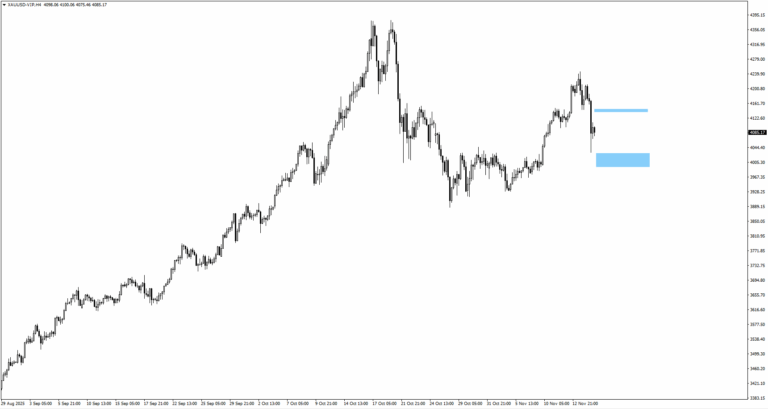
– Price currently consolidates near $4,085 after a steep drop from recent highs around $4,260.
– If price retests and rejects near $4,160–4,170, downside continuation remains in play.
– Key support sits at $4,005–4,045; bullish setups may emerge from this zone if momentum holds.
– Break below $4,000 could expose deeper retracements; a reclaim of $4,170 reopens upside potential.
Bitcoin (BTCUSD)
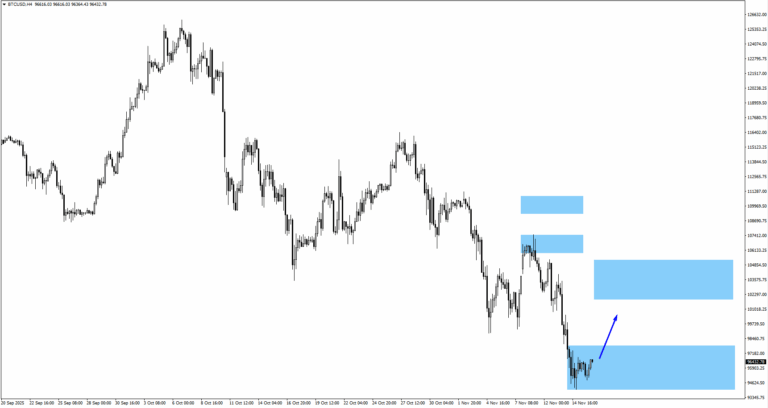
– Bitcoin is trading around the $96,850 monitored zone; bulls lack momentum without liquidity tailwinds.- – A move toward $102,000 or $104,500 could follow if rate cut odds rebound.
– Downside risk grows if US macro surprises on the hawkish side.
S&P 500 (SP500)
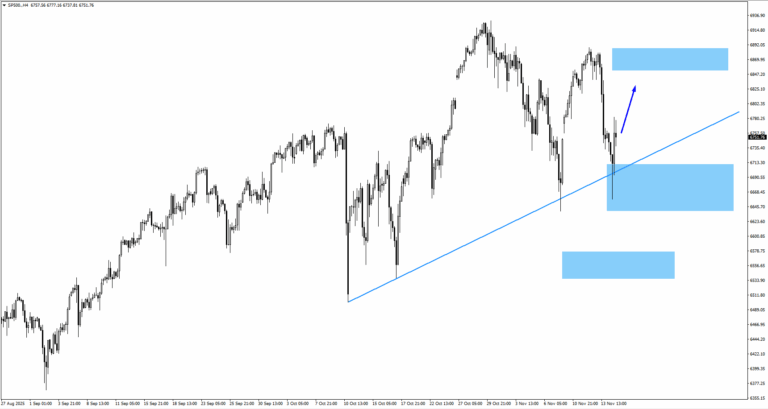
– SP500 is holding support around 6,665 but remains range-bound.
– If price consolidates, a retest of 6,865 may follow; a break lower would signal a deeper correction.
– Fed outlook and macro data will dictate broader equity sentiment this week.
USOil
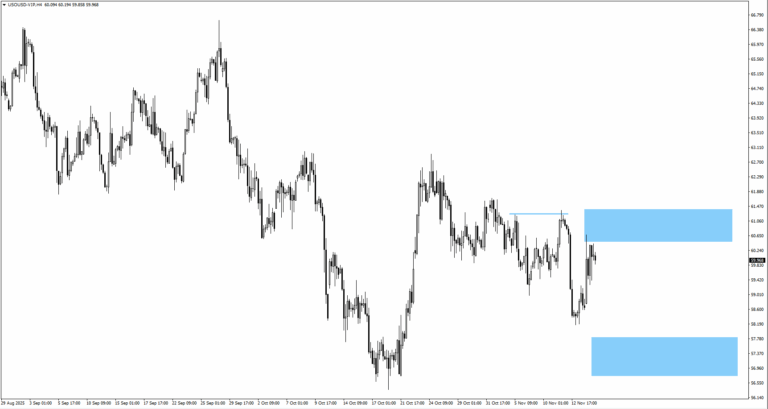
– USOil was trading around 60.45 last week, but quickly fell to around 59.5 per barrel on Monday, paring gains from the previous session after Russia’s Novorossiysk port resume oil loading operations.
– If momentum turns lower, the next key support to watch is around 57.80, where buyers previously stepped in.
EURUSD
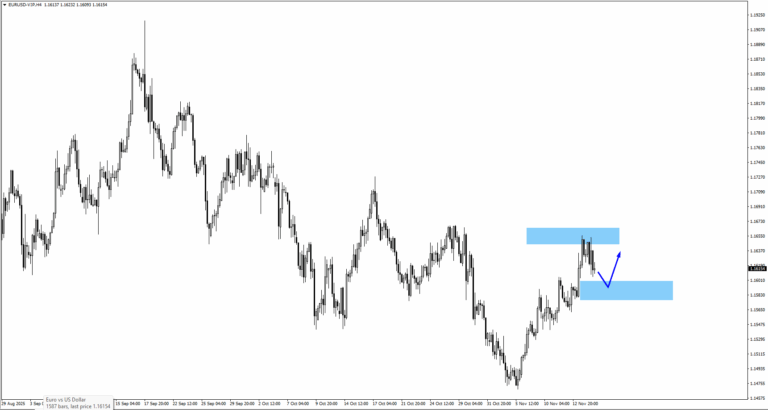
– EURUSD dipped from the 1.1650 area; bullish structure now monitored at 1.1590.
– A break below 1.1555 would invalidate the upside zone.
– Price action hinges on US inflation data and ECB tone.
GBPUSD
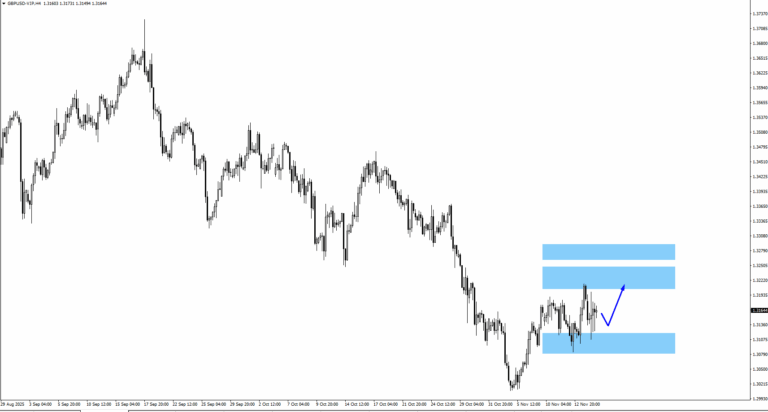
– Cable pulled back from the 1.3225 zone and may revisit 1.3100 before the next leg higher.
– Traders eye price response near 1.3275 on a rally.
– CPI figures on Wednesday are key for the next directional leg.
Key Events This Week
17 November
1. CAD CPI m/m, Forecast: 0.20%, Previous: 0.10%
If USDCAD moves higher early in the week, this release could drag it lower.
19 November
1. UK CPI y/y, Forecast: 3.60%, Previous: 3.80%
A soft print reinforces cooling inflation narrative; watch for movement in GBPUSD.
20 November
1. US NFP, Forecast: 58K, Previous: 22K
Labour market update carries weight in absence of full data post-shutdown.
2. US Unemployment Rate, Forecast: 4.3%, Previous: 4.3%
Unclear if October figures will be released; any new data could sway Fed outlook.
Market Snapshot
The Federal Reserve approaches its December meeting with a divided stance and limited data visibility, making the policy outlook uncertain. Traders remain highly reactive to incoming macro headlines, particularly around employment and inflation. With CPI, NFP, and the Fed minutes all on deck, these events will play a key role in shaping market expectations as year-end approaches.







