



During the European session, WTI oil price drops to $59.34 and Brent falls to $63.38.
The Japanese yen shows a slight recovery against a weakening USD, but lacks strong bullish momentum.
As we enter the European session, the Japanese Yen has made a slight recovery, pulling the USD/JPY pair down from its highest point since February. Japan’s Finance Minister has verbally intervened, and a risk-averse atmosphere has bolstered the Yen, keeping the USD/JPY pair close to the important 155.00 level.
Japan’s Prime Minister is proposing tax cuts to stimulate spending, raising concerns about the country’s fiscal health. Weak Q3 GDP figures might delay interest rate hikes from the Bank of Japan, which could influence the Yen’s value. On the other hand, expectations of a less accommodating Federal Reserve are supporting the US Dollar. Traders are wary as they await the FOMC Minutes and delayed US Nonfarm Payroll reports.
Concerns Over Forex Volatility
Japan’s Finance Minister has voiced concerns about forex market volatility, suggesting potential intervention may occur. The caution from Fed officials regarding easing rates has shaped expectations for a December rate cut, benefiting the US Dollar. Traders are eagerly waiting for the FOMC Minutes and US Nonfarm Payroll results while closely monitoring speeches from FOMC members. On a technical note, if USD/JPY remains above 155.00, it suggests an upward trend. A strong move past 155.60 might push it to 156.00. On the downside, support is found in the 154.50-154.45 range. If it drops below this, the pair could slide toward 153.60-153.50. Currently, the Yen is notably stronger against the Australian Dollar amid various currency movements. The main factor influencing the USD/JPY pair is the large gap between interest rates set by the US Federal Reserve and the Bank of Japan (BoJ). With the Fed funds rate above 5.25% and the BoJ’s rate close to 0.1%, holding dollars is much more profitable than holding yen. This fundamental difference keeps putting upward pressure on the currency pair.Strategic Options for Traders
We are now hearing serious verbal warnings from Japanese officials, which often precedes direct market intervention. A similar pattern occurred in 2022 and again in 2024, when authorities bought yen to prevent its decline after the dollar surpassed key levels like 150 and 158. This history makes the current warnings around the 155 mark very relevant for traders. The risk of a sudden reversal has increased volatility, making options a useful tool in the coming weeks. Traders who suspect imminent intervention might consider buying USD/JPY put options to profit from a decline, while limiting their potential losses. This strategy can help navigate the unpredictable actions of the government. Conversely, the US economy remains strong, supporting a robust dollar. Recent job reports show the US added over 210,000 jobs, and core inflation remains steady at about 3.6%. These figures make a Federal Reserve rate cut less likely in the near term, providing additional support for the USD/JPY. For traders who believe the interest rate advantage will outweigh intervention worries, buying USD/JPY call options could be a strategy to target a move towards 156.00. Using option spreads can help reduce the cost of this position, which is wise given the heightened volatility. The technical outlook remains positive as long as the pair stays above the 154.50 support level. In the coming weeks, the market will closely watch the upcoming FOMC minutes and the delayed US Nonfarm Payroll report. These data points will significantly influence expectations about the Fed’s next decisions, so sharp price fluctuations can be expected as these opposing factors interact. Create your live VT Markets account and start trading now.New Zealand dollar drops to 0.5650 as rate cut expectations for RBNZ grow
NZD/USD fell to around 0.5655 during the early European session. The Reserve Bank of New Zealand (RBNZ) is expected to cut the Official Cash Rate by 25 basis points to 2.25% in their next meeting.
This expectation follows a previous 50 basis point cut by the RBNZ, due to a 0.9% decline in GDP during Q2 2025. The larger cut aimed to support a slowing economy.
Trade Relations Shift
US President Trump has lifted tariffs on New Zealand exports, including beef, valued at NZ$2.21 billion annually. This move may help slow the NZD’s decline against the USD. The September US Nonfarm Payrolls report will come out on Thursday, with predictions of 50,000 new jobs added. The Unemployment Rate is expected to stay at 4.3%, and if the data is weaker than anticipated, it could put pressure on the USD. The NZD, often called the Kiwi, is influenced by New Zealand’s economy and central bank policies. Key factors include China’s economic performance and dairy prices, which affect exports. RBNZ decisions significantly impact the NZD’s value. High interest rates attract foreign investors. When the market feels optimistic, the NZD strengthens, but in unstable conditions, it may weaken. Currently, the New Zealand dollar is trading weakly at around 0.5655 as the market waits for the RBNZ’s decision next week. The main reason for this is the strong expectation of a 25 basis point cut, lowering the Official Cash Rate to 2.25%. This follows the unexpected 50 basis point cut from October due to economic contraction. The market shows over an 85% chance for this rate cut, suggesting that any initial market reaction might be limited unless the RBNZ gives a more aggressive outlook. We should look for indications of further cuts early next year.Factors Influencing Market Sentiment
Recent data has not prompted the RBNZ to pause, adding to bearish sentiment for the Kiwi. The most recent Global Dairy Trade auction on November 4th showed a 1.8% drop in price, indicating weakness in New Zealand’s crucial export sector. This reinforces the need for additional monetary stimulus. On the other hand, the US dollar remains strong with ongoing inflation. The October core CPI showed a 0.3% month-over-month increase, keeping the annual rate at 4.1%, well above the Federal Reserve’s target. This suggests the Fed will maintain current rates, creating a divergence from New Zealand’s monetary policy and benefiting the dollar. For derivative traders, this situation indicates a clear trend against the NZD. Buying NZD/USD put options with expiration after the RBNZ meeting could be a smart way to profit from a continuing downward trend, especially if the RBNZ indicates more easing ahead. However, we should closely monitor the US Nonfarm Payrolls report on Thursday. A big shortfall from the expected 50,000 new jobs could lead to a sharp, but likely short-lived, rally in NZD/USD. Even though the US has removed some tariffs on New Zealand food exports, this is unlikely to counter the strong influence of differing central bank policies. Looking back to the 2014-2015 period offers useful insights. At that time, the RBNZ was easing while the Federal Reserve signaled potential rate hikes, causing the NZD/USD to drop over 25%. The current macroeconomic conditions show similar signs, suggesting that the easiest path for the pair is downward. Create your live VT Markets account and start trading now.The E-mini Nasdaq has broken through the neckline of a two-month head and shoulders pattern around 24850.
**Elsewhere In The Market**
The Emini Nasdaq has broken below the neckline of a two-month head and shoulders pattern at approximately 24,850. This confirmed break signals over a 50% chance of a moderate decline, indicating a sell signal for the medium term.
If it breaks below 24,600, it would trigger another sell signal, which might create a buying opportunity around 24,200/24,000. Traders with long positions should set stops below 23,850, while those with short positions should set stops above 25,100, due to strong resistance at 24,850/24,950.
Currently, EUR/USD is around 1.1600, and GBP/USD is near 1.3150 during European trading hours. Gold is close to a one-week low, and Bitcoin has fallen below $90,000. The S&P 500 continued its pullback from the previous trading day, while Solana experienced a 2% rise.
FXStreet offers market insights and subscriptions for expert-driven analyses directly sent to subscribers’ inboxes. It’s essential to clarify that the information shared here is for informational purposes only and is not investment advice, as market investments come with risks, including the potential loss of principal. The views expressed are solely those of the authors.
**Market Sentiment And Economic Data**
Stocks are poised for a notable decline as we approach the end of 2025. The Emini Nasdaq has dropped below a key support level at 24,850, completing a bearish pattern. This serves as a critical medium-term sell signal, suggesting further declines may be in store.
This technical breakdown coincides with disappointing economic data. Last week’s October CPI report came in unexpectedly high at 3.9%, heightening inflation concerns. Additionally, U.S. jobless claims rose to 245,000, their highest level in three months, indicating the labor market may be cooling. This mix of persistent inflation and slowing growth is affecting investor confidence.
A similar market situation occurred in autumn 2023, leading to a sharp 10% drop in the Nasdaq the following month. This historical pattern shows that once key support levels break, declines can happen quickly. Traders should brace for increased volatility in the upcoming weeks.
For those trading derivatives, it may be wise to consider buying put options or taking short futures positions. A decisive move below 24,600 would confirm this trend, potentially leading to a decline toward our target zone of 24,200/24,000. Any rebounds to the 24,850/24,950 range might present chances to enter new short positions.
Risk management is crucial in this scenario. Short traders should contemplate placing stops above 25,100 to guard against sudden reversals. Those looking to go long should employ a tight stop-loss below 23,850, as failing to maintain that level could result in a more severe decline.
Create your live VT Markets account and start trading now.
Investor sentiment declines as the Fed’s rate outlook leads to reassessment in the Forex market
The market sentiment has become cautious due to uncertainty from a backlog of US economic data and reduced expectations for a Federal Reserve rate cut in December. As a result, investors turned to safe-haven assets, leading to a nearly 0.3% rise in the US Dollar on Monday. Major US stock indexes like the S&P 500 and Nasdaq Composite declined during this period.
A table showed the US Dollar’s performance, which was strongest against the Australian Dollar, which fell by 0.86%. Meanwhile, USD/JPY was stable around 155.00 after reaching a peak during the Asian session. The Reserve Bank of Australia’s November meeting minutes indicated that the policy rate would be held steady unless new data suggests a change.
Canada’s Inflation Trends
In Canada, annual inflation dropped to 2.2% in October, causing USD/CAD to stay within a narrow range. In Europe, EUR/USD fell by 0.3%, while gold continued its downward trend, dropping below $4,100. The Federal Reserve plays a significant role in the US economy, affecting the US Dollar through interest rate changes, Quantitative Easing (QE), and Quantitative Tightening (QT). The Fed meets eight times a year to review economic conditions, with QE and QT influencing the value of the USD in opposing ways. Market sentiment has shifted negatively, as safe-haven investments gain traction amid fading hopes for a December Fed rate cut. This shift was prompted by recent data, including an October inflation report higher than expected at 3.5% and a surprisingly strong jobs report showing 210,000 new jobs. The CME FedWatch Tool indicates the probability of a December cut has dropped to below 35%, down from over 60% just two weeks ago. The US Dollar Index remains steady near 99.50, prompting strategies that might benefit from continued dollar strength in the weeks ahead. Buying call options on the USD against currencies from dovish central banks like the Australian Dollar seems promising, especially since the Reserve Bank of Australia’s recent minutes suggest further easing, creating a clear policy divergence with the Fed.Equity Market Reactions
The cautious mood is affecting equities, with US stock futures indicating further losses as Wall Street adjusts to the possibility of higher interest rates. The CBOE Volatility Index (VIX), a measure of market fear, has risen above 22, a significant leap from the low teens we saw last month. Consider buying put options on the S&P 500 or Nasdaq 100 to hedge existing long positions or to speculate on potential downturns. This situation is similar to 2022 when the market had to quickly adjust to a more aggressive Fed, which led to a significant and prolonged rally in the dollar. Upcoming speeches from Fed policymakers will be crucial. Any hawkish comments could easily trigger further dollar gains and lower equity prices. Gold is under pressure from a strong dollar and expectations of prolonged high interest rates, now trending toward the $4,000 level. This environment raises the opportunity cost of holding gold. We could explore buying puts on gold futures or creating bear put spreads to profit from this ongoing weakness. In the currency market, USD/JPY is noteworthy as it approaches the 155.00 level. Japan’s planned economic stimulus might weaken the yen further, but we should be wary of potential interventions from Japanese authorities at this level. Using option strategies like bull call spreads can help us profit from further increases while protecting against sudden reversals. Create your live VT Markets account and start trading now.The Australian dollar recovers losses as the US dollar weakens with market caution
The Australian Dollar reduced its losses due to the Reserve Bank of Australia’s (RBA) careful policy and strong employment data. The RBA Meeting Minutes suggested that if data remains positive, the cash rate might not change. Unemployment dropped to 4.3% in October from 4.5% previously.
The US Dollar dipped a little, trading around 99.50, as the market waits for US economic data and a possible Federal Reserve rate cut. The CME FedWatch Tool revealed a decrease in the chances of a 25 basis point cut at the December meeting, falling from 62% to 43% in one week. Officials highlighted vulnerabilities in the labor market and urged caution regarding rate cuts.
The AUD/USD Pair
The AUD/USD pair hovered around 0.6490, showing little movement. It traded below the nine-day EMA, with key support at 0.6470 and resistance at 0.6514. Several factors influence the Australian Dollar, such as RBA interest rates, the health of the Chinese economy, and iron ore prices. The table indicated the Australian Dollar’s weakness against the Swiss Franc. Various elements impact the AUD, including interest rates, export prices, and trade balance, often tied to the Chinese economy. Currently, there is a noticeable difference in policy paths between the RBA and the US Federal Reserve. The RBA is maintaining its interest rates, backed by a surprisingly strong domestic economy. In contrast, the Federal Reserve seems more inclined to cut rates due to a slowing US labor market.Global Environment for Risk-Sensitive Currencies
Recent data showed Australia’s inflation for the third quarter unexpectedly rose to 3.1%, remaining above the RBA’s target. Additionally, iron ore prices, crucial for the Aussie dollar, have stayed strong, recently trading at about $125 per tonne due to steady Chinese demand. These factors support the idea that the RBA might hold off on rate cuts until late 2026. Meanwhile, the US economy shows more signs of slowing. The latest Non-Farm Payrolls report for October, released in early November 2025, indicated only 85,000 jobs were added, falling short of forecasts and confirming existing labor market weaknesses. This came after a US Core CPI reading that dropped to 2.8%, providing the Fed more leeway to ease policy without triggering inflation. For traders dealing in derivatives, this scenario suggests preparing for possible AUD/USD strength in the coming weeks. The pair is currently moving within a range of about 0.6470 to 0.6630, offering a chance to buy call options expiring in January 2026. This strategy would capitalize on a potential breakout while limiting initial risk. However, we must also consider the risk that this breakout may not occur. The 0.6470 level is a significant support point; a consistent drop below it could challenge our optimistic outlook. Traders might use this level to establish stop-losses on long positions or think about buying put options as protection against unexpected weakness in the Aussie dollar. Overall, the global environment seems to be improving for risk-sensitive currencies like the AUD. The anticipated finalization of a rare earths agreement between the US and China by Thanksgiving could enhance global trade sentiment. If this improved risk appetite develops, it would provide additional support for the Australian dollar. Create your live VT Markets account and start trading now.Dividend Adjustment Notice – Nov 18 ,2025
Dear Client,
Please note that the dividends of the following products will be adjusted accordingly. Index dividends will be executed separately through a balance statement directly to your trading account, and the comment will be in the following format “Div & Product Name & Net Volume”.
Please refer to the table below for more details:
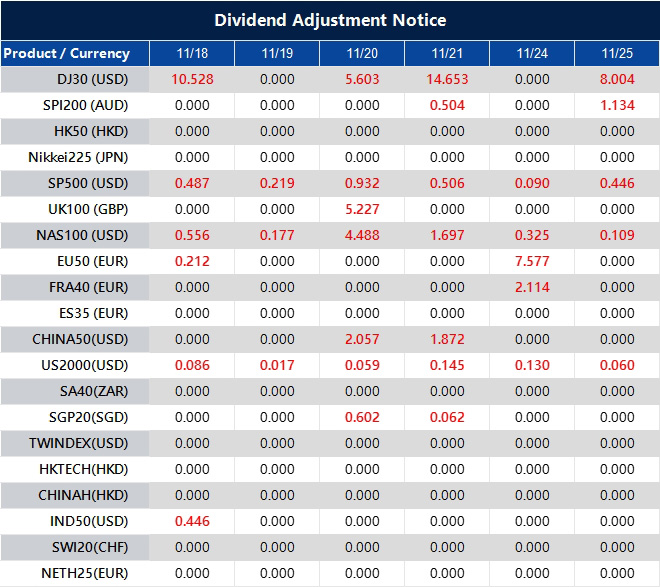
The above data is for reference only, please refer to the MT4/MT5 software for specific data.
If you’d like more information, please don’t hesitate to contact [email protected].
EUR/GBP stays stable around 0.8800 despite speculation of a Bank of England rate cut
The EUR/GBP pair remains steady at approximately 0.8810 during the early European session. Weak UK GDP growth and a declining job market hint at a possible move towards lower interest rates from the Bank of England (BoE).
The UK’s unemployment rate has risen to 5%, the highest level since early 2021, alongside falling wage growth. This situation raises speculation about a potential BoE rate cut to 3.75% in December, depending on upcoming economic data from the Autumn Budget and inflation reports.
The UK Consumer Price Index is expected to increase by 3.6% year-over-year in October, with a core index forecasted at 3.4%. Any unexpected rise in inflation could boost the GBP, presenting a challenge for EUR/GBP in the short term.
The European Central Bank (ECB) has kept interest rates steady since June 2025, likely continuing this trend into next year. Analysts expect the ECB will hold off on rate cuts as they adopt a cautious economic approach.
The Euro, used by 20 EU countries, is the second most traded currency worldwide, representing 31% of forex transactions in 2022. The ECB’s decisions on interest rates, inflation, and economic data significantly impact the Euro’s value.
With the EUR/GBP pair stable near 0.8810, we are particularly watching the anticipated BoE rate cut. Market forecasts now indicate over an 85% chance that the BoE will adjust rates in its December meeting due to clear signs of a cooling UK economy.
Recent data supports a weaker pound. The UK economy grew by only 0.1% in the third quarter of 2025, and the unemployment rate has reached 5%, a level not seen since early 2021. This slow performance gives the BoE strong reasons to cut interest rates to stimulate the economy.
Traders should pay attention to UK inflation data set to release tomorrow, November 19th. The market anticipates a headline CPI of 3.6%, and a number significantly above this could temporarily boost the pound. This may create a chance to take advantage of the larger trend.
In contrast, the European Central Bank (ECB) has maintained its key interest rates since June 2025. Although Eurozone inflation has decreased from its peak, it remains around 2.8%, preventing the ECB from considering rate cuts just yet. This difference between a dovish BoE and a neutral ECB supports a positive outlook for EUR/GBP.
Looking ahead, any strength in the pound should be seen as temporary. Traders might consider buying EUR/GBP call options with expiry dates after the December BoE meeting to benefit from the expected rate cut. If tomorrow’s UK CPI report surprises with a high figure, it might provide a more favorable entry point for these trades.
USD/CHF hovers near 0.7950 amidst a stable SNB and a US-Swiss tariff agreement
The USD/CHF exchange rate has dropped to about 0.7950 after the U.S. and Switzerland reached a new tariff agreement. This deal cut tariffs from 39% to 15%, giving a boost to the Swiss Franc as it relieved the burden of high tariffs. Plus, there are growing expectations that the Swiss National Bank will keep its policy rate at 0% in December, adding more support for the Swiss Franc.
Monetary Policy Influences
The chance of a 25 basis point rate cut by the Federal Reserve in December is currently at 43%, according to the CME FedWatch Tool. Federal Reserve officials have mixed opinions about rate cuts; some focus more on risks in the labor market than on inflation. The strength of the Swiss Franc largely depends on the Swiss economy and the Swiss National Bank’s actions. The Swiss Franc is generally considered a safe-haven currency, thanks to Switzerland’s stable economy and neutrality in global conflicts. Economic indicators, especially those related to inflation and growth, heavily influence its value. Additionally, the economic policies of the Eurozone affect the Swiss Franc because Switzerland is closely tied to this region. This means the performances of the Euro and the Swiss Franc are strongly linked. With the new U.S.-Switzerland tariff deal, the Swiss Franc is gaining solid support. Lowering the tariff from 39% to 15% is a significant boost for Switzerland’s export-focused economy, which exported over $67 billion worth of goods to the U.S. in 2024. This development should provide strong momentum for the Franc in the weeks ahead. The Swiss National Bank’s consistent policies give us more confidence in the Franc. With October 2025’s inflation rate at 1.9%, the SNB’s choice to keep the policy rate at 0% is seen as a strong move, making the Franc more appealing. We expect this policy stability to help maintain the currency’s value leading up to the December SNB meeting.Market Strategies
On the other hand, the U.S. dollar is experiencing uncertainty due to a divided Federal Reserve. The latest U.S. Non-Farm Payrolls report showed a disappointing increase of just 95,000 jobs, raising concerns about a slowing labor market. The differing views among Fed officials on rate cuts for December introduce volatility that we can potentially take advantage of. For those trading derivatives, this situation suggests that selling rallies in USD/CHF may be a wise strategy. The differing outlook from the Fed is likely to increase implied volatility, making options trading appealing. We should think about buying put options on USD/CHF as we expect it to move lower towards the 0.7800 level. It’s also essential to remember the Swiss National Bank’s past actions, like when it suddenly removed the euro peg in 2015, which caused chaos in the markets. While the current situation seems stable, this history serves as a caution to manage risk carefully. The possibility of sudden policy changes means that holding long-volatility positions could be advantageous. Besides this pair, the strength of the Swiss Franc may create chances against other currencies. With recent Eurozone manufacturing PMI figures for October 2025 staying below 50, indicating contraction, we see potential in shorting EUR/CHF. This move would capitalize on a robust Swiss economy alongside a struggling Eurozone. Create your live VT Markets account and start trading now.EUR/USD pair stabilizes around 1.1600 after pulling back from recent highs
The EUR/USD pair is currently near 1.1600 after dropping from a two-week high of 1.1656. The US Dollar is struggling as traders await the important US Nonfarm Payrolls (NFP) data. The US Dollar Index is slightly down, around 99.45, as hopes for another Federal Reserve interest rate cut this year diminish.
Recent data shows the chance of a rate cut at the December Fed meeting has decreased from 62.4% to 43%. In the Eurozone, several European Central Bank officials believe interest rates should stay steady, given the balanced inflation and growth risks. EUR/USD faces resistance near a downward trendline from September’s high and is near its 20-day EMA at 88.70.







