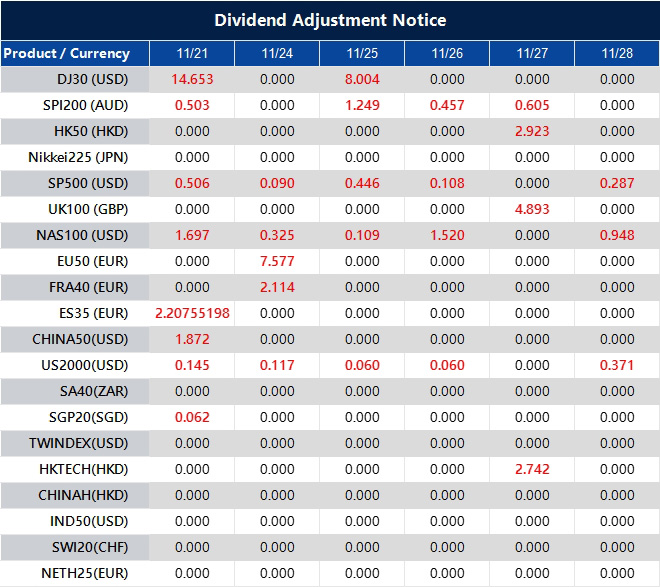
Dividend Adjustment Notice – Nov 21 ,2025

Dear Client,

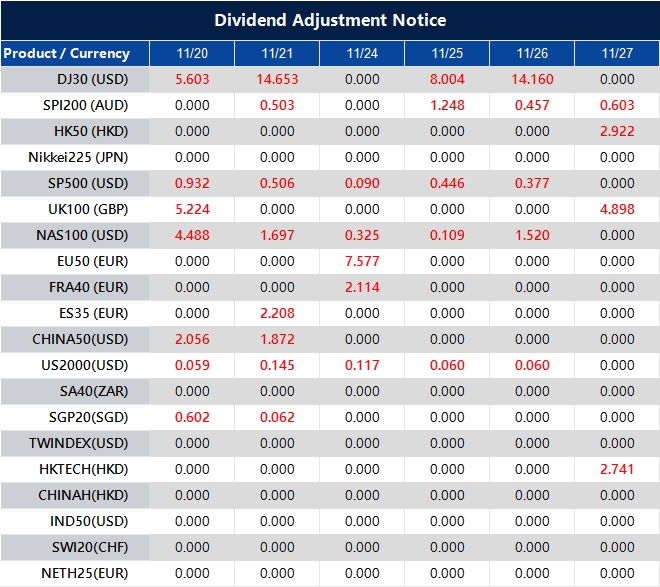
Please note that the dividends of the following products will be adjusted accordingly. Index dividends will be executed separately through a balance statement directly to your trading account, and the comment will be in the following format “Div & Product Name & Net Volume”.

Please refer to the table below for more details:

Dividend Adjustment Notice

The above data is for reference only, please refer to the MT4/MT5 software for specific data.

If you’d like more information, please don’t hesitate to contact [email protected].

Dividend Adjustment Notice – Nov 20 ,2025

Dear Client,

Please note that the dividends of the following products will be adjusted accordingly. Index dividends will be executed separately through a balance statement directly to your trading account, and the comment will be in the following format “Div & Product Name & Net Volume”.

Please refer to the table below for more details:

Dividend Adjustment Notice

The above data is for reference only, please refer to the MT4/MT5 software for specific data.

If you’d like more information, please don’t hesitate to contact [email protected].

Dividend Adjustment Notice – Nov 19 ,2025

Dear Client,

Please note that the dividends of the following products will be adjusted accordingly. Index dividends will be executed separately through a balance statement directly to your trading account, and the comment will be in the following format “Div & Product Name & Net Volume”.

Please refer to the table below for more details:

Dividend Adjustment Notice

The above data is for reference only, please refer to the MT4/MT5 software for specific data.

If you’d like more information, please don’t hesitate to contact [email protected].

Kiwi Weakening As Rate Cut Approaches

The New Zealand dollar slipped to around $0.563 on Wednesday, continuing its decline amid mounting expectations that the Reserve Bank of New Zealand (RBNZ) will implement another 25-basis-point rate cut next week.

Markets are now fully pricing in this move, as recent economic indicators have pointed to sluggish domestic activity and easing inflationary pressures.

Today’s data revealed that producer prices increased less than anticipated in the third quarter, reinforcing the view that policymakers are likely to maintain an accommodative stance to support economic growth.

Analysts, however, suggest that this upcoming cut may signal the end of the easing cycle, with further reductions unlikely unless global conditions deteriorate significantly.

External Factors Provide Limited Support

The external environment remains mixed. Although US President Donald Trump’s recent decision to lift tariffs on over 200 food products could offer a boost to New Zealand’s export sector, the move has so far had little impact on the Kiwi in the near term.

Global risk sentiment remains subdued, while the US dollar has stayed firm ahead of key American economic releases, keeping the NZD/USD pair under pressure.

Technical Analysis

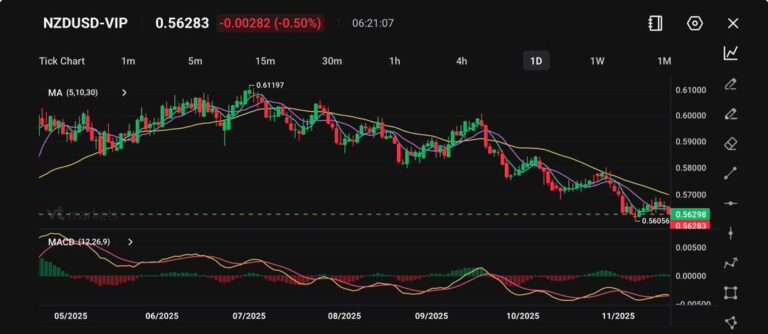
NZD/USD is trading around 0.5628, down 0.50%, with the daily chart showing continued bearish momentum. Prices are hovering near recent lows of approximately 0.5606, where temporary support was found earlier in the week.

Short-term moving averages (5, 10, 30) remain aligned in a downtrend, while the MACD indicator continues to signal negative momentum below the zero line. Immediate resistance lies at 0.5670, followed by 0.5710, while key support levels are at 0.5600 and 0.5560.

Cautious Outlook

The Kiwi dollar is expected to remain under pressure ahead of the RBNZ meeting, with traders anticipating a dovish tone in the policy statement. A confirmed rate cut could push NZD/USD below 0.5600, whereas any indication that the easing cycle is concluding might trigger a short-term rebound towards 0.5700.

Looking at the broader picture, subdued global growth and soft commodity demand are likely to constrain the currency’s upside through the end of the year.

Open your live VT Markets account and begin trading today.

Global concerns grow over the USD as the US lowers harmful tariffs, sparking economic optimism

The US government is lowering its previously set punitive tariffs, recognizing their harmful effects. This change raises questions about future economic policies, especially given the administration’s unpredictability. A new report indicates that EU officials are exploring options for US dollar funding. They suggest that central banks outside the US work together to pool their USD reserves for financial emergencies. There are worries about the Federal Reserve possibly ending current swap lines, which would affect USD availability outside the US during crises.

Foreign Policy Tensions

This development highlights foreign policy tensions that the US has created, causing other countries to rethink their dependence on the US dollar. It shows how the US dollar is a powerful tool for influence beyond its borders. The US Treasury’s ‘strong dollar policy’ aims to ensure global influence and does not necessarily promote a high currency value. The idea of a ‘USD pool’ is viewed as insufficient for addressing crises due to limited resources. The Fed’s swap lines can effectively manage USD shortages because they can supply unlimited funds. In contrast, limited reserves may expose central banks to risks if they run low on USD. The gradual reduction of US tariffs is providing short-term relief in markets, but this should be seen as an indicator of unpredictability rather than a stable policy change. For derivative traders, this means political risks remain high, even if trade tensions seem to be easing. Implied volatility may stay high, with the VIX index stubbornly around 19 despite positive news. For those trading options on major currency pairs like EUR/USD, this landscape suggests that traders should account for the risk of sudden policy changes. A recent report from the Commerce Department showed imports from the EU and China increased by 4.5% in October 2025, but this trend is fragile and highly dependent on the current administration’s decisions. This uncertainty supports strategies that can benefit from sudden price swings rather than those betting on a clear, sustained direction.

Long-Term Dependence on the US Dollar

We are witnessing other countries questioning their long-term dependence on the US dollar, creating challenges for the currency. While discussions about an EU-led dollar reserve pool seem ineffective now, they reveal a growing geopolitical divide. This sentiment is becoming evident in official data, as the IMF’s latest report for Q3 2025 shows the dollar’s share of global reserves has declined to 58.4%, continuing a gradual decrease. This creates a dilemma: any immediate financial stress is likely to drive investors *to* the US dollar for safety and liquidity. The rush for dollars during the 2020 crisis demonstrated this, where the Fed’s currency swap lines were the most effective support for the global system. This reality strengthens the dollar’s supremacy in times of crisis, even as countries search for alternatives. Considering these opposing forces, preparing for increased volatility in currency markets—especially involving dollar pairs—seems wise in the upcoming weeks. The tension between a gradual move away from the dollar and its essential role as a safe haven creates a complicated trading environment. This implies that strategies aimed at profiting from market breaks, rather than a specific direction, may be the most suitable. Create your live VT Markets account and start trading now.

here to set up a live account on VT Markets now

Dow Jones futures decline 0.30% to below 46,550 amid risk aversion and Fed expectations

**Risk of US Federal Reserve Rate Cut Declines** The Dow Jones dropped by 1.18%, the S&P 500 by 0.92%, and the Nasdaq 100 by 0.83%. US stocks struggled as enthusiasm for the AI sector faded ahead of Nvidia’s earnings report. Investors are also waiting for earnings results from Target and Walmart. The Dow Jones Industrial Average includes the 30 most actively traded US stocks. It is a price-weighted index, calculated by dividing the total price by 0.152, which has led to criticism for its limited coverage compared to broader indices like the S&P 500. Several factors influence the DJIA, including quarterly earnings, macroeconomic data, Federal Reserve interest rates, and inflation. Dow Theory, created by Charles Dow, analyzes market trends and volume through phases like accumulation, public participation, and distribution. ### Methods of Trading the DJIA You can trade the DJIA through various options such as ETFs, futures contracts, options, and mutual funds, each providing unique ways to engage with the index. With US index futures suggesting a lower open, caution is visible in the market. This follows yesterday’s decline and reflects growing uncertainty ahead of important economic data this week. The CBOE Volatility Index (VIX), often called the market’s fear gauge, rose above 18, a significant increase from the calmer times we observed in October 2025. The main cause of this caution is the quickly changing expectations around interest rates. Just a week ago, there was a 67% chance of a December rate cut from the Federal Reserve. But now, that likelihood has dropped below 50%. This shift happened after the latest CPI report for October 2025 showed core inflation stuck at 3.6%, leaving the Fed with less flexibility to ease policies. Create your live VT Markets account and start trading now.

here to set up a live account on VT Markets now

ING reports that EUR/USD stays stable around 1.160 despite key US data and equity sell-offs

The EUR/USD pair is currently steady around the 1.160 mark. The euro is benefiting from strong liquidity, especially during the recent stock market decline. High-risk currencies like the Australian dollar (AUD) and New Zealand dollar (NZD) have faced greater losses in the G10 currency group. There is potential for the EUR/USD to rise. It is trading below its short-term fair value, with an undervaluation estimated at 0.8%.

Year-End Target For EUR/USD

The EUR/USD target for the end of the year is still set at 1.180. The positive trends usually seen in December may help the pair rise, although this increase may not be as steady as earlier in the year. FXStreet shares insights from market experts and analysts. Promotions and offers are available through their subscriptions. Please remember that the information on FXStreet’s website is for informational purposes only and does not serve as investment advice. They recommend thorough research before making any investment decisions, as they do not guarantee the accuracy or completeness of the information. FXStreet and its writers are not liable for any errors, omissions, or damages arising from using the information. We expect the EUR/USD to remain around 1.1600, and it seems to be undervalued based on current factors. The potential for a rise appears greater than the risk of a fall, especially after last week’s U.S. Consumer Price Index report for October, which came in at 2.8%, slightly below expectations. This lessens the likelihood of any aggressive moves from the Federal Reserve in the short term.

Options Strategy Consideration

For those looking to profit from a possible rise, buying call options that expire in late December or early January is a simple strategy. This allows for potential gains if the pair heads towards the 1.1800 target. The risk is limited to the cost of the options. To keep costs down, consider a bull call spread—buying a call option at a 1.1650 strike price and selling one at a 1.1800 strike price. This reduces the initial cost of the trade but caps the maximum profit at 1.1800. Implied volatility has increased a bit due to recent market uncertainty, but it’s not excessively high for this strategy. This optimistic outlook is supported by strong seasonal trends observed over the past ten years. December has historically been a good month for EUR/USD, as dollar demand often weakens toward the year’s end. In fact, the pair has risen in seven of the last ten December months, adding further confidence to the potential for growth. Create your live VT Markets account and start trading now.

here to set up a live account on VT Markets now

USD/CAD remains stable around 1.4050, supported by a bullish trend in its channel

Canadian Dollar Performance Against Major Currencies

The USD/CAD currency pair is currently around 1.4050, showing a strong upward trend on the daily chart. The pair is close to the nine-day Exponential Moving Average (EMA) of 1.4036, and the 14-day Relative Strength Index (RSI) is above 50, indicating continued bullish momentum. There is a chance for USD/CAD to test its seven-month high of 1.4140. If it succeeds in breaking this level, the pair could move towards the upper limit of the ascending channel at 1.4190. Watch for support levels at the nine-day EMA of 1.4036 and the channel’s lower boundary around 1.4000. If the pair falls below the 50-day EMA of 1.3969, market sentiment may turn bearish, possibly revisiting the three-month low of 1.3721. Overall, the currency heat map reflects changes, highlighting that the Canadian Dollar is performing particularly well against the Australian Dollar. Traders and analysts are closely watching currency movements in the forex market. FXStreet recommends thorough research before making any investment choices, noting that participating in the market involves the risk of losses. The information provided is purely for informational purposes and not intended as investment advice.

Investment Strategies and Risks

With the USD/CAD pair steady at around 1.4050, the technical indicators suggest continued upward activity within its rising channel. The Relative Strength Index is above 50, showing that bullish momentum persists. The nine-day EMA at 1.4036 is the first support to consider in this trend. This positive outlook is supported by recent news, as the US reported an unexpected increase in Non-Farm Payrolls for October 2025, adding 210,000 jobs. A strong US labor market means the Federal Reserve is unlikely to reduce interest rates soon. This supports a potential test of the recent high at 1.4140. Conversely, the Canadian economy is slowing down, with the latest inflation data for October 2025 dropping to 2.6%, near the Bank of Canada’s target. This raises expectations that the BoC might loosen its policies before the Fed, creating a policy gap that could push USD/CAD higher. This situation resembles a similar divergence seen in late 2023 that boosted the pair. Additionally, West Texas Intermediate (WTI) crude oil prices have fallen over 5% in the past two weeks, now around $76 per barrel. Lower oil prices, which impact the Canadian economy significantly, typically weaken the loonie. Given this context, USD/CAD seems likely to rise. In the coming weeks, strategies that capitalize on a rise toward the 1.4190 upper channel boundary could be effective. Consider buying call options with a strike price of 1.4150, expiring in December 2025 or January 2026, to take advantage of this expected increase. Options provide defined risk, making them useful in this trending market. Alternatively, for those who feel neutral to bullish about the situation, selling put spreads with a short strike below the critical 1.4000 support could help collect premium. This strategy benefits from rising prices and time decay, as long as the pair remains above this support level. The main risks to this perspective include sudden shifts in oil prices or unexpectedly weak US economic data. Create your live VT Markets account and start trading now.

here to set up a live account on VT Markets now

Walmart shows consistent growth before Q3 results, while Target’s lower valuation attracts potential buyers

Walmart has seen steady growth, with its stock up 14% in 2025. In contrast, Target’s stock has dropped by 30%. Walmart is expected to report a 4% sales increase to $177.14 billion for Q3, along with a 5% rise in earnings per share (EPS) to $0.61. Target, on the other hand, is projected to see a 1% sales decline to $25.36 billion and a 5% drop in EPS to $1.76. Recently, Walmart has successfully expanded into e-commerce and high-margin sectors, generating over $100 billion in digital sales annually. This has led to more than 100% growth over the past five years. Target has struggled with slower sales growth and has been less adaptable to consumer spending changes, resulting in a 45% stock decline during the same time. Target’s stock is priced lower compared to both the S&P 500 and the Zacks Retail and Wholesale sectors. Walmart’s stock trades at a premium due to its EPS growth. Both companies’ stocks are priced at less than 2X their expected sales. As dividend kings, both Walmart and Target have increased their payouts for 50 years. Walmart’s steady growth makes it appealing for long-term investors, while Target offers a higher dividend yield of 5.07%, compared to Walmart’s 0.92%. Just days before earnings reports, there is a clear divide between Walmart and Target. As of November 18, 2025, Walmart’s stock has risen 14% this year, while Target has seen a sharp 30% decline. This situation creates a classic opportunity for options traders looking to capitalize on either momentum or a reversal. Target, which will report tomorrow, has low expectations with sales and earnings forecasted to decline. The company has often missed earnings estimates, which might entice traders to buy put options, anticipating another disappointment. Recent government data revealed that retail sales growth slowed to just 0.2% last month, indicating that consumers are cutting back on discretionary spending, which is crucial for Target. However, since Target’s stock has already dropped significantly, much of the bad news may be included in the price. This could lead to a sharp rally if any positive surprises occur. The implied volatility on Target’s options is currently high, suggesting a potential stock move of over 8% in either direction. This makes a straddle—a strategy of buying both a call and put option—a good choice for those expecting a big move but uncertain about the direction. Walmart reports on Thursday, and its situation is quite different. The stock is valued high due to its strong performance. It is priced for perfection, meaning that even a solid report that meets expectations might lead to a sell-off. In its Q2 2025 report, for instance, the stock fell nearly 5% despite beating revenue forecasts because EPS missed by a few cents. With Walmart’s high valuation, buying protective puts or using a bear call spread may be wise as earnings approach. Recent consumer sentiment reports show improvement, reaching 78.8, but shoppers are still focused on value, benefiting Walmart’s grocery-heavy model. Any signs of slower e-commerce growth or weaker forecasts could hurt the stock’s high valuation. For anyone betting on these stocks, keep in mind that implied volatility often drops sharply after earnings releases, which can decrease the value of options. This “IV crush” means it’s essential to accurately predict both the direction and magnitude of the stock’s movement. Selling premium through strategies like credit spreads could be a better choice for those who believe the market is overestimating the potential volatility after earnings.
Walmart and Target Stock Performance (2025)

here to set up a live account on VT Markets now

Governor Ueda of the BoJ meets with Prime Minister Takaichi to discuss the economy and monetary policy

After a meeting with Japan’s Prime Minister, BoJ Governor Kazuo Ueda talked about the economy and monetary policy. The BoJ will base its monetary policy decisions on a review of various data. The Bank of Japan aims to achieve a stable 2% inflation target by adjusting how much monetary support it provides. While foreign exchange issues were mentioned, no specific details were shared. The preference is for a stable foreign exchange rate that aligns with the economy’s fundamentals.

Market Reaction

After these comments, USD/JPY traded around 155.00, down by 0.12%. The Bank of Japan, as the central bank, focuses on controlling the currency and monetary policy to maintain price stability with a 2% inflation target. Since 2013, the BoJ has followed an ultra-loose monetary policy to boost the economy through Quantitative and Qualitative Easing. In 2016, the policy was further loosened by implementing negative interest rates and controlling the 10-year government bond yield. In March 2024, the BoJ raised interest rates, marking a shift from its prior policy due to a weakening yen and rising global energy prices that pushed Japanese inflation above the 2% target. Anticipated increases in wages in Japan also played a role in this policy change.

BoJ Policy Outlook

Governor Ueda’s comments reinforce the Bank of Japan’s cautious approach, which depends on data for future policy decisions. He indicated that while the move to normalize policy is starting, any changes will be slow and careful. This creates uncertainty, with upcoming data releases under close market scrutiny. With core inflation at 2.4% in October 2025, the BoJ is considering further tightening after earlier small rate hikes. However, wage growth from the 2025 Shunto negotiations was a more moderate 3.8%, causing policymakers to hesitate about the sustainability of rising wages and prices. This mixed data explains the governor’s cautious tone, suggesting the next policy meeting in December will be significant. His mention of foreign exchange signals to the market that with USD/JPY at 155, a level that triggered intervention back in 2024, there is a desire for stable movement aligned with fundamentals. This implies that the government is becoming less tolerant of further yen weakening. For derivatives traders, this atmosphere suggests that implied volatility in yen options may be undervalued. The risk of an unexpected policy shift or sudden intervention is heightened, making long volatility strategies appealing. Buying JPY call options (or USD/JPY put options) provides a way to position for a significant appreciation of the yen with defined risk. The interest rate gap between the US and Japan continues to be a key factor, even as the Federal Reserve keeps rates steady near 4.0% for much of 2025. This makes yen-funded carry trades tempting, but Ueda’s comments raise the risk of a sudden reversal. Thus, using forward contracts or currency swaps to hedge against a sharp yen appreciation is increasingly wise. Create your live VT Markets account and start trading now.

here to set up a live account on VT Markets now

Back To Top
server

Hello there 👋

How can I help you?

Chat with our team instantly

Live Chat

Start a live conversation through...

  • Telegram
    hold On hold
  • Coming Soon...

Hello there 👋

How can I help you?

telegram

Scan the QR code with your smartphone to start a chat with us, or click here.

Don’t have the Telegram App or Desktop installed? Use Web Telegram instead.

QR code