



Australian dollar declines against US dollar as Fed rate cut expectations decrease
The Australian Dollar (AUD) is weakening against the US Dollar (USD) as hopes for a US Federal Reserve interest rate cut in December fade. Strong job data in Australia has helped support the AUD, maintaining the Reserve Bank of Australia’s cautious approach. The ASX 30-Day Interbank Cash Rate Futures show a 6% chance of a rate cut to 3.35% from 3.60% at the upcoming RBA Board meeting.
The US Dollar Index (DXY) has risen, now around 99.40, as the possibility of a Fed rate cut decreases. The CME FedWatch Tool reports a 46% chance of a 25 basis point cut in December, down from 67%. Recently, US President Donald Trump signed a bill to end the longest government shutdown in history. Mixed signals from the US economy and disappointing labor data have also emerged.
The EUR/CAD pair falls to around 1.6275, but downside potential is limited due to ECB caution.
The EUR/CAD currency pair fell to around 1.6275 during the early European trading session on Monday. This drop coincided with growing anticipation for the Canadian Consumer Price Index (CPI) inflation data for October, which was due to be released later that day. Market expectations indicate less than a 50% chance of another interest rate cut by July 2026 and only a 4% chance for the December 2025 meeting.
European Central Bank (ECB) officials, including Olli Rehn and Mārtiņš Kazāks, have suggested that interest rates might stay the same given the current economic conditions. Rehn cautioned that the potential for slowing inflation deserves attention, although risks remain. Kazāks noted that any necessary rate changes would come after significant shifts in the economy.
Canadian Dollar and Oil Prices
The reopening of Russia’s Novorossiysk port after a brief closure due to a strike in Ukraine relieved worries about oil supply disruptions. This news impacted the Canadian Dollar (CAD), as Canada’s economy heavily relies on oil prices. When crude oil prices drop, as they did with the resumption of operations at the Russian port, the value of the CAD tends to fall, reflecting Canada’s status as a major oil exporter. With the EUR/CAD cross around 1.6275, today’s Canadian inflation data takes center stage. The release of October’s CPI is crucial for determining the pair’s direction this week. Given that Canada’s CPI for September was 2.9%, any figure exceeding the market’s expectation of 2.7% could trigger major movement. If inflation comes in higher than expected, it may compel the Bank of Canada to keep its strict policy, which could strengthen the CAD. We observed a similar pattern earlier in 2025 when strong economic data delayed any discussions on rate cuts. Such a scenario might push EUR/CAD lower, likely testing support levels below 1.6200. However, the CAD may struggle due to falling oil prices, which are a key export for Canada. The reopening of the Russian port has eased supply concerns, pushing WTI crude prices down to about $78 a barrel from over $85 just two months ago. This decline in the energy market limits the CAD’s strength, regardless of inflation data.Euro’s Stability Amid ECB Policy
On the other side, the European Central Bank (ECB) is creating a strong support system for the Euro. ECB officials have indicated they are not in a hurry to change interest rates, with markets pricing in only a 4% chance of a rate cut in December 2025. This stability from the ECB suggests that any drops in the EUR/CAD cross may be temporary. With these mixed signals, we should expect increased volatility in the upcoming weeks. The pair’s advance toward 1.6300 has paused, but underlying support for the Euro remains solid, creating a delicate balance. Options traders might consider strategies like straddles to profit from significant price swings in either direction instead of betting on a specific trend. Looking forward, it’s essential to watch upcoming Eurozone flash inflation figures and Canada’s next employment report. These data points will be critical in determining whether the Bank of Canada or the European Central Bank will first signal any policy changes. For now, the trading environment favors those prepared for abrupt and unpredictable movements. Create your live VT Markets account and start trading now.The EUR/USD pair experiences a bearish trend as the US dollar strengthens amid rate cut fears.
EUR/USD fell on Monday due to a stronger US Dollar and lower chances of a rate cut by the US Federal Reserve. The currency pair dropped from its recent peak, with traders looking for a significant drop below the 1.1600 level for further losses.
Last week’s resistance around the 50-day Simple Moving Average supports a bearish outlook. Daily chart indicators suggest being cautious, as the European Central Bank is likely to keep its deposit rate steady, which could help the Euro.
Support And Resistance Levels
If the pair declines further, buyers may step in around the 1.1575-1.1570 support zone. Breaking below this level could lead to more selling, targeting 1.1500 and possibly moving down to 1.1470-1.1465. On the upside, the 50-day SMA near the 1.1660-1.1665 area is a key barrier. If the pair surpasses this, it could reclaim 1.1700 and reach the 1.1755-1.1760 range, and eventually 1.1800. Currently, the US Dollar is performing best against the Australian Dollar. The heat map shows percentage changes of major currencies, comparing base and quote currencies in rows and columns.Current Market Overview
As of November 17, 2025, the EUR/USD pair is under downward pressure, testing the 1.1600 mark due to a robust US dollar. This dollar strength is driven by expectations that the Federal Reserve will hold interest rates steady. Last week, the pair failed to break above its 50-day moving average, suggesting that the bearish trend may continue. Recent economic data supports this view. The latest US Consumer Price Index for October was 3.4%, slightly above the 3.3% forecast, and the last jobs report indicated a robust increase of 210,000 jobs. In contrast, Eurozone inflation was softer at 2.5%, giving the European Central Bank less reason to adopt a hawkish stance. This divergence between central banks is similar to trends seen in 2022, when the Fed’s tightening policies pushed the dollar significantly higher against the euro. For derivative traders, the critical support level to monitor is the 1.1575-1.1570 zone. A clear break below this could spur more selling, making put options or short futures contracts appealing, targeting around the 1.1500 level. However, caution is advised, as further declines might attract buyers. The immediate resistance to watch is the 50-day Simple Moving Average, currently around 1.1665. A sustained move above this level would weaken the bearish case and could signal closing short positions or considering call options targeting the 1.1700 level. Create your live VT Markets account and start trading now.USD/CHF strengthens near 0.7950 as chances of a Fed rate cut in December decrease
USD/CHF is rising and trading close to 0.7950 as the US Dollar gains strength. This is due to lower expectations for a Federal Reserve rate cut in December. The CME FedWatch Tool indicates a 46% chance of a 25-basis-point cut, down from 67% just a week ago.
The delay in US economic data following the government reopening is creating uncertainty. The September Nonfarm Payrolls report is now expected on November 20. The Kansas City Fed President recommended controlling demand growth with monetary policy, while the St. Louis Fed President emphasized the resilience of the US economy.
Swiss Franc Support
The Swiss Franc might strengthen if the Swiss National Bank (SNB) keeps its policy rate at 0% in December due to inflation worries. An agreement between Switzerland and the US on tariffs has also supported the Franc, reducing previous high tariffs. As a popular global currency, the Swiss Franc serves as a safe-haven asset because of Switzerland’s stable economy and political neutrality. SNB decisions, especially during inflationary times, can bolster the Franc by increasing rates. Economic data and Eurozone policies significantly influence its value. The US Dollar is strengthening as the market reassesses a potential December Fed rate cut, pushing USD/CHF toward 0.7950. The chance of a 25-basis-point cut has decreased to 46%, a steep drop from 67% last week. This shift from Fed officials indicates that shorting the US Dollar could be risky now. A key event is the delayed September Nonfarm Payrolls report set for November 20. We remember how a strong jobs report in October 2023, which added 336,000 jobs, led to a dollar rally. A similar positive surprise this week could dash any hopes for a December rate cut and likely push USD/CHF higher.Potential Rate Decisions Impact
However, we think the upside for USD/CHF might be limited since the SNB is expected to stay firm at 0%. Although Swiss inflation is low, it has been rising recently, making the SNB cautious about cutting rates too soon. The new 15% tariff agreement with the US also removes a significant uncertainty for the Swiss economy, offering some support to the Franc. With the upcoming US jobs data posing major event risks, there are opportunities in the options market. Implied volatility is expected to rise as we approach the November 20 announcement, making a long straddle a suitable strategy. By buying both a call and a put option, we can be ready for a significant price movement in either direction without needing to predict the outcome precisely. Looking ahead to December, the situation will depend on policy decisions from both the Fed and the SNB. Unlike mid-2024 when the SNB was cutting rates while the Fed maintained theirs, there’s now less divergence in their policies. This could make the pair more range-bound, so strategies that benefit from low volatility, like selling an iron condor, may become appealing after the central bank meetings. Create your live VT Markets account and start trading now.Sleijpen suggests a stablecoin run may require changes to the ECB’s monetary policy in an interview.
The European Central Bank (ECB) may need to adjust its monetary policy if stablecoins cause a serious economic crisis. There are worries that stablecoins could become crucial to the financial system.
The Euro dropped by 0.17%, trading at 1.1600. The ECB, based in Frankfurt, sets interest rates and manages monetary policy for the Eurozone.
Quantitative Easing And Tightening
The primary goal of the ECB is to keep prices stable, targeting around 2% inflation. In special circumstances, the ECB can use Quantitative Easing (QE), which involves injecting money into the economy by buying assets. This can lead to a weaker Euro. Quantitative Tightening (QT) is the opposite of QE. In this case, the ECB stops purchasing bonds, which tends to strengthen the Euro. QT is often used during economic recoveries to help control rising inflation. Stablecoins are becoming more significant due to their potential economic impact. The ECB may need to adjust its policies, which could shift its focus away from price control. A major run on stablecoins could harm the economy. This situation would likely require intervention from the ECB to maintain financial stability.Potential ECB Intervention
The ECB’s worry about a potential stablecoin run adds a new challenge for the Euro. If a major stablecoin fails, the central bank might need to provide funds or lower rates to keep the system stable. This possibility of an unexpected shift in policy makes us cautious about the Euro’s strength, even as the EUR/USD pair remains steady around 1.1600. We need to recognize how much this market has grown since the Terra/LUNA collapse in 2022. In November 2025, the combined market value of the top two stablecoins is over $150 billion, making any instability a real risk. Their deep connection to the financial system is why the ECB must now pay close attention. For those trading derivatives, purchasing volatility on the Euro could be a wise strategy in the coming weeks. The implied volatility for one-month EUR/USD options has risen to 7.2%, indicating that the market is starting to account for this uncertainty. Strategies like long straddles or strangles could be beneficial if there’s a significant price change either way due to a crypto event or the ECB’s response. This situation is further complicated by current inflation data in the Eurozone. The latest Harmonised Index of Consumer Prices (HICP) for October 2025 is at 2.4%. The ECB’s ability to respond is limited; any emergency action to handle a stablecoin crisis could conflict with its goal of maintaining price stability, potentially increasing market unpredictability. Create your live VT Markets account and start trading now.USD/INR trades sideways under 89.00 during Asian session amid India’s economic outlook
**Moody’s Economic Outlook for India**
Recent updates from the Federal Reserve suggest that interest rates may stay the same in their next meeting. The CME Group’s FedWatch Tool indicates a 45% chance of a 25 basis-point rate cut next month, down from 50% last week. This news is giving some strength to the USD, which influences the USD/INR exchange rate.
Several factors affect the value of the INR, including India’s reliance on oil imports, the strength of the US Dollar, and foreign investments. The RBI’s actions in the foreign exchange market and its interest rate policies also play a crucial role. Macroeconomic factors like inflation, GDP growth, and trade balances additionally impact the INR. High inflation and adjustments to interest rates by the RBI can either help or hurt the Rupee.
The USD/INR exchange rate is currently stuck in a narrow range below 89.00, reflecting a tension between a thriving Indian economy and a strong US Dollar. Two opposing forces are at play: India’s solid growth supports the Rupee. This has resulted in the exchange rate consolidating over the past few weeks.
**Reasons for the USD and INR Standoff**
India’s strong economic indicators are keeping the Rupee stable. The Q3 2025 GDP growth rate was a solid 7.2% year-over-year, and the RBI has reported foreign exchange reserves of over $630 billion. This gives the central bank the power to prevent significant drops in the Rupee’s value, making the 89.00 level a tough barrier to breach.
Meanwhile, the US Dollar remains strong as traders lower their expectations for a Federal Reserve rate cut in December. The most recent US CPI data for October 2025 showed core inflation steady at 3.5%, supporting the Fed’s cautious approach. Upcoming events like the FOMC Minutes and the delayed US Nonfarm Payrolls report are key events that could shift the current situation.
For derivative traders, this low-volatility environment offers unique opportunities. With implied volatility for one-month USD/INR options at multi-year lows, selling strangles with strikes around 88.25 and 89.25 could be a smart strategy. This approach allows traders to earn a premium while the exchange rate remains stable, taking advantage of market uncertainty and time decay.
However, this period of consolidation is often seen as a pause before a potential upward movement. Traders who expect a bullish breakout, possibly triggered by upcoming US data, should think about buying call options. Purchasing December-expiry call options with a strike price just above 89.00 is a cost-effective way to position themselves for a potential rise.
We’ve seen similar patterns before, especially when the RBI defended the 83.00-83.50 range in late 2023 and early 2024. Central bank interventions often lead to these consolidation phases, which can result in sharp movements once a significant catalyst comes into play. Therefore, using options to manage risk is a wise approach as we await key economic announcements this week.
Create your live VT Markets account and start trading now.
Dividend Adjustment Notice – Nov 17 ,2025
Dear Client,
Please note that the dividends of the following products will be adjusted accordingly. Index dividends will be executed separately through a balance statement directly to your trading account, and the comment will be in the following format “Div & Product Name & Net Volume”.
Please refer to the table below for more details:
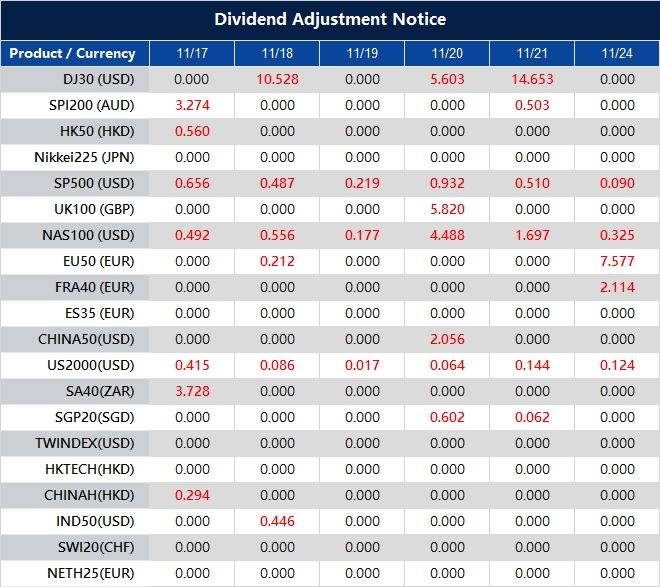
The above data is for reference only, please refer to the MT4/MT5 software for specific data.
If you’d like more information, please don’t hesitate to contact [email protected].
Positivity stays in the AUD/JPY pair above 100.50, despite early losses near 100.85
**Recent Economic Data and BoJ Outlook**
The current market shows a strong bullish signal with an RSI above 58.10, and the prices are above the 100-day EMA. If the price exceeds the resistance of 101.75, we might see more upward movement. However, if it drops below 100.00, we could see the price fall to around 98.97.
The Japanese Yen’s value relies on Japan’s economic health, the policies of the Bank of Japan (BoJ), and the difference between Japanese and US bond yields. During uncertain times, the Yen often acts as a safe haven, which can cause its value to rise.
Currently, AUD/JPY is around 100.85, highlighting a distinct difference in economic trends that will affect trading strategies in the near future. The Australian dollar benefits from a strong economy, while the Japanese Yen struggles due to a recent economic downturn. This difference suggests that the pair may continue to rise.
**Policy Divergence and Trade Strategy**
Recent data supports this view. The Australian Bureau of Statistics confirmed on November 13 that the unemployment rate stayed low at 4.1%, which was better than expected and allows the Reserve Bank of Australia to keep its rates hawkish at 4.35% earlier this month.
In contrast, Japan’s economy shrank by an annualized 1.8% in the third quarter, much worse than anticipated. This has nearly wiped out expectations for a rate hike from the Bank of Japan in December. This difference in policy creates a favorable environment for AUD/JPY.
For traders, a bullish outlook is advisable as long as the price remains above the 100-day EMA. Buying call options with strike prices over the 101.75 resistance could be effective in anticipating a rise towards 102.30, the high from November 2024. The bullish RSI near 58.10 indicates there is still potential for upward movement.
However, we must be cautious of the significant 100.00 level. A break below this support could invalidate the bullish case. To safeguard against this, purchasing put options with a strike around 99.50 could help protect against a sharp decline towards the recent low of 98.97 on November 7.
The overall market conditions also favor a higher AUD/JPY, as global risk sentiment remains stable with the VIX index close to a low 15. This reduces the allure of the Japanese Yen as a safe-haven asset. As long as market volatility stays low, this will likely benefit the Australian dollar over the Yen.
Create your live VT Markets account and start trading now.
Pound weakens against US Dollar during early Asian session, approaching 1.3155
The GBP/USD pair fell to about 1.3155 during the Asian session on Monday. This drop is due to worries about the UK’s fiscal debt and weak economic data. Reports surfaced that UK leaders had decided not to raise income tax rates ahead of the budget on November 26, which impacted the Pound further.
Last week, GBP/USD experienced directionless movement but managed to bounce back from seven-month lows. The pair was affected by weak sentiment around the US Dollar and concerns about UK finances. The US Dollar reached its lowest level in two weeks, even after the conclusion of the longest government shutdown in US history.
Central Bank Commentary
The US Dollar remained stable as the market turned its attention to central bank announcements, including potential changes from the Bank of England. Other currency movements included USD/CAD testing the nine-day EMA barrier around 1.4050, while the Japanese Yen depreciated. Gold displayed a negative trend below $4,100 due to a stronger USD and reduced expectations for Federal Reserve rate cuts. Investors are looking for updates on monetary policy, especially from the Bank of England, as global financial conditions continue to influence exchange rates. Additionally, the FXStreet platform provided insights and analysis on various market trends and forecasts. With the Pound dropping to about 1.3155, this decline appears to stem from domestic UK issues, particularly fiscal uncertainty. The recent decision to cancel a planned income tax increase before the November budget raises questions about how to handle deficits. This follows new data showing the UK economy grew by only 0.1% in the third quarter, indicating underlying weakness. We are closely monitoring signals from the Bank of England, as the market increasingly expects an interest rate cut next month. However, UK inflation, according to the latest ONS data from October, remains stubborn at 2.9%, complicating any decision to cut rates. This clash between slow growth and ongoing inflation will likely leave the pound’s future uncertain.US Dollar Dynamics
The US Dollar is not presenting a strong alternative, which explains why the currency pair is struggling to find direction. Recent US CPI data showed inflation easing to 2.8% year-over-year, suggesting that the Federal Reserve is likely to maintain its current stance. This situation caps the dollar’s strength and leads to the current tug-of-war in GBP/USD. For derivative traders, the focus in the coming days should be on volatility ahead of the UK budget. We expect the pair’s implied volatility to increase significantly, making strategies like buying straddles or strangles appealing. These strategies could profit from a major price movement in either direction after the fiscal announcement, without risking a specific outcome. We remember the market turmoil following the ‘mini-budget’ in September 2022, which led to a dramatic drop in the pound. Although the context now is different, it shows how sensitive the currency is to surprises in fiscal policy. This precedent suggests that traders should be ready for a sharp move once the budget details are released. Create your live VT Markets account and start trading now.The Australian dollar weakens against the US dollar after earlier gains due to cautious RBA sentiment
The Australian Dollar (AUD) is losing value against the US Dollar (USD) due to lower chances of a Federal Reserve (Fed) rate cut. This follows its previous gains. The USD is gaining strength due to cautious comments from Fed officials, impacting the AUD/USD exchange rate, which is around 0.6520.
Australia’s economy is performing well, with the unemployment rate dropping to 4.3% in October and a rise in full-time jobs. However, the Reserve Bank of Australia (RBA) is likely to keep its cautious approach, with only a 6% chance of a rate cut from 3.60% to 3.35% in December, according to ASX futures.







