



In a recent auction, Spain’s 9-month letras yielded 1.965%, slightly lower than the previous yield of 1.96%
The market shows a mix of activity among different currency pairs. Traders use tools like live charts and forecasts to predict changes in EUR/USD and GBP/USD. Key economic indicators like the Fed sentiment index help capture the current market landscape.
Kocher suggests no changes needed for monetary policy during the European trading session.
A member of the European Central Bank’s (ECB) Governing Council, Martin Kocher, said that the current monetary policy is suitable and doesn’t need changes. He mentioned that interest rates are in a good spot and there won’t likely be significant changes soon.
The Euro (EUR/USD) has stayed stable, trading between 1.1547 and 1.1570. The ECB, located in Frankfurt, has a main goal of keeping price stability, aiming for an inflation rate around 2% through adjusting interest rates.
Quantitative Easing and Tightening
Quantitative Easing (QE) means creating Euros to buy assets from banks, which usually weakens the Euro. This approach was used during the Great Financial Crisis and the COVID pandemic when lower interest rates alone couldn’t ensure price stability. Quantitative Tightening (QT) is the opposite of QE. It stops bond purchases to control rising inflation, often strengthening the Euro. The ECB uses these methods to adjust economic conditions and influence the Euro’s value as needed. Since the ECB has signaled its plan to keep monetary policy steady, we shouldn’t expect major changes that could stir the Euro in the upcoming weeks. Officials seem confident in the current interest rates, making it a time for stability rather than expecting big movements based on central bank updates. This cautious approach is backed by recent economic data, which is mixed but not alarming enough to trigger a policy change. As of October 2025, Eurozone inflation was at 2.1%, just above the ECB’s target, while quarterly GDP growth was a slow 0.2%. These numbers support the bank’s choice to pause and monitor the situation, suggesting the economy is neither overheating nor collapsing.Implications for Derivative Traders
For derivative traders, this environment favors strategies that benefit from low volatility and stable pricing. Selling options, such as strangles or iron condors on the EUR/USD, could be a smart move since the lack of a strong directional change will likely keep implied volatility low. Essentially, we are betting that the currency pair will stay within a predictable range for now. This calm period is a stark contrast to the aggressive rate-hiking cycle we saw in 2023 and early 2024, which was marked by high volatility and significant price changes after every central bank meeting. The market has shifted into a phase of policy normalization and quiet observation. However, we must stay alert. Any unexpected inflation report or sudden guidance from the US Federal Reserve could quickly change this stability. It’s important to closely watch upcoming inflation reports and employment data from both the Eurozone and the United States, as they could trigger a breakout. In the short term, this suggests that the EUR/USD will likely stay within its current technical levels, bouncing between key support and resistance. Derivative strategies should be designed with this expected lack of strong drivers in mind, rather than betting on a major trend change. The tight trading range we see today, between 1.1547 and 1.1570, likely hints at what’s ahead. Create your live VT Markets account and start trading now.Commerzbank analyst Michael Pfister suggests an imminent resolution for remaining US trade conflicts.
The US is close to making a trade deal with Switzerland, which is a positive step for nations that haven’t yet established agreements with the US. Reports indicate the deal could include a 15% tariff, which matches the EU rate and is significantly lower than the current 39%. However, this agreement is not finalized yet, and earlier talks have failed.
A 15% tariff would create similar trade conditions to those between the US and EU. Swiss economic growth may continue to slow in the third and fourth quarters, but there’s cautious optimism for some small growth next year.
Negotiation Details
Negotiating with the US is complex. If Switzerland can get a deal without tariffs on certain sectors, especially pharmaceuticals, it would be beneficial. This outcome depends on the approval of the agreement, with uncertainties still present in the current US administration. A US-Switzerland trade deal could strengthen the Swiss franc. The currency has struggled to find its way recently, with September 2025 data showing a nearly 5% year-over-year drop in Swiss exports to the US. Lowering tariffs from 39% to 15% should help recover this, making bearish strategies, like buying put options on the USD/CHF pair, a sensible approach in the coming weeks. We expect a positive shift in the Swiss equity market, especially for companies focused on exports. The Swiss Market Index (SMI) has underperformed compared to other European indices this year, showing a modest 2% gain by November 2025, reflecting the ongoing trade uncertainties. A successful deal could spark a relief rally, making call options on the SMI a good way to take advantage of this potential growth.Market Volatility
Volatility is another important factor to consider, as the outcome is still uncertain. The VSMI, or Swiss Volatility Index, is currently high at around 17, compared to its five-year average of 13, as traders are concerned about the possibility of talks failing again. If you believe a positive outcome is likely, selling volatility through options strategies could be rewarding, as a signed deal would likely cause the VSMI to drop sharply. However, it’s important to note that a similar breakthrough was anticipated last July before the talks fell through. The specific terms of the deal, especially regarding the critical pharmaceutical sector, will be crucial. Traders should manage risk carefully, as the market reaction will be significant depending on whether the news is positive or negative. Create your live VT Markets account and start trading now.ING analyst says UK employment figures show weaker job market performance
Recent data from the UK labour market shows that unemployment has risen to 5.0%, up from an expected 4.9%, for the three months ending in September. In October, employment fell by 32,000, and September’s numbers were revised down from a 10,000 decrease to 32,000.
Weekly earnings growth has also slowed down. The year-on-year rate for the last three months was 4.8%, falling short of expectations. These economic trends suggest that predictions for future rate hikes by the Bank of England have decreased.
Euro GBP Pressure
Despite these conditions, the EUR/GBP currency pair is facing upward pressure, as the market has not fully priced in a potential rate cut in December. The euro-pound is trading higher due to embedded risk premiums, and the year-end target for EUR/GBP is set at 0.88. The FXStreet Insights Team gathers expert observations on the market, including input from outside analysts. These insights help provide context for market movements and forecasts without promoting specific investment actions. The UK jobs market is showing signs of caution following the release of today’s data. Unemployment reached 5.0% for the three months to September, while weekly earnings growth slowed more than expected to 4.8%. This trend was also evident in the October CPI release, which revealed a drop in inflation to 3.8% from its summer highs. These numbers bolster the case for the Bank of England to shift away from its previous hawkish approach. Earlier, the focus was on inflation risks, with little concern for the weak labour market. Now, with both inflation and employment data declining, the rationale for a rate cut is becoming stronger.Market Opportunities
With the Autumn Budget coming up on November 21, any announced tax increases could prompt a December rate cut. Currently, markets are only pricing in about 18 basis points of a cut for the December 14 meeting, suggesting there is potential for a more dovish outlook. This puts the Sterling at risk for further declines in the upcoming weeks. For traders, this indicates a potential upside for EUR/GBP, which is currently around 0.8720. A movement toward our year-end target of 0.88 seems more likely if this dovish trend continues. This view is supported by the latest ONS data, showing that Q3 GDP was flat, just avoiding contraction and confirming a stagnant economy. Given this outlook, purchasing EUR/GBP call options with January 2026 expiries could be a smart move to position for further weakness in the Sterling. Reflecting on the Bank of England’s policy change in late 2021, we noted that once a clear dovish trend is established, implied volatility generally rises. This highlights the importance of entering positions ahead of the market consensus. Create your live VT Markets account and start trading now.Megan Greene from the Bank of England questions the effectiveness of the UK’s monetary policy.
Bank of England policymaker Megan Greene is worried that the current monetary policy might not be strict enough. She believes that managing inflation risk should guide BoE policy, especially since household expectations are at their highest.
The recent wage data came in lower than expected, which is a relief. However, surveys show that future wage increases might be higher than desired. Greene is concerned about ongoing inflation in the UK and suggests that stricter monetary measures may be necessary.
BoE Commentary on Inflation Persistence
FXStreet’s BoE Speechtracker rated Greene’s comments as hawkish, giving them a score of 8.0. Despite this, the GBP/USD fell by 0.4%, trading near 1.3120. The Bank of England sets the base lending rate, which influences overall interest rates and the value of the Pound Sterling. The BoE raises rates to fight inflation, making the UK appealing for international financial activities. On the other hand, lower rates can encourage investment during slow growth periods, which may weaken the Pound. In extreme cases, the BoE might resort to Quantitative Easing, which often reduces the value of Sterling by adding more credit to the system. In contrast, Quantitative Tightening boosts Sterling by limiting credit flow and stopping bond purchases, which can strengthen the economy and inflation.Interest Rate Market Challenges
A senior Bank of England official is indicating that current interest rates may not be sufficient to manage inflation. This opinion arises from worries that inflation could remain a long-lasting issue in the UK. It suggests that monetary policy may need to be more restrictive than the market expects. Recent data supports this concern. The October 2025 inflation rate from the ONS shows CPI at 3.1%, still above the 2% target. Although recent wage data was a bit lower than expected, average weekly earnings are growing at an annual rate of 4.5%, raising concerns about future price increases. These comments cast doubt on the market’s belief that the Bank Rate, held steady at 5.0% since May 2025, is set to decrease. If inflation remains persistent, as Greene suggests, the market may be underestimating the chance that rates will stay high into 2026. Therefore, we need to reassess any positions betting on significant rate cuts in the next six to nine months. For traders dealing in derivatives, this means we should think about buying volatility on short-sterling interest rate futures. Options strategies like straddles could be useful if we expect the Bank to take a more hawkish approach than the market currently anticipates. This view suggests a period of increased uncertainty regarding UK interest rates. We might also consider interest rate swaps to bet that the market is too aggressive in its pricing for rate cuts in the first half of 2026. A strategy that pays a fixed rate in exchange for a floating rate could be profitable if the BoE maintains or raises rates from here. This would align with the policymaker’s assertion that the current policy is not yet adequately restrictive. It’s worth remembering how persistent inflation was back in 2023, remaining high longer than expected. As a result, the Bank had to keep a tight policy for an extended period. Current comments indicate we might be facing a similar situation, suggesting that the market’s hopes for easier policies could be premature. Create your live VT Markets account and start trading now.European Central Bank official says market valuations are overly stretched and inflation is balanced
European Central Bank (ECB) policymaker Boris Vujčić shared that the risks related to inflation are currently balanced. He noted that economic conditions are strong, with growth and inflation rates above expectations.
Vujčić pointed out that market valuations seem high. He raised concerns about the fast rise in retail investors in the stock market compared to hedge funds. Despite the easing of tariff frontloading, consumers in Europe are being cautious.
Stability Of The Euro
The EUR/USD remained steady at 1.1555, showing no immediate reaction to Vujčić’s remarks. The ECB’s main job is to ensure price stability with an inflation target of around 2%, usually achieved by adjusting interest rates. In tough times, the ECB uses Quantitative Easing (QE) to buy assets, often leading to a weaker Euro. Quantitative Tightening (QT) is the opposite and is used during economic recovery, usually strengthening the Euro. The Governing Council makes the ECB’s policy decisions, meeting eight times a year. This council includes the heads of national banks from the Eurozone and six permanent members. **Market Indicator Concerns** Vujčić’s worries about high market valuations are an important signal for the upcoming weeks. The EURO STOXX 50’s price-to-earnings ratio is now around 18, significantly higher than its ten-year average of 15, increasing the risk of a market correction. With strong growth figures, we should not expect the central bank to support markets if they decline. In this context, it might be wise to explore hedging strategies. The European volatility index, VSTOXX, is currently around 14, a sign of complacency that we saw before sharp market drops in 2023 and 2024. Buying put options on major indices like the DAX could provide low-cost protection against a potential downturn. The fact that inflation is higher than expected adds another layer of complexity for equities. Recent data shows Eurozone inflation at 2.8%, stubbornly above the ECB’s 2% target. This situation limits the likelihood of any dovish policy changes to counter market weakness, differing from the rate cuts we began in mid-2024. Additionally, the increase in retail participation is a classic late-cycle indicator. Historically, when retail investors are more active than institutional funds, it often signals excessive optimism and a possible market peak. This observation, along with high valuations, strengthens the case for adopting a more defensive approach in derivatives portfolios. Create your live VT Markets account and start trading now.Japanese Yen lags behind US Dollar amid uncertainty surrounding the Bank of Japan
The Japanese Yen (JPY) is struggling to recover after hitting a multi-month low against the US Dollar. Ongoing uncertainty around the Bank of Japan (BoJ) adds to this challenge. The BoJ’s latest Summary of Opinions presents mixed views on interest rate hikes. BoJ’s Junko Nakagawa advised caution in policy decisions, suggesting that any rate increases may be postponed.
Growing hope for an end to the US government shutdown puts extra pressure on the JPY. This optimism, combined with a slight rise in the USD, allows the USD/JPY pair to stay above the 154.00 mark during early European trading. However, the possibility of future US Federal Reserve rate cuts may hold back any USD gains. There are also concerns that Japan might intervene to stop the Yen from weakening further, making the market more cautious.
Japanese Yen Traders Cautious
Traders dealing in the Japanese Yen are cautious, weighing intervention risks against BoJ decisions and global economic factors. Issues like US tariffs and wage growth complicate predictions for interest rate changes. Japan’s Economy Minister Minoru Kiuchi acknowledged the impact of inflation on consumer spending and highlighted plans to ease these effects, noting that a weak JPY raises costs. The US economy is showing positive signs, with rising US Treasury bond yields supporting the USD/JPY pair. Forecasts indicate a potential rise past the 154.45-154.50 range, possibly reaching 155.00. However, pullbacks around 154.00 might signal buying opportunities. A significant drop below this level could lead to losses near the 152.15 mark. Data indicates that the US Dollar is performing better than the British Pound and other currencies. The accompanying heatmap illustrates these exchange rate changes and showcases percentage variations for major currency pairings.US Dollar Strengthened by Solid Labor Market
As of November 11, 2025, the Japanese Yen remains weak against the US Dollar, primarily because of the BoJ’s cautious approach. October’s inflation figures showed that the core CPI is still above the BoJ’s 2% target, but annual wage growth has only barely kept up, leading the bank to hesitate on raising rates. This difference in policy between the US and Japan is why USD/JPY remains steady above 154.00. On the other hand, the US Dollar is supported by a robust labor market and a Federal Reserve signaling that rates will stay high for a while. The latest non-farm payrolls report indicated that the US economy added 210,000 jobs, which lowers expectations for rate cuts from the Fed anytime soon. This strength in the US economy helps boost the dollar, especially against the yen. However, the risk of intervention from Japanese authorities looms large. Historical data from interventions in 2022 and 2024 shows that the Ministry of Finance is quick to act when the yen drops too fast. This concern puts a cap on market movement and prevents traders from aggressively selling the yen. For those trading derivatives, this means that upside volatility may be limited due to concerns about intervention. Rather than straightforward long call options on USD/JPY, a more suitable strategy might be to use call spreads. This approach could involve buying the 155.00 strike call while selling a 157.00 strike call. This way, traders can profit from modest upward movement while reducing the cost, which is important if the pair suddenly reverses direction. On the flip side, any unexpected strength in Japanese economic data or hints of a policy change from the BoJ could cause a sharp decline in USD/JPY. To guard against this, traders might consider buying out-of-the-money puts with strikes around the 152.50 level. This strategy offers a cost-effective way to hedge long positions and provides protection against a sudden Yen rally or downturn in the US economy. Create your live VT Markets account and start trading now.WTI and Brent crude oil prices drop at the opening of the European market
West Texas Intermediate (WTI) oil prices fell on Tuesday during the early European session. WTI was priced at $59.78 per barrel, down from $60.06 the day before. Brent crude also dropped to $63.69 from $63.96.
WTI oil is a type of crude oil known for its low gravity and low sulfur content, making it easy to refine. It originates in the United States and is primarily distributed from the Cushing hub, serving as a key benchmark in the oil market.
Factors Influencing Oil Prices
WTI oil prices are mainly influenced by supply and demand. Key factors include global economic growth, political instability, and OPEC’s production decisions. The strength of the US dollar also plays a role. Weekly inventory data from the American Petroleum Institute and the Energy Information Agency can affect prices. A decrease in inventories usually signals higher demand, which can drive prices up, while higher inventories may push prices down. OPEC’s production quotas can also adjust supply, impacting WTI prices. Market insights from FXStreet highlight risks and remind readers that individual decisions about investments lie with them, as neither FXStreet nor the author provide direct investment advice. This morning, WTI crude oil is struggling to stay above the $60 per barrel mark, a significant psychological support level. Sentiment is bearish despite OPEC+ stating last week that it will keep production cuts in place until the end of the year. Market concerns about demand outweigh these supply constraints.Global Economic Concerns
Fears of a global economic slowdown are a major concern, overshadowing any optimism from supply management. China’s latest Manufacturing PMI for October dropped to 49.8, suggesting a slight contraction and raising worries about demand from the world’s largest oil importer. Similarly, the weak German ZEW Economic Sentiment survey indicates broader economic issues in major economies. Additionally, the strong US dollar is adding pressure, with the DXY index holding steady around 106. A stronger dollar makes oil more expensive for those using other currencies, typically leading to reduced demand. Attention is now focused on this week’s inventory data, especially after last week’s EIA report showed a surprise increase of 2.1 million barrels, indicating that US demand may be softening. In light of these factors, it may be prudent to position for further declines in the coming weeks. One strategy could be buying put options with strike prices around $55 for December contracts, anticipating lower price levels. For a less aggressive approach, selling out-of-the-money call options or setting up bear call spreads could be effective for generating premium income while prices remain contained. Looking back at the price collapse of late 2023, similar fears of a global slowdown caused WTI to drop from over $90 to the low $70s within just a few months. While the current situation isn’t as dire, it demonstrates how quickly market sentiment can shift when demand concerns arise. The upcoming EIA report on Wednesday will be critical, potentially confirming this bearish trend or offering temporary support. Create your live VT Markets account and start trading now.Dividend Adjustment Notice – Nov 11 ,2025
Dear Client,
Please note that the dividends of the following products will be adjusted accordingly. Index dividends will be executed separately through a balance statement directly to your trading account, and the comment will be in the following format “Div & Product Name & Net Volume”.
Please refer to the table below for more details:
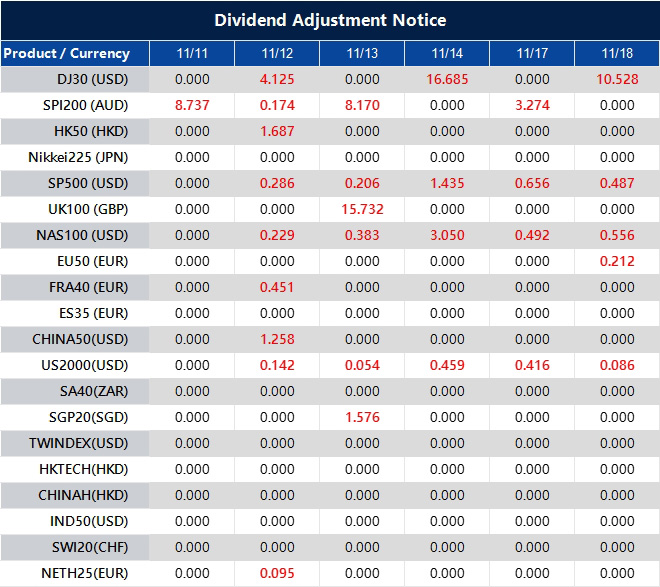
The above data is for reference only, please refer to the MT4/MT5 software for specific data.
If you’d like more information, please don’t hesitate to contact [email protected].
UK ILO unemployment rises to 5.0% for the quarter, exceeding the expected 4.9%
The UK unemployment rate increased to 5.0% for the quarter ending in September. This is higher than the predicted 4.9% and up from the previous rate of 4.8%, according to the Office for National Statistics.
In October, jobless benefit claims rose by 29,000. This is a big jump compared to September’s modest increase of 400. Employment figures for September also showed a drop of 22,000 jobs, a significant change from August, which saw 91,000 jobs added.







