Dividend Adjustment Notice – Nov 11 ,2025

Dear Client,

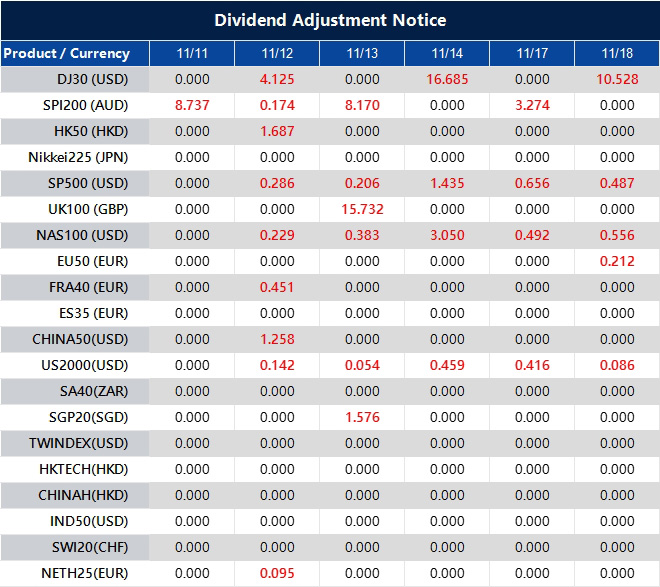
Please note that the dividends of the following products will be adjusted accordingly. Index dividends will be executed separately through a balance statement directly to your trading account, and the comment will be in the following format “Div & Product Name & Net Volume”.

Please refer to the table below for more details:

Dividend Adjustment Notice

The above data is for reference only, please refer to the MT4/MT5 software for specific data.

If you’d like more information, please don’t hesitate to contact [email protected].

UK ILO unemployment rises to 5.0% for the quarter, exceeding the expected 4.9%

The UK unemployment rate increased to 5.0% for the quarter ending in September. This is higher than the predicted 4.9% and up from the previous rate of 4.8%, according to the Office for National Statistics. In October, jobless benefit claims rose by 29,000. This is a big jump compared to September’s modest increase of 400. Employment figures for September also showed a drop of 22,000 jobs, a significant change from August, which saw 91,000 jobs added.

Average Earnings

Average earnings (excluding bonuses) grew by 4.6% year-on-year for the three months up to September. This met expectations but was a slight decrease from the 4.7% noted before. When including bonuses, average earnings rose by 4.8%, which is a bit lower than the expected 4.9%. Following the release of this employment data, the GBP/USD exchange rate fell by 0.40% to 1.3131. This could lead the Bank of England to think about interest rate cuts at its meeting in December. Currently, the GBP/USD pair is close to the nine-day Exponential Moving Average of 1.3163, with the possibility of testing a seven-month low of 1.3010. If it rises, it might approach the 50-day EMA of 1.3328. In the past, a 5.0% unemployment rate was a big negative signal for the pound. Now, the Office for National Statistics shows the unemployment rate at a stronger 4.2%, indicating a much tighter job market than before.

The Current Economic Environment

Back then, discussions about the Bank of England (BoE) preparing for rate cuts are quite different from today. The BoE has cut rates this year to 4.0%; however, with wage growth sitting at 5.5%, they remain cautious. This contrasts sharply with the previous period’s wage inflation, which was under 5%. In the past, the GBP/USD dropped to around 1.31, but today, it’s trading much lower at around 1.2450. The current market dynamics focus less on small rises in unemployment and more on the interest rate differences between the UK and the US. The Federal Reserve’s slower easing has kept the dollar strong against the pound. In the upcoming weeks, the balancing act between a slowing economy and rising wage inflation suggests more volatility for the pound. Traders should consider strategies that take advantage of sudden price movements instead of looking for a clear direction. We think options strategies like straddles on GBP/USD, which can profit from significant moves in either direction, are ideal for this unpredictable environment. The key driver will be the upcoming inflation and wage data set to be released before the BoE’s December meeting. If wages show unexpected strength, it could pause the Bank’s rate cuts and lift the pound significantly. Conversely, if the numbers are weak, it might intensify expectations for rate cuts, pushing the currency down. Either scenario would favor a long volatility position. Create your live VT Markets account and start trading now.

here to set up a live account on VT Markets now

Energy Sector SPDR (XLE) rises 1.4% amid increasing inflation concerns and institutional interest

The Energy Sector SPDR (XLE) rose by 1.4% last Friday, fueled by worries about inflation and a move towards safer investments. The price is approaching a $90 resistance level, but it is held back by the 200-day moving average at $87 and a relative strength index (RSI) of 58. XLE has traded between $74 and $98 over the past year. The near-term ceiling at $90 indicates a potential pullback to the $86-$87 support range. The Consumer Staples Sector SPDR (XLP) increased by 1.5%, bouncing off a recent 52-week low of $75. However, the RSI shows some bearish pressure could slow this upward trend. The short-term target for XLP is $78, which is just below strong resistance at $80.50. This limited volatility might make defined-risk call spreads a good strategy for steady income.

The Utilities Sector

The Utilities Sector SPDR (XLU) also saw a 1.4% rise as investors shifted towards stable sectors. XLU aims for an initial resistance level of $90, with the potential to challenge previous highs of $93. The $88-$89 range is seen as an ideal entry point for long positions, suggesting opportunities for gains through options. The Global X Uranium ETF (URA) dropped 14% last week, hitting the $45 support level. This decline seems more like a broader sell-off than a simple correction. If support holds, a recovery target of $51 is possible, making defined-risk strategies like December call spreads attractive. The iShares Ethereum Trust (ETHA) fell by 11% due to a reduction in risk around digital assets. The $25 level may offer an entry point if conditions stabilize. Short-term targets are set at $33, and defined-risk options like December call spreads are recommended to handle volatility.

The Energy Sector

The energy sector is currently facing significant resistance between $87 and $90. Recent data from the U.S. Energy Information Administration indicates that crude oil inventories are stable, making a breakout above this level unlikely in the coming weeks. Given this strong ceiling, a pullback to the $86 to $87 support range is expected. A breakout above $90 is needed before considering new long positions. Looking at similar situations from 2024, these resistance levels often hold for weeks before a new trend forms. This scenario is perfect for a defined-risk strategy to benefit from a potential pullback. A bear call spread, which involves selling a call option with a strike price above $90, could effectively generate income. This strategy works if the price remains steady or trends lower towards its long-term support. In consumer staples, the bounce from the $75 floor signals that major buyers are entering at this level. Nonetheless, the recent October 2025 Consumer Price Index report shows food price inflation has eased to just over 2% annually. This reduced pricing pressure suggests the rally may lack momentum. We expect the rebound to lose steam around the $78 resistance level over the next few weeks. A significant move towards the previous high of $80.50 appears unlikely without new drivers. Thus, we should see this as a short-term bounce within a broader range. This market structure is suited for collecting premium through credit strategies. We could implement a risk-defined call spread by selling call options with strike prices between $78 and $80. This allows us to benefit as the sector remains range-bound and the bounce loses strength. The utilities sector is showcasing a promising setup for continued upward movement. Its recent strength is supported by hints from the Federal Reserve that interest rate hikes may be ending, which has historically benefitted utilities. During the 2023 rate pause, capital often moved into this defensive sector in anticipation of stable monetary policy. Our strategy is to establish a long position on any dips to the $88 to $89 range. This creates a strong potential for a move targeting the $90 psychological level and the prior all-time high near $93. The technical structure of the sector backs this upward trend. With low implied volatility, buying long-dated call options is an appealing strategy. We should consider purchasing December calls with a strike price of $90 or $91. This method is cost-effective for leveraging a move to new highs, offering a potential reward that exceeds the initial risk. The uranium ETF saw a significant sell-off, but Friday’s bounce from the $45 support level suggests that the selling pressure may be waning. This sharp decline was likely due to profit-taking rather than a fundamental shift in the long-term outlook for nuclear energy. Reports from early November 2025 confirmed government funding for new-generation nuclear projects, reinforcing the sector’s strength. We need to see the price hold above the $45 support level through the middle of this week. If it does, it will confirm a tactical entry point for a counter-trend rally, with the initial upside target set at the $51 resistance level. Given the sector’s high volatility, a defined-risk options approach is the most prudent. Once stability at $45 is confirmed, we should look to initiate a long call spread, such as the December $48/$53 spread. This strategy enables participation in the expected rebound while clearly defining our maximum risk. In the digital asset space, the Ethereum trust’s 11% weekly decline reflects a broad trend of reducing risk. Recent data showed net outflows exceeding $150 million from crypto investment funds, indicating that institutional players are pulling back. The long-term bullish outlook for Ethereum now hinges on the vital support at its 200-day moving average near $23. For the next week, we are focused on monitoring the $25 level for stability. If this level remains firm following the weekend’s trading, it may present a high-probability entry for a short-term recovery trade. However, we expect strong resistance around $28.55. If price confirms support at $25, we can initiate a trade aiming for a recovery target of $33. To manage the risks and time decay, a defined-risk structure is necessary. Buying a December $26/$33 call spread would be a good strategy to take advantage of a potential bounce. Create your live VT Markets account and start trading now.

here to set up a live account on VT Markets now

USD/CAD pair rises to approximately 1.4035 as the US approaches a shutdown resolution

The USD/CAD pair is gaining strength, reaching about 1.4035 early on Tuesday in European trading. This rise follows the US Senate’s approval of a funding bill that might end the federal government shutdown, helping the US Dollar rise against the Canadian Dollar. In Canada, the job market showed surprising growth in October, supporting the Bank of Canada’s decision to keep interest rates steady. The unemployment rate dropped to 6.9% from 7.1%, and 66,600 jobs were added, marking the second month of unexpected gains.

Factors Impacting the Canadian Dollar

The value of the Canadian Dollar is affected by factors like the Bank of Canada’s interest rates, oil prices, and the overall health of the economy. The US economy, which is Canada’s largest trading partner, also plays a significant role. When oil prices are high and economic data is strong, the Canadian Dollar often gets stronger. The Bank of Canada adjusts interest rates to manage inflation, aiming for a target between 1-3%, which influences the Canadian Dollar. Changes in oil prices and inflation can directly impact the CAD’s value. Economic reports, such as GDP and employment statistics, also help determine how strong the Canadian Dollar is, with positive data generally leading to an increase in value. Looking at the market on November 11, 2025, the USD/CAD pair is not as strong as it was during previous times of US fiscal stress, now trading nearer to 1.3750. We remember when the pair surpassed 1.4000 during the government shutdown under the Trump administration. The current situation is different; the market now seems to take ongoing budget negotiations as a normal part of US politics. US fiscal policy continues to be in the spotlight, with the Congressional Budget Office recently estimating the federal deficit could reach $2 trillion in the upcoming fiscal year. This ongoing fiscal pressure might impact the US Dollar, creating chances for traders to use options to protect against or speculate on potential USD weaknesses. Thus, buying CAD call options or USD put options might be a strategy to consider for managing downside risks in the pair.

Canadian Economic Updates and Strategies

On the Canadian front, the economic landscape has changed notably since the previous period discussed. The Bank of Canada’s key interest rate is now at 4.5%, significantly higher than the previous level of 2.25%. With Canada’s unemployment rate stable at a low 6.2% based on last month’s data, the strong interest rate differential continues to support the Canadian Dollar. Also, the price of West Texas Intermediate crude oil, a crucial Canadian export, has remained solid at around $80 per barrel. This price level provides important support for the loonie, similar to previous trends. For derivative traders, this scenario makes selling USD/CAD futures contracts appealing, expecting that strong oil prices and favorable interest rates will keep boosting the CAD. Considering the ongoing US fiscal uncertainty and the solid fundamentals of Canada’s economy, implied volatility for the pair may rise in the coming weeks. This situation is suitable for traders who are exploring volatility strategies, such as straddles, which could generate profits from significant price movements in either direction. Traders should also keep an eye on the upcoming US ADP employment figures, as any signs of weakness in this data could accelerate a decline in USD/CAD. Create your live VT Markets account and start trading now.

here to set up a live account on VT Markets now

WTI futures remain near $60 due to oversupply concerns after OPEC+ announces plans to increase output.

WTI oil prices are around $59.75, down 0.5% in early European trading. The market is worried about oversupply since OPEC+ has raised its December output target by 137,000 barrels per day, similar to the targets set for October and November. Despite some positive news about US government funding, oil prices have not reacted strongly. After Senate Democrats supported the funding bill, it moved to the Republican-led House. This could increase oil demand if the government reopens.

WTI Trading Patterns

Currently, WTI is in a Descending Triangle pattern, trying to break out of its boundaries. The price is close to the 20-day EMA, which shows it’s stuck in a sideways trend. If it dips below the November 6 low of $58.75, we could see prices fall to October’s high of $57.43. On the other hand, if prices rise above the August 6 high of $66.00, they might climb to July’s peaks around $68.00 and $70.00. The 14-day RSI is between 40.00 and 60.00, indicating lower volatility. WTI oil inventory data from API on Tuesdays and EIA on Wednesdays significantly influences trading. Changes in inventory, whether indicating more supply or demand, reveal broader market trends. For almost two weeks, oil prices have hovered around $60, showing uncertainty in the market. The Descending Triangle formation suggests a potential sharp drop may be on the way. Low volatility, shown by the RSI remaining between 40.00 and 60.00, indicates a larger move might be coming. Recently, concerns over oversupply have intensified, affecting prices. Last week’s EIA report revealed an unexpected inventory increase of 2.1 million barrels, contrary to analyst expectations for a small reduction. This aligns with the December supply increases announced by OPEC+, reinforcing a bearish outlook.

Market Outlook and Strategy

The boost in demand from the US government reopening has not pushed prices up, as rising oil stockpiles are more pressing. A similar technical setup occurred in late 2023, which resulted in a price drop of over 15% in the following weeks. For derivative traders, planning for a breakdown appears to be a better strategy. Buying put options with strike prices at or below $57.00 allows you to profit from a potential price drop while limiting your risk. Alternatively, you can set up a bear put spread to reduce entry costs if implied volatility is high. We’re closely watching the November 6 low of $58.75. If prices break below this level, it could trigger a decline towards October’s high of $57.43 and further down to April’s critical support at $54.80. A move above the resistance at $66.00 would invalidate this bearish outlook. Create your live VT Markets account and start trading now.

here to set up a live account on VT Markets now

GBP/USD pair remains near 1.3170 as optimism rises ahead of the labor market report

The UK will release its labour market report soon. The Claimant Count Change for October is expected to rise by 20.3K, up from 25.8K in September. Last month, the Claimant Count Rate was 4.4%. The report will be out at 07:00 GMT. In the currency market, the GBP/USD pair is feeling pressure as the USD gains strength. This change comes as people anticipate a possible end to the US government shutdown. The US Senate recently passed a funding bill with a 60-40 vote, but it still needs approval from the House.

GBP/USD Recent Performance

On Monday, GBP/USD held onto its recent gains, marking a four-day winning streak. With US markets slowing down for Veterans Day, some experts think investors will remain optimistic if the government shutdown ends. In the UK, wages are expected to dip slightly for the three months ending in September, while the ILO Unemployment Rate might rise to 4.9%. During the North American session, GBP/USD traded around 1.3150. Speculation about the end of the US government shutdown has boosted the USD. President Donald Trump is hopeful about reaching an agreement. Currently, GBP/USD trades around 1.3170, showing pressures from a slowing UK economy. Recent data from the ONS shows that unemployment remains steady at 4.2%, but wage growth has slowed to 5.5%, down from over 6% last quarter. This trend suggests that the Bank of England might consider cutting rates in 2026, which could weaken the pound.

US Government Funding and Impact

Looking back at past US government shutdowns, like the one in late 2018 and early 2019, we see that resolving them has generally helped the US dollar. As US lawmakers approach another funding deadline in early December 2025, any signs of a smooth bipartisan deal would likely strengthen the dollar again. Traders should keep an eye out for positive news from Washington as it could lead to GBP/USD weakness. The upcoming UK Claimant Count is expected to show another small rise, reflecting the soft labour market we’ve seen for months. For those anticipating further declines in the pound, buying put options on GBP/USD might be a sensible strategy. This approach allows traders to benefit from a drop in the exchange rate while limiting their potential risk to the premium paid. The main theme for the coming weeks is the growing gap between the UK and US economies. The Bank of England is facing weak growth, while US inflation remains high at 3.5%. This suggests that the Federal Reserve may keep interest rates higher for a longer time. This fundamental difference in central bank policies will likely be a significant challenge for the GBP/USD pair. Create your live VT Markets account and start trading now.

here to set up a live account on VT Markets now

In the Netherlands, the annual consumer price index fell from 3.3% to 3.1%

In October, the Consumer Price Index (CPI) in the Netherlands decreased, with the year-on-year rate falling to 3.1%, down from 3.3%. This decline indicates that inflation has slowed over the past year, a trend reflected in national economic data.

ECB’s Rate Hiking Cycle

The slight decrease in Dutch inflation is a crucial signal for the broader Eurozone. It suggests that the European Central Bank’s rate hike cycle is behind us. We think that the market is not fully recognizing the possibility of rate cuts in the second half of 2026. Therefore, investing in derivatives that benefit from lower interest rates, like buying Euribor futures for late 2026, seems appealing. This situation is a good sign for European stocks, which have reacted to interest rate changes since the tightening in 2023. With the VSTOXX volatility index currently around 16, which is relatively low, purchasing call options on the Euro Stoxx 50 index is a smart way to take advantage of potential gains if the markets rise due to expectations of easier financial conditions.

Potential Divergence in Major Economies

The CPI data may also highlight a divergence with other major economies, especially the United States, where the latest report showed core CPI steady at 3.4%. This difference indicates that the ECB might lower rates before the Federal Reserve. As a result, we should think about trades that expect a weaker Euro, like buying EUR/USD put options, to benefit from this policy gap in the coming weeks. Create your live VT Markets account and start trading now.

here to set up a live account on VT Markets now

Australian dollar weakens near 100.60 as Japanese yen gains from intervention comments

AUD/JPY has dropped to around 100.60 in early European trading on Tuesday. This decline stems from concerns over possible intervention by Japanese officials. The Japanese Yen (JPY) has strengthened against the Australian Dollar (AUD) after Japan’s Finance Minister cautioned about rapid currency shifts last week. From a technical perspective, the outlook for AUD/JPY is still positive. It has support above the 100-day Exponential Moving Average on the daily chart. The 14-day Relative Strength Index shows bullish momentum, currently at 58.25, which is above the midpoint. Resistance is found at 101.03, with the potential for the pair to rise to 101.70 and possibly even 102.30.

Key Support and Influences

On the downside, the 100.00 level is crucial support for AUD/JPY. If it falls below this, it could drop to 98.97, with further support between 97.45 and 97.35. The AUD is significantly affected by interest rates set by the Reserve Bank of Australia, the price of iron ore, and the performance of the Chinese economy. Higher interest rates tend to support the AUD, while quantitative tightening might provide additional support. Iron ore, Australia’s largest export, has a direct impact on the AUD’s value. The Trade Balance, which represents the difference between exports and imports, plays an essential role in determining the AUD’s strength. A positive Trade Balance boosts the currency. Currently, the AUD/JPY pair is around 100.60, balancing between a technically strong position and concerns over Japanese intervention. The daily chart’s moving averages suggest an uptrend, but officials’ warnings create short-term risks. Thus, a cautious approach is advisable instead of a definitive bet in one direction. The concern over intervention is valid, as the Ministry of Finance has intervened before. For instance, significant action occurred at the end of 2022 when the USD/JPY exceeded 150. Now, with it trading above 162, the pressure is high. Any sudden official move could lead to a swift decline across all yen pairs, including AUD/JPY.

Australian Fundamentals and Global Factors

Presently, Australian fundamentals are supportive, helping to keep the cross high. The Reserve Bank of Australia has maintained its cash rate at 4.50% following last month’s Q3 CPI data, which was slightly above expectations at 3.8%. This interest rate differential keeps the carry trade appealing. External factors also support a stronger AUD. Iron ore prices have been resilient, trading above $125 per tonne on the Dalian exchange. Moreover, China’s Caixin Manufacturing PMI came in at 50.7, suggesting stable, modest growth in the industrial sector, which benefits Australian exports. For derivative traders, this situation presents a chance to use options to mitigate the risk of intervention. A bull call spread that targets the 101.70 to 102.30 resistance area could allow for profits from further gains while capping potential losses. This strategy is safer than a straightforward long position, which could suffer significant downside risk due to an unexpected announcement. For those currently holding long positions, buying put options with strikes near the 100.00 psychological level could serve as a solid hedge. A decisive break below this level could trigger a wave of selling towards the key support zone around 97.35, helping protect existing gains against sudden market shifts. Create your live VT Markets account and start trading now.

here to set up a live account on VT Markets now

USD/CHF pair drops to about 0.8045 amid expectations of a US-Swiss trade agreement

The USD/CHF pair has fallen to about 0.8045, with the Swiss Franc gaining strength as many expect a new trade deal between the US and Switzerland. This shift happened during the late trading session in Asia on Tuesday, fueled by rising hopes for progress on the trade agreement. A report suggests the US and Switzerland could announce this deal within two weeks. This deal might cut US tariffs on Swiss imports from 39% to 15%. Lower tariffs would make Swiss goods more competitive worldwide. Additionally, the US Senate has sent a government funding bill to the House of Representatives, which is expected to approve it by Wednesday.

The Fed Rate Cut Odds

The US Dollar Index remains steady around 99.60 as the market watches for potential interest rate cuts from the Federal Reserve. There is a 62.4% chance that the Fed will lower rates by 25 basis points to 3.50%-3.75% in December. So far this year, the Fed has already cut rates by 50 basis points, primarily due to concerns about the job market. Tariffs are fees on imports and are different from taxes paid at the time of purchase. Economists have mixed opinions on tariffs, as they can lead to higher prices and trade tensions. US President Donald Trump has indicated he will use tariffs to strengthen the US economy while also aiming to lower personal income taxes. We are seeing the Swiss Franc gain value with hopes of a trade deal with the US, pulling the USD/CHF toward 0.8045. With a deal expected soon to reduce tariffs on Swiss goods, it might be a good idea to buy put options on USD/CHF. A strike price near 0.7950 with a December expiry could help us benefit from potential declines. Recent data shows that Swiss exports to the US, especially in pharmaceuticals and machinery, have already risen by 8% year-over-year, despite the high tariffs. A cut from 39% to 15% could significantly boost this trend, likely pushing the currency pair below 0.8000. We saw similar sharp currency changes during the US-China trade discussions in 2019.

Volatility and Trade Strategies

On the flip side, the US Dollar is weak due to a softening job market. The latest jobs report showed a modest gain of only 95,000 jobs, much lower than expected, which strengthens the case for a Federal Reserve rate cut next month. This suggests we may see a lower USD/CHF, as monetary policies between the US and Switzerland begin to diverge. The nature of this trade announcement means we should prepare for sudden market swings. Implied volatility on USD/CHF options is already increasing, so it’s wise to act quickly. If the deal is confirmed, the pair could test the year’s low around 0.7850. However, we also need to be ready for the risk that the deal might not happen. If negotiations stall, we might see a sharp rebound in USD/CHF towards the 0.8200 resistance level. This is why using options is a sensible strategy, as it limits our potential losses to the premium paid. Another important factor is the Swiss National Bank (SNB), particularly since Switzerland’s recent inflation rate was a modest 1.5%. A rapidly rising Franc could bring inflation down further, which might concern the SNB. For now, the narrative around the trade deal is the key factor for the next two weeks. Create your live VT Markets account and start trading now.

here to set up a live account on VT Markets now

GBP/JPY stabilizes near two-week high above 203.00 ahead of UK employment figures

The GBP/JPY pair is holding steady near its two-week high, exceeding 203.00, as traders wait for UK employment data. The recent rise in the pair has slowed down because of concerns about the Bank of Japan’s potential rate hikes and issues regarding the UK’s finances. The upcoming UK job report may lead to a Bank of England (BoE) rate cut, with unemployment expected to rise to 4.9%, the highest since 2021. A weaker job market could lead to more BoE easing, reducing aggressive GBP bets and capping GBP/JPY gains. Meanwhile, the Japanese Yen continues to struggle due to uncertainty about the BoJ’s rate hikes.

Bank Of Japan Policy Considerations

BoJ policymakers are uncertain about how new policies will affect the economy and future interest rates. This cautious stance and general market optimism reduce the Yen’s appeal as a safe haven. While this slightly supports GBP/JPY, possible Japanese intervention could limit gains for the currency pair. The UK’s ILO Unemployment Rate is a key economic indicator that reveals the health of the job market and greatly influences GBP value. An increase in unemployment usually indicates economic weakness, which is bad for GBP, while a decrease is good. The next report, due on November 11, 2025, will provide more insights. Today, November 11, 2025, the UK jobs report reveals that unemployment has risen to 4.9%, the highest since 2021. This indicates a cooling labor market and strengthens the argument for a BoE rate cut next month. As a result, any potential strength in the British Pound may be limited. In the next few weeks, we should explore strategies to take advantage of potential GBP weakness against the Yen. Buying put options on GBP/JPY could be a smart move to prepare for a decline, as it offers a defined risk if the pair unexpectedly rises. Essentially, we are betting that the negative UK economic data will outweigh other influences.

Japanese Yen’s Persistent Weakness

It’s essential to note the ongoing weakness of the Japanese Yen. The BoJ is uncertain about its next rate hike due to concerns over the new prime minister’s policies and wage growth. This hesitation to tighten policy has historically weakened the Yen, providing some support for the GBP/JPY pair and preventing a drastic drop. The Yen’s decline has been a consistent issue since the global inflation surge in 2022-2023, as the BoJ took a different approach compared to other central banks. Although Japanese authorities may talk about intervention, their past actions have often provided only temporary relief. Therefore, any declines in GBP/JPY should be viewed as a struggle between two weakening currencies, not just a one-sided drop. A crucial factor to consider is that UK inflation is decreasing, with the latest October Consumer Price Index at 3.1%. This is a significant drop from the multi-decade highs seen in previous years. With inflation declining and unemployment rising, the BoE has a strong rationale to start easing monetary policy. This situation means the BoE is signaling potential rate cuts more clearly than the BoJ is indicating rate hikes. Therefore, we need to be cautious about holding long positions and should look for signs of increasing selling pressure on the Pound. The market will be very responsive to any further dovish comments from BoE officials. Create your live VT Markets account and start trading now.

here to set up a live account on VT Markets now

Back To Top
server

Hello there 👋

How can I help you?

Chat with our team instantly

Live Chat

Start a live conversation through...

  • Telegram
    hold On hold
  • Coming Soon...

Hello there 👋

How can I help you?

telegram

Scan the QR code with your smartphone to start a chat with us, or click here.

Don’t have the Telegram App or Desktop installed? Use Web Telegram instead.

QR code