



AIB Services PMI for Ireland rises from 53.5 to 56.7 this month
In October, Ireland’s AIB Services PMI rose to 56.7 from 53.5 last month, showing a strong improvement in the service sector.
The Euro gained strength as traders anticipated a careful stance from the European Central Bank in the next policy meeting. The British Pound stayed above 1.3000, affected by expected tax increases in the UK budget.
Gold prices increased due to safe-haven demand amid fears of a continuing US government shutdown. Bitcoin, Ethereum, and Ripple stabilized after recent market corrections, showing less volatility.
Stellar’s (XLM) price is at risk of falling 15% due to a bearish trend and weaker retail demand. Traders are cautious as different approaches from central banks are impacting currencies like the Australian Dollar and the Pound.
FXStreet underlines that market information is for informational use only. Investing carries inherent risks, including possible total losses, so readers should do thorough research. Neither the author nor FXStreet gives direct investment advice.
The strong Irish services PMI score of 56.7 in October indicates solid economic activity in key areas of the Eurozone. This could be a sign to consider long positions in the Euro, especially through EUR/USD call options, as the pair stays around 1.1500. This data, showing Ireland’s Q3 2025 GDP growth at a healthy 1.1%, suggests a possible divergence trade against slower parts of the region.
The ongoing US government shutdown is creating significant uncertainty, driving a preference for safety that has been rising for some time. With gold prices exceeding $3,950 an ounce and silver above $47.50, using derivatives to stay long on precious metals seems wise. This situation is highlighted by the latest US CPI data from September 2025, which showed persistent inflation at 4.5%, making real assets more appealing than they were back in 2023.
For the British Pound, we are seeing mixed signals around the 1.3025 mark against the dollar. While weakness in the US dollar provides support, hints from the UK Finance Minister about future tax increases could limit any significant gains. Given this situation, traders might consider strategies like straddles or strangles on GBP/USD to take advantage of potential volatility around upcoming central bank meetings.
China’s decision to lift agricultural tariffs is a positive sign for global trade, benefiting commodity currencies directly. We are looking at the Australian Dollar with renewed interest, especially after the Reserve Bank of Australia adopted a more hawkish tone in its recent meeting. Australia’s trade surplus with China widened to a record in Q3 2025, suggesting that buying AUD call options could be a smart way to engage with this risk-on sentiment.
AIB Services PMI for Ireland falls to 52.6, down from 53.5
Ireland’s AIB Services Purchasing Managers’ Index (PMI) fell to 52.6 in October, down from 53.5 in September. This drop hints at a slowdown in Ireland’s service sector.
The EUR/JPY exchange rate rose above 176.50, influenced by the European Central Bank’s cautious approach. Gold prices also climbed as worries about a US government shutdown increased demand for safe-haven assets, pushing gold above $3,950.
The GBP/USD saw slight gains, trading around 1.3025. However, growth may be limited due to expected tax increases in the UK. In contrast, the Australian Dollar strengthened after China decided to lift tariffs on US agricultural products.
Cryptocurrencies such as Bitcoin, Ethereum, and Ripple are stabilizing following a recent market correction, as traders rethink their next moves. Stellar (XLM), however, may face a 15% decline after a Death Cross pattern signaled possible further losses.
Risk sentiment could face challenges from US economic data and central bank meetings in Australia and the UK. The US Dollar might struggle despite recent boosts from Federal Reserve actions and positive earnings.
The Irish Services PMI has dropped to 52.6, suggesting a slowdown in a vital part of the Eurozone economy. This aligns with the HCOB Eurozone Composite PMI for October, which also showed growth easing to 51.9. This trend may lead us to expect a more cautious stance from the European Central Bank. Strategies like buying EUR/USD put options could become more appealing.
The ongoing US government shutdown is clearly driving investors to seek safety, with gold now trading above $3,950 an ounce. Recent data confirmed this trend, as gold-backed ETFs saw net inflows of over $1.5 billion—the largest weekly increase since the banking turmoil in 2023. Given the political uncertainty, traders might consider using derivatives, like buying call options on the VIX volatility index, to protect against further risk.
In the UK, discussions about broad tax increases from the finance minister are putting pressure on the Pound Sterling. This comes as the latest GfK survey revealed UK consumer confidence has dropped to a six-month low, indicating that households are feeling the strain. Therefore, we should be cautious about the Sterling’s strength above the 1.3000 level against the US dollar and think about put options to guard against a potential decline.
Conflicting signals exist, as the Australian dollar strengthened after China announced it would lift some agricultural tariffs. However, it’s important to note that China’s industrial production figures for October showed only a 3.1% year-over-year growth, missing expectations and indicating weak domestic demand. This suggests the Aussie’s strength might be temporary, presenting an opportunity to sell AUD/USD call options against this rally.
China’s RatingDog Services PMI matches expectations with a report of 52.6 in October
The China RatingDog Services Purchasing Managers’ Index (PMI) for October is 52.6, matching market expectations. A figure above 50 means the services sector is growing, indicating stability and potential growth.
This information could be a good sign for China’s economic recovery, especially amid global trade tensions and local economic policies. Analysts are watching how this data might influence the overall market and align with future economic trends.
Gold Prices Rise
The PMI report comes with other market news, like increasing gold prices due to the US government shutdown, which has increased demand for safe-haven assets. Also, the GBP/USD is showing modest gains around 1.3025 as investors await further data, including US private payroll numbers. In the world of cryptocurrency, Bitcoin, Ethereum, and Ripple are stabilizing after recent corrections. This indicates that traders are reevaluating their strategies as volatility decreases. Other market movements involve speculation on EUR/USD trends, influenced by European Central Bank policies and possible tax increases in the UK that may affect exchange rates. Stellar (XLM) may see a drop of around 15% due to weakened demand and technical signals suggesting further declines. With the ongoing US government shutdown, traders are again favoring safety, which means high volatility is expected. The CBOE Volatility Index (VIX) has jumped above 25 in recent days, a pattern reminiscent of past shutdowns in 2013 and 2018. In this environment, strategies like buying straddles on major indices could capitalize on large price fluctuations. The rise in precious metals is a direct response to the uncertainty surrounding US fiscal policy, with gold nearing the $4,000 mark. This situation recalls the sharp increase during the 2011 debt ceiling crisis. Long positions in gold and silver futures or purchasing call options are effective ways to protect against ongoing dollar weakness.Currency Market Trends
In the currency markets, the trend seems clear: short the US dollar. The euro is climbing toward 1.1500, driven by expectations of a cautious ECB, while the Japanese yen is gaining strength as a safe-haven asset, pushing USD/JPY below 154.00. Selling USD call options or buying EUR and JPY call options are straightforward strategies for this trend. The British pound is in a more complicated situation, trading just above 1.3000. While it benefits from a weaker dollar, discussions about potential domestic tax hikes pose a challenge, especially as UK inflation has remained over 3% for much of 2024. This makes GBP/USD better suited for range-bound option strategies rather than strong directional bets. Meanwhile, the stable China Services PMI reading of 52.6 provides some stability, which should support commodity-linked currencies. Since more than 30% of Australia’s exports go to China, this PMI data could stabilize the Australian dollar. This may lessen bearish bets on AUD/USD and suggests the currency could perform better if the US situation deteriorates. Create your live VT Markets account and start trading now.The capital structure of AI trading and the challenges of rising energy costs
The AI trade has a complicated capital system where money moves around thanks to non-traditional credit. This system works as long as cash flow can pay the bills. Problems arise when cash flow drops, forcing the need for term sheets to cover costs.
Oracle’s big investment shows the shift from cash-driven operations to those relying on debt. This change affects how capital cycles work. Moving from relying on equity to engaging creditors indicates a shift in focus. This dependence on private credit could create instability if credit conditions alter, meaning significant impacts on AI capital expenditure (capex).
Challenges go beyond just funding; infrastructure issues, especially regarding energy needs, play a big role. New data centers need a lot of electricity, which can’t be quickly solved with money. Special tariffs raise total costs, and delays in energy supply make matters worse. This situation reflects a broader economic cycle where the idea of self-funding productivity is questioned against larger economic factors.
The potential AI bubble hinges on the increasing costs of both financial and energy expansion. Financial markets will likely swing between fear and recovery. Key indicators of trouble will not be market feelings but rather tighter funding and setbacks in capex projections, especially as utilities struggle more to meet energy demands.
The AI capital spending cycle, where profits just flow back into the system, is starting to show real weaknesses. We are noticing the shift from easy cash flow to debt, and people are seeing the costs of that debt. For example, recent filings from major private credit funds for Q3 2025 show that borrowing costs for new data center projects have risen by at least 75 basis points since the summer.
This anxiety is evident in the options market, where risk for the tech sector is now higher than it’s been since the 2024 market panic. Implied volatility on long-dated puts for semiconductor ETFs has risen steadily in the last quarter, indicating traders are hedging against a slowdown. The high growth momentum seen over the past two years is clearly losing strength.
Besides the cost of borrowing, we’re reaching a hard limit on electricity. Major utilities are now openly acknowledging the strain. Reports from grid operators indicate that the wait times for new energy-hungry projects extend into 2029. The latest forecast from the Energy Information Administration, released last month, increased its estimate for data center power usage, which current grid infrastructure cannot meet on time.
As a result, we are shifting our focus from pure growth strategies to relative value trades that account for these new limitations. We are starting pairs trades by buying call options on manufacturers of transmission and electrical equipment while also buying puts on specific data center REITs in regions facing power shortages. This approach aims to benefit from the physical bottleneck that financial solutions cannot address.
The key indicators to watch now are no longer product launches but the details in quarterly reports and the tone of utility earnings calls. We will be listening for any mention of “capex rationalization” from major cloud providers in their upcoming forecasts. This will signify that funding is tightening and the era of growth at any cost is hitting a barrier.
AIB Services PMI in Ireland rises to 56.7 from 53.5
Ireland’s AIB Services PMI rose to 56.7 in October, up from 53.5, signaling growth in the service sector.
The GBP/USD pair made slight gains above 1.3000, thanks to a weaker US Dollar. However, potential increases could be limited by the UK finance minister’s mention of upcoming tax hikes in the budget.
Gold prices soared past $3,950 during European trading due to concerns about a US government shutdown and geopolitical tensions, boosting demand for safe assets.
In the cryptocurrency space, Bitcoin, Ethereum, and Ripple have stabilised after a recent drop. These coins are holding steady near important support levels as traders consider their next moves.
The DeFi platform Balancer suffered a $120 million hack, impacting older pools that Balancer couldn’t pause.
Several brokers are highlighted for their 2025 offerings, focusing on trading costs, leverage, and regional details. There are recommendations on the best brokers for various trading needs.
FXStreet shares information about risks and uncertainties and does not recommend specific trading actions. They stress the importance of thorough research before making investment choices.
The ongoing US government shutdown, now in its fifth week, is fueling demand for safe assets and putting pressure on the US Dollar. The US Dollar Index has softened to around 100.00 due to this extended political instability. Last week’s initial jobless claims rose to 250,000. Moving forward, traders might consider buying call options on major currency pairs against the dollar, like the EUR/USD, to benefit from further dollar weakness.
The move to safety is driving gold prices to new highs over $3,950 an ounce, reminiscent of the last decade’s sovereign debt fears. This situation is not solely due to the shutdown; persistent global inflation, highlighted by the latest US CPI report showing 4.1% inflation, is also significant. Given these factors, we suggest using long call spreads on gold futures contracts to gain upside exposure while managing high option costs.
Unlike the chaos in the US, Europe shows resilience, exemplified by Ireland’s strong 56.7 services PMI. This positive news follows Germany’s ZEW Economic Sentiment survey, which unexpectedly rose to 15.2. A cautious European Central Bank and a weak dollar hint that the EUR/USD pair, currently around 1.1500, could rise further. We believe selling out-of-the-money put options to collect premium is a smart strategy.
The British Pound remains above 1.3000, but challenges are on the horizon as the UK Finance Minister hinted at tax increases. Last week’s UK retail sales slipped by 0.2%, indicating that consumers are already feeling pressure before any new taxes come into play. This creates a mixed picture for the GBP/USD, making range-bound strategies like setting up an iron condor around the 1.3050 level potentially profitable.
Swiss officials discuss tariff negotiation advancements with the US President
US President Donald Trump met with Swiss officials to discuss trade and aim for a reduction in Switzerland’s high tariff rates. He mentioned that US Trade Representative Jamieson Greer would continue talks with Swiss leaders.
The USD/CHF exchange rate fell slightly by 0.05%, reaching 0.8103. Tariffs are taxes on imported goods designed to help local businesses compete. While both tariffs and taxes raise money for the government, they are different: tariffs are paid by importers at ports, while taxes are paid by consumers at the time of purchase.
Economists have differing opinions on tariffs. Some see them as protective tools, while others believe they can increase trade tensions. Trump’s 2024 tariff plan targets Mexico, China, and Canada, which are major sources of US imports, to bolster the US economy. He intends to use the revenue from these tariffs to reduce personal income taxes.
In other financial markets, results were mixed. Silver prices rose due to increased demand for safe investments, and gold also climbed for similar reasons. The US Dollar Index dropped as the government shutdown continued. Other currency pairs and cryptocurrencies experienced small fluctuations.
The recent meeting with Swiss officials signals a renewed focus on protectionist trade policies by the administration. It suggests that the tariff plans discussed during the 2024 election campaign are now moving forward. While the immediate concern is with Switzerland, the impacts could extend further into global trade.
The market appears to be preparing for this uncertainty, with the US Dollar Index hovering around 100.00 during the ongoing government shutdown. The USD/CHF rate of 0.8103, rarely seen since the early 2010s, highlights the current weakness of the dollar. Traders should expect that further tariff discussions, particularly regarding major trading partners, might worsen this trend, making options that predict a weaker dollar increasingly important.
Reflecting on the 2018-2019 period, tariffs on China caused significant market volatility and hurt sectors dependent on global supply chains. Today, with Mexico, China, and Canada making up over $1.3 trillion in US imports each year, the stakes are even higher. Thus, we should consider using derivatives to prepare for increased volatility in equity markets.
This situation is driving a noticeable shift towards safer investments, as evidenced by rising gold and silver prices. The current demand for safe-haven assets is strong, and any escalation in trade conflicts is likely to heighten it. Derivative traders may find this an opportune time to invest in commodities or volatility through options, gearing up for the market fluctuations that often follow major changes in trade policy.
New Zealand dollar weakens against US dollar as unemployment hits nine-year high
The NZD/USD pair dropped to around 0.5640, its lowest since April, during the early Wednesday session in Asia. This drop followed an unexpected rise in New Zealand’s unemployment rate to 5.3% in the third quarter, the highest in nine years. Statistics New Zealand indicated that employment stayed the same, missing the anticipated 0.1% growth.
Since August last year, the Reserve Bank of New Zealand (RBNZ) has cut the Official Cash Rate by 300 basis points, bringing it down to 2.5%. Another cut of 25 basis points is expected at the upcoming meeting on November 26. Even with positive signs from US-China trade discussions, the ongoing US government shutdown may weaken the Greenback against the NZD.
Impact on the New Zealand Dollar
The New Zealand Dollar’s value depends on the country’s economic conditions and central bank decisions. The performance of the Chinese economy and dairy prices heavily influence the NZD, as China is New Zealand’s largest trading partner and dairy exports are essential. High growth, low unemployment, and strong confidence boost the NZD, while risk sentiment plays a role; the NZD tends to strengthen when investors are willing to take risks. With the NZD/USD slipping below 0.5650, our main concern is the weak labor market in New Zealand. The unemployment rate of 5.3% is notable and shows a decline we’ve observed since rates were in the low 4s back in 2024. This poor data suggests the Kiwi might weaken further, making put options a solid choice. The RBNZ’s cautious approach is another important factor to monitor. With an interest rate cut likely on November 26, the gap between US and New Zealand monetary policy could widen. Derivative markets have already priced in an over 80% chance of this cut, indicating that betting against the Kiwi is becoming a common strategy.US Economic Outlook
While the extended US government shutdown creates some uncertainty for the US dollar, we’re paying close attention to new economic data. The US ISM Services PMI, which has mostly stayed above 52 for the past year, could highlight the strength of the US economy. A strong reading may overshadow concerns related to the shutdown and could influence the NZD/USD pair. Positive developments in US-China trade are important, but we see their ability to support the Kiwi as limited. This is similar to previous times when a dovish RBNZ had a stronger impact than general market sentiment. The immediate effect of a potential rate cut is likely a more significant factor for the currency than any indirect benefits from improved trade relations. Create your live VT Markets account and start trading now.GBP/USD continues to decline, dropping about 0.9% and falling below 1.3100
In the US, the ADP Employment Change figures will be released on Wednesday. Although these numbers often do not align well with official reports, they will be important this time because the government shutdown is affecting data releases.
Pound Sterling and Its Influences
The Pound Sterling is the UK’s official currency and plays a significant role in the foreign exchange market. It is the fourth most traded currency, accounting for 12% of global transactions and averaging $630 billion every day. Its value is mainly influenced by the Bank of England’s monetary policy, which aims for a 2% inflation rate. Economic indicators like GDP, PMIs, and employment data can affect the value of the Pound. A strong economy tends to attract investments, which might lead to higher interest rates and a stronger GBP. On the other hand, weak economic data usually weakens the currency. The Trade Balance is also important; a positive balance supports the Pound. Recent trends show a clear bearish momentum for GBP/USD, especially after dropping below 1.3100. This is the third week in a row of declines, indicating that sellers are dominating the market. Traders should see any short-term increases as chances to start new short positions. The Bank of England’s meeting this Thursday is a key upcoming event, but we expect them to keep interest rates unchanged. With the latest inflation data from October 2025 at 3.5%, significantly above the 2% target, the BoE can’t justify a rate cut. This situation removes crucial support for the Pound from its central bank.Implications for Traders
On the US side, yesterday’s ADP employment report revealed the addition of 215,000 jobs, which has strengthened the dollar. Due to the ongoing government shutdown, the official Nonfarm Payrolls data won’t be released, making the ADP figure more important than usual. This economic divergence reinforces the case for a weaker GBP/USD. For derivative traders, this market environment suggests strategies that can profit from continued decline or increased volatility. Buying GBP/USD put options is a straightforward way to bet on further drops toward the 1.2900 level. Those anticipating a significant movement after the BoE announcement could consider long strangles to take advantage of potential volatility spikes. Looking back at the 2022-2023 period, we see how high inflation can push a central bank to act; however, the current situation is different. Recent UK economic growth has been sluggish, with Q3 2025 GDP only growing by 0.1%. This stagnation prevents the BoE from raising rates to support the currency, leaving it vulnerable. The fundamental economic health of the UK also impacts the Pound, as seen in the latest trade balance figures. The September 2025 data revealed a widening trade deficit, meaning the country is spending more on imports than it’s earning from exports. This ongoing weakness presents a persistent barrier to any significant recovery for the Sterling. Create your live VT Markets account and start trading now.Nikkei Slumps As Tech Sell-Off Sends Markets Tumbling
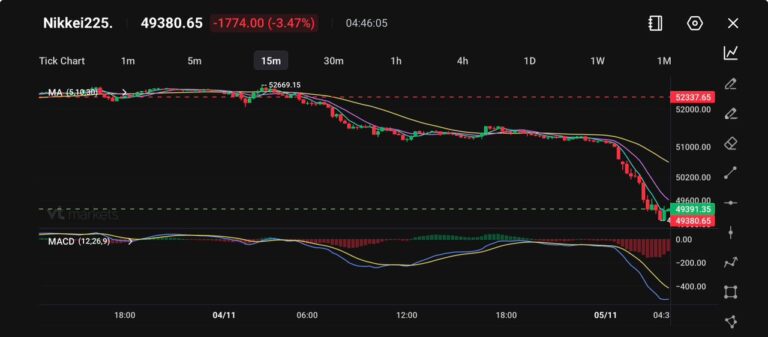
Asian equities plunged on Wednesday as investors dumped risk assets following a sharp, tech-driven rout on Wall Street. Japan’s Nikkei 225 slumped 3.47% to 49,380.65, wiping out nearly 7% from Tuesday’s record peak, while South Korea’s KOSPI dropped 6.2% amid heavy selling in chipmakers and AI-related shares.
The sell-off was sparked by renewed concerns over lofty stock valuations after several major Wall Street leaders, including the CEOs of Morgan Stanley, Goldman Sachs, and JPMorgan Chase cautioned that the market’s rapid rally might be unsustainable.
“It’s red across the board,” said Chris Weston of Pepperstone, adding that traders appear reluctant to “buy the dip” ahead of Nvidia’s earnings on 19 November.
Broader Market Moves
The MSCI Asia ex-Japan Index sank 2.3%, marking its steepest one-day drop since early April, when US tariff tensions rattled markets. SoftBank Group tumbled 10%, while other major tech names followed the Nasdaq Composite’s near 2% overnight decline.
In the currency space, the US dollar slipped 0.3% to ¥153.16 after dovish Bank of Japan meeting minutes were released. The US Dollar Index (USDX) also eased after briefly touching a five-month high at 100.25.
Meanwhile, Bitcoin briefly fell below $100,000 for the first time since June before staging a mild recovery, and gold edged up 0.2% to $3,938.54 per ounce following three straight sessions of losses.
Technical Analysis
The Nikkei 225’s sharp 3.5% drop to 49,380.65 erased part of its recent rally, pulling it back beneath the psychological 50,000 threshold. The steep reversal comes after an extended uptrend, signalling potential weakness in the short-term outlook.
Technically, the index broke below recent support levels and short-term moving averages, with the MACD histogram widening on the downside, indicating mounting negative momentum.
From a fundamental viewpoint, the drop is tied to broad-based tech sell-offs in Asia following warnings from major US banks about ‘stretched valuations,’ especially in the semiconductor and AI sectors.
In Japan, exporters were hit doubly by the tech slump and by a stronger yen and more cautious global demand backdrop, undermining the bullish momentum that had driven the Nikkei higher.
Looking ahead, the key things to watch: if the index can hold above the next support near 48,000, there may be a rebound attempt; but if it breaks decisively below that level, a deeper correction toward 46,000–45,000 could be on the cards.
Conversely, for a turnaround, the Nikkei would need a strong close back above 50,000 and a tightening of the MACD spread, ideally driven by fresh catalyst headlines such as improved earnings or positive trade news.
Outlook
The index remains exposed as traders weigh stretched valuations against solid corporate earnings. With volatility reaching its highest since April, investors are likely to stay defensive in the run-up to Nvidia’s results and key US inflation data.
While short-term sentiment remains fragile, longer-term fundamentals, including resilient profit growth and a weak yen, could help steady Japanese equities once the current correction finds its footing.
In October, New Zealand’s ANZ Commodity Price improved slightly from -1.1% to -0.3%
New Zealand’s ANZ Commodity Price Index rose to -0.3% in October, up from -1.1% in September. This change shows a shift in commodity prices during the month.
The US Dollar Index dropped to around 100.00 because of an ongoing US government shutdown. Gold is now trading near $3,950 in Asia, bouncing back from a 1.80% drop on Tuesday.
The Australian dollar gained strength after China announced it will remove tariffs on US agricultural goods starting November 10. The USD/INR stayed above 88.50 due to low trading volume caused by an Indian bank holiday.
Bitcoin fell below $100,000, leading to $2 billion in liquidations. Despite the broader market downturn, platforms like ZKsync and Internet Computer remained steady.
Balancer, a DeFi platform, suffered a $120 million hack, unable to stop the attack due to outdated pools. The cryptocurrency market is still facing security issues, even as decentralized finance grows.
The ongoing US government shutdown has weakened the US Dollar considerably. This situation is similar to the 35-day shutdown from 2018-2019, which also impacted the economy and the currency. Traders might want to look for strategies that benefit from a weak dollar, such as buying call options on safe-haven assets like gold.
Gold is approaching $4,000, driven by market safety and a weak dollar. This increase is supported by a long-term trend of central bank purchases. Data shows that central banks bought a record 1,078 tonnes of gold in 2022, with strong buying continuing into 2024. This demand suggests that any dips in gold prices might be good buying opportunities for traders.
In the commodity currency market, we see a clear divide. The Canadian dollar is weakening, with WTI crude oil prices dropping below $60 a barrel, pushing USD/CAD to seven-month highs. Meanwhile, the Australian dollar benefits from China’s decision to lift some agricultural tariffs, boosting regional risk sentiment.
This creates potential trading opportunities, such as going long on AUD/CAD. Although New Zealand’s commodity price index improved slightly, it remains negative, suggesting the Kiwi may not recover as quickly as the Aussie. Therefore, taking long positions on the Australian dollar against its commodity peers seems favorable.
The British Pound is sharply declining, disconnected from the broader focus on the US dollar. UK inflation rates have remained around 4%, twice the Bank of England’s target, raising fears of stagflation and hurting the currency. This suggests that put options on GBP/USD could be a useful hedge against further sterling weakness.
The overall market sentiment is negative, evidenced by the drop in cryptocurrencies, particularly Bitcoin falling below $100,000. This movement away from speculative assets highlights a focus on capital preservation. Traders should stay cautious, as the political situation in the US may lead to increased market volatility in the weeks ahead.







