



New Zealand dollar weakens against US dollar as unemployment hits nine-year high
The NZD/USD pair dropped to around 0.5640, its lowest since April, during the early Wednesday session in Asia. This drop followed an unexpected rise in New Zealand’s unemployment rate to 5.3% in the third quarter, the highest in nine years. Statistics New Zealand indicated that employment stayed the same, missing the anticipated 0.1% growth.
Since August last year, the Reserve Bank of New Zealand (RBNZ) has cut the Official Cash Rate by 300 basis points, bringing it down to 2.5%. Another cut of 25 basis points is expected at the upcoming meeting on November 26. Even with positive signs from US-China trade discussions, the ongoing US government shutdown may weaken the Greenback against the NZD.
GBP/USD continues to decline, dropping about 0.9% and falling below 1.3100
In the US, the ADP Employment Change figures will be released on Wednesday. Although these numbers often do not align well with official reports, they will be important this time because the government shutdown is affecting data releases.
Pound Sterling and Its Influences
The Pound Sterling is the UK’s official currency and plays a significant role in the foreign exchange market. It is the fourth most traded currency, accounting for 12% of global transactions and averaging $630 billion every day. Its value is mainly influenced by the Bank of England’s monetary policy, which aims for a 2% inflation rate. Economic indicators like GDP, PMIs, and employment data can affect the value of the Pound. A strong economy tends to attract investments, which might lead to higher interest rates and a stronger GBP. On the other hand, weak economic data usually weakens the currency. The Trade Balance is also important; a positive balance supports the Pound. Recent trends show a clear bearish momentum for GBP/USD, especially after dropping below 1.3100. This is the third week in a row of declines, indicating that sellers are dominating the market. Traders should see any short-term increases as chances to start new short positions. The Bank of England’s meeting this Thursday is a key upcoming event, but we expect them to keep interest rates unchanged. With the latest inflation data from October 2025 at 3.5%, significantly above the 2% target, the BoE can’t justify a rate cut. This situation removes crucial support for the Pound from its central bank.Implications for Traders
On the US side, yesterday’s ADP employment report revealed the addition of 215,000 jobs, which has strengthened the dollar. Due to the ongoing government shutdown, the official Nonfarm Payrolls data won’t be released, making the ADP figure more important than usual. This economic divergence reinforces the case for a weaker GBP/USD. For derivative traders, this market environment suggests strategies that can profit from continued decline or increased volatility. Buying GBP/USD put options is a straightforward way to bet on further drops toward the 1.2900 level. Those anticipating a significant movement after the BoE announcement could consider long strangles to take advantage of potential volatility spikes. Looking back at the 2022-2023 period, we see how high inflation can push a central bank to act; however, the current situation is different. Recent UK economic growth has been sluggish, with Q3 2025 GDP only growing by 0.1%. This stagnation prevents the BoE from raising rates to support the currency, leaving it vulnerable. The fundamental economic health of the UK also impacts the Pound, as seen in the latest trade balance figures. The September 2025 data revealed a widening trade deficit, meaning the country is spending more on imports than it’s earning from exports. This ongoing weakness presents a persistent barrier to any significant recovery for the Sterling. Create your live VT Markets account and start trading now.Nikkei Slumps As Tech Sell-Off Sends Markets Tumbling
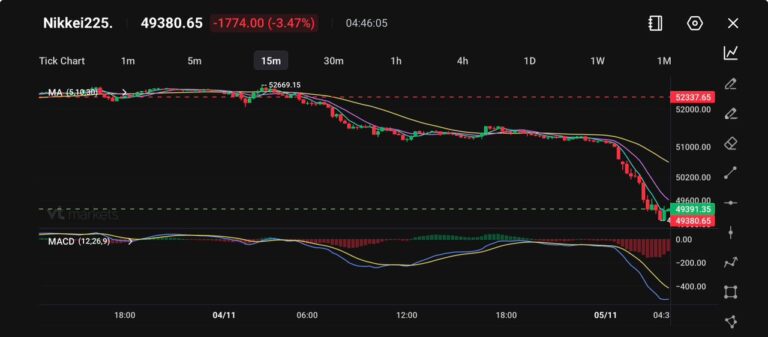
Asian equities plunged on Wednesday as investors dumped risk assets following a sharp, tech-driven rout on Wall Street. Japan’s Nikkei 225 slumped 3.47% to 49,380.65, wiping out nearly 7% from Tuesday’s record peak, while South Korea’s KOSPI dropped 6.2% amid heavy selling in chipmakers and AI-related shares.
The sell-off was sparked by renewed concerns over lofty stock valuations after several major Wall Street leaders, including the CEOs of Morgan Stanley, Goldman Sachs, and JPMorgan Chase cautioned that the market’s rapid rally might be unsustainable.
“It’s red across the board,” said Chris Weston of Pepperstone, adding that traders appear reluctant to “buy the dip” ahead of Nvidia’s earnings on 19 November.
Broader Market Moves
The MSCI Asia ex-Japan Index sank 2.3%, marking its steepest one-day drop since early April, when US tariff tensions rattled markets. SoftBank Group tumbled 10%, while other major tech names followed the Nasdaq Composite’s near 2% overnight decline.
In the currency space, the US dollar slipped 0.3% to ¥153.16 after dovish Bank of Japan meeting minutes were released. The US Dollar Index (USDX) also eased after briefly touching a five-month high at 100.25.
Meanwhile, Bitcoin briefly fell below $100,000 for the first time since June before staging a mild recovery, and gold edged up 0.2% to $3,938.54 per ounce following three straight sessions of losses.
Technical Analysis
The Nikkei 225’s sharp 3.5% drop to 49,380.65 erased part of its recent rally, pulling it back beneath the psychological 50,000 threshold. The steep reversal comes after an extended uptrend, signalling potential weakness in the short-term outlook.
Technically, the index broke below recent support levels and short-term moving averages, with the MACD histogram widening on the downside, indicating mounting negative momentum.
From a fundamental viewpoint, the drop is tied to broad-based tech sell-offs in Asia following warnings from major US banks about ‘stretched valuations,’ especially in the semiconductor and AI sectors.
In Japan, exporters were hit doubly by the tech slump and by a stronger yen and more cautious global demand backdrop, undermining the bullish momentum that had driven the Nikkei higher.
Looking ahead, the key things to watch: if the index can hold above the next support near 48,000, there may be a rebound attempt; but if it breaks decisively below that level, a deeper correction toward 46,000–45,000 could be on the cards.
Conversely, for a turnaround, the Nikkei would need a strong close back above 50,000 and a tightening of the MACD spread, ideally driven by fresh catalyst headlines such as improved earnings or positive trade news.
Outlook
The index remains exposed as traders weigh stretched valuations against solid corporate earnings. With volatility reaching its highest since April, investors are likely to stay defensive in the run-up to Nvidia’s results and key US inflation data.
While short-term sentiment remains fragile, longer-term fundamentals, including resilient profit growth and a weak yen, could help steady Japanese equities once the current correction finds its footing.
In October, New Zealand’s ANZ Commodity Price improved slightly from -1.1% to -0.3%
New Zealand’s ANZ Commodity Price Index rose to -0.3% in October, up from -1.1% in September. This change shows a shift in commodity prices during the month.
The US Dollar Index dropped to around 100.00 because of an ongoing US government shutdown. Gold is now trading near $3,950 in Asia, bouncing back from a 1.80% drop on Tuesday.
The Australian dollar gained strength after China announced it will remove tariffs on US agricultural goods starting November 10. The USD/INR stayed above 88.50 due to low trading volume caused by an Indian bank holiday.
Bitcoin fell below $100,000, leading to $2 billion in liquidations. Despite the broader market downturn, platforms like ZKsync and Internet Computer remained steady.
Balancer, a DeFi platform, suffered a $120 million hack, unable to stop the attack due to outdated pools. The cryptocurrency market is still facing security issues, even as decentralized finance grows.
The ongoing US government shutdown has weakened the US Dollar considerably. This situation is similar to the 35-day shutdown from 2018-2019, which also impacted the economy and the currency. Traders might want to look for strategies that benefit from a weak dollar, such as buying call options on safe-haven assets like gold.
Gold is approaching $4,000, driven by market safety and a weak dollar. This increase is supported by a long-term trend of central bank purchases. Data shows that central banks bought a record 1,078 tonnes of gold in 2022, with strong buying continuing into 2024. This demand suggests that any dips in gold prices might be good buying opportunities for traders.
In the commodity currency market, we see a clear divide. The Canadian dollar is weakening, with WTI crude oil prices dropping below $60 a barrel, pushing USD/CAD to seven-month highs. Meanwhile, the Australian dollar benefits from China’s decision to lift some agricultural tariffs, boosting regional risk sentiment.
This creates potential trading opportunities, such as going long on AUD/CAD. Although New Zealand’s commodity price index improved slightly, it remains negative, suggesting the Kiwi may not recover as quickly as the Aussie. Therefore, taking long positions on the Australian dollar against its commodity peers seems favorable.
The British Pound is sharply declining, disconnected from the broader focus on the US dollar. UK inflation rates have remained around 4%, twice the Bank of England’s target, raising fears of stagflation and hurting the currency. This suggests that put options on GBP/USD could be a useful hedge against further sterling weakness.
The overall market sentiment is negative, evidenced by the drop in cryptocurrencies, particularly Bitcoin falling below $100,000. This movement away from speculative assets highlights a focus on capital preservation. Traders should stay cautious, as the political situation in the US may lead to increased market volatility in the weeks ahead.
Bank of Japan board discusses low real interest rates and potential hikes in September minutes
The Bank of Japan (BoJ) board discussed the monetary policy outlook at their meeting in September. They noted uncertainty around trade policies and their effects on the global economy. The members agreed to monitor how these issues affect both local and international economic conditions and prices. Some members believed the BoJ should use monetary policy to support the economy, especially with potential US tariffs on the horizon.
Some board members felt that the possibility of raising rates was becoming clearer, but they emphasized caution to avoid disrupting markets. One member suggested that it could be a good time to start raising rates but expressed concern about the unclear situation regarding the US economic slowdown. There was also a focus on tracking wage trends to help shape future policies. The board discussed the advantages and disadvantages of waiting to raise rates, considering Japan’s long-standing situation with deflation.
The current easy monetary conditions were seen as suitable since inflation expectations remained low. It was noted that the effects of US tariffs were less severe than anticipated and unlikely to destabilize Japan’s economy. Following the meeting, the USD/JPY dropped by 0.43% to 153.53.
The minutes from the BoJ’s September meeting revealed differing opinions among members, but the overall feeling leaned toward another rate hike. While some members recommended caution due to uncertainty in global trade, others felt the cost of waiting was growing. This internal debate suggests that future decisions will heavily depend on new economic data.
As of November 5, 2025, recent data supports increasing policy tightening sooner rather than later. The national core CPI for October 2025 stood at 2.5%, remaining above the 2% target for more than a year. The final results from the 2025 “Shunto” spring wage negotiations showed an average pay rise of 4.5%, giving the Bank confidence that a sustainable wage-price spiral is developing.
The minutes also raised concerns about a slowdown in the US economy, which has become clearer as Q3 2025 US GDP growth decreased to just 1.5%. This situation reduces the interest rate gap that has weighed down the yen. The combination of rising domestic inflation and a weaker US outlook creates favorable conditions for yen appreciation.
For traders dealing in derivatives, this environment suggests preparing for a stronger yen and increased market volatility in the coming weeks. We believe buying Japanese yen call options or USD/JPY put options is a wise strategy. This allows traders to benefit from a sudden rise in the yen if the BoJ signals a hike in December.
There’s also the risk of direct intervention from the Ministry of Finance, especially with USD/JPY trading at 153.53. In 2024, there were multiple interventions when the currency fell below the 155 level, which set a firm ceiling for the pair. This government support makes selling out-of-the-money USD/JPY call options an appealing way to earn premiums while betting that the pair won’t rise significantly.
Since the BoJ aims to avoid surprising the markets, they may hint at a rate hike before it’s officially announced, possibly pushing the actual decision to early 2026. Therefore, using options that expire in January or March 2026 could be a better strategy to capture this potential policy shift. This approach allows enough time for the trade to develop while managing the risk of the BoJ maintaining its current stance in December.
Japan’s year-on-year monetary base recently fell from -6.2% to -7.8%
Japan’s monetary base fell to -7.8% year-on-year in October, down from -6.2% earlier. This shows that the money supply in the economy is decreasing.
The finance ministry in China announced that starting November 10, it will remove some tariffs on US agricultural products. At the same time, gold prices are rising as the US government faces a potential record-long shutdown.
USD Exchange Rate Trends
The USD/INR exchange rate is above 88.50 amid lower trading activity due to a holiday in India. The USD/CAD has climbed to a seven-month high, trading above 1.4100, driven by falling crude oil prices. WTI crude oil prices continue to drop and are near $60.00 per barrel because of rising US inventories. China’s Premier noted that protectionist measures have severely affected the global economy. In the cryptocurrency market, ZKsync and Internet Computer are holding their value, while Bitcoin has fallen below $100,000, causing $2 billion in liquidations. Decentralized finance platforms are under scrutiny following a $120 million hack on Balancer, an established decentralized exchange. Highlights include EUR/USD gaining strength and GBP/USD hitting lows, while gold rebounds after a recent dip. Next week may challenge risk sentiment and impact the Dollar, Aussie, and Pound.Monetary Policy and Political Impact
Japan’s shrinking monetary base is a key current indicator. The Bank of Japan is speeding up its balance sheet reduction to -7.8%, marking a significant shift from years of loose policy. This tightening trend is likely to support the Japanese Yen. Meanwhile, the US government is heading toward one of its longest shutdowns ever. The 35-day shutdown from 2018-2019 was estimated to have cut GDP by $11 billion, reminding us that political gridlock can hurt economic stability and weaken the US dollar. This stark contrast between Japan tightening its policy and the US government paralysis makes shorting the USD/JPY pair an attractive strategy. We anticipate this difference will push the pair lower in the upcoming weeks. Buying put options on USD/JPY could be a smart move to capitalize on this expected decline. The Yen is expected to strengthen against currencies facing their own issues. The British Pound, for instance, is in a significant decline, having dropped for nearly two weeks. This makes shorting GBP/JPY particularly appealing. While China’s decision to cut some agricultural tariffs positively impacts sentiment, it pales in comparison to the major influences of central banks and political events. The combination of a US shutdown and a hawkish Bank of Japan creates potential for high volatility in currency markets. We believe strategies that benefit from increased market fluctuations, like long straddles, could perform well. Gold is trading around $3,950 an ounce, highlighting persistent inflation concerns. This makes the Bank of Japan’s commitment to tightening policy even more crucial, signaling a global effort for price stability—even at the expense of short-term growth. Create your live VT Markets account and start trading now.Concerns about the US government shutdown cause USD/JPY to drop to 153.50
The USD/JPY has dropped to about 153.65 in early Asian trading because of worries about a US government shutdown. The Senate’s inability to pass a funding bill could lead to the longest federal funding gap in US history.
This deadlock has resulted in a Republican-supported temporary bill failing in the Senate for the 14th time. There are no new votes scheduled, increasing concerns about a long shutdown that may weaken the US Dollar short-term.
The Japanese authorities might step in to support the JPY, especially after comments from Japan’s Finance Minister stressed the need for stable currency movements. However, uncertainty about the Bank of Japan’s next interest rate hike is limiting the JPY’s rise.
Market watchers are paying close attention to key upcoming data, including the ADP Employment Change and the US ISM Services PMI for October. Traders are also curious about the economic policies of Japan’s new Prime Minister.
The Japanese Yen’s performance is impacted by the Bank of Japan’s policies, differences in bond yields with the US, and overall market sentiment. The Yen often acts as a safe-haven currency, gaining strength during market stress.
As USD/JPY trades around 153.50, the main factor is the US government shutdown. This situation brings uncertainty for the US dollar, indicating a bearish outlook for the currency in the near term. Derivative traders should prepare for increased volatility as long as the political impasse continues.
Looking back, the 35-day shutdown from late 2018 to early 2019 resulted in a drop of over 1% for the US Dollar Index (DXY). With the current shutdown possibly becoming the longest ever, we might see similar or greater selling pressure on the dollar. Buying put options on USD/JPY could be a smart way to hedge against or bet on further dollar weakness.
The possibility of intervention from Japanese officials adds more downward pressure to this currency pair. We recall the interventions from September and October 2022, which happened at lower levels than today’s. With the pair above 153.00 now, the likelihood of officials intervening to strengthen the yen is very high, supporting bearish positions.
Yet, we must also consider the Bank of Japan’s cautious stance on monetary policy, which may limit the yen’s strength. Japan’s core inflation was at 2.8% year-over-year in the latest September 2025 data, but it hasn’t compelled the central bank to adopt a hawkish approach yet. This uncertainty from the BoJ complicates the typical response to the shutdown, making directional bets risky.
With these competing forces, volatility is expected to dominate in the coming weeks. We predict sharp, unpredictable movements rather than a steady trend. Options strategies that benefit from major price swings, such as long straddles or strangles, might work well in this environment.
In the short term, upcoming US data like the ISM Services PMI will be vital. If the report is weak, it could raise concerns about the economic effects of the shutdown, likely driving USD/JPY lower. On the other hand, a stronger-than-expected report could lead to a temporary bounce, making it important to have strategies ready for movement in either direction.
New Zealand’s unemployment rate rises to 5.3% in the third quarter, meeting market expectations
New Zealand’s unemployment rate rose to 5.3% in the third quarter, up from 5.2% in the previous quarter. This matches market expectations. Employment growth remained unchanged at 0%, following a slight drop of 0.1% in the second quarter. Additionally, the participation rate decreased to 70.3% from 70.5%.
As a result of the employment data, the NZD/USD pair fell by 1.09%, now trading at 0.5648. The state of the labor market affects the value of the currency, which, in turn, influences consumer spending and economic growth.
Wage growth is key to economic policy because it impacts consumer spending and inflation. Central banks study wage growth to guide their monetary policy. When wages rise consistently, it can fuel underlying inflation.
Different central banks prioritize employment levels based on their goals. However, labor market conditions are vital indicators of economic health and impact inflation, regardless of the central banks’ specific mandates.
The Q3 unemployment data released today, November 5th, 2025, indicates a cooling labor market in New Zealand. The unemployment rate met expectations at 5.3%, but the job growth of 0% was weaker than expected. This suggests that high-interest rates are now putting pressure on the economy.
This data gives the Reserve Bank of New Zealand (RBNZ) more reason to consider a more cautious approach. We believe the market may start anticipating a higher chance of an interest rate cut in the first half of 2026. This marks a significant change from the aggressive rate hikes seen throughout 2024 to control inflation.
Recent data supports this weakening trend, making a bearish outlook more likely. Last month’s Consumer Price Index (CPI) data showed annual inflation dropped to 3.1%, down sharply from its peak and getting closer to the RBNZ’s target range. Moreover, the October 2025 ANZ Business Outlook survey revealed that business confidence hit its lowest level in over a year, signaling that companies are bracing for a slowdown.
For derivative traders, this outlook suggests positioning for further weakness in the NZD/USD pair, which is already trading below 0.5650 today. We might consider buying put options on the NZD/USD to capitalize on a continued decline while managing our risk. Shorting NZD/USD futures offers a more straightforward way to profit as it approaches the 2024 lows near the 0.5500 level.
There are also opportunities in currency crosses, especially with a short NZD/AUD position. Australia’s recent employment report from October 2025 showed its unemployment rate steady at 4.1%, highlighting a clear policy difference with New Zealand. This trade exposes the specific weakness in the Kiwi economy.
Looking back, this situation resembles the economic slowdown of 2017, where a weakening labor market led to a period of NZD underperformance as the RBNZ adjusted its policy. We expect a similar trend may emerge in the coming weeks as markets fully absorb today’s data, reinforcing our bearish outlook on the New Zealand dollar.
Australia’s Composite PMI drops to 52.1, down from 52.6
Australia’s S&P Global Composite PMI dropped to 52.1 in October, down from 52.6 in September. This change indicates a slowdown in the country’s economic activity.
In currency news, USD/CAD reached seven-month highs above 1.4100, affected by falling crude oil prices. At the same time, WTI crude oil prices fell to around $60.00 due to increasing US inventories.
Gold and Cryptocurrency Challenges
Gold prices went below $3,850, struggling against a strong US Dollar but supported by lower US Treasury bond yields. The cryptocurrency market also faced difficulties, with Bitcoin falling below $100,000, resulting in $2 billion in liquidations. The decentralized exchange Balancer suffered a hack that resulted in $120 million in losses. The platform confirmed that it could not stop the breach, impacting its older pools. Central banks, including the European Central Bank, are key players in currency movements. The Euro rose as traders expected a cautious ECB policy, allowing EUR/USD to recover to around 1.1490. GBP/USD fell consistently, hurting the Pound Sterling’s value over 12 trading sessions. This drop pushed the currency to a new low against the US Dollar.Australia’s Economic Slowdown
Australia’s composite PMI decrease to 52.1 suggests a cooling economy, although it is still in expansion territory. This reflects a broader slowdown observed in developed economies in late 2023, indicating that growth is becoming more fragile. Since Australia is closely linked to China’s economy, this slowdown puts downward pressure on the Australian dollar. The US dollar remains strong, and it is expected to continue this trend in the near future. The Dollar Index (DXY) has stayed above 106 since the Federal Reserve signaled a hawkish pause in its October 2025 meeting, indicating low chances of rate cuts. This strength is shown as USD/CAD hits seven-month highs, and the Pound falls below 1.3100. Falling crude oil prices are influencing currency markets, particularly for commodity-linked currencies. With WTI struggling near $60 a barrel and a surprising increase in US inventories of 3.6 million barrels last week, supply is exceeding demand. This creates challenges for currencies like the Canadian dollar. Given these factors, holding a short position on the AUD/USD seems wise, especially as it lingers around 0.6450. China’s cautious economic signs, including the PBOC setting a weaker yuan reference rate, will continue to affect the Australian dollar negatively. There appears to be little reason for this trend to change in the upcoming weeks. The British pound’s sharp decline also deserves attention, as it is quickly losing value against the dollar. This kind of momentum resembles the volatility seen after the UK’s mini-budget crisis in 2022, suggesting that traders should be careful when trying to catch a bottom. Options strategies that profit from further declines or high volatility may be effective. Gold is caught between a strong US dollar and the risk of adverse events, such as a potential US government shutdown. While the strong dollar typically limits gold’s price, safe-haven buying might offer support, keeping it within a range. We should consider using straddles or strangles to trade on the potential for a breakout in either direction rather than making a straightforward directional bet. Create your live VT Markets account and start trading now.Australian S&P Global Services PMI drops to 52.5, missing expectations of 53.1
Australia’s S&P Global Services PMI for October was 52.5, falling short of the expected 53.1. This index gauges the health of the services sector, with scores above 50 showing growth.
In other news, the USD/CAD rose to a seven-month high, crossing 1.4100 due to falling crude oil prices. WTI crude dropped near $60.00 as US oil inventories continued to increase.







